

Hidden fields are the ingested half of Embedded Data — the values
that arrive from outside the survey. Nothing renames and nothing changes for surveys you already run; see
Hidden Fields & Variables for what is new around them.
How to Add Hidden Fields
- Open the survey in the editor, stay on the Questions tab and scroll to the bottom. You will find a Hidden fields section.
- Type a field ID and choose Add hidden field ID. Add as many as you need.

Naming
Field ids follow one rule everywhere — the editor and the management API refuse the same names (ENG-2539):- A new field id must start with a lowercase letter and then contain only lowercase letters, numbers and underscores:
^[a-z][a-z0-9_]*$. Sopage_type, notpageTypeorPage Type. - Reserved names are refused in any casing. These are the link-survey system params and internal ids:
userId,source,suid,end,start,welcomeCard,hidden,verifiedEmail,multiLanguage,embed,verify,suToken,lang,preview,startAt,skipPrefilled,offlineSupport. A field named exactly like one of them is never filled from a survey URL, whatever the casing of the parameter: that parameter belongs to the survey link. An older survey that declares a case variant such asSourcekeeps being filled by that exact spelling (?Source=), never by the reserved one (?source=); the mismatch logs a browser console warning naming the spelling that fills the field. - Auto-captured field names are refused too: every survey can already read those by name without declaring them, and a second field under the same name would be ambiguous in recall and logic. The full list:
source,url,country,action,browser,os,deviceType,ipAddress,finished,language,locale,responseId,surveyId,durationSeconds,startedAt,finishedAt,pagePath,pageReferrer,utmSource,utmMedium,utmCampaign,utmTerm,utmContent,screenWidth,screenHeight,viewportWidth,viewportHeight,timezone. - A hidden field and a variable may not share a name, in any casing, for the same reason: recall and logic address both by name. Adding a variable
planto a survey with a hidden fieldplan(or the reverse) is refused.
Ids a survey already declares keep working: they load, collect values and can be re-saved unchanged —
only adding such a name as a new field is refused. The same goes for a hidden field and a variable that
already share a name. Deleting a grandfathered field spends the reprieve: once it is gone from the saved
survey, the name can no longer be re-added. One consequence: re-creating a survey from an exported document
fails with a 400 when the export declares a refused name. Rename that field in the payload before importing.
Set Hidden Field via URL
Single Hidden Field:Set Hidden Fields via SDK
Attach the values once and every survey displayed afterwards picks them up, until you remove the key or the page reloads:setEmbeddedData for merge and clearing semantics, and
Mobile SDKs for the mobile call syntax.
The older per-trigger form still works, and an explicit value there still wins over an ambient one:
View Hidden Fields in Responses
These hidden fields will now be visible in the responses tab just like other fields in the Summary as well as the Response Cards, and you can use them to filter and analyze your responses.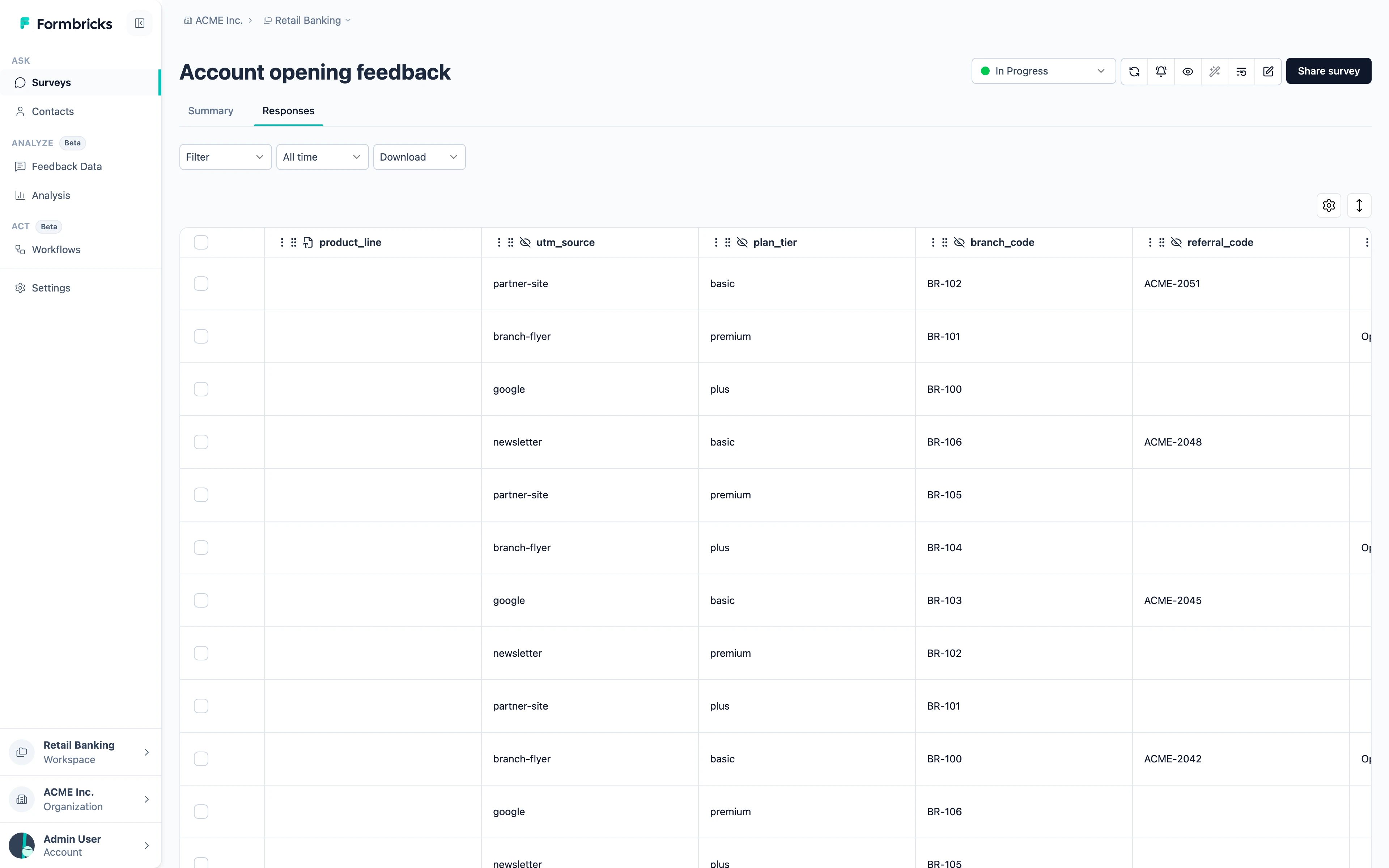
Use Cases
- Tracking Source: You can add a hidden field to track the source of the survey. For a detailed guide on Source Tracking, check out the Source Tracking guide.
- User Metadata: You can add hidden fields to capture user metadata such as user ID, email, or any other user-specific information.
- Survey Metadata: You can add hidden fields to capture other metadata, e.g. the screen from which the survey was filled, or any other app specific information.