

70+ Post Event Survey Questions to Improve Your Next Event (2026)

Johannes
CEO & Co-Founder
13 Minutes
May 3rd, 2026
Whether attendees return to your next event rarely comes down to the keynote. It comes down to whether they felt their experience was heard and acted on. Most organizers skip post-event surveys entirely, or send a generic "how was it?" form three weeks later when the details have faded. The result: repeated mistakes, avoidable attrition, and sponsor renewal conversations built on gut feeling instead of data.
This guide gives you 70+ ready-to-use post event survey questions organized by audience and category, including separate question sets for attendees, staff, volunteers, and sponsors. Each question includes a recommended type and effectiveness rating.
What you will find in this guide:
- 70+ post event survey questions organized into 10 categories
- Separate question sets for attendees, staff, volunteers, and sponsors
- Question type and effectiveness rating for each question
- Post-conference survey examples and templates
- Best practices for timing, length, and distribution
- Common mistakes that kill your response rates
- A free post event survey template
What Is a Post Event Survey?
A post event survey is a structured feedback tool sent to attendees after an event to measure satisfaction, identify what worked, and uncover what needs improvement. It uses a mix of rating scales, multiple choice, and open-ended questions to capture both quantitative benchmarks and qualitative insights.
Post event surveys apply to every event format: in-person conferences, virtual webinars, hybrid summits, workshops, trade shows, team retreats, and product launches. The format changes slightly depending on the event type, but the core purpose remains the same: collect actionable feedback while the experience is still fresh.
Timing matters more than most organizers realize. Send your survey within 24 hours of the event ending. Response rates decline significantly after 48 hours because attendees lose the emotional connection to the experience and start forgetting specific details. For multi-day events, consider a short daily pulse survey with a comprehensive follow-up after the final session.
70+ Post Event Survey Questions by Category
Each question below includes a recommended question type and an effectiveness rating: Essential (include in every survey), Recommended (include when relevant), or Nice-to-have (include if survey length allows).
Overall Event Satisfaction (Questions 1-8)
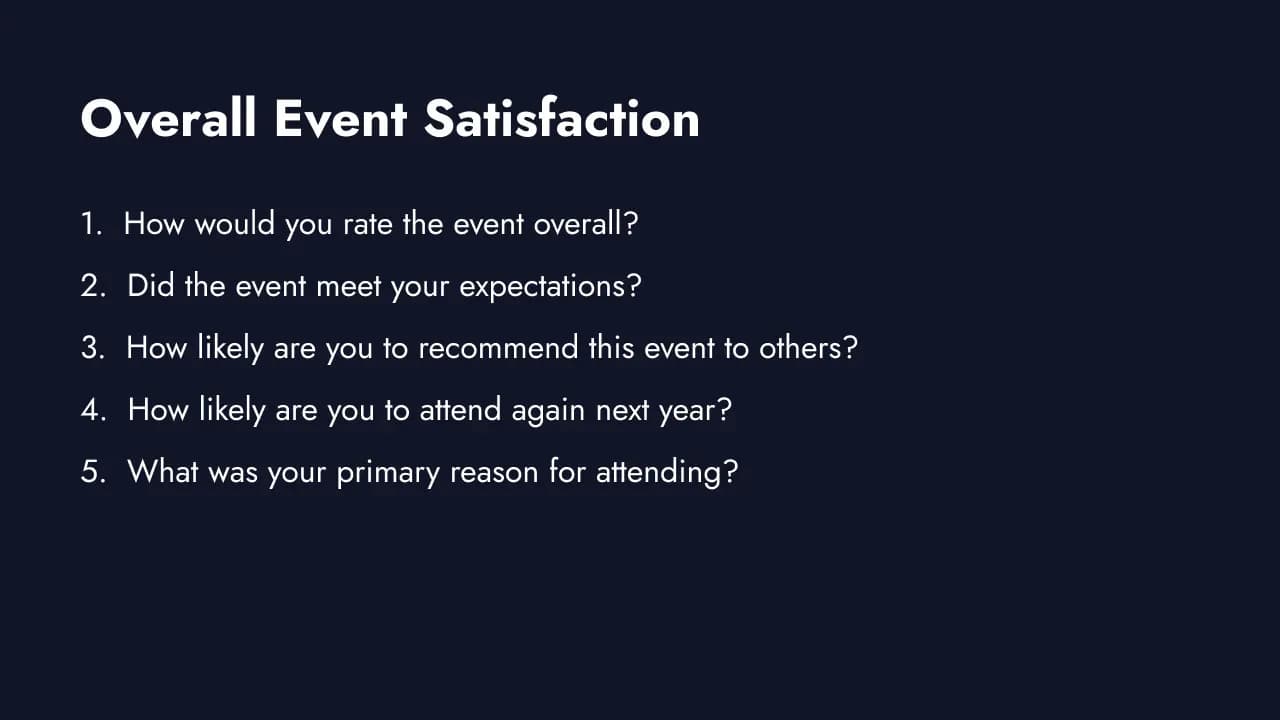
Start with big-picture questions that establish your satisfaction baseline. These are the metrics you will track across events to measure improvement over time.
1. How would you rate the event overall?
- Type: Likert (1-5) | Essential
- Your primary benchmark metric. Track this across every event to measure whether changes are moving the needle. A consistent 4+ average signals a healthy event.
2. Did the event meet your expectations?
- Type: Scale (Exceeded / Met / Below) | Essential
- Identifies expectation gaps between your marketing promises and the actual experience. Consistent "Below" scores point to messaging issues, not just delivery issues.
3. How likely are you to recommend this event to a colleague?
- Type: Rating (0-10, NPS) | Essential
- Net Promoter Score℠ is your best single predictor of organic growth. Segment into Promoters (9-10), Passives (7-8), and Detractors (0-6). For benchmarking context, see our guide on NPS question examples.
4. How likely are you to attend this event again next year?
- Type: Likert (1-5) | Essential
- Direct retention predictor. Low scores here are an early warning for declining attendance. Cross-reference with satisfaction to find whether dissatisfied attendees still plan to return (habit) or satisfied attendees do not (competing priorities).
5. How would you rate the overall value of the event relative to the cost (ticket price, travel, time)?
- Type: Likert (1-5) | Recommended
- Value perception drives both retention and word-of-mouth. Low value scores combined with high content scores suggest a pricing or logistics problem, not a quality problem.
6. How would you describe the event to a colleague who did not attend?
- Type: Open-ended | Recommended
- Captures attendee perception in their own language. Useful for refining next year's event positioning and marketing copy.
7. What was your primary reason for attending this event?
- Type: Multiple choice (Networking / Learning / Industry trends / Specific speakers / Company sent me / Other) | Recommended
- Reveals what actually drives attendance. Often different from what organizers assume. Use this to align programming with attendee motivations.
8. How did this event compare to similar events you have attended?
- Type: Scale (Much worse / Worse / About the same / Better / Much better) | Nice-to-have
- Competitive positioning data. Tells you whether you are winning or losing against alternative events in your attendees' consideration set.
Content and Programming (Questions 9-16)
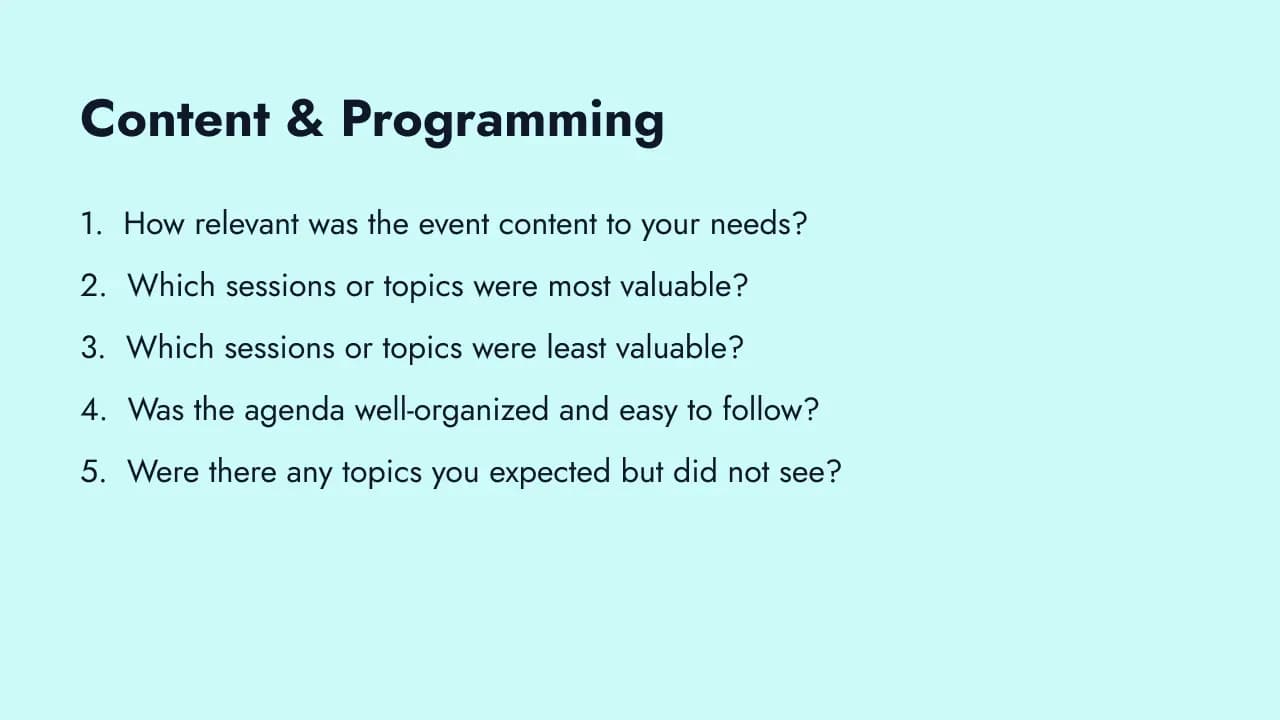
Content is why most people show up. These questions help you understand what resonated, what fell flat, and what to prioritize for next time. The content quality evaluation template gives you a focused set of questions for this category.
9. How relevant was the event content to your professional needs?
- Type: Likert (1-5) | Essential
- Relevance is the foundation of content satisfaction. If content does not connect to attendees' actual challenges, nothing else matters.
10. Which sessions or topics were most valuable to you?
- Type: Open-ended or Multi-select | Essential
- Identifies your content hits. The sessions mentioned most frequently are the ones to build on and expand next year.
11. Which sessions or topics were least valuable to you?
- Type: Open-ended or Multi-select | Recommended
- The counterpart to question 10. Together they give you a complete picture of content peaks and valleys. Do not skip this one because it feels uncomfortable.
12. Was the event agenda well-organized and easy to follow?
- Type: Likert (1-5) | Recommended
- Agenda clarity affects the entire experience. Confusing schedules, overlapping tracks, and unclear room assignments create frustration that bleeds into content ratings.
13. Were there enough interactive elements (Q&A, polls, workshops, hands-on sessions)?
- Type: Scale (Too few / About right / Too many) | Recommended
- Passive listening fatigues attendees. Interactive sessions increase engagement and retention. "Too few" responses signal an opportunity to add more participatory formats.
14. How would you rate the balance between session topics (e.g., technical vs. strategic, beginner vs. advanced)?
- Type: Likert (1-5) | Nice-to-have
- Audience skill levels vary. A conference heavy on beginner content frustrates experienced attendees. One heavy on advanced material alienates newcomers. This question reveals whether your mix is right.
15. Was the session length appropriate?
- Type: Scale (Too short / About right / Too long) | Recommended
- Session length directly affects attention and satisfaction. "Too long" responses suggest content padding. "Too short" suggests you are trying to cover too much ground.
16. Were there any topics or sessions you expected but did not find on the agenda?
- Type: Open-ended | Nice-to-have
- Surfaces content gaps and unmet expectations. High-frequency responses here become strong candidates for next year's programming.
Speakers and Presenters (Questions 17-22)
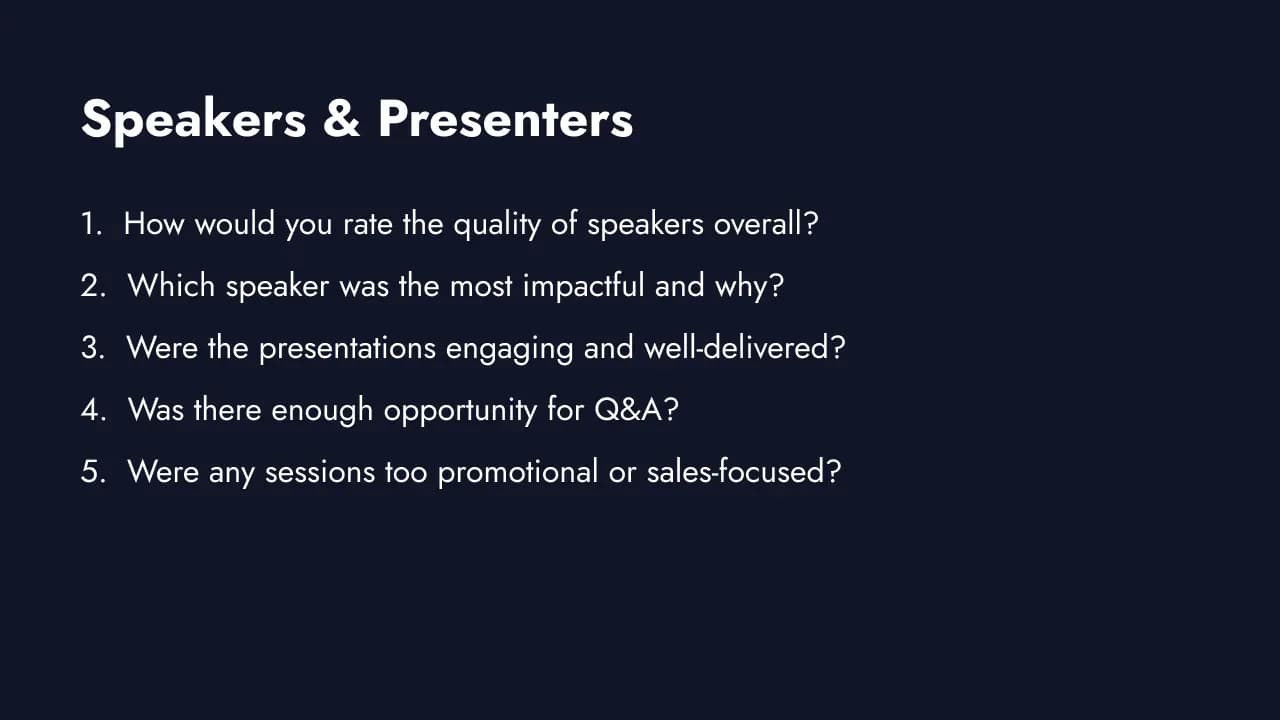
Speakers can make or break an event. These questions separate overall speaker quality from individual performance and help you build a stronger lineup next time.
17. How would you rate the quality of speakers overall?
- Type: Likert (1-5) | Essential
- Your aggregate speaker quality benchmark. Track this across events to see if your speaker selection process is improving.
18. Which speaker or presenter was most impactful? Why?
- Type: Open-ended | Essential
- Identifies your standout performers and, more importantly, what made them stand out. The "why" reveals whether it was content depth, delivery style, practical takeaways, or storytelling.
19. Were the presentations engaging and well-delivered?
- Type: Likert (1-5) | Recommended
- Separates delivery quality from content quality. A speaker can have great content but poor delivery, or vice versa. You need to know which problem to solve.
20. Was there enough opportunity for Q&A with speakers?
- Type: Scale (Too little / About right / Too much) | Recommended
- Q&A is often where the most valuable exchanges happen. "Too little" responses suggest either cutting session content or adding dedicated Q&A slots.
21. How knowledgeable were the speakers on their topics?
- Type: Likert (1-5) | Nice-to-have
- Perceived expertise drives credibility. Low scores here suggest your vetting process needs tightening or that speakers are presenting outside their core area.
22. Were there any speakers you felt were too promotional or sales-focused?
- Type: Binary (Yes/No) + conditional open-ended | Recommended
- Attendees distinguish between valuable insights and thinly-veiled sales pitches. Sponsor sessions are expected to have some promotion, but keynotes and breakouts should deliver genuine value.
Logistics and Organization (Questions 23-30)
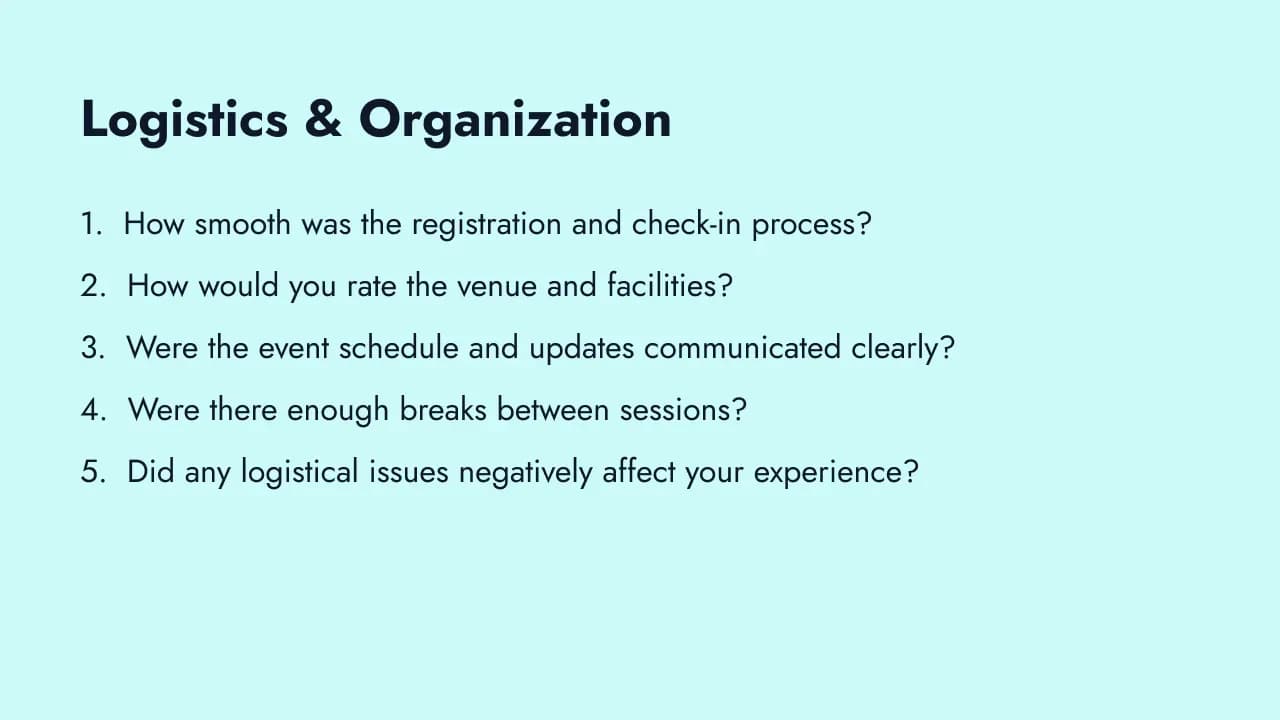
Logistics failures overshadow great content. These questions identify friction points that are usually fixable with better planning.
23. How smooth was the registration and check-in process?
- Type: Likert (1-5) | Essential
- First impressions set the tone. A slow or confusing check-in creates frustration before the first session even starts.
24. Was the event schedule communicated clearly and in advance?
- Type: Likert (1-5) | Recommended
- Clear communication reduces confusion and helps attendees plan their day. Low scores often trace back to late schedule changes or poor app/website design.
25. How would you rate the event venue (location, accessibility, comfort)?
- Type: Likert (1-5) | Essential
- Venue quality encompasses multiple dimensions: ease of access, seating comfort, room temperature, noise levels, and AV quality. Low scores warrant a follow-up question to pinpoint the specific issue.
26. How would you rate the food and beverage options?
- Type: Likert (1-5) | Recommended
- Food is one of the most commented-on aspects of any in-person event. Dietary accommodations, quality, and availability during breaks all factor into attendee satisfaction.
27. Were there enough breaks between sessions?
- Type: Scale (Too few / About right / Too many) | Recommended
- Break frequency affects energy levels, networking time, and overall satisfaction. Back-to-back sessions without adequate breaks lead to fatigue and early departures.
28. How would you rate the signage and wayfinding at the venue?
- Type: Likert (1-5) | Nice-to-have
- Getting lost at a conference is frustrating and wastes time. This is especially important for large venues with multiple tracks and floors.
29. Did the event start and end on time?
- Type: Binary (Yes/No) | Recommended
- Time management signals professionalism. Chronic overruns disrespect attendee schedules and erode trust in the organizers.
30. Were there any logistical issues that negatively affected your experience?
- Type: Open-ended | Essential
- Catch-all for logistics problems you did not think to ask about. Wi-Fi quality, parking, power outlets, and restroom access are common themes that surface here.
Networking and Engagement (Questions 31-36)
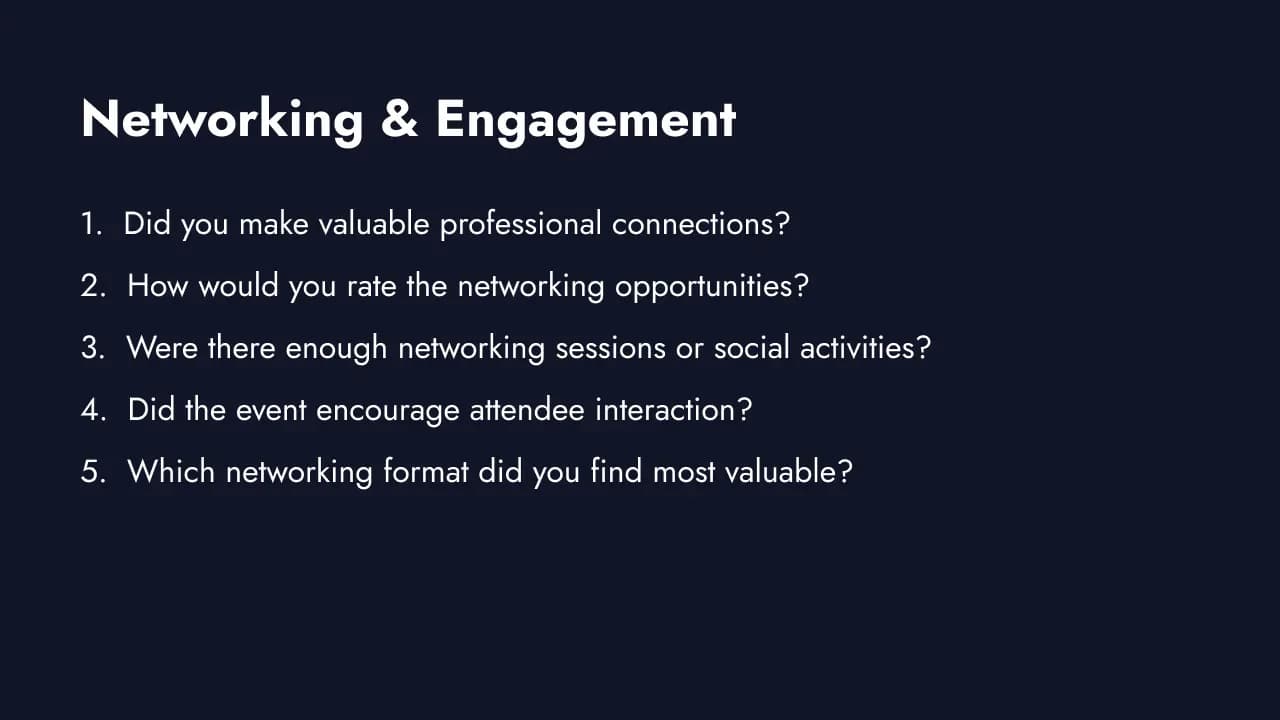
For many attendees, networking is the primary reason they show up. These questions measure whether your event delivered on that promise.
31. Did you make valuable professional connections at this event?
- Type: Binary (Yes/No) | Essential
- The simplest and most direct networking question. Cross-reference with "primary reason for attending" to see whether networking-motivated attendees got what they came for.
32. How would you rate the networking opportunities provided?
- Type: Likert (1-5) | Essential
- Goes beyond "did you network?" to measure the quality and accessibility of networking formats. Low scores suggest you need more structured networking activities.
33. Were there enough dedicated networking sessions or social events?
- Type: Scale (Too few / About right / Too many) | Recommended
- Quantity matters, but so does timing. Networking sessions after a long day of content have different energy than mid-day mixers.
34. How effective was the event app or matchmaking tool for connecting with other attendees?
- Type: Likert (1-5) | Nice-to-have
- If you provided a networking tool, measure whether attendees actually found it useful. Many event apps promise AI matchmaking but deliver mediocre results.
35. Did the event format encourage interaction among attendees?
- Type: Likert (1-5) | Recommended
- Event design choices (round tables vs. theater seating, interactive workshops vs. lectures, smaller group sizes) directly affect organic networking. This question measures whether your format helped or hindered connection.
36. What type of networking format do you find most valuable?
- Type: Multiple choice (Structured speed networking / Casual social events / Small group discussions / 1-on-1 meeting slots / Open reception / Other) | Nice-to-have
- Preference data for planning next year's networking activities. Different audiences prefer different formats.
Virtual and Hybrid Experience (Questions 37-40)
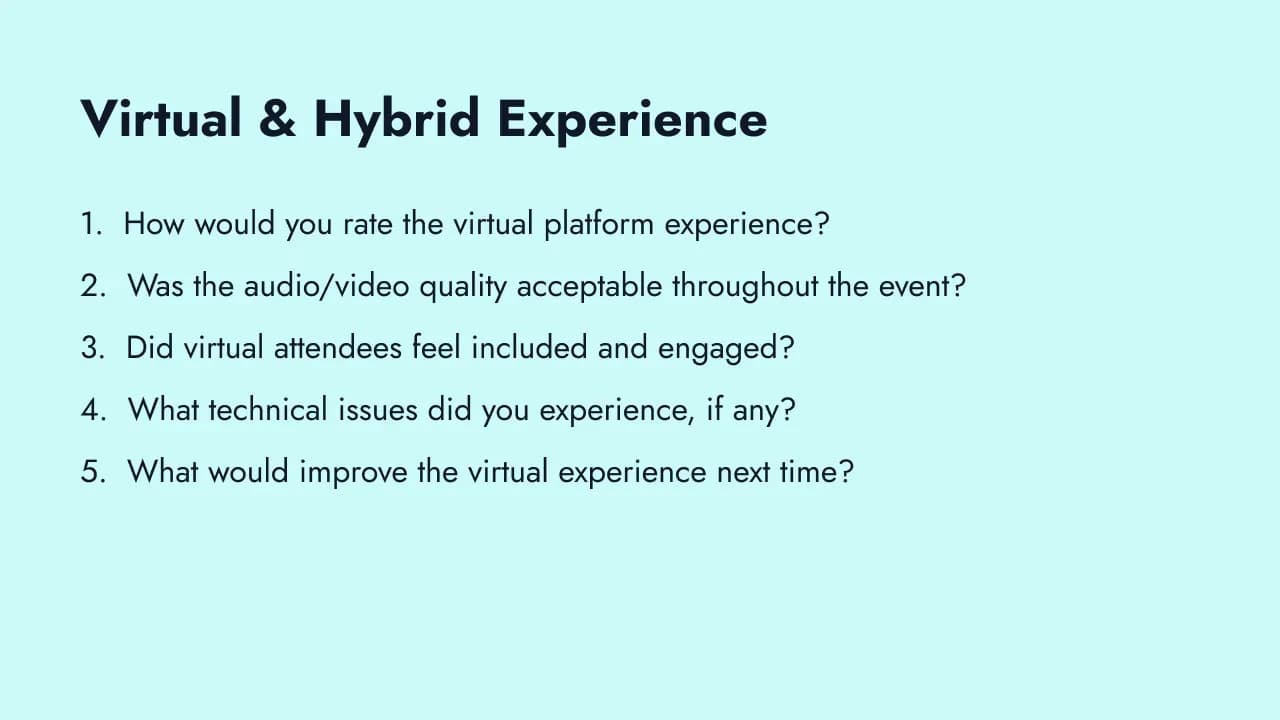
If your event had a virtual component, these questions measure whether remote attendees had an equitable experience.
37. How would you rate the virtual platform experience (ease of use, stability, features)?
- Type: Likert (1-5) | Essential (for virtual/hybrid)
- Platform quality is the foundation of virtual events. Poor UX, crashes, and confusing navigation undermine everything else.
38. Was the audio and video quality acceptable for all sessions you attended?
- Type: Scale (Yes / Mostly / No) | Essential (for virtual/hybrid)
- AV quality is table stakes. "Mostly" responses indicate inconsistency across sessions, which usually points to speaker setup variability rather than platform issues.
39. As a virtual attendee, did you feel you could participate equally compared to in-person attendees?
- Type: Likert (1-5) | Recommended (for hybrid)
- The core challenge of hybrid events. Low scores reveal where your hybrid model creates a two-tier experience. Common pain points: being ignored during Q&A, poor camera angles, and inability to network.
40. What would improve the virtual or hybrid experience for future events?
- Type: Open-ended | Recommended (for virtual/hybrid)
- Surfaces specific, actionable improvements. Virtual attendees often have very concrete suggestions because they experienced the friction firsthand.
Open-Ended and Future Events (Questions 41-47)
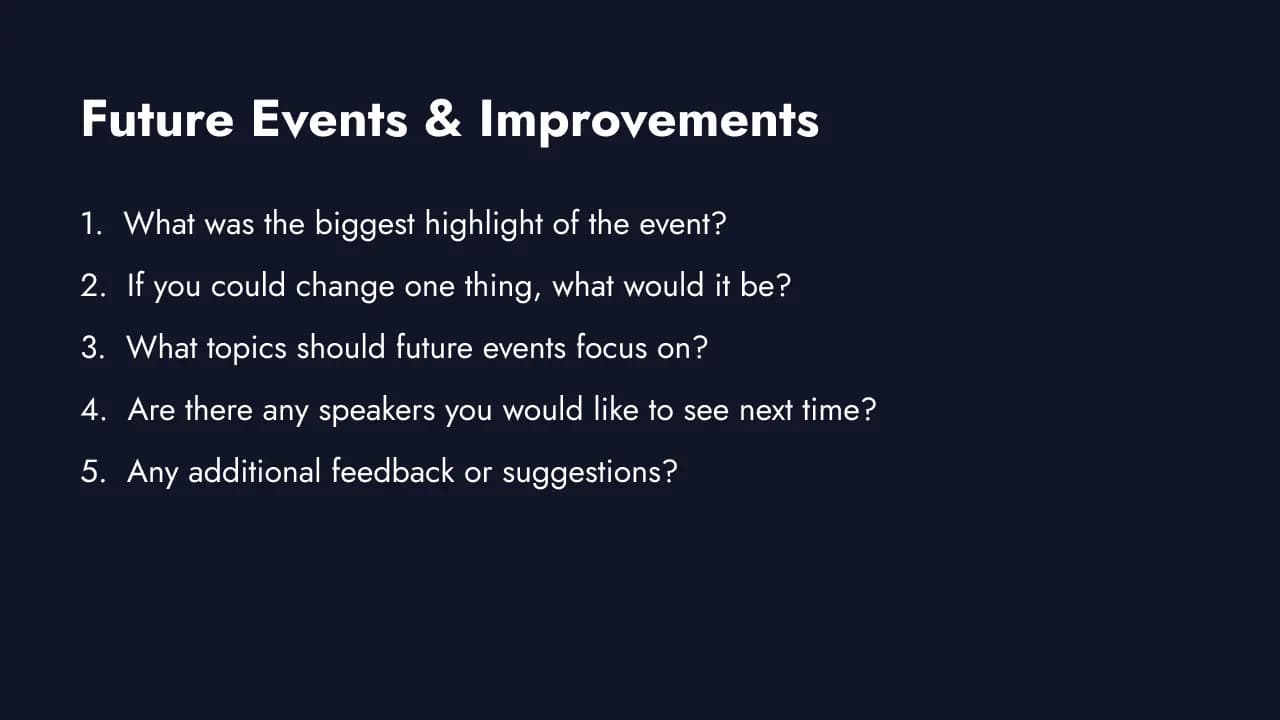
Open-ended questions surface insights that structured questions miss. Future-focused questions help you plan the next event based on attendee demand rather than assumptions.
41. What was the single biggest highlight of the event for you?
- Type: Open-ended | Essential
- Identifies your peak moments from the attendee perspective. These are the experiences to replicate and amplify. Aggregate responses into themes to find patterns.
42. If you could change one thing about the event, what would it be?
- Type: Open-ended | Essential
- The "one thing" constraint forces prioritization. More actionable than a generic "any improvements?" question that yields scattered wish lists.
43. What topics or themes should we cover at the next event?
- Type: Open-ended | Essential
- Direct input for next year's content planning. Group responses by frequency to identify high-demand topics. This is your audience telling you exactly what they want to learn.
44. Are there any speakers you would like to see at a future event?
- Type: Open-ended | Recommended
- Crowdsourced speaker suggestions. Attendees often know thought leaders in their space that you have not discovered yet.
45. What format changes would improve the event (e.g., shorter sessions, more workshops, different schedule)?
- Type: Open-ended | Recommended
- Format preferences evolve. What worked three years ago might not match current attendee expectations. This question keeps your format aligned with audience needs.
46. Would you be interested in a community or online group to stay connected between events?
- Type: Binary (Yes / Maybe / No) | Nice-to-have
- Tests demand for year-round engagement. High "Yes" rates justify investing in a community platform to maintain attendee relationships between events.
47. Any other feedback or comments you would like to share?
- Type: Open-ended | Recommended
- The catch-all. Some of the most valuable feedback comes from questions you did not think to ask. Always include this as your final question to capture anything the structured questions missed.
Post Event Survey Questions for Staff and Organizers (Questions 48-55)
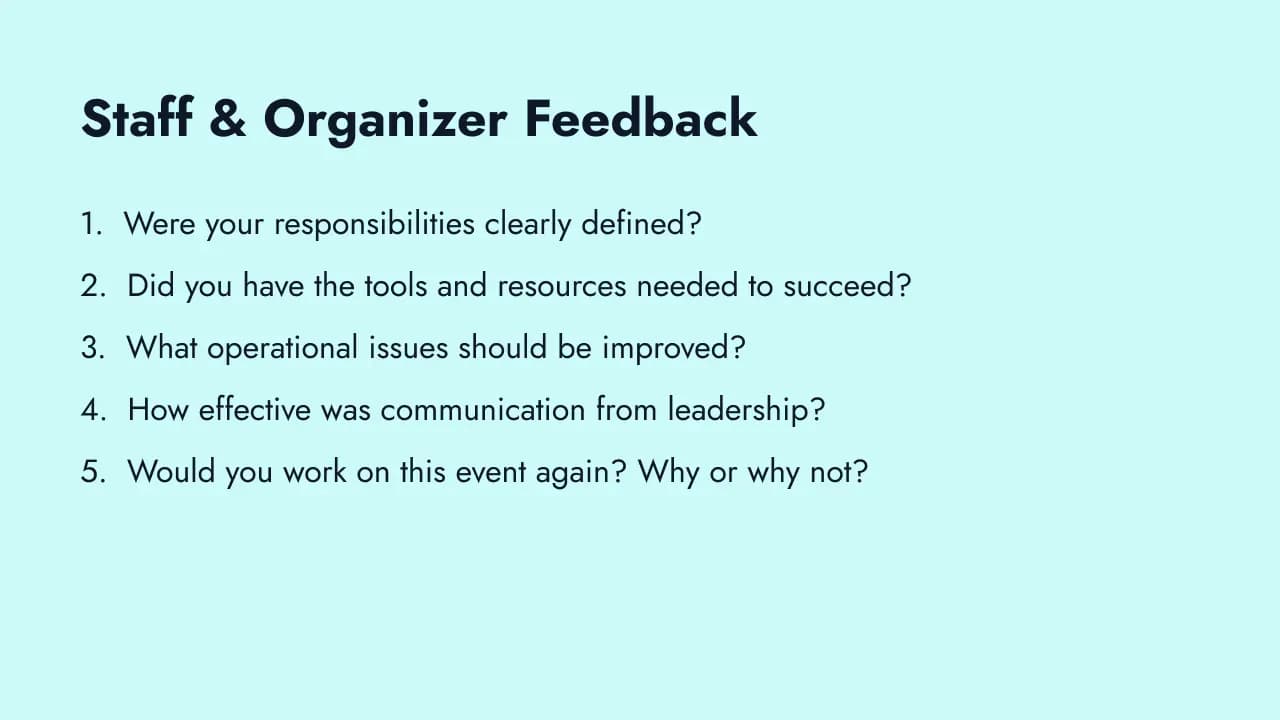
Attendees see the front of house. Staff and organizers see everything behind it. Surveying your own team after an event surfaces operational problems that no attendee survey will catch, from vendor breakdowns to unclear responsibilities. Run this as a separate survey sent to all event staff within 48 hours of the event ending.
48. Were your responsibilities clearly defined before and during the event?
- Type: Likert (1-5) | Essential
- Unclear roles are the root cause of most operational failures. Low scores here point to onboarding and briefing gaps for the next event.
49. Did you have the tools, resources, and information needed to do your job effectively?
- Type: Likert (1-5) | Essential
- Resource gaps show up in real time as improvisation. Capturing them after the fact builds a better pre-event checklist.
50. Which logistical problems arose that you feel we should have anticipated better?
- Type: Open-ended | Essential
- Staff experience the practical failures attendees rarely notice or report. These responses are your most actionable operational improvement data.
51. Which part of the event ran more smoothly than you expected, and why?
- Type: Open-ended | Recommended
- Positive surprises reveal what worked and why. Documenting these helps you replicate successes intentionally rather than accidentally.
52. How clear and timely was communication from event leadership during the event?
- Type: Likert (1-5) | Recommended
- Communication breakdowns during events are common and fixable. This question helps identify whether problems were structural (no clear chain of command) or situational.
53. What would you change about the pre-event preparation process?
- Type: Open-ended | Essential
- Most event failures are set up weeks before the event. Staff who ran logistics have the clearest view of where preparation fell short.
54. What additional support or resources would have made your job easier?
- Type: Open-ended | Recommended
- Opens the door to resource requests (more staff, better equipment, different tools) before the next planning cycle starts.
55. Would you want to work on this event again? What would change your answer?
- Type: Binary (Yes/No) + open-ended follow-up | Nice-to-have
- Staff retention matters for events with recurring formats. "No" responses with strong follow-up reasons are high-signal data.
Post Event Survey Questions for Volunteers (Questions 56-62)
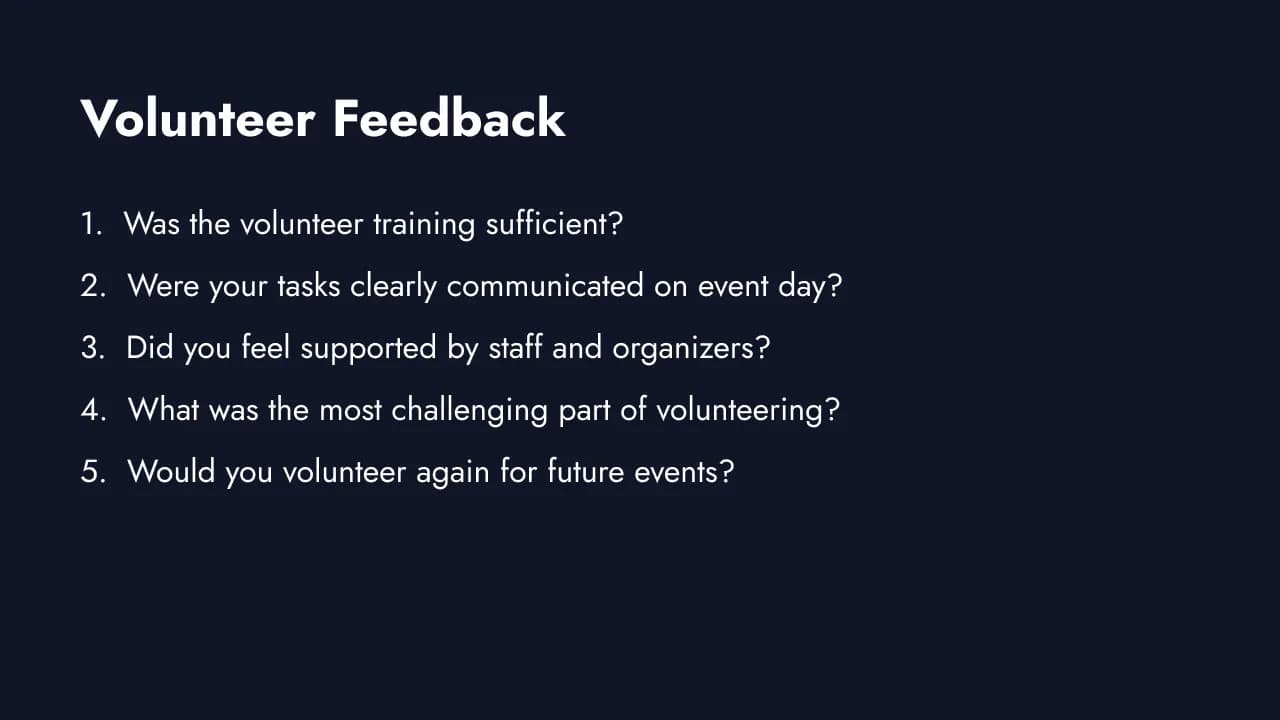
Volunteers are your most cost-efficient operational resource and one of the most overlooked feedback sources. A volunteer who struggled with unclear instructions or felt undervalued will not sign up next year. Survey them separately and use their responses to improve your volunteer program, not just the event itself.
56. Was the training and briefing you received before the event sufficient to prepare you for your role?
- Type: Likert (1-5) | Essential
- Inadequate training is the top complaint in volunteer feedback. Low scores here directly predict higher no-show and dropout rates at future events.
57. Were your tasks and responsibilities clearly communicated on the day of the event?
- Type: Likert (1-5) | Essential
- Last-minute confusion on the day is separate from pre-event briefing quality. Both need to be measured.
58. Did you feel supported by event organizers and staff when problems arose?
- Type: Likert (1-5) | Recommended
- Volunteers who feel abandoned during crises do not return. This question measures the quality of your volunteer support infrastructure.
59. What was the most challenging part of volunteering for this event?
- Type: Open-ended | Essential
- Surfaces the friction points specific to the volunteer experience. Common themes: unclear contacts to escalate to, insufficient break time, last-minute role changes.
60. What would have made your volunteering experience more positive?
- Type: Open-ended | Essential
- Direct improvement input. Volunteers often have very practical, low-cost suggestions that significantly improve program quality.
61. Would you volunteer at this event again? What would make you more or less likely to?
- Type: Binary (Yes/No) + open-ended follow-up | Essential
- Your volunteer retention metric. The follow-up captures the specific factors driving the decision.
62. Is there anything about how the event was organized that surprised you (positively or negatively)?
- Type: Open-ended | Nice-to-have
- Fresh eyes notice things that experienced staff no longer see. Volunteer observations often surface systemic issues.
Post Event Survey Questions for Sponsors (Questions 63-70)
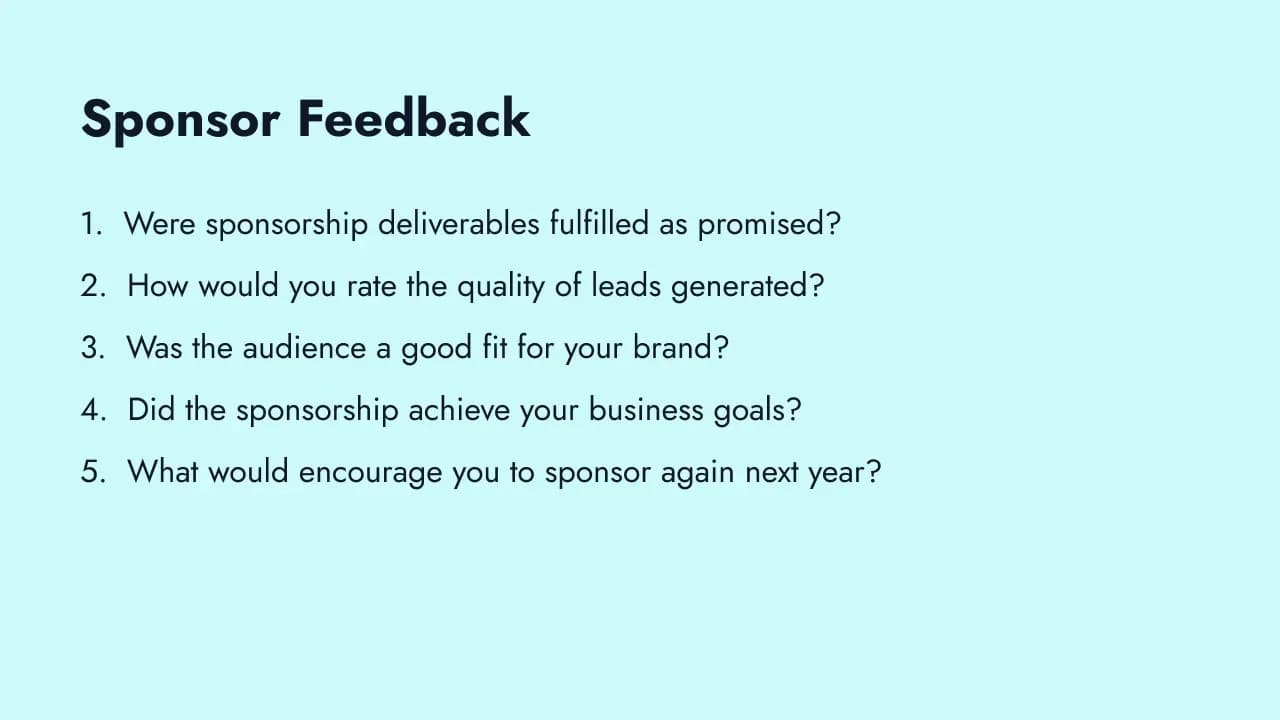
Sponsors evaluate your event through a fundamentally different lens than attendees. Their questions are about lead quality, brand exposure, and whether the investment achieved their business goals. A sponsor who renews at a higher tier is one whose specific outcomes were met and measured. These questions create the data needed for those renewal conversations.
63. Were all the sponsorship deliverables you were promised fulfilled as agreed?
- Type: Scale (All fulfilled / Most fulfilled / Partially fulfilled / Not fulfilled) | Essential
- The baseline expectation check. Any gap between promised and delivered is a renewal risk that needs to be addressed directly.
64. How would you rate the quality and relevance of the leads or contacts you made at the event?
- Type: Likert (1-5) | Essential
- Lead quality is the primary ROI metric for most sponsors. Low scores here signal audience-sponsor fit problems or poor booth/session placement.
65. Was the event audience a good fit for your brand and business goals?
- Type: Likert (1-5) | Essential
- Audience fit predicts long-term sponsor retention better than short-term lead counts. A sponsor who reaches the wrong audience will not return regardless of lead volume.
66. How satisfied were you with the logistical support you received as a sponsor (booth setup, signage, communication)?
- Type: Likert (1-5) | Recommended
- Logistics failures create friction that overshadows even strong lead outcomes. Easy to fix once identified.
67. Did you achieve the specific goals you set for this sponsorship?
- Type: Scale (Yes, fully / Mostly / Partially / No) | Essential
- Goal attainment is how sponsors justify their spend internally. If they cannot check this box, renewal is a hard sell.
68. How would you rate the overall ROI of your sponsorship investment?
- Type: Likert (1-5) | Recommended
- Perceived ROI is not the same as measured ROI. Both matter for renewal decisions.
69. What would encourage you to renew or upgrade your sponsorship for the next event?
- Type: Open-ended | Essential
- The most direct renewal conversion question. Sponsors who give specific answers (more speaking time, better placement, exclusive access) are telling you exactly how to close the upsell.
70. What could the organizers have done better to support your sponsorship experience?
- Type: Open-ended | Recommended
- Operational improvement input from sponsors who had a direct financial stake in success. High-quality signal for refining your sponsor program.
Post Event Survey Best Practices
Asking the right questions is only half the equation. How you structure, time, and deliver your survey determines whether you get actionable data or an empty inbox.
Send within 24 hours. Response rates fall significantly after 48 hours. Attendees forget details quickly, and the emotional energy from the event fades. Schedule your survey to go out the morning after the event ends.
Keep to 8-12 questions. The sweet spot is 8-12 questions that can be completed in under 5 minutes. If your survey takes longer than that, you will lose a significant portion of your respondents. When you need more depth, segment your audience and send tailored question sets rather than a longer single survey.
Use a mix of ratings and open-ended. Aim for 70-80% closed-ended questions (ratings, scales, multiple choice) for benchmarking and 20-30% open-ended for qualitative discovery. Limit open-ended questions to 3-4 per survey to manage respondent fatigue.
Segment by ticket type. VIP attendees, general admission, speakers, and sponsors have fundamentally different experiences. Send tailored question sets to each group instead of one generic survey. A sponsor cares about lead quality. An attendee cares about session content. Asking both the same questions wastes everyone's time.
Include one NPS question for benchmarking. Net Promoter Score gives you a single number to track across events and compare against industry benchmarks. It also identifies your promoters (potential advocates) and detractors (at-risk attendees) for targeted follow-up.
Thank attendees for participating. A brief thank-you message at the end of the survey reinforces that you value their time. Mention how their feedback will be used: "Your responses will directly shape next year's event." This closes the loop and increases willingness to respond to future surveys. For a deeper framework, see our guide on closing the feedback loop.
Common Post Event Survey Mistakes
These mistakes are common and quietly sabotage your feedback quality. Each one is fixable.
Mistake 1: Sending the survey too late. Waiting a week or more kills your response rate and data quality. Attendees forget specifics and default to vague impressions. Set up your survey in advance so it is ready to send within hours of the event ending.
Mistake 2: Asking too many questions. A 30-question post event survey feels like homework. Most attendees will either abandon it or rush through with low-quality answers. Cut ruthlessly. If a question does not lead to a specific decision, remove it.
Mistake 3: Only asking about overall satisfaction. "How was the event?" tells you almost nothing actionable. You need to drill into specific dimensions: content relevance, speaker quality, logistics, networking, and venue. Category-level feedback is what drives specific improvements.
Mistake 4: Not asking about future events. Post event surveys that only look backward miss the opportunity to shape what comes next. Questions about future topics, format preferences, and likelihood to return give you a head start on planning.
Mistake 5: Not sharing results with the team. Survey data that lives in one person's inbox is wasted. Share findings with your entire event team within one week. Create a summary deck with key scores, top themes from open-ended feedback, and clear action items. For a framework on turning feedback into action, see our guide on analyzing customer feedback.
How to Distribute Post Event Surveys
The right distribution channel can double your response rate. Match your method to your event type and audience behavior.
| Channel | Best For | Timing | Key Tip |
|---|---|---|---|
| Most event types; primary distribution | Within 24 hours of event end | Personalize with attendee name and reference a specific session | |
| In-app notification | Virtual events, platform-based conferences | Immediately after the final session | Capture feedback while attendees are still on the platform |
| QR code | In-person events (exit doors, badges, session rooms) | During the event and at departure | Place codes where people naturally pause; offer a small incentive |
| SMS | High-priority feedback from VIP or small groups | Within 2 hours of event end | Keep to 1-3 questions; link to full survey for more detail |
| Social media polls | Quick pulse checks, casual community events | 24-48 hours post-event | Good for engagement metrics but limited depth |
For virtual and hybrid events, in-app distribution captures feedback at the moment of experience. No email open rates to worry about, no context switching.
For in-person events, email remains the primary channel, but QR codes at the exit serve as a powerful secondary channel that catches attendees while the experience is still fresh.
For a deeper dive into channel strategies and increasing response rates, see our guide on survey distribution methods.
Free Post Event Survey Template
Skip the blank page. Formbricks offers a free, open-source survey platform you can use to build and send your post event survey in minutes. Start with the event feedback survey template or create a link survey that you can distribute via email, embed in your event app, or share through a QR code at the venue.
Related templates:
- Event Feedback Survey for comprehensive event feedback
- Net Promoter Score (NPS) for loyalty measurement
- Feedback Box for open-ended feedback
How to get started:
- Sign up at formbricks.com (free tier available, no credit card required)
- Create a new link survey using the feedback collection template or add the questions from this guide that match your event type
- Customize the branding to match your event identity
- Generate a shareable link or QR code for distribution
- Send within 24 hours of your event and monitor responses in real time
Formbricks is open source, privacy-first, and supports self-hosting for teams that need full data control. It is built for event organizers, product teams, and marketing teams who want targeted feedback without heavy engineering lift.
Create Your Free Post Event Survey →
Frequently Asked Questions
Try Formbricks now