
130 fun survey questions that actually get answered (2026)

Johannes
CEO & Co-Founder
12 Minutes
May 3rd, 2026
A serious survey with a light first question outperforms one that opens cold. The psychology is simple: a low-stakes opener lowers the friction of starting, and respondents who answer the first question are far more likely to finish.
But the research goes further than that. Tews, Michel, and Stafford (2013), in a study published in the Cornell Hospitality Quarterly, found that fun activities at work improved employee performance and that manager support for workplace fun significantly reduced turnover, especially among younger employees (Tews, Michel & Stafford, 2013). Fun is not decoration. It changes behavior.
This guide gives you 130 fun survey questions grouped by category and use case. Every group comes with advice on where to use it.
What you will find in this guide:
- Why fun questions work, backed by research
- 130 questions grouped by 12 categories
- Hot takes, work preference polls, and the escalation principle
- Where to use each category: meetings, newsletters, classrooms, virtual events
- When NOT to use fun questions
- Best practices for tone, inclusion, and reading the room
Why fun survey questions work
Fun questions are not filler. They have a measurable effect on response rates, team connection, and data quality.
They reduce drop-off. Respondents who answer the first question are far more likely to finish. A heavy opener ("rate your satisfaction with senior leadership") makes people close the tab. A light one keeps them in.
They improve performance and retention. Tews, Michel, and Stafford (2013) studied 195 hourly employees over six months and found that fun activities improved sales performance, and manager support for workplace fun significantly reduced turnover, particularly among younger workers (Tews, Michel & Stafford, 2013). The mechanism is straightforward: when people enjoy being at work, they stay longer and try harder.
Escalating questions build real closeness. Aron and colleagues (1997) found that pairs of strangers who worked through questions that gradually increased in depth felt as close afterward as people in long-term relationships. Closer than pairs who had a standard small-talk conversation (Aron et al., 1997). The key was escalation: start easy, go deeper over time. The same principle applies to team polls.
Specificity beats polish. "What is your favorite breakfast food?" is generic. "Cereal or no cereal, and if cereal, which one?" is specific enough to spark a real answer. Specificity gives people something to react to.
They work across channels. One good fun question works as a meeting opener, a newsletter poll, a classroom warm-up, and an event icebreaker. Build a library once, reuse for years.
Icebreakers for team meetings (questions 1-10)
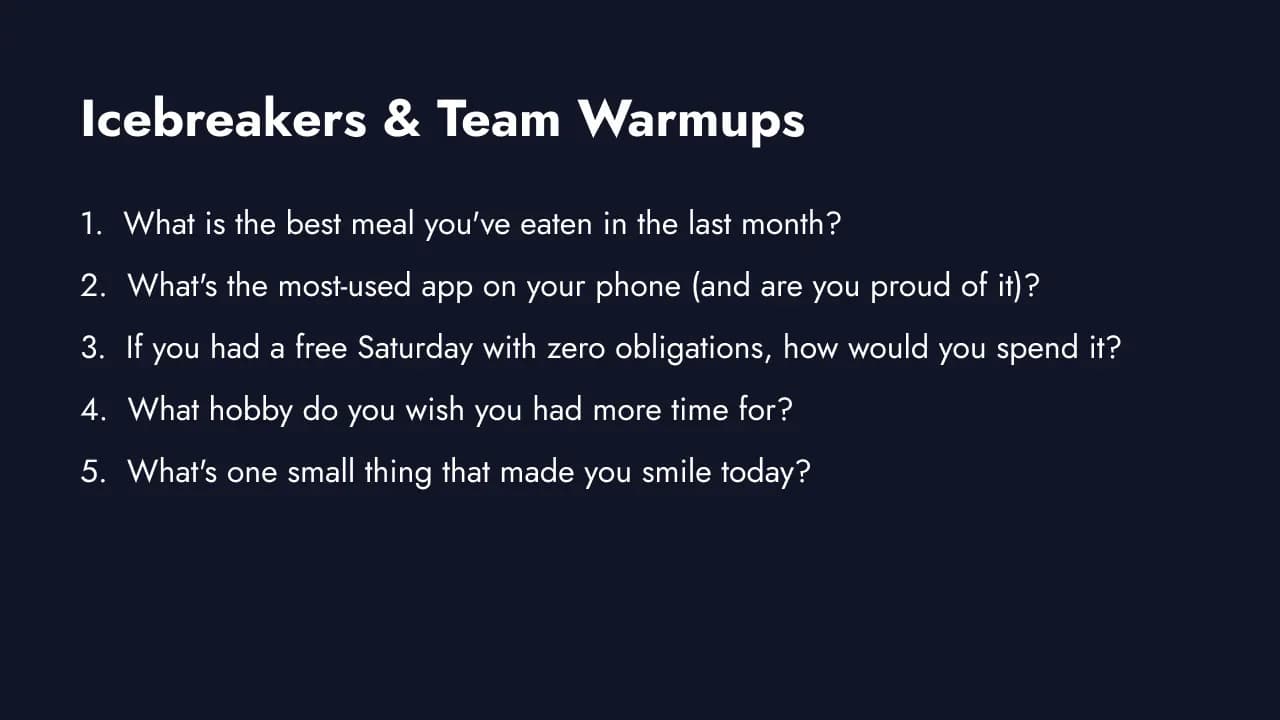
Start a team meeting with one of these. They take 30 seconds, warm everyone up, and give quieter teammates a low-stakes chance to speak first.
- What is the best meal you have eaten in the last month?
- If you could instantly become an expert at something, what would it be?
- What is one small thing that made you smile today?
- Coffee, tea, or something else?
- What is the most-used app on your phone (and are you proud of it)?
- What show are you currently watching, and is it any good?
- What is a hobby you wish you had more time for?
- What is the last thing you bought that you would buy again in a heartbeat?
- If you had a free Saturday with no obligations, how would you spend it?
- What is your go-to snack when you are in deep focus?
How to use them
Drop one into the top of a weekly team meeting. Give everyone 60 seconds to answer in chat or go around the room. Keep it moving. The goal is to warm the room, not to fill ten minutes.
Would you rather questions (questions 11-20)
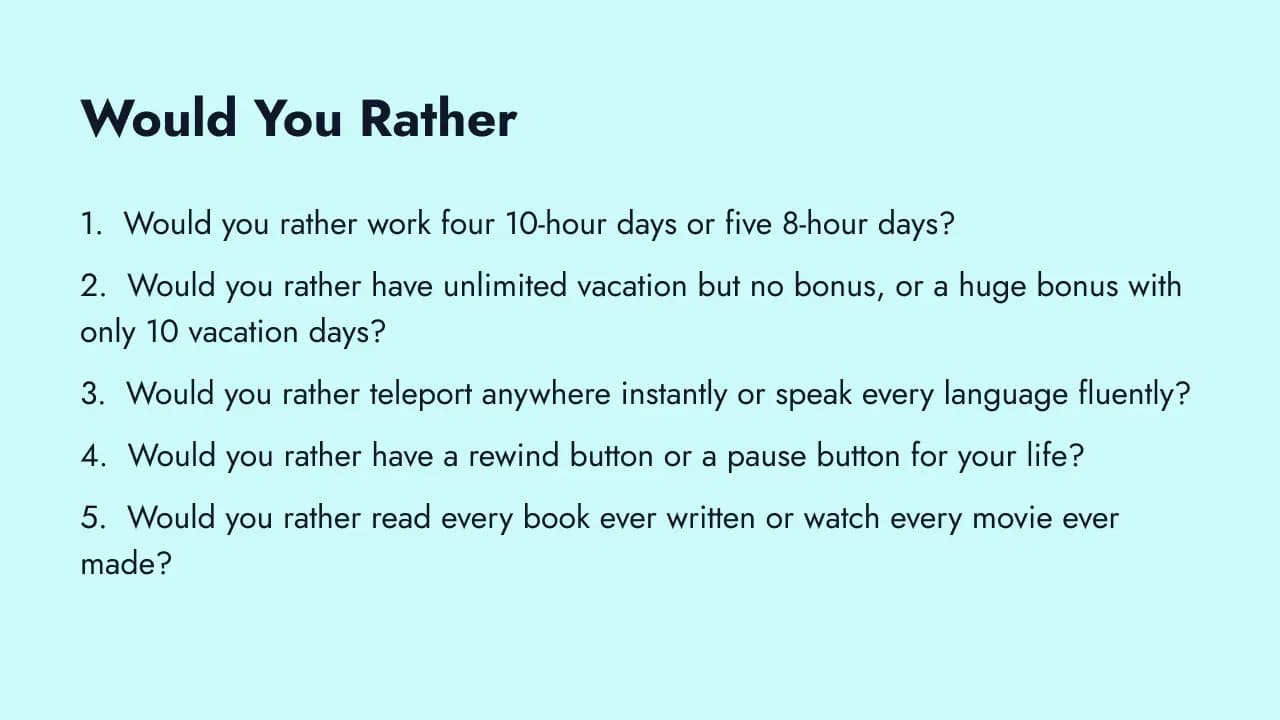
These work because they force a choice. The answer is not as interesting as the reasoning behind it, so always ask "why?" as a follow-up.
- Would you rather always be 10 minutes early or always 10 minutes late?
- Would you rather live in a house with no Wi-Fi or a house with no running water for a week?
- Would you rather have unlimited vacation days but no bonus, or a big bonus but only 10 vacation days?
- Would you rather work four 10-hour days or five 8-hour days?
- Would you rather never have to sleep again or never have to eat again?
- Would you rather be able to teleport anywhere instantly or be fluent in every language?
- Would you rather have a rewind button for your life or a pause button?
- Would you rather get one month of paid vacation or one month working from a place of your choice?
- Would you rather have a photographic memory or always guess numbers correctly?
- Would you rather read every book ever written or watch every movie ever made?
How to use them
Use for onboarding icebreakers, remote team bonding, or as a fun first question on an engagement pulse. Put the answer on a binary multiple choice so you can chart the split.
This or that questions (questions 21-30)
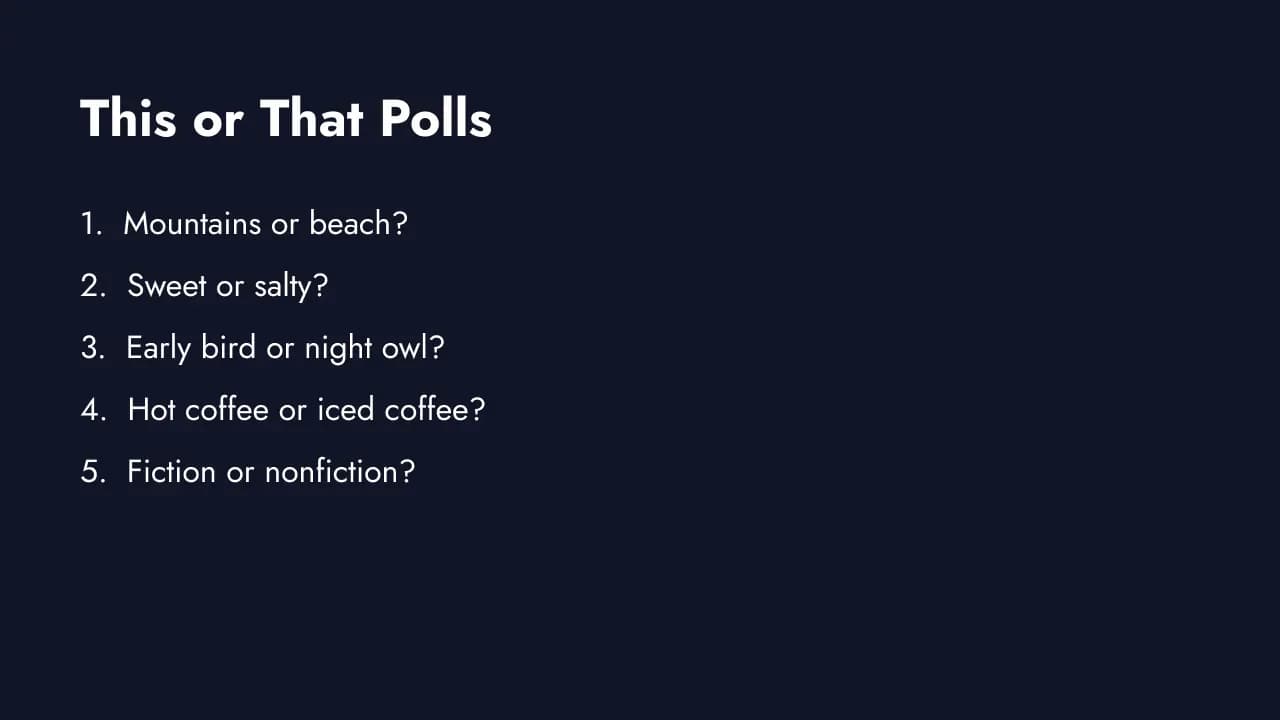
Fast and scrollable. These work well in newsletters and on social because the answers generate quick reactions.
- Sunrise or sunset?
- Mountains or beach?
- Cats or dogs?
- Sweet or salty?
- Early bird or night owl?
- Calendar or to-do list?
- Print or digital?
- Hot coffee or iced coffee?
- Window seat or aisle seat?
- Fiction or nonfiction?
How to use them
Put 5 of these at the end of a newsletter every week. Rotate which ones you use. Ask readers to reply with their answers. You will get replies from readers who never reply to anything else.
Get-to-know-your-team questions (questions 31-42)
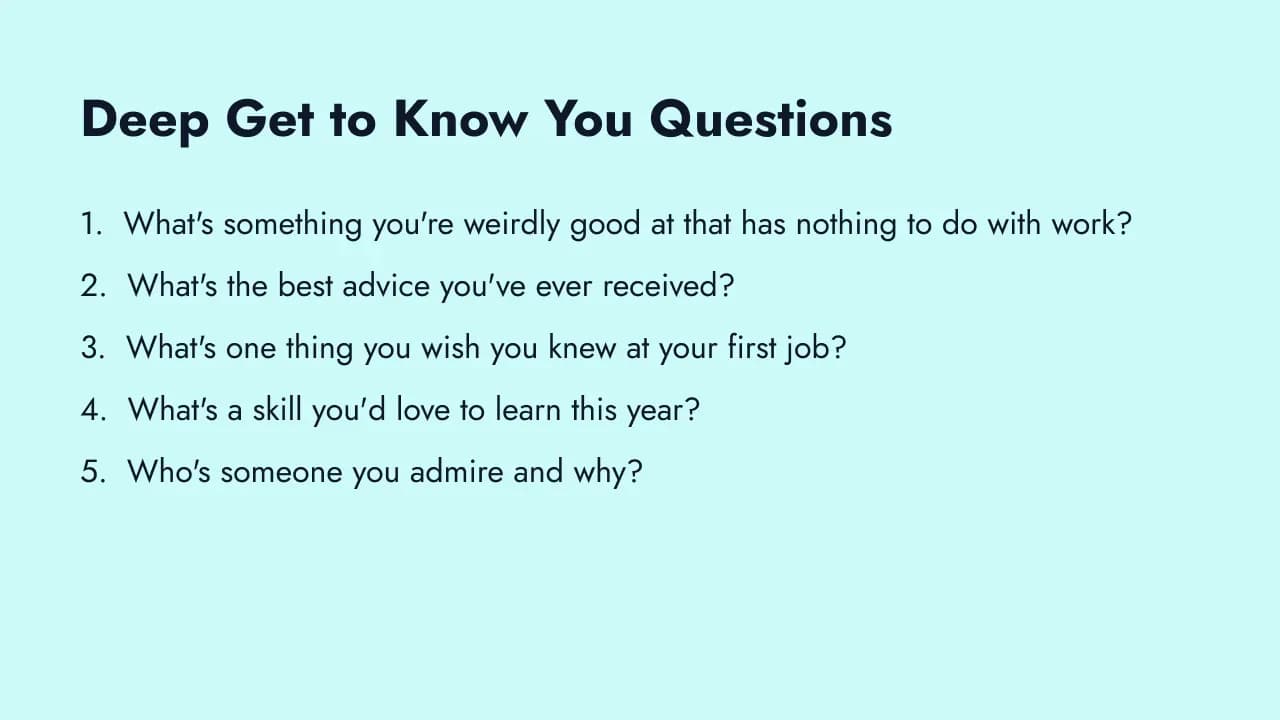
Deeper than icebreakers, still safe. Use these for team retreats, new hire lunches, or an "about me" round in a Slack intro thread.
- What is the job you wanted to have when you were 10?
- What is something you are weirdly good at that has nothing to do with work?
- What is a small thing someone did for you recently that made your week?
- What is the last thing you learned that surprised you?
- What is one thing you wish you had known at your first job?
- What is a book, podcast, or article that changed the way you think?
- If you had to eat one food for the rest of your life, what would it be?
- What is the most memorable trip you have taken?
- What is something you used to hate that you now love?
- What is the best piece of advice you have ever received?
- What is a skill you would love to learn in the next year?
- Who is someone you admire and why?
How to use them
Perfect for new hire onboarding surveys. Mix two or three into the Week 1 touchpoint to help new team members introduce themselves to peers. See our onboarding survey questions guide for the full framework.
Fun poll questions for newsletters (questions 43-54)
Newsletter polls live and die by specificity. Generic questions get skipped. Specific ones get replies.
- What is the one food you could never stop eating?
- What is the last thing you bookmarked and actually came back to?
- What book are you currently reading, or lying about reading?
- What is your favorite place to work from that is not a desk?
- What is your most-used keyboard shortcut?
- What is the last thing you Googled that you would not want anyone to see (just kidding, tell us a normal one)?
- What podcast episode have you relistened to?
- What is a purchase under $50 that changed your daily life?
- What is your favorite piece of "old internet" that is still alive?
- What is the smallest thing that makes a coffee shop good?
- What is the last recipe you made that actually worked?
- What is your go-to "everything tastes bad today" comfort meal?
How to use them
Pick one per newsletter. Put it at the bottom as a reply-or-click prompt. The best performers over time become the seed for future content.
Virtual event and conference icebreakers (questions 55-64)
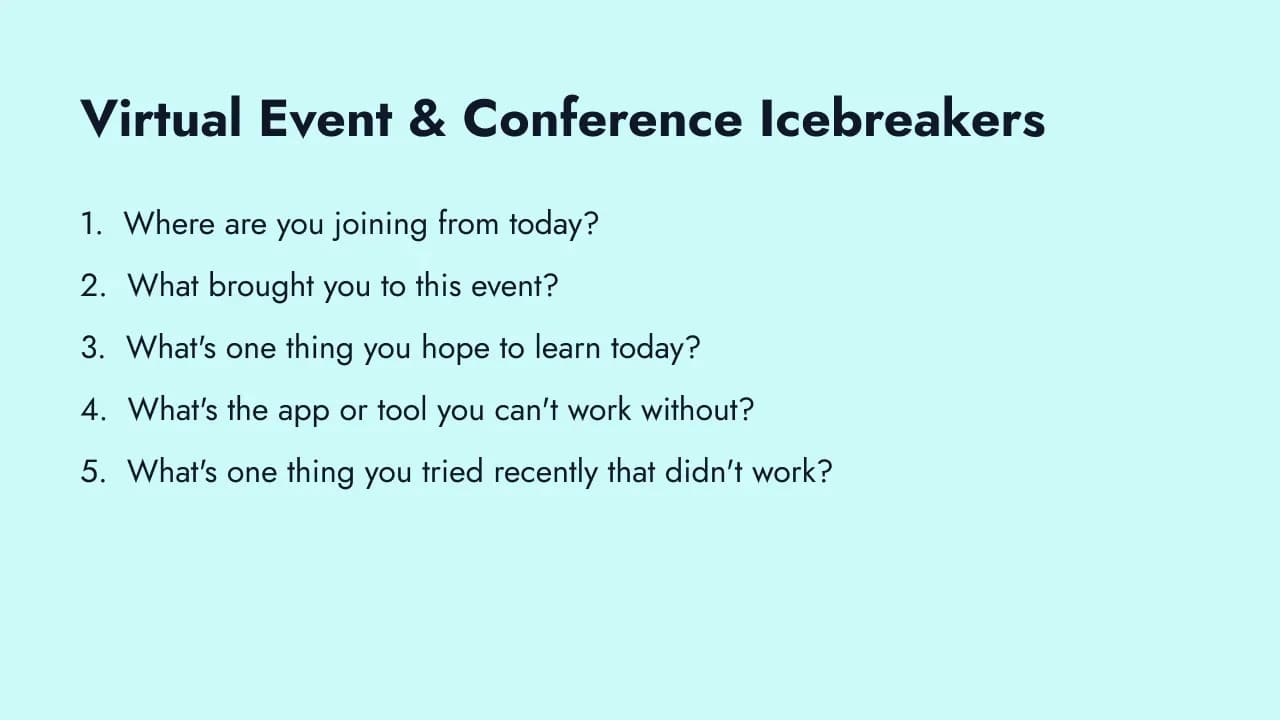
Remote events are hard to warm up. One good question at the start carries more weight than three mediocre ones.
- Where are you joining from today?
- What brought you to this event?
- What is one thing you are hoping to learn today?
- What is the best talk you saw in the last year?
- What is the app or tool you cannot work without?
- What is one thing you have tried recently that did not work?
- If you could instantly delete one meeting from your calendar every week, which one would it be?
- What is a question you wish someone would ask you?
- What is the one thing you hope will be different about work in five years?
- What is the strangest thing on your desk right now?
How to use them
Use a live poll or a quick chat prompt at the start of a session. Read a few answers out loud to bring the group into the room. For event surveys after the fact, see post-event survey questions.
Classroom warm-up questions (questions 65-74)
For teachers, trainers, and facilitators. Short, inclusive, low-stakes.
- What was the best part of your weekend?
- What is something you are looking forward to this week?
- If you could be any animal for a day, which one would you pick?
- What is the weirdest food combination you actually like?
- What is the last song that got stuck in your head?
- If you could teach a class on anything, what would you teach?
- What is one thing you learned recently that surprised you?
- What is a small act of kindness you have seen this week?
- If you could visit any place for a day, where would you go?
- What is the best thing you have ever built or made?
How to use them
Open a class or training session with one question. Have students answer on paper, in a poll, or out loud. The answers are a free source of what your learners actually care about.
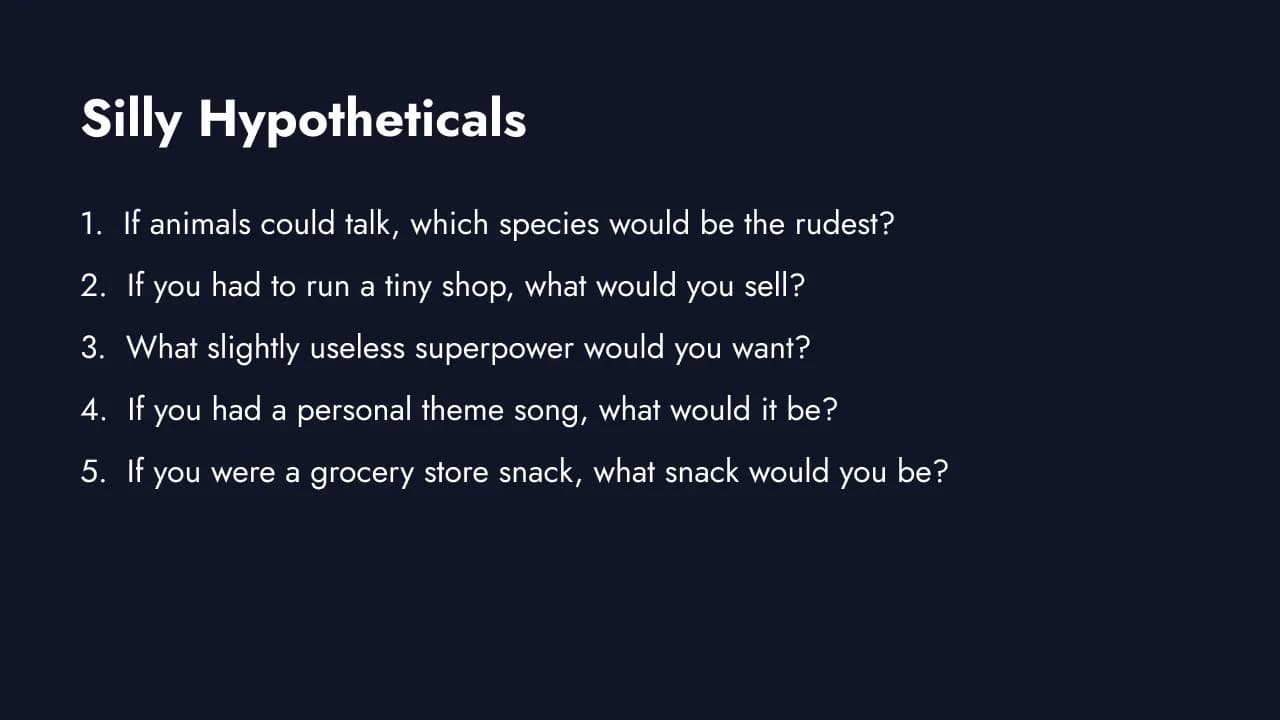
Silly hypotheticals and desert-island questions (questions 75-84)
These are the "impossible to answer seriously" questions. Lean into the absurdity.
- If you could only listen to three songs for the rest of your life, what would you pick?
- If you were stranded on a desert island and could bring one book, one album, and one food, what would you bring?
- If you had to run a small shop, what would you sell?
- If you could live in any time period (other than the present), when would you pick?
- If animals could talk, which species would be the rudest?
- If you could have dinner with any historical figure, who would it be?
- If you could have one superpower but it had to be slightly useless, what would you pick?
- If you had to pick a theme song that plays every time you walk into a room, what would it be?
- If you were a snack at the grocery store, what snack would you be?
- If you had to move to a country you have never visited for a year, where would you go?
How to use them
Great for retreats, offsites, and end-of-year team surveys. Share the aggregate answers as a light moment in a team all-hands.
Nostalgia and childhood questions (questions 85-92)
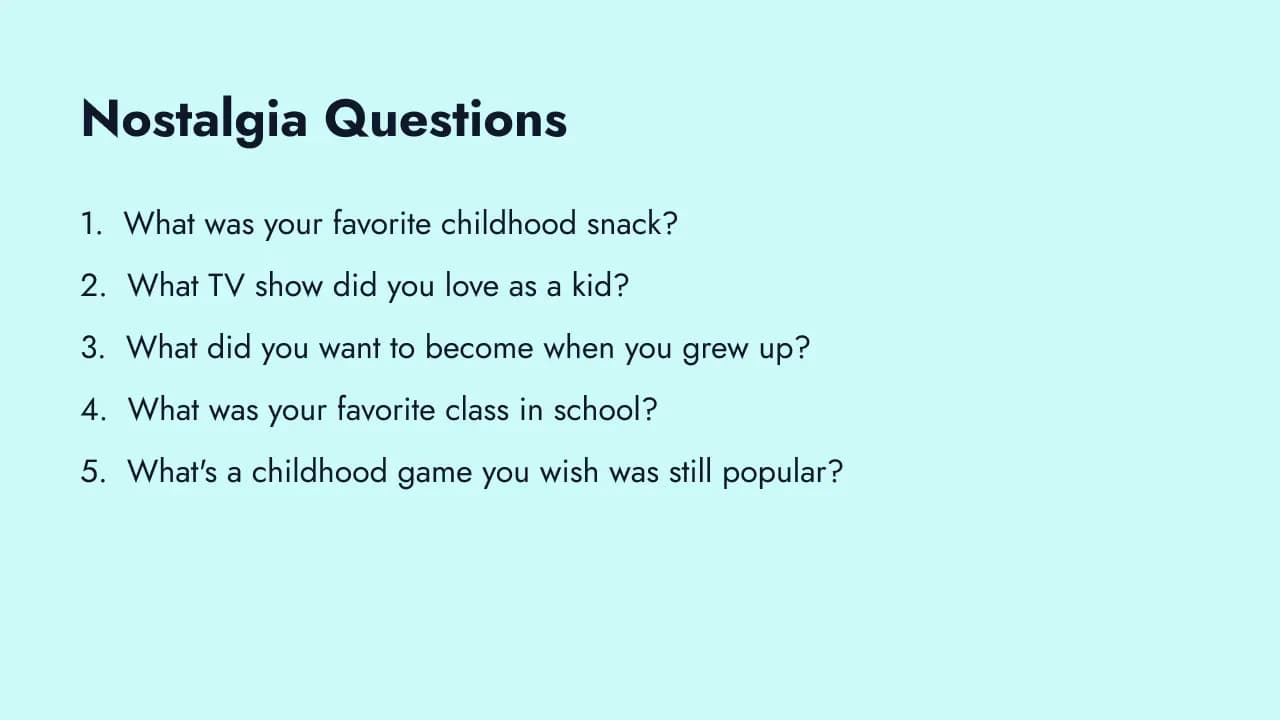
Nostalgia is a reliable way to warm up a group. Keep the prompts generation-neutral so everyone has something to say.
- What was your favorite childhood snack?
- What was your favorite TV show as a kid?
- What did you want to be when you grew up?
- What was the first concert you ever went to?
- What is a game you used to play that you wish was still popular?
- What was your favorite class in school, and why?
- What is one thing you did as a kid that kids today might not get to do?
- What is a family tradition you still think about?
How to use them
Use sparingly in team contexts. Once or twice a year is enough to get the warm glow without wearing the category out.
Food, travel, and pop culture questions (questions 93-100)
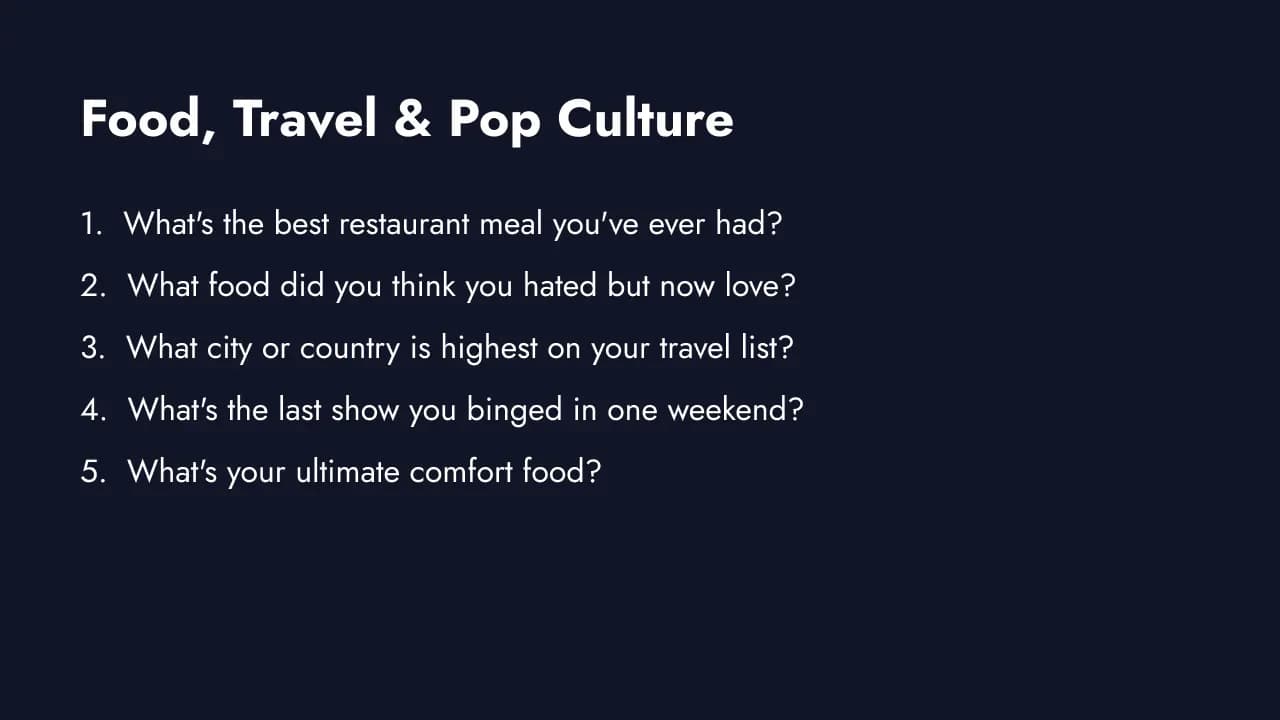
The universal ice-breakers. Almost everyone has an opinion on food, travel, or a show.
- What is the best meal you have eaten in a restaurant?
- What is a food you thought you hated but now love?
- What is the best dessert you have ever had?
- What is a country or city on your must-visit list?
- What is the last show you binged in a single weekend?
- What is the movie you have seen more times than any other?
- What is your go-to comfort food?
- What is the strangest food combination you secretly love?
How to use them
Rotate one per week in Slack or at a standup. Compile the aggregate list into a "team favorites" document that new hires can read on day one.
Hot takes and opinion polls (questions 101-112)
These are the highest-engagement format. A hot take forces a position on something people have mild-but-real feelings about. The answer is less interesting than the argument it starts.
- Is a hot dog a sandwich? Defend your answer.
- Pineapple on pizza: acceptable or not?
- Is cereal a soup? Yes or no.
- Does a straw have one hole or two?
- Is it acceptable to reply to an email with just "Thanks"?
- Are back-to-back meetings ever justified?
- Should "reply all" be banned as a default?
- Is it rude to eat smelly food at your desk?
- Is it acceptable to leave a meeting that has no agenda?
- Should lunch be a no-meeting zone for the whole company?
- Is it okay to message a colleague outside of work hours if it is not urgent?
- Is a standup that could have been an email still a good standup?
How to use them
Drop one into a Slack channel with a simple Yes / No / It's complicated poll. The replies write themselves. These also work as a quick vote at the start of a meeting to get people talking before the real agenda begins.
Work preferences and productivity questions (questions 113-122)
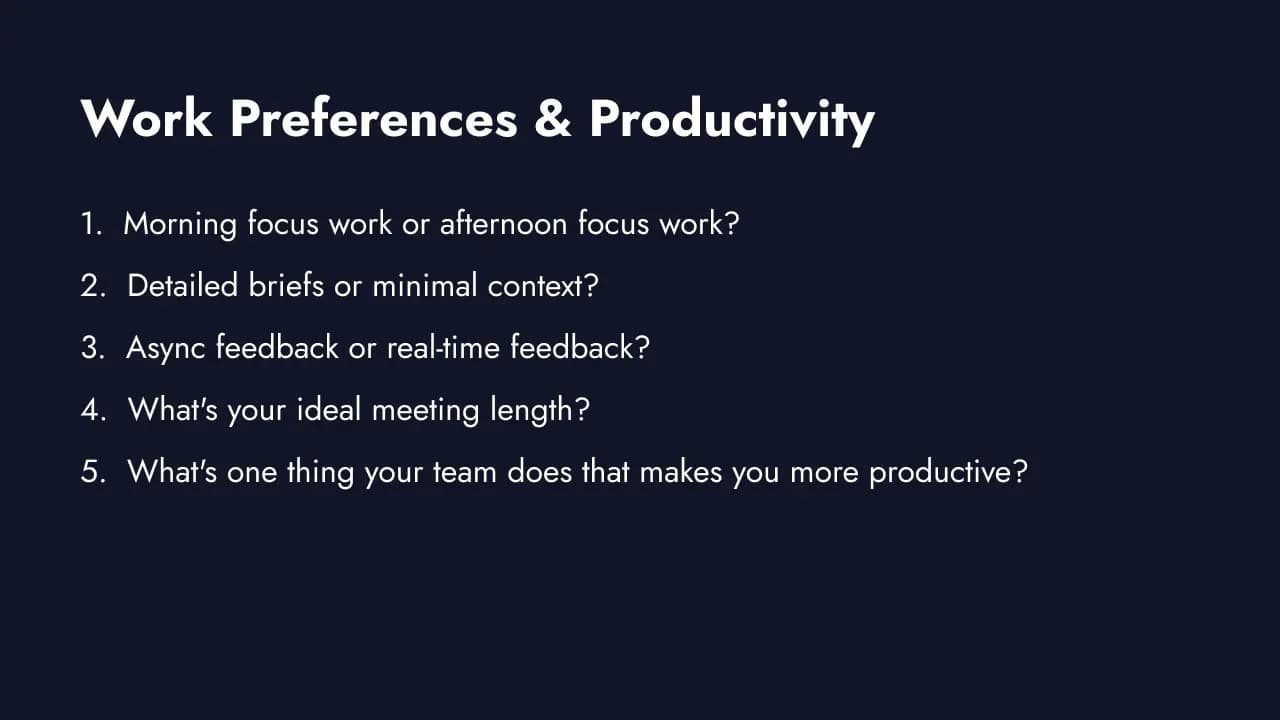
These feel light to answer but surface genuinely useful information about how your team works. Run them as a pulse alongside a regular employee pulse survey.
- What is your ideal meeting length?
- Morning focus work or afternoon focus work: which are you?
- Do you prefer detailed briefs or just enough context to get started?
- Headphones in: do not disturb, or fine to interrupt?
- Would you rather have one deep-focus day per week, or more flexible but interrupted time throughout?
- Async or real-time: what is your preference for feedback on your work?
- What time of day are you at your sharpest?
- Open calendar or protected focus blocks: how do you prefer to schedule your week?
- Do you work better with a clear deadline or an open-ended timeline?
- What is the one thing your team does that makes you more productive?
How to use them
Run five of these as a monthly Slack poll and share the aggregate results in your team channel. Over time, you build a map of how your team actually works, not how you assumed they work. Pair with your employee engagement survey questions to connect preferences to satisfaction scores.
The escalation principle: why depth matters
Aron et al. (1997) showed that connection is not about the number of questions. It is about the arc. Questions that start surface-level and gradually get more personal generate more closeness than a flat list of equally light questions (Aron et al., 1997).
The same principle works in team polls. If you run an icebreaker every week, do not recycle the same level. Build over time:
- Week 1 (easy, universal): "What is your go-to comfort food?"
- Week 2 (a bit more personal): "What is something you are proud of that has nothing to do with work?"
- Week 3 (revealing): "What is a skill you are quietly working on?"
- Week 4 (genuine): "What is one thing you wish your team knew about how you work best?"
By week four, people are giving real answers because the prior three weeks established that it is safe to do so. The escalation builds trust incrementally. That is exactly what team culture needs.
You do not need 36 questions. You just need a sequence.
When NOT to use fun poll questions
Every guide on fun questions tells you when to use them. None of them tell you when to stop.
After bad news. A fun icebreaker the week after a layoff, a missed target, or a difficult all-hands reads as tone-deaf. Acknowledge the moment first. Save the levity for when the team has processed.
Before a sensitive survey. If the next question asks about compensation, harassment, or psychological safety, a silly opener creates a jarring gear shift. Keep the tone consistent with the purpose of the survey.
When participation is mandatory. Forced fun is the opposite of fun. If people are required to answer, a quirky question stops being a warm-up and starts being an obligation.
With a team that does not know each other yet. A hot take among strangers can land badly. Escalate gradually. Use light, universal questions until people have answered a few rounds, then go deeper.
When you cannot share the results. Fun questions only build connection if you close the loop. If you run a poll and never share what people said, the next round gets fewer responses. Always report back.
How to use fun survey questions effectively
Fun questions work when they are deliberate. They fail when they feel like filler.
Use one at the start, not five. A fun question is a warm-up, not the whole workout. One at the start of a survey is enough to lower friction and raise completion rates. More starts to feel like a quiz.
Match the question to the audience. A would-you-rather about commute time works for desk workers. A desert-island question works for teams that already know each other. A newsletter poll should match the publication's voice. Reuse is fine; mismatch is not.
Follow up with a real question. The point of a fun opener is not the answer, it is the momentum. Always pair a fun question with a real one the respondent can answer while they are warmed up.
Report back. Share aggregate answers in a team all-hands or newsletter. Showing that the answers get read makes the next round of fun questions more engaging.
Respect the tone of the topic. Do not open an exit survey with a silly hypothetical. Do not put a would-you-rather before a compensation question. Match the tone of the opener to the purpose of the survey.
For a broader library of survey question formats, see our survey questions examples guide.
Best practices and common mistakes
Include everyone. Avoid questions that reference alcohol, gambling, religion, politics, or family structures that assume everyone has kids, partners, or living parents. Inclusion is a design criterion, not an afterthought.
Keep it fast. Fun questions should take 10 seconds to answer. If respondents need to think for a minute, the question is too heavy.
Skip inside jokes. A reference that only half the audience understands excludes the other half. Test every question on someone outside your immediate circle.
Do not overdo it. A survey that is all fun is not a survey; it is a BuzzFeed quiz. Fun is a warm-up, not the main course.
Avoid gendered assumptions. "What beer are you drinking?" excludes a lot of people. "What is your favorite evening wind-down?" does not.
Test one on yourself first. Before launching, answer your own question and see if it feels safe. If it makes you uncomfortable, it will make respondents uncomfortable.
Read the room. After a tough week, a silly question can feel tone-deaf. Check the mood before you open with levity.
See our guide on increasing survey response rates for the broader playbook on making surveys feel worth answering.
Free Formbricks survey template
Skip the blank page. Formbricks is an open-source experience management platform with free survey templates you can deploy in minutes. Plug any of the 100 questions above into a one-minute template and share it with your team, newsletter list, or event audience.
Why Formbricks for fun survey questions:
- Open source and self-hostable. Your data stays on your infrastructure. No third-party access, no data sharing. This matters even for light surveys because respondents trust channels that respect their privacy.
- Drag-and-drop survey builder. Launch a poll in under 5 minutes with no engineering help. Start from the survey templates library or build from scratch.
- Flexible distribution. Deploy via link, email, in-app widget, or website embed. Reach teammates, subscribers, event attendees, or students with the same tool.
- Free tier. Start collecting responses without a credit card.
How to get started:
- Sign up at formbricks.com
- Start from a blank survey or pick a template
- Plug in questions from this guide
- Share the link in Slack, a newsletter, or on event signage
- Watch responses come in
Start your fun survey with Formbricks →
Frequently asked questions
Try Formbricks now