

65+ Employee Pulse Survey Questions by Category (2026)

Johannes
CEO & Co-Founder
12 Minutes
May 3rd, 2026
A Journal of Applied Psychology meta-analysis by Harter, Schmidt & Hayes (2002) covering 7,939 business units found that employee engagement is significantly linked to lower turnover, higher productivity, and stronger business performance. Annual engagement surveys measure that picture once a year. Pulse surveys track it in real time. The problem is that most pulse programs collapse within 12 months because HR teams slowly grow the question list until the "quick check-in" becomes a 15-minute survey. This guide shows you how to build one that lasts.
We cover what a pulse survey is, the 3 types and when to use each, the right cadence, the rotating question model that keeps pulses short without sacrificing coverage, and 65+ ready-to-use questions organized across every engagement driver. Every recommendation is built for sustainability over 12 to 24 months, not just the first three pulses.
What you will find in this guide:
- What an employee pulse survey is and how it differs from an engagement survey
- The 3 types of pulse surveys and when to use each
- The right cadence: weekly vs biweekly vs monthly
- The rotating question model that sustains pulses long term
- 65+ pulse questions organized by theme and rotation slot
- Fun pulse check questions for culture and morale
- Best practices for anonymity, length, and action
- Common mistakes that kill pulse programs
- Free Formbricks pulse survey template
What is an employee pulse survey
An employee pulse survey is a short, high-frequency survey that tracks a small set of engagement indicators over time. It complements (rather than replaces) a longer annual or semi-annual engagement survey.
The defining characteristics:
- Short. 3 to 5 questions. Completion in under 2 minutes.
- Frequent. Weekly, biweekly, or monthly. Frequent enough to catch trends; infrequent enough to avoid fatigue.
- Anonymous. By default. Anonymity is what makes high-frequency honest answers possible.
- Focused. Each pulse targets 2 or 3 specific topics, not a broad engagement scan.
- Actionable. Every pulse produces data that the team can act on within the next pulse cycle.
What a pulse survey is not:
- An engagement survey. Engagement surveys are long (25 to 40 questions), run once or twice a year, and produce a broad baseline across all drivers.
- A poll. A poll asks one question with no context. A pulse is a structured measurement with at least one consistent core item for trend tracking.
- A form of continuous monitoring without action. Pulses that collect data but produce no visible change kill their own response rates.
For the broader engagement framework, see our employee engagement survey questions guide. For the full set of annual survey questions, see our employee survey questions guide.
Pulse vs annual engagement survey
Both matter. They serve different purposes.
| Dimension | Pulse survey | Annual engagement survey |
|---|---|---|
| Length | 3-5 questions | 25-40 questions |
| Frequency | Monthly or biweekly | Annual or semi-annual |
| Goal | Trend tracking, early signal | Broad baseline, driver analysis |
| Time to complete | Under 2 minutes | 10-15 minutes |
| Anonymity | Essential | Essential |
| Output | Time series on core items | Full driver scorecard |
| Best action horizon | One pulse cycle | Annual action plan |
A healthy program runs both: the annual survey sets the baseline and priorities, and the pulse tracks whether things are getting better or worse month over month.
The 3 types of pulse surveys
Not all pulses serve the same purpose. Choosing the wrong type for your situation is a major reason pulse programs produce data that no one acts on. There are three distinct types, each with a different objective, cadence, and question design.
| Type | Objective | Best cadence | Who receives it |
|---|---|---|---|
| Monitoring | Regular temperature checks on engagement or eNPS | Weekly, monthly, or quarterly | Entire organization or random samples |
| Discovering | Deep dives into a specific issue or driver | Ad-hoc, time-bounded | Targeted group or "hotspot" teams |
| Responding | Gauging reactions to a planned event or unplanned crisis | Just-in-time | Affected groups or entire org |
Monitoring pulses are the baseline. They track 2 to 3 core engagement indicators on a fixed schedule. Their value builds over months and quarters as trend lines emerge. Most of the questions in this guide are designed for monitoring pulses.
Discovering pulses run when monitoring data surfaces a problem but does not explain it. If eNPS drops three months in a row, a discovering pulse targets that group with deeper questions about specific drivers: manager effectiveness, workload, recognition, or compensation. These pulses are not recurring; they run until the issue is understood.
Responding pulses deploy fast. A merger announcement, a senior leader departure, a return-to-office policy change: these events shift employee sentiment quickly, and a single question deployed within 48 hours gives leadership actionable real-time data. Responding pulses are often just 1 to 2 questions.
Defining the type before designing the pulse determines everything else: length, cadence, audience, and the expected action.
Pulse frequency: what cadence to choose
The cadence question determines whether your pulse program will survive its first year.
Monthly (the default). Fits almost every team. Enough signal to catch trends, not so much burden that fatigue kicks in. Start here unless you have a specific reason not to.
Biweekly. Works when a team is actively diagnosing a specific issue and needs tighter resolution. Rarely sustainable long term.
Quarterly. Works for large organizations or teams that already run engagement surveys often. Lower resolution, but almost no fatigue risk.
Weekly. Rarely the right answer. Weekly pulses suffer from diminishing marginal signal (most items do not move week over week) and high fatigue. Response rates typically collapse within 6 to 8 weeks.
How to decide:
- Start monthly.
- If a specific issue needs faster signal, temporarily move that team to biweekly for 6 to 12 weeks, then return to monthly.
- Never default to weekly without a clear, time-bounded reason.
The rotating question model
The biggest sustainability problem in pulse programs is question bloat. Krosnick (1999) in the Annual Review of Psychology documented satisficing: the behavior where respondents put minimal effort into survey answers when surveys feel too long or too frequent. The rotating question model directly counters this by keeping every pulse short while covering all engagement drivers over time.
How it works:
- Keep 1 or 2 core items constant every pulse. These are the trend items you plot over time.
- Rotate 2 or 3 items across cycles, drawing from a pool covering engagement drivers, wellbeing, manager, inclusion, compensation, change, and open feedback.
- Each theme surfaces every 3 to 4 months. Over a year, you cover all drivers without ever running a long pulse.
Core items we recommend keeping constant:
- eNPS. "How likely are you to recommend [company] as a place to work?" (0 to 10)
- Overall satisfaction. "How satisfied are you with your current work situation?" (1 to 5)
Everything else rotates. Here is a sample 6-month rotation plan:
| Month | Core items | Rotating focus |
|---|---|---|
| Jan | eNPS + overall sat | Engagement drivers |
| Feb | eNPS + overall sat | Wellbeing |
| Mar | eNPS + overall sat | Manager effectiveness |
| Apr | eNPS + overall sat | Inclusion and belonging |
| May | eNPS + overall sat | Growth and development |
| Jun | eNPS + overall sat | Compensation and benefits |
| Jul | eNPS + overall sat | Engagement drivers (repeat) |
Every pulse stays at 3 to 5 questions. Every theme comes back every 6 months. Fatigue is minimized; coverage is maximized.
65+ employee pulse survey questions
Each question is tagged with theme and priority (Essential, Recommended, Nice-to-have).
Core items (every pulse, questions 1-3)
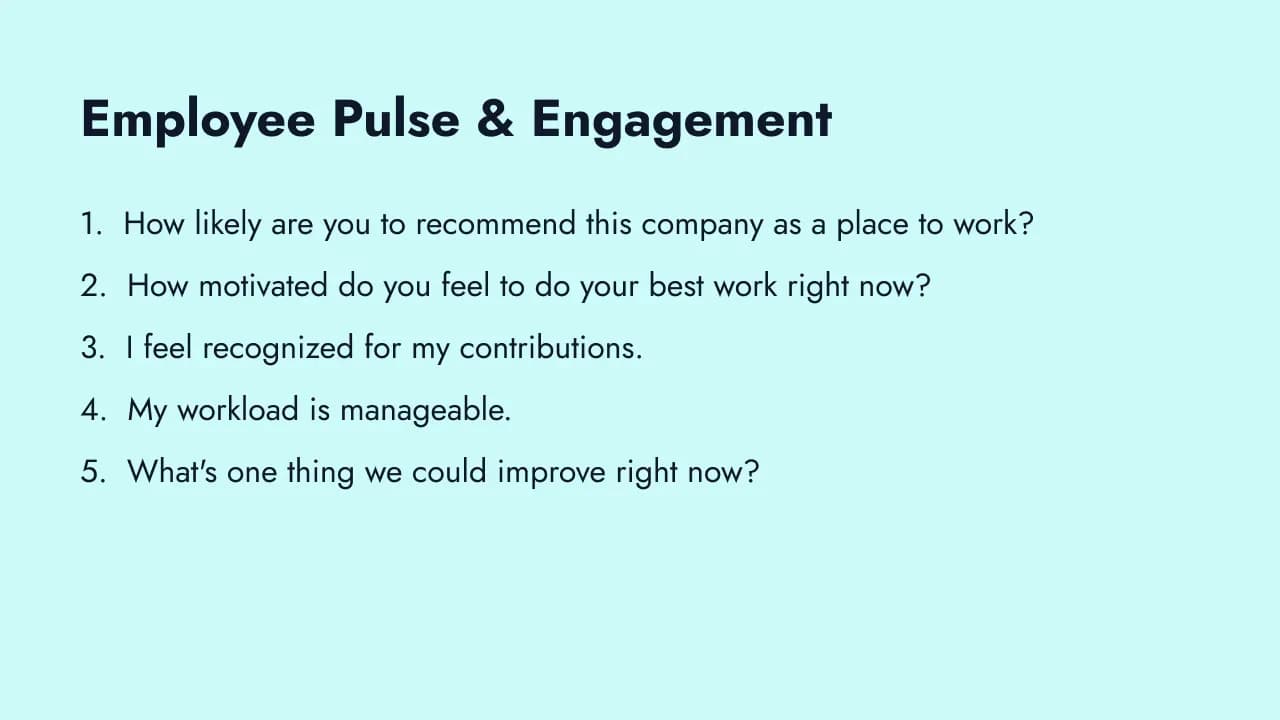
Keep these constant. They produce your trend data.
1. How likely are you to recommend [company] as a place to work? (eNPS)
- Type: Rating (0-10) | Essential
- The single most benchmarkable pulse item. Track the trend line, not just the absolute number. Use the NPS® calculator to score each cycle.
2. How satisfied are you with your current work situation?
- Type: Likert (1-5) | Essential
- Top-line satisfaction signal. Cross-reference with eNPS to separate structural dissatisfaction (both low) from role-specific frustration (eNPS high, satisfaction low).
3. How motivated do you feel to do your best work right now?
- Type: Likert (1-5) | Essential
- Alternate core item if you prefer a motivation proxy over a general satisfaction item. Motivation measures discretionary effort more directly than satisfaction does.
Rotating: engagement drivers (questions 4-10)
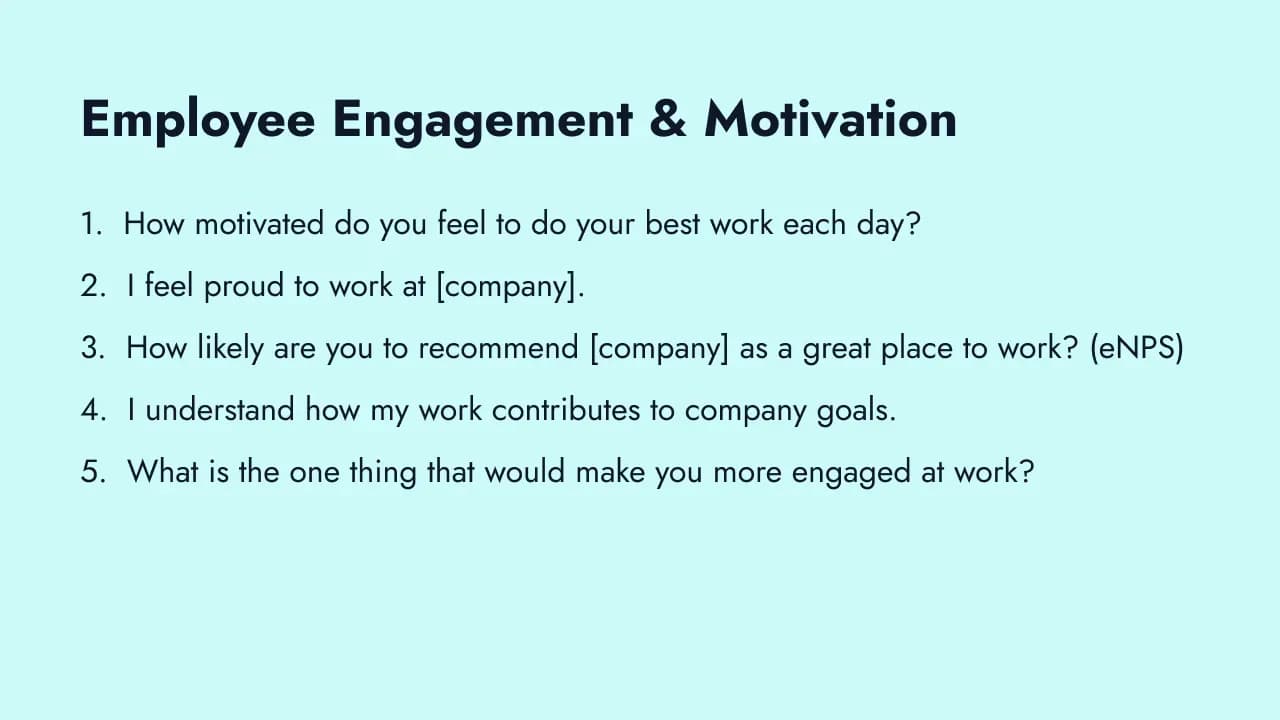
Use once every 3 to 4 months.
4. I feel proud to work at [company].
- Type: Likert (1-5) | Essential
- Organizational pride is a leading indicator of advocacy and retention. When pride drops, external employer brand usually follows.
5. I have the opportunity to do what I do best every day.
- Type: Likert (1-5) | Essential
- Strength-role fit predicts sustained motivation. Low scores here often point to role design problems rather than individual performance issues.
6. I feel my opinions count at work.
- Type: Likert (1-5) | Essential
- Perceived voice in decisions is one of the strongest predictors of belonging and commitment, independent of whether those opinions actually change outcomes.
7. I understand how my work contributes to company goals.
- Type: Likert (1-5) | Recommended
- Line-of-sight to impact. When employees cannot connect their tasks to outcomes, motivation drops even when conditions are otherwise good.
8. I feel recognized for my contributions.
- Type: Likert (1-5) | Essential
- Rhoades & Eisenberger (2002) found in a meta-analysis of 73 studies that perceived organizational support, including recognition, is significantly associated with lower turnover intent and higher commitment. Recognition is not just a nicety; it is a structural driver of retention.
9. I have a clear understanding of what is expected of me.
- Type: Likert (1-5) | Recommended
- Clarity of expectations is the most basic engagement condition. When this score drops, almost every other driver follows.
10. What is one thing that would make you more engaged at work right now?
- Type: Open-ended | Essential
- The "one thing" constraint forces prioritization. Aggregate responses by theme across 3 to 4 pulses to identify the most persistent engagement barriers.
Rotating: wellbeing and workload (questions 11-17)
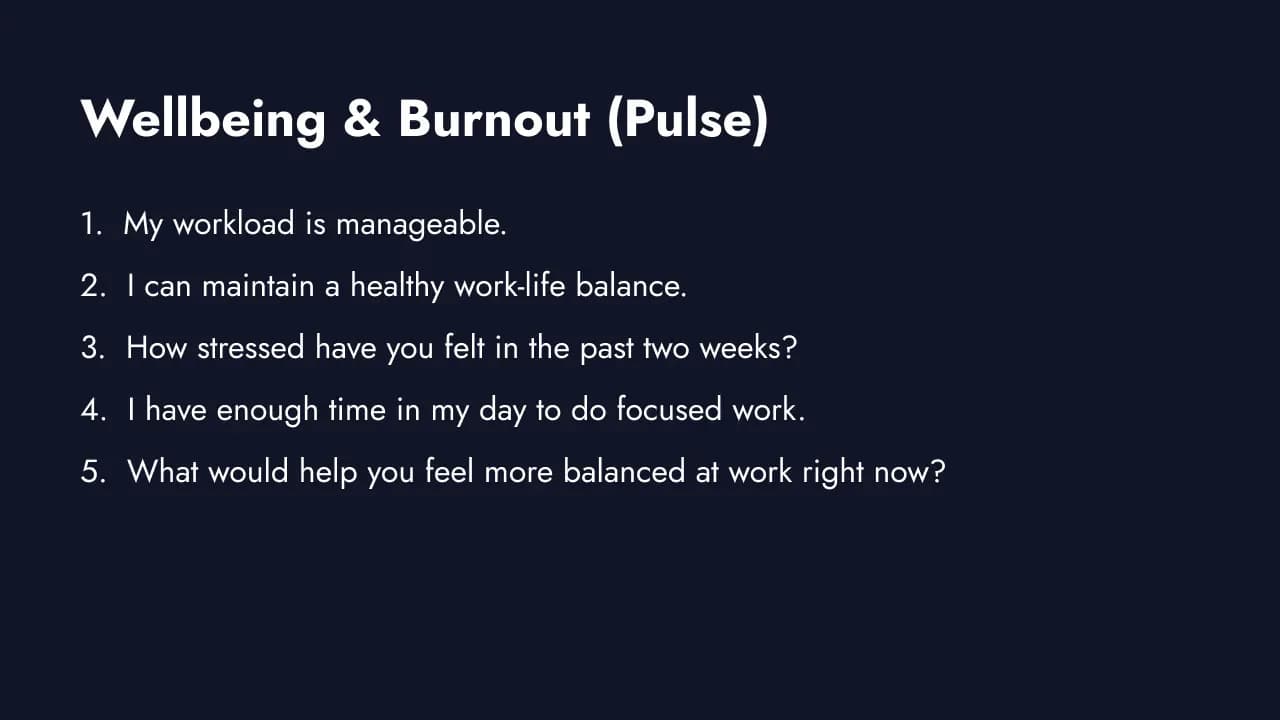
11. My workload is manageable.
- Type: Likert (1-5) | Essential
- Chronic overwork is a leading predictor of burnout and turnover. Consistently low scores in specific teams often indicate understaffing or process inefficiency rather than individual performance issues.
12. I can maintain a healthy work-life balance.
- Type: Likert (1-5) | Essential
- Oswald, Proto & Sgroi (2015) in the Journal of Labor Economics found that higher subjective wellbeing produces roughly 12% higher productivity in controlled experiments. Workload and balance questions are not soft measures; they predict output.
13. How stressed have you felt in the past two weeks?
- Type: Likert (1-5) | Essential
- Direct stress check. A two-week reference window captures recent experience rather than asking employees to summarize an abstracted "general" stress level.
14. I feel supported when I am struggling at work.
- Type: Likert (1-5) | Recommended
- Perceived support is one of the three drivers in Deci & Ryan's (2000) Self-Determination Theory. Organizations that score low here see lower intrinsic motivation even when work conditions are otherwise adequate.
15. I have enough time in my day to do focused work.
- Type: Likert (1-5) | Recommended
- Meeting overload and constant context switching are primary complaints in hybrid and remote work environments. This question surfaces that friction specifically.
16. I am able to take breaks during the workday without guilt.
- Type: Likert (1-5) | Nice-to-have
- Guilt around breaks indicates a performance culture that penalizes recovery. Long-term, this pattern is associated with higher burnout rates and lower creative output.
17. What would help you feel more balanced at work right now?
- Type: Open-ended | Recommended
- Open-ended wellbeing question. Look for actionable patterns: meeting reduction, schedule flexibility, resource gaps.
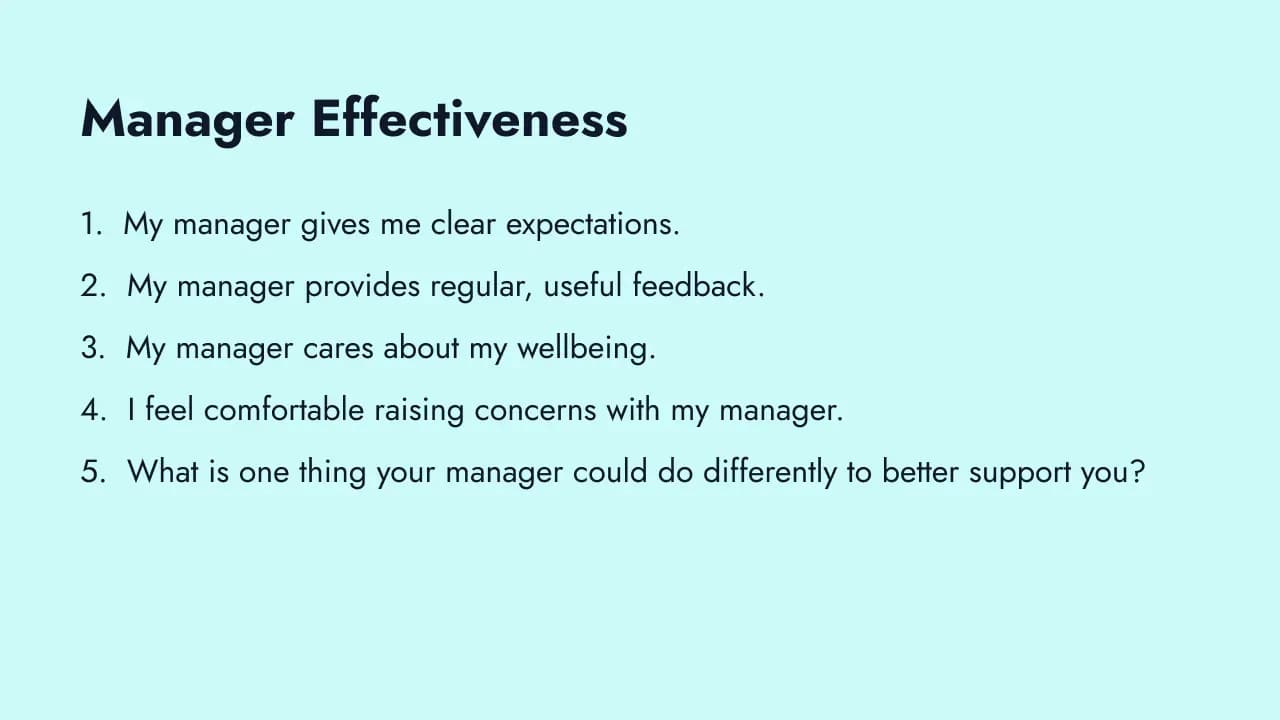
Rotating: manager effectiveness (questions 18-24)
Manager quality is the most influential variable in employee engagement at the team level. Harter, Schmidt & Hayes (2002) found that manager-level conditions, including clear expectations and regular feedback, explained a significant share of business unit performance variance across nearly 8,000 teams.
18. My manager gives me clear expectations.
- Type: Likert (1-5) | Essential
- Clarity is the foundation of effective management. Ambiguous expectations produce anxiety, avoidable errors, and disengagement.
19. My manager provides regular, useful feedback.
- Type: Likert (1-5) | Essential
- Kluger & DeNisi (1996) in a Psychological Bulletin meta-analysis of 607 effect sizes found that feedback interventions significantly improve performance when frequent and specific.
20. My manager cares about my wellbeing.
- Type: Likert (1-5) | Essential
- Wellbeing concern separates managers from people managers. This question has become a stronger predictor of retention than compensation in many industries since 2020.
21. I feel comfortable raising concerns with my manager.
- Type: Likert (1-5) | Essential
- Measures psychological safety at the team level. Low scores indicate a fear-based dynamic where problems go unreported until they become crises.
22. My manager supports my professional growth.
- Type: Likert (1-5) | Recommended
- Growth support signals investment in the employee's future. Low scores correlate with high turnover among high performers.
23. My manager helps me prioritize my work.
- Type: Likert (1-5) | Recommended
- Prioritization support is distinct from clarity of expectations. A manager can be clear about what the job is while still failing to help employees navigate competing demands.
24. What is one thing your manager could do differently to better support you?
- Type: Open-ended | Essential
- This question requires anonymity to produce honest answers. Even a small number of consistent responses here can surface specific, actionable coaching opportunities.
Rotating: inclusion and belonging (questions 25-31)
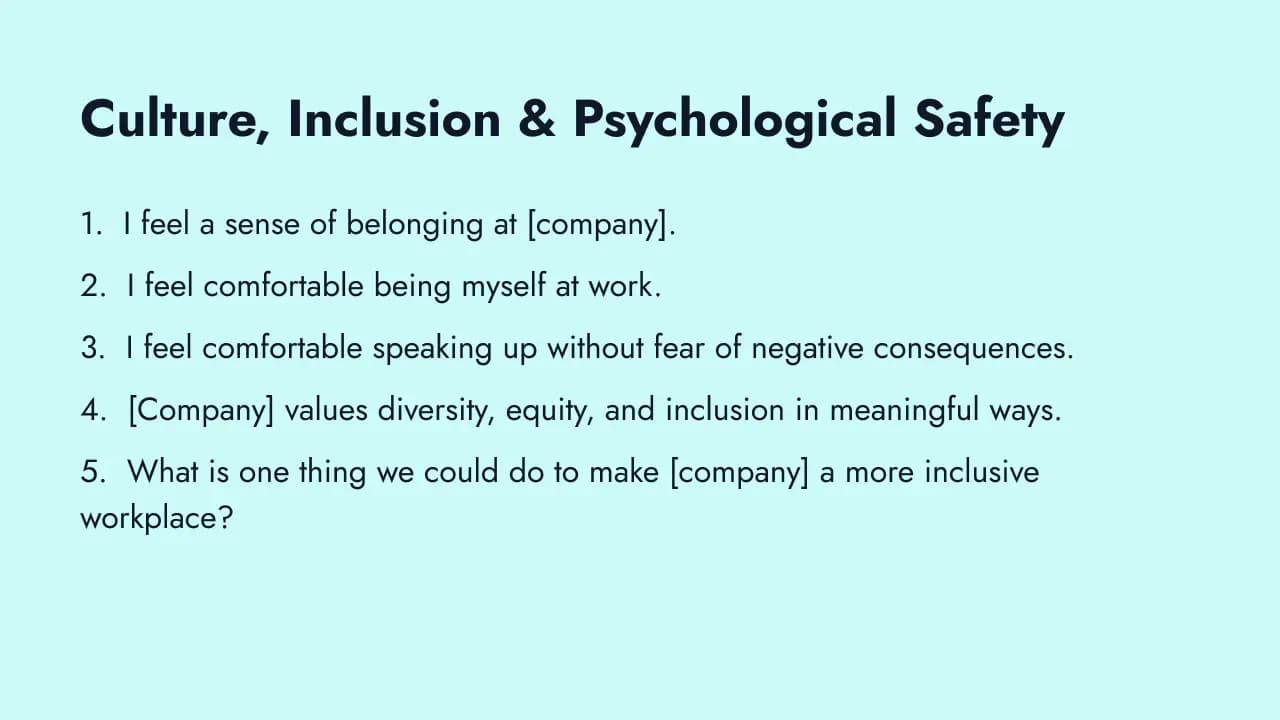
25. I feel a sense of belonging at [company].
- Type: Likert (1-5) | Essential
- Baumeister & Leary (1995) described the need to belong as a fundamental human motivation whose deprivation predicts a range of negative outcomes. This question is not aspirational; it measures a basic psychological condition.
26. I feel comfortable being myself at work.
- Type: Likert (1-5) | Essential
- Covers psychological safety at the identity level. Employees who mask identity at work show consistently lower engagement and higher turnover intent.
27. I feel comfortable speaking up with ideas or concerns.
- Type: Likert (1-5) | Essential
- Voice. Employees who do not feel safe speaking up do not just disengage; they withhold information that organizations need to avoid costly mistakes.
28. [Company] values diversity, equity, and inclusion in meaningful ways.
- Type: Likert (1-5) | Recommended
- This question tests whether DEI commitments feel genuine or performative. Gap between stated values and lived experience is common; this question tracks it.
29. I see myself represented in leadership.
- Type: Likert (1-5) | Nice-to-have
- Representation visibility matters most for underrepresented groups. Segment this item by demographic data when possible.
30. I feel safe raising concerns about inclusion.
- Type: Likert (1-5) | Recommended
- Separates safety from belonging. An employee can feel they belong to the current team while still feeling unsafe raising DEI concerns upward.
31. What is one thing we could do to make our culture more inclusive?
- Type: Open-ended | Recommended
- Single most important open-ended inclusion question. Do not skip the follow-through: employees remember when they raised inclusion concerns that were never acknowledged.
Rotating: growth and development (questions 32-36)
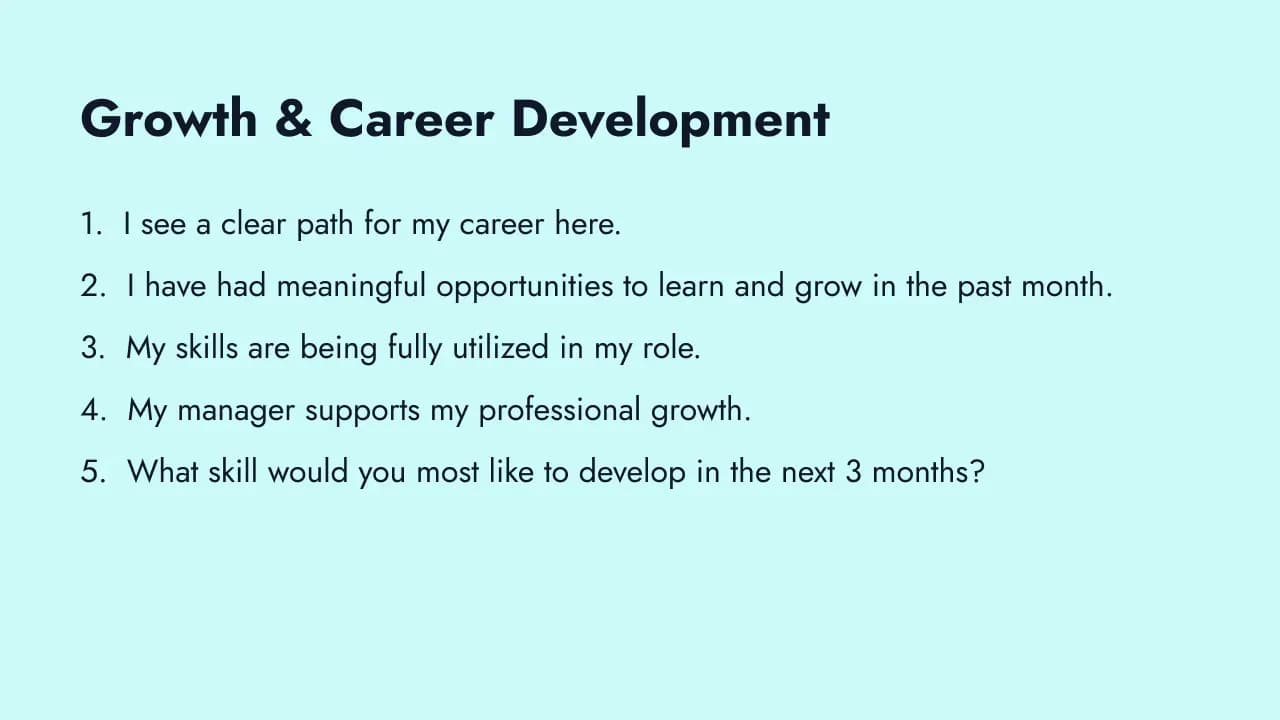
32. I have had meaningful opportunities to learn and grow in the past month.
- Type: Likert (1-5) | Essential
- Monthly framing captures recent experience rather than a general impression, which makes the data more actionable and harder to dismiss.
33. I see a clear path for my career here.
- Type: Likert (1-5) | Essential
- Career path clarity is the retention predictor across all levels. When employees cannot see their next step, they start looking externally.
34. My skills are being fully utilized in my role.
- Type: Likert (1-5) | Recommended
- Underutilization is one of the least-discussed engagement killers. High performers who are bored disengage faster than those who are overworked.
35. I had a meaningful development conversation with my manager in the past month.
- Type: Binary (Yes/No) | Recommended
- Factual check, not a perception question. If the majority answer No, there is a structural absence of development conversations regardless of manager intention.
36. What skill would you most like to develop in the next 3 months?
- Type: Open-ended | Recommended
- Surfaces specific development priorities across the team. Aggregate to inform L&D investment decisions.
Rotating: compensation and benefits (questions 37-41)
Compensation perception is one of the most underpolled topics in pulse programs. Employees rarely raise it directly, but dissatisfaction compounds silently. Pulse surveys give anonymity that makes honest feedback possible.
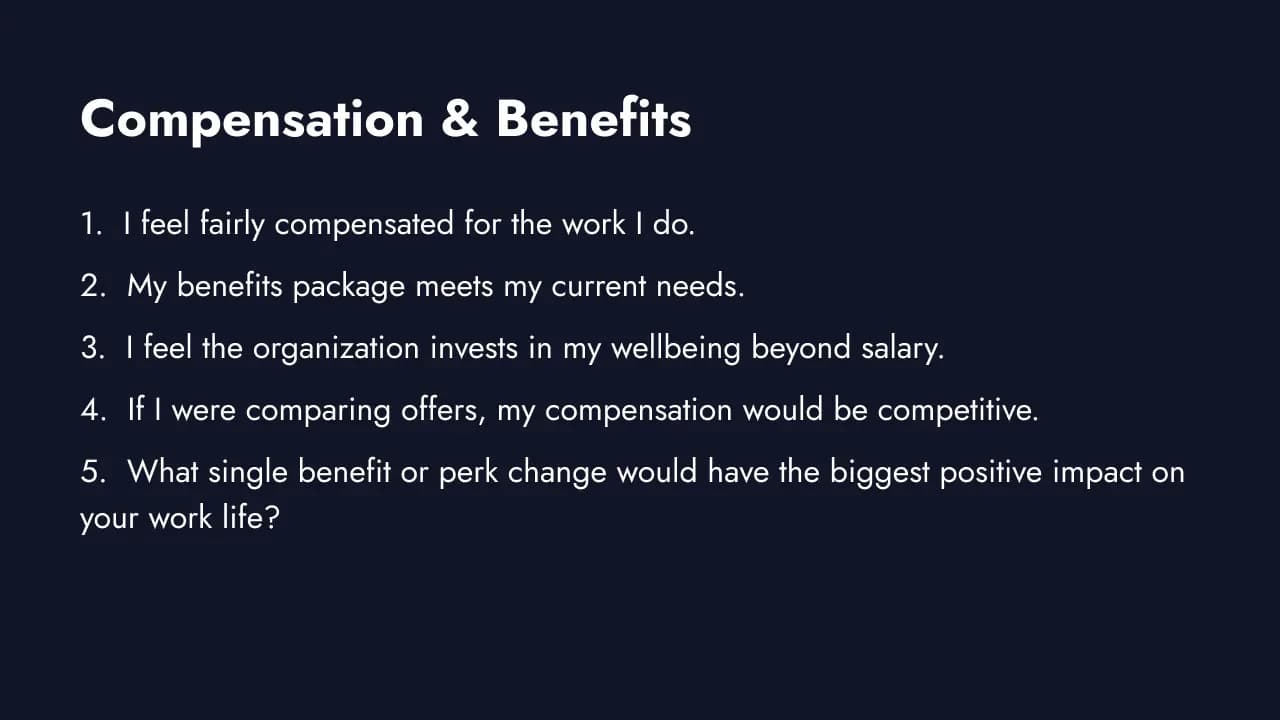
37. I feel fairly compensated for the work I do.
- Type: Likert (1-5) | Essential
- Pay fairness perception, not absolute salary. Research consistently shows that perceived fairness matters more than actual compensation level in predicting turnover intent.
38. My benefits package meets my current needs.
- Type: Likert (1-5) | Recommended
- Benefits needs shift over time with life stage. This question surfaces misalignment between the benefits offered and what employees actually need right now.
39. I feel the organization invests in my wellbeing beyond salary.
- Type: Likert (1-5) | Recommended
- Captures whether non-cash investment in wellbeing (mental health support, flexibility, development budgets) registers with employees.
40. If I were comparing offers, my compensation would be competitive.
- Type: Likert (1-5) | Nice-to-have
- This framing gets at retention risk more directly than asking about satisfaction. Low scores here are a leading indicator of active job searching.
41. What single benefit or perk change would have the biggest positive impact on your work life?
- Type: Open-ended | Recommended
- Prioritization question for benefits strategy. One common theme here is worth more than a full compensation benchmarking study.
Rotating: change management (questions 42-47)
Deploy this rotation immediately after a major announcement, a restructure, a policy change, or a technology rollout. For ongoing change, run it once per quarter.
42. I understand the reasons behind recent changes at [company].
- Type: Likert (1-5) | Essential
- Clarity of rationale is the single most important variable in whether employees accept or resist change. Low scores here predict active disengagement, rumour spread, and informal resistance.
43. I feel the organization communicated recent changes clearly and in advance.
- Type: Likert (1-5) | Essential
- Timing perception. Employees who feel surprised by change, even if the change is reasonable, show lower confidence in leadership than employees who felt prepared.
44. I feel supported in adapting to recent changes.
- Type: Likert (1-5) | Recommended
- Covers training, tools, and manager support. Change adoption fails most often not because employees object, but because they lack resources to adapt.
45. I am confident in leadership's ability to navigate this change well.
- Type: Likert (1-5) | Essential
- Change confidence is distinct from change acceptance. An employee can accept that a change is necessary while still doubting leadership's ability to execute it.
46. Recent changes have had a positive impact on how I work.
- Type: Likert (1-5) | Recommended
- Outcome question for post-change pulses. Run 60 to 90 days after the change to measure actual impact versus initial reaction.
47. What concern about this change has not been addressed yet?
- Type: Open-ended | Essential
- The most important open-ended question in any change management pulse. Do not skip it. Surface unresolved concerns before they become rumours.
Rotating: remote and hybrid work (questions 48-53)
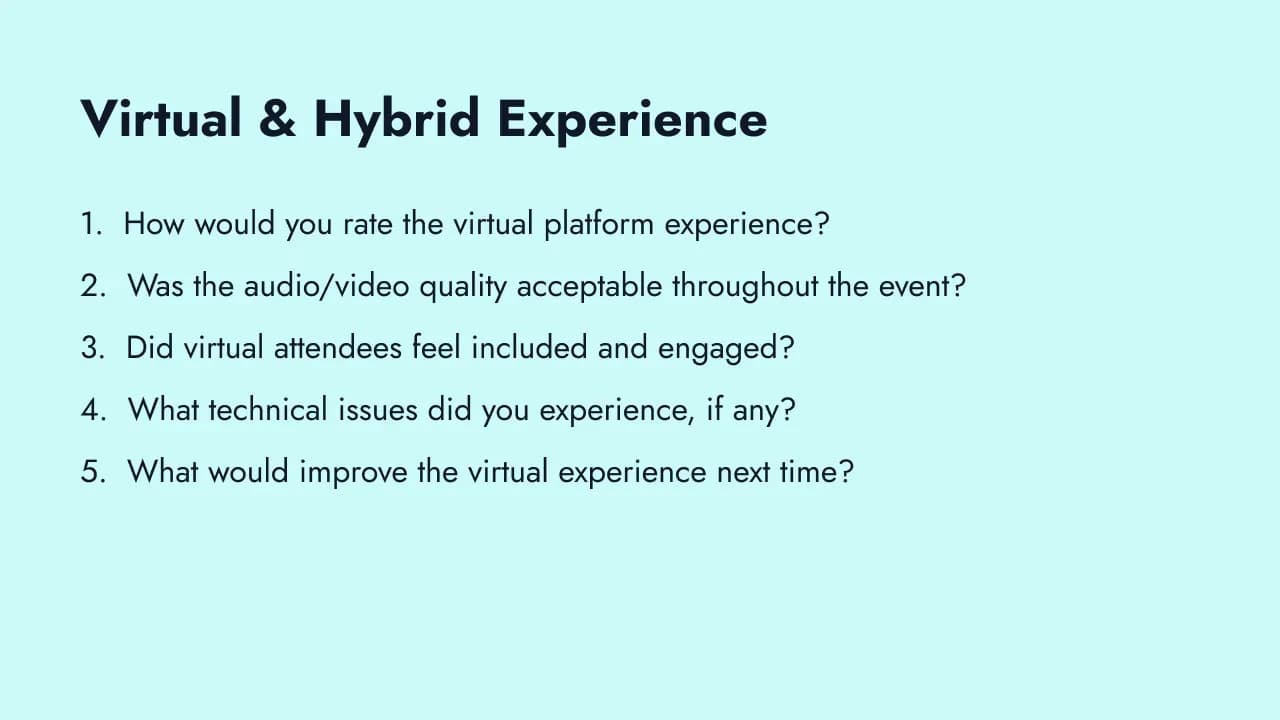
48. I feel connected to my team regardless of where I work.
- Type: Likert (1-5) | Essential
- Connection is the primary risk in distributed work. Employees can have excellent tools and still feel isolated.
49. I have the tools I need to collaborate effectively in our current work model.
- Type: Likert (1-5) | Essential
- Infrastructure check. Low scores here are directly fixable, which makes them high-priority items.
50. My current work arrangement supports my productivity.
- Type: Likert (1-5) | Recommended
- Does not presuppose what the "best" arrangement is. Employees in different roles have genuinely different needs.
51. I feel equally included in decisions whether I am remote or in office.
- Type: Likert (1-5) | Recommended
- Proximity bias is one of the most common failure modes in hybrid work. This question specifically tracks whether remote employees feel penalized relative to in-office peers.
52. Meetings I attend are necessary and well run.
- Type: Likert (1-5) | Recommended
- Meeting overload is the primary productivity complaint in hybrid environments. Low scores here warrant a specific meeting audit.
53. What would improve your remote or hybrid work experience the most right now?
- Type: Open-ended | Recommended
- Surfaces practical, often low-cost improvements: async norms, documentation quality, meeting structure, or communication channel clarity.
Fun pulse check questions (questions 54-60)
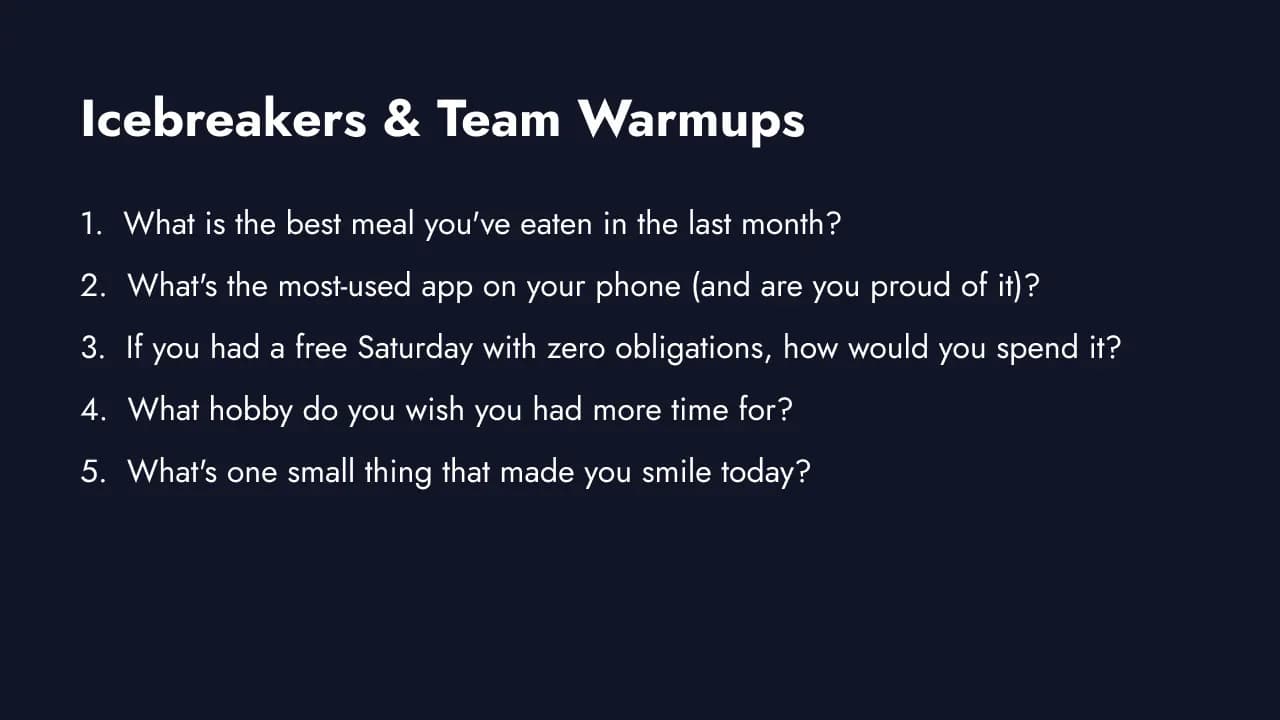
These questions measure morale and energy without the weight of formal engagement metrics. Use them sparingly, once every 3 to 4 months as a rotating addition to the standard pulse. They produce genuine signal that heavily clinical questions sometimes miss, and they signal to employees that the organization has a human perspective on the experience at work. Oswald, Proto & Sgroi (2015) demonstrated that positive affect and morale predict measurable productivity gains, not just job satisfaction scores.
54. On a scale of 1-5, how would you rate your energy level at work this week?
- Type: Likert (1-5) | Recommended
- Energy is a more immediate signal than engagement. A sudden drop in average energy across the team often precedes burnout indicators by 4 to 6 weeks.
55. On a scale of 1-5, how optimistic are you about the company's direction over the next quarter?
- Type: Likert (1-5) | Recommended
- Forward-looking morale indicator. Useful before and after strategic announcements to test whether the direction landed.
56. How fun is your team to work with right now? (1 = not at all, 5 = a lot)
- Type: Likert (1-5) | Nice-to-have
- Team enjoyment is a distinct dimension from belonging. People can belong without enjoying the group dynamics. Low scores here often point to interpersonal friction or conflict that formal questions do not surface.
57. What is one thing you are proud of from this month?
- Type: Open-ended | Recommended
- Inverts the usual deficit framing. Reading through pride responses builds a picture of what employees value about their work, which is often different from what leadership assumes.
58. What is something you wish your manager knew about how you do your best work?
- Type: Open-ended | Recommended
- Gives employees a low-stakes channel to share working style preferences that rarely come up in formal settings.
59. On a scale of 1-5, how excited are you to come to work (or log on) on Monday mornings?
- Type: Likert (1-5) | Recommended
- The "Monday morning test" is a simple, honest proxy for sustained engagement. Track the trend rather than reacting to any single score.
60. If you could improve one thing about how your team works together, what would it be?
- Type: Open-ended | Nice-to-have
- Team dynamics question framed constructively. Often surfaces practical workflow fixes rather than interpersonal complaints.
Open-ended quick wins (questions 61-65)
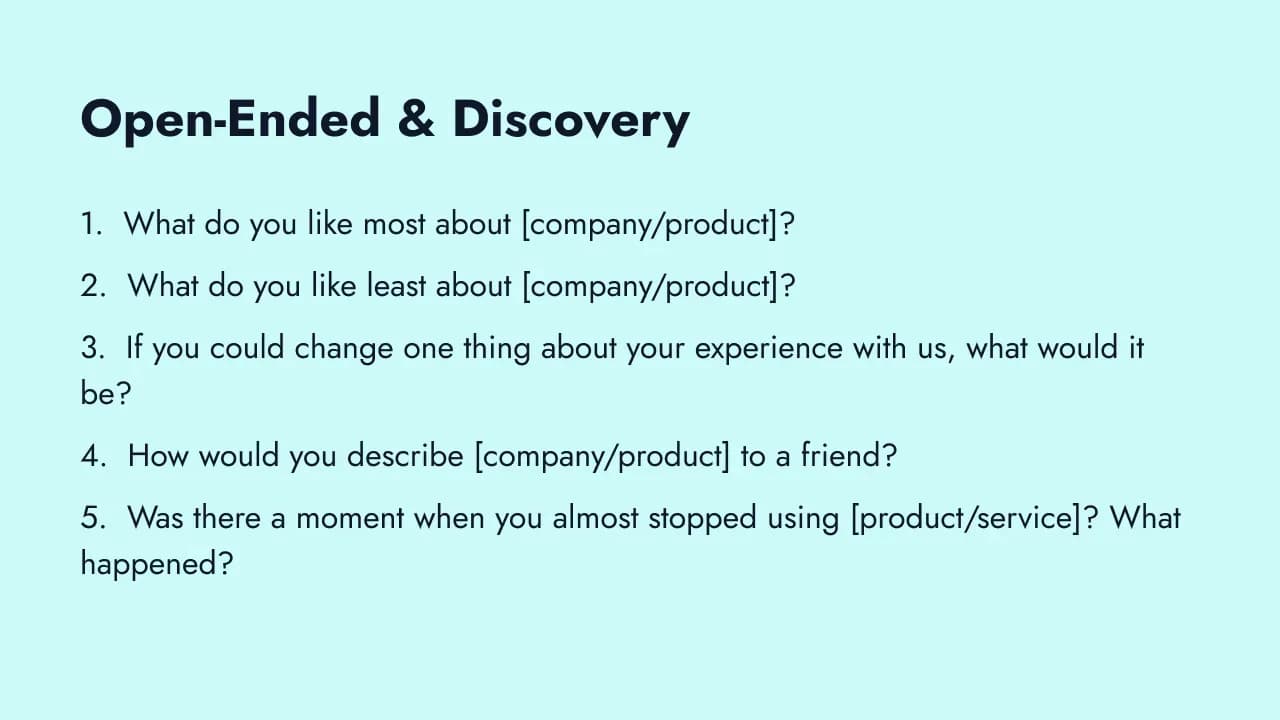
Use one per pulse as the rotating open-ended item.
61. What is one thing we are doing well right now?
- Type: Open-ended | Essential
- Reinforces what is working before the next cycle asks what needs to change. Equally important for organizational learning.
62. What is one thing we could be doing better right now?
- Type: Open-ended | Essential
- The core improvement question. Aggregate by theme across cycles to identify persistent friction points.
63. What is one decision we made recently that you support?
- Type: Open-ended | Recommended
- Surfaces positive organizational decisions that often go unacknowledged, strengthening trust in leadership over time.
64. What is one thing you wish leadership knew?
- Type: Open-ended | Essential
- The most candid question in any pulse bank. Anonymity is critical here. Common themes from this question often reveal the largest gaps between leadership perception and employee reality.
65. Is there anything else you want to share?
- Type: Open-ended | Recommended
- Catch-all closer. Often captures the most actionable feedback of any pulse, precisely because it has no constraint.
Best practices
Keep it short. 3 to 5 questions. No exceptions. Once the pulse grows, fatigue sets in and response rates collapse. Krosnick (1999) documented that respondents shift to satisficing behavior (minimal effort, random or first-option answers) when surveys feel burdensome.
Anonymize by default. Employees are more candid in anonymous channels, and anonymous pulses sustain themselves over time. Use a tool that enforces this at the platform level.
Act before the next pulse. Within two weeks of each pulse, do one visible thing based on the results. Tell employees what you did. Visible action is the single most important retention lever for pulse programs.
Rotate questions. Never run the same full survey every month. Rotate the non-core items using the rotation model above.
Trend, do not react. Do not overreact to one pulse. Trend lines over 3 to 4 pulses are where decisions live. A single low score is noise; three consecutive low scores are a signal.
Share results. Aggregate scores and a short "what we are doing about it" note after every pulse. Hidden results kill the program.
Protect sacred time. Do not run pulses the week of a major deadline, all-hands, or organizational crisis. Signal will be noise.
See our closing the feedback loop guide for the full action framework.
Common mistakes
Adding questions slowly. Death by a thousand "just one more question" additions. Every addition costs response rate.
Running pulses without action. Employees stop answering when nothing changes. Silent pulses are worse than no pulses because they actively erode trust.
Weekly pulses without a specific, time-bounded reason. Fatigue kicks in within 6 to 8 weeks. Response rates collapse faster than the insight they generate.
No anonymity. Self-censorship kills data quality. Responses on sensitive topics (manager, compensation, inclusion) become worthless without genuine anonymity.
Trending a single item that is too volatile. Pick core items that move meaningfully but not randomly. eNPS and overall satisfaction are good choices; daily mood items are too noisy.
Replacing the annual engagement survey. Pulses complement; they do not replace. An annual survey sets the diagnostic baseline. Pulses track movement within that baseline.
Ignoring segmentation. Aggregate data hides patterns. Segment by team, tenure, role, and manager. The most important signals almost always appear in the subsegments.
Free employee pulse survey template
Formbricks is an open-source experience management platform with free pulse survey templates you can deploy in minutes.
Why Formbricks for pulse surveys:
- Open source and self-hostable. Pulse data stays on your infrastructure. No third-party access, full compliance with internal data security policies.
- Anonymous by design. Anonymity enforced at the platform level, so employees trust the process.
- Automated cadence. Schedule the monthly pulse once; it runs on its own.
- Rotating question support. Set up the rotating items and let the platform cycle through them each month.
- Segmentation. Break pulse results down by team, tenure, role, and manager with granular targeting.
- Free tier. No credit card required.
How to get started:
- Sign up at formbricks.com
- Start from the pulse survey template
- Pick your core items and rotating set
- Schedule the monthly cadence
- Review results within a week of each pulse and ship one visible change
Start your employee pulse survey with Formbricks →
For related guides, see our pulse survey questions, employee survey questions, employee engagement survey questions, and employee satisfaction survey questions.
Frequently asked questions
Try Formbricks now