

50+ Employee Satisfaction Survey Questions (2026 Guide)

Johannes
CEO & Co-Founder
12 Minutes
May 2nd, 2026
Most employee satisfaction surveys ask the wrong questions in the wrong order and still wonder why scores do not move. The University of Warwick found that happy employees are 12% more productive than unhappy ones (Oswald, Proto & Sgroi, 2015), and a Journal of Applied Psychology meta-analysis covering 7,939 business units found that high-engagement teams significantly outperform low-engagement teams on productivity, profitability, customer satisfaction, and retention (Harter, Schmidt & Hayes, 2002). The gap between high- and low-performing teams is not a talent problem. It is a question design problem.
This guide gives you 50+ employee satisfaction survey questions across 10 categories, with question type recommendations and effectiveness ratings. You also get the science behind what drives satisfaction, the Q12 explained, scoring benchmarks, and a free template.
What you will find in this guide:
- 54 employee satisfaction survey questions across 10 categories
- The Herzberg two-factor model: why fixing pay alone never works
- What research says your survey must cover beyond hygiene factors
- Question type and effectiveness rating for every question
- Scoring methods, benchmarks, and analysis frameworks
- Common mistakes that destroy data quality
- A free survey template ready to deploy
What Is an Employee Satisfaction Survey?
An employee satisfaction survey measures how content employees are with specific aspects of their work experience. It covers tangible conditions like compensation, benefits, workload, physical environment, and management quality. The goal is straightforward: find out what is working, what is not, and where to invest resources for the biggest impact on retention and productivity.
Satisfaction surveys differ from engagement surveys in focus. Satisfaction asks "Are you happy with X?" while engagement asks "Are you emotionally invested in this company's success?" Both matter, but they measure different things. Harter, Schmidt, and Hayes (2002), in a meta-analysis published in the Journal of Applied Psychology, found a significant positive correlation between employee satisfaction, engagement, and business outcomes including productivity, profitability, customer loyalty, and turnover.
Organizations that regularly measure satisfaction catch problems early. A drop in scores for a specific team is an early warning signal, often appearing 6-12 months before an actual turnover spike. Without this data, leaders rely on exit interviews, which only capture the perspective of people who already decided to leave.
Satisfaction surveys fit into a broader employee feedback ecosystem. Onboarding surveys capture the new hire experience. Pulse surveys track sentiment monthly. Exit surveys explain why people leave. The satisfaction survey ties it all together by measuring ongoing contentment with the conditions that determine whether people stay.
Employee Satisfaction vs. Employee Engagement
These terms are used interchangeably, but they measure different things. Understanding the distinction determines what actions you take.
| Dimension | Satisfaction | Engagement |
|---|---|---|
| What it measures | Contentment with work conditions | Emotional commitment and motivation |
| Core question | "Are you happy here?" | "Do you care about this company's success?" |
| Drivers | Pay, benefits, environment, workload, management | Purpose, autonomy, growth, recognition, connection |
| Predictive power | Predicts complaints and dissatisfaction | Predicts retention, performance, and advocacy |
| Example | "I am fairly compensated for my work" | "I am willing to go above and beyond for this company" |
| Risk when low | Increased complaints, absenteeism | Quiet quitting, turnover, productivity decline |
An employee can be satisfied but not engaged. They show up, do what is asked, collect their paycheck, and go home. They are not unhappy, but they are not invested either. This is often called "quiet quitting."
An employee can be engaged but not satisfied. They care deeply about the mission but are frustrated by low pay, poor tools, or bad management. This is a retention problem because they will eventually find somewhere that values their commitment.
The strongest workplaces score high on both. Your survey strategy should measure both dimensions with different instruments. The employee engagement survey questions guide covers the engagement side in detail.
The Science Behind Job Satisfaction: Herzberg's Two-Factor Model
Most HR teams design satisfaction surveys that only measure hygiene factors: pay, benefits, working conditions, company policy. Then they wonder why improvements to those factors do not produce lasting satisfaction gains.
Frederick Herzberg, Bernard Mausner, and Barbara Snyderman's foundational research (The Motivation to Work, 1959) explains why. They identified two distinct categories of workplace factors:
Hygiene factors (when absent, they cause dissatisfaction; when present, they only prevent dissatisfaction, they do not create it):
- Salary and compensation
- Job security
- Physical working conditions
- Company policies and administration
- Relationship with direct manager
- Status
Motivators (actively create satisfaction and drive performance):
- Achievement and accomplishment
- Recognition for that achievement
- The work itself (is it interesting, meaningful?)
- Responsibility and autonomy
- Advancement opportunities
- Personal growth
The practical implication: if your survey only asks about hygiene factors and you spend the next year improving compensation and office conditions, you will reduce dissatisfaction, but you will not meaningfully increase satisfaction. For that, you need to measure motivators.
Hackman and Oldham's Job Characteristics Model (Organizational Behavior and Human Performance, 1976) builds on this with five specific work design dimensions that predict satisfaction and motivation:
| Dimension | What It Means | Survey Question Angle |
|---|---|---|
| Skill variety | Job requires diverse abilities | "Does your role challenge you in different ways?" |
| Task identity | Completing a whole, identifiable piece of work | "Do you see the direct result of your work?" |
| Task significance | Job impacts others' lives | "Do you feel your work matters?" |
| Autonomy | Freedom in how work is done | "Do you have enough independence to do your job well?" |
| Feedback | Clear information about performance | "Do you know how well you are doing in your role?" |
Your survey should cover both hygiene factors (to detect problems) and motivators (to understand what drives your best people). The question categories below are organized accordingly.
What Research Says Your Survey Must Cover
Herzberg's two-factor model identifies what prevents dissatisfaction (hygiene factors) but does not explain what creates satisfaction. For that, you need to cover both categories in your survey.
Harter, Schmidt & Hayes (2002), in a Journal of Applied Psychology meta-analysis of 7,939 business units in 36 companies, found that the conditions most predictive of business outcomes are not pay or perks. They are psychological conditions: knowing what is expected, having development support, feeling your opinions count, finding the work meaningful, and having genuine growth opportunities.
Judge, Thoresen, Bono & Patton (2001), across 312 independent samples in a Psychological Bulletin meta-analysis, found that job satisfaction has a robust positive correlation with job performance. The relationship holds across industries and job types.
The practical implication: your satisfaction survey should cover both Herzberg's hygiene factors (to detect dissatisfaction) and the deeper psychological conditions above (to understand what creates satisfaction and performance). A survey that only asks about pay and conditions is measuring half the picture.
For a full breakdown of evidence-based engagement drivers, see the employee engagement survey questions guide.
Types of Questions for Satisfaction Surveys
Choosing the right question format determines the quality of data you collect. Here is how each type fits into a satisfaction survey.
| Question Type | Best For | Pros | Cons |
|---|---|---|---|
| Likert Scale (1-5) | Satisfaction ratings, agreement | Easy to benchmark over time, quantifiable | Susceptible to acquiescence bias |
| Open-Ended | Context, unexpected insights | Rich qualitative data | Higher nonresponse rate |
| Multiple Choice | Preferences, categorization | Fast to answer and analyze | Limited to predefined options |
| Rating Scale (0-10) | eNPS, granular measurement | More sensitivity than 5-point | Can feel arbitrary |
| Binary (Yes/No) | Factual questions, screening | Fastest for respondents | No nuance |
Key guideline: Use 70-80% closed-ended questions (Likert, multiple choice, rating) for benchmarking and trend tracking. Use 20-30% open-ended for qualitative discovery. Limit open-ended questions to 2-3 per survey to keep completion rates high.
50+ Employee Satisfaction Survey Questions by Category
Each question includes a recommended type and an effectiveness rating: Essential (include in every survey), Recommended (include when relevant), or Nice-to-have (include if survey length allows).
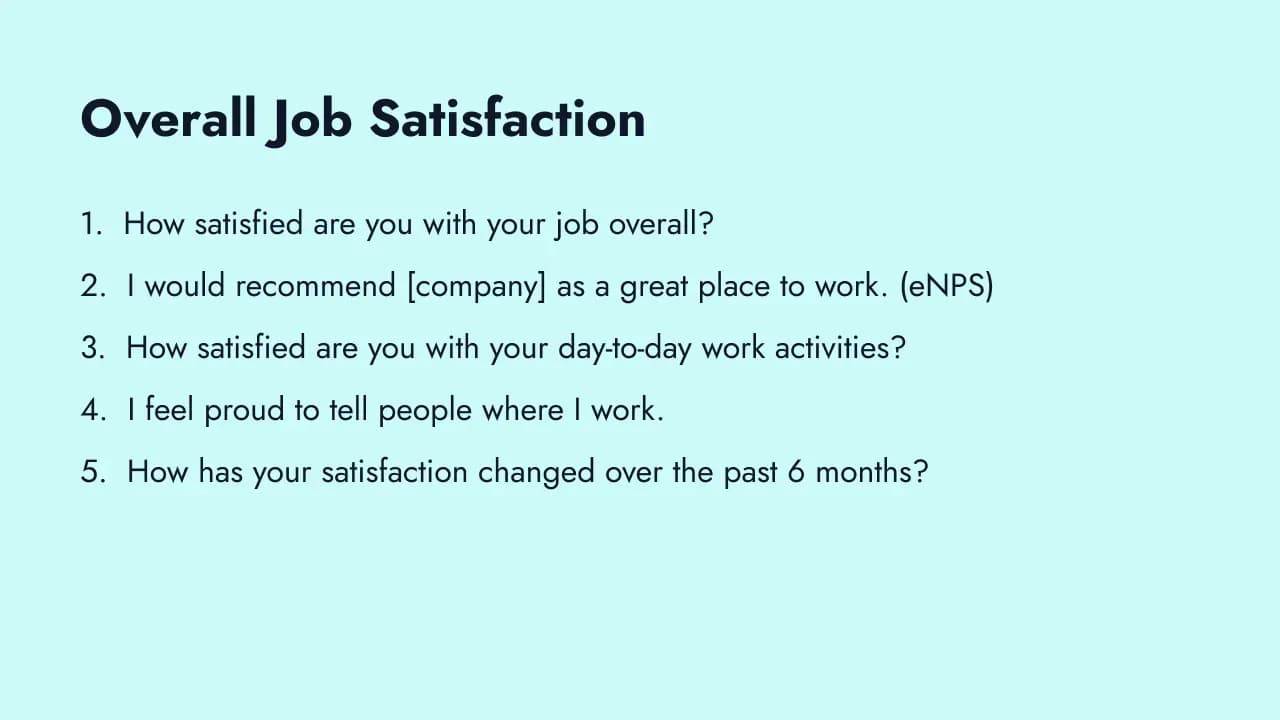
Overall Job Satisfaction (Questions 1-6)
Start with big-picture satisfaction questions. These establish your baseline and give you the most trackable metrics over time.
1. How satisfied are you with your job overall?
- Type: Likert (1-5) | Essential
- Your primary benchmark metric. Track this quarterly to spot trends before they become retention problems.
2. I would recommend [company] as a great place to work. (eNPS)
- Type: Rating (0-10) | Essential
- Employee Net Promoter Score℠. Segment into Promoters (9-10), Passives (7-8), and Detractors (0-6). A rising eNPS signals improving workplace health.
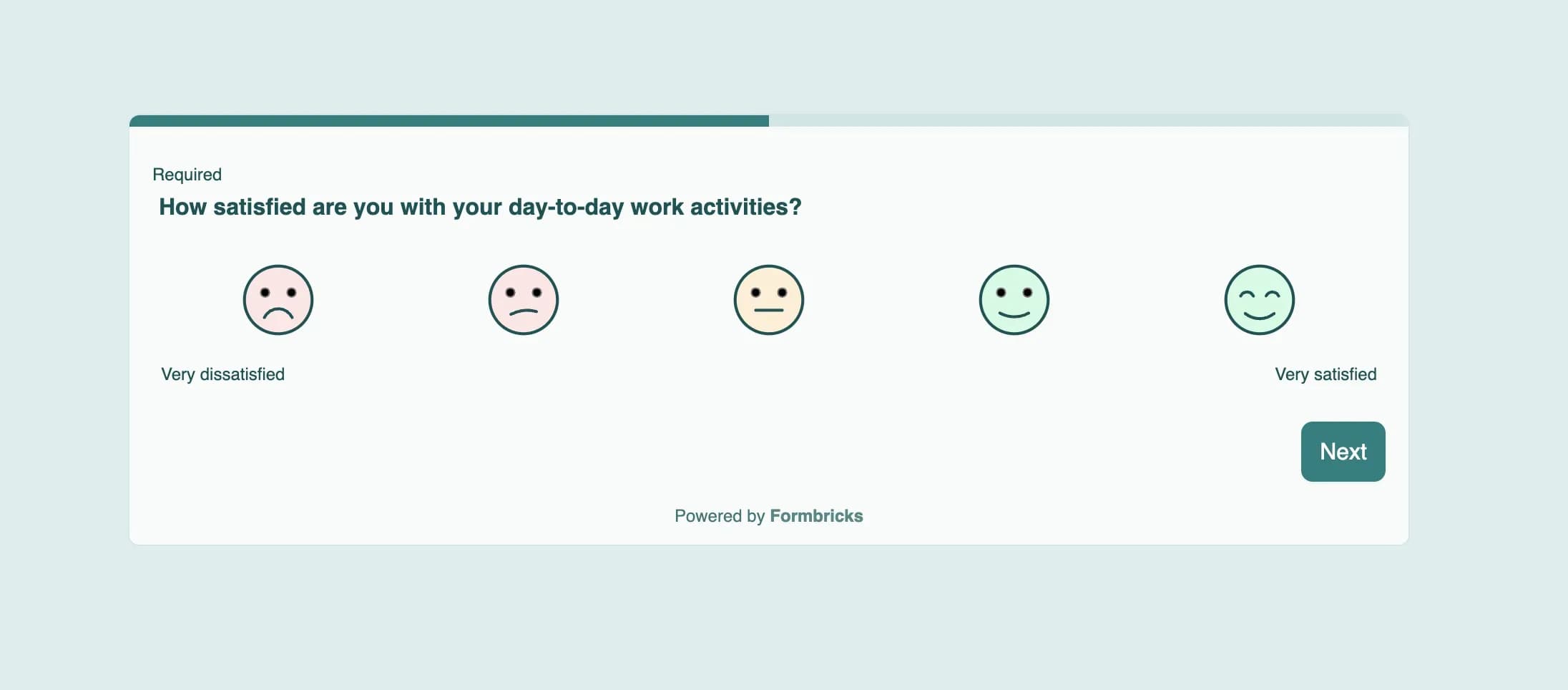
3. How satisfied are you with your day-to-day work activities?
- Type: Likert (1-5) | Essential
- Separates overall job satisfaction from task-level satisfaction. Someone can like their company but dislike their actual work.
4. I feel proud to tell people where I work.
- Type: Likert (Strongly Disagree to Strongly Agree) | Recommended
- Organizational pride correlates strongly with retention and advocacy. Low scores here often signal a gap between stated values and daily reality.
5. How has your satisfaction changed over the past 6 months?
- Type: Scale (Much worse / Worse / Same / Better / Much better) | Recommended
- Tracks the trajectory of satisfaction. A score of 3.5 that is trending up is a very different story than a 3.5 that is trending down.
6. If you could change one thing about your job, what would it be?
- Type: Open-ended | Essential
- The "one thing" constraint forces prioritization. Aggregate responses by theme to find the most common satisfaction barriers across the organization.
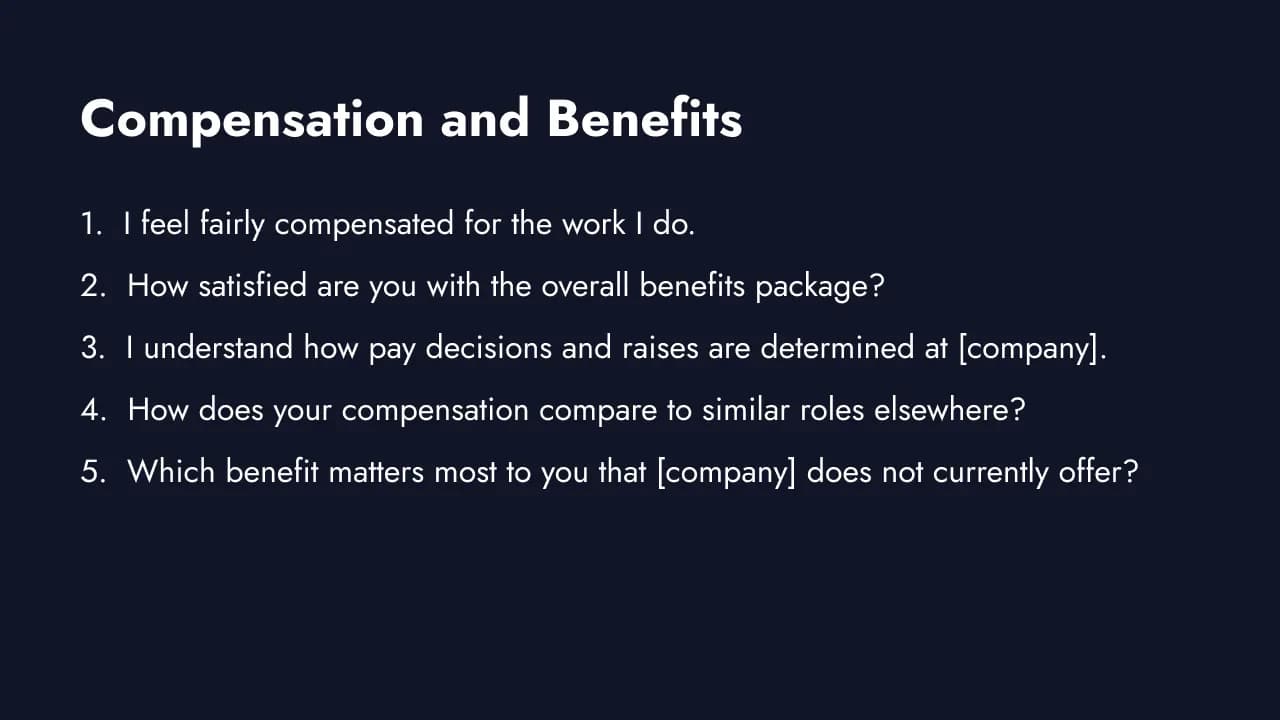
Compensation and Benefits (Questions 7-12)
Compensation is a hygiene factor in Herzberg's model: employees who feel underpaid are dissatisfied, but competitive pay alone does not create satisfaction. These questions surface whether employees feel fairly treated.
7. I feel fairly compensated for the work I do.
- Type: Likert (1-5) | Essential
- Perception of fair pay matters as much as actual pay. Low scores here do not always mean you are underpaying. They sometimes signal a communication gap about total compensation.
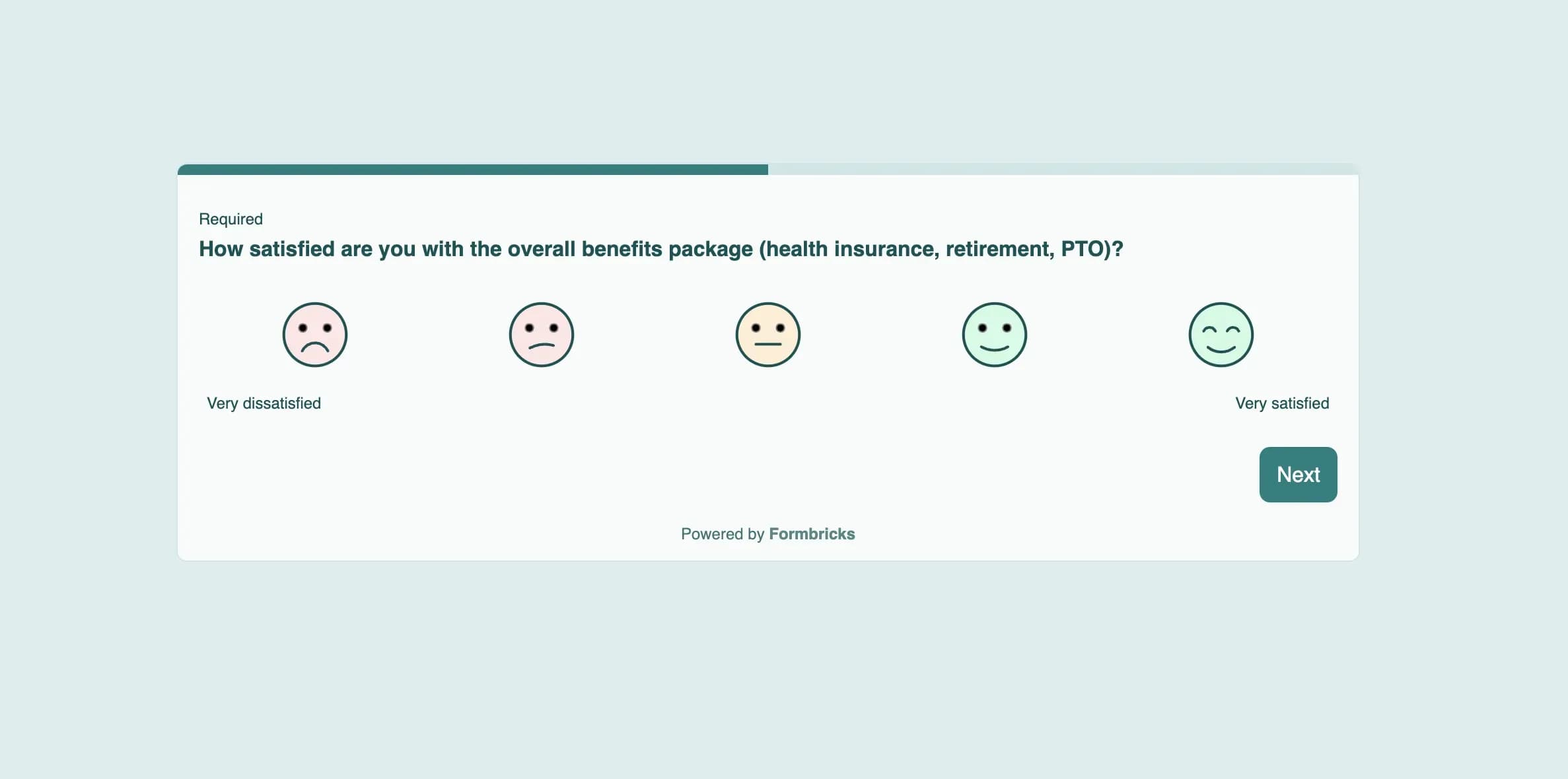
8. How satisfied are you with the overall benefits package (health insurance, retirement, PTO)?
- Type: Likert (1-5) | Essential
- Benefits satisfaction often ranks second only to base pay as a retention driver. If scores are low, break this into follow-up questions to identify which benefits need attention.
9. I understand how pay decisions and raises are determined at [company].
- Type: Likert (Strongly Disagree to Strongly Agree) | Recommended
- Transparency about pay processes reduces resentment. Low scores here suggest a communication problem, not necessarily a compensation problem.
10. How does your compensation compare to what you could earn in a similar role elsewhere?
- Type: Scale (Much lower / Slightly lower / About the same / Slightly higher / Much higher) | Recommended
- Market perception data. If most employees believe they could earn more elsewhere, you are in a retention risk zone, even if your actual pay is competitive.
11. Which benefit matters most to you that [company] does not currently offer?
- Type: Open-ended | Nice-to-have
- Surfaces unmet benefit needs. Common responses cluster around flexible scheduling, childcare support, and professional development budgets. For a focused benefits assessment, use the employee benefits survey template.
12. I feel recognized and rewarded for strong performance.
- Type: Likert (1-5) | Essential
- Recognition is one of the top satisfaction drivers. Research on perceived organizational support consistently shows that employees who feel acknowledged for their contributions have higher organizational commitment and lower turnover intent.
Work Environment and Conditions (Questions 13-18)
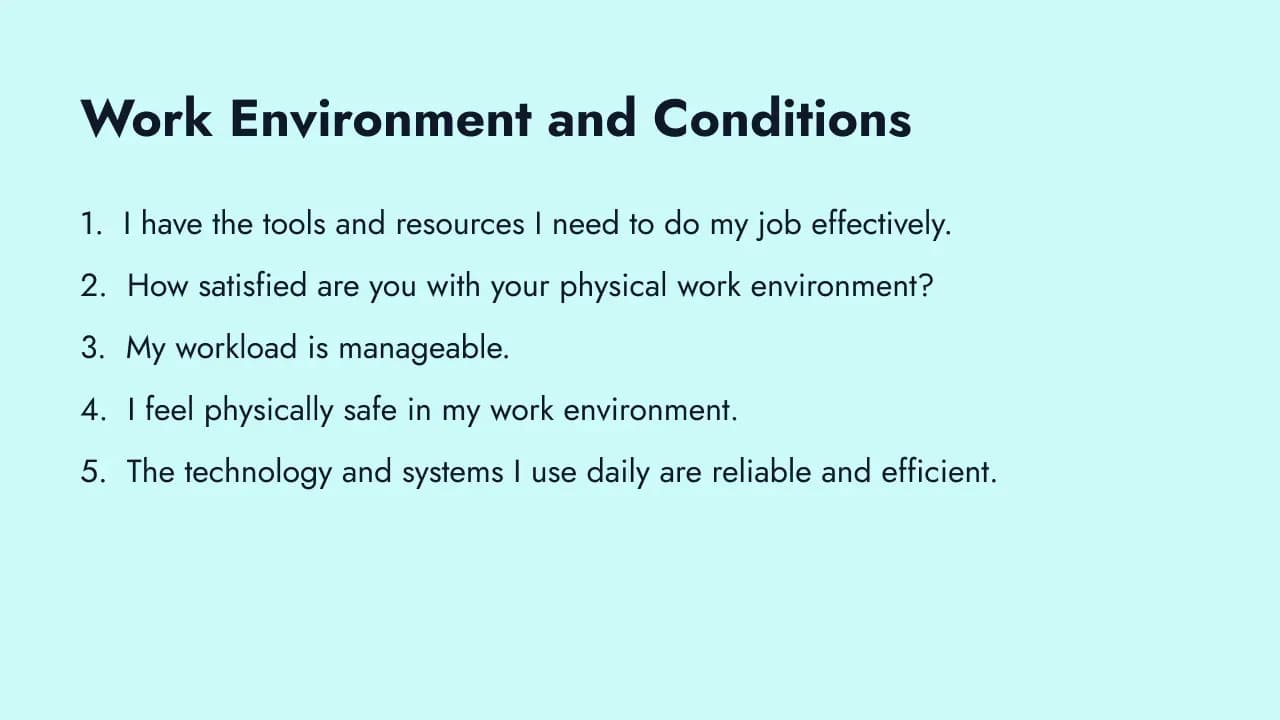
Environment includes both physical workspace and the tools, processes, and conditions that shape the daily experience.
13. I have the tools and resources I need to do my job effectively.
- Type: Likert (1-5) | Essential
- One of the most actionable satisfaction drivers. When employees lack basic tools, frustration compounds daily. This is often the quickest win because the fix is concrete and visible.
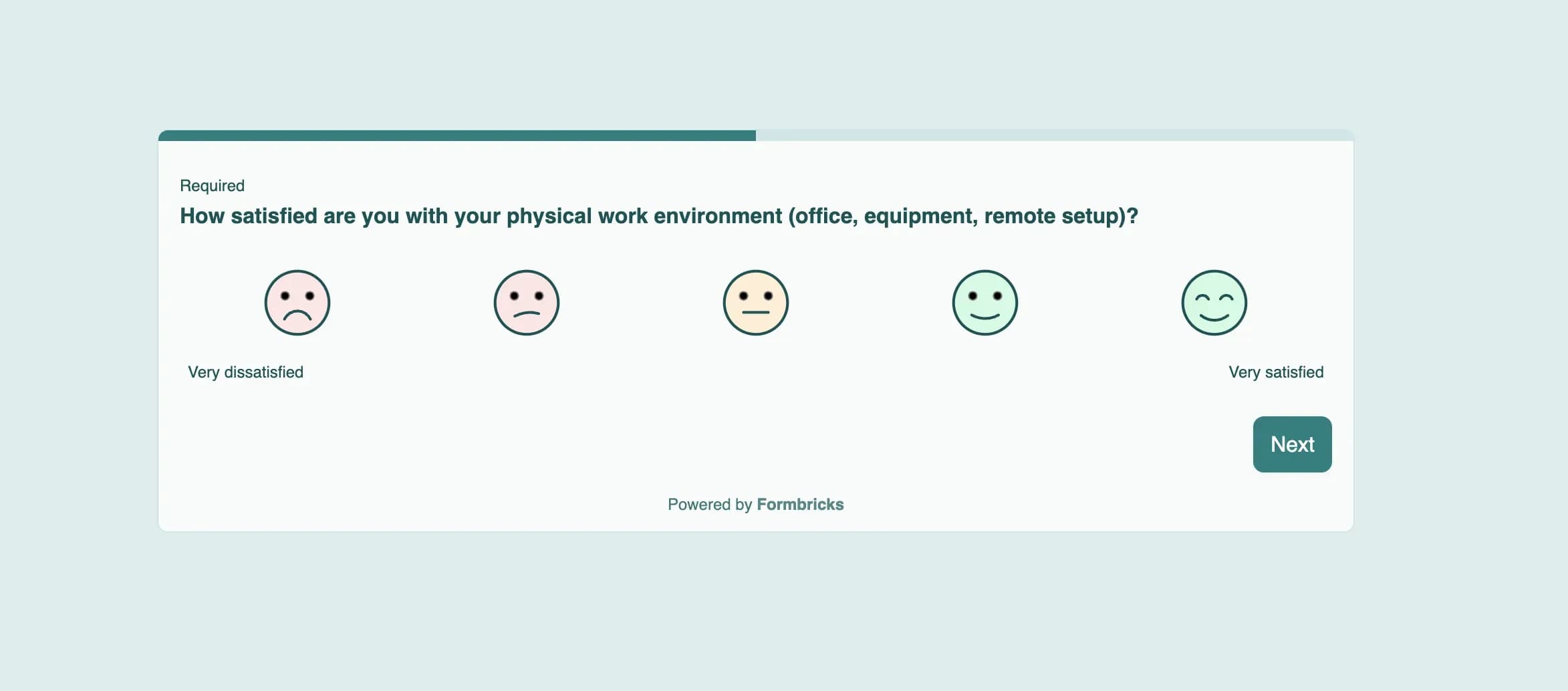
14. How satisfied are you with your physical work environment (office, equipment, remote setup)?
- Type: Likert (1-5) | Recommended
- For hybrid and remote teams, include "remote setup" to capture the full picture. Workspace quality directly affects productivity and focus.
15. My workload is manageable.
- Type: Likert (Strongly Disagree to Strongly Agree) | Essential
- Chronic overwork is the leading cause of burnout. Consistently low scores in specific teams often point to understaffing or process inefficiency rather than individual issues.
16. I feel physically safe in my work environment.
- Type: Likert (1-5) | Essential
- A baseline requirement. Low scores demand immediate attention. Especially important for manufacturing, retail, healthcare, and other on-site roles.
17. The technology and systems I use daily are reliable and efficient.
- Type: Likert (1-5) | Recommended
- Poor technology is a silent satisfaction killer. Employees may not complain about slow software in meetings, but they will tell you in an anonymous survey.
18. How would you rate the level of flexibility you have in how and where you work?
- Type: Likert (1-5) | Recommended
- Flexibility is now a top-3 factor in job satisfaction. Low scores here represent a flight risk for employees who have options.
Management and Communication (Questions 19-24)
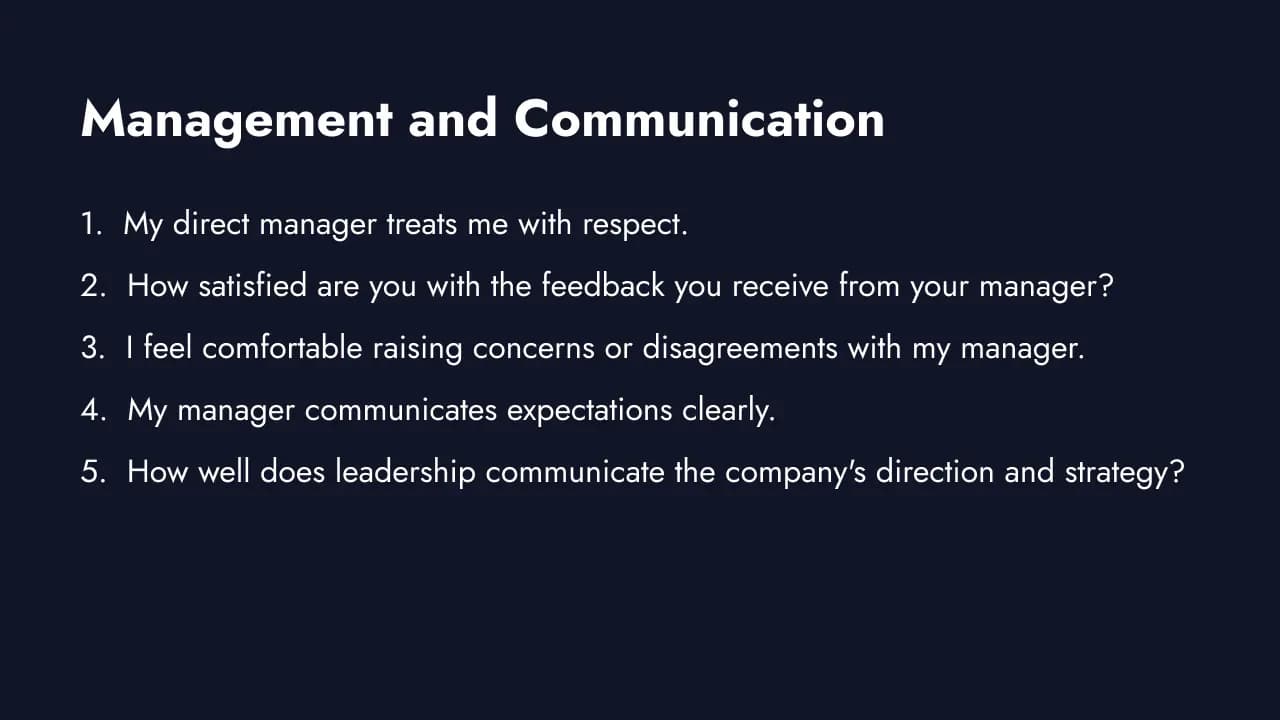
Managers are the single biggest variable in team satisfaction. Research on perceived supervisor support consistently shows manager quality as the strongest predictor of team-level engagement, outweighing compensation, job content, and physical conditions combined (Harter, Schmidt & Hayes, 2002). These questions surface whether leadership is helping or hurting.
19. My direct manager treats me with respect.
- Type: Likert (1-5) | Essential
- The most fundamental management question. Low scores here override everything else because employees leave managers, not companies.
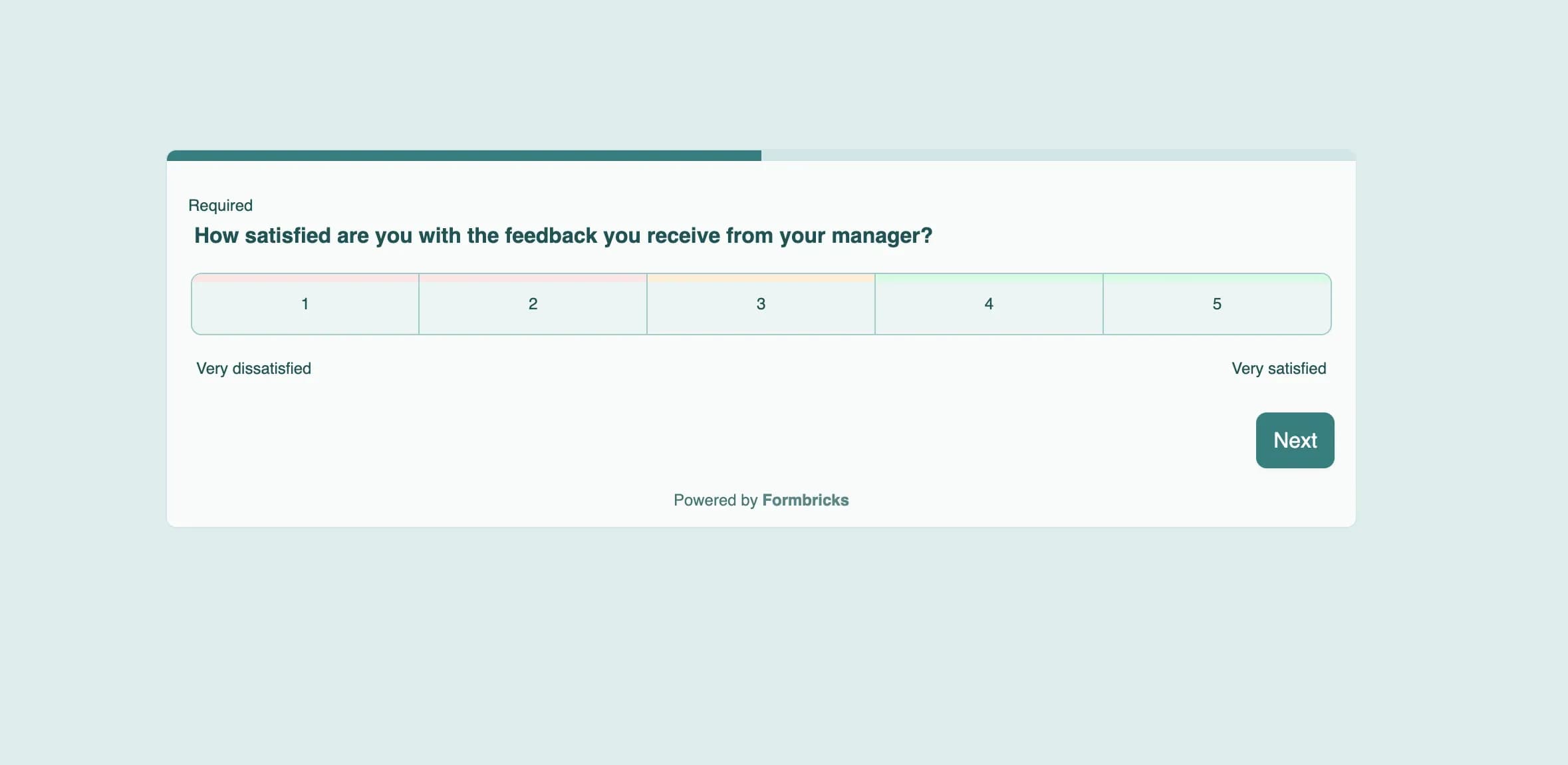
20. How satisfied are you with the feedback you receive from your manager?
- Type: Likert (1-5) | Essential
- Quality feedback is both a satisfaction driver and a development accelerator. Low scores suggest managers need coaching on how to give constructive, regular feedback.
21. I feel comfortable raising concerns or disagreements with my manager.
- Type: Likert (Strongly Disagree to Strongly Agree) | Essential
- Measures psychological safety at the team level. When employees cannot voice concerns, problems fester until they become turnover.
22. My manager communicates expectations clearly.
- Type: Likert (1-5) | Recommended
- Unclear expectations create stress and wasted effort. Ambiguity about priorities is one of the most fixable sources of dissatisfaction.
23. How well does leadership communicate the company's direction and strategy?
- Type: Likert (1-5) | Recommended
- Captures satisfaction with senior leadership communication, not just the direct manager. A gap between manager scores and leadership scores reveals where the communication chain breaks.
24. I trust the decisions made by senior leadership.
- Type: Likert (Strongly Disagree to Strongly Agree) | Recommended
- Trust in leadership predicts organizational commitment. Declining trust scores often precede broader satisfaction and retention declines by 1-2 quarters.
Work-Life Balance (Questions 25-30)
Work-life balance has moved from a "nice-to-have" to a primary satisfaction driver. These questions reveal whether your organization respects employee boundaries.
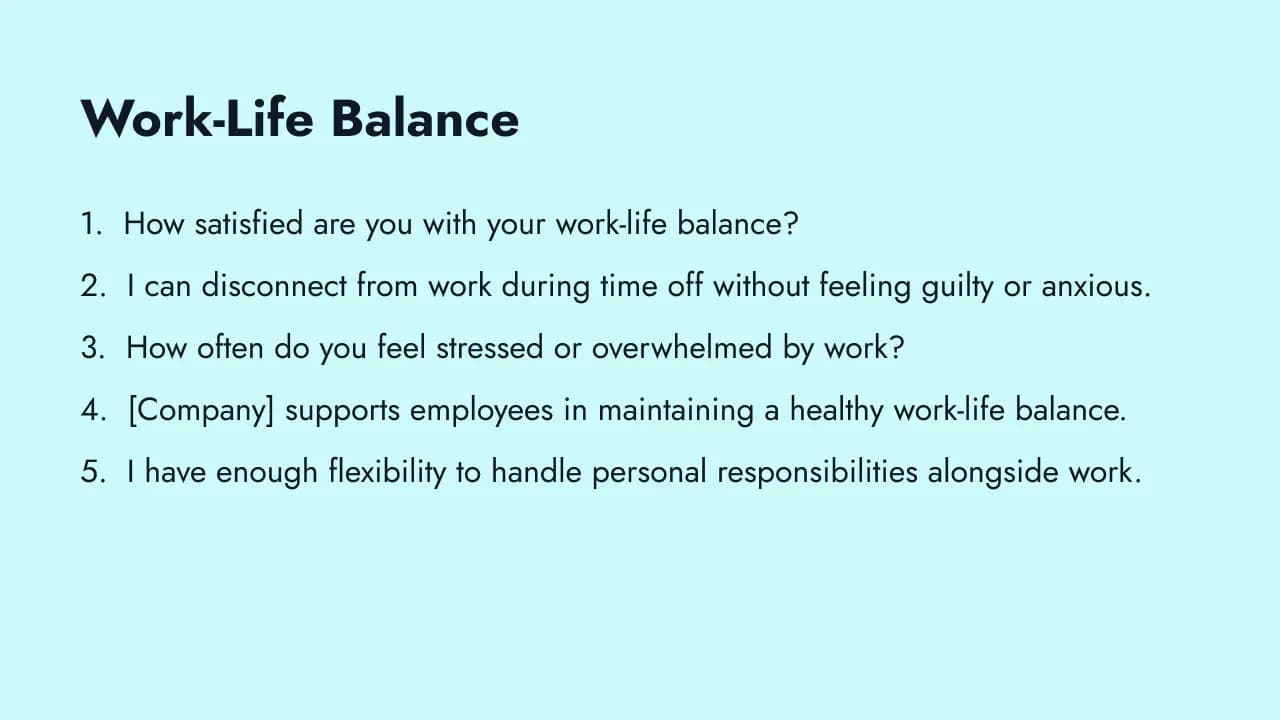
25. How satisfied are you with your work-life balance?
- Type: Likert (1-5) | Essential
- Your headline balance metric. Cross-tabulate with department and role to find where balance is worst.
26. I can disconnect from work during my time off without feeling guilty or anxious.
- Type: Likert (Strongly Disagree to Strongly Agree) | Essential
- Measures the quality of time off, not just the quantity. An employee with 20 PTO days who checks email constantly is not getting real rest.
27. How often do you feel stressed or overwhelmed by work?
- Type: Scale (Rarely / Sometimes / Often / Almost always) | Recommended
- Frequency-based stress measurement is more actionable than a general satisfaction score. "Often" and "Almost always" responses are your intervention targets.
28. [Company] supports employees in maintaining a healthy work-life balance.
- Type: Likert (1-5) | Recommended
- Separates organizational support from individual experience. You might have good policies that are poorly enforced or culturally undermined.
29. I have enough flexibility to handle personal responsibilities alongside work.
- Type: Likert (1-5) | Recommended
- Practical flexibility for appointments, childcare, and personal tasks. This is especially important for working parents and caregivers.
30. What is one thing [company] could do to better support your work-life balance?
- Type: Open-ended | Recommended
- Surfaces specific, actionable suggestions. Responses often cluster around meeting culture, after-hours communication norms, and scheduling flexibility.
Career Development (Questions 31-35)
Lack of growth opportunities is the leading reason employees leave, even above compensation. Career growth maps directly to Herzberg's "advancement" and "personal growth" motivators. These questions reveal whether employees see a future at your organization.
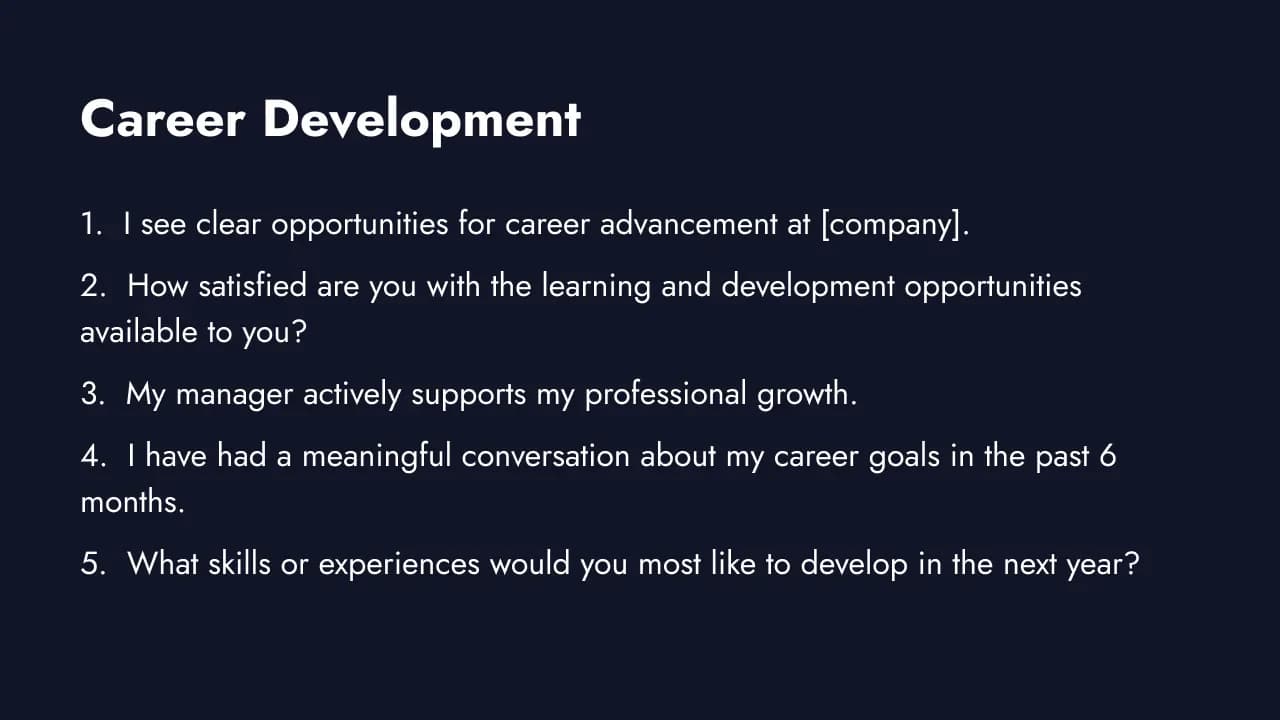
31. I see clear opportunities for career advancement at [company].
- Type: Likert (1-5) | Essential
- The single most predictive question for voluntary turnover. When employees cannot see a path forward, they start looking outside.
32. How satisfied are you with the learning and development opportunities available to you?
- Type: Likert (1-5) | Essential
- Development investment signals that the company values employees long-term. Low scores here are a retention risk, especially for high performers who have the most options.
33. My manager actively supports my professional growth.
- Type: Likert (Strongly Disagree to Strongly Agree) | Recommended
- Connects development to the manager relationship. Some managers are great at operations but neglect career conversations. This question surfaces that gap.
34. I have had a meaningful conversation about my career goals in the past 6 months.
- Type: Binary (Yes/No) | Essential
- A concrete binary check on whether development conversations are actually happening. If the answer is "No" for a majority, your career development process exists on paper but not in practice.
35. What skills or experiences would you most like to develop in the next year?
- Type: Open-ended | Recommended
- Forward-looking development data. Aggregate responses to identify common skill gaps and design training programs that match actual employee interests.
Company Culture (Questions 36-41)
Company culture is among the most cited factors in why people stay or leave, yet it is also the dimension most surveys treat superficially. These six questions probe culture at the level where it actually operates: daily behavior, not stated values.
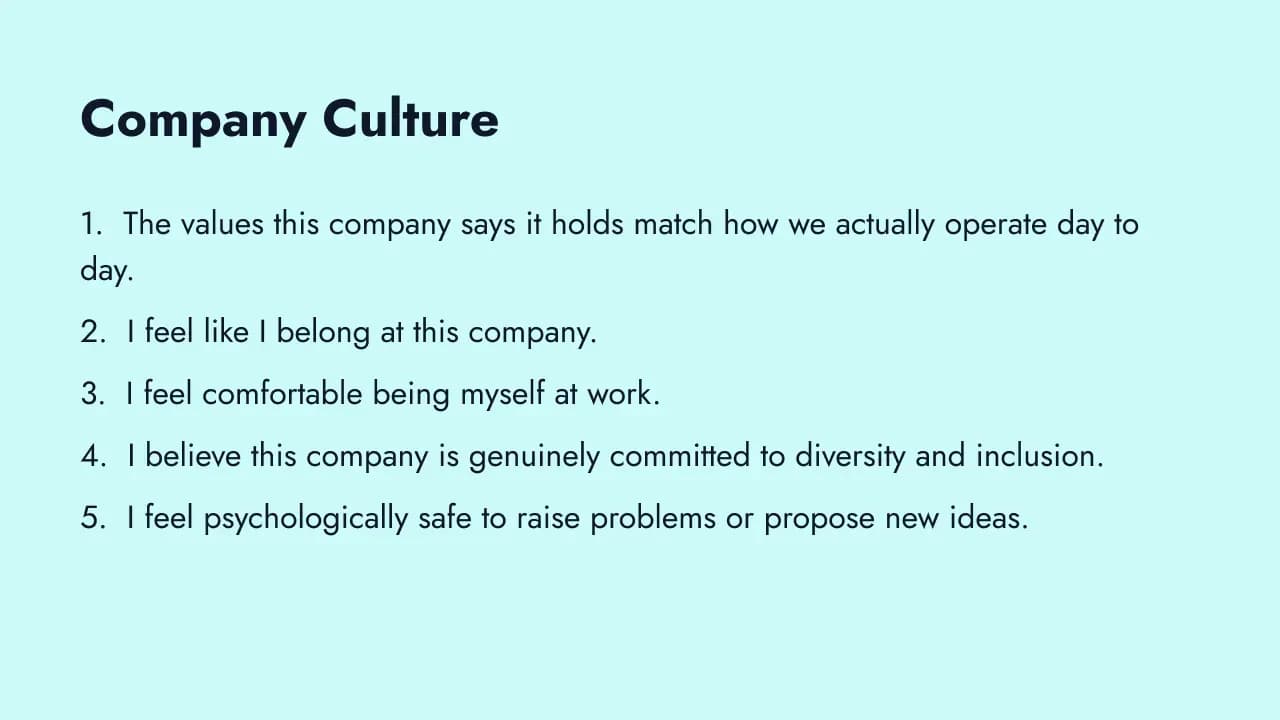
36. The values this company says it holds match how we actually operate day to day.
- Type: Likert (Strongly Disagree to Strongly Agree) | Essential
- The gap between stated and lived values is one of the fastest ways to erode trust. This question surfaces whether your culture exists on the website or in practice.
37. I feel like I belong at this company.
- Type: Likert (1-5) | Essential
- Belonging is distinct from inclusion. An employee can be included in meetings but still feel like an outsider. Low scores here predict disengagement and departure across all demographics.
38. I feel comfortable being myself at work.
- Type: Likert (Strongly Disagree to Strongly Agree) | Recommended
- Psychological safety at the identity level. When people cannot be authentic, they expend energy on self-monitoring rather than work.
39. I believe this company is genuinely committed to diversity and inclusion.
- Type: Likert (1-5) | Recommended
- Separates stated DEI commitment from perceived reality. Low scores often reveal a gap between executive messaging and team-level experience.
40. I feel psychologically safe to raise problems or propose new ideas without fear of punishment.
- Type: Likert (Strongly Disagree to Strongly Agree) | Essential
- Psychological safety is one of the strongest predictors of team performance, per Google's Project Aristotle research. Without it, problems stay hidden until they become crises.
41. How would you describe the culture of this company to a friend?
- Type: Open-ended | Recommended
- The most revealing culture question. The actual language employees use is more informative than any Likert scale. Cluster the words: adjectives tell you culture, verbs tell you behavior.
Team and Colleague Relationships (Questions 42-46)
Peer relationships are a reliable predictor of engagement. Chiaburu & Harrison's (2008) Journal of Applied Psychology meta-analysis found that coworker support has significant positive effects on job satisfaction, organizational commitment, and lower turnover intention, effects that are independent of manager quality. These questions measure the social fabric of your workplace.
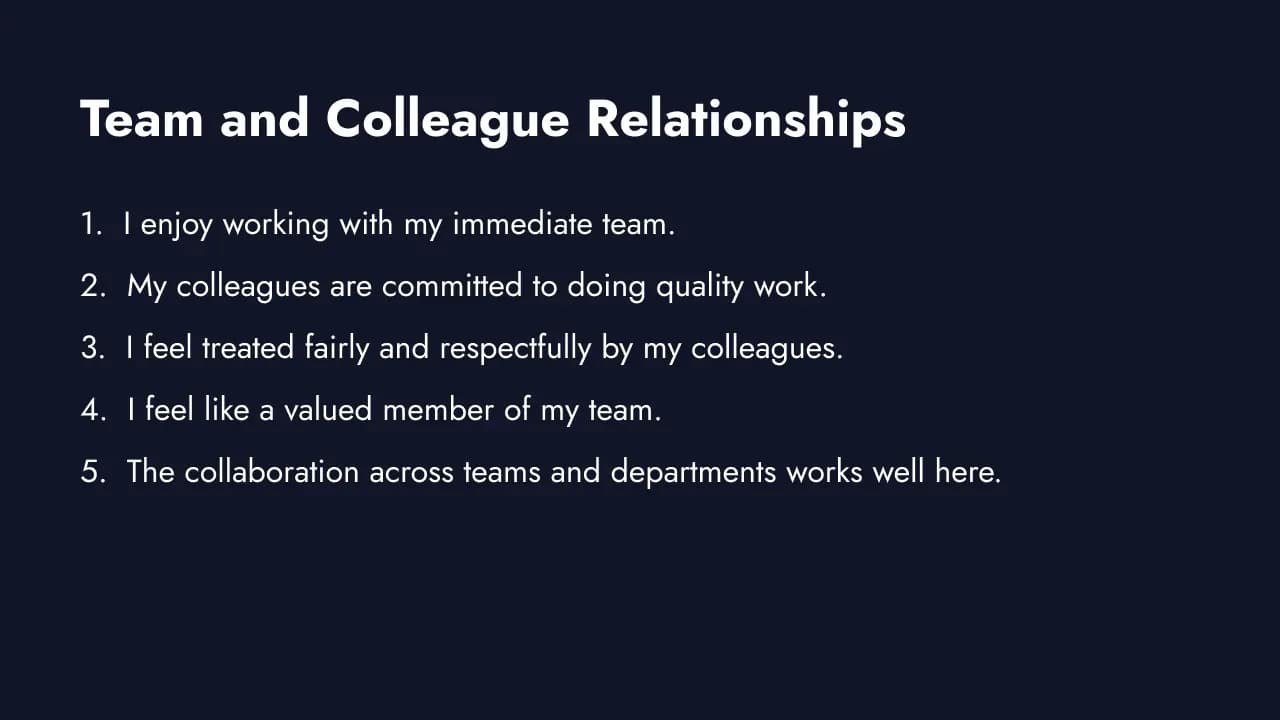
42. I enjoy working with my immediate team.
- Type: Likert (1-5) | Essential
- Team dynamics are a daily experience. Low scores here affect performance, retention, and motivation regardless of how well everything else is going.
43. My colleagues are committed to doing quality work.
- Type: Likert (Strongly Disagree to Strongly Agree) | Essential
- This is Q12 item #9, verbatim. It captures whether employees feel pulled up or dragged down by the people around them.
44. I feel treated fairly and respectfully by my colleagues.
- Type: Likert (1-5) | Essential
- Peer respect is a baseline for psychological safety. Low scores here often surface before managers are aware of a team dynamic problem.
45. I feel like a valued member of my team, not just someone filling a role.
- Type: Likert (Strongly Disagree to Strongly Agree) | Recommended
- Measures belonging at the team level. Employees who feel interchangeable are easier to lose.
46. The collaboration across teams and departments works well here.
- Type: Likert (1-5) | Nice-to-have
- Captures cross-functional friction that direct team questions miss. Especially relevant for organizations going through growth or structural change.
Wellbeing and Mental Health (Questions 47-49)
Workplace wellbeing has become a distinct dimension of satisfaction that standard surveys frequently omit. The World Health Organization defines workplace wellbeing as a state in which employees can cope with normal stresses of work, work productively, and contribute to their organization. These questions track whether your organization supports that state.
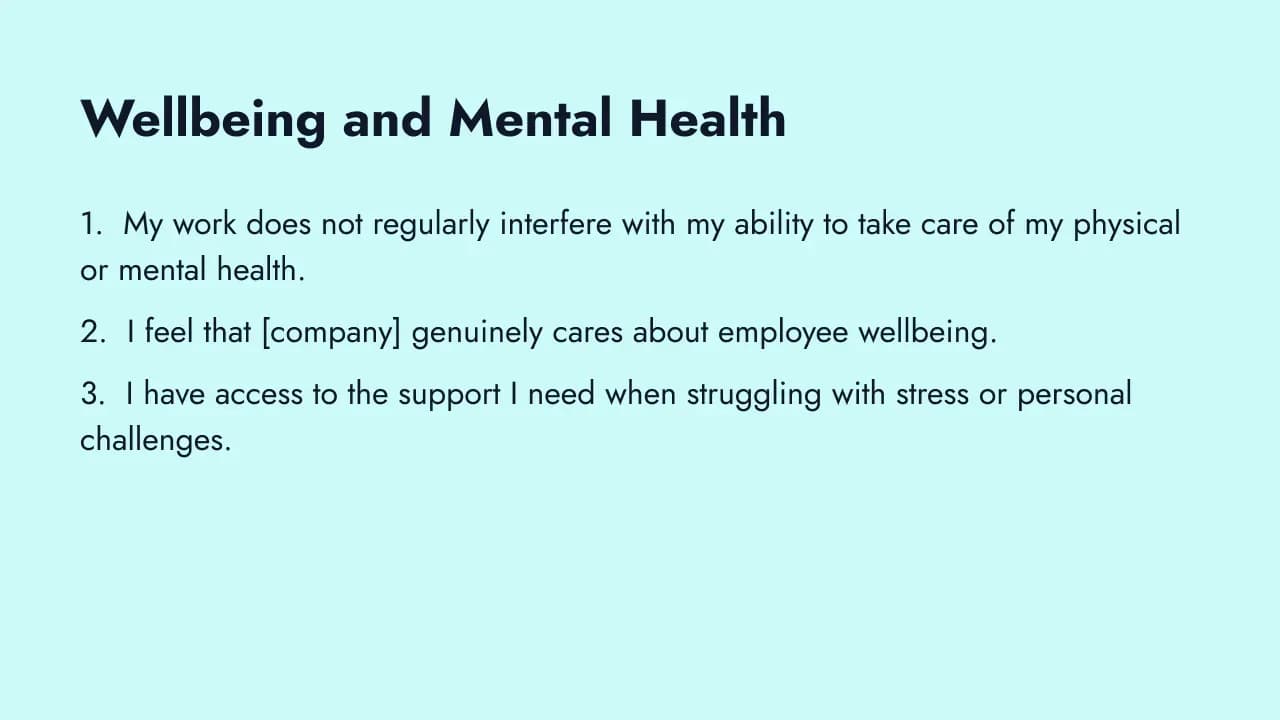
47. My work does not regularly interfere with my ability to take care of my physical or mental health.
- Type: Likert (Strongly Disagree to Strongly Agree) | Essential
- Frames the question around interference rather than asking for a clinical assessment. More employees will answer honestly about interference than about mental health status directly.
48. I feel that [company] genuinely cares about employee wellbeing, not just productivity.
- Type: Likert (1-5) | Recommended
- Perception of organizational care is a strong predictor of commitment and extra-role behavior. Employees who feel the company sees them as people, not resources, perform differently.
49. I have access to the support I need when I am struggling with stress or personal challenges.
- Type: Likert (Strongly Disagree to Strongly Agree) | Recommended
- Directly assesses whether your EAP, manager culture, and HR support are perceived as accessible. Low scores suggest either a structural gap or an awareness gap in what support exists.
Flight Risk Indicators (Questions 50-54)
This is the category no competitor survey guide includes, and it is arguably the most valuable. These five questions, when scored together, function as an early warning system for employees likely to leave within 90 days. Judge, Thoresen, Bono, and Patton's meta-analysis (2001), covering 312 samples published in Psychological Bulletin, found that job satisfaction has a meaningful relationship with turnover intent. Track these questions across survey waves to identify at-risk teams before the actual departures begin.
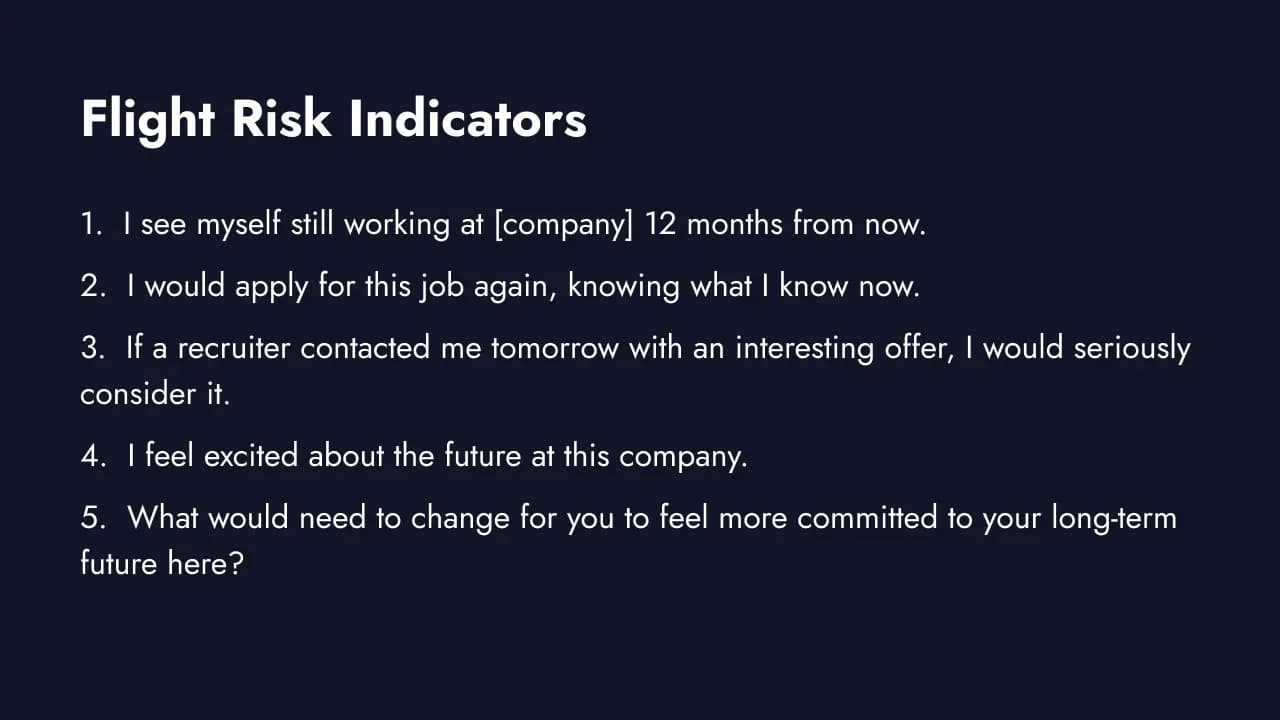
50. I see myself still working at [company] 12 months from now.
- Type: Likert (Strongly Disagree to Strongly Agree) | Essential
- The single most direct flight risk indicator. Employees who answer 1 or 2 here are telling you they are already mentally leaving. Anonymize carefully and set team thresholds.
51. I would apply for this job again, knowing what I know now.
- Type: Binary (Yes/No) | Essential
- Retrospective satisfaction test. A "No" answer is a strong signal that the employee's experience has diverged significantly from what they expected when they joined.
52. If a recruiter contacted me tomorrow with an interesting offer, I would seriously consider it.
- Type: Likert (Strongly Disagree to Strongly Agree) | Recommended
- More honest than "Are you looking for a job?" Most people who are flight risks are passively open, not actively searching. This phrasing captures that.
53. I feel excited about the future at this company.
- Type: Likert (1-5) | Essential
- Measures forward-looking commitment. An employee who scores low on this but high on current satisfaction is satisfied today but has no reason to stay tomorrow.
54. What would need to change for you to feel more committed to your long-term future here?
- Type: Open-ended | Recommended
- The most direct retention intelligence question you can ask. Responses give you a specific list of what it would take to retain this employee. Aggregate responses by theme to identify systemic retention levers.
Scoring Methods and Benchmarks
Raw survey data only becomes useful when you can score it consistently and compare it against meaningful benchmarks.
How to Score Your Results
Likert Scale (1-5) scoring: Calculate the average score for each question and each category. An average of 4.0+ is generally positive. Below 3.5 needs attention. Below 3.0 signals a serious problem.
eNPS scoring: Subtract the percentage of Detractors (0-6) from the percentage of Promoters (9-10). Scores range from -100 to +100. Above 0 is acceptable. Above +20 is good. Above +50 is excellent.
Satisfaction percentage: Calculate the percentage of respondents who selected 4 or 5 on a 5-point scale. This "top-2-box" method is widely used and easy to communicate. Above 70% is good. Above 80% is excellent.
Flight risk score: Average questions 50-54. A team average below 3.0 on these items warrants immediate attention from HR and the relevant manager, regardless of how the rest of the survey scores.
Benchmark Ranges
| Metric | Poor | Fair | Good | Excellent |
|---|---|---|---|---|
| Average Likert Score | Below 3.0 | 3.0-3.5 | 3.5-4.2 | Above 4.2 |
| Satisfaction % (top-2-box) | Below 50% | 50-65% | 65-80% | Above 80% |
| eNPS | Below -10 | -10 to +10 | +10 to +30 | Above +30 |
| Response Rate | Below 40% | 40-60% | 60-75% | Above 75% |
| Flight Risk Score | Below 2.5 | 2.5-3.0 | 3.0-3.8 | Above 3.8 |
Internal benchmarks matter more than external ones. A score that dropped from 4.2 to 3.8 in one quarter demands attention even if 3.8 is technically "above average." Track trends over time, segment by department and tenure, and compare against your own history before looking at industry data.
Employee Satisfaction Survey Best Practices
Writing good questions is half the battle. How you structure, distribute, and follow up determines whether you get actionable data or noise.
Guarantee anonymity and mean it. Use a survey tool that collects responses without identifiers. Explain in the introduction exactly how data will be aggregated and who will see it. Set a minimum response threshold of 5 per team before reporting team-level data, to prevent de-anonymization in small groups. For sensitive workplace feedback, use a GDPR-compliant survey tool that supports anonymous collection by design.
Keep it short. Target 10-15 questions for a comprehensive survey, 3-5 for a pulse check. Respect people's time and they will give you honest answers. If you need all 54 questions from this guide, rotate them across survey waves rather than running all at once.
Time it well. Avoid launching surveys during high-stress periods: end of quarter, layoff announcements, or major product launches. The data you collect during a crisis reflects the crisis, not your baseline. Tuesday through Thursday, mid-morning, consistently produces higher response rates than Monday or Friday sends. For more on timing and channel selection, see the guide on survey distribution methods.
Communicate the purpose. Before launching, tell employees why you are running the survey, how the data will be used, and what changed as a result of the last one. This single step builds the trust that drives both participation and honesty.
Act on results visibly. The fastest way to destroy future response rates is to collect feedback and do nothing with it. Share key findings within two weeks of closing the survey. Identify 2-3 specific actions you will take, assign owners, and communicate progress. See the guide on closing the feedback loop for a step-by-step framework.
Segment your analysis. Company-wide averages mask important patterns. Break results down by department, tenure, role level, and location. A 4.0 average that hides a 2.8 in customer support is misleading.
Common Employee Satisfaction Survey Mistakes
These mistakes silently sabotage your data quality and employee trust. Each one is common and fixable.
Mistake 1: Asking only hygiene questions
If your survey only covers pay, benefits, and working conditions (all hygiene factors), you are measuring the absence of dissatisfaction, not the presence of satisfaction. Add motivator questions: recognition, meaningful work, growth, and autonomy. A survey that only catches problems will never tell you what is making your best people stay.
Mistake 2: Asking leading questions
Bad: "How much do you appreciate the generous benefits package?"
Better: "How satisfied are you with the benefits package?"
The word "generous" primes respondents toward a positive answer. Remove evaluative adjectives and let employees form their own judgment.
Mistake 3: Surveying without acting
Collecting feedback and doing nothing is worse than not surveying at all. It signals that leadership does not care about employee input. After each survey, commit to at least 2-3 visible changes. Even small improvements build trust for the next round.
Mistake 4: Running only an annual survey
Annual surveys capture a single snapshot that may be skewed by recent events. By the time you analyze results and take action, 6+ months have passed. Supplement annual surveys with quarterly or monthly pulse checks of 3-5 questions to track trends in real time.
Mistake 5: Not guaranteeing anonymity
Employees in small teams worry that their responses can be identified even in "anonymous" surveys. Set a minimum of 5 responses before reporting team-level data. Use tools that separate response data from employee identifiers.
Mistake 6: Double-barreled questions
Bad: "How satisfied are you with your salary and benefits?"
Better: Split into two separate questions, one for salary, one for benefits.
When employees rate two things at once, you cannot tell which one is driving the score. Each question should measure exactly one thing.
Mistake 7: Ignoring the manager variable
If one team's scores are consistently lower than peers, the common variable is often the manager, not the work. Cross-tabulate satisfaction by manager (while preserving anonymity at or above the 5-response threshold) to identify where targeted coaching or intervention is needed.
How to Distribute Your Satisfaction Survey
The right channel can double your response rate. Match your distribution method to your workforce.
| Channel | Response Rate | Best For | Key Tip |
|---|---|---|---|
| In-app / Intranet | 25-30% | Desk workers, remote teams | Capture feedback where employees already work |
| 15-25% | Broad distribution, asynchronous | Personalize subject line, send mid-morning Tue-Thu | |
| Link survey | Variable | Frontline, deskless workers | Share via Slack, Teams, or internal messaging |
| QR codes | Variable | Physical locations, retail, manufacturing | Place in break rooms or common areas |
| SMS | 40-50% | Urgent pulse checks | Keep to 1-3 questions, respect business hours |
For desk-based teams, in-app distribution with Formbricks gives you the highest response rates because employees see the survey in their workflow, not buried in their inbox. For deskless workers, link surveys distributed through internal messaging channels or QR codes in physical locations work best.
To improve response rates across any channel, see the guide on how to increase survey response rates.
How to Analyze Your Results
Collecting data is step one. Turning it into decisions is where the value lives.
Segment by department, tenure, and role. Averages mask important patterns. A 4.0 average satisfaction score might hide the fact that engineering rates satisfaction at 4.5 while customer support rates it at 3.2. Break results down by every meaningful dimension.
Cross-tabulate satisfaction by manager. This is one of the most powerful analyses you can run. Manager quality is the single biggest variable in team satisfaction. If one team's scores are consistently lower, the common factor is often leadership, not the work itself. This is how you use survey data to calibrate and develop your management team, not just gather feedback.
Score the flight risk block separately. Questions 50-54 should be analyzed together as a composite risk signal. Teams scoring below 3.0 on average across those five items are at active risk of turnover in the next quarter. Escalate this to HR and relevant managers with the anonymized thematic data from Q54 to understand what it would take to retain these employees.
Analyze open-ended responses by theme. Group responses by topic and count frequency. The intersection of high frequency (many people mention it) and high intensity (they feel strongly about it) is where to focus first. For a detailed walkthrough, see the guide on analyzing customer feedback, which applies the same framework to internal surveys.
Compare against your own history. Internal benchmarks matter more than external averages. A score that dropped from 4.2 to 3.8 demands attention, even if 3.8 would be considered "good" externally.
Prioritize by impact and feasibility. Map issues on a 2x2 matrix: impact (how many employees mention it and how strongly they feel) versus feasibility (how quickly you can address it). Quick wins build momentum and prove that feedback matters.
Close the loop. Share key findings with all employees within two weeks. Outline specific actions and deadlines. Follow up on progress. See the guide on closing the feedback loop for a step-by-step framework.
Free Employee Satisfaction Survey Template
Skip the blank page. Formbricks offers free, open-source survey templates you can deploy in minutes. Each template includes pre-written questions, smart targeting rules, and built-in analytics.
Why Formbricks for employee satisfaction surveys:
- Open source and self-hostable. Your employee data stays on your infrastructure. No third-party access, no data sharing, full compliance with internal security policies. This matters when asking employees to share sensitive feedback about pay, management, and workplace conditions.
- Built-in anonymity. Formbricks supports anonymous surveys by design, so employees trust that their responses cannot be traced back to them.
- Flexible distribution. Deploy via in-app widget, link survey, or website embed. Reach desk workers and frontline teams with the same tool.
- No engineering lift. Non-technical HR and People teams can set up, customize, and launch surveys without developer support.
- Privacy-first. GDPR-compliant out of the box. For teams with strict data requirements, see the guide on GDPR-compliant survey tools.
Related templates:
- Employee Engagement Survey for engagement measurement
- Employee Benefits Survey for benefits feedback
- Candidate Experience Survey for hiring process feedback
How to get started:
- Sign up at formbricks.com (free tier available, no credit card required)
- Choose the employee satisfaction survey template or start from scratch
- Customize the questions from this guide for your company
- Set targeting rules and anonymity preferences
- Launch and monitor responses in real time from your dashboard
Get Your Free Employee Satisfaction Survey Template →
Frequently Asked Questions
Try Formbricks now