

70+ Employee Survey Questions That Get Honest Answers (2026)

Johannes
CEO & Co-Founder
14 Minutes
May 3rd, 2026
A Journal of Applied Psychology meta-analysis by Harter, Schmidt & Hayes (2002) covering 7,939 business units found that high engagement is significantly linked to lower turnover, higher productivity, better customer satisfaction, and stronger business performance. The mechanism is straightforward: employees who feel heard, recognized, and connected to meaningful work perform differently from those who feel invisible. The gap between thriving teams and struggling ones almost always starts with whether anyone bothered to ask.
This guide gives you 70+ employee survey questions organized by category, each with a recommended question type and effectiveness rating. You also get the 5 C's of engagement, best practices for anonymity, distribution strategies, common mistakes to avoid, and a free template you can deploy in minutes.
What you will find in this guide:
- 70+ employee survey questions organized into 9 categories
- The 5 C's of employee engagement explained
- Question type and effectiveness rating for every question
- Manager-specific, fun, and wellbeing question sets
- Best practices for getting honest, actionable feedback
- How to analyze and act on employee survey results
- A free employee survey template ready to deploy
What Is an Employee Survey?
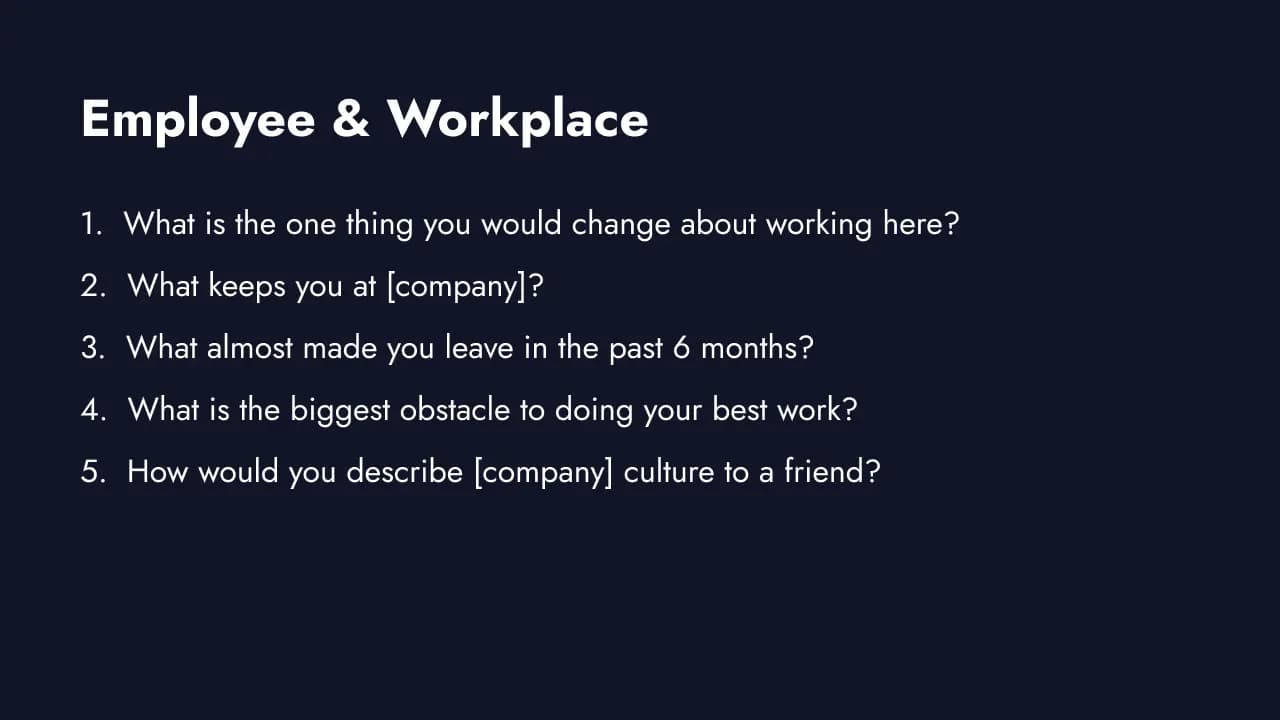
An employee survey is a structured feedback tool used to measure how people experience their workplace. It collects data on engagement, satisfaction, management quality, career growth, culture, and more. The goal is to replace assumptions with evidence so leaders can make informed decisions about people strategy.
Employee surveys come in several forms, each designed for a different purpose:
- Engagement surveys measure emotional commitment, motivation, and discretionary effort. Usually run annually or semi-annually with 20-40 questions.
- Satisfaction surveys focus on happiness with tangible conditions like pay, benefits, workload, and environment. Shorter and more frequent than engagement surveys.
- Pulse surveys are quick check-ins (3-5 questions) run weekly or monthly to track sentiment trends between larger surveys.
- Exit surveys capture feedback from departing employees about their reasons for leaving and their overall experience. See our exit survey examples for question ideas.
- Onboarding surveys gather feedback from new hires about their first weeks and months. Timing matters: the best programs survey at day 1, week 1, and the 30/60/90-day marks. See our onboarding survey questions guide for a full breakdown.
The most effective employee surveys share three traits: they are short enough to respect people's time, they guarantee anonymity on sensitive topics, and they lead to visible action that employees can point to.
The 5 C's of Employee Engagement
Before designing a survey, it helps to understand what you are actually trying to measure. The 5 C's framework describes the five conditions that drive sustained employee engagement. Each maps to specific survey questions below.
1. Clarity. Employees need to know what is expected of them and why their work matters. When expectations are ambiguous, motivation drops because people spend energy guessing rather than doing. Deci & Ryan's (2000) Self-Determination Theory identifies competence (knowing how to succeed) as one of the three fundamental psychological needs driving intrinsic motivation.
2. Connection. Employees need to feel genuinely connected to their teammates, their manager, and the organization's purpose. Baumeister & Leary (1995) in Psychological Bulletin described the need to belong as a fundamental human motivation, one that shapes behavior and wellbeing across every domain of life, including work.
3. Contribution. Employees need to believe their work makes a real difference. The sense that one's effort matters is distinct from simply having a job description. Teams where individuals feel their contribution is visible and valued show consistently higher performance.
4. Career. Employees need to see a credible path for growth. Not necessarily a promotion timeline, but evidence that the organization invests in their development and that staying is a better option than leaving for somewhere else.
5. Care. Employees need to feel the organization genuinely cares about their wellbeing, not just their output. Rhoades & Eisenberger (2002) in a Journal of Applied Psychology meta-analysis of 73 studies found that perceived organizational support is significantly associated with lower turnover intent, higher commitment, and better job performance.
Your survey should cover all five conditions. The categories below are organized to address each one.
Types of Survey Questions for Employees
Choosing the right question format determines the quality of data you collect. Each type has specific strengths depending on what you want to measure.
| Question Type | Best For | Example | Pros | Cons |
|---|---|---|---|---|
| Likert Scale (1-5) | Agreement, satisfaction, frequency | "I feel valued at work" (Strongly Disagree to Strongly Agree) | Easy to benchmark over time | Susceptible to acquiescence bias |
| Open-Ended | Context, unexpected insights | "What would you change about your team?" | Rich qualitative data | 18% nonresponse rate (Pew Research) |
| Multiple Choice | Categorization, preferences | "What benefit matters most to you?" | Fast to answer and analyze | Limited to predefined options |
| Rating Scale (0-10) | eNPS, granular measurement | "How likely are you to recommend this company?" | More sensitivity than 5-point | Can feel arbitrary |
| Binary (Yes/No) | Screening, factual questions | "Do you have regular 1-on-1s with your manager?" | Fastest for respondents | No nuance |
| Ranking | Priorities, relative preferences | "Rank these 5 benefits in order of importance" | Forces thoughtful comparison | Increases cognitive load and dropout |
Key guideline: Use 70-80% closed-ended questions for benchmarking and trend tracking. Use 20-30% open-ended questions for qualitative discovery. Limit open-ended questions to 2-3 per survey to manage respondent fatigue and keep completion rates high.
70+ Employee Survey Questions by Category
Each question below includes a recommended question type and an effectiveness rating: Essential (include in every survey), Recommended (include when relevant), or Nice-to-have (include if survey length allows). Replace bracketed text with your company name or context.
Engagement and Motivation (Questions 1-8)
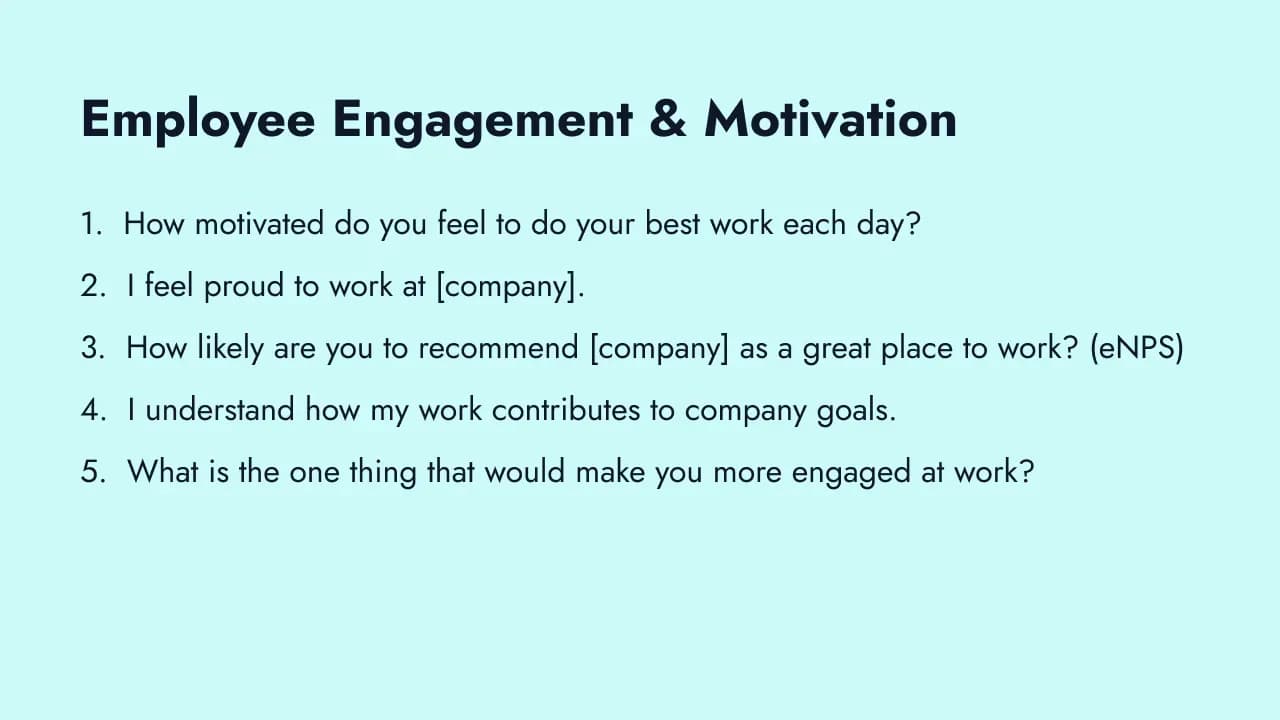
Engagement questions measure emotional investment and discretionary effort. These predict retention and performance better than satisfaction questions alone. Start with the employee engagement survey template for a ready-to-use set of questions.
1. How motivated do you feel to do your best work each day?
- Type: Likert (1-5) | Essential
- Your baseline engagement metric. Track this quarterly to spot motivation trends before they become retention problems.
2. I feel proud to work at [company].
- Type: Likert (Strongly Disagree to Strongly Agree) | Essential
- Organizational pride correlates strongly with advocacy and retention. Low scores here often signal a disconnect between company values and daily reality.
3. How likely are you to recommend [company] as a great place to work? (eNPS)
- Type: Rating (0-10) | Essential
- Employee Net Promoter Score℠ is one of the most benchmarkable engagement metrics. Segment into Promoters (9-10), Passives (7-8), and Detractors (0-6). Track the trend, not just the number.
4. I feel energized by the work I do.
- Type: Likert (1-5) | Recommended
- Differentiates between employees who are engaged because they love the work versus those who stay for external reasons (pay, convenience). Low energy scores with high satisfaction scores suggest quiet disengagement.
5. I understand how my work contributes to [company]'s goals.
- Type: Likert (1-5) | Essential
- Line-of-sight to impact is one of the strongest engagement drivers. When people cannot connect their tasks to outcomes, motivation drops.
6. I feel recognized for my contributions.
- Type: Likert (1-5) | Recommended
- Recognition is consistently ranked among the top drivers of engagement. Rhoades & Eisenberger (2002) found that perceived organizational support, including recognition, is significantly associated with lower turnover intent across 73 studies. Employees who feel unrecognized disengage quietly before they ever resign.
7. I am willing to go beyond what is expected to help [company] succeed.
- Type: Likert (1-5) | Recommended
- Measures discretionary effort, the behavioral outcome of engagement. This question separates truly engaged employees from those who are merely satisfied.
8. What is the one thing that would make you more engaged at work?
- Type: Open-ended | Essential
- The "one thing" constraint forces prioritization. Aggregate responses by theme to find the most common engagement barriers across the organization.
Job Satisfaction (Questions 9-16)
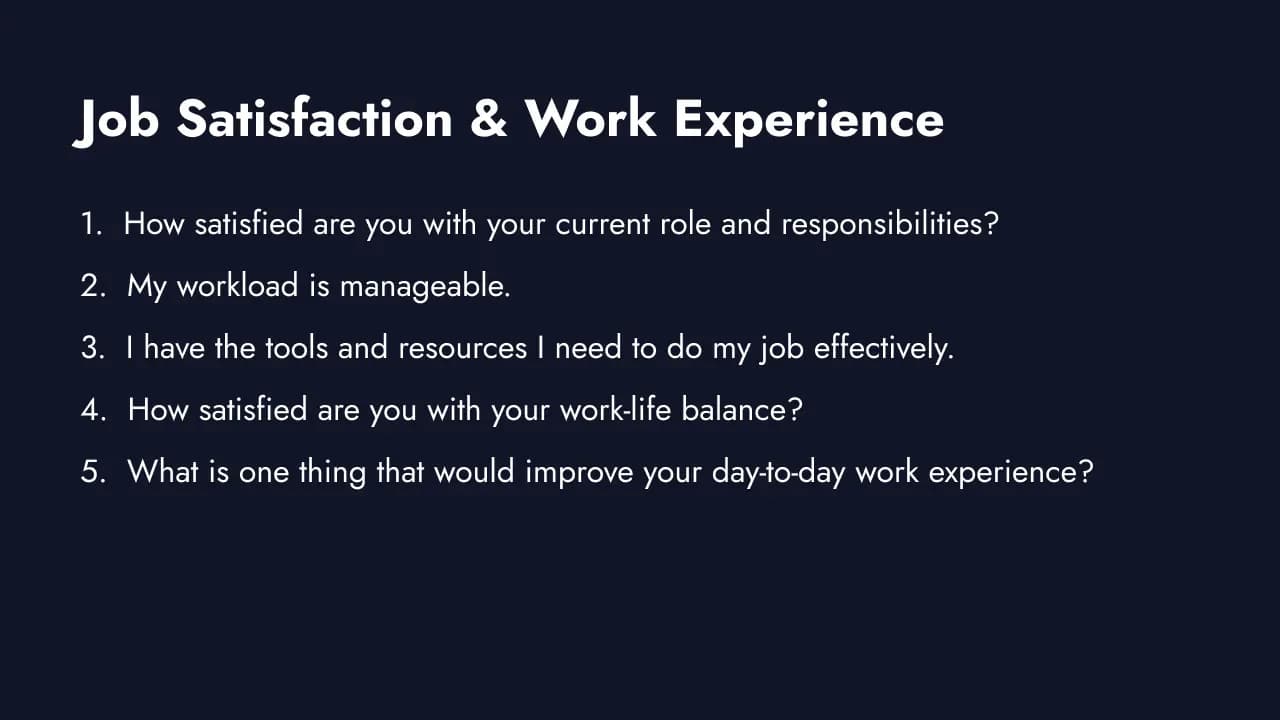
Satisfaction questions measure happiness with tangible work conditions. They are leading indicators: dissatisfaction with workload or tools often precedes disengagement. The employee satisfaction survey template gives you a quick starting point for these questions.
9. How satisfied are you with your current role and responsibilities?
- Type: Likert (1-5) | Essential
- Your primary satisfaction benchmark. Cross-tabulate with tenure to identify whether dissatisfaction spikes at specific career stages.
10. My workload is manageable.
- Type: Likert (Strongly Disagree to Strongly Agree) | Essential
- Chronic overwork leads to burnout and turnover. Consistently low scores in specific teams often point to understaffing or process inefficiency rather than individual performance issues.
11. I have the tools and resources I need to do my job effectively.
- Type: Likert (1-5) | Essential
- One of the most actionable questions you can ask. Low scores here represent fixable blockers. Employees notice quickly when you act on this feedback.
12. I am fairly compensated for the work I do.
- Type: Likert (1-5) | Recommended
- Compensation dissatisfaction is a leading exit reason, but employees are often reluctant to raise it directly. Anonymous surveys are the best channel for honest compensation feedback. Pair these questions with the employee benefits survey template to cover both compensation and perks.
13. How satisfied are you with your work-life balance?
- Type: Likert (1-5) | Recommended
- Work-life balance is a top-three factor in job satisfaction across most industries. Segment by department and role to find pockets of imbalance that may not be visible at the org level.
14. My work environment (physical or remote) supports my productivity.
- Type: Likert (1-5) | Recommended
- Covers both in-office and remote setups. For hybrid teams, this question surfaces whether the physical/digital infrastructure actually enables work or creates friction.
15. I would rate my overall job satisfaction as high.
- Type: Likert (1-5) | Recommended
- A direct satisfaction summary question. Pair with the open-ended question below to understand the drivers behind the score.
16. What is one thing that would improve your day-to-day work experience?
- Type: Open-ended | Essential
- Surfaces practical, often low-cost improvements. Common themes include better meeting hygiene, clearer priorities, and fewer tool switches.
Management and Leadership (Questions 17-24)
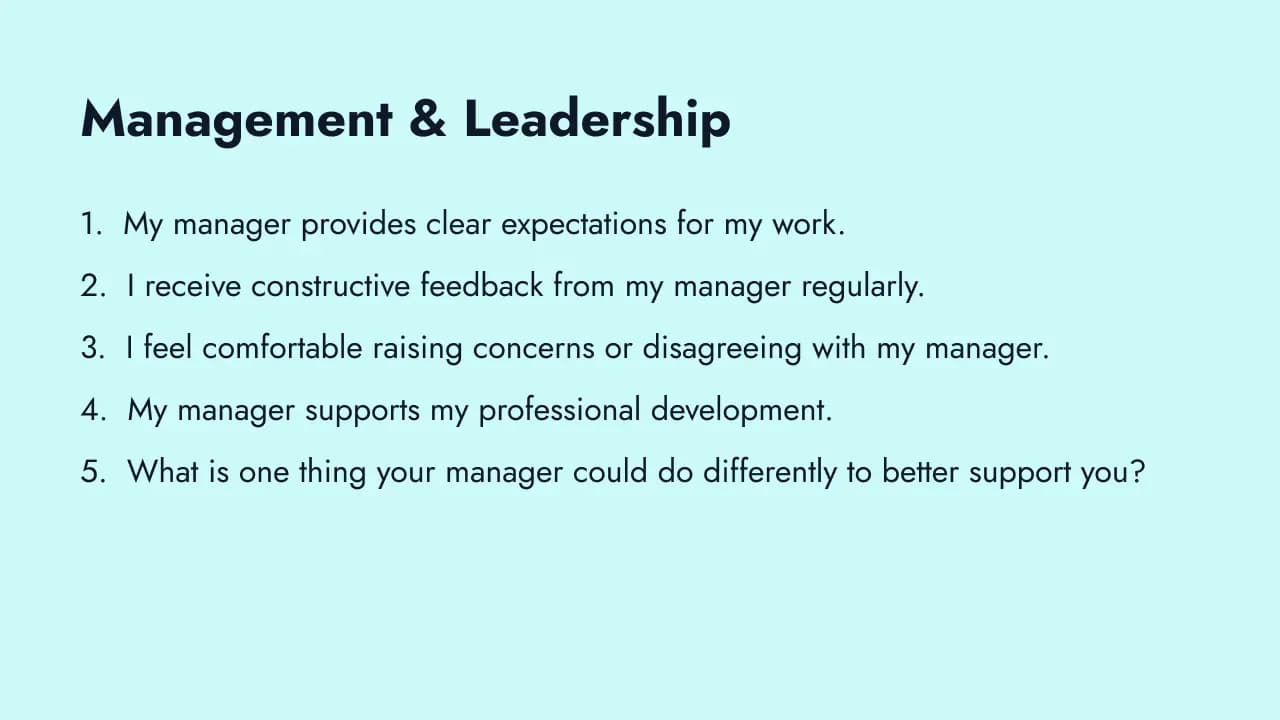
Management quality is among the strongest predictors of employee engagement and retention. The Harter, Schmidt & Hayes (2002) meta-analysis found that manager-level engagement conditions, including clear expectations, regular feedback, and development support, explained a significant share of business unit performance variance across nearly 8,000 teams.
17. My manager provides clear expectations for my work.
- Type: Likert (1-5) | Essential
- Clarity is the foundation of effective management. When expectations are ambiguous, employees waste energy guessing what success looks like instead of achieving it.
18. I receive constructive feedback from my manager regularly.
- Type: Likert (1-5) | Essential
- "Regularly" is the key word. Annual reviews are not enough. Kluger & DeNisi (1996) in a Psychological Bulletin meta-analysis of 607 effect sizes found that feedback interventions significantly improve performance, with the frequency and quality of feedback being critical moderators of that effect.
19. My manager genuinely cares about my well-being.
- Type: Likert (1-5) | Recommended
- Well-being concern separates managers from bosses. Post-pandemic, this question has become a stronger predictor of retention than compensation in many industries.
20. I feel comfortable raising concerns or disagreeing with my manager.
- Type: Likert (1-5) | Essential
- Measures psychological safety at the team level. Low scores indicate a fear-based culture where problems go unreported until they become crises.
21. My manager supports my professional development.
- Type: Likert (1-5) | Recommended
- Development support signals investment in the employee's future. Low scores here correlate with high turnover among high performers who want to grow.
22. Senior leadership communicates a clear vision for the company's future.
- Type: Likert (1-5) | Recommended
- Separates direct manager feedback from executive leadership assessment. Employees can love their manager but distrust the company's direction.
23. Do you have regular 1-on-1 meetings with your manager?
- Type: Binary (Yes/No) | Recommended
- A factual check. If significant numbers of employees lack regular 1-on-1s, you have a structural management problem, not just a perception issue.
24. What is one thing your manager could do differently to better support you?
- Type: Open-ended | Essential
- Anonymity is critical here. This question surfaces specific, actionable management improvements that employees would never share in a face-to-face setting.
Career Growth and Development (Questions 25-30)
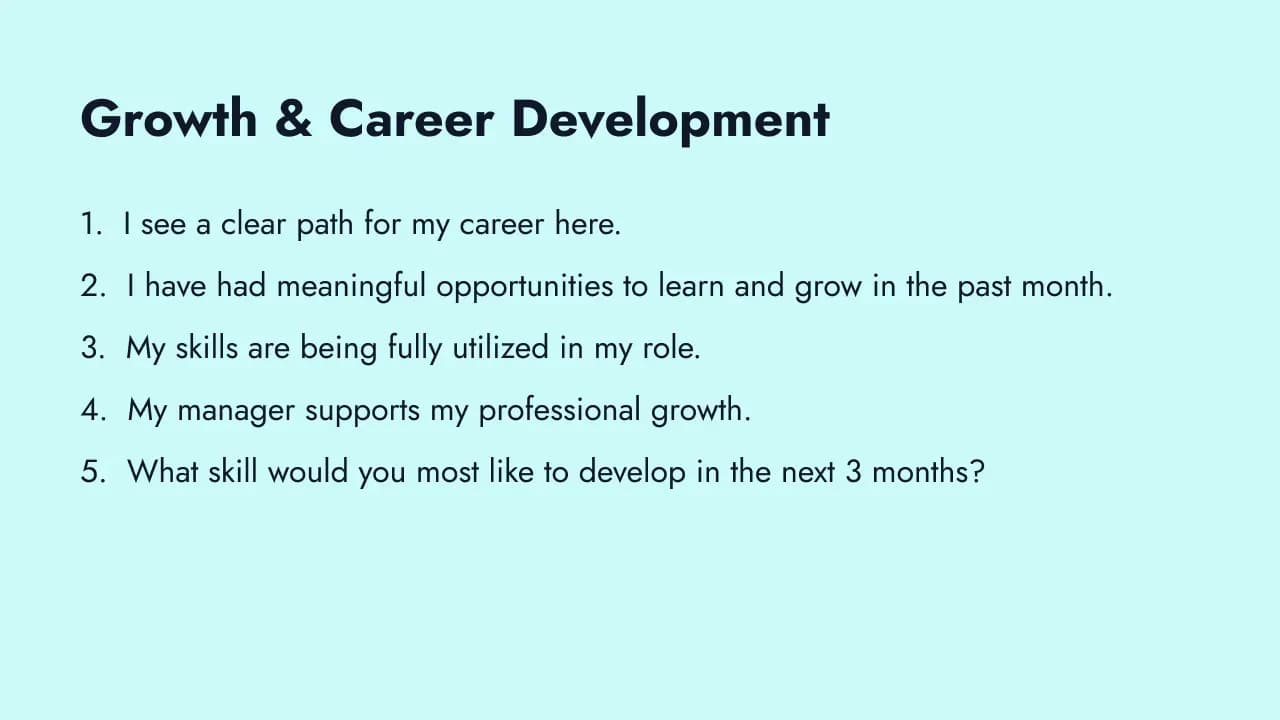
Growth opportunity is among the most cited reasons employees stay at a company and among the most common reasons they leave. Deci & Ryan's Self-Determination Theory (2000) identifies competence (the ability to grow and develop) as one of three fundamental psychological needs whose satisfaction predicts sustained intrinsic motivation. Organizations that invest in development are addressing a core human need, not just a HR nicety.
25. I see a clear path for career advancement at [company].
- Type: Likert (1-5) | Essential
- Career path clarity is a retention predictor across all levels. When employees cannot see their next step, they start looking externally.
26. I have access to learning and development opportunities that are relevant to my goals.
- Type: Likert (1-5) | Essential
- "Relevant to my goals" is the critical qualifier. Generic training programs score low here even when budget is high. Personalization matters.
27. My skills are being fully utilized in my current role.
- Type: Likert (1-5) | Recommended
- Underutilization is a hidden engagement killer. Employees who feel their skills are wasted become disengaged faster than those who feel challenged.
28. I have had a meaningful conversation about my career development in the past 6 months.
- Type: Binary (Yes/No) | Recommended
- A factual check that complements the perception-based questions. If a majority answer "No," the issue is structural, not perceptual.
29. I feel challenged in my work in a way that helps me grow.
- Type: Likert (1-5) | Nice-to-have
- Differentiates between productive challenge (flow state) and overwhelming challenge (burnout). The framing "in a way that helps me grow" is intentional.
30. What skill or experience would you most like to develop in the next year?
- Type: Open-ended | Recommended
- Gives L&D teams direct input for program planning. Aggregated responses reveal organization-wide skill gaps and development priorities.
Culture and Work Environment (Questions 31-36)
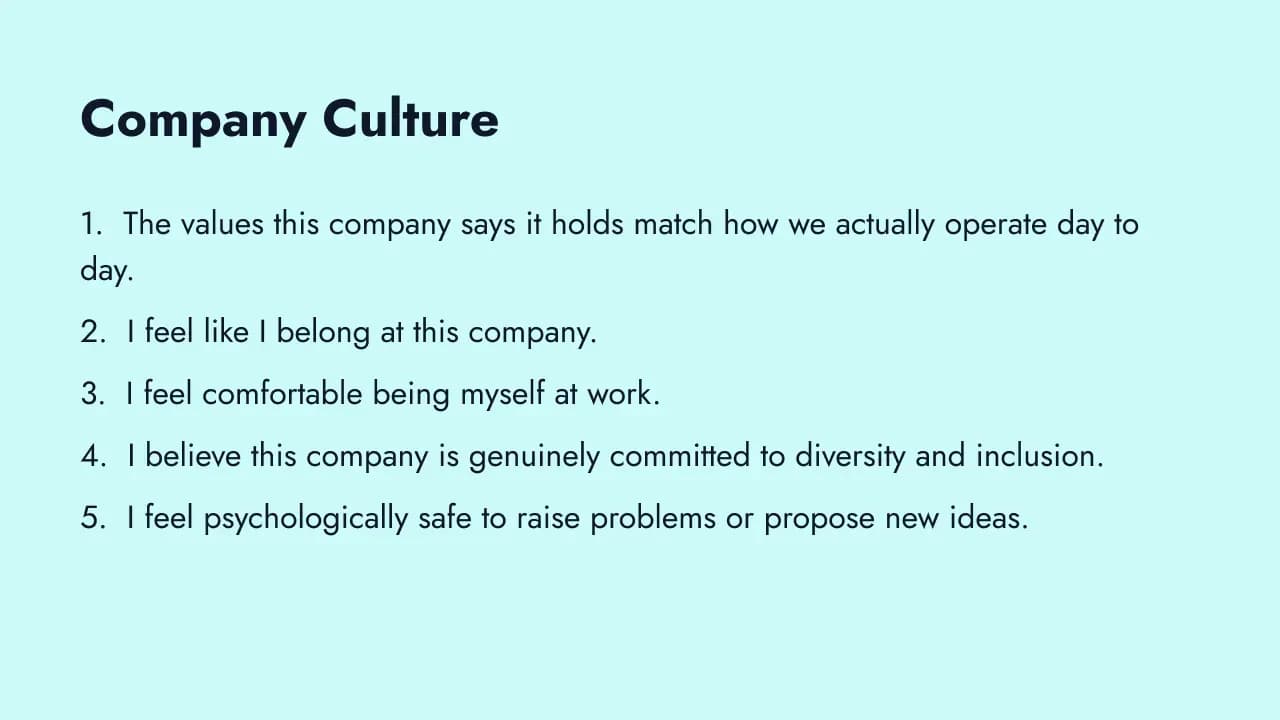
Culture questions measure belonging, inclusion, and alignment with values. These are the hardest to improve but have the longest-lasting impact on retention and employer brand.
31. I feel a sense of belonging at [company].
- Type: Likert (1-5) | Essential
- Belonging is the emotional foundation of culture. Baumeister & Leary (1995) identified the need to belong as a fundamental human motivation in Psychological Bulletin, with insufficient belonging associated with negative outcomes including reduced motivation, increased anxiety, and lower performance. Employees who do not belong disengage before they quit.
32. [Company] values diversity, equity, and inclusion in meaningful ways.
- Type: Likert (1-5) | Essential
- "In meaningful ways" prevents virtue-signaling agreement. Employees can distinguish between performative DEI statements and genuine inclusive practices.
33. I feel comfortable being myself at work.
- Type: Likert (1-5) | Recommended
- Measures psychological safety at the organizational level. Low scores suggest a culture where employees feel they need to mask parts of their identity.
34. I feel comfortable speaking up with ideas or concerns without fear of negative consequences.
- Type: Likert (1-5) | Essential
- A direct measure of psychological safety. Organizations where employees feel safe to speak up catch problems earlier, innovate faster, and retain talent longer.
35. The company lives its stated values in everyday decisions.
- Type: Likert (1-5) | Recommended
- Values-action alignment. A gap between stated values and daily behavior creates cynicism faster than having no stated values at all.
36. What is one thing we could do to make [company] a more inclusive workplace?
- Type: Open-ended | Essential
- Open-ended DEI questions surface blind spots that leadership may not see. Anonymity is especially important here since employees from underrepresented groups may face real risk in identifying themselves.
Open-Ended and Exit Questions (Questions 37-42)
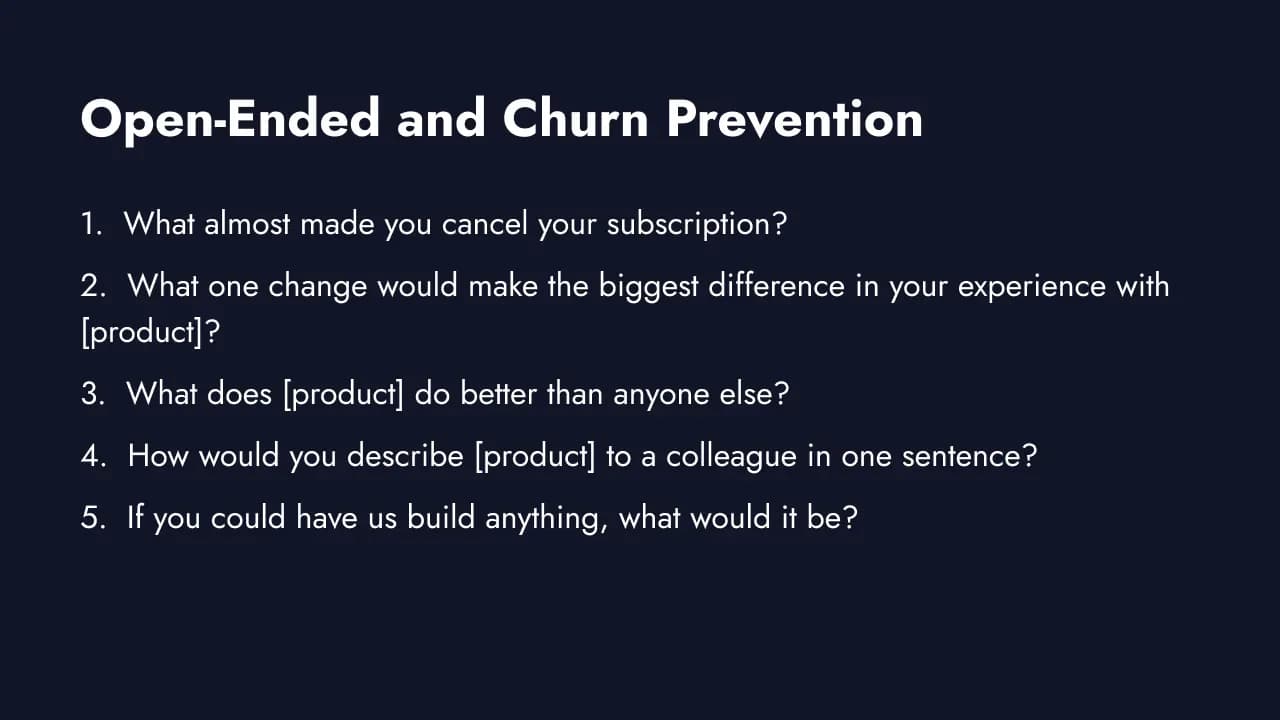
These questions surface insights that structured questions miss entirely. Use them strategically: open-ended questions have an 18% nonresponse rate compared to 1-2% for closed-ended (Pew Research Center), so limit them to 2-3 per survey.
37. What is the one thing you would change about working at [company]?
- Type: Open-ended | Essential
- The single most powerful question on any employee survey. The "one thing" constraint forces respondents to identify their top priority, making responses far more actionable than an open "any feedback?" prompt.
38. What almost made you leave [company] in the past 6 months?
- Type: Open-ended | Essential
- Identifies near-miss churn triggers. These are the issues that did not cause departure this time but will next time if left unaddressed. This question is especially valuable in anonymous surveys where employees feel safe being honest.
39. What do we do well that we should keep doing?
- Type: Open-ended | Recommended
- Equally important as identifying problems. Knowing your strengths prevents you from accidentally "fixing" things that employees actually value.
40. If you could have a candid conversation with the CEO, what would you say?
- Type: Open-ended | Nice-to-have
- Creates a safe channel for upward feedback. Often surfaces strategic concerns that do not emerge through normal management layers.
41. What would make you stay at [company] for the next 3 years?
- Type: Open-ended | Recommended
- Forward-looking retention question. The answers reveal what employees value most, whether that is growth, compensation, flexibility, or mission alignment.
42. Is there anything else you would like to share that we did not ask about?
- Type: Open-ended | Recommended
- The catch-all. Some of the most valuable insights come from questions you did not think to ask. Always include this as your final question.
Employee Survey Questions for Managers (Questions 43-52)
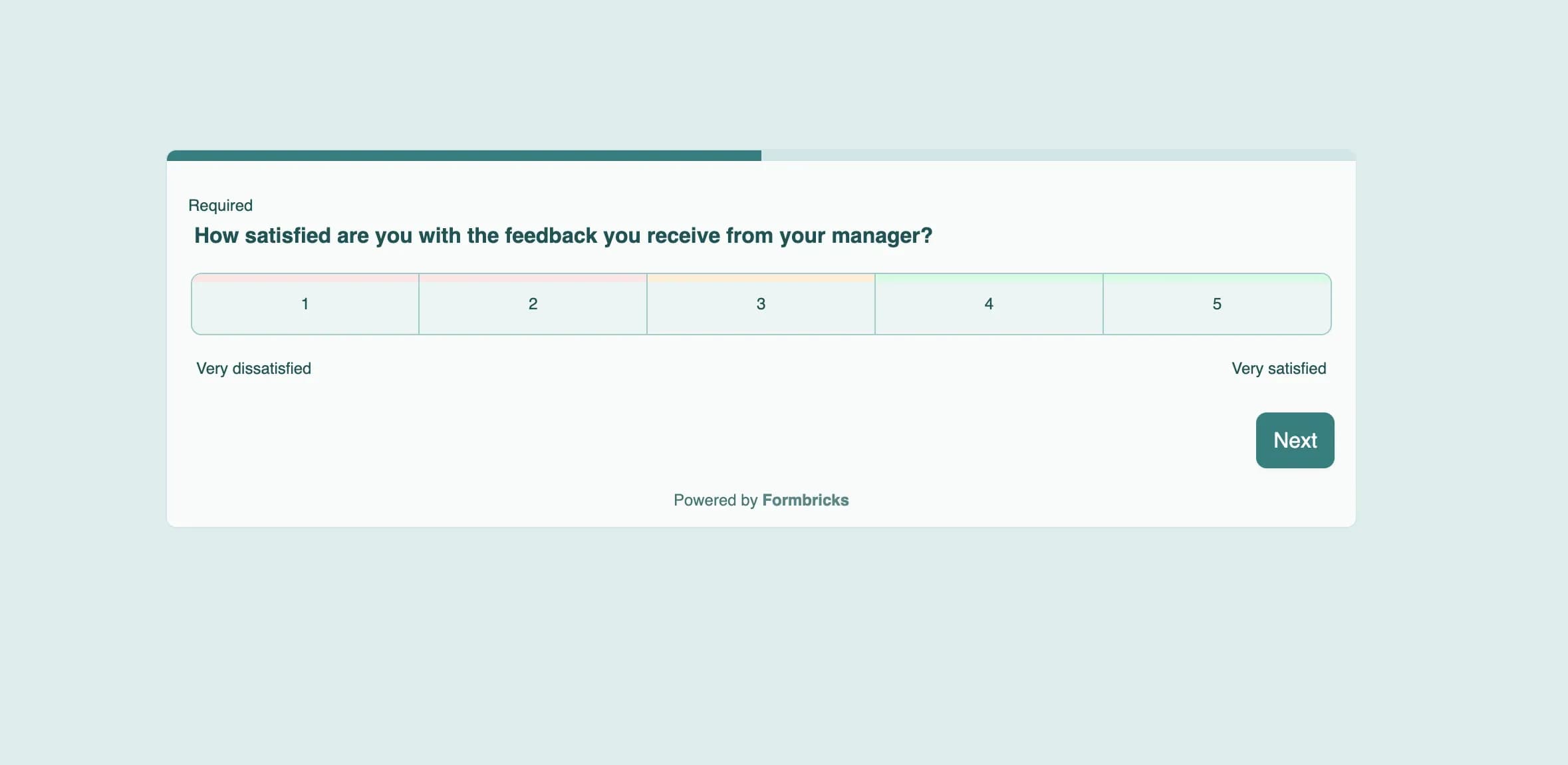
Managers are employees too. They face pressures, resource constraints, and clarity gaps that standard employee surveys never capture because the questions are designed for individual contributors. Surveying managers separately gives you the upward feedback channel most organizations are missing.
43. Do you have a clear understanding of the strategic priorities your team should focus on?
- Type: Likert (1-5) | Essential
- Managers cannot give their teams clarity if they lack it themselves. Low scores here explain why teams consistently report unclear expectations in their own surveys.
44. Do you have the authority you need to make the decisions required for your team to succeed?
- Type: Likert (1-5) | Essential
- Empowerment gap is one of the most common manager frustrations. When managers must escalate routine decisions, it slows teams and erodes their credibility with their direct reports.
45. Do you feel supported by your own manager and by senior leadership?
- Type: Likert (1-5) | Recommended
- Managers cannot sustain a supportive environment for their teams if they feel unsupported themselves. This question surfaces the cascade effect of poor executive communication.
46. Do you have the time and resources to develop and coach the people on your team?
- Type: Likert (1-5) | Essential
- When managers are stretched too thin, coaching is the first thing to go. This question separates managers who do not prioritize development from those who want to but cannot.
47. What is the biggest obstacle preventing your team from doing their best work?
- Type: Open-ended | Essential
- Managers see blockers that employees do not always surface. This question often produces the most actionable operational improvement data in any survey.
48. Do you feel equipped to support team members who are struggling with wellbeing or performance?
- Type: Likert (1-5) | Recommended
- Managers are increasingly the first responders for employee wellbeing issues. Low scores signal a need for training, not just policy.
49. How often do you receive feedback on your own performance as a manager?
- Type: Multiple choice (Weekly / Monthly / Quarterly / Rarely / Never) | Recommended
- Managers who do not receive regular feedback cannot improve. This question reveals whether your organization has a functional feedback culture up the chain, not just down.
50. What one change would most improve your ability to support your team?
- Type: Open-ended | Essential
- The highest-signal question for manager development programs. Responses often cluster around process problems, tool gaps, or training needs that HR can directly address.
51. Do you feel the organization invests in your development as a leader?
- Type: Likert (1-5) | Recommended
- Manager development is often the most underfunded part of L&D. Low scores explain why frontline management quality varies so much across the same organization.
52. What would make you feel more confident and effective in your role as a manager?
- Type: Open-ended | Recommended
- Forward-looking development input from the people responsible for executing your people strategy.
Fun Employee Survey Questions (Questions 53-60)
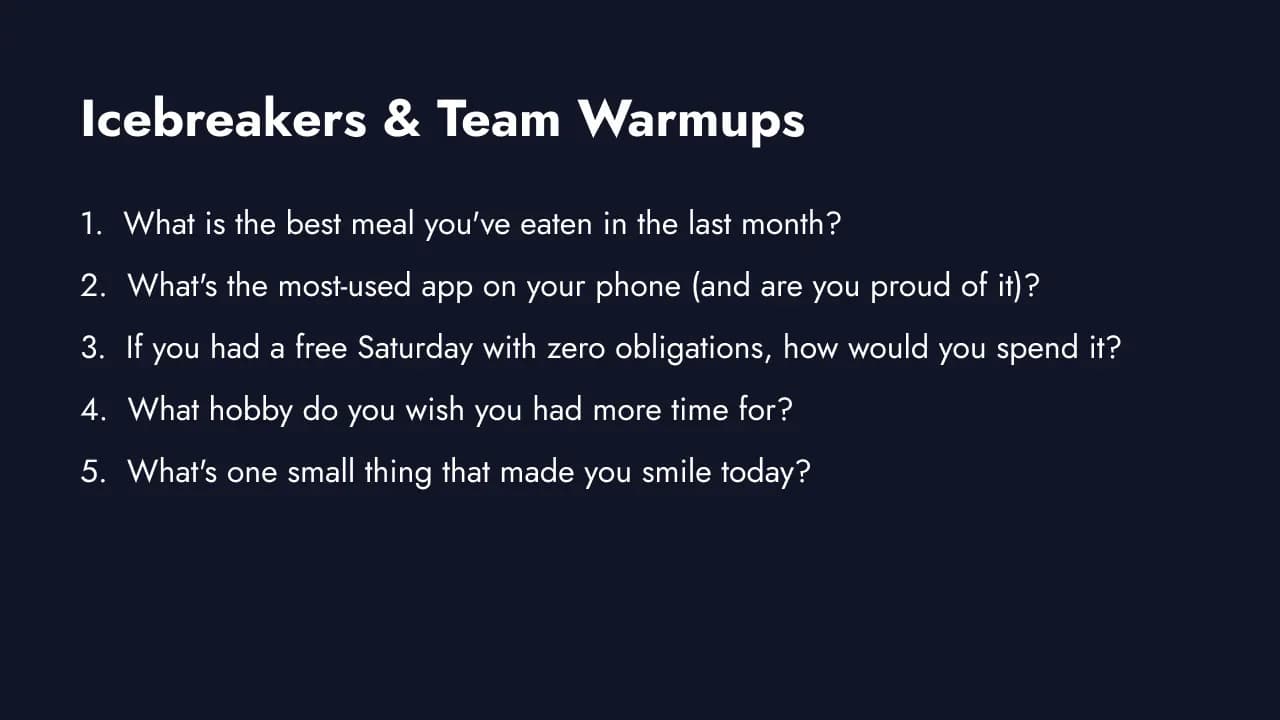
Not every question needs to measure something. Fun questions build survey rapport, reduce fatigue, and reveal personality and culture fit in ways that structured questions cannot. Use 1-2 of these at the beginning of a pulse survey to warm up respondents before the more substantive questions.
53. If you could add one perk to the benefits package (no budget limit), what would it be?
- Type: Open-ended | Nice-to-have
- Reveals what employees actually value. Answers range from predictable (more vacation) to surprisingly practical (better coffee). High-frequency answers may be more achievable than expected.
54. What is your go-to way to recharge outside of work?
- Type: Open-ended | Nice-to-have
- A low-stakes warm-up question that humanizes the survey. Helps HR and managers understand what employees care about outside the office.
55. If our company were a TV show, which one would it be?
- Type: Open-ended | Nice-to-have
- Captures culture perception through analogy. Unexpected answers reveal whether employees see the company as a well-run drama, a chaotic comedy, or something else entirely.
56. What song would be the soundtrack to your typical workday?
- Type: Open-ended | Nice-to-have
- A quick mood indicator disguised as a fun question. High-energy responses signal engagement. "Funeral march" type answers are data points worth investigating.
57. What is one thing your colleagues would be surprised to learn about you?
- Type: Open-ended | Nice-to-have
- Team-building question that encourages connection across departments. Works especially well in remote or hybrid teams where informal interaction is limited.
58. If you could work from anywhere in the world for one month, where would you go?
- Type: Open-ended | Nice-to-have
- A low-stakes question that reveals how employees think about flexibility and remote work. Also a useful conversation starter for managers running team check-ins.
59. What is the weirdest or funniest thing that has happened at work recently?
- Type: Open-ended | Nice-to-have
- Invites lighthearted storytelling. A survey where employees laugh once completes at a higher rate than one where every question is serious.
60. If you could swap jobs with anyone in the company for one day, who would it be?
- Type: Open-ended | Nice-to-have
- Surfaces curiosity about other functions and potential cross-team collaboration interests. Patterns in the answers can inform job shadowing programs and internal mobility initiatives.
Wellbeing and Mental Health (Questions 61-70)
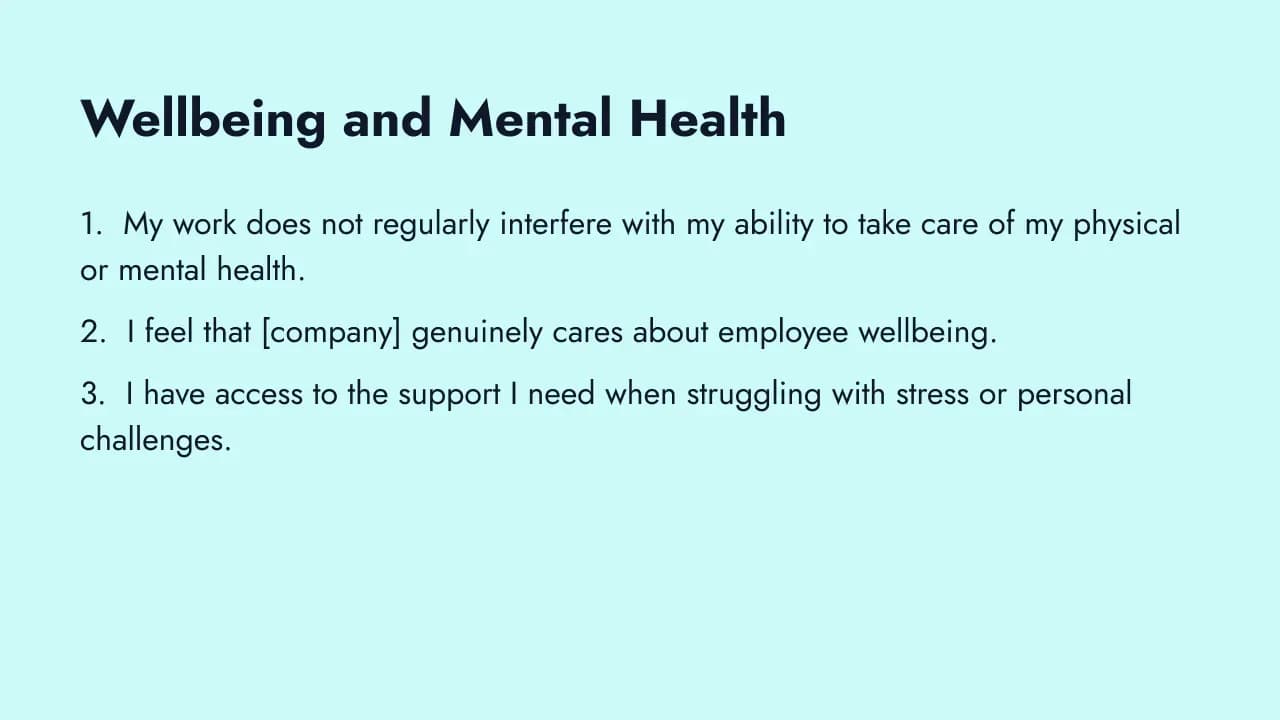
Employee wellbeing has moved from a nice-to-have to a business-critical measurement area. Oswald, Proto & Sgroi (2015) in the Journal of Labor Economics found that happy employees are 12% more productive than their counterparts in neutral or negative states. Wellbeing questions should always be included in comprehensive engagement surveys, run with guaranteed anonymity, and followed by visible support actions.
61. I feel my overall wellbeing is supported by [company].
- Type: Likert (1-5) | Essential
- A high-level wellbeing perception question. Low scores indicate employees believe wellbeing is not a genuine organizational priority.
62. My current workload is sustainable without sacrificing my health or personal life.
- Type: Likert (1-5) | Essential
- Burnout screening at the organizational level. When this score drops across a team, it is a warning sign for upcoming turnover and performance decline.
63. I feel comfortable talking about mental health challenges at work without fear of judgment.
- Type: Likert (1-5) | Recommended
- Psychological safety around mental health is still low in many organizations. Low scores predict that struggling employees will hide problems until they become crises.
64. Do you know where to access mental health or wellbeing resources at [company]?
- Type: Binary (Yes / No) | Recommended
- Awareness check. Many companies provide EAP programs and wellbeing benefits that employees have never heard of. A "No" majority here is a communication failure, not a benefit gap.
65. How often do you feel stressed to a point that it affects your ability to do your job well?
- Type: Multiple choice (Rarely / Sometimes / Often / Very often / Almost always) | Essential
- Workload stress frequency data. Segment by team and role to identify structural overload rather than individual stress responses.
66. Do you feel you have enough energy at the end of the workday to enjoy your personal time?
- Type: Likert (1-5) | Recommended
- A subtle burnout indicator. Chronically low scores signal that work is draining employees beyond the hours they are clocked in.
67. How satisfied are you with the flexibility you have to manage your personal and professional responsibilities?
- Type: Likert (1-5) | Recommended
- Flexibility satisfaction directly predicts retention, particularly among employees with caregiving responsibilities or non-standard schedules.
68. Do you feel that [company]'s workload expectations are realistic given your role and resources?
- Type: Likert (1-5) | Essential
- Realism check on organizational expectations. When this question scores low across departments, it points to systemic understaffing or poor planning rather than individual time management issues.
69. What one thing could [company] do to better support your wellbeing at work?
- Type: Open-ended | Essential
- Direct improvement input. Responses here often surface practical changes (protected meeting-free hours, better manager boundary-setting, mental health days) that are cheaper than replacing burned-out employees.
70. Do you feel encouraged to take your full vacation and disconnect from work when you do?
- Type: Likert (1-5) | Recommended
- A low recovery culture is one of the most reliable predictors of burnout. Even companies with generous vacation policies can have cultures that implicitly punish employees for actually using them.
Employee Survey Best Practices
Writing good questions is half the battle. How you structure, distribute, and follow up on your survey determines whether you get honest data or polite fictions.
Guarantee anonymity. This is non-negotiable for honest employee feedback. If employees suspect their responses can be traced back to them, they will self-censor on every sensitive topic: management quality, compensation, culture problems. Use a tool that enforces anonymity by design. For teams that need full data control, self-hosting with Formbricks means survey data never leaves your infrastructure and you can guarantee employees that no one can trace their responses.
Keep it under 15 questions per survey. Survey fatigue is real. Completion rates fall sharply as length increases. Pick the 10-15 most important questions from this guide for each survey and rotate topics across quarters rather than asking everything at once.
Run pulse surveys quarterly, full engagement annually. A single annual survey creates a 12-month blind spot. Quarterly pulse surveys (3-5 questions) track sentiment trends between major surveys. They also show employees that you care about their experience year-round, not just during "survey season."
Share results with employees. Transparency builds trust. After analyzing results, share a summary of key findings with the entire company. Be specific: "72% of you said you want more career development conversations. Here is what we are doing about it." Organizations that share results and act on them see higher participation in future surveys because employees believe the process is genuine.
Act on feedback and communicate changes. The fastest way to kill survey trust is to ask for feedback and do nothing with it. Pick 2-3 high-impact items from each survey, create an action plan, and communicate progress. For a detailed framework, see our guide on closing the feedback loop.
Avoid survey fatigue. Do not survey the same group more than once per month. If you need broad coverage, stagger surveys across teams. Respect employees' time and they will give you better data in return.
Common Employee Survey Mistakes
These mistakes silently erode survey trust and data quality. Each one is common and each one is fixable.
Making surveys too long. If your employee survey takes more than 10 minutes, you will lose a significant portion of respondents. Survey fatigue is real and predictable. Respect the time employees are giving you by asking only the questions you will actually act on.
Not guaranteeing anonymity. Without anonymity, you get socially desirable answers instead of honest ones. "My manager is great" is easy to write when your manager might see it. The most valuable employee feedback, the kind that surfaces real problems, only comes when people feel safe.
Asking but not acting. Employees notice when nothing changes after a survey. After two cycles of ignored feedback, participation drops and cynicism rises. Before launching any survey, decide in advance how you will act on the results.
Leading questions that push positive answers. "How much do you love working at [company]?" is not a survey question. It is a compliment disguised as research. Use neutral framing: "How would you describe your experience working at [company]?" Let respondents form their own judgment.
Surveying too frequently without showing results. Monthly surveys without any follow-up communication feel extractive, not caring. Every survey you send should be preceded by a brief update on what changed since the last one.
How to Distribute Employee Surveys
The right distribution channel affects both response rates and data quality. Match your method to your workforce.
| Channel | Expected Response Rate | Best For | Key Tip |
|---|---|---|---|
| In-app / On-site | 25-30% | Digital-first teams using internal tools | Captures feedback in the flow of work, minimal friction |
| 40-60% (internal) | Most employees, asynchronous completion | Send from a recognized sender, personalize subject lines | |
| Slack / Teams integration | 30-50% | Tech teams, real-time culture | Works well for pulse surveys, keep to 3-5 questions |
| Anonymous link | 20-40% | Broad distribution, sensitive topics | Share via multiple channels, set a clear deadline |
| Kiosk / QR code | 15-25% | Frontline workers, manufacturing, retail | Place where employees naturally pause (break rooms, exits) |
For digital-first teams, in-app distribution with Formbricks captures feedback at the moment employees are already engaged with internal tools. With granular targeting, you can show surveys to specific segments based on department, role, or tenure.
For more on channel strategies and timing, see our guide on survey distribution methods.
How to Analyze Employee Survey Results
Collecting data is step one. Turning it into decisions is where the value lives.
Segment by department, tenure, and role. Averages mask important patterns. A 4.0 average engagement score might hide the fact that engineering rates engagement at 4.5 while customer support rates it at 3.2. Break results down by every meaningful dimension: department, tenure bracket, management level, location, and remote vs. in-office.
Look for patterns, not outliers. One frustrated employee is anecdotal. Fifteen employees raising the same concern is a pattern. Group open-ended responses by theme and count frequency. The intersection of high frequency and high intensity is where to focus first.
Benchmark against previous surveys. Internal benchmarks (vs. last quarter, vs. last year) matter more than external ones. Track trends over time. A score that dropped from 4.2 to 3.8 in one quarter demands attention, even if 3.8 is technically "above average."
Cross-tabulate engagement by manager. This is one of the most powerful analyses you can run. If one team's engagement scores are consistently lower than peers, the common variable is often the manager. This data supports targeted coaching instead of broad, unfocused training programs.
Prioritize by impact and feasibility. Map issues on a 2x2 matrix: impact (how many employees mention it and how strongly they feel) versus feasibility (how quickly you can address it). Quick wins build momentum and demonstrate that feedback matters.
Close the loop. Share key findings with stakeholders and communicate changes back to employees: "You told us X, so we are doing Y." This is the single most important step. See our guide on closing the feedback loop for a detailed framework.
Free Employee Survey Template
Skip the blank page. Formbricks offers free, open-source survey templates you can deploy in minutes. Each template includes pre-written questions, smart targeting rules, and built-in analytics.
Why Formbricks for employee surveys:
- Open source and self-hostable. Your employee survey data stays on your infrastructure. No third-party access, no data sharing, full compliance with internal security policies. This matters when you are asking employees to share sensitive feedback.
- Built-in anonymity. Formbricks supports anonymous surveys by design, so employees trust that their responses cannot be traced back to them.
- Flexible distribution. Deploy via in-app widget, link survey, or website embed. Reach desk workers and frontline teams with the same tool.
- No engineering lift. Non-technical HR and People teams can set up, customize, and launch surveys without developer support.
- Privacy-first. GDPR-compliant out of the box. For teams with strict data requirements, see our guide on GDPR-compliant survey tools.
Related templates:
- Employee Engagement Survey for engagement measurement
- Employee Satisfaction Survey for satisfaction tracking
- Employee Benefits Survey for benefits feedback
- Candidate Experience Survey for hiring process feedback
How to get started:
- Sign up at formbricks.com (free tier available, no credit card required)
- Choose the employee survey template, the candidate experience survey template, or start from scratch
- Customize the questions from this guide for your company
- Set targeting rules and anonymity preferences
- Launch and monitor responses in real time from your dashboard
Get Your Free Employee Survey Template →
Frequently Asked Questions
Try Formbricks now