
60+ Market Research Survey Questions (With Examples & Template)

Johannes
CEO & Co-Founder
13 Minutes
May 3rd, 2026
Most market research surveys fail before the first response comes in. The questions are either too broad to produce actionable answers, too leading to produce honest ones, or aimed at the wrong people entirely. The result is data that confirms what you already believe rather than challenging it.
This guide gives you 60+ market research survey questions organized by research objective. Each question includes a recommended type and guidance on when to use it. It also covers the 7 basic questions every market research study should answer before you write a single survey item.
What you will find in this guide:
- The 7 basic market research questions framework
- 60+ questions organized into 8 categories, including psychographic and lifestyle questions
- Question type and usage guidance for each question
- Best practices for designing effective market research surveys
- Common mistakes and how to avoid them
- A free survey template ready to deploy
What Is a Market Research Survey?
A market research survey is a structured questionnaire designed to collect data about your target market, customers, and competitive landscape. It is a form of primary research, meaning you gather data directly from the source rather than relying on existing reports or databases (secondary research).
Primary research gives you data specific to your market, your audience, and your questions. Secondary research provides context and benchmarks. Strong market research programs use both, but surveys are the most scalable form of primary research available to most teams.
Market research surveys fall into several types based on the objective:
- Brand awareness surveys measure how well your target market knows your brand and what associations they hold
- Usage and attitude surveys explore how people currently use products in your category and how they feel about them
- Concept tests evaluate new product ideas, features, or messaging before you invest in building them
- Pricing studies determine willingness to pay and optimal price points
- Competitive analysis surveys reveal how customers perceive you relative to alternatives
- Brand tracking surveys measure brand health metrics over time to spot trends
Each type requires different questions, different respondent pools, and different analysis methods. The questions below are organized by these research objectives so you can pick the ones that match your study.
The 7 Basic Market Research Questions
Before writing a single survey question, answer these 7 questions about your research objective. They are the foundation of any well-designed study.
| Question | What it defines | Example |
|---|---|---|
| Who | The target respondents | "Mid-market SaaS buyers who have evaluated more than one vendor" |
| What | The specific topic or decision | "Which features justify a premium price tier?" |
| When | The relevant time window | "In the past 6 months" |
| Where | The purchase or usage context | "Enterprise procurement teams, not individual contributors" |
| Why | The research objective | "To decide which features to prioritize in the next release" |
| How | The research method | "Online survey with 200 qualified respondents" |
| How many | The required sample size | "150+ responses per segment to reach 95% confidence" |
If you cannot answer all seven before launching, your survey is not ready. The questions you write will drift without a clear frame around them.
60+ Market Research Survey Questions by Objective
Each question below includes a recommended question type and a guidance note. Customize the bracketed text for your specific brand, product, or category.
Brand Awareness and Perception (Questions 1-8)
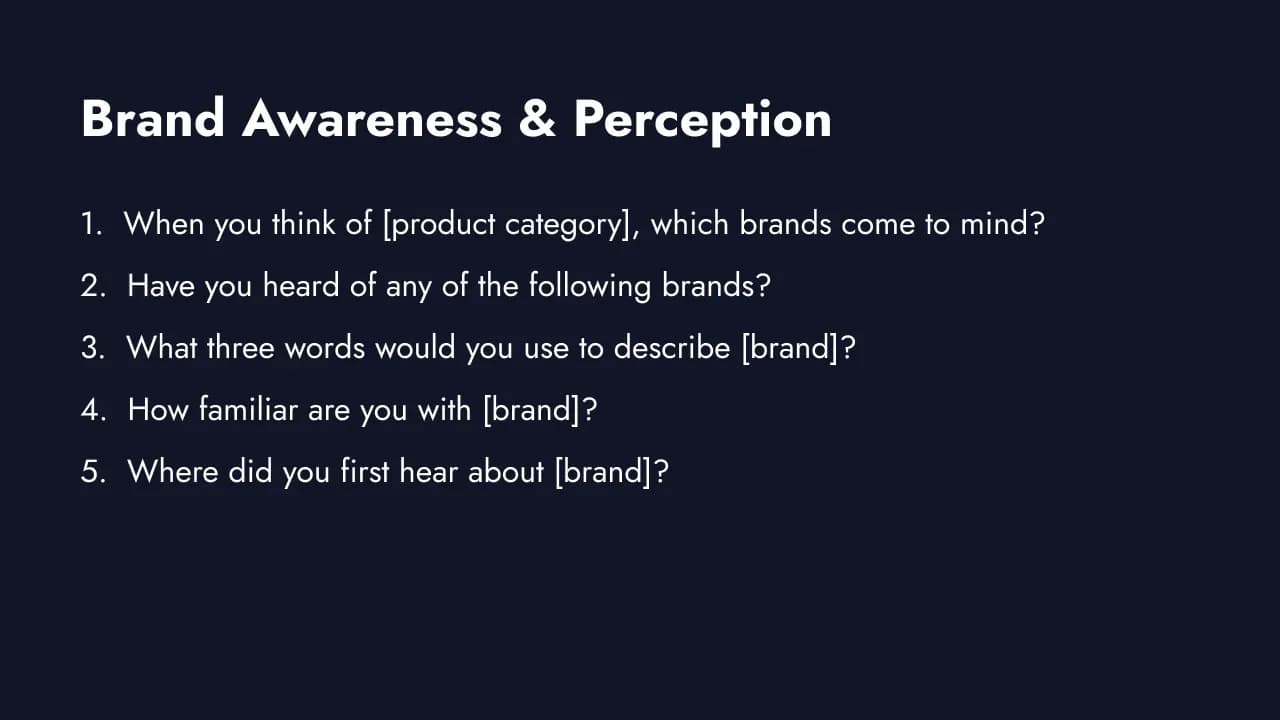
These questions measure how well your target audience knows your brand and what they associate with it. Run these before major campaigns to set a baseline, then repeat quarterly or after launches to track shifts.
1. When you think of [product category], which brands come to mind?
- Type: Open-ended (unaided recall) | Essential
- Unaided recall is the gold standard for brand awareness. If respondents name your brand unprompted, you have strong top-of-mind awareness.
2. Have you heard of any of the following brands? [list including your brand]
- Type: Multiple choice, select all that apply (aided recall) | Essential
- Aided recall measures recognition. Compare your aided recall percentage against competitors to see where you stand in the category.
3. What comes to mind when you think of [brand]?
- Type: Open-ended | Essential
- Captures raw brand associations in the respondent's own language. Aggregate responses into themes to map your perceived positioning.
4. How would you describe [brand] to someone who has never heard of it?
- Type: Open-ended | Recommended
- Reveals how customers frame your value proposition. Their language is often more effective than your marketing copy for resonating with new prospects.
5. How familiar are you with [brand]?
- Type: Likert (Not at all familiar / Slightly familiar / Moderately familiar / Very familiar / Extremely familiar) | Essential
- Quantifies awareness beyond simple yes/no. Segment by familiarity level to understand where prospects drop off in the awareness funnel.
6. Where did you first hear about [brand]?
- Type: Multiple choice (Social media / Search engine / Friend or colleague / Advertisement / News article / Event / Other) | Recommended
- Channel attribution from the customer's perspective. Often reveals different patterns than what your analytics tools report.
7. What three words would you use to describe [brand]?
- Type: Open-ended | Recommended
- A constrained version of question 3 that forces respondents to distill their perception. Useful for building word clouds and tracking perception shifts over time.
8. How does [brand] compare to [competitor] in your mind?
- Type: Scale (Much worse / Somewhat worse / About the same / Somewhat better / Much better) | Recommended
- Direct competitive perception. Pair with open-ended follow-up to understand the "why" behind the rating.
Purchase Behavior and Decision Making (Questions 9-18)
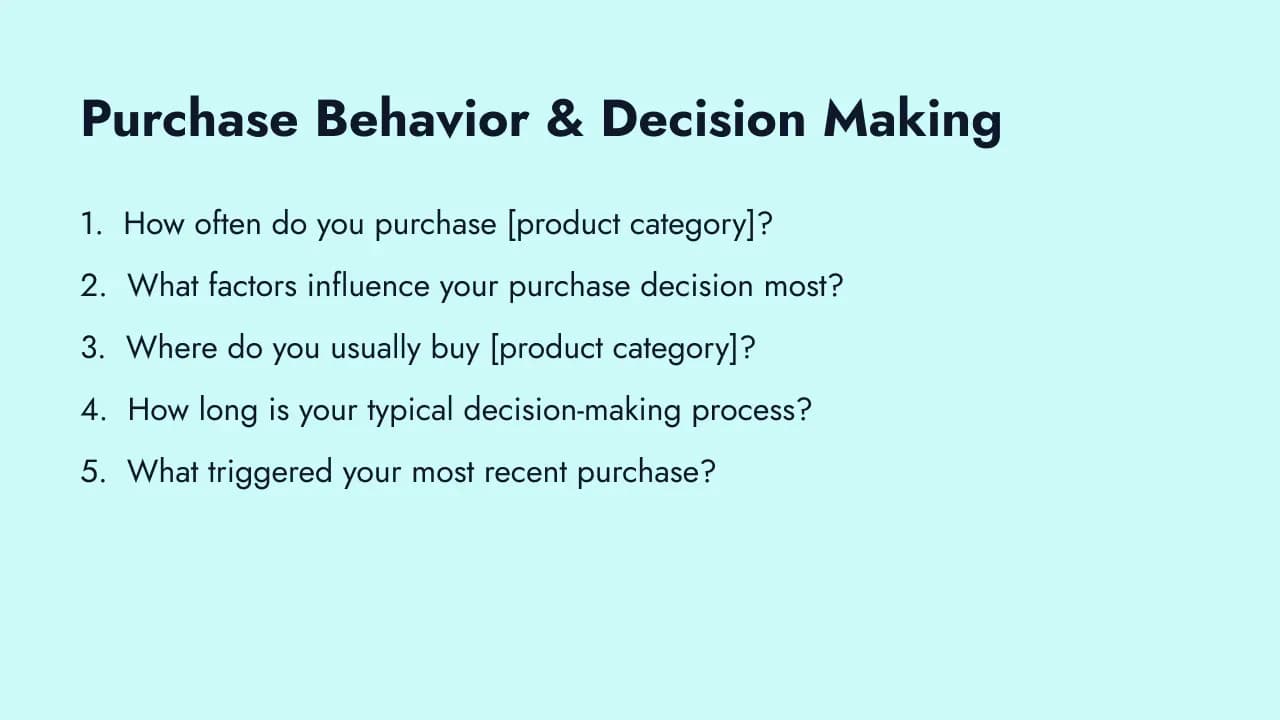
These questions reveal how your target market actually buys in your category. Behavioral questions ("What did you do?") produce more reliable data than hypothetical ones ("What would you do?"). A purchase intention survey can help you structure these questions effectively. Use these in user research to map the real purchase journey.
9. How often do you purchase [product category]?
- Type: Multiple choice (Weekly / Monthly / Quarterly / A few times a year / Rarely / Never) | Essential
- Purchase frequency establishes the baseline for your market sizing. Cross-tabulate with demographics to identify your heaviest buyer segments.
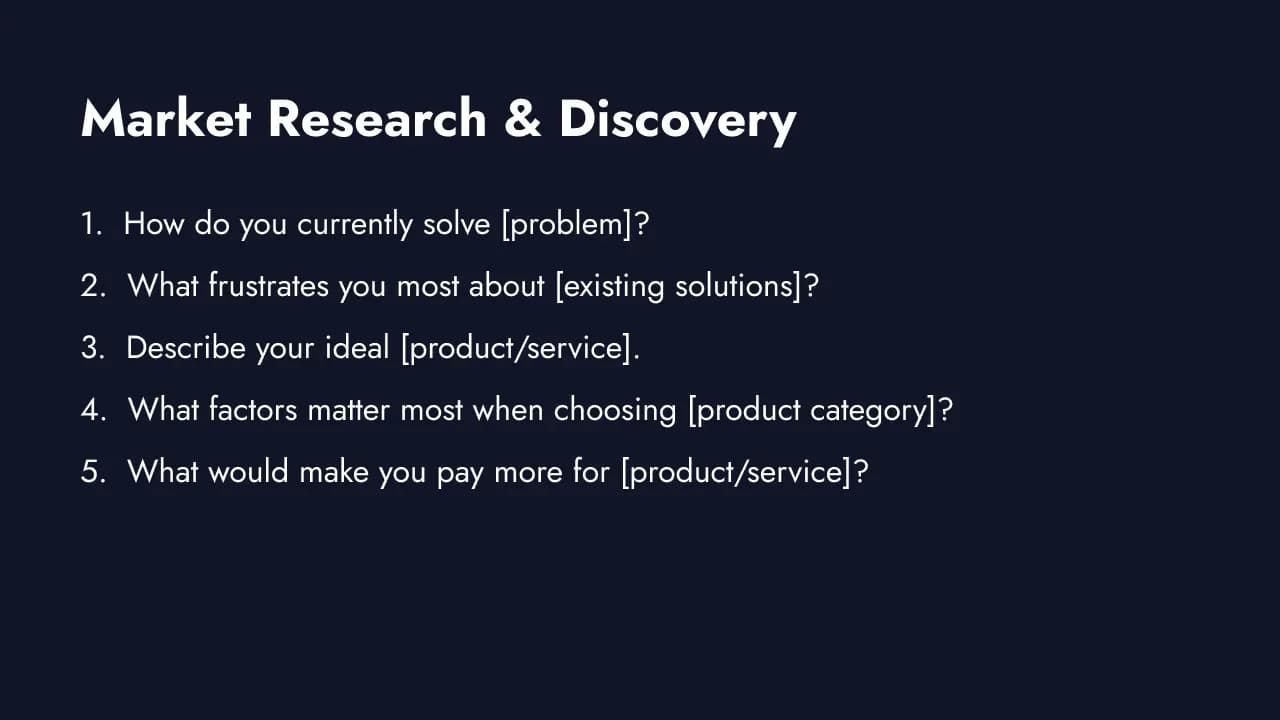
10. What factors influence your purchase decision most when choosing a [product category]?
- Type: Ranking (rank top 3 from list: price, quality, brand reputation, reviews, convenience, features, recommendations) | Essential
- Ranking forces prioritization. "Select all that apply" inflates the importance of every factor. Ranking reveals what actually tips the scale.
11. How much do you typically spend on [product category] per [time period]?
- Type: Multiple choice with ranges | Recommended
- Spending data helps you position pricing and estimate market value. Use ranges rather than exact amounts to reduce nonresponse on financial questions.
12. Where do you usually buy [product category]?
- Type: Multiple choice, select all that apply (Online marketplace / Brand website / Retail store / Specialty shop / Social media / Other) | Recommended
- Channel preference data informs your distribution strategy. A shift from retail to online may signal the need to invest in e-commerce.
13. Who influences your purchase decisions for [product category]?
- Type: Multiple choice, select all that apply (I decide alone / Partner or spouse / Friends / Online reviews / Industry experts / Social media influencers / Colleagues) | Recommended
- Identifies the real decision-making unit. B2B purchases typically involve multiple stakeholders across different functions. Even consumer purchases are shaped by social circles more than buyers admit.
14. How long is your typical decision-making process for [product category]?
- Type: Multiple choice (Same day / A few days / 1-2 weeks / 1-3 months / More than 3 months) | Recommended
- Sales cycle length shapes your content strategy, follow-up cadence, and lead nurturing approach.
15. What triggers you to start looking for a new [product/solution]?
- Type: Open-ended | Essential
- Trigger events are the highest-intent moments in the buyer journey. Understanding them lets you position your brand at the exact point of need.
16. What was the last [product category] brand you purchased from, and why?
- Type: Open-ended | Recommended
- Behavioral recall produces more accurate data than hypothetical preferences. The "why" reveals the deciding factor in their most recent purchase.
17. How satisfied are you with the [product category] you currently use?
- Type: Likert (1-5) | Essential
- Category satisfaction baseline. Low satisfaction signals an opening for disruption. High satisfaction means you need a compelling reason to switch.
18. What would make you switch from your current [product/brand] to an alternative?
- Type: Open-ended | Essential
- Directly surfaces the switching triggers. Common themes typically cluster around price, features, service quality, or reliability failures.
Needs and Pain Points (Questions 19-26)
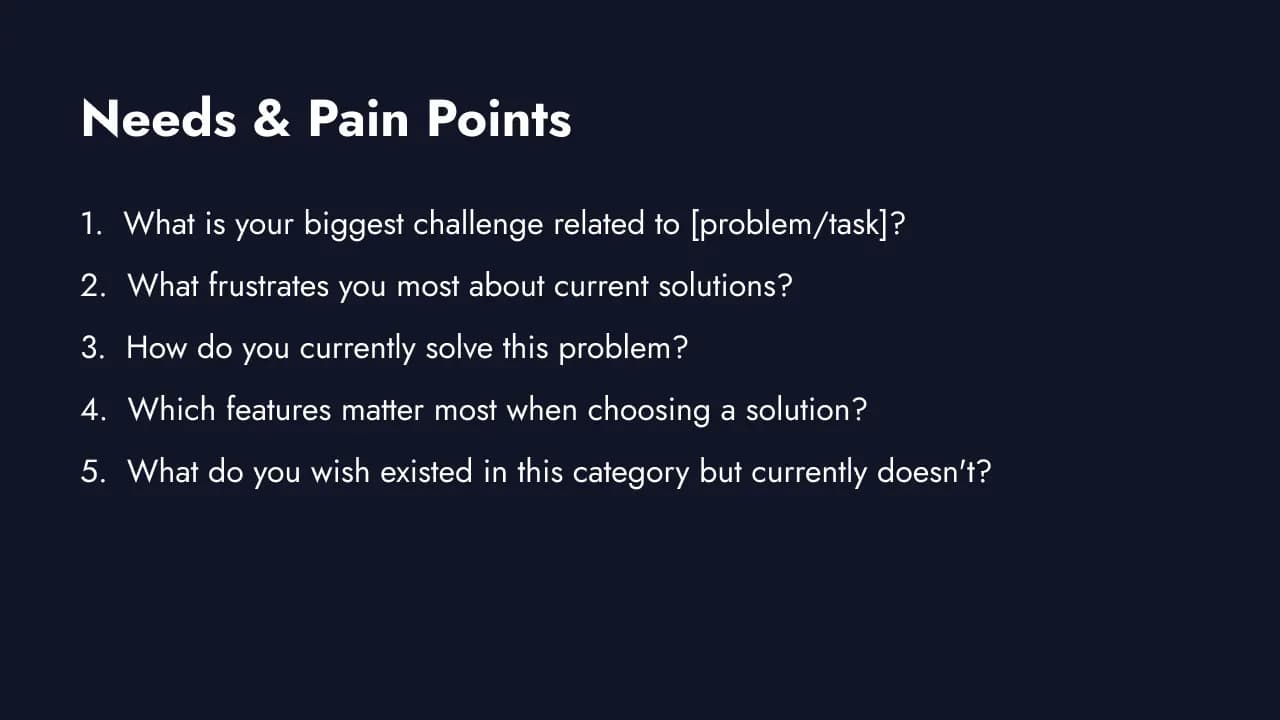
These questions uncover unmet needs and frustrations that represent market opportunities. Use them to guide product feedback and prioritize your roadmap.
19. What is your biggest challenge when it comes to [area/task]?
- Type: Open-ended | Essential
- Start broad to let respondents define the problem space. Their framing of the challenge often reveals opportunities you had not considered.
20. What frustrates you most about the [product category] options currently available?
- Type: Open-ended | Essential
- Category-level frustrations are market gaps. If multiple respondents mention the same pain point, it is likely an underserved need.
21. What would your ideal [product/solution] look like?
- Type: Open-ended | Recommended
- Aspirational question that captures the gap between current reality and desired state. Look for patterns rather than taking individual feature requests at face value.
22. How do you currently solve [problem/task]?
- Type: Open-ended | Essential
- Maps the current workflow, including workarounds, manual processes, and competing products. Workarounds are strong signals of unmet needs.
23. Which features or capabilities matter most to you in a [product category]?
- Type: Ranking (rank top 5 from list) | Essential
- Forced ranking reveals true priorities. Use the results to align your roadmap with what the market values most.
24. How much time do you spend on [task] per week?
- Type: Multiple choice with ranges (Less than 1 hour / 1-3 hours / 3-5 hours / 5-10 hours / More than 10 hours) | Recommended
- Time investment quantifies the pain. Tasks that consume significant time are ripe for automation or simplification.
25. What do you wish existed but does not in the [product category] space?
- Type: Open-ended | Recommended
- Blue ocean question. Surfaces unmet needs that no current competitor addresses. These responses often contain your strongest product differentiation opportunities.
26. How urgent is solving [problem] for you right now?
- Type: Likert (Not at all urgent / Slightly urgent / Moderately urgent / Very urgent / Extremely urgent) | Recommended
- Urgency predicts willingness to buy. High urgency combined with high frustration (question 20) identifies your most motivated prospects.
Competitive Analysis (Questions 27-34)
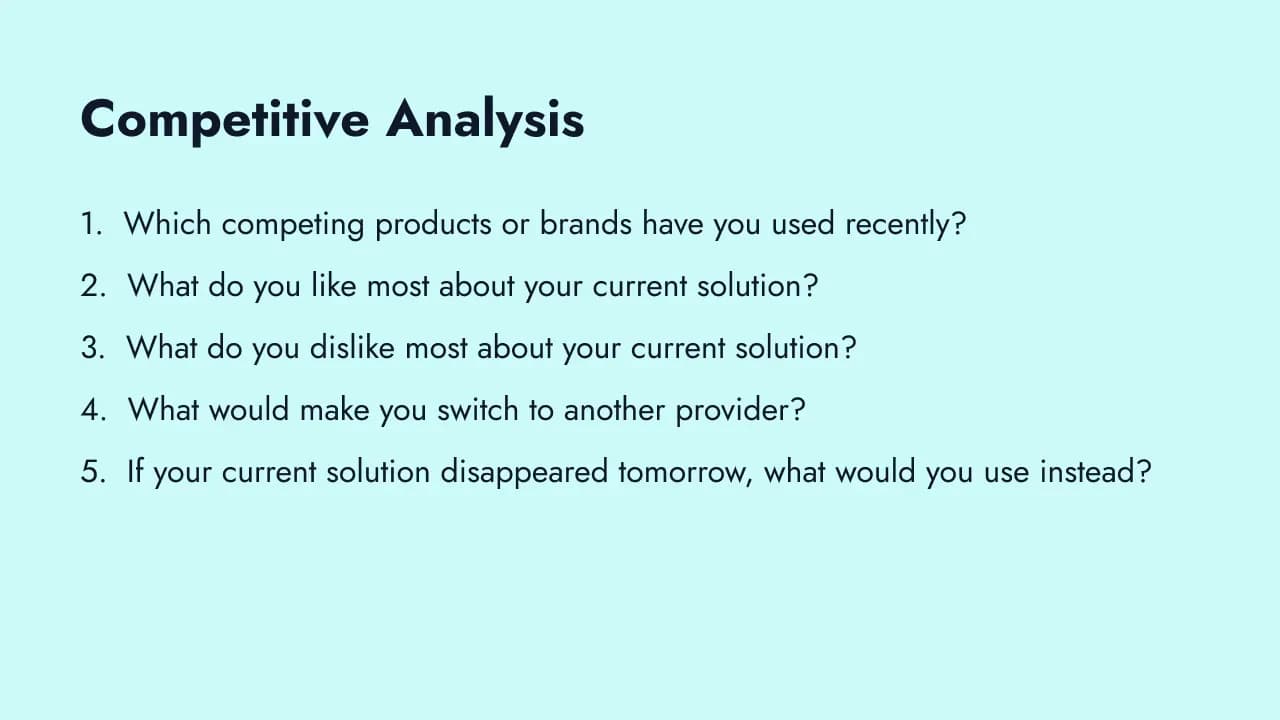
These questions map the competitive landscape from the customer's perspective. Combine survey data with secondary research to build a complete competitive picture. Use insights to refine your customer segmentation strategy.
27. Which [product category] products or brands have you used in the past 12 months?
- Type: Multiple choice, select all that apply | Essential
- Usage data is more reliable than preference data. Knowing which competitors your audience has actually used (not just heard of) reveals the real competitive set.
28. What do you like most about [competitor/current solution]?
- Type: Open-ended | Essential
- Identifies competitor strengths you need to match or counter. Respondents reveal what keeps them loyal in their own words.
29. What do you dislike about [competitor/current solution]?
- Type: Open-ended | Essential
- Competitor weaknesses are your opportunities. Recurring complaints across respondents signal systemic issues you can exploit.
30. Why did you choose [competitor/current solution] over other options?
- Type: Open-ended | Recommended
- The deciding factor in a real purchase decision. More reliable than hypothetical "what would you choose?" questions because it references actual behavior.
31. What would make you switch from [competitor/current solution]?
- Type: Open-ended | Essential
- Switching barriers and triggers. If the barriers are high (contracts, data migration, learning curve), you need to address them directly in your positioning.
32. How does [competitor] compare to other options on price?
- Type: Scale (Much cheaper / Somewhat cheaper / About the same / Somewhat more expensive / Much more expensive) | Recommended
- Price perception relative to alternatives. A product perceived as "expensive" may still win if value perception is strong.
33. How does [competitor] compare to other options on quality?
- Type: Scale (Much lower quality / Somewhat lower / About the same / Somewhat higher / Much higher quality) | Recommended
- Quality perception mapping. Plot price perception (question 32) against quality perception to map competitive positioning.
34. If [competitor/current solution] did not exist, what would you use instead?
- Type: Open-ended | Recommended
- Reveals the true substitutes, which are not always the obvious competitors. A spreadsheet, a manual process, or "nothing" are all valid and revealing answers.
Pricing and Willingness to Pay (Questions 35-40)
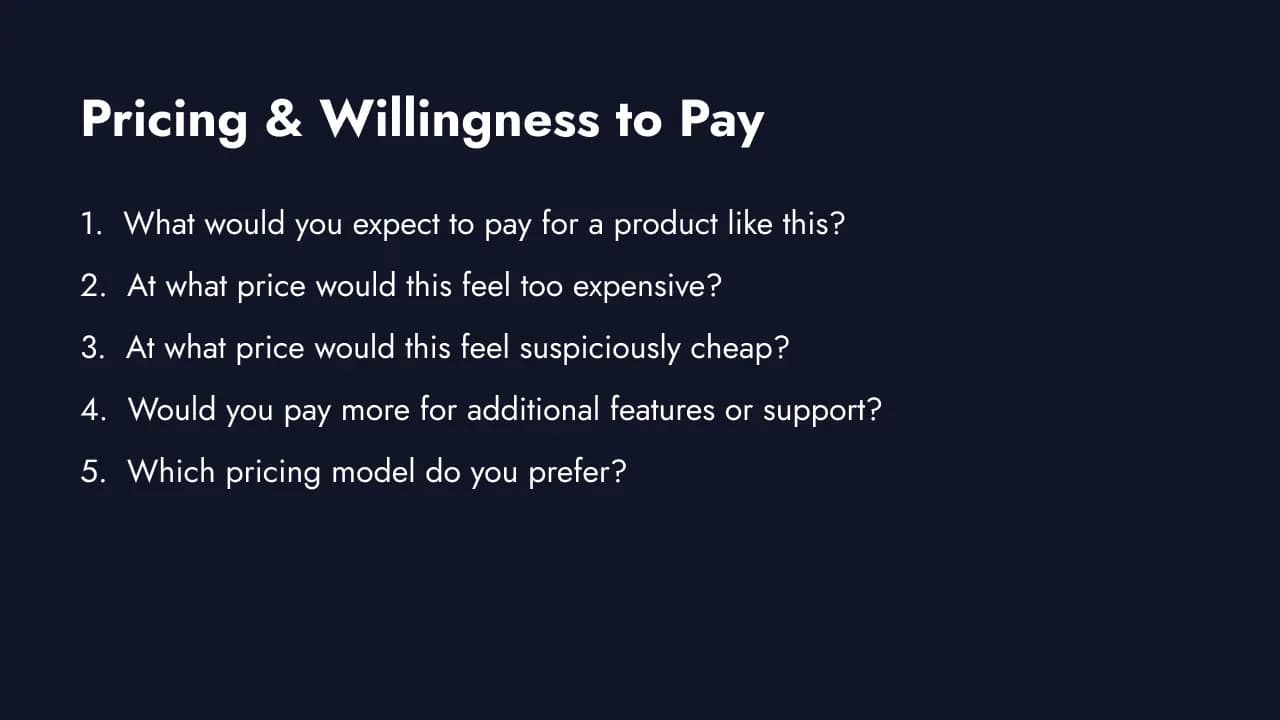
Pricing questions require careful framing. Respondents tend to understate willingness to pay in surveys, so use multiple angles to triangulate the real number. The Van Westendorp method (questions 36-37) is a well-established approach for finding optimal price ranges.
35. What would you expect to pay for a [product/service] that [key value proposition]?
- Type: Open-ended (numeric) | Essential
- Anchors the respondent's internal price reference. Compare against your actual pricing to spot perception gaps.
36. At what price would [product] be so expensive that you would not consider buying it?
- Type: Open-ended (numeric) | Essential
- Upper bound of the Van Westendorp Price Sensitivity Meter. This is the ceiling above which you lose the majority of potential buyers.
37. At what price would [product] be so cheap that you would question its quality?
- Type: Open-ended (numeric) | Essential
- Lower bound of Van Westendorp. Pricing below this point triggers quality doubts. The range between this answer and question 36 is your acceptable price band.
38. How do you feel about the current price of [product/category] in the market?
- Type: Scale (Far too expensive / Slightly expensive / About right / A good deal / Very affordable) | Recommended
- General price sentiment for the category. If most respondents say "about right," there is less room for premium positioning. If "too expensive" dominates, a lower-cost entrant has an opening.
39. Would you pay more for [specific benefit, e.g., faster delivery, better support, enhanced security]?
- Type: Binary (Yes / No) with follow-up: How much more? | Recommended
- Identifies which benefits justify a premium. Test multiple benefits across respondent groups to find the highest-value differentiators.
40. Which pricing model do you prefer for [product category]?
- Type: Multiple choice (One-time purchase / Monthly subscription / Annual subscription / Pay-per-use / Freemium with paid upgrades) | Recommended
- Pricing model preference varies by category and audience. SaaS buyers may prefer subscriptions while enterprise buyers may prefer annual contracts. Let the data guide your model.
Concept and Product Testing (Questions 41-46)
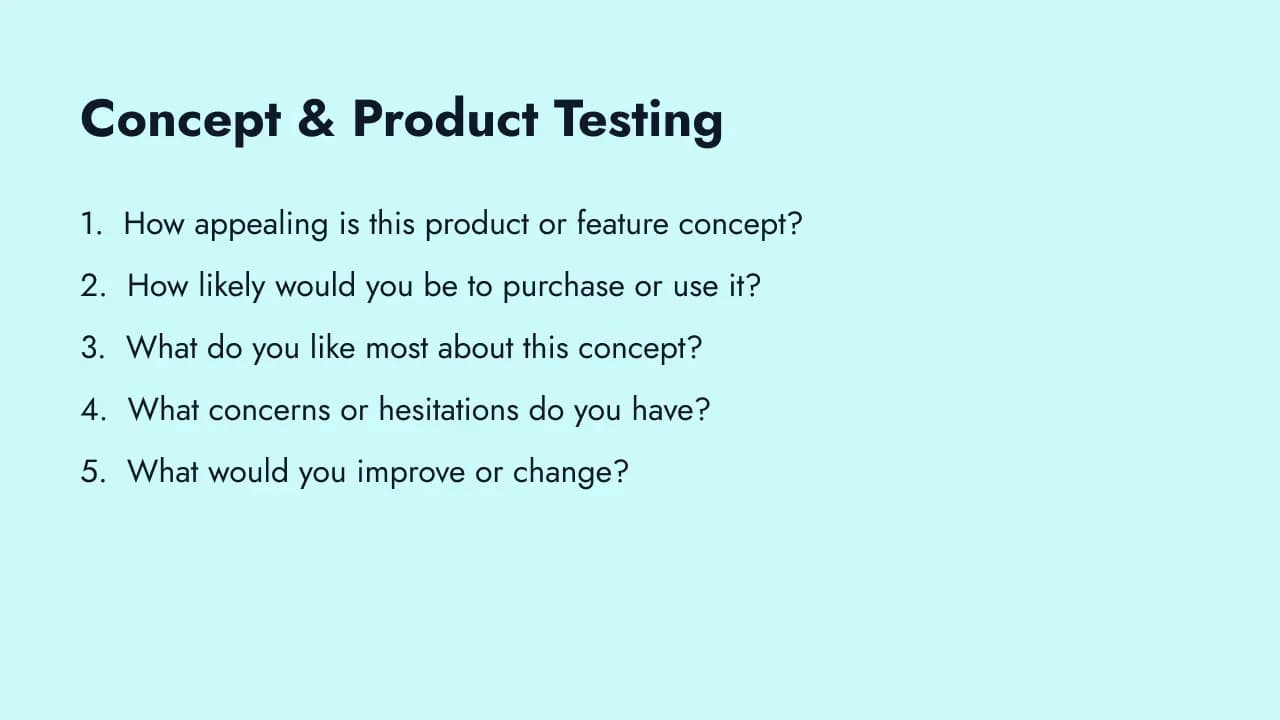
Use these questions to validate new product ideas, features, or positioning before investing in development. A ready-to-use product idea evaluation template can help you structure concept tests quickly. Show respondents a concept description, mockup, or prototype, then ask the following.
41. How appealing is this [concept/product/feature] to you?
- Type: Likert (Not at all appealing / Slightly appealing / Moderately appealing / Very appealing / Extremely appealing) | Essential
- Top-level appeal metric. Track this across multiple concepts to compare relative attractiveness.
42. Based on what you have seen, how likely would you be to purchase or use this [product/feature]?
- Type: Likert (Definitely would not / Probably would not / Might or might not / Probably would / Definitely would) | Essential
- Purchase intent. Only "definitely would" responses are strong predictors of actual purchase. Morwitz, Steckel & Gupta (2007) found in a review of purchase intention studies published in the International Journal of Forecasting that stated intentions consistently overpredict actual sales, with "probably would" responses being especially unreliable predictors (Morwitz, Steckel & Gupta, 2007).
43. What do you like most about this concept?
- Type: Open-ended | Essential
- Identifies the strongest hooks in your concept. Use respondent language in your eventual marketing messaging.
44. What concerns or hesitations do you have about this concept?
- Type: Open-ended | Essential
- Surfaces objections before you go to market. Addressing these in your positioning prevents lost sales later.
45. How does this concept compare to what you currently use for [task/problem]?
- Type: Scale (Much worse / Somewhat worse / About the same / Somewhat better / Much better) | Recommended
- Competitive comparison at the concept level. "About the same" is a warning sign: you need a clear advantage to motivate switching.
46. What would you change or improve about this concept?
- Type: Open-ended | Recommended
- Improvement suggestions from your target audience. Prioritize changes mentioned by multiple respondents over individual preferences.
Psychographic and Lifestyle Questions (Questions 47-56)
Demographics tell you who your respondents are. Psychographics tell you why they behave the way they do. This category covers values, lifestyle, personality, and attitudes: the factors that drive purchase decisions beneath the surface. Competitors tend to lump these in with demographics. They are a distinct category and often the most revealing one.
47. What matters most to you when making a major purchase decision?
- Type: Ranking (rank top 3 from list: price, quality, brand reputation, sustainability, peer recommendations, reviews, convenience, brand values) | Essential
- Reveals the value hierarchy your marketing needs to speak to. The same product can be positioned around status, practicality, or ethics depending on which values dominate.
48. How would you describe your approach to trying new products or services?
- Type: Multiple choice (Early adopter / Open but cautious / Wait and see / Stick to what I know) | Recommended
- Maps respondents on the innovation adoption curve. Segments behave very differently in concept tests and pricing studies.
49. Which of the following statements best describes you?
- Type: Multiple choice (I research extensively before buying / I trust recommendations over research / I usually buy on impulse / I wait for a deal) | Recommended
- Decision style shapes which messaging and channels reach each segment. Researchers call these "consumer information processing styles."
50. How important is it that the brands you use share your values?
- Type: Likert (1-5, Not at all important to Extremely important) | Recommended
- Values alignment varies significantly by audience and category. High scores in this question indicate an audience where brand purpose messaging will outperform feature-based messaging.
51. How do you stay informed about topics relevant to your work or life?
- Type: Multiple choice, select all that apply (Industry newsletters / Podcasts / Social media / Colleagues / Professional events / Trade publications / General news / Online communities) | Recommended
- Maps the information channels you need to occupy to reach this audience. Channel data from your own audience is always more reliable than industry averages.
52. Which of these activities do you regularly engage in outside of work?
- Type: Multiple choice, select all that apply (reading / fitness / travel / cooking / gaming / community involvement / creative pursuits / online communities / other) | Nice-to-have
- Lifestyle data enriches persona development and informs brand partnerships, event sponsorships, and content strategy.
53. What does success look like for you in [relevant role or context]?
- Type: Open-ended | Recommended
- Surfaces aspirations, not just needs. Respondents who describe what success looks like are giving you the outcome your product needs to deliver.
54. How do you feel about using technology to solve [problem area]?
- Type: Likert (Strongly resistant to Strongly enthusiastic) | Recommended
- Tech attitude is a strong predictor of adoption speed and support burden. Segment your data by this response to calibrate onboarding and messaging by cohort.
55. In what ways do you prefer brands to communicate with you?
- Type: Multiple choice, select all that apply (Email / Short-form video / Long-form articles / Social media / In-person events / Peer communities / Direct outreach) | Recommended
- Communication preference data drives channel strategy. Preferences often differ sharply from what analytics tools show about where people click.
56. Is there a cause, community, or movement you actively support that influences what you buy?
- Type: Open-ended | Nice-to-have
- Reveals values-driven purchasing behavior. Use carefully and always include an opt-out. The answers help identify brand alliance opportunities and messaging angles that resonate beyond the product itself.
Demographics and Segmentation (Questions 57-62)
Place demographic questions at the end of the survey. They enable segmented analysis but feel impersonal upfront, so leading with them reduces engagement. Only ask what you will actually use for analysis. For deeper segmentation strategies, see our guide on customer segmentation.
57. What best describes your role?
- Type: Multiple choice (Executive / Manager / Individual contributor / Freelancer or consultant / Business owner / Student / Other) | Recommended
- Role-based segmentation reveals different needs, budgets, and decision-making authority across your audience.
58. What industry do you work in?
- Type: Dropdown or multiple choice | Recommended
- Industry segmentation helps you prioritize verticals and customize messaging. Some products perform very differently across industries.
59. What is the size of your company?
- Type: Multiple choice (1-10 / 11-50 / 51-200 / 201-1000 / 1001-5000 / 5000+) | Recommended
- Company size correlates with budget, sales cycle length, and feature requirements. Use this to segment your market into SMB, mid-market, and enterprise.
60. What is your level of purchasing authority for [product category]?
- Type: Multiple choice (Final decision maker / Part of the decision-making team / Influencer but not decision maker / No purchasing authority) | Recommended
- Filters respondents by buying power. Pricing and purchase intent data from actual decision makers is far more reliable than data from users without budget authority.
61. What is your approximate annual budget for [product category]?
- Type: Multiple choice with ranges (Under $1,000 / $1,000-$5,000 / $5,000-$25,000 / $25,000-$100,000 / Over $100,000 / I do not know) | Nice-to-have
- Budget data calibrates your pricing strategy by segment. Always include "I do not know" to avoid forcing inaccurate answers.
62. How many years of experience do you have in [field/industry]?
- Type: Multiple choice (Less than 1 year / 1-3 years / 3-5 years / 5-10 years / More than 10 years) | Nice-to-have
- Experience level affects how respondents evaluate products and what features they prioritize. Novices value simplicity and guidance. Veterans value power and customization.
Market Research Survey Best Practices
Writing good questions is half the work. How you design and execute the study determines whether you get useful data or noise.
Define your research objective before writing a single question. Every survey should answer one specific research question. "What do customers think?" is too broad. "Which of these three pricing models generates the highest purchase intent among mid-market SaaS buyers?" is specific enough to design around.
Use screener questions to filter qualified respondents. If you are researching purchasing behavior in a specific category, start with a screening question: "Have you purchased [category] in the past 12 months?" Disqualify respondents who do not match your target profile. Unqualified respondents add noise, not signal.
Mix quantitative and qualitative questions. Closed-ended questions give you numbers to track over time. Open-ended questions give you context and surprise insights. Aim for 70-80% closed-ended and 20-30% open-ended. Limit open-ended questions to 3-4 per survey to manage respondent fatigue.
Test for social desirability bias. People overstate positive behaviors and understate negative ones. Instead of asking "Do you consider sustainability when making purchases?", ask "When you made your last purchase in [category], which of these factors influenced your decision?" and include sustainability as one option among many.
Keep surveys under 15 minutes. Completion rates drop sharply after the 10-minute mark. If your research requires more questions, split into multiple shorter surveys targeted at different respondent groups. Respondents who rush through a long survey produce lower-quality data than respondents who thoughtfully complete a short one.
Incentivize appropriately. The right incentive depends on your audience. B2C panels respond to gift cards and discounts. B2B executives respond to industry reports or benchmarking data. Avoid over-incentivizing, which attracts respondents motivated by the reward rather than genuine participation. For more tactics, see our guide on increasing survey response rates.
Common Market Research Mistakes
These mistakes undermine data quality in ways that are hard to detect after the fact. Each one is preventable.
Confirmation bias in question design. If you write survey questions to prove a hypothesis you already believe, you will get data that confirms it. This is the most dangerous mistake because the data looks valid but leads to wrong conclusions. Have someone outside your project team review questions for neutral framing.
Leading questions that validate your hypothesis.
Bad: "How much do you love the convenience of our one-click checkout?"
Better: "How would you rate the checkout experience?"
The first version assumes the respondent finds it convenient and loves it. The second lets them form their own judgment.
Small or unrepresentative samples. A survey of 20 people who happen to be your most loyal customers tells you what loyal customers think, not what the market thinks. Define your target population before recruiting. Aim for 100+ responses per segment you plan to analyze. Use survey distribution methods that reach beyond your existing audience.
Asking hypothetical questions instead of behavioral ones.
Bad: "Would you buy a product that does X?"
Better: "How do you currently handle X?"
People are poor predictors of their own future behavior. Questions about what they have actually done produce far more reliable data than questions about what they would do in an imaginary scenario.
Ignoring the context of responses. A "4 out of 5" satisfaction rating means something different from a loyal customer than from a first-time buyer. Always segment results by relevant dimensions (tenure, usage frequency, company size) before drawing conclusions. Averages hide more than they reveal. For a structured approach, see our guide on analyzing customer feedback.
Free Market Research Survey Template
Skip the blank page. Formbricks offers free, open-source survey templates you can deploy in minutes, including a ready-to-use market research survey template. Build market research surveys with a mix of question types, conditional logic, and targeting rules to reach the right respondents at the right time.
How to get started:
- Sign up at formbricks.com (free tier available, no credit card required)
- Choose a research survey template or start from scratch
- Customize the questions from this guide for your specific market and objectives
- Distribute via link, embed on your website, or trigger in-app for product research
- Analyze responses in real time and export data for deeper analysis
Formbricks is open source, privacy-first, and supports self-hosting for teams that need full control over research data. Whether you are running brand tracking studies, concept tests, or competitive analysis surveys, Formbricks handles the infrastructure so you can focus on insights.
Related templates:
- Brand Perception Survey for brand awareness studies
- Product Market Fit (Superhuman) for PMF measurement
- Marketing Attribution for channel effectiveness
- Evaluate a Product Idea for concept testing
Get Your Free Market Research Survey Template →
Frequently Asked Questions
Try Formbricks now