50+ Brand Survey Questions for Customers & Employees (2026)

Johannes
CEO & Co-Founder
12 Minutes
May 3rd, 2026
Your brand is not what you say it is. It is what your customers say it is. The gap between how you position your brand and how people actually perceive it is the most expensive blind spot in marketing. You can spend millions on campaigns that reinforce a message your audience does not believe.
Brand surveys quantify this gap with data instead of guesswork. They tell you whether people recognize your brand, what they associate it with, whether they trust you, and how you stack up against competitors. This guide gives you 50+ brand survey questions organized by objective, from unaided awareness through employee brand alignment, with question types and practical guidance for each one.
What you will find in this guide:
- Key branding frameworks: 5 C's, 7 pillars, 5 P's, 4 V's
- 50+ brand survey questions across 7 categories (including employees)
- Brand perception examples with real-world context
- Best practices for designing effective brand surveys
- A framework for analyzing brand survey results
- A free brand survey template you can deploy in minutes
What Is a Brand Survey?
A brand survey is a structured research tool that measures how your target audience perceives, recognizes, and relates to your brand. It uses a mix of closed-ended and open-ended questions to capture both quantitative scores (for benchmarking and tracking) and qualitative insights (for understanding the reasoning behind the numbers).
Brand surveys come in several forms, each serving a different purpose:
- Brand awareness surveys measure whether your audience knows you exist and can recall your brand
- Brand perception surveys capture the associations, emotions, and attributes people link to your brand
- Brand tracking studies run the same questions quarterly or annually to monitor changes over time
- Brand health checks combine awareness, perception, trust, and loyalty into a single diagnostic snapshot
Without structured brand feedback, you are relying on assumptions about how the market sees you. A strong voice of the customer program starts with asking the right questions about your brand.
Key Branding Frameworks: What Are You Actually Measuring?
Brand surveys measure how well your external audience perceives the frameworks your brand is built on. Understanding these frameworks helps you design questions with more precision and interpret results in context.
The 5 C's of Branding
| C | Definition | What to Survey |
|---|---|---|
| Clarity | The brand stands for something specific and understandable | "In your own words, what does [brand] do?" |
| Consistency | Identity applied uniformly across all touchpoints | "Is [brand]'s look, tone, and message consistent wherever you encounter it?" |
| Credibility | The brand delivers on its promises | "Does [brand] live up to what it promises?" |
| Character | Distinct personality and voice | "What three words describe [brand]'s personality?" |
| Customer-centricity | Built around audience needs, not internal preferences | "Does [brand] feel like it was built for people like you?" |
The 7 Pillars of Branding
The 7 pillars are Purpose, Positioning, Promise, Personality, Values, Voice, and Visual identity. Brand surveys test whether the first five are perceived externally the way the organization intends. The last two (Voice and Visual identity) are better evaluated through creative testing.
Ask: "What does [brand] stand for?" to test Purpose. Ask: "How is [brand] different from alternatives?" to test Positioning. Ask: "What does [brand] consistently deliver?" to test Promise.
The 5 P's of Brand Identity
The 5 P's are Purpose, Promise, Positioning, Personality, and Perception. The first four are internal brand strategy decisions. The fifth, Perception, is what brand surveys actually measure. The gap between your intended Positioning and actual Perception is the core insight a brand survey delivers.
The 4 V's of Branding
| V | Definition | Survey signal |
|---|---|---|
| Vision | Where the brand aspires to go | "Do you see [brand] as a future leader in [category]?" |
| Values | Principles that govern brand behavior | "Does [brand]'s values align with your own?" |
| Voice | Communication style and tone | "How would you describe the way [brand] communicates?" |
| Visuals | Logo, color palette, typography | "How recognizable is [brand]'s visual identity?" |
50+ Brand Survey Questions by Objective
Each question below includes a recommended question type and a guidance note explaining when and how to use it. Customize the bracketed text for your specific brand and category.
Brand Awareness: Aided & Unaided (Questions 1-8)
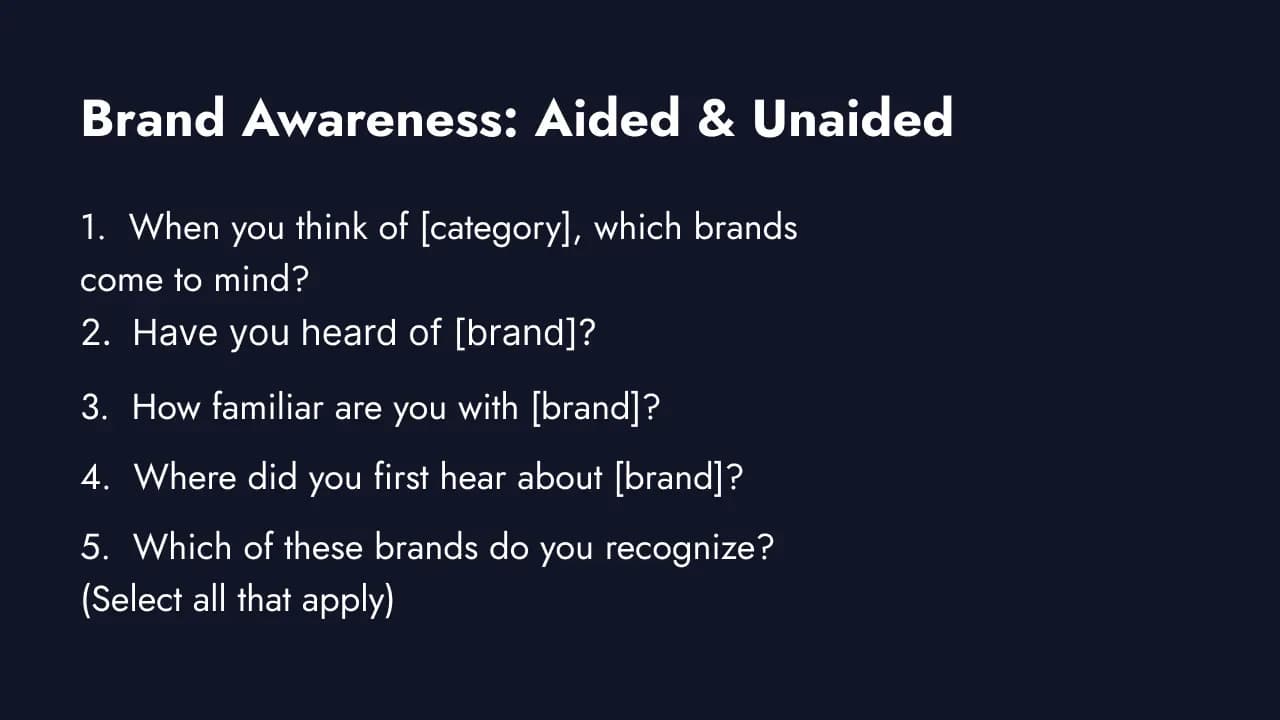
Awareness is the foundation of your brand funnel. Before people can consider you, they need to know you exist. These questions measure two levels: unaided recall (can they name you without help?) and aided recall (do they recognize you when prompted?). For attribution-specific insights, a marketing attribution survey can complement these awareness questions.
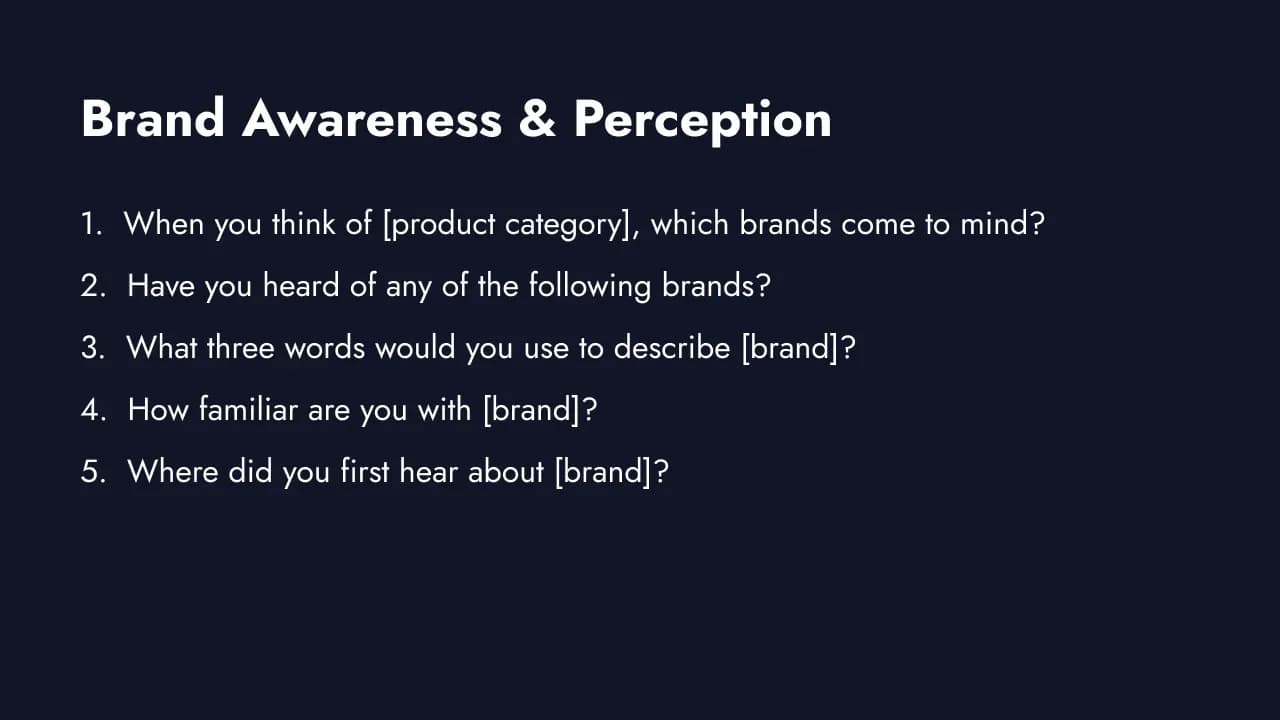
1. When you think of [category], which brands come to mind?
- Type: Open-ended (unaided)
- The gold standard for brand awareness. No prompting, no lists. If your brand appears here, it occupies real mental space in the category.
2. Have you heard of [brand]?
- Type: Binary (Yes/No) (aided)
- The simplest aided awareness check. Pair this with question 1 to measure the gap between unaided and aided recall.
3. How familiar are you with [brand]?
- Type: Likert (1-5: Not at all familiar to Extremely familiar)
- Goes beyond binary awareness to measure depth of familiarity. Someone who has "heard of" your brand may still know nothing about what you do.
4. Where did you first hear about [brand]?
- Type: Multiple choice (Social media / Search / Word of mouth / Advertisement / News or press / Event / Other)
- Attribution data for brand awareness. Reveals which channels actually drive first impressions, which is often different from what your analytics suggest.
5. Which of these brands do you recognize? (Select all that apply)
- Type: Multiple choice with brand list (aided)
- Include your brand alongside competitors. The order in which brands are listed can influence selection, so randomize the list across respondents.
6. How often do you encounter [brand] in your daily life?
- Type: Likert (Never / Rarely / Sometimes / Often / Very often)
- Measures brand presence and touchpoint frequency. High awareness with low encounter frequency suggests your brand is memorable but your distribution or media presence is limited.
7. Can you describe what [brand] does?
- Type: Open-ended
- Tests whether awareness translates to understanding. A respondent might recognize your name but have no idea what you actually offer. Misperceptions here signal a messaging problem.
8. Which brand logo do you recognize? (Select all that apply)
- Type: Visual multiple choice (aided)
- Show logos without brand names. Tests visual brand recognition, which is a stronger signal than name recognition alone.
Brand Perception & Associations (Questions 9-18)
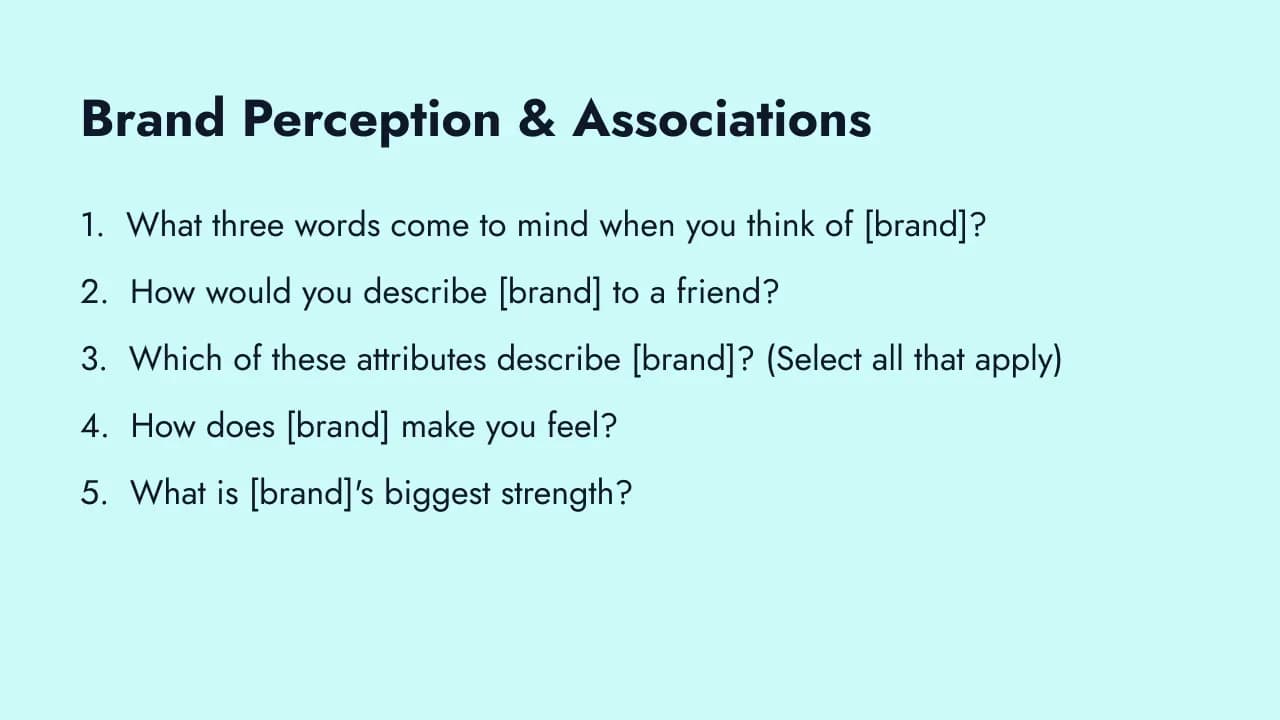
Perception questions reveal what people think and feel about your brand. These are the attributes, emotions, and stories your audience attaches to your name. The gap between intended perception and actual perception is where the biggest strategic opportunities live.
9. What three words come to mind when you think of [brand]?
- Type: Open-ended
- Captures unprompted associations in the respondent's own language. Aggregate the responses into a word cloud or frequency table to spot dominant themes.
10. How would you describe [brand] to a friend?
- Type: Open-ended
- Surfaces your brand positioning as perceived by real people. Compare these descriptions to your official positioning statement. The gaps tell you where your messaging is landing and where it is not.
11. Which of these attributes describe [brand]? (Select all that apply)
- Type: Multiple choice (Innovative / Trustworthy / Affordable / Premium / Reliable / Fun / Professional / Outdated / Confusing / Other)
- Prompted attribute mapping. Include both positive and negative attributes to avoid skewing toward positive responses. Customize the list to match your brand strategy.
12. How does [brand] make you feel?
- Type: Multiple choice (Confident / Inspired / Frustrated / Indifferent / Excited / Skeptical / Other)
- Emotional associations drive purchasing decisions more than rational attributes. If your brand leaves people feeling "indifferent," that is a bigger problem than negative sentiment.
13. What is [brand]'s biggest strength?
- Type: Open-ended
- Forces respondents to identify a single standout attribute. The themes that repeat most often are your actual competitive advantages, as perceived by the market.
14. What is [brand]'s biggest weakness?
- Type: Open-ended
- The counterpart to question 13. Weaknesses that surface repeatedly across respondents are systemic issues worth addressing. One-off mentions are noise.
15. How does [brand] compare to [competitor] on quality?
- Type: Likert (Much worse / Worse / About the same / Better / Much better)
- Competitive perception on a specific attribute. Replace "quality" with whichever dimension matters most in your category. Run this question for multiple attributes across surveys to build a full perception map.
16. How does [brand] compare to [competitor] on value for money?
- Type: Likert (Much worse / Worse / About the same / Better / Much better)
- Value perception is distinct from price perception. A premium brand can score high on value if the perceived quality justifies the cost.
17. Is [brand] for people like me?
- Type: Likert (1-5: Strongly disagree to Strongly agree)
- Measures brand relatability and target audience fit. Low scores mean your brand feels irrelevant or exclusionary to that segment, even if they are aware of you.
18. How has your perception of [brand] changed in the past year?
- Type: Scale (Much more negative / Somewhat more negative / No change / Somewhat more positive / Much more positive)
- Tracks directional shifts in sentiment. Cross-reference with specific events (campaigns, product launches, PR incidents) to understand what drives perception change.
Brand Trust & Values (Questions 19-24)
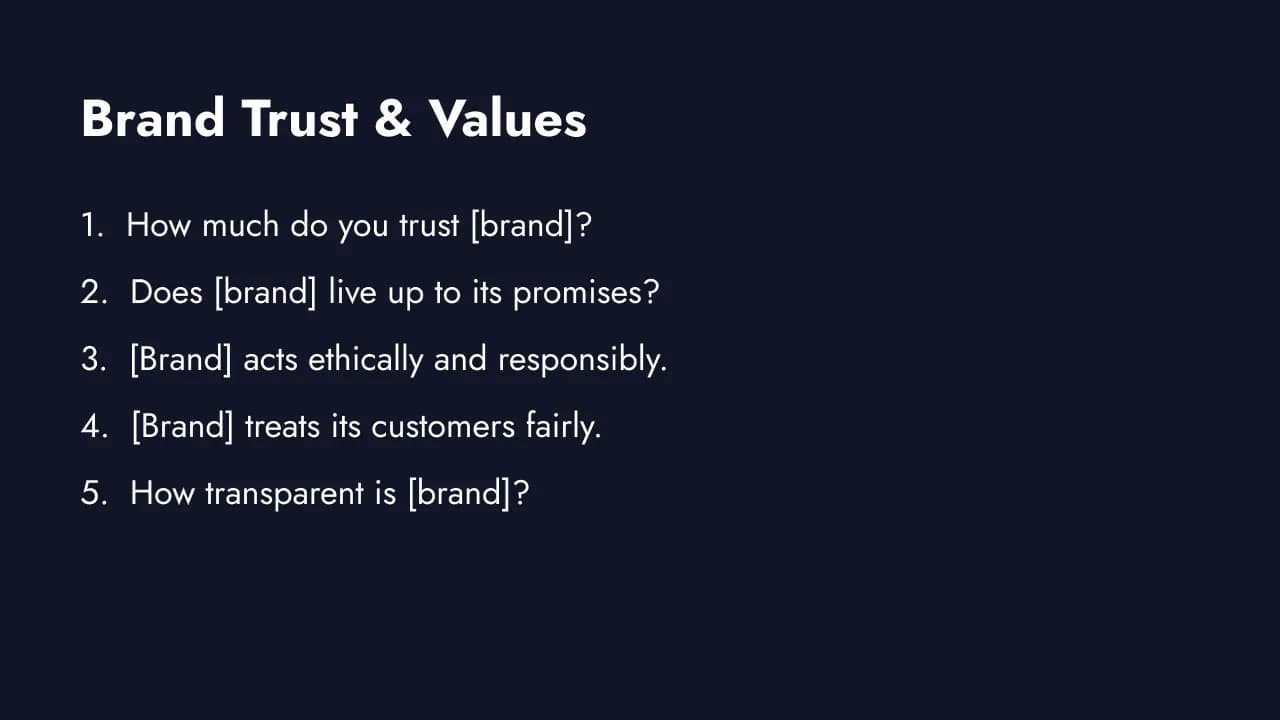
Trust is the currency of long-term brand equity. These questions measure whether your audience believes you do what you say, act ethically, and align with their personal values. Trust takes years to build and seconds to destroy.
19. How much do you trust [brand]?
- Type: Likert (1-5: Not at all to Completely)
- Your headline trust metric. Track this over time. Sudden drops usually correlate with specific incidents that are worth investigating.
20. Does [brand] live up to its promises?
- Type: Likert (1-5: Never to Always)
- Measures the gap between what your brand communicates and what it delivers. Chronic low scores here mean your marketing writes checks your product or service cannot cash.
21. [Brand] acts ethically and responsibly.
- Type: Likert (1-5: Strongly disagree to Strongly agree)
- Corporate responsibility perception. Increasingly important for purchase decisions, especially among younger demographics.
22. [Brand] treats its customers fairly.
- Type: Likert (1-5: Strongly disagree to Strongly agree)
- Fairness perception covers pricing, policies, support, and conflict resolution. Low scores often point to specific pain points like hidden fees, restrictive return policies, or unresponsive support.
23. How transparent is [brand]?
- Type: Likert (1-5: Not at all transparent to Very transparent)
- Transparency perception influences trust directly. Brands that are open about pricing, processes, and mistakes earn more trust than those that hide behind corporate speak.
24. Does [brand]'s values align with your own?
- Type: Likert (1-5: Not at all to Completely)
- Values alignment predicts loyalty beyond satisfaction. Customers who feel a values connection are less price-sensitive and more forgiving of occasional missteps.
Brand Loyalty & Advocacy (Questions 25-32)
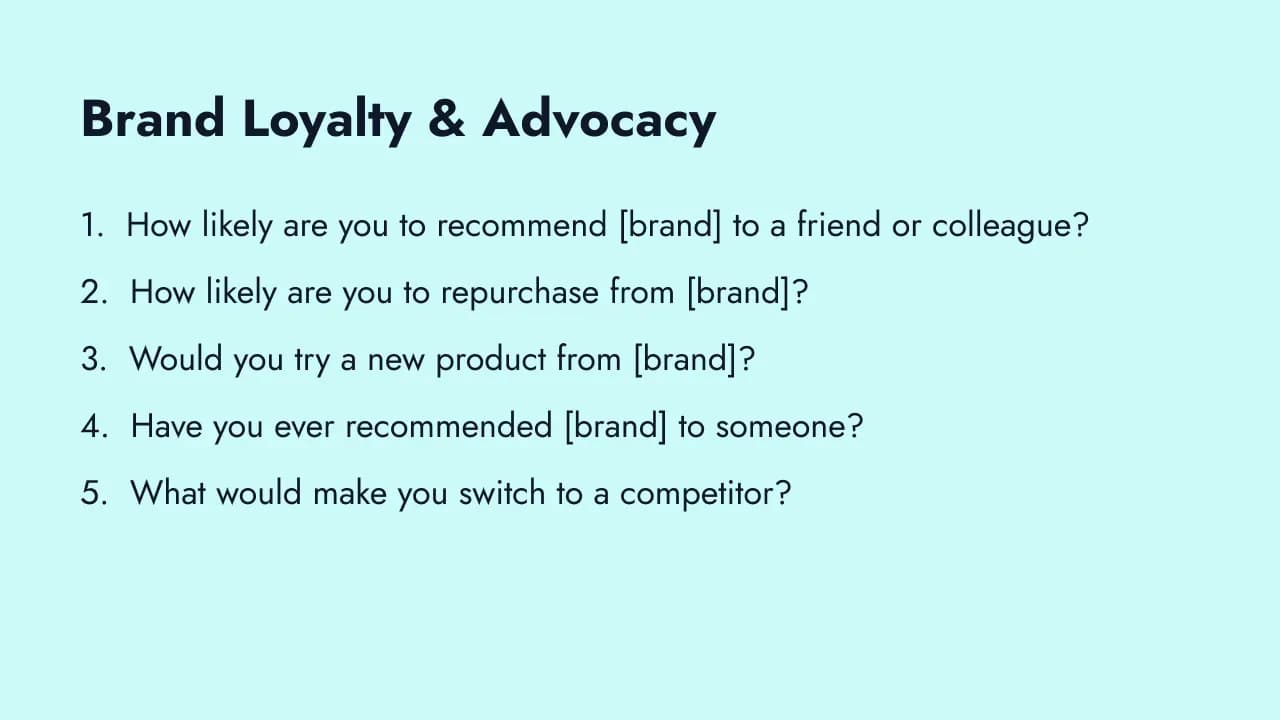
Loyalty questions measure whether your brand has earned repeat behavior and active recommendation. The distinction matters: someone can be a repeat buyer out of habit or convenience without being truly loyal. True loyalty survives a competitor's better offer. An earned advocacy score survey can help you quantify this distinction.
25. How likely are you to recommend [brand] to a friend or colleague?
- Type: Rating (0-10, NPS)
- Net Promoter Score℠. Segment into Promoters (9-10), Passives (7-8), and Detractors (0-6). For detailed implementation guidance, see our NPS question examples.
26. How likely are you to repurchase from [brand]?
- Type: Likert (1-5: Very unlikely to Very likely)
- Direct retention predictor. Low scores combined with high satisfaction scores suggest that your product is good but something else (price, convenience, competition) is pulling customers away.
27. Would you try a new product from [brand]?
- Type: Likert (1-5: Definitely not to Definitely)
- Measures brand trust beyond the current product. High scores mean your brand has earned the right to expand into adjacent categories.
28. Have you ever recommended [brand] to someone?
- Type: Binary (Yes/No)
- Past behavior is a stronger signal than future intent. If someone has already recommended you, they are a genuine advocate, not just someone who says they would recommend you on a survey.
29. What would make you switch to a competitor?
- Type: Open-ended
- Identifies your vulnerability points. The themes that repeat most often are the levers competitors could pull to take your customers. Address them before that happens.
30. How often do you choose [brand] over alternatives?
- Type: Likert (Never / Rarely / Sometimes / Usually / Always)
- Behavioral loyalty metric. "Always" and "Usually" indicate strong preference. "Sometimes" suggests you are one option among many with no clear differentiation.
31. What keeps you coming back to [brand]?
- Type: Open-ended
- Surfaces your actual retention drivers in the customer's own words. These are often different from what you think keeps people around. Use these insights to reinforce what works.
32. If [brand] were a person, how would you describe their personality?
- Type: Open-ended
- Brand personality projection. This question reveals the human traits your audience associates with your brand. Useful for validating whether your brand voice and identity are landing as intended.
Competitive Brand Positioning (Questions 33-38)
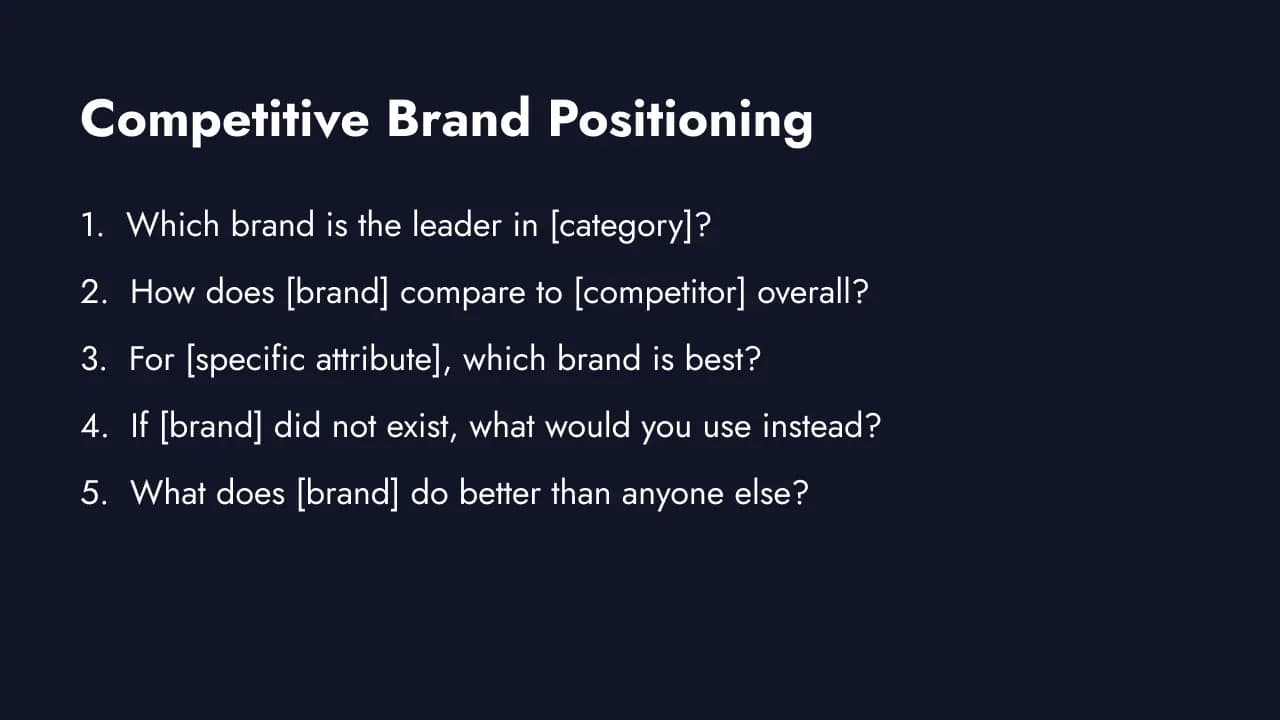
Your brand does not exist in a vacuum. Positioning questions reveal where you stand relative to competitors and what makes you distinct (or interchangeable) in your audience's mind.
33. Which brand is the leader in [category]?
- Type: Open-ended
- Identifies the perceived category leader. If it is not you, study what makes the leader top of mind and where you can differentiate. If it is you, monitor this metric to protect your position.
34. How does [brand] compare to [competitor] overall?
- Type: Likert (Much worse / Worse / About the same / Better / Much better)
- Holistic competitive comparison. Run this for your top 2-3 competitors. "About the same" is a warning sign: it means you have no perceived differentiation.
35. For [specific attribute], which brand is best?
- Type: Multiple choice (list of brands)
- Attribute-level competitive mapping. Run this question for each attribute that matters in your category (quality, innovation, price, support, etc.) to build a full competitive perception matrix.
36. If [brand] did not exist, what would you use instead?
- Type: Open-ended
- Reveals your actual competitive set as perceived by customers. The brands mentioned most often are your real competitors, which may be different from the ones you track internally.
37. What does [brand] do better than anyone else?
- Type: Open-ended
- Identifies your perceived unique advantage. If respondents cannot name one, you have a differentiation problem. If they consistently name the same thing, you have a clear positioning anchor to build on.
38. What does [brand] need to improve to compete with [competitor]?
- Type: Open-ended
- Specific, actionable competitive gap analysis. This question often surfaces concrete improvement areas that generic perception questions miss.
Open-Ended & Emerging Perceptions (Questions 39-43)
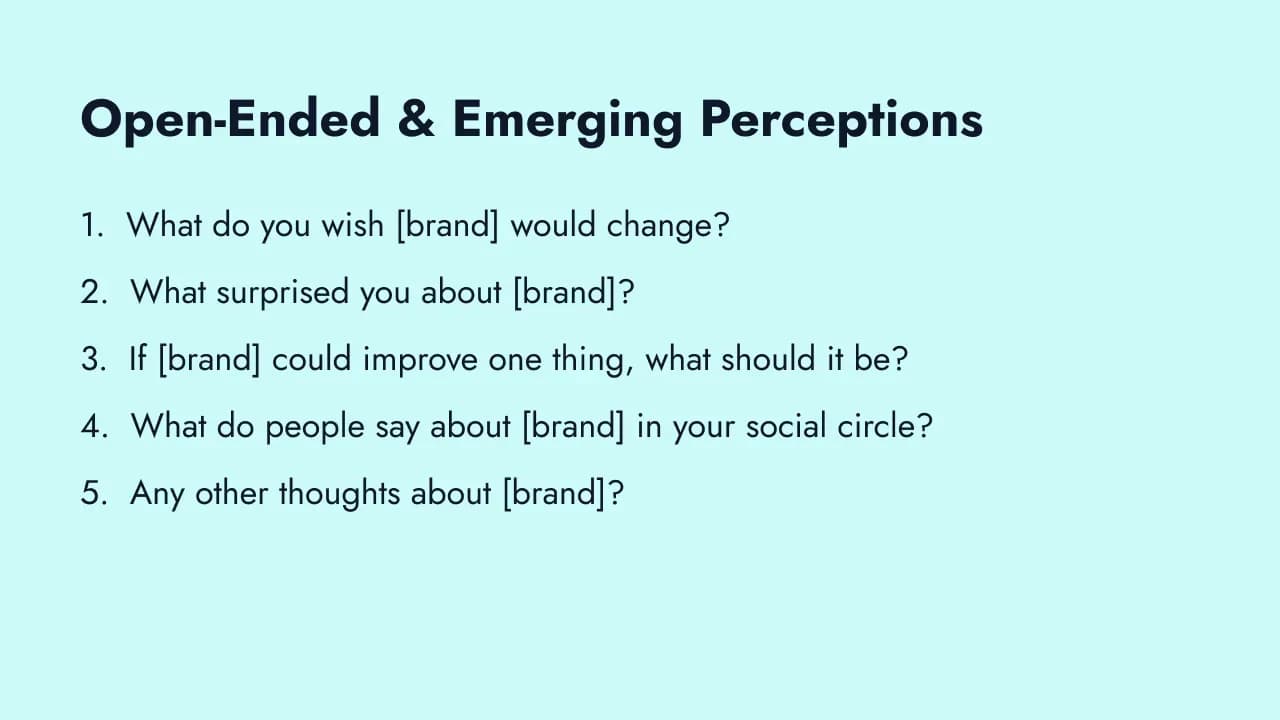
These questions capture insights that structured questions miss. Open-ended responses surface emerging themes, shifting sentiment, and feedback you did not think to ask about. Limit open-ended questions to 2-4 per survey to manage respondent fatigue. For methods on extracting patterns from qualitative data, see our guide on analyzing customer feedback.
39. What do you wish [brand] would change?
- Type: Open-ended
- A direct improvement request. The phrasing "wish" is softer than "what is wrong," which encourages constructive rather than combative responses.
40. What surprised you about [brand]?
- Type: Open-ended
- Surfaces expectation mismatches, both positive and negative. Positive surprises are opportunities to amplify. Negative surprises are expectation-setting failures.
41. If [brand] could improve one thing, what should it be?
- Type: Open-ended
- The "one thing" constraint forces prioritization. More actionable than a general "any feedback?" prompt because it demands a single focus.
42. What do people say about [brand] in your social circle?
- Type: Open-ended
- Captures word-of-mouth perception. What people say about your brand to others is a stronger signal than what they say directly to you in a survey.
43. Any other thoughts about [brand]?
- Type: Open-ended
- The catch-all. Some of the most valuable feedback comes from questions you did not think to ask. Always include this as your final question.
Brand Survey Questions for Employees (Questions 44-50)
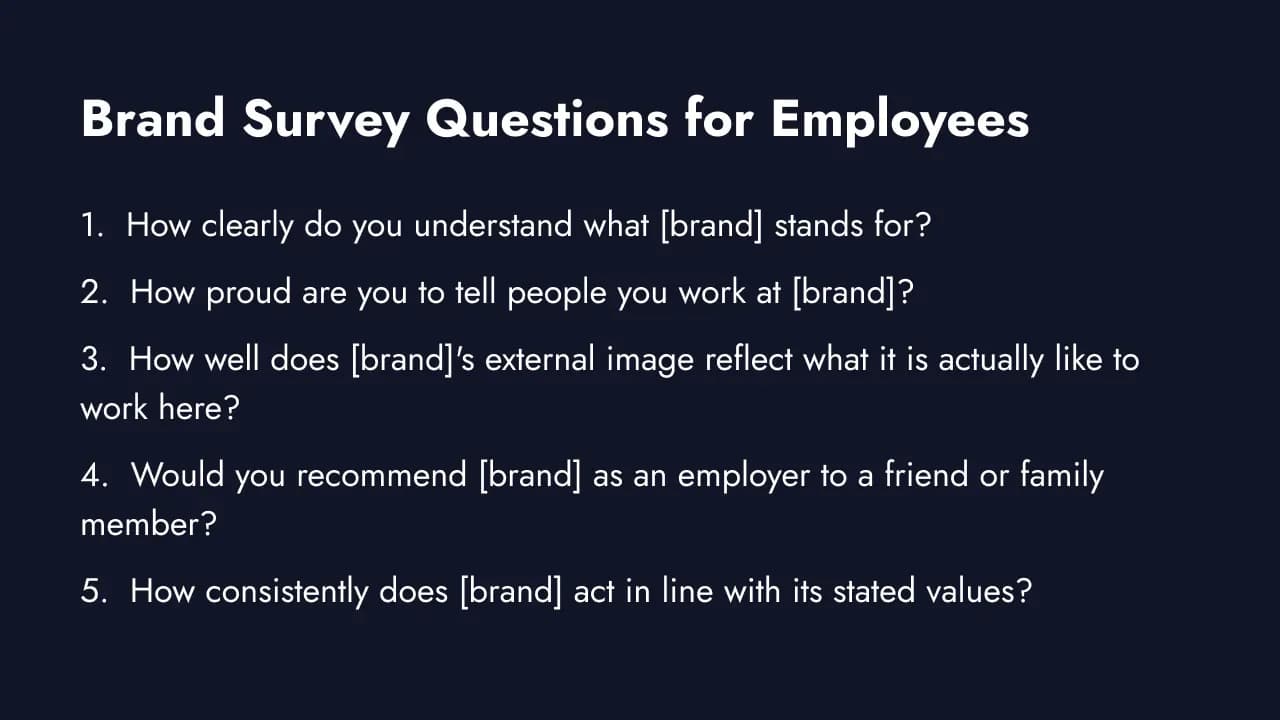
Internal brand perception matters as much as external. Employees who do not believe in or understand the brand cannot represent it authentically to customers. These questions measure employer brand strength, internal brand alignment, and whether employees see themselves as brand ambassadors.
44. How clearly do you understand what [brand] stands for?
- Type: Likert (1-5: Not at all clear to Completely clear)
- Tests brand internalization. If employees cannot articulate the brand, they cannot communicate it consistently to customers. Low scores point to internal messaging or onboarding gaps.
45. How proud are you to tell people you work at [brand]?
- Type: Likert (1-5: Not at all proud to Extremely proud)
- A proxy for employer brand strength and employee advocacy likelihood. Pride is a leading indicator of both retention and organic employer brand promotion.
46. How well does [brand]'s external image reflect what it is actually like to work here?
- Type: Likert (1-5: Not at all to Very accurately)
- Measures the gap between employer brand promise and employee experience. A large gap (brand says "innovative and people-first," employees feel bureaucratic and undervalued) undermines both recruiting and retention.
47. Would you recommend [brand] as an employer to a friend or family member?
- Type: Rating (0-10, eNPS)
- Employee Net Promoter Score for employer brand. Run the same 0-10 scale as customer NPS for direct comparison. An eNPS below 0 signals a serious employer brand problem.
48. How consistently does [brand] act in line with its stated values?
- Type: Likert (1-5: Never to Always)
- Tests values authenticity from the inside. External campaigns around company values land hollow when employees see daily behavior that contradicts them.
49. Do you feel equipped to represent [brand] accurately to people outside the company?
- Type: Likert (1-5: Not at all to Completely)
- Measures brand ambassador readiness. Employees who say "no" or "somewhat" are a liability in customer conversations. Follow up with: "What would help you represent [brand] more confidently?"
50. What is one thing that would make you more proud to be associated with [brand]?
- Type: Open-ended
- Surfaces concrete employer brand improvement priorities in employee language. More actionable than general sentiment questions and often surfaces patterns that leadership does not expect.
Brand Survey Best Practices
Getting honest, useful data from a brand survey requires more than good questions. How you design, target, and time the survey determines whether you get strategic insights or meaningless noise.
Include both aided and unaided awareness questions. Unaided recall ("Which brands come to mind?") measures true top-of-mind presence. Aided recall ("Have you heard of [brand]?") measures recognition. You need both because they tell different stories. A brand with high aided but low unaided awareness has a salience problem, not an awareness problem.
Run brand tracking quarterly for trend data. A single brand survey is a snapshot. Quarterly tracking reveals trends, seasonal patterns, and the impact of specific initiatives. Keep your core questions identical across waves so comparisons are valid. Add or rotate supplementary questions as needed.
Include competitors for benchmarking context. Brand perception data without competitive context is incomplete. Always ask comparison questions against your top 2-3 competitors. Your NPS might be +30, but if your closest competitor is at +50, you have work to do.
Use consistent scales across waves. If you use a 5-point Likert scale in Q1, do not switch to a 7-point scale in Q2. Scale changes break your ability to compare results over time. Pick your scales once and stick with them.
Mix qualitative and quantitative questions. Closed-ended questions give you numbers to track. Open-ended questions give you the context behind those numbers. A 70/30 split (closed/open) works well. For tips on keeping respondents engaged through both types, read our guide on how to increase survey response rate.
Survey non-customers, not just existing ones. Your current customers represent the people who already chose you. To understand your full brand position, survey prospects who considered but did not buy, lapsed customers who left, and people in your target market who have never interacted with you. Use user research methods like panel surveys or intercept surveys to reach these audiences.
How to Analyze Brand Survey Results
Collecting brand data is step one. Turning it into a strategy is where the value lives.
Brand Awareness Funnel
Map your audience through six stages, each measured by specific questions from this guide:
| Funnel Stage | What It Measures | Key Questions |
|---|---|---|
| Unaided Recall | Names your brand without prompting | Q1 |
| Aided Recall | Recognizes your brand from a list | Q2, Q5, Q8 |
| Familiarity | Knows what you do | Q3, Q7 |
| Consideration | Would consider purchasing | Q17, Q26 |
| Preference | Chooses you over alternatives | Q30, Q33 |
| Advocacy | Actively recommends you | Q25, Q28 |
Calculate the conversion rate between each stage. The biggest drop-off points reveal where your brand funnel is leaking and where to focus your efforts.
Perception Mapping
Plot your brand and competitors on a 2D grid using attribute pairs that matter in your category. Common axes include quality vs. affordability, innovative vs. traditional, or premium vs. accessible. Use data from questions 11, 15, 16, and 34-35 to position each brand.
Perception maps make competitive gaps and opportunities visually obvious. If every brand clusters in the same quadrant, there is an opportunity to differentiate by moving into the empty space.
Sentiment Analysis on Open-Ended Responses
Group open-ended responses from questions 9, 10, 13, 14, 29, 31, and 39-43 by theme. Count frequency (how many people mention each theme) and assess intensity (how strongly they feel). The intersection of high frequency and high intensity is where to focus first.
Use customer segmentation to break sentiment down by audience type. You may discover that power users and casual users have very different perceptions of the same brand.
Track Changes Quarter Over Quarter
Compare your key metrics across waves:
- Unaided awareness percentage
- Aided awareness percentage
- Average trust score
- NPS
- Top 3 perceived attributes
- Top 3 perceived weaknesses
Correlate shifts with specific events: campaigns launched, product releases, competitor moves, PR incidents. Over four or more quarters, patterns emerge that single surveys cannot reveal.
For a deeper walkthrough on turning feedback data into decisions, see our guide on analyzing customer feedback.
Free Brand Survey Template
Skip the blank page. Formbricks offers free, open-source survey templates you can deploy in minutes, including a dedicated brand perception survey template. Each template includes pre-written questions, smart targeting rules, and built-in analytics.
Related templates:
- Market Survey for market research
- Research Survey for comprehensive research
- Net Promoter Score (NPS) for loyalty measurement
How to get started:
- Sign up at formbricks.com (free tier available, no credit card required)
- Choose a brand survey template or start from scratch
- Customize the questions from this guide for your specific brand and category
- Set targeting rules to reach the right audience at the right time
- Launch and monitor responses in real time from your dashboard
Formbricks is open source, privacy-first, and supports self-hosting for teams that need full data control. Run brand surveys as link surveys for broad market research, in-app surveys for product-specific brand feedback, or website surveys to capture visitor perception. For guidance on picking the right channel, see our guide on survey distribution methods.
Get Your Free Brand Survey Template →
Frequently Asked Questions
Try Formbricks now