

SurveyMonkey vs Typeform (vs Formbricks): Which Should You Actually Choose in 2026?

Johannes
Co-Founder @ Formbricks
14 Minutes
August 16th, 2026
If you're comparing SurveyMonkey vs Typeform, you're weighing two different philosophies: dense, research-grade survey tooling versus a conversational, one-question-at-a-time design experience. Neither is built around an ongoing feedback program with segmentation and automated follow-up.
I believe SurveyMonkey is the right call if:
- You need advanced branching logic, premium question types, or crosstab and multi-survey analysis
- Global benchmarks and access to a large third-party respondent panel matter for your research
- You want 200+ built-in integrations rather than relying mostly on Zapier
- You're comfortable with per-seat team pricing or an opaque Individual-tier price
I believe Typeform is the right call if:
- Visual design and respondent engagement matter more than raw feature count
- Your forms are lead-generation or marketing-facing, where a polished, conversational UI drives completion
- A lower published starting price (Basic at $39/month vs SurveyMonkey's Team plans) fits your budget
- You don't need advanced logic, benchmarking, or a respondent panel
Both platforms are cloud-only, and neither is built around feedback analytics (segmentation, drop-off tracking) or automated post-response workflows the way a dedicated experience management platform is. If that's closer to what you actually need, there's a third option worth knowing before you pick between these two.
👉 Formbricks is an open feedback and experience management suite built around three things: feedback management (website, in-app, link, and email surveys, unified), feedback analytics (aggregate and per-response views, segmentation, drop-off tracking), and workflows and integrations (post-response automation plus native connections to Salesforce, HubSpot, Slack, Google Sheets, and Notion). Every tier, including the free Hobby plan, publishes a real price and ships a full API. A free, self-hosted Community Edition exists for teams that need data to never leave their own infrastructure, something neither SurveyMonkey nor Typeform offers at any price.
Table of contents:
- SurveyMonkey vs Typeform vs Formbricks at a glance
- What buyers actually mean by "SurveyMonkey vs Typeform"
- SurveyMonkey: research depth and advanced logic
- Typeform: conversational design, at a design-forward price
- Formbricks: an open feedback and experience management suite
- Side-by-side pricing
- Feature value breakdown
- Who should choose which platform
- SurveyMonkey vs Typeform FAQ
- Final verdict
SurveyMonkey vs Typeform vs Formbricks at a Glance
| SurveyMonkey | Typeform | Formbricks | |
|---|---|---|---|
| Core strength | Research depth, advanced logic, benchmarking | Conversational, one-question-at-a-time design | Unified feedback management, analytics, workflows |
| Free plan | 10 questions/survey, limited response viewing | Unlimited typeforms, 3,000+ templates, capped monthly responses | 250 responses/month, full API incl. MCP |
| Cheapest published paid tier | Team Advantage $30/user/month (3-user min) | Basic $39/month (100 responses/month) | Pro $74/month (annual) or $89/month |
| Advanced logic | Yes, per SurveyMonkey's own comparison page | Conditional logic, but SurveyMonkey's own page marks it "premium question types: no" | Conditional logic, attribute-based segmentation |
| Built-in integrations | 200+ | 50+ (per SurveyMonkey's comparison), Zapier for the rest | Native integrations plus free API/webhooks on every tier |
| Respondent panel | SurveyMonkey Audience, 335M+ people | Not offered | Not offered |
| Data residency / self-hosting | Regional data center choice on Enterprise only | Not offered | Free, self-hosted Community Edition |
| Best for | Research teams, benchmarking, structured surveys | Marketing forms, lead-gen, design-forward brands | Ongoing feedback programs, developers, regulated industries |
What Buyers Actually Mean by "SurveyMonkey vs Typeform"
Most of what ranks for this comparison is either SurveyMonkey's own vendor-authored comparison page or third-party form-builder blogs (Survicate, Content Snare, involve.me), since Typeform doesn't publish an equivalent head-to-head against SurveyMonkey.
SurveyMonkey's own comparison page takes an assertive stance, listing advanced branching logic, premium question types, PDF/PPT export, a global audience panel, global benchmarks, longitudinal and crosstab analysis, and 200+ integrations as capabilities Typeform doesn't match, versus Typeform's 50+ built-in integrations.
Survicate's independent comparison lands closer to the middle: "choose Typeform if you're just starting your journey with customer feedback... choose SurveyMonkey if, in addition to collecting feedback, you also need an external respondents base." Content Snare's testing found the split comes down to five factors that matter most: intuitiveness, customization, data analytics, integrations, and pricing, with Typeform winning on design and SurveyMonkey winning on analytics depth.
Source: SurveyMonkey's own Typeform comparison page (captured August 15, 2026) and Survicate's independent comparison.
The honest read: this is a "design vs. depth" question more than a "which is better" question. Typeform wins on respondent experience and completion rates for shorter, marketing-facing forms. SurveyMonkey wins on structured research: branching logic, benchmarking, and a purchasable respondent panel.
SurveyMonkey: Research Depth and Advanced Logic
Captured August 15, 2026 from surveymonkey.com.
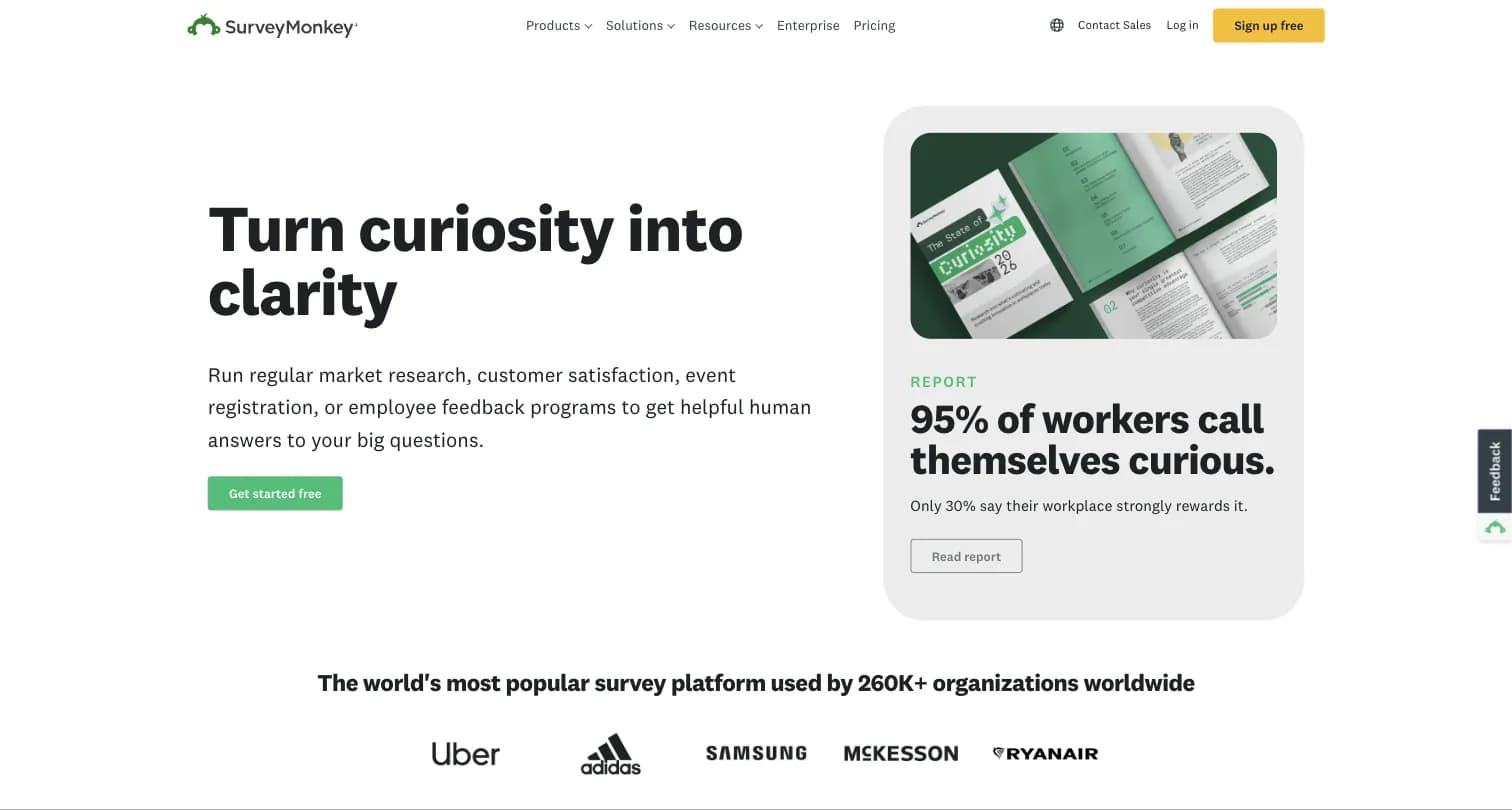
Ryan Finley founded SurveyMonkey in 1999 after finding no simple tool to collect customer feedback, later bringing on his brother Chris Finley as co-founder. The company relocated to Portland, Oregon in 2005 and now positions itself as the world's most popular survey platform, used by 260,000+ organizations, ranked #1 on G2 for online forms with 14,000+ five-star reviews per its own marketing.
What SurveyMonkey's Own Comparison Claims
SurveyMonkey's head-to-head page against Typeform (data compiled August 2025) lists these as its differentiators: advanced branching and logic, premium question types, export to PDF/PPT and more, a global audience panel, global benchmarks, longitudinal analysis, crosstab reports, multi-survey analysis, enhanced sensitive data protection, role and permission-based workgroups, advanced response management, and 24/7 customer support, all marked as capabilities Typeform doesn't offer on the same comparison table. SurveyMonkey lists 200+ built-in integrations versus Typeform's 50+.
Free and Paid Plans
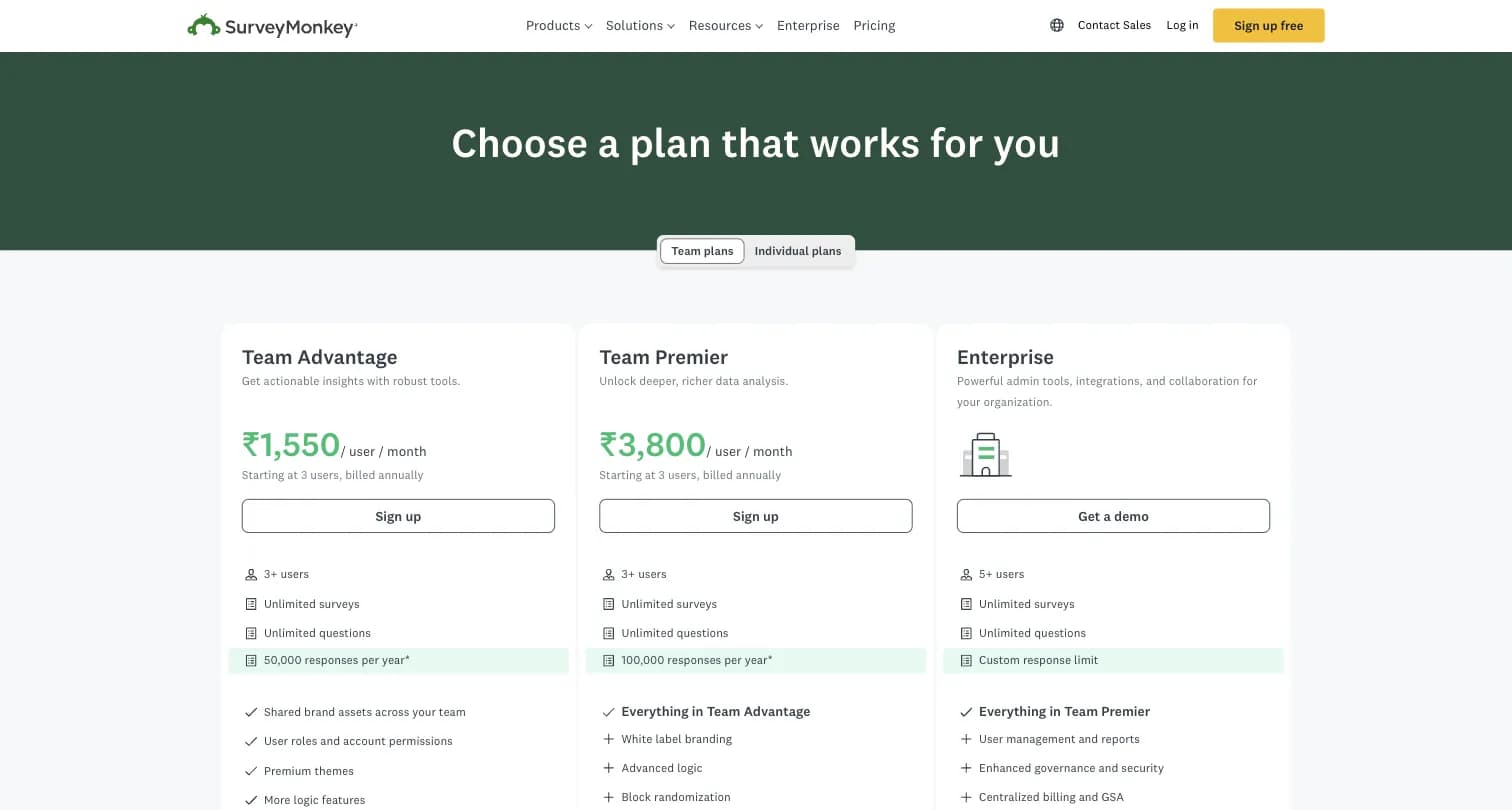
The free Basic plan caps at 10 questions per survey with limited response viewing. Individual plans (Standard, Advantage, Premier) don't show a public dollar price without account signup. Team plans require a 3-user minimum: Team Advantage at $30/user/month (annual, 50,000 responses/year) and Team Premier at $92/user/month (annual, 100,000 responses/year, white label, advanced logic, crosstabs).
Captured August 15, 2026 from surveymonkey.com/pricing.
Where SurveyMonkey Falls Short
- Individual-plan dollar prices are hidden behind account signup, and third-party sources publish conflicting numbers for the same tier
- $0.15 charged per response over your plan's limit
- Team plans require a minimum of 3 users
- Pricing is the single most-disliked theme in SurveyMonkey reviews, per Thematic's analysis, mentioned in 24.2% of negative sentiment
- A G2 reviewer cited on SurveyMonkey's own comparison page notes Typeform "will just send you a spreadsheet," implying SurveyMonkey's dashboard-style results are the differentiator, a framing that also reveals Typeform users report having to build their own reporting layer
Typeform: Conversational Design, at a Design-Forward Price
Captured August 15, 2026 from typeform.com.
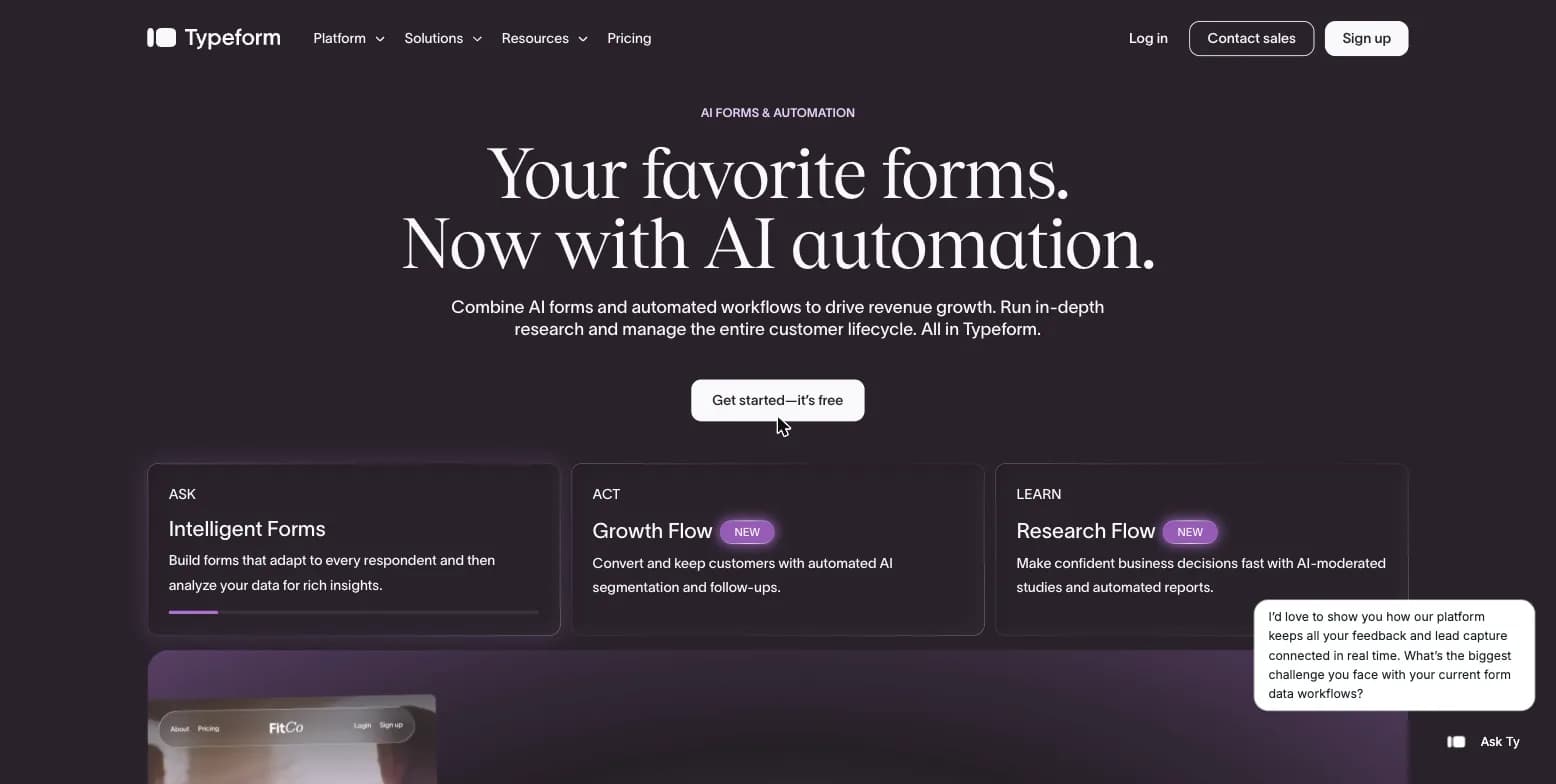
Co-founders David Okuniev and Robert Muñoz ran separate design agencies in Barcelona before a lead-generation form project for a toilet company (Roca) became the prototype for Typeform in 2012. The company now positions itself around "AI forms and automated workflows," claiming 150,000+ businesses use it.
Conversational, One-Question-at-a-Time Format
Typeform's core differentiator is presenting one question at a time in a chat-like flow rather than a dense grid, a format multiple third-party comparisons (Zite, involve.me) credit with higher completion rates and a more engaging respondent experience. Typeform AI can build a full typeform from a prompt, and the platform claims 3.5x more data collected and 48M+ responses collected monthly across the platform.
Pricing
| Plan | Price (annual billing) | Response Limit | Key Features |
|---|---|---|---|
| Free | $0 | Limited monthly responses | Unlimited typeforms, 3,000+ templates |
| Basic | $39/month ($468/year) | 100 responses/month | Unlimited typeforms, AI form creation, conditional logic, webhooks |
| Plus | $79/month ($948/year) | 1,000 responses/month | Everything in Basic, remove branding, custom subdomain |
| Business | $129/month ($1,548/year) | 10,000 responses/month | Drop-off rate analytics, conversion tracking, priority support |
| Enterprise | Custom | Custom | VIP account management, enterprise-grade security |
Typeform's pricing page also lists a separate "Talent" plan ($169/month) for recruiting forms and a "Growth Flow" add-on ($379/month) for AI-driven lead enrichment, both distinct products layered onto the same pricing page rather than a 5th tier of the core form-builder ladder.
Where Typeform Falls Short
- Not well suited to long or complex surveys, per third-party review aggregation
- Higher price per response than form-builder competitors at the entry tier: Basic costs $39/month for just 100 responses
- No respondent panel, global benchmarking, or crosstab/multi-survey analysis, capabilities SurveyMonkey's own comparison page highlights as absent
- Not an XM/experience-management platform: optimized for lead-gen and conversational data capture, not structured, recurring CX program management
Formbricks: An Open Feedback and Experience Management Suite
Formbricks isn't a third form builder competing on design polish or question-type counts. It's an open source feedback and experience management suite built around three things: feedback management, feedback analytics, and workflows and integrations, published transparently and included on every tier rather than upsold as add-ons.
Feedback Management. Formbricks unifies collection channels SurveyMonkey and Typeform don't combine on one platform: website surveys that target specific visitors, in-app surveys that reach any user cohort inside your product, link surveys for broad distribution, and branded surveys embedded directly in email.
Feedback Analytics. Response data flows into one place regardless of channel. You can follow individual feedback trails or zoom out for the aggregate picture, track partial and dropped-off responses, and segment by custom attributes, going further than SurveyMonkey's per-survey dashboards or Typeform's Business-tier drop-off analytics.
Workflows and Integrations. Formbricks Workflows automate what happens after a response comes in, routing and acting on feedback without manual handling. On the integration side, Formbricks connects to Salesforce, HubSpot, Slack, Google Sheets, and Notion through webhooks and its open API, free on every tier, including the self-hosted Community Edition.
Formbricks Pricing
Captured August 16, 2026 from formbricks.com/pricing.
| Plan | Monthly Billing | Annual Billing | Responses/Month | Workspaces |
|---|---|---|---|---|
| Hobby | Free | Free | 250 | 1 |
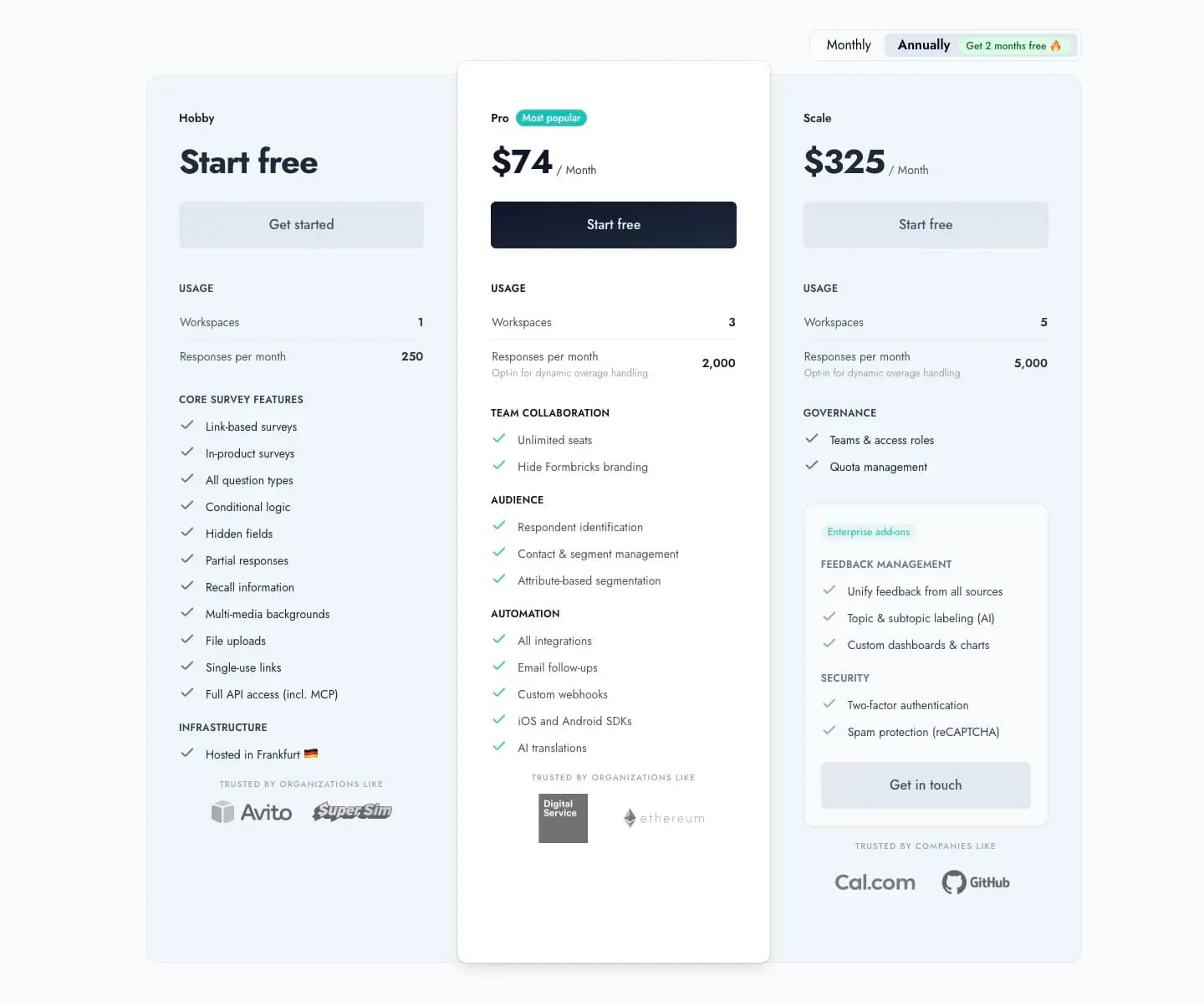
| Pro | $89/month | $890/year (displayed as $74/mo) | 2,000 | 3 |
| Scale | $390/month | $3,900/year (displayed as $325/mo) | 5,000 | 5 |
At $890/year for 2,000 responses/month (24,000/year), Formbricks Pro works out to roughly $0.037 per response, well below Typeform Basic's $468/year for just 100 responses/month (1,200/year), or roughly $0.39 per response, a real gap once you account for Typeform's response caps at each tier.
Formbricks Self-Hosting: Community Edition
The free, self-hosted Community Edition, licensed under AGPLv3, is where Formbricks diverges most sharply from both SurveyMonkey and Typeform. Data never leaves your own infrastructure, there's no response cap, and even if you stop paying for Enterprise features, the Community Edition and your data remain accessible. Neither SurveyMonkey nor Typeform offers an equivalent self-hosting path at any price.
Side-by-Side Pricing
| SurveyMonkey | Typeform | Formbricks | |
|---|---|---|---|
| Free tier | 10 questions/survey, limited responses | Unlimited typeforms, capped monthly responses | 250 responses/month, full API incl. MCP |
| Cheapest paid tier | Individual Standard (price not public) | Basic: $39/month, 100 responses/month | Pro: $89/mo (or $890/yr annual) |
| Team/mid tier | Team Advantage $30/user/mo (3-user min) | Plus: $79/month, 1,000 responses/month | Scale: $390/mo (or $3,900/yr annual) |
| Enterprise | Team Enterprise, custom, 5+ users | Custom, VIP account management | Custom pricing, published contact path |
| Respondent panel | SurveyMonkey Audience, 335M+ people | Not offered | Not offered |
| Self-hosting | Not offered on any tier | Not offered | Free Community Edition, self-hosted |
| Feedback channels | Surveys and forms | Conversational forms | Website, in-app, link, and email, unified |
Feature Value Breakdown
Design and Respondent Experience
SurveyMonkey's Approach: Traditional, dense form layout familiar to most users, solid for academic or enterprise-level surveys but less flexible on personalization per Content Snare's testing.
Typeform's Approach: One-question-at-a-time conversational flow with rich media (images, video, GIFs) on every question, widely credited with higher completion rates for shorter forms.
Formbricks' Approach: A no-code builder for standard survey layouts, with in-app and website survey targeting that neither competitor offers as a native channel.
Value Verdict: Typeform wins clearly on visual design and engagement for marketing-facing forms. This is Typeform's real differentiator, not a marginal one.
Logic, Branching, and Analytics Depth
SurveyMonkey's Approach: Advanced branching and logic, premium question types, crosstab reports, multi-survey analysis, and global benchmarks, all listed on its own comparison page as capabilities Typeform lacks.
Typeform's Approach: Conditional logic jumps exist, but SurveyMonkey's own comparison page marks "premium question types," "crosstab report," and "multi-survey analysis" as unavailable on Typeform. Independent testing (Content Snare) confirms Typeform's reporting is good for quick, accessible insights but not detailed data examination.
Formbricks' Approach: Attribute-based segmentation with conditional logic for targeting who sees a survey, plus feedback analytics (drop-off tracking, per-response views) built for an ongoing program rather than a one-off report.
Value Verdict: SurveyMonkey wins for research teams needing statistical depth and benchmarking. Formbricks wins if the goal is tracking feedback trends and segments over time.
Pricing Transparency
SurveyMonkey's Approach: Team tier prices are public; Individual-tier prices are hidden behind account signup.
Typeform's Approach: All four core tiers (Free, Basic, Plus, Business) publish a real price, though the pricing page also mixes in separate "Talent" and "Growth Flow" products that aren't part of the base form-builder ladder.
Formbricks' Approach: Every tier, Hobby through Scale, is priced and published, with both monthly and annual billing shown up front.
Value Verdict: Typeform and Formbricks both publish clean, real numbers for their core tiers. SurveyMonkey's Individual tier remains the one genuinely opaque price point among the three.
Data Residency and Self-Hosting
SurveyMonkey's Approach: Regional data center choice (US/Canada/EU) exists only on the custom-priced Team Enterprise tier.
Typeform's Approach: No self-hosting or regional data residency choice mentioned anywhere in its pricing or product documentation.
Formbricks' Approach: A free, self-hosted Community Edition under AGPLv3 keeps data on your own infrastructure entirely, on every plan.
Value Verdict: Formbricks wins clearly for any buyer where self-hosting or data residency is a hard requirement.
Who Should Choose Which Platform
Choose SurveyMonkey if:
- You need advanced branching logic, premium question types, or crosstab/multi-survey analysis
- Global benchmarks or a purchasable respondent panel matter for your research
- You want 200+ built-in integrations without relying on Zapier for most connections
- You're comfortable with per-seat team pricing or an opaque Individual-tier price
Choose Typeform if:
- Visual design and respondent engagement drive your form's purpose (lead-gen, marketing, onboarding)
- Your forms are shorter and benefit from a one-question-at-a-time flow
- A published, real starting price ($39/month) matters more than deep logic or benchmarking
- You don't need a respondent panel or crosstab-level analysis
Choose Formbricks if:
- You want one platform for website, in-app, link, and email feedback instead of forms alone
- You need feedback analytics (segmentation, drop-off tracking) and Workflows built in, not sold separately
- Self-hosting or data residency is a real requirement, not a preference
- Your engineering team wants full API access, including MCP, free on every tier
SurveyMonkey vs Typeform FAQ
Final Verdict
👍 SurveyMonkey is the right call if you're running structured research: advanced branching logic, benchmarking, crosstab analysis, or you need access to a purchasable respondent panel. Budget for the 3-seat minimum on Team plans and the opacity of Individual-tier pricing.
👍 Typeform is the right call if visual design and respondent engagement are the priority, especially for shorter, marketing-facing or lead-gen forms where a conversational flow measurably improves completion. Its published pricing is cleaner than SurveyMonkey's, but the per-response cost is higher at the entry tier.
👉 Formbricks is the better fit if you want one platform for website, in-app, link, and email feedback instead of choosing between a research tool and a design tool, and you want feedback analytics and Workflows built in from a published, monthly-or-annual price. The self-hosted Community Edition also gives you a data residency option neither SurveyMonkey nor Typeform offers at any price.
The honest read: SurveyMonkey and Typeform solve different problems (depth vs. design), and picking between them usually comes down to whether your form needs to convert respondents or analyze them rigorously. If neither answers the feedback-analytics or self-hosting question you came here with, see Formbricks' current pricing here.
Try Formbricks now