

Qualtrics vs SurveyMonkey (vs Formbricks): Which Platform Should You Actually Choose in 2026?

Johannes
Co-Founder @ Formbricks
16 Minutes
August 16th, 2026
If you're searching "Qualtrics vs SurveyMonkey," you're probably choosing between two very different philosophies, not two similar tools. Qualtrics built its business on academic-grade research depth and enterprise compliance. SurveyMonkey built its business on speed, templates, and a lower barrier to entry. Neither one publishes a self-hosting option, and neither one gives you a full price list before a sales call or a credit card.
I believe Qualtrics is the right call if:
- You need enterprise-grade statistical tooling (StatsIQ regression, clustering, R-integration) and guided academic-style research methodologies
- You'd rather a vendor own the compliance boundary end to end than run anything in your own environment
- A large managed respondent panel bundled into the platform is worth paying for
- You have budget flexibility for a quote-based enterprise contract instead of a fixed published price
I believe SurveyMonkey is the right call if:
- You want a self-serve tool your whole team can use without a dedicated admin
- Templates, a large third-party respondent panel, and fast time-to-value matter more than deep customization
- Per-seat team pricing ($30 to $92/user/month) fits your budget and you can staff a 3-person minimum team plan
- You don't need self-hosting or a hard data residency guarantee
Both platforms are cloud-only, and both gate most of their real pricing behind either a sales call (Qualtrics) or an account signup (SurveyMonkey). If transparent pricing or self-hosting matter to your evaluation, there's a third option worth knowing about before you pick between these two.
👉 Formbricks is an open feedback and experience management suite built around three things: feedback management (website, in-app, link, and email surveys, unified), feedback analytics (aggregate and per-response views, segmentation, drop-off tracking), and workflows and integrations (post-response automation plus native connections to Salesforce, HubSpot, Slack, Google Sheets, and Notion). Every tier, including the free Hobby plan, publishes a real price and ships a full API. A free, self-hosted Community Edition exists for teams that need data to never leave their own infrastructure, something neither Qualtrics nor SurveyMonkey offers at any price.
Table of contents:
- Qualtrics vs SurveyMonkey vs Formbricks at a glance
- What buyers actually mean by "Qualtrics vs SurveyMonkey"
- Qualtrics: enterprise research depth, sales-gated pricing
- SurveyMonkey: mainstream ease of use, per-seat team pricing
- Formbricks: an open feedback and experience management suite
- Qualtrics vs SurveyMonkey vs Formbricks: side-by-side pricing
- The real math: cost per response
- What reviewers say
- Feature value breakdown
- Who should choose which platform
- Qualtrics vs SurveyMonkey FAQ
- Final verdict
Qualtrics vs SurveyMonkey vs Formbricks at a Glance
| Qualtrics | SurveyMonkey | Formbricks | |
|---|---|---|---|
| Pricing transparency | ⭐⭐ One of 8 tiers has a public price | ⭐⭐⭐ Team tiers public, Individual tiers hidden | ⭐⭐⭐⭐⭐ Every tier published, monthly or annual |
| Free plan | ⭐⭐ 1 user, 500 responses total, 8 question types | ⭐⭐⭐ Unlimited surveys, capped response viewing | ⭐⭐⭐⭐⭐ 250 responses/month, full API included |
| Statistical/research depth | ⭐⭐⭐⭐⭐ StatsIQ, guided academic research solutions | ⭐⭐⭐ Statistical significance, benchmarking | ⭐⭐ No built-in advanced statistics suite |
| Ease of use | ⭐⭐ Steep learning curve per reviewers | ⭐⭐⭐⭐ Built for non-technical business users | ⭐⭐⭐⭐ No-code builder, developer-first depth |
| Data residency / self-hosting | ⭐ Cloud-only, nothing self-hosted in its own docs | ⭐⭐ Regional data center choice on Enterprise only | ⭐⭐⭐⭐⭐ Free, self-hosted Community Edition |
| API / developer access | ⭐⭐⭐ Available, scoped by tier | ⭐⭐⭐ Bundled into higher tiers | ⭐⭐⭐⭐⭐ Full API free on every tier, incl. MCP |
| Respondent panel reach | ⭐⭐⭐ Panel access on research tiers | ⭐⭐⭐⭐⭐ SurveyMonkey Audience, 335M+ people | ⭐⭐ No equivalent panel product |
| Best for | Research teams, regulated enterprises | Business users, agile teams, market research | Developers, regulated industries, unified feedback |
What Buyers Actually Mean by "Qualtrics vs SurveyMonkey"
Most of what ranks for this exact search is either SurveyMonkey's own vendor-authored comparison page or informal advice from researchers and IT teams. Neither gives you the full picture on its own.
Berry College's IT support desk, one of the few independent sources that actually ranks for this comparison, frames the split simply: SurveyMonkey's interface is more intuitive and accessible with a straightforward editor, while Qualtrics has more capacity for survey design and customization but a steeper learning curve. Qualtrics has its roots in academic research and remains the preferred platform for survey research within many academic disciplines. SurveyMonkey is more frequently used for opinion research, program and event evaluation, and general assessment work.
SurveyMonkey's own head-to-head page takes a more assertive stance: it claims to deliver "95% of the same survey features as Qualtrics, without the complexity and cost," and cites a G2 comparison report showing SurveyMonkey customers reaching ROI within a year, versus 21 months for Qualtrics, plus a claim that SurveyMonkey users launch surveys twice as fast. Treat those specific numbers as SurveyMonkey's own marketing framing of a G2 comparison report it commissioned, not independent benchmarking.
Source: Berry College IT Knowledge Base and SurveyMonkey's Qualtrics comparison page, both captured August 15, 2026.
The honest read: this isn't a "which is better" question. It's a "which problem are you solving" question, and the answer changes depending on whether you're running a rigorous multi-market research study or collecting quick customer feedback with a team that doesn't want to hire an analyst to read the results.
Qualtrics: Enterprise Research Depth, Sales-Gated Pricing
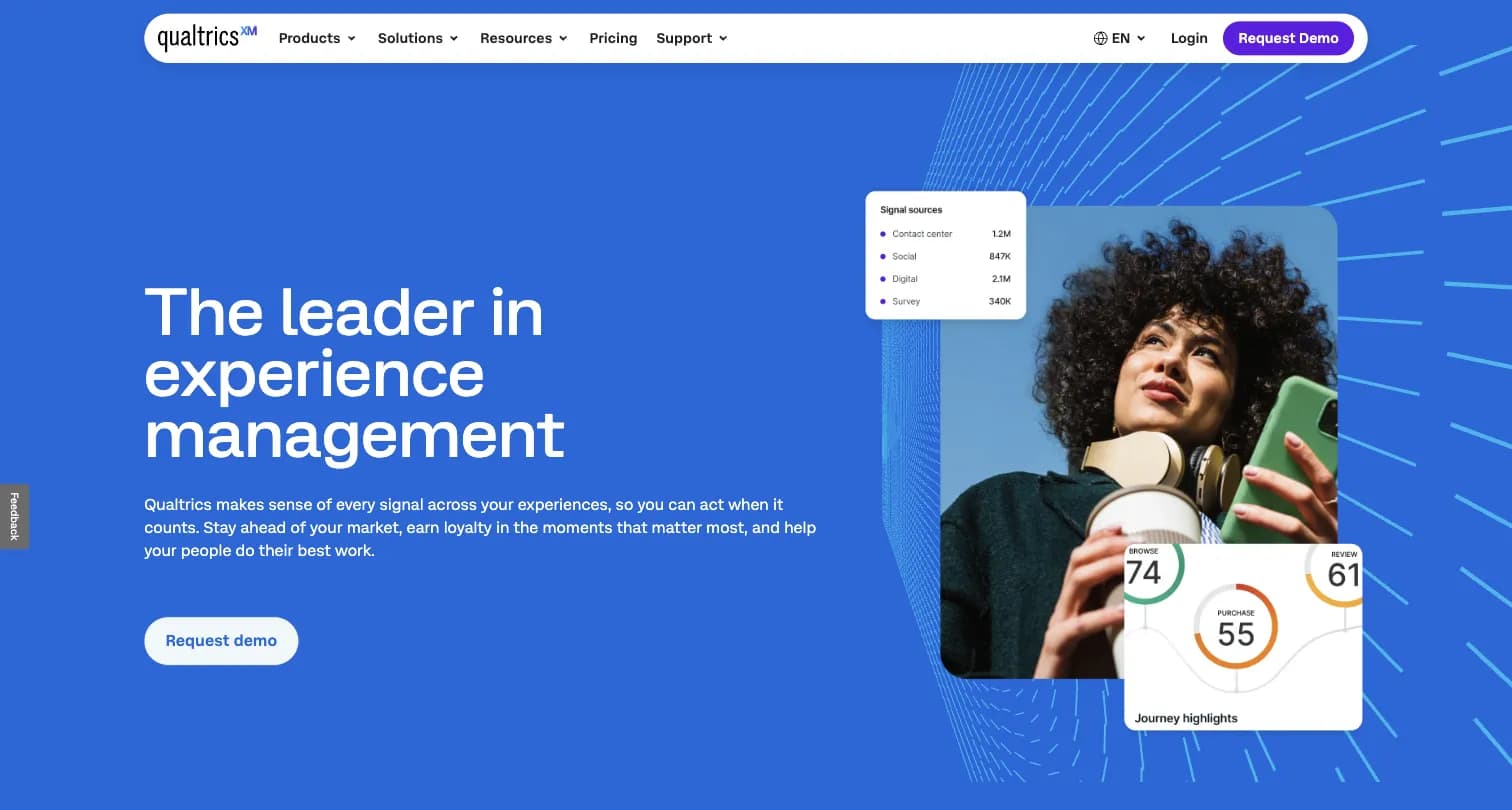
Captured August 15, 2026 from qualtrics.com.
Qualtrics was founded in 2002 in Provo, Utah by Scott M. Smith, Ryan Smith, Jared Smith, and Stuart Orgill. SAP acquired it for $8 billion in 2018, it went public on Nasdaq in January 2021 at a $27.3 billion valuation, and Silver Lake and CPP Investments took it private again in June 2023. Three ownership changes in five years is a real consideration for any buyer weighing long-term pricing direction, independent of feature quality today.
Qualtrics splits its platform into three product lines: Customer Experience, Employee Experience, and Strategy & Research, spanning eight total pricing tiers. Seven of those eight tiers are Request Pricing. For a full tier-by-tier pricing breakdown, see our Qualtrics pricing guide.
The Only Qualtrics Plan With a Public Price
Strategic Research (self-serve) is the one product you can buy with a credit card instead of a sales call.
| Feature | Details |
|---|---|
| Price | $420/month, $5,040 billed annually |
| Responses | 1,000 total, shared across all users |
| Users | Unlimited users, surveys, and questions per survey |
| Question types | 23, including video and audio responses |
| Research tools | 20+ guided solutions (Video Diaries, Conjoint, MaxDiff, Concept Testing) |
| Statistics | StatsIQ: regression, clustering, R-integration |
| Strategic Research (self-serve) | |
|---|---|
| Pros | Cons |
| ✅ The only credit-card-buyable price in the entire portfolio | ❌ Capped at 1,000 responses total, not per month |
| ✅ Full StatsIQ statistical suite included | ❌ No self-hosting or data residency option |
| ✅ 20+ guided research methodologies | ❌ Needing more responses means quote-only pricing |
The Bottom Line: this is Qualtrics at its most accessible, and it's still built for a defined research project, not an ongoing monthly feedback pipeline.
Customer Experience, Employee Experience, and Strategic Brand: All Request Pricing
The other seven tiers span three separately-priced product lines, none with a public number:
| Product Line | Products | Priced On |
|---|---|---|
| Customer Experience | CX Foundational, Frontline Digital, Frontline Care, Frontline Locations | Interactions |
| Employee Experience | People Engage, People Lifecycle | Employee count |
| Strategy & Research | Strategic Research (enterprise), Strategic Brand | Interactions |
If your evaluation needs a rough annual figure before the first sales call, none of these seven tiers will give you one. Qualtrics' own FAQ confirms pricing "may differ based on industry security requirements and product availability," another variable you can't check yourself.
Where Qualtrics Falls Short
- Seven of eight product tiers require a sales conversation before you see a single number
- No self-hosted or customer-premises deployment option appears anywhere in Qualtrics' own security documentation, only centrally-hosted cloud infrastructure
- Reviewers on TrustRadius and G2 describe add-ons as consistently costing extra, and one G2 reviewer reported an unexpected $5,000 charge to hire outside help extracting data Qualtrics' own tools couldn't handle
- Third-party benchmarking cited by UXtweak (sourced from Vendr, not Qualtrics itself) reports a median annual spend of $28,533/year, ranging $6,525 to $126,000/year
SurveyMonkey: Mainstream Ease of Use, Per-Seat Team Pricing
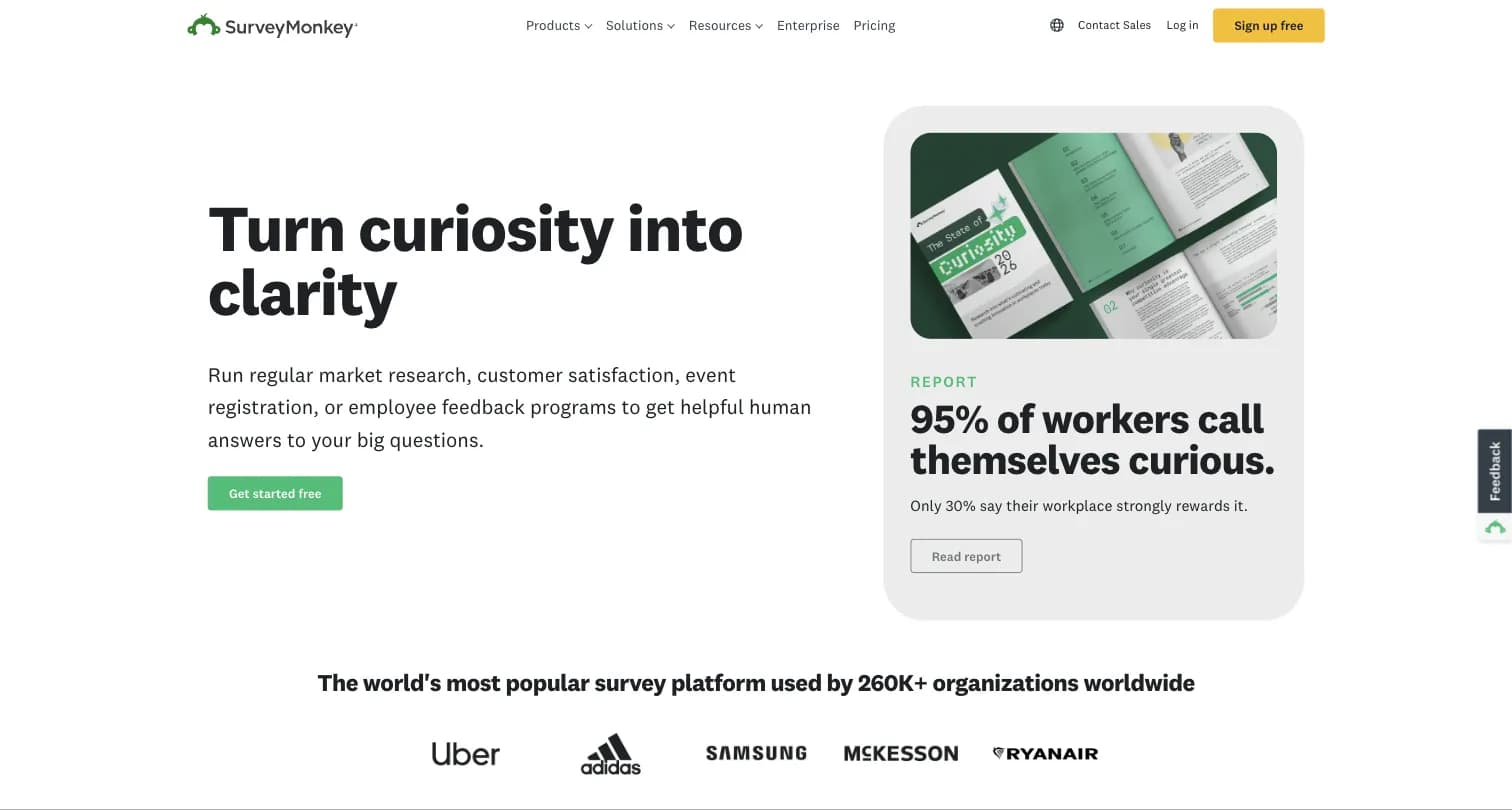
Captured August 15, 2026 from surveymonkey.com.
Ryan Finley founded SurveyMonkey in 1999 after finding no simple tool to collect customer feedback, and later brought on his brother Chris Finley as co-founder. The company relocated to Portland, Oregon in 2005 and today positions itself as the world's most popular survey platform, used by 260,000+ organizations.
Free and Individual Plans
The free Basic plan allows unlimited surveys, but caps how many responses you can view per survey. Above that sit three Individual plans:
| Plan | Response Limit | Key Features |
|---|---|---|
| Individual Standard | 1,000 responses/month | Unlimited surveys/questions, more question types, custom design, skip logic, 200+ integrations |
| Individual Advantage | 15,000 responses/year | Premium themes, accept payments, statistical significance, multi-survey analysis, Analyze with AI |
| Individual Premier | 40,000 responses/year | White label branding, advanced logic, block randomization, multilingual surveys, crosstabs, phone support |
None of the three Individual plans show a dollar price on the public pricing page without creating an account first. Third-party blogs disagree substantially on what these actually cost, one cites $39/month for Standard, another cites $99/month for the same tier, and neither figure could be independently confirmed.
Team Plans
Team plans require a minimum of 3 users and do publish per-seat prices:
| Plan | Price | Users | Responses | Key Features |
|---|---|---|---|---|
| Team Advantage | $30/user/month (annual) | 3+ | 50,000/year | Shared brand assets, user roles, premium themes, statistical significance |
| Team Premier | $92/user/month (annual) | 3+ | 100,000/year | Everything in Advantage, white label, advanced logic, multilingual, crosstabs |
| Team Enterprise | Custom | 5+ | Custom | US/Canada/EU data center choice, SSO, dedicated Customer Success |
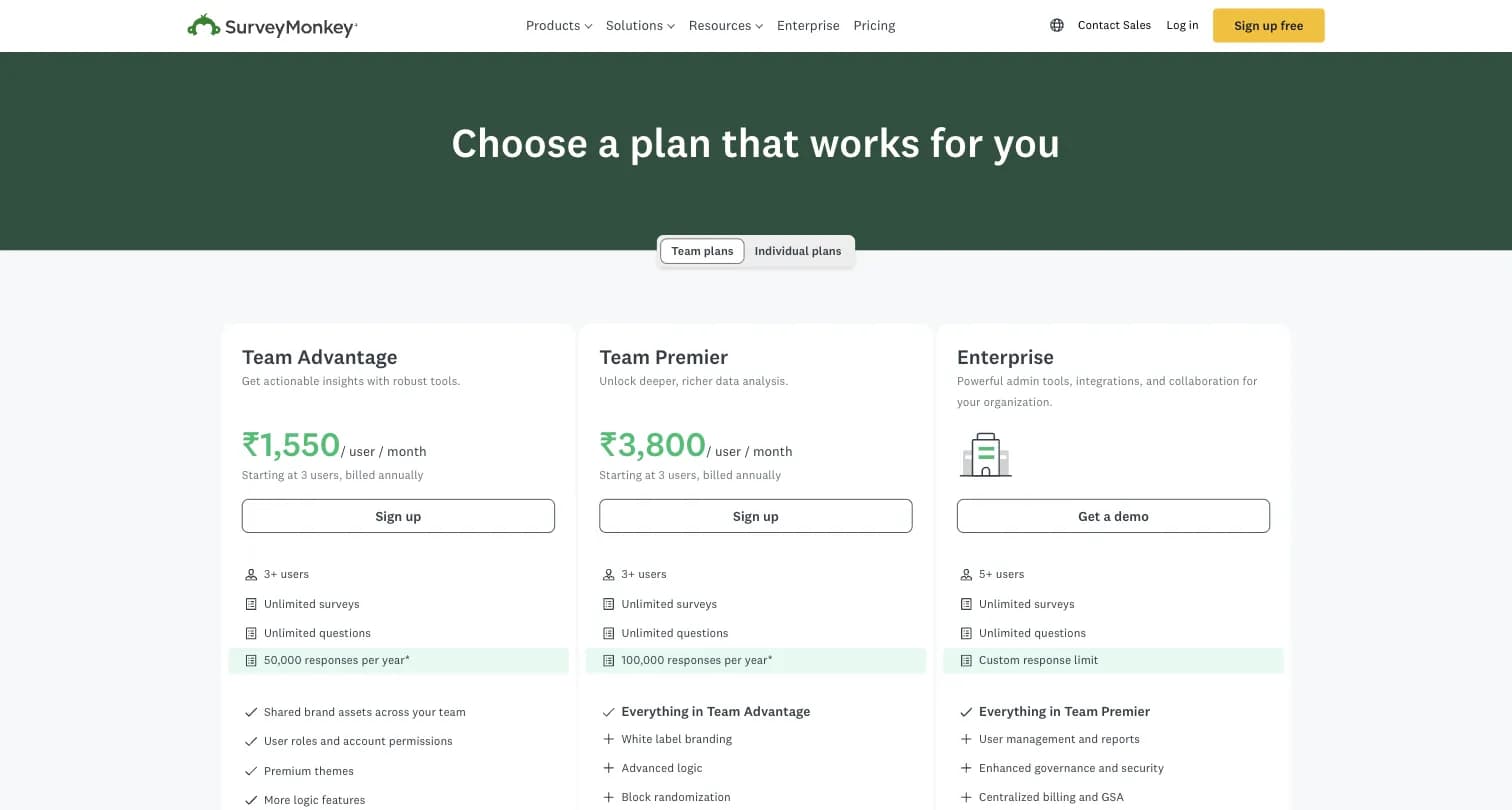
Captured August 15, 2026 from surveymonkey.com/pricing.
Where SurveyMonkey Falls Short
- Individual-plan dollar prices are hidden behind account signup, and third-party sources publish conflicting numbers for the same tier
- $0.15 charged per response over your plan's limit
- Team plans require a minimum of 3 users, so a 2-person team can't access team collaboration features without paying for a seat it doesn't need
- Regional data center choice (US/Canada/EU) is gated to the custom-priced Team Enterprise tier, so data residency has no path on any published plan
- Pricing is the single most-disliked theme in SurveyMonkey reviews: 24.2% of negative sentiment mentions price, roughly twice the rate of other survey tools, per Thematic's analysis
Formbricks: An Open Feedback and Experience Management Suite
Formbricks isn't a third survey tool competing on templates or statistical depth. It's an open source feedback and experience management suite built around three things: feedback management, feedback analytics, and workflows and integrations, all published transparently and included on every tier rather than upsold as add-ons.
Feedback Management. Formbricks unifies every collection channel that Qualtrics and SurveyMonkey split across separate products or tiers: website surveys that target specific visitors, in-app surveys that reach any user cohort inside your product, link surveys for broad distribution, and branded surveys embedded directly in email, all under one platform and one price.
Feedback Analytics. Response data flows into one place regardless of channel. You can follow individual feedback trails or zoom out for the aggregate picture, track partial and dropped-off responses, and segment by custom attributes instead of broadcasting the same survey to everyone. This is the territory Qualtrics' CX/EX lines and SurveyMonkey's Analyze with AI feature both cover, without the separate per-product pricing or per-seat cost.
Workflows and Integrations. Formbricks Workflows automate what happens after a response comes in, routing and acting on feedback without manual handling. On the integration side, Formbricks connects to Salesforce, HubSpot, Slack, Google Sheets, and Notion through webhooks and its open API, the same API available free on every tier, including the self-hosted Community Edition.
Formbricks Pricing
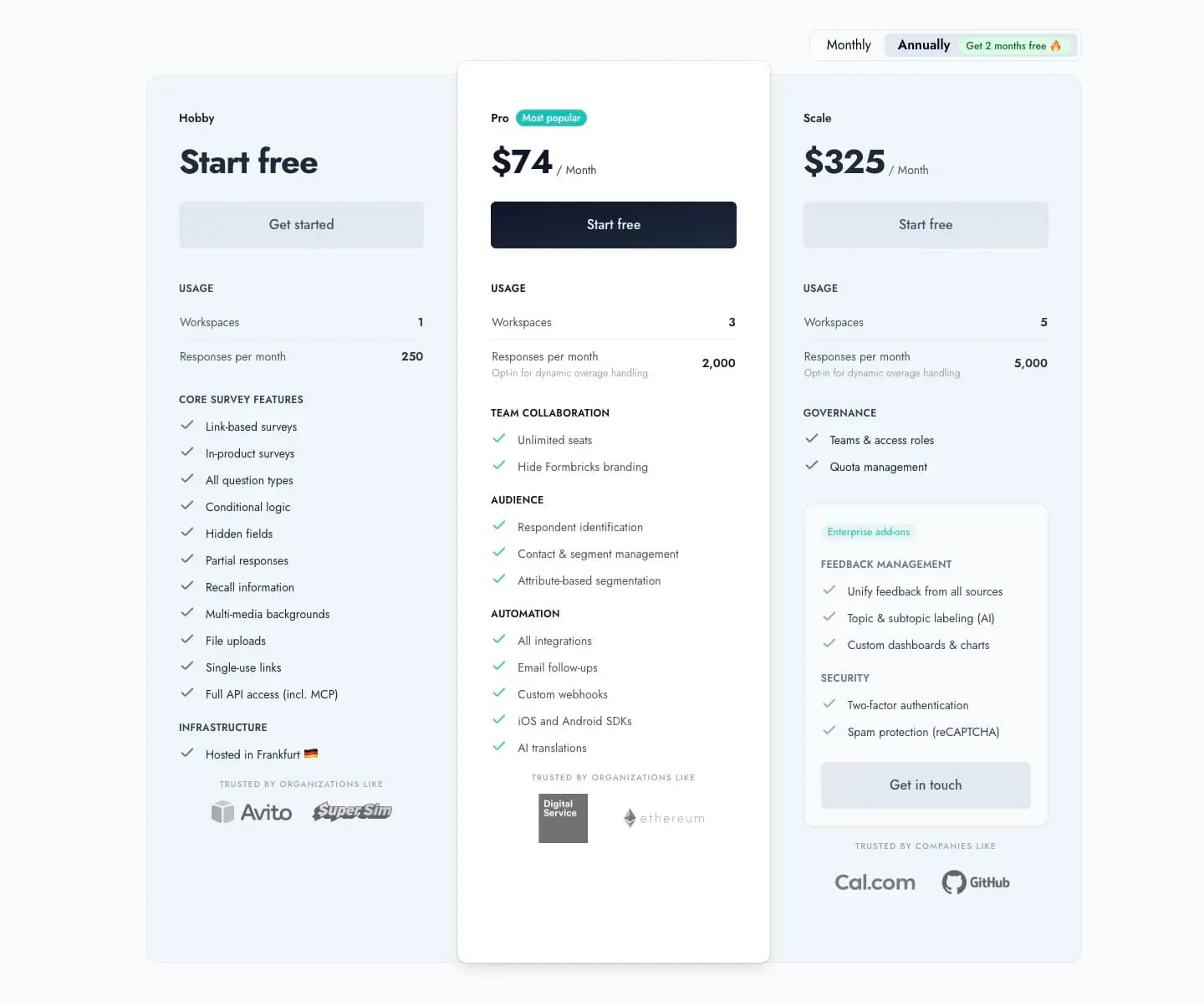
Captured August 16, 2026 from formbricks.com/pricing.
| Plan | Monthly Billing | Annual Billing | Responses/Month | Workspaces |
|---|---|---|---|---|
| Hobby | Free | Free | 250 | 1 |
| Pro | $89/month | $890/year (displayed as $74/mo) | 2,000 | 3 |
| Scale | $390/month | $3,900/year (displayed as $325/mo) | 5,000 | 5 |
Formbricks discounts annual billing to 10 months' worth of the monthly rate, effectively "2 months free," which is why the annual total ($890 for Pro) doesn't land on a clean 12x multiple of the displayed $74/month figure. Unlike Qualtrics' free account, which caps at 500 total responses and 8 question types, Formbricks Hobby includes the full API, including MCP, on day one, no separate developer tier required.
Pro adds unlimited seats, respondent identification, attribute-based segmentation, all integrations, email follow-ups, custom webhooks, and iOS/Android SDKs. Scale adds team access roles, quota management, and enterprise add-ons for unified feedback dashboards and AI topic labeling.
Formbricks Self-Hosting: Community Edition
The free, self-hosted Community Edition, licensed under AGPLv3, is where Formbricks diverges most sharply from both Qualtrics and SurveyMonkey:
- Data never leaves your infrastructure. No cloud dependency on Formbricks or any third party.
- No response limits. Unlimited surveys, responses, and team members.
- No vendor lock-in. Even if you stop paying for Enterprise features, the Community Edition and your data stay accessible, unlike losing access entirely.
- Full API on self-hosted, too. The same unrestricted API available on every cloud tier.
For a regulated-industry buyer who read the "no self-hosting" line in either competitor's section above and recognized their own procurement blocker, this is the option neither Qualtrics nor SurveyMonkey has at any price.
Qualtrics vs SurveyMonkey vs Formbricks: Side-by-Side Pricing
| Qualtrics | SurveyMonkey | Formbricks | |
|---|---|---|---|
| Free tier | 1 user, 500 responses total, 8 question types | Unlimited surveys, capped response viewing | 250 responses/month, full API incl. MCP |
| Cheapest published paid tier | Strategic Research: $420/mo, 1,000 responses total | Team Advantage: $30/user/mo (3-user minimum) | Pro: $89/mo (or $890/yr annual) |
| Mid tier | Not available self-serve | Team Premier: $92/user/mo (3-user minimum) | Scale: $390/mo (or $3,900/yr annual) |
| Enterprise | Request Pricing across 7 product lines | Team Enterprise: custom, 5+ users | Custom pricing, published contact path |
| Billing flexibility | Annual contracts standard; monthly only on Strategic Research | Monthly or annual; Team plans annual-billed | Monthly or annual (2 months free) on every tier |
| Self-hosting | Not offered anywhere in Qualtrics' documentation | Not offered on any tier | Free Community Edition, self-hosted |
| Feedback channels | Split across separately-priced CX, EX, Research lines | Surveys and forms, panel access via Audience | Website, in-app, link, and email, unified |
The Real Math: Cost Per Response
Nobody publishes this comparison directly, so here's the math using only the confirmed figures above. This isn't apples to apples: Qualtrics' price bundles guided research methodologies and statistical tooling neither other platform matches, and SurveyMonkey's Team plans require paying for 3 seats minimum regardless of how many people actually use them.
| Plan | Annual Cost | Responses Included | Cost per Response |
|---|---|---|---|
| Qualtrics Strategic Research (self-serve) | $5,040/year | 1,000 total | $5.04 |
| SurveyMonkey Team Advantage (3 users) | $1,080/year | 50,000/year | $0.022 |
| SurveyMonkey Team Premier (3 users) | $3,312/year | 100,000/year | $0.033 |
| Formbricks Pro | $890/year | 24,000/year | $0.037 |
| Formbricks Scale | $3,900/year | 60,000/year | $0.065 |
SurveyMonkey's Team Advantage looks like the cheapest per-response option on paper, but that math assumes exactly 3 users and no per-response overages ($0.15 each past the cap). Formbricks' per-response cost includes unlimited seats on every paid tier, so a 10-person team pays the same $890/year that a 3-person team does. Qualtrics' number reflects a fundamentally different product: guided academic research methodology, not a high-volume feedback pipeline.
What Reviewers Say
Qualtrics holds a 4.4 rating across 4,291 reviews on G2's seller page, 4.7 across 426 reviews on Capterra's Strategy & Research listing, and 7.7/10 across 415 reviews on TrustRadius. SurveyMonkey holds a 4.4 rating across 23,901 reviews on G2 and 4.6 across 10,421 reviews on Capterra.
| Qualtrics | SurveyMonkey | |
|---|---|---|
| What reviewers like | Friendly, knowledgeable support; intuitive builder for simple and complex surveys; wide variety of question types; powerful AI-powered analytics; strong statistical depth for complex studies | Fast, reliable, and easy to use; templates make survey creation quick and intuitive |
| What reviewers dislike | Steep learning curve paired with high costs; add-ons and packages consistently cost extra; one reviewer reported an unexpected $5,000 data-cleaning charge; opaque pricing requiring a sales call for nearly every plan | Pricing and plans are the single most-disliked theme, at roughly twice the rate of other survey tools |
Berry College's own IT knowledge base, an independent source rather than either vendor's marketing, corroborates the pattern directly: SurveyMonkey's interface is more intuitive with a straightforward editor, while Qualtrics has more design and customization capacity but a steeper learning curve.
Feature Value Breakdown
Pricing Transparency
Qualtrics' Approach: one of eight product tiers has a public price. The other seven require a sales conversation and a metric ("Interactions" or employee count) with no published rate card.
SurveyMonkey's Approach: Team plan prices are public, but Individual plan prices are hidden behind account signup, and third-party sources disagree on what they actually cost.
Formbricks' Approach: every tier, Hobby through Scale, is priced and published on the site, with both monthly and annual billing shown up front.
Value Verdict: Formbricks wins clearly here. This is a straightforward comparison of what's published versus what isn't, not a subjective call.
Data Residency and Self-Hosting
Qualtrics' Approach: centrally-hosted cloud infrastructure only, per its own security documentation. No self-hosting mentioned at any tier.
SurveyMonkey's Approach: regional data center choice (US/Canada/EU) exists only on the custom-priced Team Enterprise tier.
Formbricks' Approach: a free, self-hosted Community Edition under AGPLv3 keeps data on your own infrastructure entirely, on every plan, not just the top tier.
Value Verdict: Formbricks wins for any buyer where self-hosting or data residency is a hard requirement, not a preference.
Statistical and Research Depth
Qualtrics' Approach: StatsIQ (regression, clustering, R-integration) plus 20+ guided academic-style research solutions, built for trained researchers running rigorous studies.
SurveyMonkey's Approach: statistical significance testing, cross-tabulation, and benchmark comparisons, solid for business reporting but not academic-grade.
Formbricks' Approach: no built-in advanced statistics suite; the platform is built for feedback collection, segmentation, and workflow automation rather than academic research methodology.
Value Verdict: Qualtrics wins clearly here. If your team needs regression models or Van Westendorp pricing studies built into the platform itself, that's a real capability gap for both other platforms.
Ease of Use and Time to Value
Qualtrics' Approach: reviewers consistently describe a steep learning curve, and implementation can take weeks to months of professional services and custom setup.
SurveyMonkey's Approach: built for business users and agile teams; most users go live in under 24 hours according to SurveyMonkey's own data.
Formbricks' Approach: a no-code builder for non-technical users, with developer-first depth (full API, SDKs, webhooks) available underneath for teams that want to go further.
Value Verdict: SurveyMonkey and Formbricks both beat Qualtrics on time to first survey. Between the two, SurveyMonkey has the larger template library, Formbricks has the deeper developer/API layer.
Feedback Channel Breadth
Qualtrics' Approach: Customer Experience, Employee Experience, and Strategy & Research are three separately-branded, separately-priced product lines, each with its own products and quote process.
SurveyMonkey's Approach: primarily survey and form collection, extended by SurveyMonkey Audience for third-party respondent panel access.
Formbricks' Approach: website, in-app, link, and email feedback collection live on one platform under one pricing structure, with analytics and Workflows built in rather than sold as separate line items.
Value Verdict: Formbricks wins on unification. Qualtrics' breadth within each product line is real, but it comes at the cost of three separate buying processes instead of one.
Who Should Choose Which Platform
Choose Qualtrics if:
- You need enterprise-grade statistical and research tooling that goes beyond basic survey analytics
- You want the vendor to own the compliance boundary rather than running anything in your own environment
- Bundled research services and a managed respondent panel are worth the contract on their own
- You have budget flexibility for a quote-based enterprise contract
Choose SurveyMonkey if:
- You want a tool your whole company can use without a dedicated admin or IT resource
- You need access to a large third-party respondent panel for market research
- Per-seat team pricing fits your budget and you can staff a 3-person minimum team plan
- You're comfortable with US-based cloud storage and no hard data residency requirement
Choose Formbricks if:
- You're buying for government, healthcare, or another regulated sector and want the easiest possible procurement: self-host Formbricks on your own servers, private cloud, AWS GovCloud, or Azure Government and the data never leaves a boundary you already have approved
- You want to keep the subprocessor list short, because every vendor-side processor is another review your security team has to run
- You need self-hosting or strict data residency control that neither Qualtrics nor SurveyMonkey offers
- You want transparent, published pricing on every tier instead of a sales call or a hidden Individual-plan price
- You need one unified feedback platform (website, in-app, link, email) instead of separately-priced product lines or panel add-ons
- Your engineering team wants full API access, including MCP, free on every tier rather than gated to an enterprise contract
Qualtrics vs SurveyMonkey FAQ
Final Verdict
👍 Qualtrics is the right call if your team runs genuinely advanced research: guided methodologies, StatsIQ regression and clustering, and you have the budget and patience for a quote-based enterprise contract. Its certification list is genuinely deep if you want a vendor to carry the compliance boundary for you, and reviewers consistently rate the platform highly for exactly this kind of depth.
👍 SurveyMonkey is the right call if you want a self-serve tool your whole company can use without a dedicated admin, and you value templates, speed to launch, and access to a large respondent panel over deep customization. Just budget for the 3-seat minimum on Team plans and the per-response overage fees once you outgrow your cap.
👉 Formbricks is the better fit if transparent pricing matters, you want to forecast your actual cost before talking to sales, and you'd rather run feedback management, feedback analytics, and workflows on one unified platform instead of choosing between a sales-gated research suite and a per-seat survey tool. Every tier is published, monthly and annual billing are both available, and the cloud runs SOC 2 Type II and ISO 27001 compliant with GDPR and CCPA covered. The AGPLv3-licensed Community Edition then gives you a self-hosted path neither Qualtrics nor SurveyMonkey offers at any price, which is usually the fastest way through a government or healthcare procurement review: run it on your own servers, private cloud, AWS GovCloud, or Azure Government and there is no vendor data path and no subprocessor list to clear.
The honest read: Qualtrics and SurveyMonkey solve different problems at different price points, and picking between them usually comes down to research depth versus ease of use. If neither answers the data residency or pricing-transparency question you actually came here with, see Formbricks' current pricing here.
Try Formbricks now