
SurveyMonkey Alternatives in 2026: Free, Enterprise and Self-Hosted Options Compared

Johannes
Co-Founder
12 Minutes
Updated November 13, 2026
Most teams start looking for SurveyMonkey alternatives at renewal time. The free Basic plan stops at 10 questions per survey, the cheapest month-to-month plan costs $149 in the US, and data center choice only comes with the custom-priced Enterprise tier. This guide compares 10 SurveyMonkey alternatives on price, free plan, compliance and hosting, and says plainly where each one falls short.
Quick answer: the best SurveyMonkey alternatives at a glance
| Tool | Best for | Free plan | Paid plans from |
|---|---|---|---|
| Formbricks | Self-hosting, data ownership, in-app and link surveys | Yes: 250 responses/month on Surveys Hobby, free self-hosted Community Edition | $74/month billed annually (Surveys Pro); Experience Suite by quote |
| Google Forms | Free internal forms and quick polls | Yes, no response cap | Bundled with Google Workspace |
| Typeform | Design-led, one-question-at-a-time forms | Yes (limited responses) | $28/month billed annually |
| forms.app | Fast forms with an AI form builder | Yes | See vendor pricing |
| Zoho Survey | Teams already on Zoho CRM | Yes | $7.42/month (Basic) |
| SurveySparrow | Conversational, chat-style surveys | Yes | $19/month (Basic) |
| QuestionPro | Market research and regional data centers | Yes (Essentials) | $99/user/month billed annually |
| Zonka Feedback | Multi-channel CX across locations | Demo or trial on request | See vendor pricing |
| Qualtrics | Enterprise research and statistics | Yes (limited account) | $420/month self-serve; enterprise by quote |
| LimeSurvey | Open-source academic research | Yes, free Community Edition | See vendor pricing |
Our short verdict: Google Forms is the best free swap for simple internal forms. Typeform wins on design. QuestionPro and Qualtrics cover research depth. If your security team needs survey data to stay on your own infrastructure, Formbricks and LimeSurvey are the two open-source options here, and Formbricks adds in-app surveys, SSO, ISO 27001 and a SOC 2 Type II audited Public Cloud for teams that prefer hosting.
Sources for the prices above are linked in each tool section below. Prices checked November 2026.
Why teams look for SurveyMonkey alternatives
1. The free plan is a trial in practice
SurveyMonkey Basic caps each survey at 10 questions, allows 3 collectors and leaves out data exports. SurveyMonkey's own machine-readable pricing reference lists a limit of 10 on Basic responses as well, and third-party reviews such as Featurebase report similar small caps. That is enough to test the editor and not much more.
2. Paid plans add up fast
SurveyMonkey publishes its US prices on the Individual pricing page:
- Standard Monthly: $149/month, 1,000 responses per month
- Advantage Annual: $468/year ($39/month), 15,000 responses per year
- Premier Annual: $1,668/year ($139/month), 40,000 responses per year
- Team Advantage: $30/user/month billed annually, 3-user minimum
- Team Premier: $92/user/month billed annually, 3-user minimum
- Enterprise: 5 or more users, custom quote
- Overage: $0.15 per response above your plan limit
For the full breakdown, read our SurveyMonkey pricing guide.
3. Data residency sits behind the Enterprise tier
US, Canada or EU data center choice only comes with SurveyMonkey Enterprise (pricing). SurveyMonkey does not offer self-hosting at any tier. For banks, hospitals and public bodies that must keep feedback inside their own perimeter, that ends the evaluation early.
4. Ownership and product changes
An STG-led consortium took SurveyMonkey's parent, Momentive Global, private for about $1.5 billion in May 2023, and the company went back to the SurveyMonkey name (SurveyMonkey newsroom). Since then it has trimmed its portfolio: GetFeedback Direct, its Salesforce-native survey product, retires on December 31, 2026 (Salesforce Ben). Procurement teams weigh this kind of vendor change when they renew.
5. Design and analysis limits on lower tiers
White-label surveys, crosstabs, block randomization and phone support are reserved for Premier and Team Premier, per SurveyMonkey's plan reference. Teams that need those features on a budget often look elsewhere.
How we picked these SurveyMonkey alternatives
We started from the tools that rank for this search (Fomr, Pollfish, Gartner Peer Insights, FormGrid) and kept the ones that are still sold in 2026. We dropped Delighted, which Qualtrics shut down in mid-2026 (Delighted sunset FAQ). Each tool was checked against its own pricing page or a dated third-party source, and we list one honest trade-off per tool. Formbricks is our product, so read that section with that in mind.
The 10 best SurveyMonkey alternatives in 2026
1. Formbricks: best for self-hosting and owning your experience data
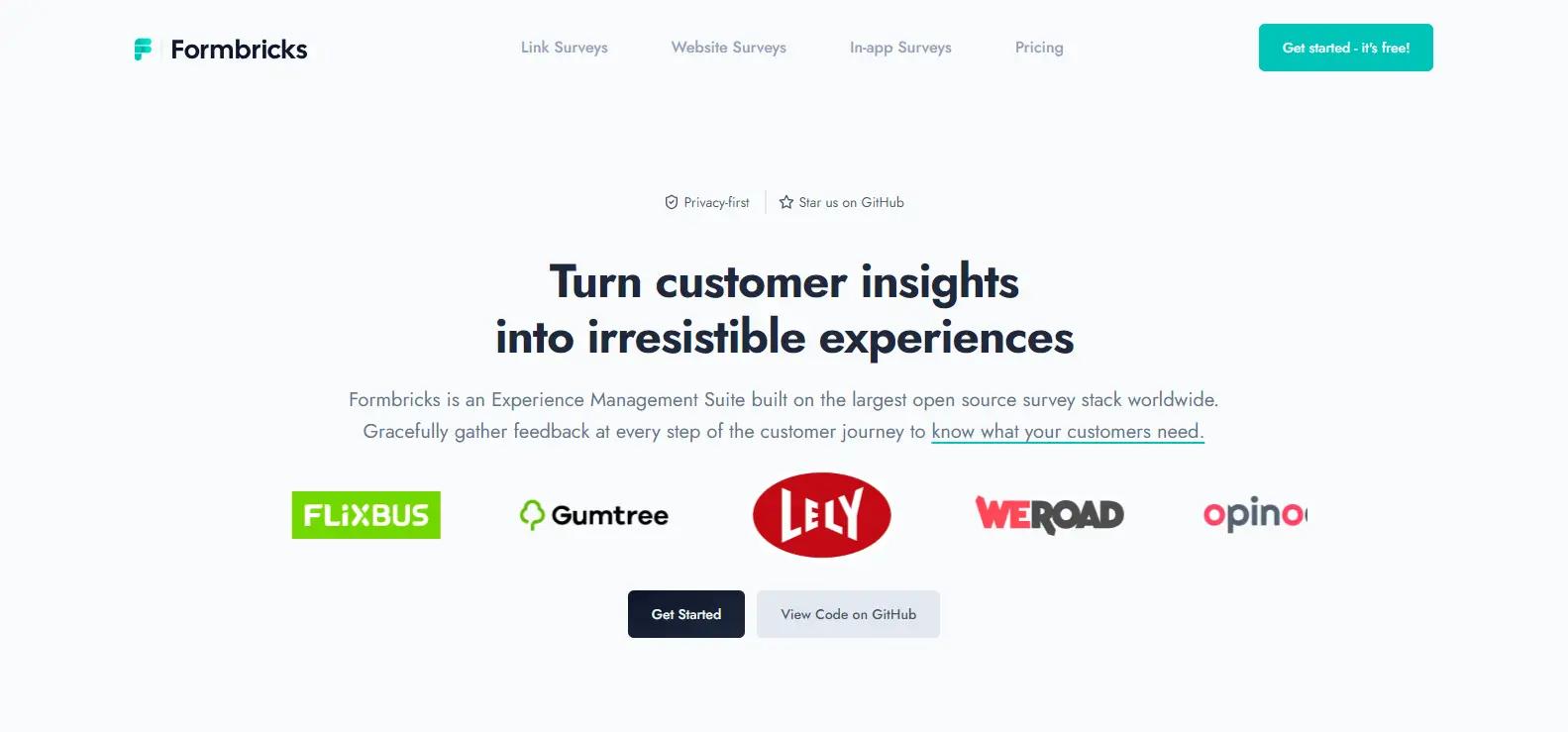
Formbricks is an open-source experience management platform for link, website, in-app and email surveys. Teams that switch from SurveyMonkey to Formbricks usually cite one of three reasons.
Data sovereignty. You decide where responses live. Run Formbricks on your own servers, in your own AWS, Azure or GCP account, or let Formbricks manage the hosting. When you self-host, Formbricks the company processes none of your data, so there are zero Formbricks sub-processors in the chain. Our guide to Formbricks self-hosting covers the setup options.
Security and compliance. Formbricks is ISO 27001, GDPR and CCPA compliant, and its hosted Public Cloud (EU, Frankfurt) is SOC 2 Type II audited. Self-hosted customers run their own controls on the same codebase. The compliance page lists the Trust Center, the DPA with its full sub-processor list, and the controls IT teams ask about: SSO (SAML and OIDC), role-based access and audit logging. Experience Suite contracts come with a DPA and custom terms.
Cost that follows responses. Paid Surveys plans include unlimited seats, so the bill grows with response volume instead of headcount. That matters when a whole CX or product team needs access.
For IT: deploy with Docker or Helm charts, connect your identity provider, and keep data in your jurisdiction. For CX teams: run NPS, CSAT and CES programs across web, app and email, target surveys by user attributes, and pipe results to Slack, Google Sheets, Notion, Airtable, Zapier, Make or n8n. For insights teams: Experience Suite adds Unify Feedback, which brings survey responses, CSVs and API records into one place with AI enrichment (sentiment) and Topics (Preview), plus dashboards and charts, Workflows (beta) for actions such as an email when a response completes, and an MCP server for AI agents.
Pricing: Surveys Hobby is free with 250 responses per month. Pro costs $89/month, or $74/month billed annually, and adds unlimited seats, contacts and segments, all integrations and the iOS and Android SDKs. The self-hosted Community Edition is free and open source. Experience Suite (SSO, teams and access roles, audit logging, support SLAs) is an annual license by quote, priced by responses and workspaces with unlimited seats, and comes with a free 15-day trial license key. Details on the pricing page.
Trade-off: Formbricks has no respondent panel like SurveyMonkey Audience, and its template library is smaller. If you need to buy responses from a panel, pair Formbricks with a panel provider or keep SurveyMonkey for that one job.
2. Google Forms: best free option for simple forms
Google Forms is the most widely used survey tool on the web. 6sense estimates it at 47.78% of the survey software market by number of customer domains, against 4.83% for SurveyMonkey (6sense). It is free with any Google account, has no response cap, and sends results straight into Google Sheets.
Trade-off: branding, logic and analysis are basic, and there is no in-app survey option. Data sits in Google's cloud under your Workspace terms. Compare the two in detail in our SurveyMonkey vs Google Forms breakdown.
Best for: internal polls, event sign-ups and quick feedback forms where cost matters more than features.
3. Typeform: best for design-led forms
Typeform shows one question at a time with rich media and smooth transitions, which suits marketing and lead-gen forms. Its pricing page lists Basic at $39/month ($28/month billed yearly, 100 responses), Plus at $79/month ($56 yearly, 1,000 responses) and Business at $129/month ($91 yearly, 10,000 responses). The free plan allows 10 responses per month.
Trade-off: response caps are tight for the price, and advanced research features (crosstabs, panels) are missing. See our SurveyMonkey vs Typeform comparison.
Best for: marketing teams where completion rate and brand feel come first.
4. forms.app: best for fast form building
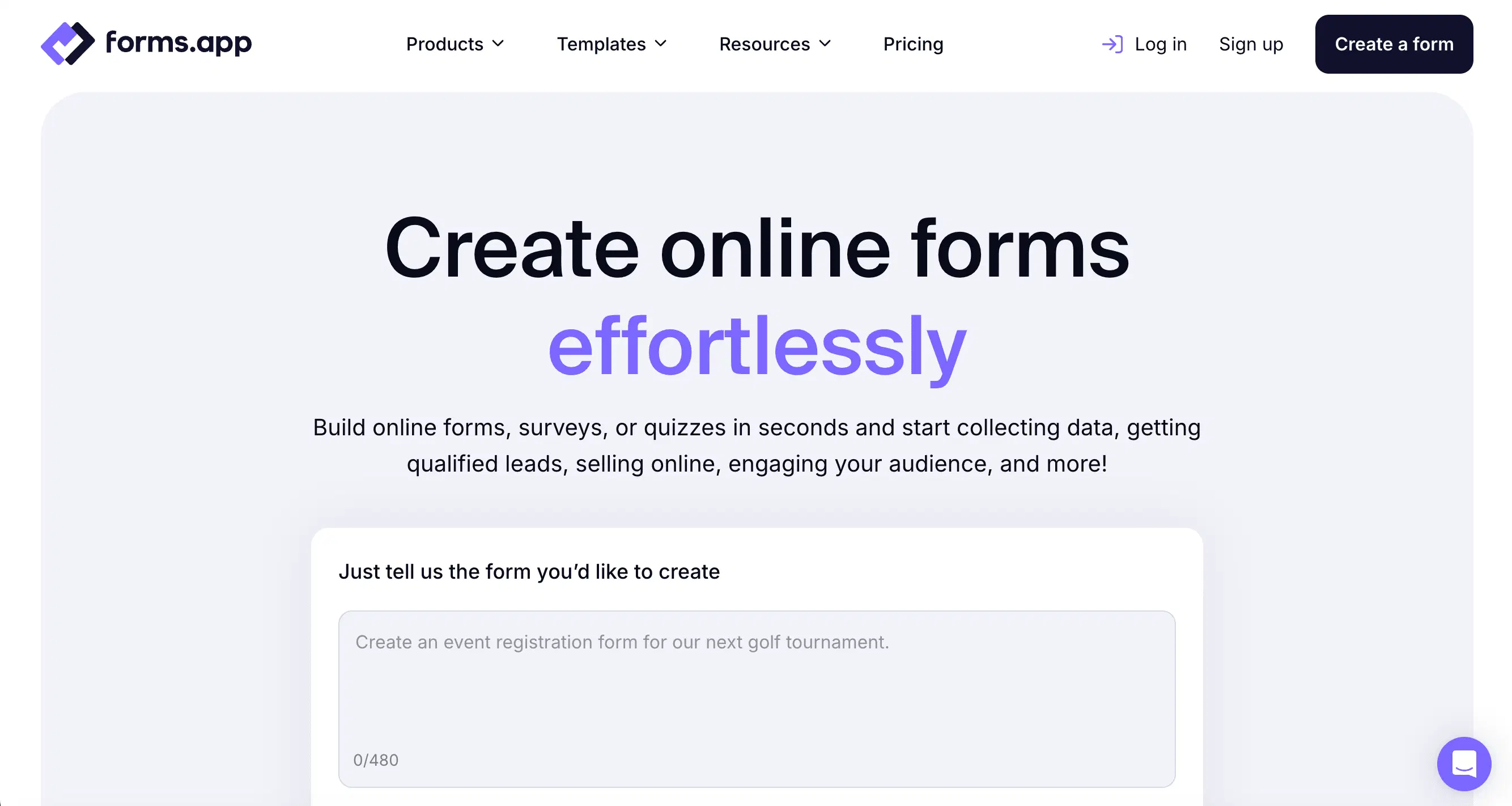
forms.app is a general form and survey builder with an AI form generator and a large template library. It has a free plan and paid tiers with higher response limits; current prices are on its pricing page.
Trade-off: it is a form builder first, so CX program features (closed-loop follow-up, targeting inside your product) are limited.
Best for: small teams that want quick, good-looking forms without a learning curve.
5. Zoho Survey: best for Zoho ecosystem teams
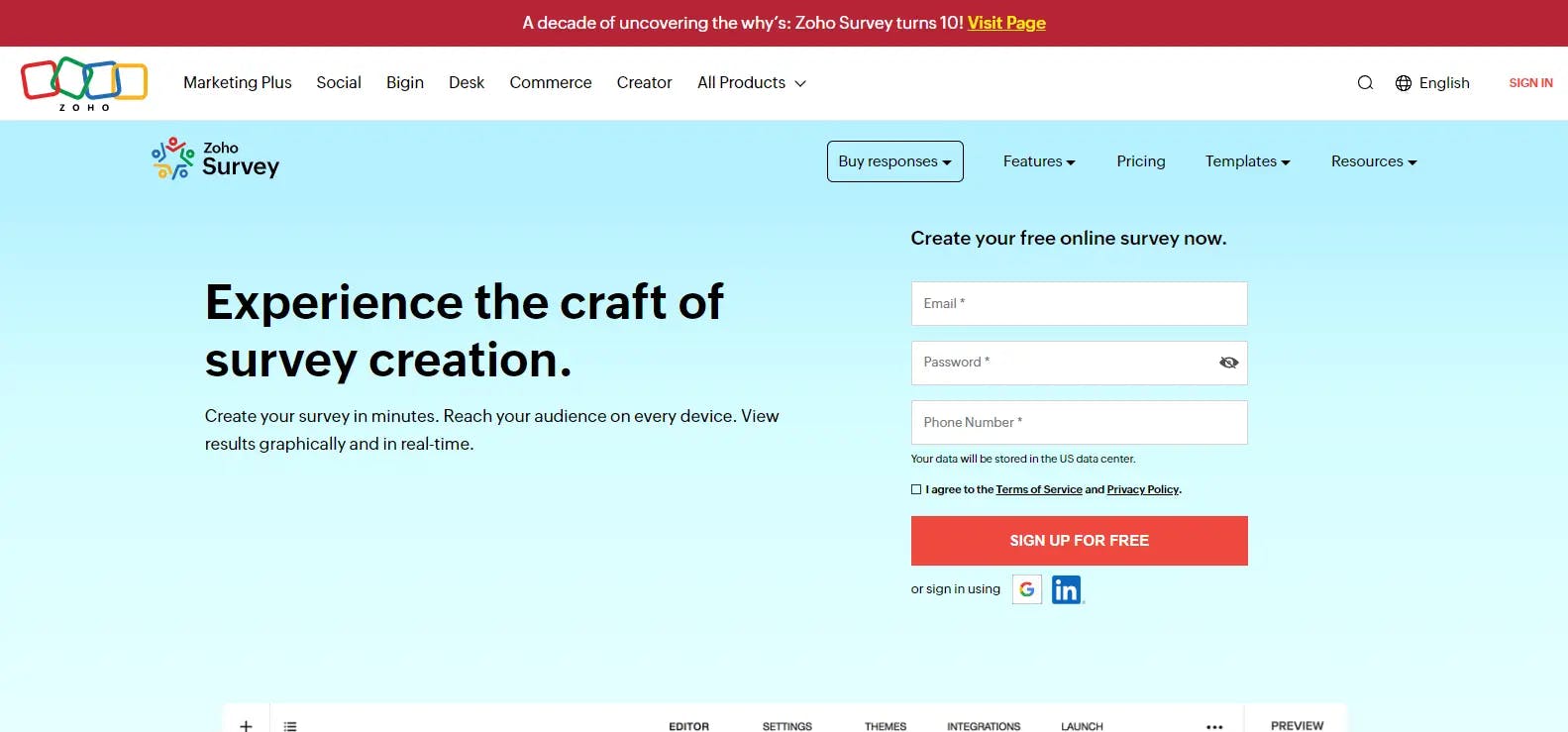
Zoho Survey connects natively to Zoho CRM, Desk and Analytics, so responses can land on customer records without middleware. It has a free plan. FormGrid's February 2026 review lists paid plans at $7.42/month (Basic), $25 (Plus), $35 (Pro) and $75 (Enterprise) (FormGrid); check Zoho's page for your region.
Trade-off: most tiers below Enterprise are single-user, and integrations outside Zoho are thinner.
Best for: SMBs already running on Zoho.
6. SurveySparrow: best for conversational surveys
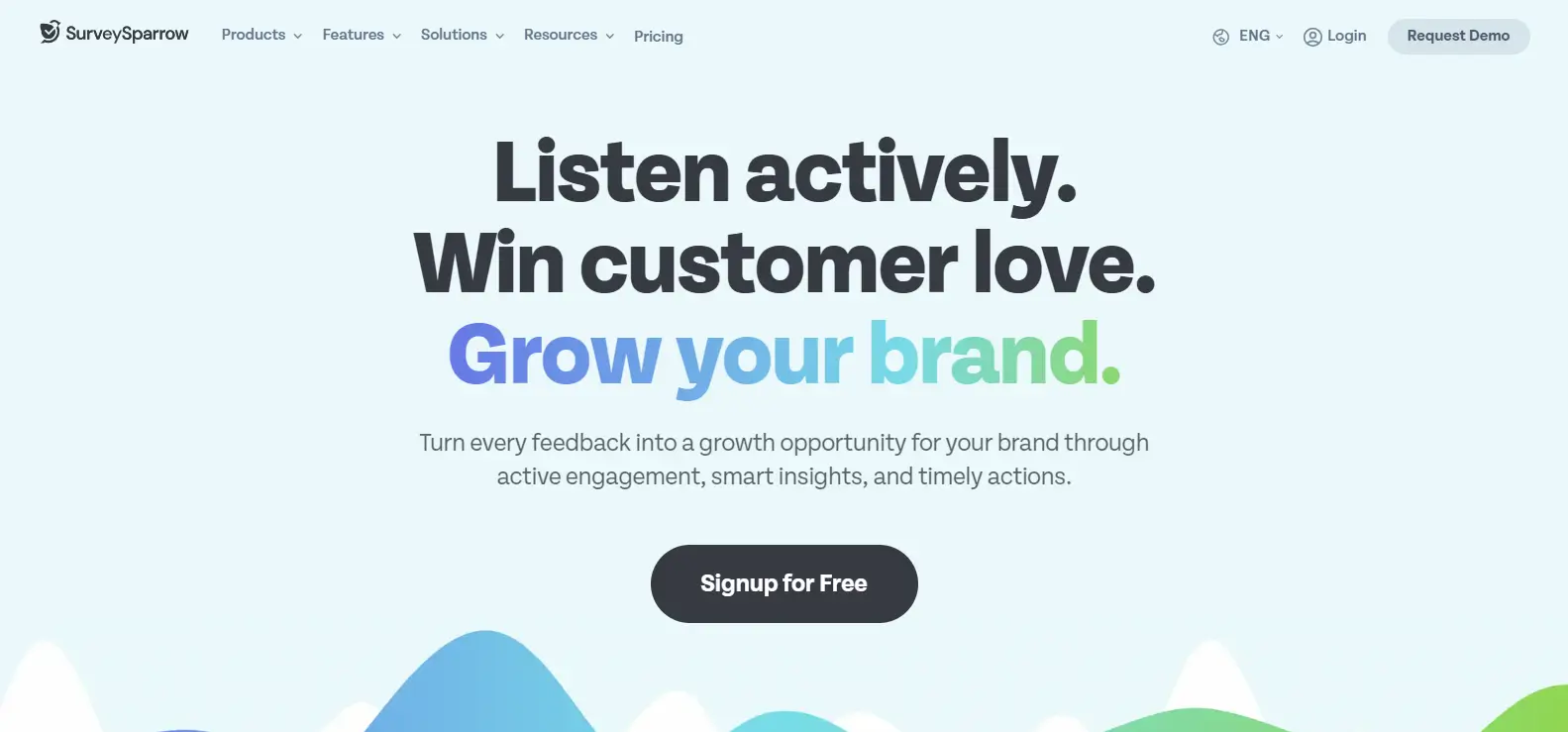
SurveySparrow uses a chat-like format and adds 360-degree assessments and offline collection. Per FormGrid, paid plans run Basic $19/month, Starter $39/month and Business $79/month (36,000 responses per year), billed annually; confirm current prices on the SurveySparrow pricing page.
Trade-off: no monthly billing on most plans, and the higher tiers are quote-based.
Best for: HR and CX teams that want higher completion on longer surveys.
7. QuestionPro: best for market research on a mid-market budget
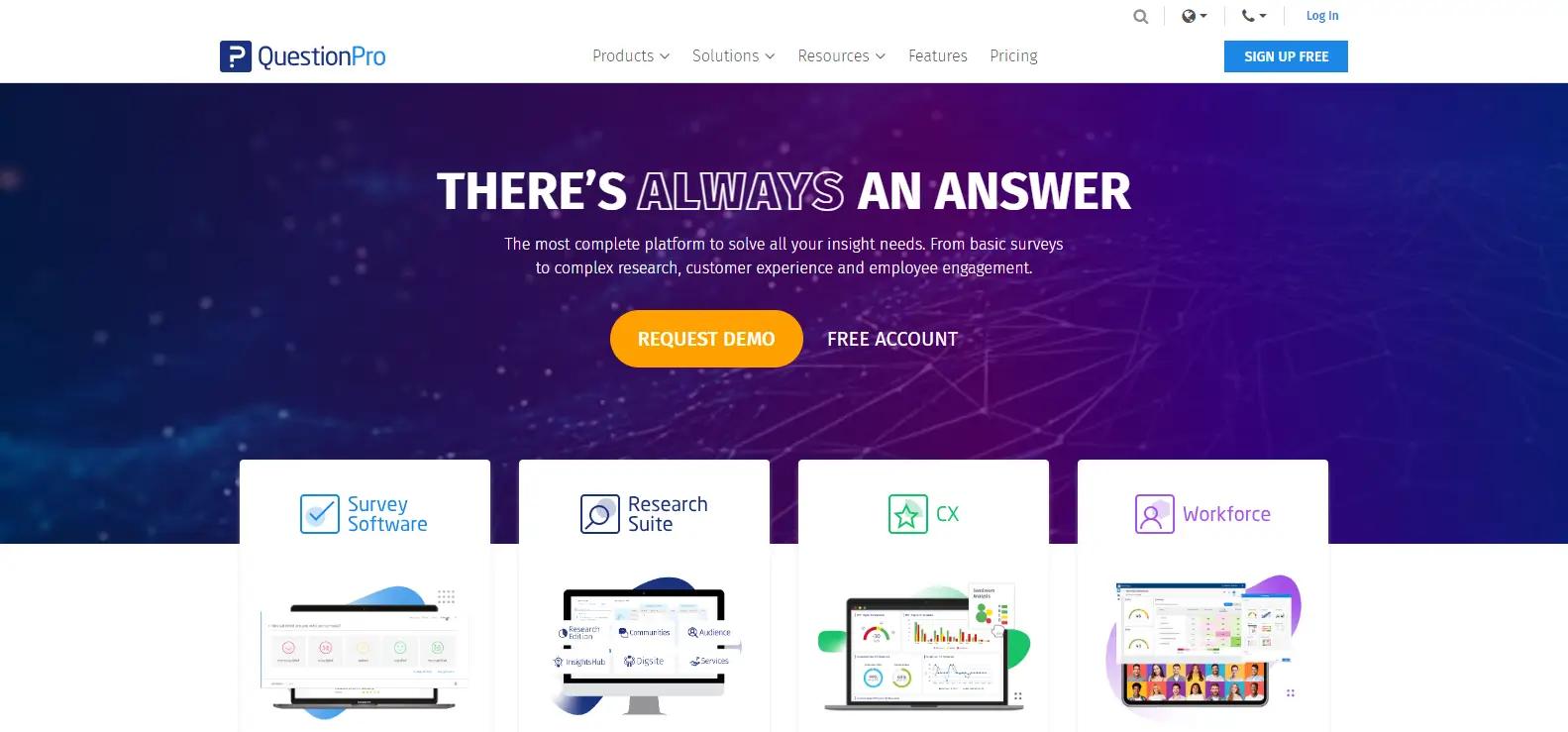
QuestionPro offers a free Essentials plan, advanced research methods and regional data centers. Its pricing page lists Advanced at $99/user/month billed annually and Team Edition at $83/user/month for 5 or more users. The Research Suite with panels and communities is quote-based. Our QuestionPro vs SurveyMonkey comparison goes deeper.
Trade-off: published prices are billed annually, and no self-hosted option is published on the pricing page.
Best for: research teams that need conjoint, MaxDiff and data center choice without a Qualtrics budget.
8. Zonka Feedback: best for multi-location CX programs
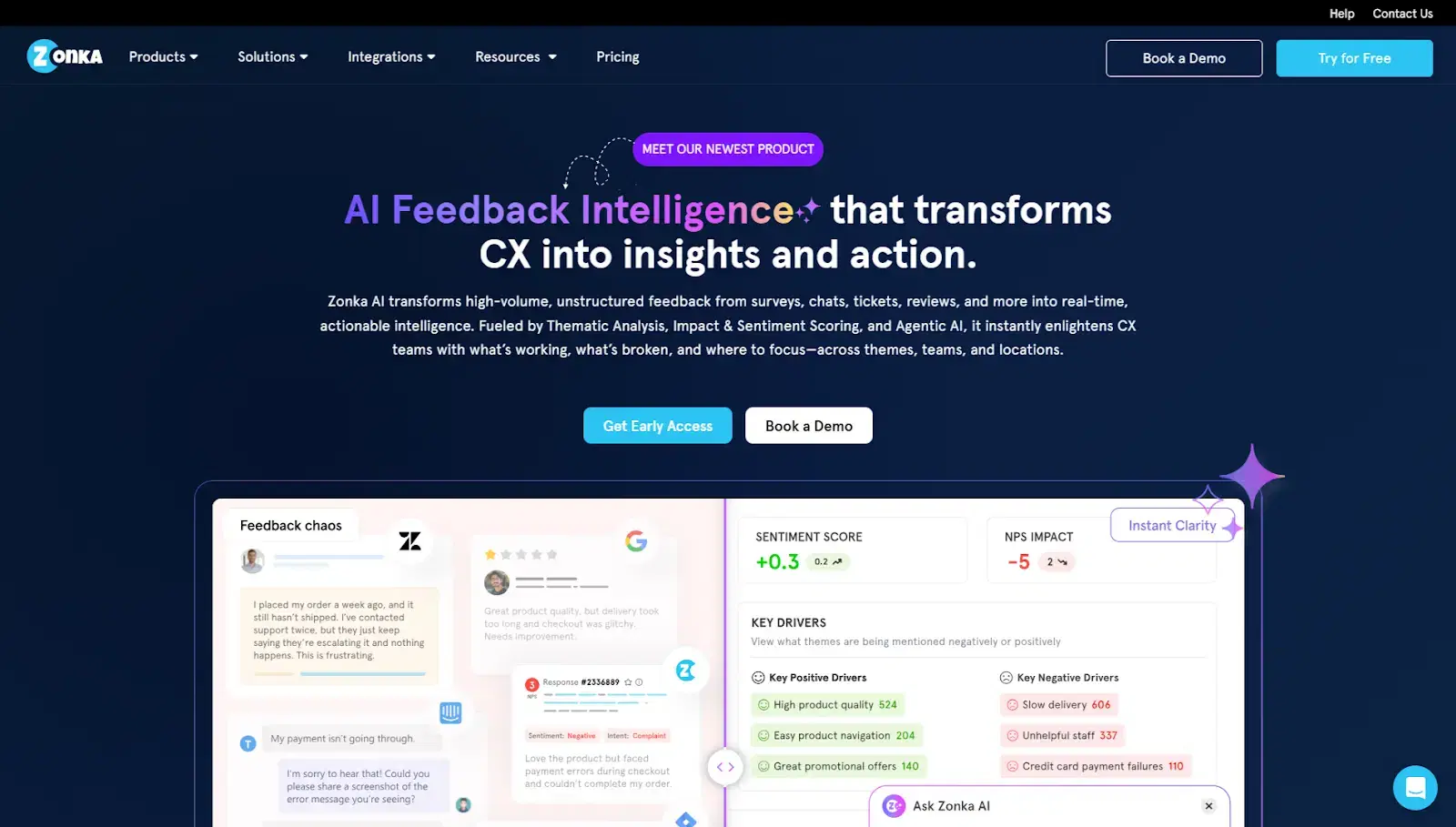
Zonka Feedback collects feedback across email, SMS, WhatsApp, web, in-app and kiosks, and adds AI theme and sentiment analysis. The vendor lists integrations with Salesforce, HubSpot, Zendesk and Intercom.
Trade-off: cloud only, and pricing scales with channels and locations, so get a quote for larger programs.
Best for: retail, hospitality and healthcare teams collecting feedback at physical locations.
9. Qualtrics: best for enterprise research depth

Qualtrics is the enterprise benchmark for survey research, with advanced statistics and dozens of guided research methods. Its one public paid price is Strategic Research at $420/month ($5,040/year) on the self-serve page; everything else is quote-based. Qualtrics was taken private by Silver Lake in 2023 and closed its $6.75 billion acquisition of Press Ganey Forsta in May 2026 (CX Today), which also brings InMoment under the same owner. For a direct comparison, see Qualtrics vs SurveyMonkey.
Trade-off: long sales cycles, high contract values, and cloud-only hosting.
Best for: large research and CX organizations that need statistical depth and can run a procurement process.
10. LimeSurvey: best open-source option for academic research
LimeSurvey is a long-running open-source survey tool used widely in universities. You can self-host the free Community Edition or buy LimeSurvey Cloud. It is strong on complex questionnaires, quotas and many languages.
Trade-off: the interface feels dated, and it focuses on standalone questionnaires, with no in-app targeting or SDKs for product feedback.
Best for: academic and public-sector researchers who want open source and full control over the questionnaire.
How to move from SurveyMonkey to another tool
- Export your data first. Data exports are not included on Basic, and SPSS export starts at Advantage (plan reference). Export responses as CSV or XLSX before your paid plan ends.
- Mind the deletion rules. According to the FAQ on SurveyMonkey's Individual pricing page, if you downgrade to Basic, responses above the Basic limit that are older than 365 days get deleted.
- Rebuild your top surveys. Most tools, Formbricks included, have NPS, CSAT and CES templates, so the core programs take minutes to recreate. Copy question text for custom surveys.
- Swap the collectors. Replace SurveyMonkey links in emails and on your website, and move integrations (Slack, CRM, Sheets) to the new tool.
- Run both in parallel for one cycle so trend lines stay comparable.
How to choose the right SurveyMonkey alternative
- Zero budget, simple forms: Google Forms
- Design and completion rate: Typeform or forms.app
- Zoho shop: Zoho Survey
- Conversational and HR surveys: SurveySparrow
- Market research depth: QuestionPro or Qualtrics
- Multi-location CX: Zonka Feedback
- Data must stay on your infrastructure, or InfoSec blocked SurveyMonkey: Formbricks (self-hosted in-app, web and link surveys with SSO and audit logging) or LimeSurvey (open-source questionnaires)
Want the wider market view, including who owns whom? Read our overview of SurveyMonkey competitors.
SurveyMonkey alternatives FAQ
Is SurveyMonkey free anymore?
What is the best free survey platform?
Why is SurveyMonkey so expensive?
What happened to SurveyMonkey?
What is the best open-source alternative to SurveyMonkey?
Can I import my SurveyMonkey surveys into another tool?
What is the best SurveyMonkey alternative for enterprises?
Is there an alternative to SurveyMonkey Audience?
Related comparisons
- SurveyMonkey competitors and market overview
- SurveyMonkey pricing explained
- Our SurveyMonkey review
- SurveyMonkey vs Typeform
- QuestionPro vs SurveyMonkey
- Qualtrics vs SurveyMonkey
- GetFeedback pricing
- GetFeedback competitors
Exploring other categories? See our guides to Microsoft Forms alternatives, Medallia alternatives and Survicate alternatives.