

SurveyMonkey Review 2026: Features, Pricing, and an Open Alternative

Johannes
Co-Founder @ Formbricks
11 Minutes
August 16th, 2026
SurveyMonkey is the platform most people picture when they hear "online survey," and for good reason. It's been around since 1999, it's used by 260,000+ organizations, and it's ranked #1 on G2 for online forms by its own count. But brand recognition and a good product aren't the same thing, so I went through SurveyMonkey's own pricing page, its feature set, and G2/Capterra review data to write this SurveyMonkey review.
I believe SurveyMonkey is the right call if:
- You want a widely-recognized, template-driven survey tool with 500+ templates and a large integration ecosystem
- You need access to SurveyMonkey Audience, a 335M+ person respondent panel, for market research
- Statistical significance testing and benchmarking matter for your analysis
- You're comfortable with per-seat Team pricing or an opaque Individual-tier price
It's a weaker fit if:
- You need a genuinely usable free plan (SurveyMonkey's caps at 10 questions per survey)
- You want transparent, public pricing before creating an account
- You need a unified feedback management suite (in-app surveys, workflows, feedback analytics) rather than a standalone survey tool
- Data residency or self-hosting is a hard requirement
Because of that, I've included a full look at Formbricks later in this review, since it's a transparently-priced, unified alternative built around feedback management, feedback analytics, and workflows rather than survey collection alone.
Table of contents:
- What is SurveyMonkey?
- SurveyMonkey Pros & Cons
- SurveyMonkey Review: How It Works & Key Features
- Where SurveyMonkey Falls Short
- What Reviewers Actually Say
- A Different Approach: Formbricks as an Open Feedback and Experience Management Suite
- SurveyMonkey vs Formbricks: Technical & Business Comparison
- Who Should Actually Use SurveyMonkey
- SurveyMonkey Review FAQ
- Final Verdict
What is SurveyMonkey?
Ryan Finley founded SurveyMonkey in 1999 after finding no simple tool available to collect customer feedback and building his own; his brother Chris Finley later joined as co-founder. The company relocated to Portland, Oregon in 2005. SurveyMonkey positions itself with the tagline "turn curiosity into clarity," describing itself as the world's most popular survey platform, used by 260,000+ organizations worldwide.
The platform spans individual surveys, team collaboration plans, and an enterprise tier, plus SurveyMonkey Audience, a service for purchasing responses from a 335M+ person global panel across 130+ countries. SurveyMonkey serves everyone from individuals running a quick poll to Fortune 500 market research teams.
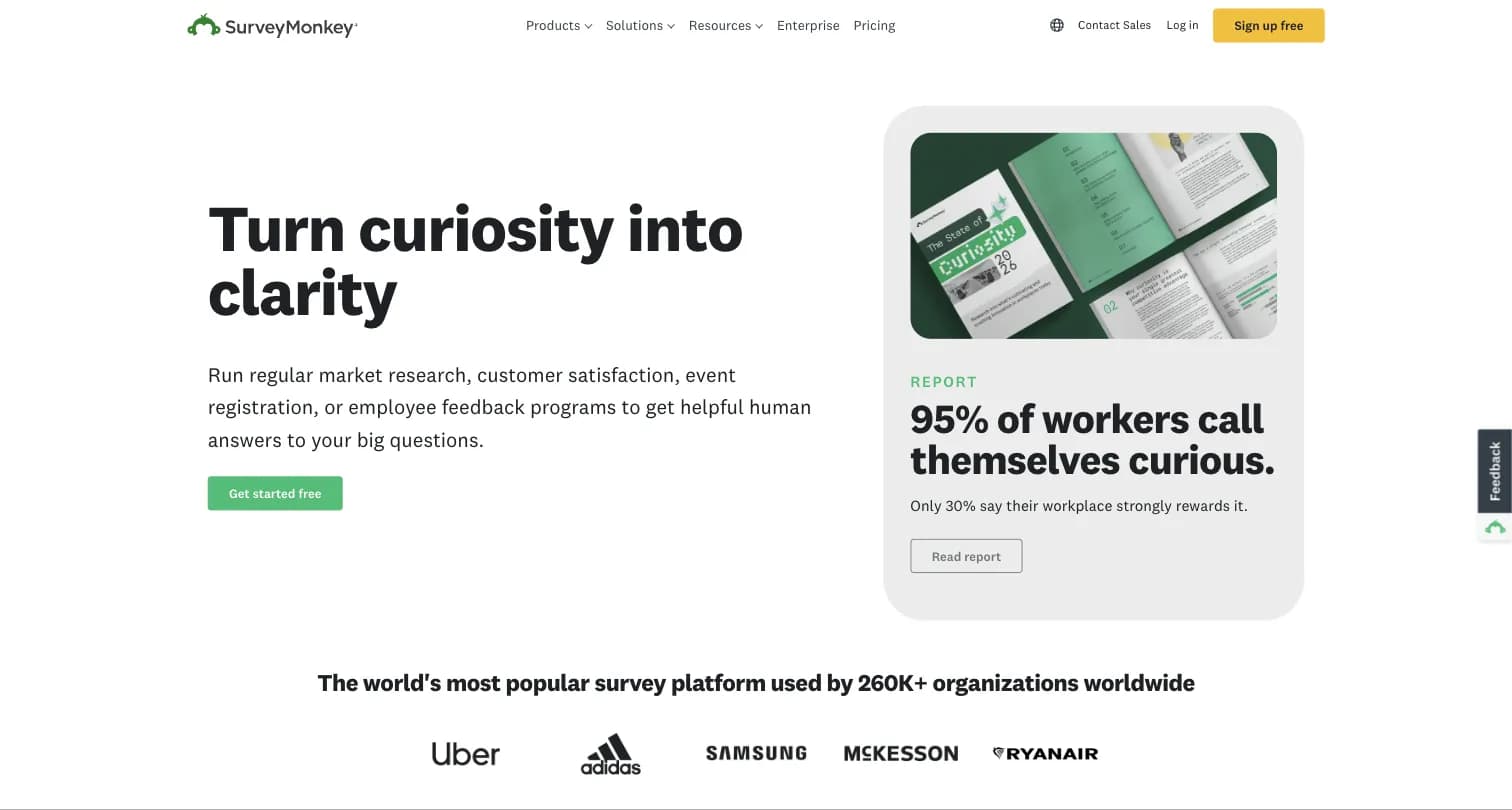
Captured August 15, 2026 from surveymonkey.com.
SurveyMonkey Pros & Cons
| Pros | Cons |
|---|---|
| ✅ Fast, reliable, and easy to use; templates make survey creation quick and intuitive | ❌ Pricing and plans are the single most-disliked theme in reviews, at roughly twice the rate of other survey tools |
| ✅ 500+ expert-written templates and AI-assisted survey/form creation | ❌ Free plan caps surveys at 10 questions with limited response viewing |
| ✅ SurveyMonkey Audience gives access to a 335M+ person respondent panel | ❌ Individual-tier dollar prices are hidden behind account signup |
| ✅ 200+ built-in integrations, more than most competitors | ❌ $0.15 charged per response over your plan's limit |
| ✅ Statistical significance testing, crosstabs, and benchmarking on paid tiers | ❌ Team plans require a minimum of 3 users |
| ✅ Ranked #1 on G2 for online forms per SurveyMonkey's own count | ❌ Regional data center choice (US/Canada/EU) gated to the custom-priced Enterprise tier |
Source: G2, Capterra, and Thematic's review analysis, captured August 15, 2026.
SurveyMonkey Review: How It Works & Key Features
Survey Builder and Templates
SurveyMonkey's builder centers on a large template library (500+ templates) spanning customer satisfaction, employee engagement, market research, and event feedback. Users can build from scratch, copy and paste existing questions, import a question list, or use Build with AI: type a prompt like "I run a flower shop and want to survey customers about their shopping experience," and SurveyMonkey generates a complete survey ready for editing.
Even building from scratch, SurveyMonkey's recommended-questions feature suggests both questions and answer choices based on a chosen survey category, a level of guided assistance free competitors like Google Forms don't offer. The platform supports 20+ question types on paid tiers, including A/B testing within a survey (testing two versions of a question, image, or piece of content against different segments of respondents) and Click Map questions for image-based feedback.
Distribution and Respondent Access
SurveyMonkey supports distribution via web link, email (with reminders for non-respondents), embedded web forms, SMS, social sharing, QR codes, and a native mobile app for on-the-go survey creation and editing. SurveyMonkey Audience extends this further: instead of relying only on your own contact list, you can purchase responses from a global panel of 335M+ people across 130+ countries, filtered by over 90 targeting criteria including country, gender, age, and income.
Analytics and Reporting
SurveyMonkey's paid tiers include statistical significance testing, cross-tabulation and filtering, industry benchmark comparisons, multi-survey analysis, and custom variables and weighting. Reports support eight chart types with customizable colors and labels, plus export to PDF, XLS, CSV, PPTX, or SPSS for further analysis. The free Basic plan's analytics are far more limited, consistent with its 10-question survey cap.
AI Features
SurveyMonkey Genius covers survey creation from a prompt, automatic question-type prediction, survey quality scoring to predict response success, suspicious-response detection, and sentiment/theme extraction from open-ended answers, built on the company's accumulated survey data since 1999.
Where SurveyMonkey Falls Short
A free plan that's really a demo. The Basic plan caps surveys at 10 questions with response viewing limited to roughly 25-40 responses depending on the source, workable for a quick informal poll but not a real survey program.
Hidden Individual-tier pricing. Standard, Advantage, and Premier plans don't display a public dollar figure without creating an account, and third-party sources disagree substantially on what they actually cost, one blog cites $39/month billed annually, another cites $99/month month-to-month for the same tier name.
Costs that escalate with usage. A $0.15 per-response overage fee applies once you exceed your plan's response limit, and Team plans require a minimum of 3 users even if only 1-2 people need access.
Pricing is the top reviewer complaint. Per Thematic's analysis of review sentiment across the category, pricing and plans are the single most-disliked theme in SurveyMonkey reviews, at roughly twice the rate of other survey tools analyzed.
No self-hosting or broad data residency choice. Regional data center selection (US/Canada/EU) exists only on the custom-priced Team Enterprise tier, leaving no path to data residency for teams on lower tiers, and no self-hosting option exists at any price.
What Reviewers Actually Say
SurveyMonkey holds a 4.4 rating across 23,901 reviews on G2 and 4.3-4.6 across 5,821-10,486 reviews on Capterra, depending on which comparison listing is consulted. Reviewers consistently praise the platform as fast, reliable, and easy to use, with templates that make survey creation feel quick and professional.
On a direct Capterra comparison against QuestionPro, one reviewer (Digvijay S M., a self-employed founder) offered a candid, mixed take: "As an owner watching every line item, I felt the cost constantly, and the way useful features are parceled out across tiers left me feeling like I was always one upgrade away from what I needed. If your survey needs are simple and occasional, this is probably overkill and overpriced... But if feedback is a regular, load-bearing part of how you run things, and you value dependability and respondent trust over saving a few dollars, it earns its place."
Another reviewer on the same comparison (Cody F., Principal Software Engineer) flagged a specific usability complaint: "The reporting dashboards are so confusing. When you click into individual questions to check the skip conditions it takes literally forever to load and it lags so bad which drives me crazy when I am trying to finish a campaign."
Source: Capterra's QuestionPro vs SurveyMonkey comparison, captured August 15, 2026.
A Different Approach: Formbricks as an Open Feedback and Experience Management Suite
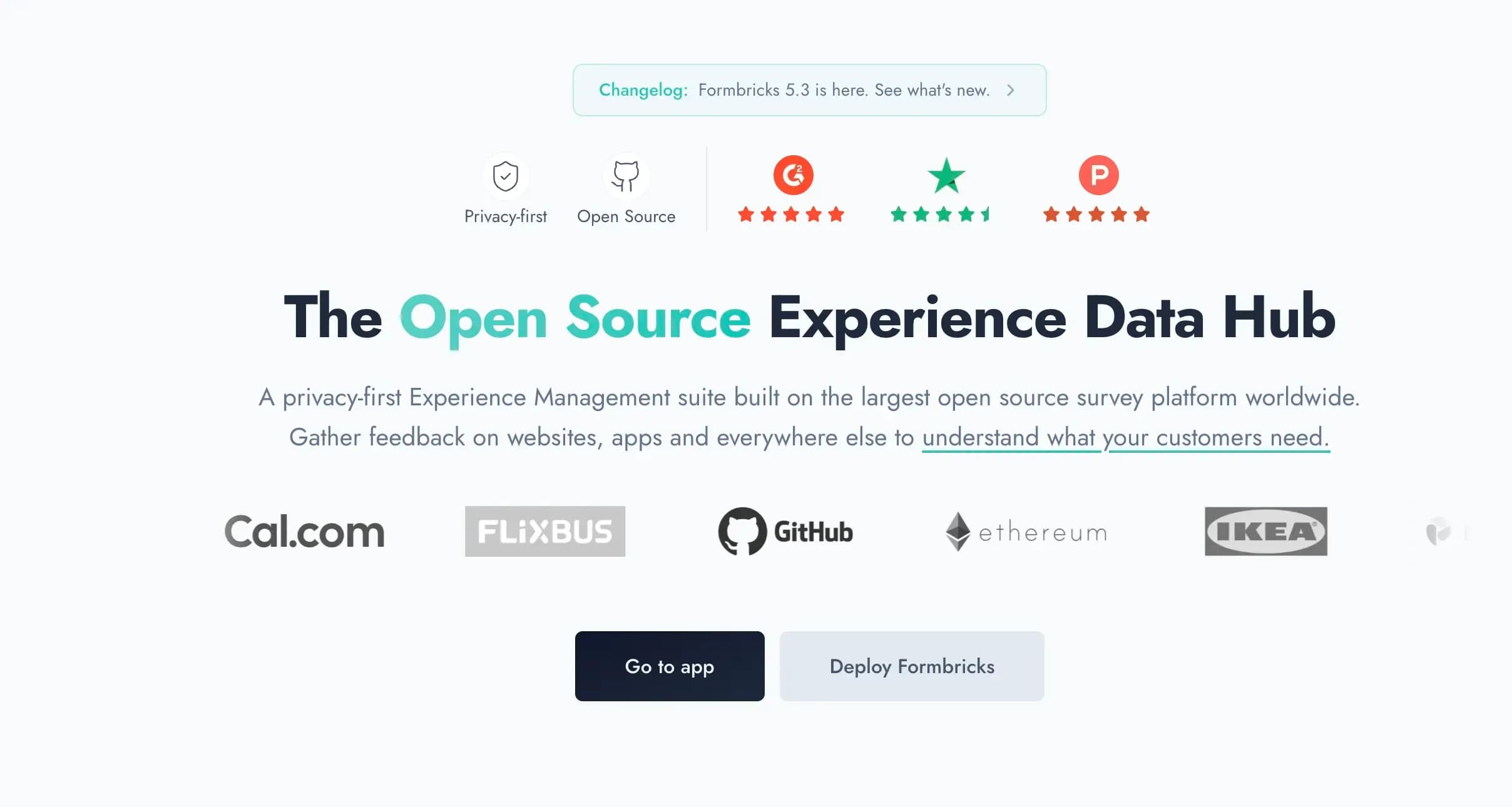
Captured August 15, 2026 from formbricks.com.
Formbricks isn't a fourth mainstream survey tool competing on templates or panel access. It's an open source feedback and experience management suite built around three things: feedback management, feedback analytics, and workflows and integrations, unified on one platform and one published price.
Feedback Management. Formbricks unifies collection channels SurveyMonkey doesn't combine on a single platform: website surveys that target specific visitors, in-app surveys that reach any user cohort inside your product, link surveys for broad distribution, and branded surveys embedded directly in email.
Feedback Analytics. Response data flows into one place regardless of channel. Teams can follow an individual response's full trail or zoom out for the aggregate picture, track partial and dropped-off responses, and segment by custom attributes instead of broadcasting the same survey to everyone.
Workflows and Integrations. Formbricks Workflows automate what happens after a response comes in, routing and acting on feedback without manual handling. On the integration side, Formbricks connects to Salesforce, HubSpot, Slack, Google Sheets, and Notion through webhooks and an open API, free on every tier, including the self-hosted Community Edition.
Formbricks Pricing, Verified Live
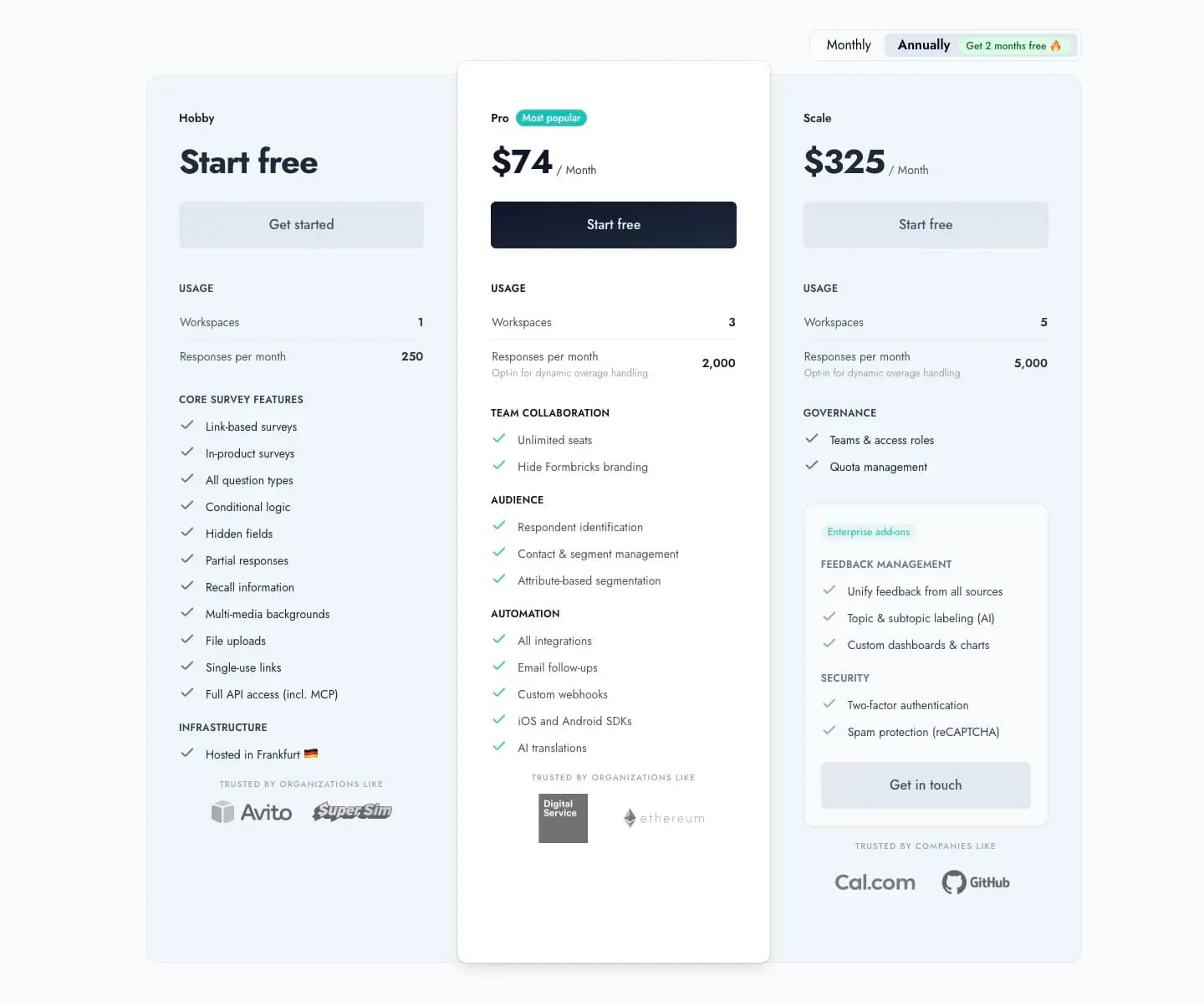
Captured August 16, 2026 from formbricks.com/pricing.
| Plan | Price | Usage |
|---|---|---|
| Hobby | Free forever | 1 workspace, 250 responses/month, full API access (incl. MCP), hosted in Frankfurt |
| Pro | $89/month billed monthly, or $74/month billed annually ($890/year total) | 3 workspaces, 2,000 responses/month, unlimited seats, attribute-based segmentation, all integrations |
| Scale | $390/month billed monthly, or $325/month billed annually ($3,900/year total) | 5 workspaces, 5,000 responses/month, teams & access roles, quota management |
Unlike SurveyMonkey's free Basic plan (10-question cap, no meaningful analytics) or its hidden Individual-tier pricing, every Formbricks tier is published directly on formbricks.com/pricing with no signup gate required to see a real number.
Self-Hosting: The Path SurveyMonkey Doesn't Have
The free, self-hosted Community Edition, licensed under AGPLv3, is where Formbricks diverges most sharply from SurveyMonkey. Data never leaves your own infrastructure, there's no response cap, and even if you stop paying for Enterprise features, the Community Edition and your data remain fully accessible. For a regulated buyer who needs data residency, this is the option SurveyMonkey doesn't offer at any price.
SurveyMonkey vs Formbricks: Technical & Business Comparison
| Aspect | SurveyMonkey | Formbricks |
|---|---|---|
| Core Philosophy | Mainstream, template-driven survey platform | Unified, transparently-priced feedback and experience suite |
| Pricing Transparency | Team tiers public; Individual tiers hidden behind signup | Every tier published, including monthly and annual rates |
| Free Tier | 10 questions/survey, limited response viewing | 250 responses/month, full API access, unlimited surveys |
| Data Control | Regional data center choice on Enterprise tier only | Self-hosted Community Edition available under AGPLv3 |
| API Access | Bundled into higher tiers | Full API, free on every tier including self-hosted |
| Feedback Channels | Surveys and forms, panel access via Audience | Website, in-app, link, and email surveys unified |
| Post-Response Automation | Not a core product feature | Formbricks Workflows on the same platform |
| Respondent Panel | SurveyMonkey Audience, 335M+ people | Not offered |
Who Should Actually Use SurveyMonkey
SurveyMonkey makes sense if you want a widely-recognized platform with a large template library, access to a very large third-party respondent panel, and statistical analysis tools for structured market research, and you're comfortable paying per seat or absorbing an opaque Individual-tier price.
Consider a hypothetical: a 15-person customer success team adopts SurveyMonkey's Team Advantage plan for quarterly CSAT surveys, discovers the 3-user minimum means paying for seats colleagues barely use, and later realizes hitting the response cap adds $0.15 per additional response, an unpredictable line item that wasn't obvious at signup. This is illustrative rather than a named customer, but it reflects the pricing-opacity and overage pattern documented above.
It's a weaker fit if you need a genuinely usable free plan, transparent public pricing across every tier, a unified feedback management platform (in-app surveys, feedback analytics, workflows) instead of survey collection alone, or data residency and self-hosting.
SurveyMonkey Review FAQ
Final Verdict
👍 SurveyMonkey is the right call if you want a widely-recognized, template-driven platform, access to a very large respondent panel for market research, and statistical analysis on paid tiers, and you're comfortable with per-seat pricing or an opaque Individual-tier price point.
👉 Formbricks is the better fit if transparent pricing matters, you want to see a real number before creating an account, and you'd rather run feedback management, feedback analytics, and workflows on one unified platform instead of a standalone survey tool with a restrictive free plan. Every tier is published, native integrations and Workflows come free on every plan, and the AGPLv3-licensed Community Edition gives you a self-hosted path SurveyMonkey simply doesn't offer.
The honest read: SurveyMonkey earns its reputation on scale and reliability, but its pricing model is genuinely the thing most reviewers complain about. If a hidden Individual-tier price or a 10-question free plan is the reason you're reading a SurveyMonkey review in the first place, see Formbricks' current pricing here.
Try Formbricks now