
9 Best Qualtrics Competitors in 2026 (Including an Open-Source Option)

Johannes
Co-Founder @ Formbricks
12 Minutes
August 16th, 2026

Qualtrics is the biggest name in experience management, and for good reason: 20,000+ brands use it, and its research tooling (StatsIQ, guided academic methodologies) goes deeper than almost anything else in the category. But that scale comes with sales-gated pricing across seven of its eight product tiers, three separately-priced product lines (CX, EX, Strategy & Research), and a company that's changed ownership three times in five years. Here are 9 real Qualtrics competitors, what each one actually does differently, and one gap none of the current "Qualtrics competitors" guides mention.
What Is Qualtrics?
Qualtrics was founded in 2002 in Provo, Utah by Scott M. Smith, Ryan Smith, Jared Smith, and Stuart Orgill. SAP acquired the company for $8 billion in an all-cash deal in 2018, spun it back out for a Nasdaq IPO in January 2021 at a $27.3 billion valuation, then Silver Lake and CPP Investments took it private again in a deal that closed June 28, 2023. It positions itself as "the leader in experience management," claiming 20,000+ brands as customers.
The platform spans three product lines:
- Customer Experience (CX): Surveys, website and mobile app feedback, digital experience analytics, contact center analytics, and online reputation management, priced on an "Interactions" metric
- Employee Experience (EX): Employee engagement, pulse surveys, onboarding and exit, and 360 development, priced by employee count
- Strategy & Research: Market research, product research, UX research, and brand research, including the StatsIQ statistical suite (regression, clustering, R-integration) and 20+ guided academic-style methodologies
Qualtrics holds a 4.4 rating across 4,291 reviews on G2's seller page, 4.7 across 426 reviews on Capterra's Strategy & Research listing, and 7.7 out of 10 across 415 reviews on TrustRadius. It also holds ISO 27001, ISO 42001, FedRAMP High, IL4, HITRUST, and SOC 2 Type 2 certifications, all delivered from centrally-hosted cloud infrastructure.
Why Companies Look for Qualtrics Competitors
Every current "Qualtrics alternatives" and "Qualtrics competitors" guide we reviewed, plus Qualtrics' own reviewer commentary, converges on the same handful of complaints.
1. Sales-Gated Pricing Across Almost the Entire Portfolio
Seven of Qualtrics' eight product tiers are "Request Pricing" with no public rate card. The one exception, the self-serve Strategic Research plan, costs $420/month ($5,040 billed annually) and caps out at 1,000 total responses shared across every user on the account. Third-party benchmarking data cited by UXtweak (sourced from Vendr) reports a median annual spend of $28,533/year, ranging from $6,525 to $126,000/year, a wide enough range that a budget-stage evaluator genuinely can't ballpark their own cost without a sales call.
2. Add-On Costs Beyond the Base Quote
Reviewers on TrustRadius describe add-on features and packages as consistently costing extra, with an "upselling" feel. One G2 reviewer reported an unexpected $5,000 charge to hire outside help extracting and cleaning data the platform's own tools couldn't handle.
3. Steep Learning Curve
A G2 reviewer specifically flagged the combination of a steep learning curve and high cost. Survicate's own research (drawn from G2, TrustRadius, and Reddit) echoes this: teams say they need dedicated training to get value out of the platform, and reporting and day-to-day data work come across as harder than expected for non-technical owners.
4. Three Separately-Priced Product Lines Instead of One
CX, EX, and Strategy & Research are three different products with three different pricing metrics (Interactions, employee count, and a self-serve tier respectively). A team that just wants unified customer feedback collection and analytics inherits the complexity of evaluating and buying across all three.
5. A History of Ownership Changes
Three ownership structures in five years, SAP's 2018 acquisition, the 2021 IPO, and the 2023 Silver Lake/CPP Investments take-private, is a real consideration for buyers weighing long-term platform direction and pricing stability, independent of how good the product is today.
6. Mismatch Between "Enterprise Suite" and "Simple Survey" Needs
If your actual requirement is running NPS, CSAT, or product feedback surveys, not academic-grade research or a full XM operationalization program, you're paying for (and navigating) a lot of platform you'll never touch.
Qualtrics Competitors at a Glance
| Competitor | Best For | Free Plan | Starting Price | Open Source |
|---|---|---|---|---|
| Formbricks | Open-source XM with self-hosting and transparent pricing | Yes (250 responses/mo) | $74/month ($890/year) | Yes |
| Medallia | Large enterprise CX, real-time frontline action | No | Custom (EDR-based) | No |
| SurveyMonkey | Fast, simple survey deployment at scale | Yes (limited, 10 questions) | $39/month | No |
| Alchemer | Mid-market CXM without enterprise complexity | No | $49-55/user/month | No |
| GetFeedback | Salesforce-native CX (being retired Dec 2026) | 14-day trial | $1,190/year | No |
| QuestionPro | Affordable enterprise-grade surveys | Yes (1 user, 200 responses/survey) | $99/user/month | No |
| Forsta | Healthcare and regulated-industry VoC | No | Custom, not published | No |
| CustomerGauge | B2B account-level experience management | No | Custom, quote-based | No |
| InMoment | AI-powered CX analytics across unstructured data | No | Custom (~$13,488/yr avg. per Vendr) | No |
Top 9 Qualtrics Competitors in 2026
1. Formbricks: The Open-Source Pick for Transparent Pricing and Self-Hosting
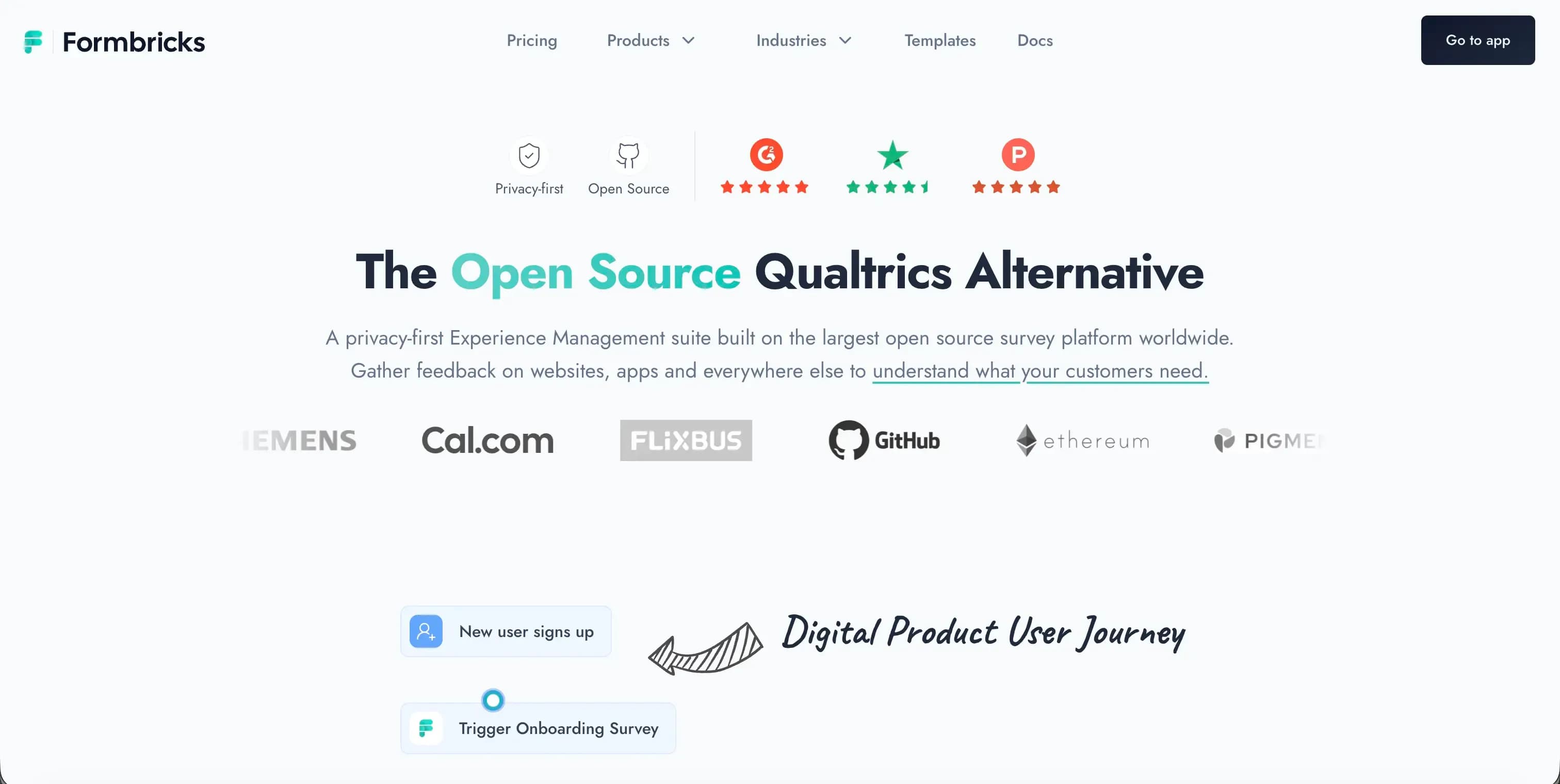
If the reason you're evaluating Qualtrics competitors is pricing opacity or a data residency requirement Qualtrics can't meet, Formbricks is built specifically for that gap.
Why it stands out as a Qualtrics competitor:
Formbricks is an open-source feedback and experience management suite built around three pillars: feedback management (website, in-app, link, and email surveys unified on one platform, instead of split across Qualtrics' separately-priced CX, EX, and Research lines), feedback analytics (response dashboards, drop-off tracking, and segmentation), and workflows and integrations (Formbricks Workflows for post-response automation, plus native integrations to Salesforce, HubSpot, Slack, Google Sheets, and Notion, all through a free API on every tier).
Key features:
- Multi-channel surveys: link surveys, website pop-ups, in-app micro-surveys, and email-embedded surveys on one platform
- Attribute-based targeting: show surveys to specific segments based on behavior, attributes, or customer journey stage
- Feedback analytics: aggregate and per-response views, drop-off tracking, and custom segmentation
- Formbricks Workflows: automate what happens after a response comes in, without a separate case-management product
- Open API and webhooks on every tier, including the free plan, unlike Qualtrics where deeper integration work sits inside a custom enterprise contract
- iOS and Android SDKs for native mobile in-app surveys
- Self-hosting option, the one capability Qualtrics' own security documentation doesn't mention anywhere
Pricing (Cloud):
- Hobby (Free): 250 responses/month, 1 workspace, full API access (including MCP), hosted in Frankfurt
- Pro: $74/month ($890/year billed annually) for 3 workspaces and 2,000 responses/month, unlimited seats, branding removal
- Scale: $325/month ($3,900/year billed annually) for 5 workspaces and 5,000 responses/month, teams and access roles, two-factor authentication
Pricing (Self-Hosted):
- Community Edition: Free forever, AGPLv3, unlimited surveys and seats
- Enterprise Edition: Custom pricing for SSO, branding removal, and white-glove onboarding
Best for: Product, CX, and research teams that want dedicated feedback tooling without a sales-gated quote for every tier, and organizations with data residency requirements that self-hosting solves directly.
2. Medallia: The Enterprise Real-Time Action Platform
Medallia is the competitor named most consistently across every source we reviewed for this guide, the Gartner alternatives page, CustomerGauge's comparison, and Survicate's guide all list it as Qualtrics' closest rival.
How it compares to Qualtrics: Medallia and Qualtrics target the same large-enterprise CX buyer, but their strengths diverge. Per Survicate's own research, "if your primary need is advanced survey design, deep customization, predictive analytics, or professional-grade market research capabilities, Qualtrics emerges as the stronger choice," while Medallia wins when the priority is "real-time feedback management, heavy emphasis on unstructured data (like call recordings or reviews), frontline workforce activation, or a broader, unified CX platform across channels." CustomerGauge's own scoring puts Medallia's G2 rating at 4.5, just ahead of Qualtrics' 4.3 on the same comparison page.
Key features:
- Omnichannel signal collection across surveys, calls, digital, and social
- Medallia Athena: AI-powered pattern detection and action recommendations
- Real-time alerting and case management routed to frontline staff
- Hierarchical, role-based reporting for complex multi-unit organizations
Pricing: Custom, priced on Medallia's own "Experience Data Record" (EDR) metric. Thoma Bravo, a private equity firm, acquired Medallia in October 2021 for approximately $6.4 billion, taking it private. Third-party estimates place typical enterprise contracts in the tens of thousands of dollars per year and up.
Best for: Large enterprises with complex multi-unit or multi-brand structures that need real-time frontline action management more than academic-grade survey research.
3. SurveyMonkey: The Broadest Reach at the Lowest Cost of Entry
SurveyMonkey is the most widely recognized name in the survey category, with over 17 million active users according to the company, spanning two decades of survey science since its 1999 founding.
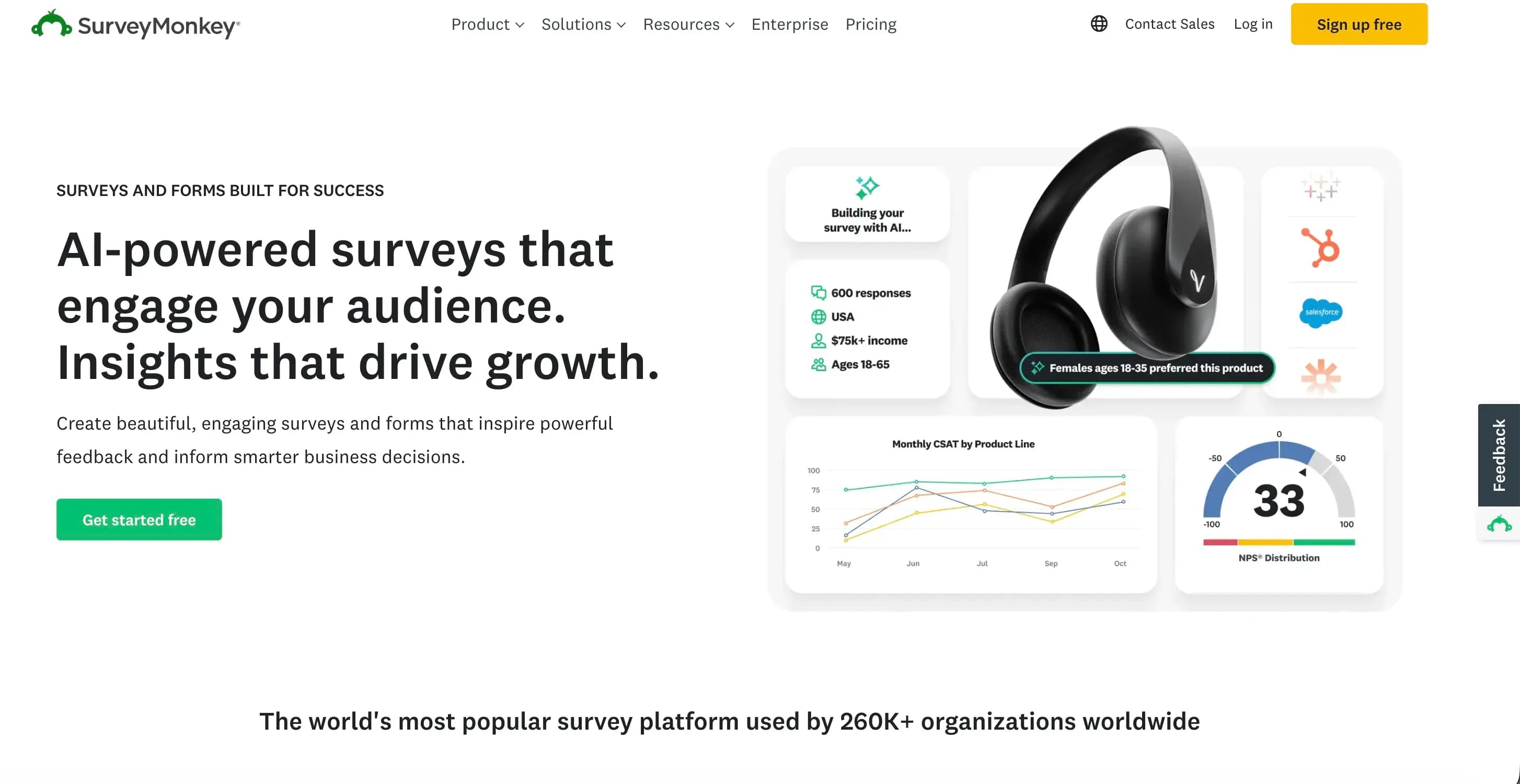
How it compares to Qualtrics: Qualtrics is a full XM suite with research-grade tooling. SurveyMonkey doesn't try to be that. If your actual need is sending NPS, CSAT, or market research surveys quickly, SurveyMonkey delivers a large share of that value at a fraction of the setup time and cost. SurveyMonkey also owns GetFeedback (covered separately below), which it's actively migrating onto its own Enterprise CX product.
Key features:
- 400+ survey templates covering NPS, CSAT, CES, and market research
- SurveyMonkey Genius: AI-powered survey builder with quality scoring
- Multi-channel distribution: email, web link, social, embedded, QR code
- Integrations with Salesforce, HubSpot, Marketo, and 100+ tools
Pricing:
- Free: 10 questions per survey, up to 40 responses per survey
- Standard Monthly: $39/month for 1,000 responses/month
- Team Advantage: $25/user/month (billed annually, 3-user minimum)
- Team Premier: $75/user/month (billed annually, 3-user minimum)
- Enterprise: Custom pricing
Best for: Teams that need fast, reliable survey deployment without the complexity of a full CX platform, and organizations running periodic feedback programs rather than continuous XM operations.
4. Alchemer: The Mid-Market Middle Ground
Alchemer, founded in 2006 as SurveyGizmo, positions itself explicitly as the space between SurveyMonkey's simplicity and Qualtrics' complexity, a framing CustomerGauge's own comparison confirms directly.
How it compares to Qualtrics: In Gartner's Critical Capabilities report (cited by CustomerGauge), Alchemer scored 2nd for enabling mid-size businesses but fell short for large enterprises, scoring mid-table for B2C, B2B, and B2B2C use cases. That makes it a well-rounded pick for smaller organizations that want more sophistication than a basic survey tool without Qualtrics' price tag or learning curve.
Key features:
- Advanced survey logic with branching, piping, and quotas
- 40+ question types including MaxDiff, conjoint, and custom HTML
- White-label surveys and API access for custom data pipelines
- HIPAA, GDPR, and SOC 2-ready compliance posture
Pricing: Self-service plans start around $49-55/user/month depending on the tier, with the dedicated VoC/CX platform priced by quote. No free plan, but a free trial is available.
Best for: Mid-market companies that need more survey sophistication than SurveyMonkey offers but can't justify (or don't need) a full enterprise CX platform.
5. GetFeedback: Salesforce-Native, But Being Phased Out
GetFeedback, owned by SurveyMonkey's parent company Momentive, built its identity around deep native Salesforce integration. That identity is ending: GetFeedback Direct, the survey-focused version of the product, is scheduled to sunset on December 31, 2026, with SurveyMonkey actively pushing customers toward SurveyMonkey Enterprise for CX instead.
How it compares to Qualtrics: Where Qualtrics is a broad, research-first XM suite, GetFeedback has historically been Salesforce-first and operational, syncing survey responses directly into CRM records for reporting and follow-up workflows. Reviewers on Reddit describe it as integrating "nicely with Salesforce," but note it "can be pricey for smaller teams" without heavy Salesforce-driven workflows to justify the cost.
Key features:
- Native, bi-directional Salesforce integration for CSAT, NPS, and CES surveys
- Multi-channel survey distribution with centralized analysis
- Integrations with Zendesk and, via Zapier, HubSpot and others
Pricing: Starter at $1,190/year for up to 1,000 responses/month, Plus at $2,990/year for up to 2,000 responses/month. Given the December 2026 sunset, most prospective buyers will end up quoted on SurveyMonkey Enterprise instead.
Best for: Teams already deep in the Salesforce ecosystem today, with the caveat that this specific product is being retired and folded into SurveyMonkey's broader Enterprise line.
6. QuestionPro: Enterprise Features at a Fraction of the Cost
QuestionPro undercuts Qualtrics and Medallia on price while covering a comparable feature surface: customer experience, employee experience, and market research, all with templates and analytics built in.
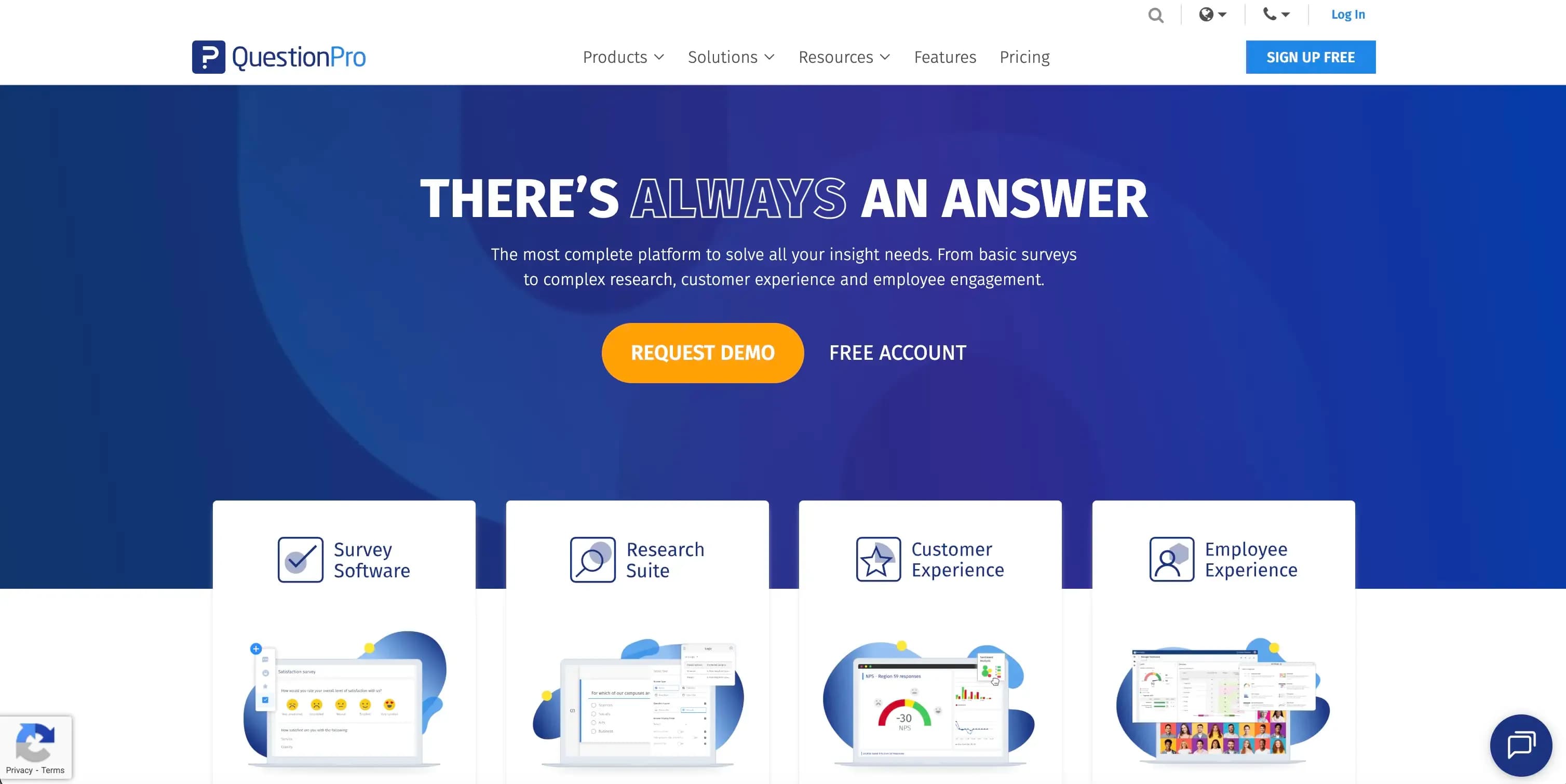
How it compares to Qualtrics: QuestionPro isn't trying to be a real-time CX action platform. It's a survey and research tool with CX capabilities layered on. CustomerGauge's Gartner-sourced scoring notes QuestionPro "scored quite low for Enterprise B2B needs," making it a stronger fit for teams that primarily need to design, distribute, and analyze surveys than for large, complex enterprise deployments.
Key features:
- 350+ survey templates across CX, EX, and market research
- Advanced question types including MaxDiff, conjoint, and Van Westendorp pricing
- Offline surveys via mobile app for field research
- Community Management for ongoing research panels
Pricing:
- Essentials: Free (1 user, 200 responses per survey, 30 question types)
- Advanced: $99/user/month (billed annually, 25,000 responses/year, 38 question types)
- Team Edition: $83/user/month (billed annually, 5+ users, 100,000 responses/year)
- Research Suite: Custom pricing (52 question types, advanced methodologies)
Best for: Budget-conscious teams that need enterprise-grade survey capabilities without enterprise pricing, especially in market research and academic use cases.
7. Forsta (Press Ganey Forsta HX Platform): The Regulated-Industry Specialist
Forsta shows up on Gartner's own Qualtrics alternatives page as the Press Ganey Forsta HX Platform, rated 4.6 across 121 ratings, one of the higher-scoring names on that list.
How it compares to Qualtrics: Forsta's reviewer commentary on Gartner describes a platform built to "connect patient, caregiver, safety, quality and operational data into a unified view," pointing to a specialization in healthcare and other heavily-regulated experience programs rather than Qualtrics' broader, industry-agnostic XM footprint. That heritage traces back to Press Ganey's decades of healthcare patient-experience measurement.
Key features:
- Unified view across patient/customer, safety, quality, and operational data
- Healthcare-specific experience measurement heritage via Press Ganey
- VoC and CX platform capabilities comparable in scope to Qualtrics' CX line
Pricing: Not publicly available in any source we reviewed for this guide. Forsta requires a sales conversation, consistent with the sales-gated pattern across most of this category.
Best for: Healthcare and other regulated organizations that need experience data unified with safety, quality, and operational metrics specifically, rather than a generic enterprise XM suite.
8. CustomerGauge: Purpose-Built for B2B Account Experience
CustomerGauge is the only platform on this list built specifically around B2B account-level experience management rather than general-purpose CX or survey collection.
How it compares to Qualtrics: Per CustomerGauge's own comparison, "Qualtrics is an exceptional end-to-end experience management software suitable for both B2B and B2B2C needs," but for a B2B brand focused on account retention and revenue growth specifically, CustomerGauge's Account Experience methodology, which visualizes account hierarchies and ties CX directly to churn and upsell signals, is the more purpose-built tool. CustomerGauge cites Gartner's 2020 Critical Capabilities Report, where it scored highest (3.42) for the enterprise B2B use case, ahead of Medallia (3.38) and Qualtrics (3.22).
Key features:
- Account Experience methodology for multi-stakeholder B2B account structures
- Churn-signal alerts, including monitoring for "absence of signal"
- SMART goal tracking tied to revenue outcomes, not just satisfaction scores
- G2 rating of 4.6, per its own sourced comparison page
Pricing: Custom, quote-based. No public rate card.
Best for: B2B companies specifically focused on account retention, churn reduction, and connecting CX directly to revenue, rather than broad B2C feedback collection.
9. InMoment: AI-Powered Analytics Across Unstructured Data
InMoment, which acquired MaritzCX in 2020, positions itself as an "integrated CX" platform that pulls in social reviews, support tickets, and other unstructured signals alongside survey data.
How it compares to Qualtrics: Where Qualtrics is research- and survey-first, InMoment goes deeper on unstructured-data analytics out of the box, aggregating feedback from sources Qualtrics doesn't natively cover, like review sites and social mentions. Gartner's own alternatives page rates InMoment XI Platform at 4.9 across 74 ratings, among the highest scores on that comparison page.
Key features:
- AI-powered text analytics with theme detection and intent analysis
- Aggregation of reviews, social mentions, and support transcripts alongside surveys
- Customer journey mapping with automated touchpoint analysis
- Industry-specific solutions for retail, healthcare, and hospitality
Pricing: Custom, quote-based. Vendr's buyer guide reports an average annual cost of about $13,488, a benchmark figure rather than a list price.
Best for: CX teams that need advanced AI analytics across multiple unstructured data sources, particularly in retail, hospitality, and financial services.
Qualtrics vs Medallia: The Head-to-Head
Every source we reviewed for this guide, Gartner, CustomerGauge, and Survicate alike, names Medallia as Qualtrics' closest and most frequently compared rival. Here's how the two actually differ.
| Factor | Qualtrics | Medallia |
|---|---|---|
| Ownership | Silver Lake and CPP Investments (private, since June 2023); previously SAP (2018-2021), then public via 2021 IPO | Thoma Bravo (private, since October 2021, ~$6.4B) |
| Core strength | Research-grade survey design, StatsIQ statistical depth, guided academic methodologies | Real-time frontline action management, unstructured data (calls, reviews) |
| G2 rating | 4.3-4.4 depending on listing | 4.5 |
| Pricing transparency | 1 of 8 tiers public ($420/mo self-serve research plan) | None, fully EDR-based custom quotes |
| Employee experience | Full EX suite (People Engage, People Lifecycle) | Present but secondary to CX |
| Self-hosting | Not offered anywhere in its documented platform | Not offered anywhere in its documented platform |
| Best for | Research teams, academic-style methodologies, multi-departmental XM | Frontline-heavy enterprises needing real-time action routing |
The short version: choose Qualtrics if flexible survey design and research depth matter most. Choose Medallia if real-time frontline action and unstructured-data analysis matter more than academic-grade research tooling. Choose neither, and look at a lighter, transparently-priced tool instead, if your actual requirement is running NPS, CSAT, and product feedback surveys rather than an enterprise XM operationalization program.
The Self-Hosting Gap None of These Competitor Guides Mention
Every "Qualtrics competitors" and "Qualtrics alternatives" page we reviewed for this guide, Gartner's, CustomerGauge's, and Survicate's, evaluates platforms on pricing, feature depth, ease of use, and industry fit. None of them ask a data residency question: can you deploy this on your own infrastructure?
Across the 8 competitors above, not one publishes a self-hosted or customer-premises deployment option in any source we reviewed for this guide. Qualtrics' own security documentation is explicit about this for its own platform: it describes only centrally-hosted cloud infrastructure (data centers, SOC 2, FedRAMP-authorized environments), with no self-hosting mentioned anywhere. Medallia, SurveyMonkey, Alchemer, GetFeedback, QuestionPro, Forsta, CustomerGauge, and InMoment are all cloud-only SaaS products as far as their public documentation shows.
Formbricks is the exception. Its Community Edition, licensed under AGPLv3, is free and self-hostable on your own infrastructure, with no response caps and no vendor dependency for where the data physically lives.
This matters most for organizations in banking, healthcare, government, or any sector where a compliance or data residency mandate rules out third-party SaaS hosting entirely, regardless of how good the platform is otherwise. If that's your actual constraint, the comparison isn't Qualtrics vs. Medallia vs. InMoment. It's whether self-hosting is on the table at all, and today, Formbricks is the only name on this list where the answer is yes.
How to Choose the Right Qualtrics Competitor
Picking the right platform depends on which part of Qualtrics' scope you actually need.
Start With Your Use Case
- Transparent pricing and self-hosting: Formbricks
- Large enterprise, real-time frontline action: Medallia
- Fast, low-cost survey deployment: SurveyMonkey
- Mid-market CXM without enterprise complexity: Alchemer
- Salesforce-native CX (short-term only, given the sunset): GetFeedback
- Budget-conscious enterprise-grade surveys: QuestionPro
- Healthcare and regulated-industry VoC: Forsta
- B2B account-level experience tied to revenue: CustomerGauge
- AI analytics across unstructured, multi-channel data: InMoment
Then Evaluate These Criteria
| Criteria | Questions to Ask |
|---|---|
| Pricing transparency | Can you get a real number without a sales call, or is everything quote-based? |
| Data residency | Where does your feedback data live? Can you self-host if compliance requires it? |
| Scope match | Do you need academic-grade research tooling, or lightweight ongoing feedback collection? |
| Time to value | How long until your first survey is live? Do you need consultants or professional services? |
| Integration depth | Does it connect natively to your CRM, helpdesk, and product analytics stack? |
| Billing flexibility | Is monthly billing available, or are you locked into annual contracts? |
The Question Most Buyers Skip
Most evaluations start with feature checklists and end with a pricing negotiation. The question that actually narrows the field fastest is simpler: does your compliance posture require self-hosting, or is cloud-only acceptable? If self-hosting is required, this list of 9 collapses to exactly one option. If it isn't, the rest of this guide is the real comparison to work through.
For related reading, see our Medallia alternatives, Qualtrics alternatives, and Qualtrics pricing guides.
Frequently Asked Questions
If your evaluation of Qualtrics (or any of the 8 competitors above) comes down to transparent pricing and the option to self-host, Formbricks gives you feedback management, feedback analytics, and workflows on one platform, with a free tier and no sales call required to see a real price.
Try Formbricks now