

Medallia Pricing in 2026: What the EDR Model Actually Costs, and Why There's No Rate Card

Johannes
Co-Founder @ Formbricks
15 Minutes
August 16th, 2026
Medallia's pricing page is unusually candid about its philosophy and unusually silent on its numbers. It walks through the Experience Data Record (EDR) model in detail, tells you it doesn't nickel-and-dime you for point solutions, and describes pricing as "simple, transparent, understandable." What it doesn't do anywhere on the page is publish a single dollar figure.
So this breakdown works with what's actually available: Medallia's own qualitative description of the EDR model, real contract data from a third-party spend-benchmarking firm, what reviewers report, and Medallia's own recent financial history, which turns out to be directly relevant to why its pricing has stayed this opaque. We compared all of it to Formbricks, an open feedback and experience management suite that publishes every tier's price on its own pricing page.
I believe Medallia is the right call if:
- You're a large enterprise that wants to unify many signal types (survey, speech, video, digital, social) under one pricing metric instead of paying for separate point solutions
- Medallia's single-tenant, Medallia-owned private-cloud infrastructure meets your isolation requirements without needing true customer-controlled self-hosting
- You have budget flexibility for a quote-based, enterprise-scale relationship and don't need a number before your first sales call
- You need signal-type breadth (speech analytics, video feedback, social listening) well beyond a survey or feedback tool
It's a weaker fit if:
- You need genuine self-hosting or customer-controlled infrastructure, not offered even though Medallia's cloud model is more isolated than typical multi-tenant SaaS
- You want a published, self-serve price before talking to sales
- You're a smaller team that only needs straightforward survey or feedback collection, not a full multi-signal experience data platform
- You're wary of vendor stability during a multi-year private equity ownership transition (more on this below)
Because Medallia's own pricing page won't give you a number, I've built a full comparison with Formbricks later in this breakdown, since it's the clearest example of what transparent, self-serve pricing looks like in the same feedback and experience management category.
Table of contents:
- Medallia Pricing at a Glance
- What Is the Experience Data Record (EDR) Pricing Model?
- The Only Real Numbers: What 46 Actual Medallia Contracts Show
- Where Medallia Pricing Falls Short
- What's Actually Going On With Medallia (and Why It Matters for Pricing)
- What Reviewers Say About the Real Cost
- Formbricks: An Open Feedback and Experience Management Suite
- Medallia vs Formbricks: Side-by-Side Pricing
- Feature Value Breakdown
- Who Should Actually Pay for Medallia
- Medallia Pricing FAQ
- Final Verdict
Medallia Pricing at a Glance
| What | Medallia's Answer |
|---|---|
| Published tiers | None |
| Pricing metric | Experience Data Record (EDR): one record per discrete customer or employee interaction |
| Billing cadence | Custom, quote-based via sales, priced in annual tiers |
| Free tier | None |
| Self-serve checkout | None, every CTA routes to "Talk to Sales" |
| Third-party reported SMB average | $20,671/year (per SpendHound, based on 8 tracked SMB customers) |
| Third-party reported Enterprise average | $598,947/year (per SpendHound, based on 38 tracked Enterprise customers) |
Sources: medallia.com/pricing (captured August 15, 2026) and SpendHound's Medallia pricing page (captured August 15, 2026, based on de-identified spend data from 46 real Medallia customers).
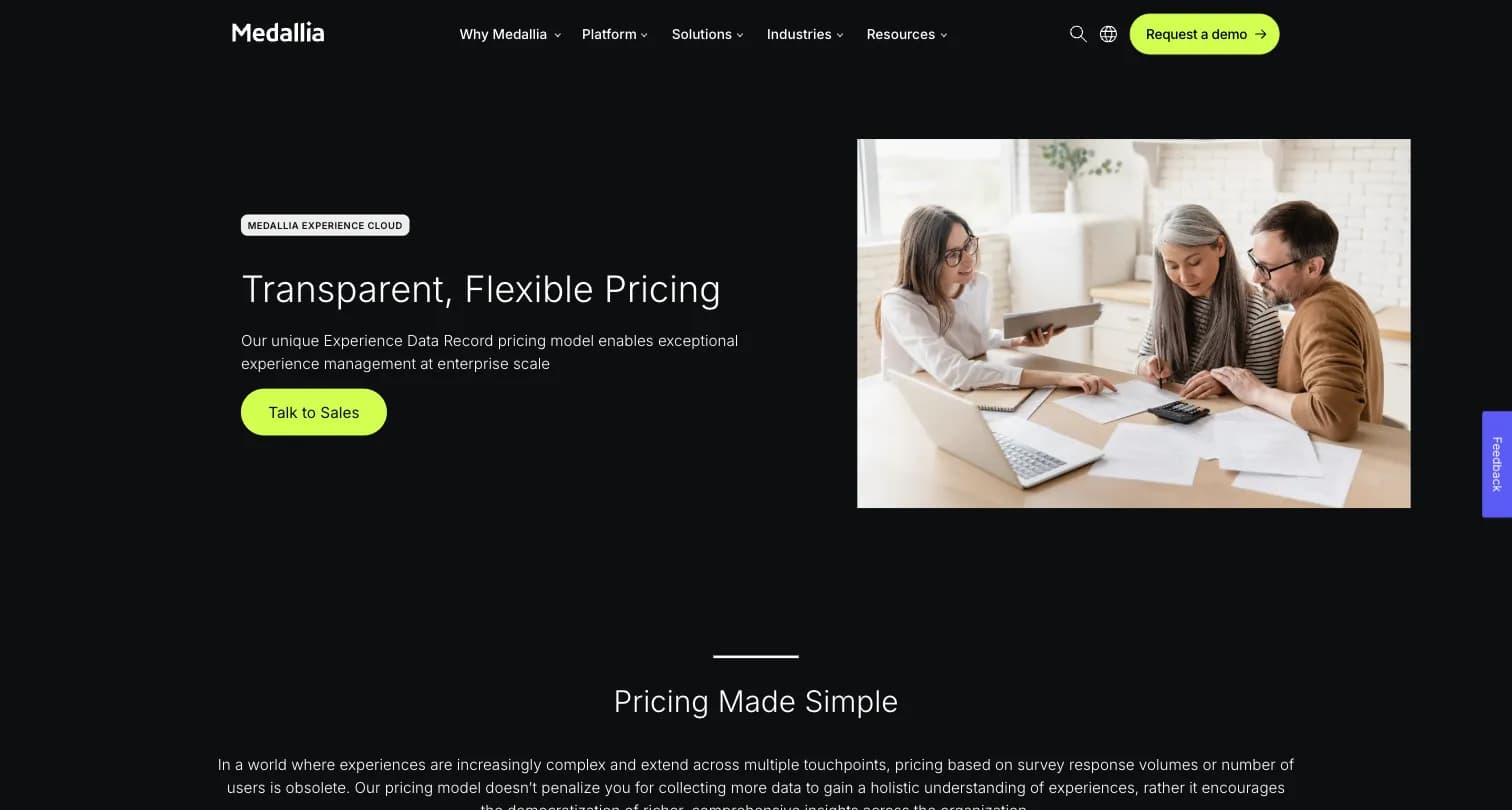
Captured August 15, 2026 from medallia.com/pricing.
What Is the Experience Data Record (EDR) Pricing Model?
Medallia prices on a single metric it calls the Experience Data Record, one record per discrete interaction between a customer or employee and a company. That's a deliberate departure from pricing by survey response volume or by seat, and Medallia's own pricing page argues both of those older models are "obsolete" for the multi-channel, multi-signal reality of modern experience data.
Every EDR you pay for, per Medallia's page, includes the full platform stack. There's no separate line item for analytics, workflows, or security:
| Included in EDR pricing | What it covers |
|---|---|
| 100s of signal types | Surveys, speech, social signals, digital feedback, video feedback |
| Experience analytics | Medallia AI, text analytics, speech analytics, acoustic analytics, survey analytics |
| Workflow features | Unlimited users, role-based reporting, automatic alerting, case management, closed-loop feedback |
| Security & self-service | Anti-cheating engine, PII detection and redaction, developer portal, admin suite, sandboxes |
Medallia frames this as "pricing that reflects a true partnership," pitching simplicity, a unified platform, predictable total cost of ownership, and the flexibility to scale without being billed separately per channel. All of that may be true. What's also true is that none of it comes with a number attached. Every "Contact us to learn more about pricing" CTA on the page routes to a sales form, not a rate card, a calculator, or even an illustrative price range.
The Bottom Line: Medallia's EDR pricing model is coherent and well-explained as a philosophy. As a budgeting tool for anyone who hasn't already talked to sales, it's useless, there's no dollar figure anywhere on the page to anchor a conversation around.
Source: medallia.com/pricing, captured August 15, 2026.
The Only Real Numbers: What 46 Actual Medallia Contracts Show
Since Medallia won't publish a number, we went looking for one anywhere else it might exist. The most concrete figure we found comes from SpendHound, a procurement benchmarking firm that collects de-identified spend data from over 1,300 companies. Its Medallia page is built from actual contract data across 46 real Medallia customers, not published rates or estimates.
| Segment | Companies tracked | Average annual spend | Year-over-year change |
|---|---|---|---|
| SMB (50-1,000 employees) | 8 | $20,671/year | +27.33% |
| Enterprise (1,000+ employees) | 38 | $598,947/year | -0.29% |
That's roughly a 29x gap between what a typical SMB customer pays and what a typical enterprise customer pays, which lines up with Medallia's own positioning as a platform built for large-scale, multi-channel deployments rather than a lightweight feedback tool. The SMB segment's 27% year-over-year increase is also worth flagging on its own, that's a steep jump for companies in the smallest tracked tier, and SpendHound's own commentary notes finance teams are increasingly "scrutinizing whether the per-user cost justifies the value across the organization."
For context, the same SpendHound page reports Gainsight, a comparable customer-success platform, averaging $87,784/year for SMB and $240,442/year for enterprise, meaning Medallia's enterprise contracts run roughly 2.5x higher than Gainsight's on average, while its SMB contracts run lower.
| Platform | SMB average (annual) | Enterprise average (annual) |
|---|---|---|
| Medallia | $20,671 | $598,947 |
| Gainsight | $87,784 | $240,442 |
The Bottom Line: This is real contract data, not a Medallia-published figure, so treat it as directional rather than a quote you can hold Medallia to. But it's the closest thing to ground truth that exists outside a live sales conversation, and it confirms Medallia's enterprise pricing lands well into six figures annually.
Source: SpendHound's Medallia pricing page, captured August 15, 2026.
Where Medallia Pricing Falls Short
No Public Pricing, at Any Tier
- The EDR model is described only qualitatively on medallia.com/pricing, zero dollar figures anywhere on the page
- Every pricing-related CTA routes to a "Talk to Sales" contact form, not a self-serve checkout or calculator
- Budget-stage evaluators can't get even a rough estimate without a sales conversation, and the SpendHound estimates above required tracking real contracts to surface
A Private Cloud That Still Isn't Self-Hosting
- Medallia runs its own private cloud on Medallia-owned hardware in Tier III colocation facilities, with single-tenant architecture rather than shared multi-tenant SaaS, per Medallia's security documentation
- That's a genuinely more isolated model than typical multi-tenant competitors, but it's still entirely Medallia-managed infrastructure, not customer-controlled deployment
- Buyers who specifically need true self-hosting or on-premise deployment have no path with Medallia at any budget, even though the private-cloud model can sound like it addresses that requirement at first read
Rating-Scale and Workflow Friction Reported by Actual Users
- Reviewers on TrustRadius note that since mostly unhappy customers tend to complete unsolicited surveys, the resulting data can skew sentiment relative to the true customer base
- Filtering, navigation, and case or alert reassignment are described as clunky by several reviewers
- Reviewers want more in-depth data descriptions and better mobile access to reports, plus more direct email-to-customer functionality from within a case
What's Actually Going On With Medallia (and Why It Matters for Pricing)
Here's the piece of this story none of the pricing pages tell you, and it's directly relevant to why Medallia's rate card stays locked behind a sales call.
Medallia was a public company (NYSE: MDLA) until 2021, when Thoma Bravo acquired it for $6.4 billion in an all-cash deal at $34.00 per share, taking it private at what was, at the time, a 9x forward-revenue multiple. Thoma Bravo put in roughly $5 billion of equity, with the rest financed through roughly $1.8 billion in debt from lenders including Blackstone Credit, Apollo, and KKR Credit.
That debt has not gone well. According to reporting from OnlyCFO, a finance-industry newsletter that tracks private-credit loan valuations, Medallia's original $1.8 billion loan grew to roughly $2.8 billion through several years of payment-in-kind (PIK) interest, where unpaid interest gets added to the loan balance instead of paid in cash. Rising benchmark rates made this worse: the variable portion of Medallia's debt rose from about 0.75% in 2021 to a peak of 5.4% in late 2023. By 2026, annual interest on the loan had grown to roughly $300 million a year, against reported EBITDA of only about $200 million a year.
$200 million in earnings against $300 million in annual interest is not a business that can service its own debt from operating cash flow. In early 2026, per the same reporting, Blackstone (Medallia's largest lender) declined to "amend and extend" the loan again, and Thoma Bravo handed control of the company to its lenders, wiping out Thoma Bravo's roughly $5 billion equity stake in the process. Thoma Bravo's own Orlando Bravo reportedly told CNBC the firm "way overestimated" Medallia's growth trajectory when it paid the original price: "We made a mistake. And that cost us to pay too much."
Why this matters for a pricing article: a company mid-transition from a leveraged private-equity owner to lender control has every incentive to extract maximum value from each enterprise contract individually rather than publish a rate card that lets buyers benchmark and negotiate down. It's not proof that Medallia's pricing opacity is deliberate for this reason, but it's a real, sourced piece of context that's missing from every other Medallia pricing article currently ranking for this keyword.
The Bottom Line: Medallia the product remains a genuine market leader (a 2026 Gartner Magic Quadrant leader for Voice of the Customer platforms, per Medallia's own homepage). Medallia the company is mid-restructuring under a debt load its own operating earnings can't currently service. Both things are true at once, and it's worth knowing the second one before you sign a multi-year enterprise contract with the first.
Sources: Medallia's 2021 Thoma Bravo press release, Thoma Bravo's acquisition-completion press release, and OnlyCFO's reporting on the 2026 lender takeover, captured August 15, 2026.
What Reviewers Say About the Real Cost
Medallia holds a 4.5 rating across 634 reviews aggregated on G2's seller page (spanning 10 product profiles; the core "Medallia Customer Experience" listing alone is also 4.5 across 210 reviews), and an 8.9 out of 10 across 44 reviews on TrustRadius.
| Medallia Reviews | |
|---|---|
| Pros | Cons |
| ✅ Easy-to-use, intuitive, clean interface | ❌ Rating-scale skew: unhappy customers complete unsolicited surveys more, which can misrepresent overall sentiment |
| ✅ Seamless Salesforce integration with real-time data and tailored dashboards | ❌ Filtering, navigation, and case/alert reassignment described as clunky |
| ✅ Actionable insights and clear graphical dashboards for pain points and trends | ❌ Desire for more in-depth data descriptions and better mobile report access |
| ✅ Advanced AI-driven analytics and closed-loop feedback praised for smarter decisions | ❌ Limited direct email-to-customer functionality from within a case |
Medallia's own homepage cites a Forrester Total Economic Impact study reporting a 185% three-year ROI, $30 million in growth attributed to personalization, a 3x return for every $1 invested, and $15 million saved via technology consolidation for the customers studied. That's a Medallia-commissioned study, so treat the specific figures as directional rather than independently verified, but it's consistent with reviewers' generally strong sentiment about the platform's analytical depth once you're actually using it.
Formbricks: An Open Feedback and Experience Management Suite
Formbricks isn't a single-purpose survey tool. It's an open source feedback and experience management suite built around three things: feedback management, feedback analytics, and workflows and integrations, all published transparently, all included on every tier rather than gated behind a custom quote.
Feedback Management. Formbricks unifies website surveys, in-app surveys, link surveys, and branded email surveys under one platform and one published price, not an EDR metric that requires a sales conversation to translate into a real number.
Feedback Analytics. Response data flows into one place regardless of channel. Follow individual response trails or zoom out to the aggregate view, track partial and dropped-off responses, and segment by custom attributes. This is the closest overlap with what Medallia's EDR-priced analytics cover, minus the speech, video, and social-signal breadth Medallia bundles in at enterprise scale.
Workflows and Integrations. Formbricks Workflows automate what happens after a response comes in, routing and acting on feedback without manual handling. Native integrations connect to Salesforce, HubSpot, Slack, Google Sheets, and Notion via webhooks and a free, unrestricted API on every tier, including the self-hosted Community Edition.
Formbricks Hobby Plan: Free Forever
| Feature | Details |
|---|---|
| Price | $0 |
| Workspaces | 1 |
| Responses | 250/month (cloud) |
| API access | Full, including MCP |
| Hosting | Frankfurt, Germany |
Where Medallia has no free tier and no path to even a ballpark number without a sales call, Formbricks Hobby is free forever, with the full API included from day one.
The Bottom Line: Hobby is built for testing and small feedback programs, with the same unrestricted API access as every paid tier above it.
Formbricks Pro Plan: $74/month
| Feature | Details |
|---|---|
| Price | $74/month, or $890 billed annually |
| Workspaces | 3 |
| Responses | 2,000/month |
| Audience | Respondent identification, contact and segment management, attribute-based segmentation |
| Automation | All integrations, email follow-ups, custom webhooks, iOS/Android SDKs, AI translations |
At $890/year, Pro costs less than a rounding error on SpendHound's reported $20,671/year SMB average for Medallia, let alone the $598,947/year enterprise average, and it's a published number, not an estimate pieced together from third-party contract data.
The Bottom Line: Pro fits a team running an ongoing feedback program with unlimited seats, priced and published, no sales call required to see the number.
Formbricks Scale Plan: $325/month
| Feature | Details |
|---|---|
| Price | $325/month, or $3,900 billed annually |
| Workspaces | 5 |
| Responses | 5,000/month |
| Governance | Teams and access roles, quota management |
| Enterprise add-ons | Feedback unification across sources, AI topic/subtopic labeling, custom dashboards, two-factor authentication, spam protection |
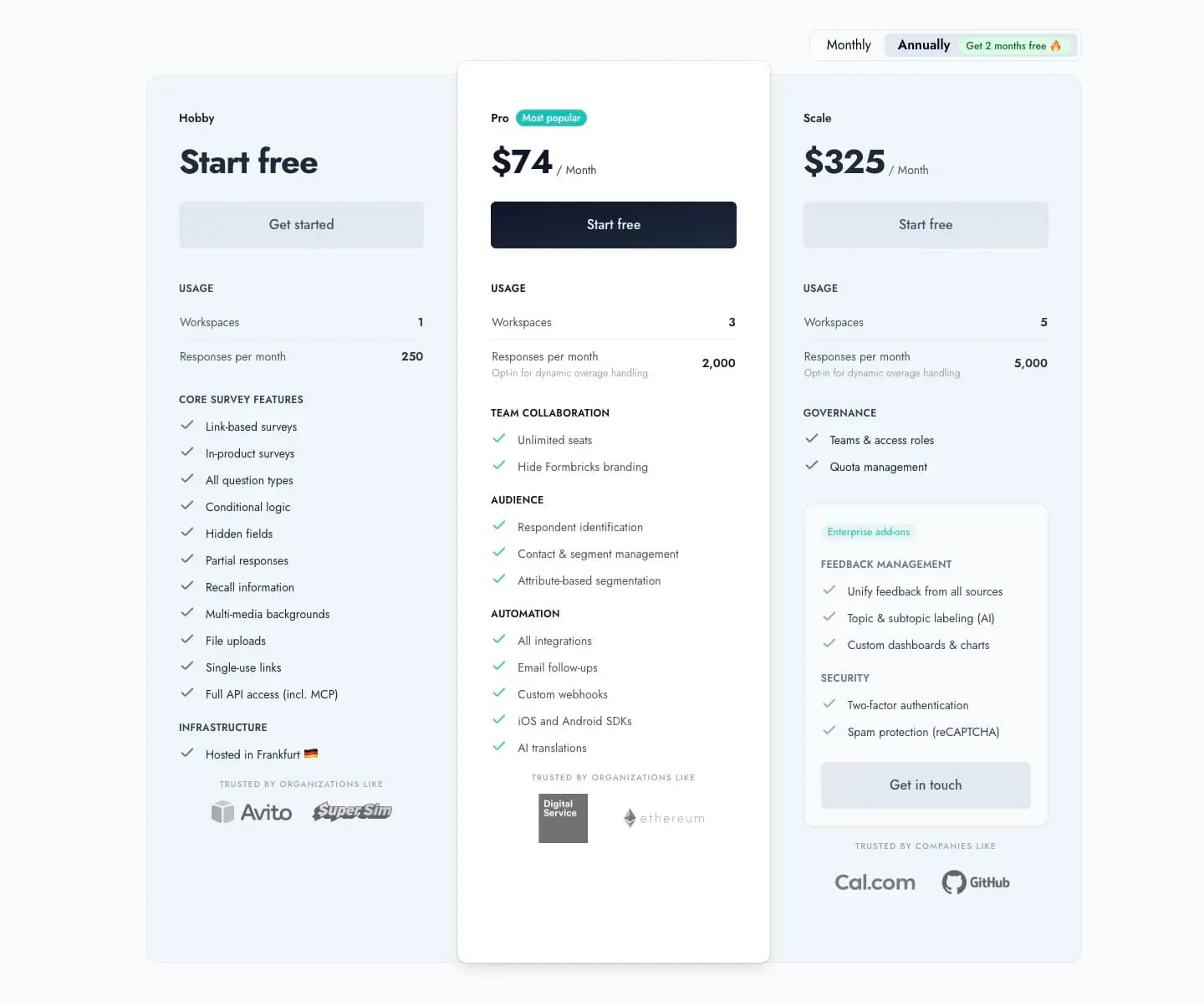
Captured August 15, 2026 from formbricks.com/pricing.
The Bottom Line: Scale is the highest published, self-serve tier. Above it, Formbricks offers custom Enterprise pricing through a published "Get in touch" contact path, not a mandatory sales gate before you see anything else.
Formbricks Self-Hosting: Community Edition
The free, self-hosted Community Edition, licensed under AGPLv3, is where Formbricks diverges most sharply from Medallia's private-cloud model:
- True customer-controlled self-hosting, not a more-isolated-but-still-vendor-managed private cloud. Data never leaves your own infrastructure.
- No response limits. Unlimited surveys, responses, and team members.
- No vendor lock-in. Even if you stop paying for Enterprise features, the Community Edition and your data remain accessible.
- Full API on self-hosted, too. The same unrestricted API available on every cloud tier.
Recall the earlier distinction: Medallia's single-tenant, Medallia-owned private cloud is more isolated than typical multi-tenant SaaS, but it's still entirely Medallia's infrastructure, not yours. For a buyer whose procurement policy requires the vendor's infrastructure to be hosted and operated entirely within the customer's own environment, that distinction is the whole ballgame, and it's the option Medallia doesn't offer at any price.
Medallia vs Formbricks: Side-by-Side Pricing
| Medallia | Formbricks | |
|---|---|---|
| Free tier | None | Hobby: 250 responses/month, full API including MCP, hosted in Frankfurt |
| Cheapest published price | None published; SpendHound reports an SMB average of $20,671/year from real contracts | Pro: $74/month ($890/year), 2,000 responses/month |
| Enterprise | No published price; SpendHound reports an average of $598,947/year from real contracts | Custom pricing, published contact path |
| Pricing metric | Experience Data Record (EDR): one record per interaction, across surveys, speech, video, social, and more | Responses per month, per workspace tier |
| Signal-type breadth | Surveys, speech, social signals, digital feedback, video feedback, and more, unified under one metric | Website, in-app, link, and email surveys unified in one platform |
| Self-hosting | Not offered; Medallia-owned single-tenant private cloud only | Community Edition, self-hosted, free, AGPLv3 |
| Billing flexibility | Custom, quote-based, priced in annual tiers | Monthly or annual billing on every published tier |
| Ownership stability | Under lender control as of 2026 following a distressed Thoma Bravo leveraged buyout (see above) | Independent, founder-operated |
Feature Value Breakdown
Pricing Transparency
Medallia's Approach: The EDR model is explained qualitatively in detail, what it covers, why it's structured this way, but zero dollar figures appear anywhere on the public pricing page. The only real numbers available come from a third-party firm tracking actual customer contracts.
Formbricks' Approach: Every tier, Hobby through Scale, is priced and published on formbricks.com/pricing, with monthly and annual billing options on all of them.
Value Verdict: Formbricks wins decisively. This is what's published versus what isn't, not a subjective call.
Data Residency and Self-Hosting
Medallia's Approach: Medallia runs a single-tenant private cloud on Medallia-owned hardware in Tier III colocation facilities, more isolated than typical multi-tenant SaaS, but still entirely vendor-managed infrastructure. No customer-controlled or on-premise deployment option exists at any tier.
Formbricks' Approach: A free, self-hosted Community Edition under AGPLv3 gives regulated buyers a genuine path to keep data entirely on their own infrastructure.
Value Verdict: Formbricks wins for any buyer where self-hosting or strict data residency is a hard requirement, not a preference. Medallia's private-cloud model is a real differentiator versus typical multi-tenant SaaS, but it's not the same thing as customer-controlled infrastructure.
Signal-Type Breadth
Medallia's Approach: The EDR model natively unifies surveys, speech analytics, video feedback, social signals, and digital behavior under one pricing metric, at genuine enterprise scale (1B+ signals processed per month, per Medallia's own stats).
Formbricks' Approach: Formbricks is focused on survey and in-product feedback collection across website, in-app, link, and email channels. It doesn't publish an equivalent for speech analytics, video feedback, or social listening.
Value Verdict: Medallia wins here, clearly. If your program needs to unify call-center speech data, video feedback, and social signals alongside surveys under one platform, that's real breadth Formbricks doesn't claim to match.
Vendor Stability
Medallia's Approach: Publicly traded until 2021, taken private by Thoma Bravo in a $6.4 billion leveraged buyout, and as of 2026, under lender control after that buyout's debt load outgrew the company's operating earnings.
Formbricks' Approach: Independently operated, with an AGPLv3-licensed Community Edition that guarantees you retain the platform and your data even if Formbricks' business circumstances ever change.
Value Verdict: Formbricks wins on structural risk. A multi-year enterprise contract with a vendor mid-transition between ownership structures carries a real, sourced element of uncertainty that a smaller, independent, open-source alternative doesn't carry in the same way.
Who Should Actually Pay for Medallia
Medallia makes sense if you're an enterprise wanting to unify many signal types, speech, video, social, digital, and survey, under one pricing metric rather than paying per point solution, Medallia's single-tenant, Medallia-owned private-cloud model satisfies your isolation requirements without needing true self-hosting, and you have the budget flexibility for a quote-based, enterprise-scale relationship.
It's a weaker fit if you need genuine self-hosting or customer-controlled infrastructure (not offered even though Medallia's cloud model is more isolated than typical SaaS), you want a published, self-serve price before talking to sales, you're a smaller team that only needs straightforward survey or feedback collection rather than a full multi-signal experience data platform, or vendor ownership stability during a multi-year contract matters to your procurement process.
A useful illustration: a healthcare payer evaluating Medallia for patient experience surveys might be reassured by its single-tenant, Medallia-owned infrastructure, only to discover mid-procurement that this still doesn't satisfy an internal policy requiring the vendor's infrastructure to be hosted and operated entirely within the customer's own environment. That's the exact gap true self-hosting closes.
Medallia Pricing FAQ
Final Verdict
👍 Medallia is the right call if you're a large enterprise that needs to unify speech, video, social, digital, and survey signals under one platform and one pricing metric, its single-tenant, Medallia-owned private cloud satisfies your isolation requirements without needing true self-hosting, and you have the budget and patience for a quote-based enterprise contract. Reviewers consistently praise its analytics depth and Salesforce integration, and it remains a 2026 Gartner Magic Quadrant leader in Voice of the Customer platforms.
👉 Formbricks is the better fit if you need a real number before your first sales call, you're evaluating specifically for feedback and survey collection rather than a full multi-signal experience data platform, and you want a self-hosted option that's actually customer-controlled rather than vendor-managed-but-isolated. Every tier is published, monthly and annual billing are both available, and the AGPLv3-licensed Community Edition gives you a self-hosted path Medallia's infrastructure model doesn't offer, backed by an independent business rather than one currently working through a lender-led ownership transition.
The honest read: Medallia's pricing opacity isn't just a sales tactic, it's compounded by a company mid-transition between owners after a leveraged buyout that didn't work out the way its private equity sponsor expected. If you need one public number to plan around instead of a "Talk to Sales" form and a third-party estimate, see Formbricks' current pricing here.
Try Formbricks now