
11 Medallia Competitors in 2026: Who Rivals It and How the CX Market Is Structured

Johannes
Co-Founder @ Formbricks
13 Minutes
Updated November 13, 2026
Medallia competitors fall into five groups: enterprise XM suites, unified CXM platforms, contact-center vendors, vertical specialists and survey platforms. This page maps who competes with Medallia in 2026, who owns whom after a year of deals, and where each rival wins or loses. It is a market overview. If you are planning a move, our Medallia alternatives guide covers migration, pilots and shortlists.
Medallia competitors at a glance
| Competitor | Segment | Where it beats Medallia | Where Medallia wins |
|---|---|---|---|
| Qualtrics | Enterprise XM suite | Survey design, research, statistics | Frontline action, unstructured signals |
| InMoment | AI CX analytics | Review and social aggregation | Scale, breadth |
| Forsta | Research and CX | Market research programming | CX operations |
| Sprinklr | Unified CXM | Social listening, service suite | Dedicated VoC depth |
| Verint | Contact center | Workforce and speech tools | Survey-led CX |
| NICE | CCaaS | Contact-center infrastructure | Digital and EX programs |
| Concentrix | CX services and tech | Managed programs | Self-run platform |
| SMG | Vertical CX | Multi-location benchmarks | Cross-industry breadth |
| Alchemer | Survey and CX | Price, survey flexibility | Enterprise scale |
| QuestionPro | Survey and research | Price, research methods | CX workflows |
| Formbricks | Sovereign experience management | Self-hosting, data control | Speech, video, social |
Ownership changes in 2026: Bloomberg Law and Medallia (Medallia), Research Live and Becker's (Qualtrics, Forsta, InMoment).
Who owns Medallia now?
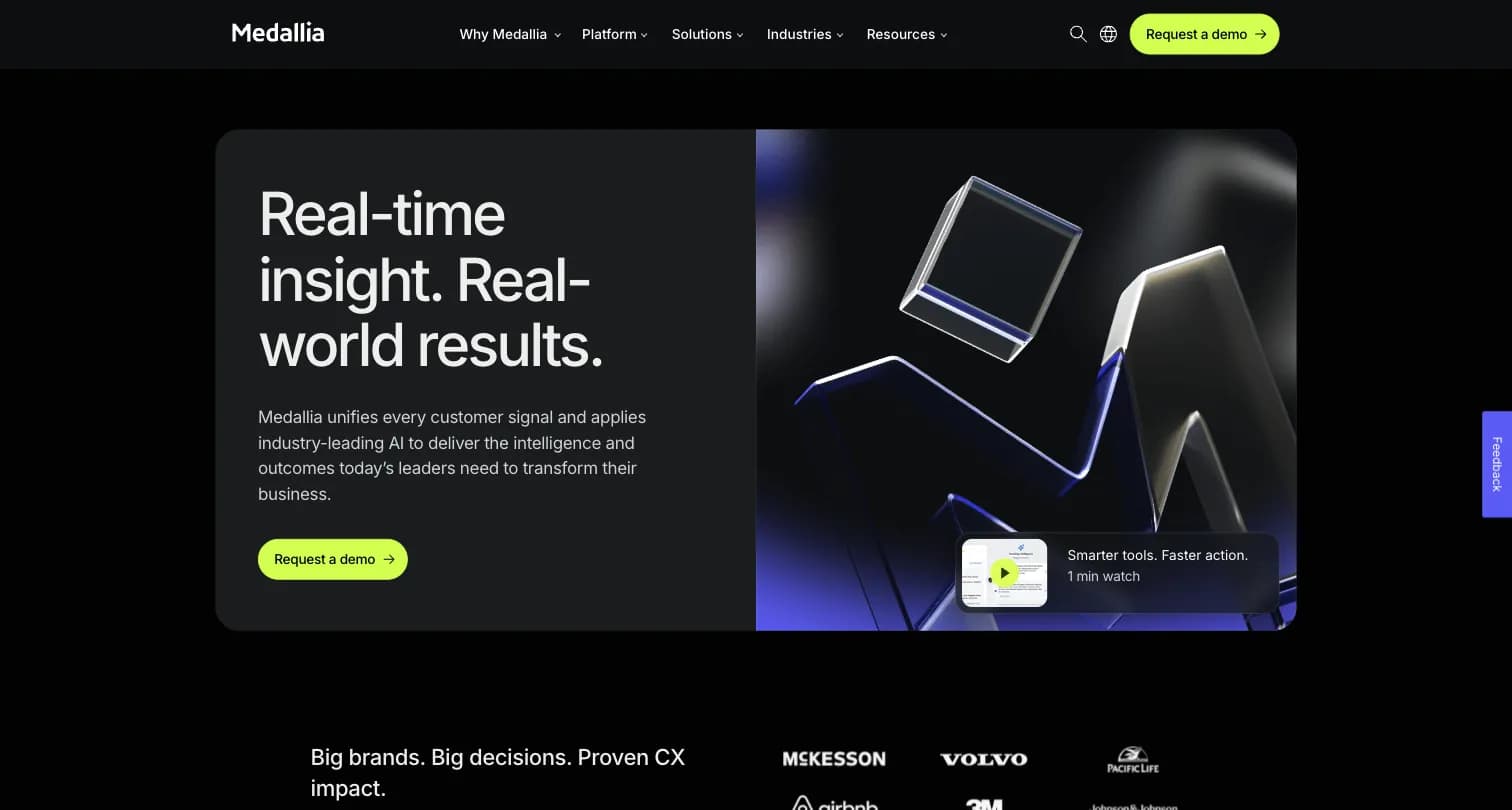
Medallia was founded in 2001 and went public on the NYSE in 2019. Thoma Bravo took it private in 2021 for $6.4 billion. Medallia carried about $3 billion of debt by 2026, and Reuters reported that a handover to lenders would wipe out Thoma Bravo's roughly $5.1 billion equity (Private Equity Wire). After Thoma Bravo declined to inject fresh cash, Medallia signed a recapitalization agreement with its lenders on June 17, 2026 (Bloomberg Law). It closed on August 3, 2026, when ownership passed to a creditor group led by Blackstone, with Apollo and FS KKR Capital Corp (Medallia).
Medallia, Inc. lists its main office in McLean, Virginia (contact page). It reports 2,000+ brand customers, 1,800+ employees and 1 billion+ signals a month (About Medallia). Named customers include 3M, ADP, Airbnb, Albertsons, Best Western, Comcast, Cox and Deliveroo (customer stories). Medallia prices on Experience Data Records and publishes no rates. See Medallia pricing for contract benchmarks.
How the Medallia competitors market is structured
Gartner tracks this category as Voice of the Customer Platforms. Its Medallia alternatives page lists Qualtrics, InMoment, Verint, Concentrix, SMG, NICE, Alchemer and QuestionPro among the top alternatives. Sprinklr and SurveySparrow also compete for parts of Medallia's business. Those names compete with Medallia in different ways:
- Enterprise XM suites (Qualtrics, now including Forsta and InMoment) compete head to head across CX, EX and research.
- Unified CXM (Sprinklr) competes when social, service and marketing teams consolidate on one contract.
- Contact-center vendors (Verint, NICE, Concentrix) compete for programs where calls and agents drive most value.
- Vertical specialists (SMG) compete in restaurants, retail and hospitality with location benchmarks.
- Survey and research platforms (Alchemer, QuestionPro, SurveySparrow) compete on price and survey depth.
Two shifts changed this map in 2026. First, consolidation: Qualtrics bought Press Ganey Forsta for $6.75 billion in May, bringing InMoment along, and Qualtrics shut down Delighted on June 30 (SmartSurvey). Gartner's "Qualtrics (InMoment)" label reflects that ownership. Second, Medallia itself changed hands. Buyers now weigh vendor ownership alongside features.
A sixth group is growing: platforms that let you run experience management on your own infrastructure. Formbricks sits there. We cover it after the profiles.
Why buyers compare Medallia competitors
Teams evaluating Medallia, or renewing it, usually raise six issues: no published pricing, multi-month implementations, modules priced on top of the license, clunky reporting, no customer-controlled hosting, and, since 2026, ownership risk. Each competitor answers some of these and not others.
The 10 main Medallia competitors in 2026 (plus Formbricks)
1. Qualtrics
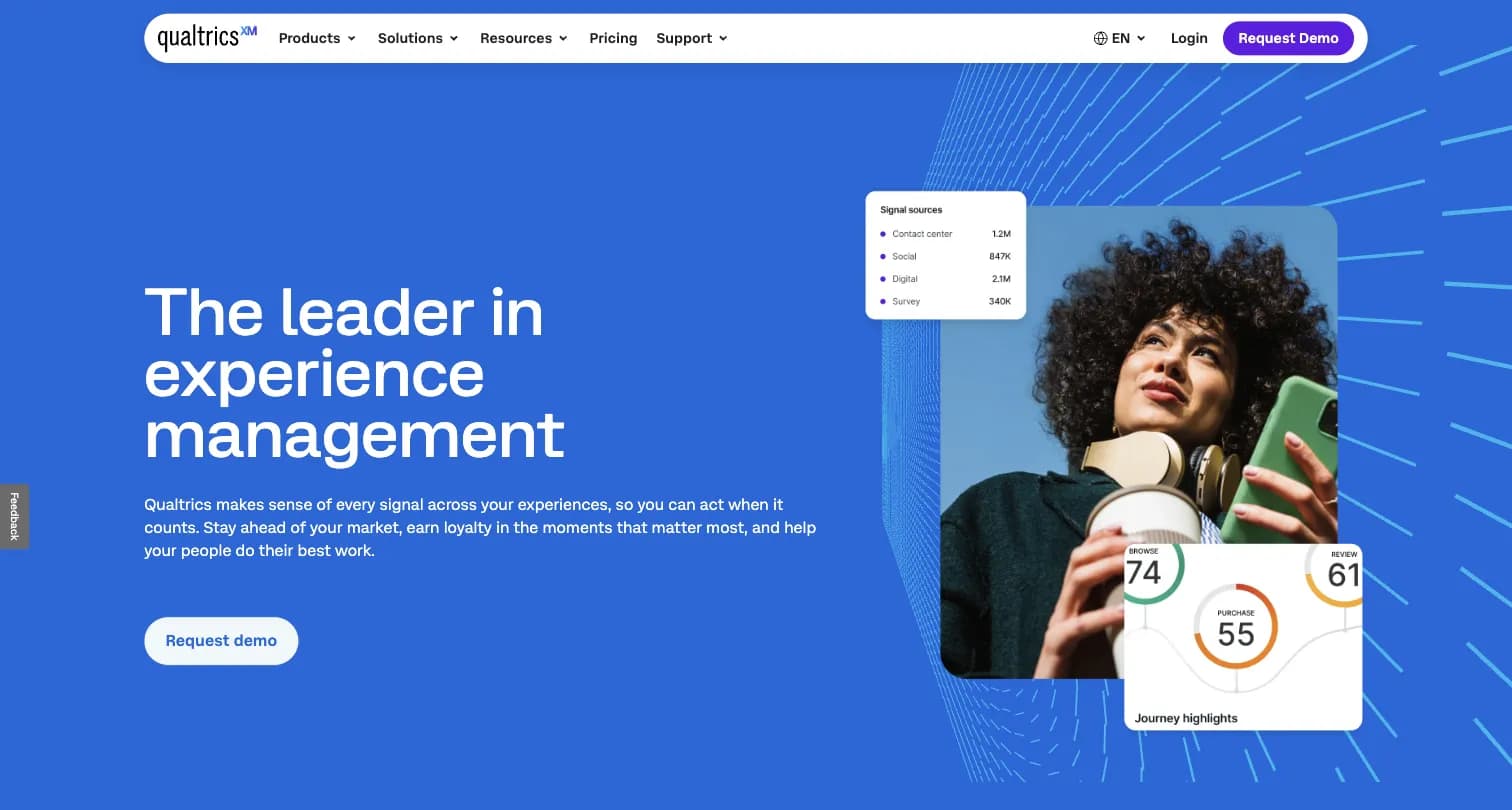
How it competes: Qualtrics is Medallia's most cited rival, and Medallia is Qualtrics' most cited rival in return. It sells CX, EX and Strategy and Research on one platform. SAP owned it from 2019, kept a majority after the 2021 IPO, and sold it to Silver Lake and CPP Investments in 2023.
- Pros: research-grade survey design, StatsIQ statistics, XM Discover text analytics, large integration catalog
- Cons: quote-based for most products, vendor-hosted only, roadmap for Forsta and InMoment still open
Pricing signal: one self-serve Strategic Research plan at $420 a month. UXtweak, citing Vendr, reports a median of $28,533 a year. See Qualtrics competitors.
Best for: Enterprises that run research, CX and EX on one platform.
2. InMoment
How it competes: InMoment aggregates surveys, reviews, social and support transcripts into one analytics layer. Press Ganey acquired it in 2025, so it now sits under Qualtrics.
- Pros: strong AI text and sentiment analysis, review and reputation management
- Cons: independent roadmap is now uncertain, quote-based pricing
Pricing signal: Vendr reports an average of about $13,488 a year.
Best for: Retail and hospitality teams that rely on reviews and unstructured feedback.
3. Forsta
How it competes: Forsta (Confirmit, FocusVision and Dapresy, then merged with Press Ganey) competes with Medallia on research-heavy CX programs. It is now a Qualtrics product.
- Pros: deep survey programming, quotas, crosstabs, vertical templates
- Cons: no public pricing, integrate-or-sunset decisions pending inside Qualtrics
Pricing signal: none published. See Forsta pricing.
Best for: Market research teams with complex, scripted studies.
4. Sprinklr
How it competes: Sprinklr bundles Service (contact center), Social, Marketing and Insights, which includes a surveys module. It wins when VoC is one part of a wider CX consolidation.
- Pros: social listening across 30+ channels, contact-center AI, broad certifications
- Cons: surveys are a small module, steep learning curve, reviewers call it expensive
Pricing signal: quote only. See Sprinklr competitors.
Best for: Large brands consolidating social, service and marketing.
5. Verint
How it competes: Verint sells contact-center automation and workforce engagement, with a VoC line for digital feedback and surveys. The overlap with Medallia is the contact center.
- Pros: speech and text analytics, quality management, agent bots
- Cons: VoC is a smaller part of the business, weaker for digital and EX programs
Pricing signal: quote only. See Verint competitors.
Best for: Contact centers that want workforce tools and VoC together.
6. NICE
How it competes: NICE runs contact-center infrastructure, workforce management and analytics on one cloud platform. It overlaps with Medallia's contact-center and speech analytics products.
- Pros: omnichannel routing, sentiment and intent analysis, workforce tools in one place
- Cons: narrower survey and digital feedback depth than a dedicated XM suite
Pricing signal: quote only.
Best for: Large contact centers replacing their infrastructure.
7. Concentrix
How it competes: Concentrix sells customer experience services and technology. It competes when a company wants a partner to run the VoC program as well as supply the software.
- Pros: managed services and analysts alongside the platform
- Cons: less fit for teams that want to run their own program in-house
Pricing signal: quote only, usually bundled with services.
Best for: Companies that want an outsourced VoC program.
8. SMG
How it competes: SMG focuses on restaurants, retail, consumer goods and hospitality, with clients such as Wendy's, McDonald's and Nestle.
- Pros: location-level reporting, industry benchmarks, combined brand, customer and employee insight
- Cons: narrow vertical focus, less suited to B2B or digital products
Pricing signal: quote only.
Best for: Restaurant, retail and hospitality chains with many locations.
9. Alchemer
How it competes: Alchemer (formerly SurveyGizmo) competes where buyers mostly use Medallia for surveys and dashboards.
- Pros: branching, piping, quotas, 40+ question types, faster setup
- Cons: lighter frontline action tools, per-user pricing
Pricing signal: from $55 per user per month billed monthly, or $315 per user per year billed annually. See Alchemer alternatives.
Best for: Mid-market teams running survey-led CX.
10. QuestionPro
How it competes: QuestionPro sells survey, research and CX products at lower price points, plus a GovCloud option for US public sector.
- Pros: MaxDiff, conjoint and pricing research, offline surveys, low entry price
- Cons: CX workflows less mature than Medallia's
Pricing signal: Advanced plan from $99 per user per month. QuestionPro's own Medallia comparison quotes its CX product from $24,000 a year.
Best for: Cost-sensitive research and CX teams, including US public sector.
Also worth noting: SurveySparrow, a conversational survey tool with a free plan and a published price list. It replaces survey collection, not a full Medallia program. Feedback analytics layers such as Chattermill also show up in Medallia evaluations when the main need is analyzing feedback collected elsewhere. See Chattermill pricing.
The gap in this market: customer-controlled deployment
Every competitor above runs on vendor-operated cloud. Medallia itself runs a single-tenant private cloud on Medallia-owned hardware (Medallia security). None of these vendors publish a customer-controlled self-hosted option that we could find. For banks, insurers, health systems and public bodies with strict residency rules, that narrows the field before features are even compared.
11. Formbricks
Formbricks is an experience management suite that runs self-hosted today, on your own servers or in your own AWS, Azure or GCP account. Dedicated cloud and Managed by Formbricks (EU or Saudi Arabia) are coming soon. Responses stay in your jurisdiction. Own your experience data instead of renting it back.
- For IT: Formbricks is ISO 27001 compliant and GDPR and CCPA compliant, and its hosted Public Cloud is covered by a SOC 2 Type II audit (compliance, SOC 2). An Experience Suite license adds SAML and OIDC SSO, teams and roles, audit logging, a DPA and custom terms. Helm charts are available in every edition. Self-hosted, you run your own controls on the same codebase and there are zero sub-processors. See how self-hosting works.
- For CX: web, in-app, email and link surveys; Experience Suite capabilities: Unify Feedback with AI enrichment for feedback from other sources, Topics and subtopics (preview), dashboards and charts, and Workflows (beta) for actions such as an email when a response completes; integrations with Slack, Zapier, Make, n8n, Notion, Google Sheets, Airtable and webhooks, an API and an MCP server. Salesforce, HubSpot and Attio connect through Make (recommended), n8n or a custom webhook.
- For budget: an Experience Suite license is an annual license priced by responses and workspaces, with unlimited seats. Experience Suite by quote, with a free 15-day trial license.
The core is open source, which is how we deliver the control. It is not the only open-source option: LimeSurvey is one too, focused on surveys.
- Pros: full data control, audited security, cost not tied to seats
- Cons: no native speech analytics, video feedback or social listening; frontline case management is built with Workflows and integrations
Where Medallia still leads its competitors
Medallia keeps three advantages that most rivals do not match in one product:
- Signal breadth. Surveys, speech, video, digital behavior and social under one pricing unit.
- Frontline action. Role-based reporting pushes the right score and comment to each store, branch or agent, with case management to close the loop.
- Scale. Medallia reports more than a billion signals a month across global programs.
Competitors win by going narrower (contact center, vertical, research), cheaper (survey platforms) or more controllable (self-hosted). Few beat Medallia on all three at once.
How to evaluate Medallia competitors
| Criterion | Question to ask each vendor |
|---|---|
| Ownership | Who owns you, and what changed in the last 24 months? |
| Deployment | Where does our data live, and can we host it ourselves? |
| Scope | Which Medallia capabilities do you replace, and which do we keep elsewhere? |
| Pricing unit | Do you charge by response, interaction, seat or module? |
| Security | Can we see your SOC 2 report, ISO certificate and sub-processor list? |
| Exit | Can we export all raw data at any time without a fee? |
Medallia vs Qualtrics: what is the difference?
| Factor | Medallia | Qualtrics |
|---|---|---|
| Owner (2026) | Blackstone-led lenders | Silver Lake and CPP Investments |
| Recent deals | Lender takeover, agreed June 17 and closed August 3, 2026 | Bought Press Ganey Forsta (and InMoment), May 2026 |
| Core strength | Real-time frontline action, calls, video, digital signals | Survey design, research methods, statistics |
| Employee experience | Yes, secondary to CX | Full EX suite |
| Pricing | EDR-based, no published rates | One self-serve plan, rest by quote |
| Deployment | Medallia-owned private cloud | Vendor cloud |
Choose Medallia if real-time frontline action and unstructured signals matter most. Choose Qualtrics if research depth matters more. Neither lets you host the platform yourself.
Medallia competitors by industry
| Industry | Competitors that show up most |
|---|---|
| Retail and restaurants | SMG, InMoment, Qualtrics |
| Hospitality and travel | SMG, InMoment, Qualtrics |
| Banking and insurance | Qualtrics, Verint, NICE, Formbricks for self-hosted needs |
| Healthcare | Qualtrics (with Press Ganey), Formbricks for self-hosted needs |
| Telecom and utilities | Verint, NICE, Sprinklr |
| Public sector | QuestionPro GovCloud, Formbricks self-hosted |
| Technology and SaaS | Qualtrics, Alchemer, Formbricks |
Medallia sells into all of these. Its own customer list spans automotive, banking, communications, healthcare, insurance, manufacturing, restaurants, retail, technology, travel and utilities.
Which Medallia competitor fits which buyer?
- Like-for-like suite: Qualtrics
- Social plus service consolidation: Sprinklr
- Contact-center-led program: Verint, NICE or Concentrix
- Multi-location brands: SMG
- Survey-led program on a tighter budget: Alchemer or QuestionPro
- Data sovereignty, self-hosting or regulated industries: Formbricks
Medallia competitors FAQ
Who are Medallia's main competitors?
Who owns Medallia now?
Is Medallia a good company?
What is the difference between Qualtrics and Medallia?
Which companies use Medallia?
Who is the main competitor for Qualtrics?
Why does Gartner list Qualtrics (InMoment)?
Is NICE a competitor to Medallia?
What is the difference between Sprinklr and Medallia?
Does Medallia offer self-hosting?
Is there an open-source Medallia competitor?
Related comparisons
- Medallia alternatives: switching guide with migration plan, pilot checklist and shortlist
- Medallia pricing: real contract benchmarks and total cost of ownership
- Forsta pricing: Forsta costs and options after the Qualtrics deal
- Chattermill pricing: what an AI feedback analytics layer costs