
9 Best Alchemer Alternatives in 2026 (Including Open Source)

Johannes
Co-Founder @ Formbricks
12 Minutes
August 16th, 2026
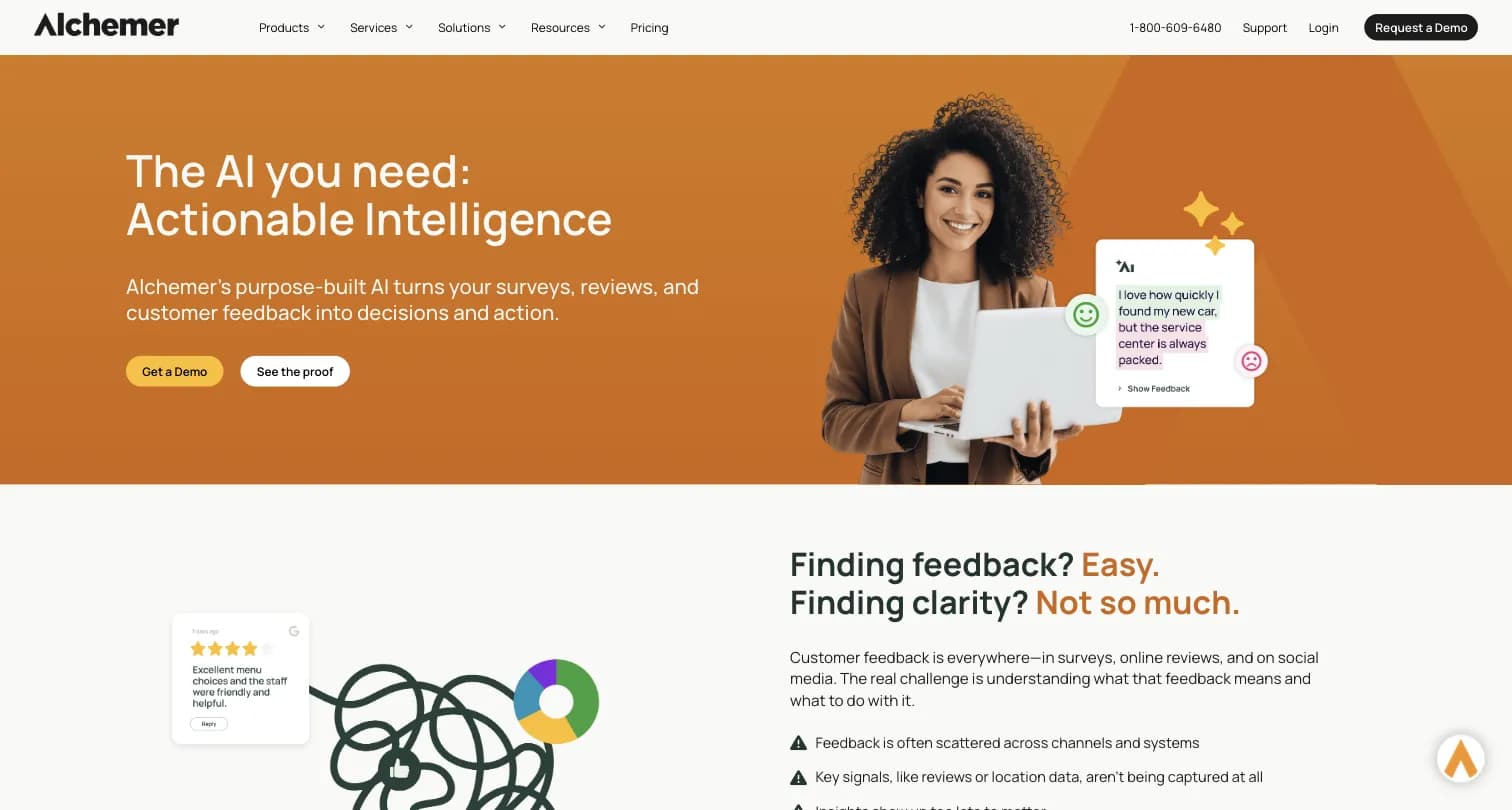
Captured August 15, 2026 from alchemer.com.
Alchemer (formerly SurveyGizmo) markets itself as "enterprise power without the enterprise price tag," and its 5 consecutive Gartner Magic Quadrant inclusions for Voice of the Customer back that up. But its named self-serve plans cap out at 3 users, its Business Platform tier is entirely quote-based, and real G2 reviewers describe price increases as steep as 10x in a single renewal. Here are 9 real Alchemer alternatives, what each one does differently, and one option none of the usual "Alchemer alternatives" roundups mention.
What Is Alchemer?
Alchemer was founded in 2006 in Boulder, Colorado as SurveyGizmo, bootstrapped by co-founder and CEO Christian Vanek without outside investment capital. The company rebranded to Alchemer in 2020, KKR made a majority investment in 2022, and Alchemer has since acquired Apptentive (2023) and Chatmeter (2025).
Alchemer positions itself as "the AI you need," turning surveys, reviews, and customer feedback into decisions and action. The company claims 11,000+ companies across 80+ countries and 30+ industries, 3.4 billion survey responses collected, 500 million people reached monthly via mobile apps, 400+ integrations, and 5 consecutive inclusions in Gartner's Magic Quadrant for Voice of the Customer.
Alchemer holds a 4.4 rating across 954 reviews on G2 and 4.5 across 319 reviews on Capterra.
Why it stands out as an Alchemer alternative:
Alchemer Pros & Cons
| Pros | Cons |
|---|---|
| Responsive, human phone support that "always answers the phone right away" per its own pricing page | Named self-serve plans (Professional, Full Access) cap at 3 users; more requires a custom Business Platform quote |
| Publishes exact self-serve prices for 3 of its tiers, more transparent than most enterprise XM tools | One reviewer reported a price jump from under $1,000 for 8 users to nearly $8,000 in a single renewal |
| Omnichannel feedback (surveys, reviews, social, location listings) via its COMPASS and CONNECT pillars | A free plan is referenced in the pricing FAQ but isn't shown as a distinct tier on the pricing page itself |
| SOC 2 compliant, GDPR-ready, HIPAA-capable via signed BAA | Reviewers describe support going unanswered for months on basic tickets |
| 400+ pre-built integrations with workflow automation | G2 reviewers report bugs in offline mode and inconsistent, lost reporting data |
Source: alchemer.com/plans-pricing and G2 reviews, captured August 15, 2026.
Why Teams Look for Alchemer Alternatives
We reviewed Alchemer's own pricing page and real customer reviews on G2 to understand the patterns behind this search. Five come up repeatedly.
1. Steep, Unpredictable Price Increases
Alchemer's named tiers run Collaborator ($55/user/month or $315/user/year, 75,000 responses/year), Professional ($165/user/month, max 3 users, 100,000 responses/year), and Full Access ($275/user/month, max 3 users, 125,000 responses/year). Beyond that, Business/Platform plans are entirely quote-based.
One G2 reviewer, Brandon N., described his team's bill jumping from under $1,000 for 8 users to nearly $8,000, a "10X price increase this year." Another reviewer, Bhavesh N., said Alchemer left him on a "legacy plan" with fewer features and no clear downgrade path, calling the pricing model "greedy, unconscionable, all for money."
2. Support That Reviewers Say Goes Quiet
Alchemer's own pricing page advertises phone support that "always answers the phone right away." Reviewers on G2 tell a different story: one mid-market user reported nine months of unresolved technical issues with no follow-up, and another said a basic support ticket sat unanswered for six months, with a voicemail box too full to leave a message.
3. A 3-User Cap on Named Self-Serve Plans
Both Professional and Full Access cap out at 3 users. A 4th team member means moving into a custom Business Platform conversation, adding a sales cycle a flat per-workspace price wouldn't require.
4. Reliability Complaints: Bugs, Lost Data, Inconsistent Reports
One reviewer called offline mode "practically useless" and said a technical issue took weeks to resolve. Another described the platform as "very buggy" while on the enterprise plan. A separate reviewer reported lost survey data with no explanation, plus "poor" and "not consistent" reporting.
5. A Free Plan That's Referenced But Not Shown
Alchemer's pricing FAQ states a free plan exists with limited features and responses, but no free tier appears as a card on the pricing page itself, an internal inconsistency that can confuse self-serve buyers comparing options.
Alchemer Alternatives at a Glance
| Alternative | Best For | Free Plan | Starting Price | Open Source / Self-Hosted |
|---|---|---|---|---|
| Formbricks | Open-source feedback & experience management | Yes (250 responses/mo) | $74/month (billed annually) | Yes / Yes |
| SurveyMonkey | Broadest reach, fastest deployment | Yes (limited, 10 questions) | $30/user/month (3-user min) | No / No |
| Qualtrics | Enterprise research depth | Yes (500 responses total) | $420/month (self-serve) | No / No |
| Medallia | Large enterprise, real-time frontline action | No | Custom (EDR-based) | No / No |
| QuestionPro | Enterprise features at a lower price | Yes (1 user, 200 responses/survey) | $99/user/month | No / No |
| SurveySparrow | Conversational, chat-like surveys | Yes (75 responses/quarter) | $19/month | No / No |
| Google Forms | Free, no-frills forms | Yes (unlimited) | $7/user/month (Workspace seat) | No / No |
| SurveyLab | Multi-language, enterprise CRM integrations | No (14-day trial) | Custom | No / No |
| Formstack | Forms beyond surveys, workflow automation | No (trial) | Custom | No / No |
Top 9 Alchemer Alternatives in 2026
1. Formbricks: The Open-Source Pick for Transparent Pricing and Self-Hosting
If the reason you're evaluating Alchemer alternatives is its 3-user cap, its opaque Business Platform pricing, or a data residency requirement, Formbricks is built specifically for that gap.
Formbricks is an open-source feedback and experience management suite built around three pillars: feedback management (website, in-app, link, and email surveys unified on one platform, instead of Alchemer's per-user, per-tier pricing), feedback analytics (response dashboards, drop-off tracking, and segmentation), and workflows and integrations (Formbricks Workflows for post-response automation, plus native integrations to Salesforce, HubSpot, Slack, Google Sheets, and Notion, all through a free API on every tier).
Key features:
- Multi-channel surveys: link surveys, website pop-ups, in-app micro-surveys, and email-embedded surveys on one platform
- Attribute-based targeting: show surveys to specific segments based on behavior, attributes, or customer journey stage
- Feedback analytics: aggregate and per-response views, drop-off tracking, and custom segmentation
- Formbricks Workflows: automate what happens after a response comes in
- Open API and webhooks on every tier, including the free plan, unlike Alchemer, where API access is only confirmed for Business Platform accounts per its own pricing FAQ
- iOS and Android SDKs for native in-app surveys
- Self-hosting option, a capability not found anywhere on Alchemer's pricing or security pages
Pricing (Cloud):
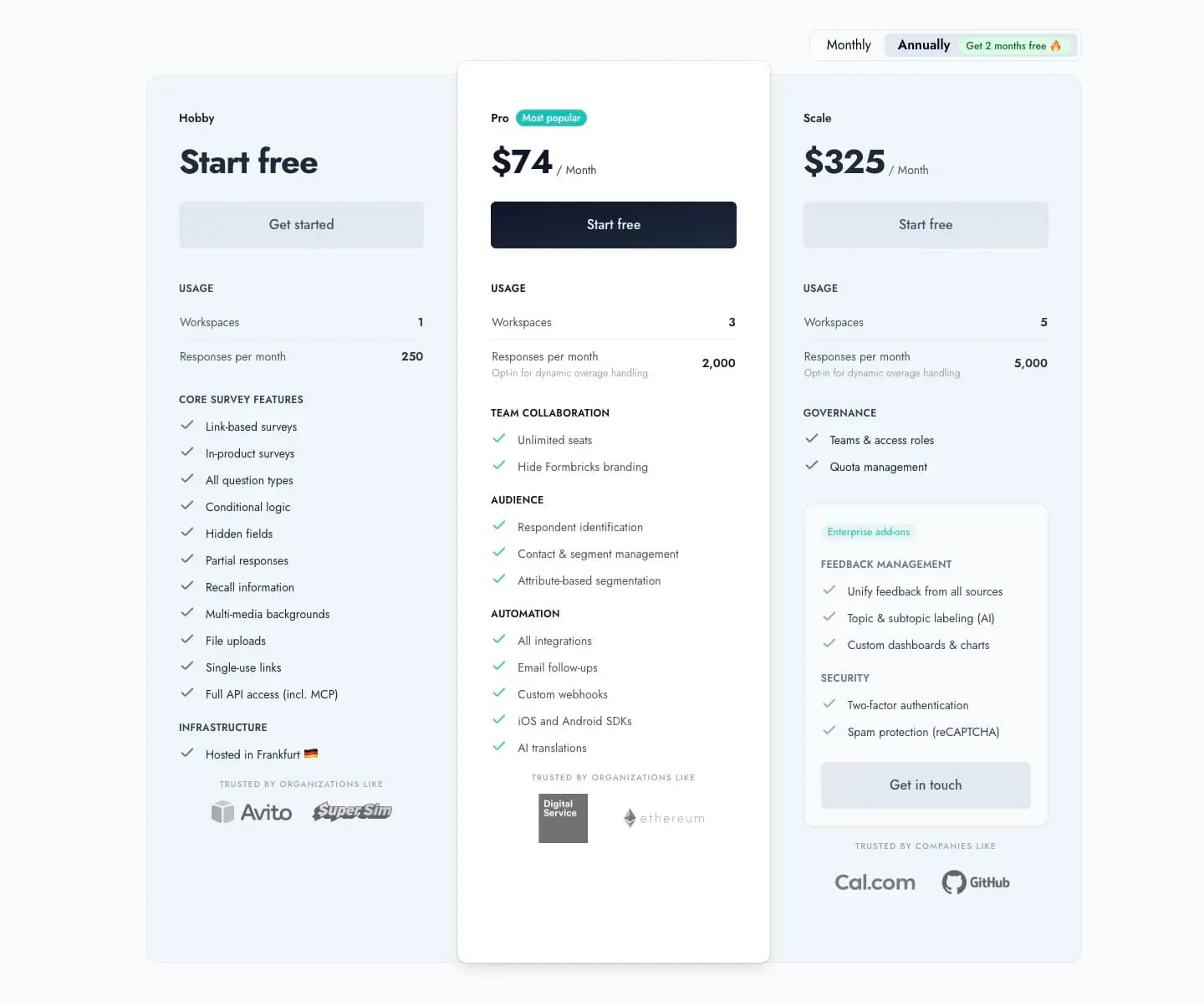
Captured August 16, 2026 from formbricks.com/pricing.
- Hobby (Free): 250 responses/month, 1 workspace, full API access (including MCP), hosted in Frankfurt
- Pro: $89/month billed monthly, or $74/month billed annually ($890/year) for 3 workspaces and 2,000 responses/month, unlimited seats, branding removal
- Scale: $390/month billed monthly, or $325/month billed annually ($3,900/year) for 5 workspaces and 5,000 responses/month, teams and access roles, quota management
Pricing (Self-Hosted):
- Community Edition: Free forever, AGPLv3, unlimited surveys and seats
- Enterprise Edition: Custom pricing for SSO, branding removal, and white-glove onboarding
Best for: Teams that hit Alchemer's 3-user cap or its Business Platform sales gate, and organizations with data residency requirements that self-hosting solves directly.
2. SurveyMonkey: The Broadest Reach at the Fastest Time to Value
SurveyMonkey positions itself as the world's most popular survey platform, used by 260,000+ organizations worldwide.
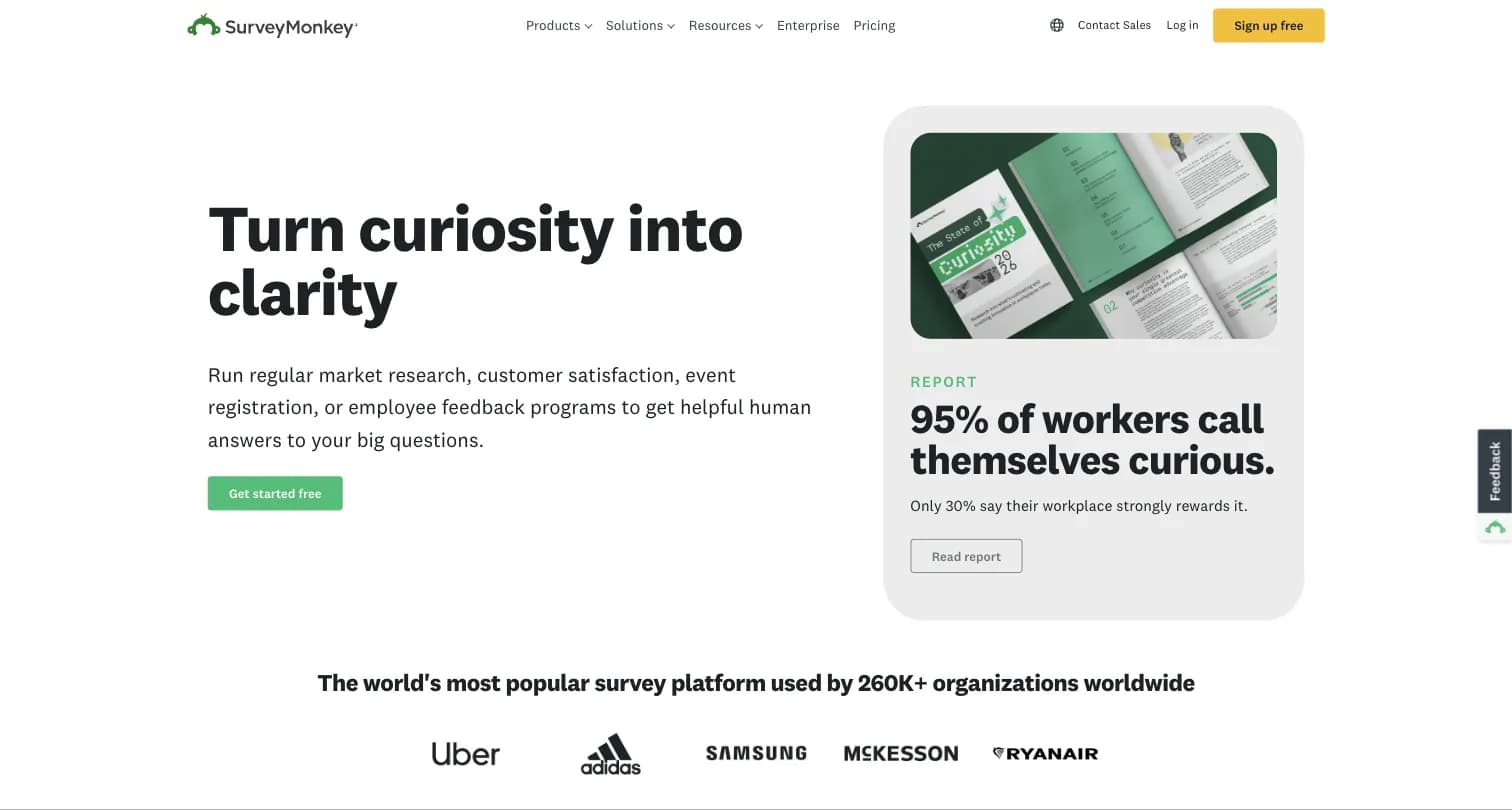
How it compares to Alchemer: Where Alchemer's named tiers cap at 3 users, SurveyMonkey's Team plans start at a 3-user minimum but scale further, and its brand recognition and 500+ templates mean less ramp-up time for non-technical teams. SurveyMonkey doesn't try to match Alchemer's omnichannel review and location-management pillars, it focuses on surveys and forms.
Key features:
- 500+ expert templates and AI-assisted survey/form creation
- SurveyMonkey Audience: a 335M+ person respondent panel across 130+ countries
- 200+ integrations
- AI-powered response analysis
Pricing: Free Basic plan (unlimited surveys, capped response viewing). Team Advantage at $30/user/month (billed annually, 3-user minimum, 50,000 responses/year). Team Premier at $92/user/month (same minimum, 100,000 responses/year). Team Enterprise is custom, with US/Canada/EU data center choice and SSO. Individual-tier dollar prices are not shown publicly without account signup, and third-party sources disagree on what they actually cost.
Best for: Teams that want fast, template-driven survey deployment without Alchemer's per-seat pricing on Professional and Full Access.
3. Qualtrics: The Enterprise Research Depth Option
Qualtrics is the biggest name in experience management, and the platform Alchemer explicitly markets itself as a lower-cost alternative to.
How it compares to Alchemer: Qualtrics splits into three separately-priced product lines (Customer Experience, Employee Experience, Strategy & Research) spanning eight tiers, seven of which are entirely quote-based. Its one public price, the self-serve Strategic Research plan, costs $420/month ($5,040/year) for 1,000 total responses, but includes StatsIQ statistical tooling (regression, clustering, R-integration) and 20+ guided research methodologies that neither Alchemer nor most of this list matches.
Key features:
- StatsIQ statistical suite and 20+ guided academic-style research solutions
- FedRAMP High, HITRUST, ISO 27001, and ISO 42001 certifications
- 23 question types including video and audio responses
Pricing: Qualtrics Surveys free account (1 user, 500 total responses, 8 question types). Strategic Research (self-serve) at $420/month ($5,040/year, 1,000 responses total). Every other product line is Request Pricing.
Best for: Teams that specifically need academic-grade statistical tooling and can absorb a quote-based enterprise contract, where Alchemer's per-user model isn't the deciding factor.
4. Medallia: The Enterprise Real-Time Action Platform
Medallia targets the same large-enterprise CX buyer as Alchemer's Business Platform tier, but built around real-time frontline action rather than omnichannel survey collection.
How it compares to Alchemer: Medallia's Athena AI processes unstructured data (call recordings, reviews, social) at a depth Alchemer's COMPASS reputation-management add-on doesn't attempt, and its hierarchical, role-based reporting is built for complex multi-unit organizations.
Key features:
- Omnichannel signal collection across surveys, calls, digital, and social
- Medallia Athena: AI-powered pattern detection and action recommendations
- Real-time alerting and case management routed to frontline staff
Pricing: Custom, priced on Medallia's own "Experience Data Record" (EDR) metric. Thoma Bravo acquired Medallia in October 2021 for approximately $6.4 billion, taking it private.
Best for: Large, multi-location enterprises that need real-time frontline action routing more than Alchemer's location-review aggregation.
5. QuestionPro: Enterprise Features Without the 3-User Cap Trade-off
QuestionPro directly targets buyers comparing enterprise survey and research tools on price, the same buyer Alchemer's "enterprise power without the enterprise price tag" positioning targets.
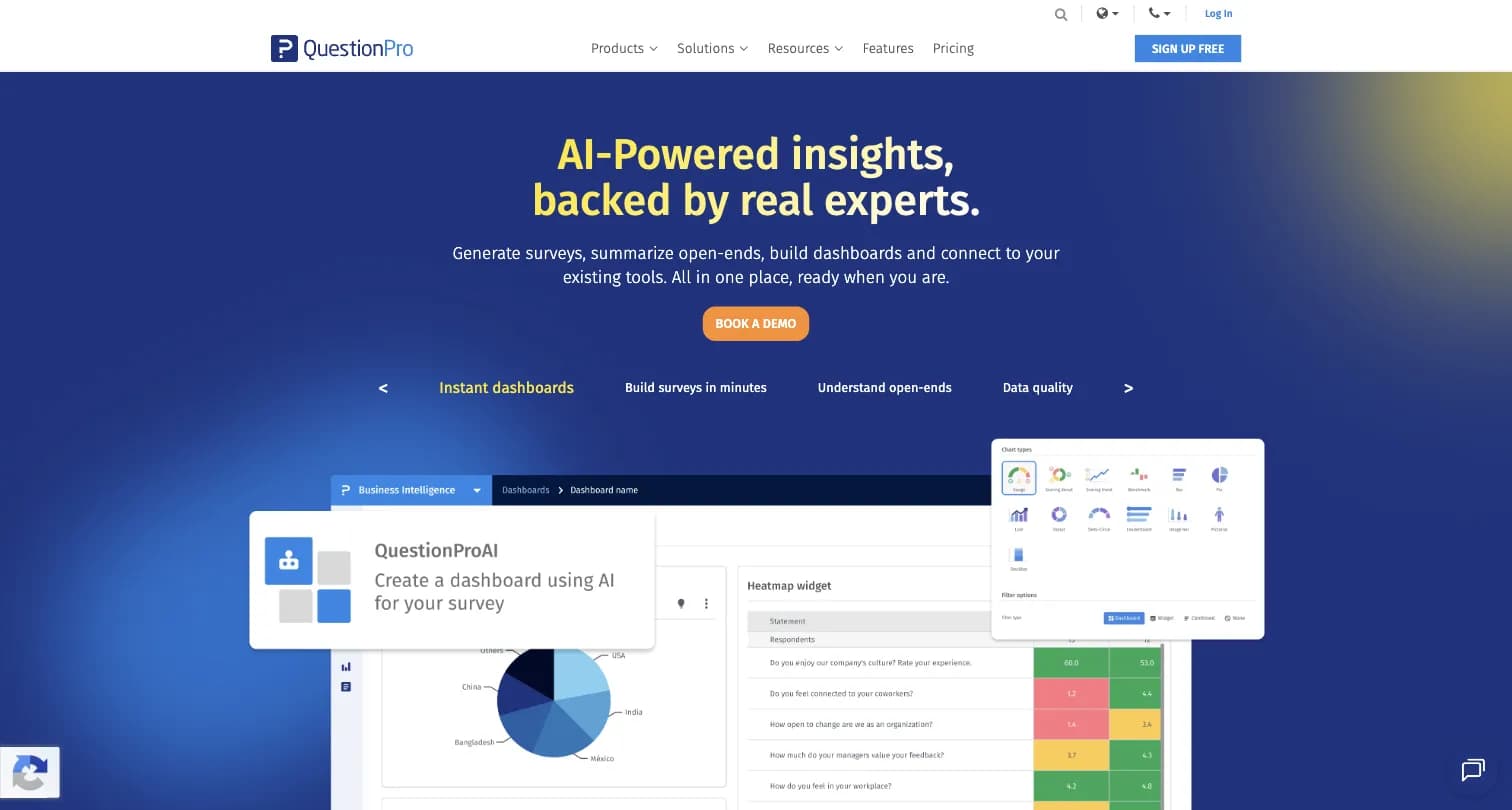
How it compares to Alchemer: QuestionPro's Team Edition requires a 5-user minimum (steeper than Alchemer's 3-user cap on the way in, but it doesn't force a custom quote to add a 4th person the way Alchemer's Professional or Full Access tiers do). QuestionPro also publishes real self-serve pricing for its Advanced tier, where Alchemer's equivalent single-user option (Collaborator) is priced per-user rather than flat.
Key features:
- QuestionPro AI: instant dashboards, open-end summarization, VideoAI sentiment analysis
- 8 regional data centers for data residency needs
- CCPA, GDPR, ISO 27001, and HIPAA compliance
Pricing: Essentials free (1 user, 200 responses/survey, 30 question types). Advanced at $99/user/month (billed annually, 25,000 responses/year). Team Edition at $83/user/month (5+ users, 100,000 responses/year). Research Suite is custom.
Best for: Teams that want built-in market-research tooling (panels, communities) alongside standard surveys, at a lower price than Alchemer's Full Access tier.
6. SurveySparrow: The Conversational Survey Alternative
If Alchemer feels too enterprise-heavy for what's really a customer or employee feedback program, SurveySparrow's chat-like survey format is built for higher completion rates on lighter-weight surveys.
How it compares to Alchemer: SurveySparrow claims up to 40% higher completion rates through its conversational, one-question-at-a-time interface, a very different bet than Alchemer's dense, research-grade survey builder. Neither offers self-hosting, and SurveySparrow only bills quarterly at minimum, a real constraint for organizations running seasonal, one-off surveys.
Key features:
- Conversational, chat-like survey interface
- 360-degree assessments and reputation management across 100+ review platforms
- Offline survey collection via mobile app
Pricing: Forever-free plan (75 responses/quarter) plus a 14-day trial. Basic at $19/month, Starter at $39/month, Business (Professional tier) and Enterprise both quote-based, quarterly billing only.
Best for: HR and CX teams that want higher survey completion rates through engagement design, rather than Alchemer's research-methodology depth.
7. Google Forms: The Free, No-Frills Option
For teams whose actual need is a simple internal form, not Alchemer's omnichannel VoC platform, Google Forms is the free default.
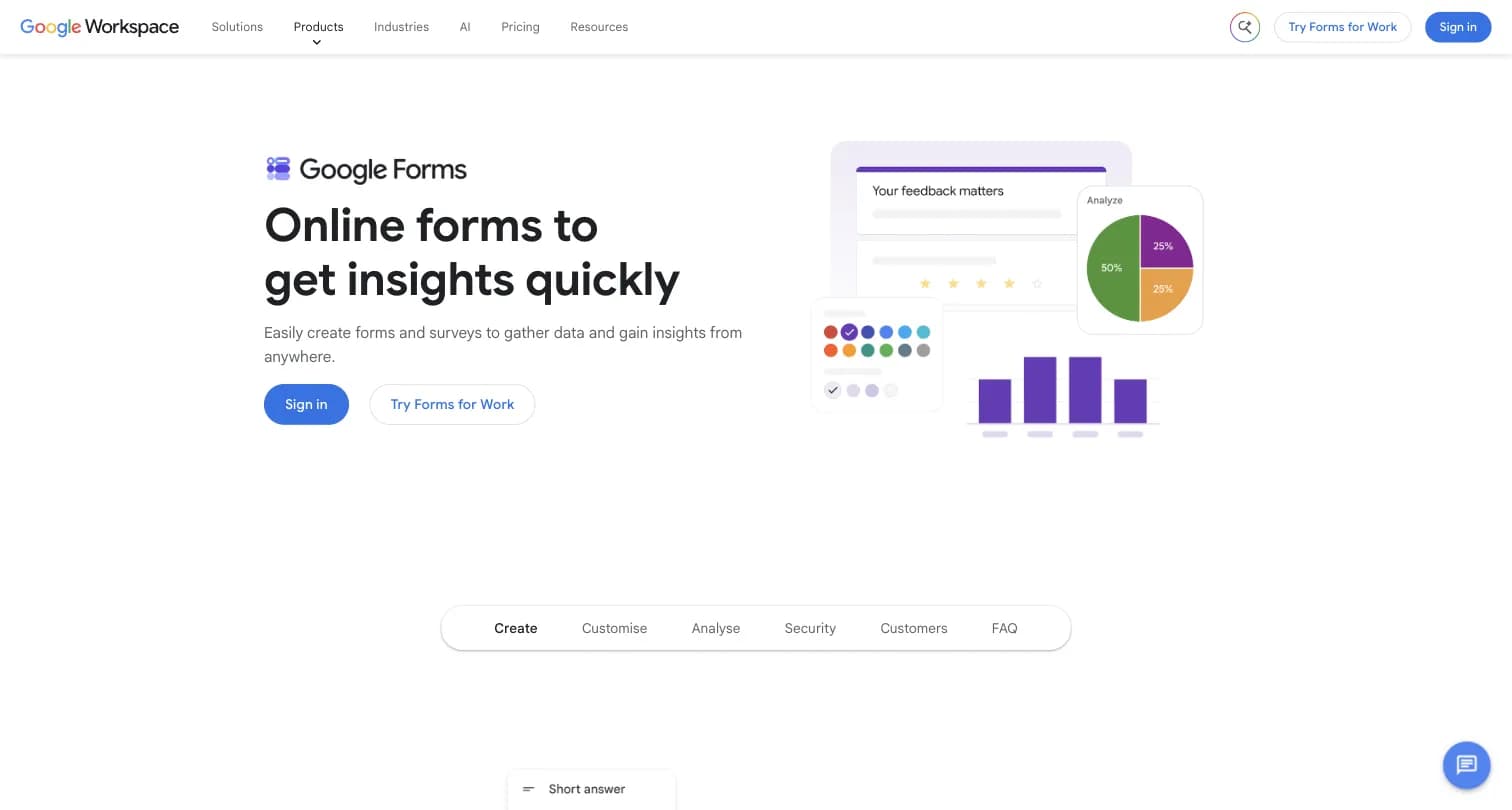
How it compares to Alchemer: Google Forms has no branding, payments, advanced logic, or CX program layer of any kind, it competes purely on being free and simple, not on feature depth. Alchemer's cheapest named tier (Collaborator, $55/user/month) buys a completely different category of tool: unlimited surveys, 75,000 responses/year, and email support.
Key features:
- Unlimited forms and responses on any Google account
- Real-time automated charts, exportable to Google Sheets
- Multiple question types with drag-and-drop organization
Pricing: Free with any Google account. Google Workspace (which bundles Forms with email, storage, and every other Workspace app) starts at $7/user/month for Business Starter, there is no standalone Forms price.
Best for: Teams that already pay for Google Workspace and need a free, no-frills internal survey or RSVP form, not an omnichannel VoC program.
8. SurveyLab: The Multi-Language, Enterprise-Integration Specialist
SurveyLab, founded in 2009, positions itself directly against Alchemer on internationalization and CRM depth.
How it compares to Alchemer: Where Alchemer's team features are gated behind its priciest per-user tiers, SurveyLab bundles CRM and helpdesk integrations (Salesforce, Intercom, Zendesk) with multi-language questionnaires that include automatic browser-language detection, serving over 85,000 customers from public institutions to global brands.
Key features:
- Multi-language questionnaires with automatic browser detection
- Native integrations with Salesforce, Intercom, and Zendesk
- Mobile-responsive surveys and real-time reporting
- Dedicated support including SLA and onboarding help
Pricing: Not published in the source reviewed for this guide; SurveyLab offers a 14-day free trial.
Best for: Multi-national organizations that need survey internationalization and deep CRM/helpdesk integration without Alchemer's per-user pricing model.
9. Formstack: Forms and Workflow Automation Beyond Surveys
Formstack pitches itself explicitly as "more than surveys," aimed at teams that need Alchemer's data-collection depth plus broader workflow automation.
How it compares to Alchemer: Formstack's own comparison page notes that Alchemer's team collaboration features are "only available on their most expensive plan," where Formstack bundles Approval Workflow and Data Routing at a lower cost. Formstack also offers 300+ templates spanning event registration, order forms, and lead generation, not just surveys, plus Partial Submissions and Field Bottlenecks analytics that Alchemer's base tiers don't include.
Key features:
- 300+ prebuilt templates across use cases beyond surveys
- Partial Submissions and Field Bottlenecks for abandonment analysis
- 200+ integrations plus 60+ Zapier connections, API and webhooks
- Used by 32,000+ organizations
Pricing: Not published in the source reviewed for this guide; Formstack offers a free trial and demo-based sales process.
Best for: Teams that need forms, workflow automation, and data routing across use cases beyond surveys, without Alchemer's team-features-on-the-top-tier-only structure.
How to Choose the Right Alchemer Alternative
Picking the right platform depends on which part of Alchemer's scope you actually need.
Start With Your Use Case
- Transparent pricing and self-hosting: Formbricks
- Fast, template-driven survey deployment: SurveyMonkey
- Enterprise research and statistical depth: Qualtrics
- Large enterprise, real-time frontline action: Medallia
- Enterprise features without the per-user premium: QuestionPro
- Engagement-first, conversational surveys: SurveySparrow
- Free, no-frills internal forms: Google Forms
- Multi-language, CRM-heavy programs: SurveyLab
- Forms plus workflow automation beyond surveys: Formstack
Then Evaluate These Criteria
| Criteria | Questions to Ask |
|---|---|
| Pricing transparency | Can you get a real number without a sales call, and does adding a 4th user force a quote? |
| Data residency | Where does your feedback data live? Can you self-host if compliance requires it? |
| Support reliability | Are support SLAs backed by real reviewer evidence, or just a marketing claim? |
| Scope match | Do you need omnichannel VoC (reviews, social, location), or straightforward survey collection? |
| Integration depth | Does it connect natively to your CRM, helpdesk, and product analytics stack? |
The Question Most Buyers Skip
Every "Alchemer alternatives" roundup we found evaluates platforms on price, features, and ease of use. None asks whether you can deploy on your own infrastructure. Across the 8 competitors above, only Formbricks publishes a self-hosted, open-source path. If a compliance or data residency requirement is part of your evaluation, that question narrows the field before pricing ever comes up.
Frequently Asked Questions
If your evaluation of Alchemer (or any of the 8 alternatives above) comes down to transparent pricing and the option to self-host, Formbricks gives you feedback management, feedback analytics, and workflows on one platform, with a free tier and no 3-user cap forcing an early sales call.
Try Formbricks now