

Qualtrics Review 2026: Features, Pricing, and an Open Alternative

Johannes
Co-Founder @ Formbricks
12 Minutes
August 16th, 2026
Qualtrics is one of the biggest names in experience management, and also one of the hardest to size up in a single review. That's because it isn't one product. It's three separately-priced product lines (Customer Experience, Employee Experience, and Strategy & Research), each with its own tools, its own pricing metric, and its own sales process.
To write this Qualtrics review, I went through the company's own product and pricing pages, its security documentation, and third-party review data on G2, Capterra, and TrustRadius. I believe Qualtrics is the right call if:
- You need enterprise-grade statistical and research tooling (StatsIQ regression, clustering, R-integration, guided academic-style methodologies) that goes well beyond basic survey analytics
- You'd rather a vendor own the compliance boundary end to end than stand up anything in your own environment
- You want the managed respondent panel and services layer bundled in, not sourced separately
- You have the budget and patience for a quote-based enterprise contract across whichever product line you need
It's a weaker fit if:
- You're in government, healthcare, or another regulated sector where the fastest approval path is data that never leaves infrastructure you already run, something Qualtrics offers at no tier and no price
- Every additional subprocessor is a line item your security review has to clear, and you'd rather keep that list as short as possible
- You want transparent, self-serve pricing beyond a single entry-level research tier
- You need one unified feedback platform instead of three separately-priced product lines
- You're a product team that just needs lightweight in-app or in-product feedback rather than a full academic-grade research suite
Because of that, I've included a full look at Formbricks later in this review, since it's the clearest example of what a unified, transparently-priced feedback and experience management suite looks like next to Qualtrics' three-product-line model.
Table of contents:
- What is Qualtrics?
- Qualtrics Pros & Cons
- Qualtrics Review: How It Works & Key Features
- Where Qualtrics Falls Short
- What Reviewers Actually Say
- A Different Approach: Formbricks as an Open Feedback and Experience Management Suite
- Qualtrics vs Formbricks: Technical & Business Comparison
- Feature Value Breakdown
- Who Should Actually Use Qualtrics
- Qualtrics Review FAQ
- Final Verdict
What is Qualtrics?
Qualtrics was founded in 2002 in Provo, Utah by Scott M. Smith, Ryan Smith, Jared Smith, and Stuart Orgill. The company has been through three ownership structures in under a decade: SAP acquired it for $8 billion in an all-cash deal announced in November 2018, it was later spun back out and went public on Nasdaq in January 2021 at a $27.3 billion valuation, and it was taken private again by Silver Lake and CPP Investments in a deal that closed in June 2023.
Qualtrics describes itself as "the leader in experience management," positioning the platform around making "sense of every signal across your experiences, so you can act when it counts." The company says over 20,000 brands rely on it to close experience gaps.
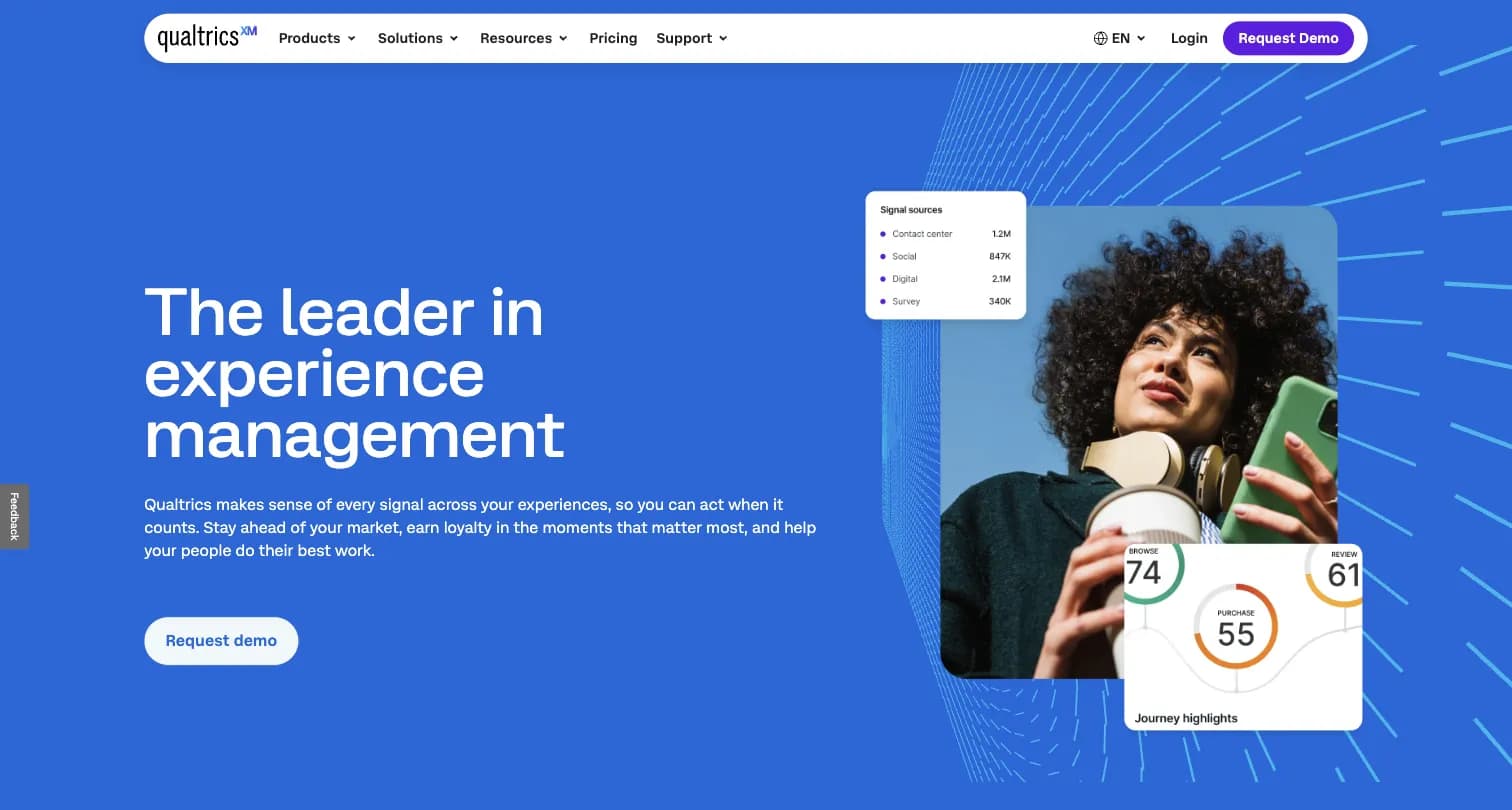
Captured August 15, 2026 from qualtrics.com.
Today Qualtrics isn't a single tool. It's an umbrella covering three distinct product lines: Customer Experience (CX), Employee Experience (EX), and Strategy & Research, each sold and priced separately. Understanding Qualtrics means understanding all three, since which one you evaluate changes both the feature set and the pricing conversation entirely.
Qualtrics Pros & Cons
| Pros | Cons |
|---|---|
| ✅ Friendly, knowledgeable customer support that follows up on inquiries | ❌ Steep learning curve paired with high costs |
| ✅ Intuitive interface for both simple and complex surveys, with customizable look and feel | ❌ Add-on features and packages consistently cost extra beyond the base quote |
| ✅ Wide variety of question and item types, including non-respondent reminders | ❌ Difficult to configure without prior experience |
| ✅ Powerful, AI-powered analytics that turn complex datasets into actionable insights | ❌ A reviewer reported an unexpected $5,000 charge to hire outside help extracting data the platform's own tools couldn't handle |
| ✅ Strong statistical depth for complex studies and large, multi-market sample sizes | ❌ Reported lag and performance issues on large-scale studies |
| ✅ Deep certification list (FedRAMP High, IL4, HITRUST, ISO 27001, ISO 42001, SOC 2 Type 2) | ❌ Pricing requires a sales call for 7 of 8 product tiers |
Source: G2, TrustRadius, and qualtrics.com/platform/security, captured August 15, 2026.
Qualtrics Review: How It Works & Key Features
Because Qualtrics splits into three separately-priced product lines, each one deserves its own look rather than a single rolled-up feature list.
Customer Experience (CX)
The CX line bundles four separately-branded products, all priced on an "Interactions" metric: CX Foundational (a first step to establish a CX program), Frontline Digital (for digital owners increasing conversion and CSAT), Frontline Care (for contact center leaders retaining and upselling customers), and Frontline Locations (for location-based industries like hospitals, restaurants, hotels, and retail).
Across these four products, the feature set includes surveys, website and mobile app feedback, digital experience analytics, contact center analytics, quality management and compliance, agent coaching, and an Online Reputation Management module. That last one lets teams connect Google Places, search the web for reviews across sites like Facebook and TripAdvisor, or add specific review sources, then build dashboards and automated workflows on top of the aggregated review data, including replying to reviews directly from inside Qualtrics.
Qualtrics also ships a Location Experience Hub for CX leaders managing feedback across many physical sites at once.
Employee Experience (EX)
The EX line has two products, both priced by employee count rather than Interactions: People Engage (for improving engagement, productivity, and lowering attrition costs) and People Lifecycle (for talent acquisition and people development, covering candidate and employee journeys).
Feature areas bundled in include employee engagement surveys, employee pulse surveys, employee research, onboarding and exit surveys, candidate experience management, 360-degree development assessments, employee retention analytics, and continuous employee listening.
Because EX pricing scales with headcount instead of survey volume, cost is tied to company size regardless of how much of the platform you actually use.
Strategy & Research
This is the product line with Qualtrics' one and only public price. Strategic Research (self-serve) costs $420/month, billed annually at $5,040/year, for 1,000 responses total shared across all users on the account, with unlimited users and surveys included.
For that price, Strategic Research includes 23 question types (including video and audio responses), 20+ pre-built guided research solutions (Video Diaries, Conjoint, MaxDiff, Concept Testing, Market Landscape Assessment), and Qualtrics' StatsIQ statistical suite: regression, clustering, pivot analysis, and R-integration. If you need more than 1,000 responses, a second Strategic Research tier exists with the identical feature list, but it's "available by quote only."
Rounding out this product line is Strategic Brand, aimed at marketing and brand leaders who want deeper, real-time insights, priced on interactions that include both brand-tracking responses and social mentions, again with no public number.
Security & Compliance
Across all three product lines, Qualtrics carries a genuinely deep certification list: ISO 27001 and ISO 42001 (AI governance), FedRAMP High and IL4 authorization, HITRUST certification, SOC 2 Type 2, plus sensitive-data and PII redaction controls, GDPR right-to-erasure tooling, SSO and MFA, and bring-your-own-key data isolation. If you want a vendor to carry the compliance boundary on your behalf, that list does the job. It's worth being clear about what it isn't, though: every one of those certifications covers Qualtrics' own cloud. Regulated buyers who need the data to stay inside infrastructure they already control get nothing from them, and for that group a self-hosted platform is the shorter procurement path, because there's no vendor environment to assess and no subprocessor list to clear in the first place.
Where Qualtrics Falls Short
Sales-gated pricing across the portfolio. Seven of the eight listed product tiers on Qualtrics' pricing page say the same two words: Request Pricing. There's no calculator or public rate card for the "Interactions" metric that prices most of the CX and Research lines, and Qualtrics' own FAQ confirms pricing "may differ based on industry security requirements and product availability," adding another variable buyers can't check themselves.
Costs that extend past the base quote. TrustRadius reviewers describe add-on features and packages as consistently costing extra, with an "upselling" feel. One G2 reviewer reported an unexpected $5,000 charge to hire outside help extracting and cleaning data the platform's own tools couldn't handle, on top of what they'd already paid for the license.
No path to self-hosting or data residency control. Qualtrics' own security documentation describes only centrally-hosted cloud infrastructure: data centers, SOC 2, and FedRAMP-authorized environments. No self-hosted or customer-premises deployment option appears anywhere in that documentation, at any budget or contract tier. This is an absence-of-evidence finding rather than an explicit vendor denial, but for regulated buyers who need on-prem or region-locked deployment, the practical result is the same: there's no path with Qualtrics regardless of budget.
A fragmented buying process. Because CX, EX, and Strategy & Research are three separately-priced product lines, a company that wants both customer feedback and employee feedback tooling has to run two (or three) separate sales processes, each with its own pricing metric and its own contract.
A history of ownership changes. Qualtrics was acquired by SAP for $8 billion in 2018, spun back out and IPO'd on Nasdaq in January 2021 at a $27.3 billion valuation, then taken private again by Silver Lake and CPP Investments in June 2023. Three ownership structures in five years is a real consideration for any buyer weighing long-term platform stability and pricing direction, independent of feature quality today.
What Reviewers Actually Say
Qualtrics holds a 4.4 rating across 4,291 reviews on G2's seller page (an aggregate across all Qualtrics product listings), a 4.7 rating across 426 reviews on Capterra's Strategy & Research listing specifically, and 7.7 out of 10 across 415 reviews on TrustRadius, also scoped to the Strategy & Research product.
Third-party SaaS benchmarking data cited by UXtweak (sourced from Vendr's marketplace data) reports a median annual Qualtrics spend of $28,533/year, ranging from $6,525 to $126,000/year. This is a third-party estimate, not a Qualtrics-published figure, so treat it as directional rather than a number Qualtrics has confirmed itself.
Recurring reviewer complaints, beyond pricing, center on performance and data handling. One reviewer on Featurebase's Qualtrics review (a competitor review site, captured August 15, 2026) described struggling to extract and clean survey data with Qualtrics' own tools, eventually paying a graduate student roughly $5,000 to do it manually, on top of the base license cost. G2 reviewers cited in that same piece describe the interface as "overwhelming for new users" and note that "performance can slow down when working with very large datasets or highly customized dashboards."
A note on Qualtrics' Trustpilot score. Featurebase's review also flags that Qualtrics carries an unusually low 1.1-star rating across 166 reviews on Trustpilot. It attributes this largely to a specific pattern: many businesses use Qualtrics to design surveys and then work with separate panel providers to recruit and pay respondents for taking those surveys, and complaints about not getting paid trace back to that respondent-facing side, not to the CX/EX/Research software itself. That distinction matters for anyone researching "Qualtrics reviews" and running into results that read more like a paid-survey complaint than a software review. It's also the reason search results for this exact keyword surface odd, adjacent questions like whether working for Qualtrics is legit, covered in the FAQ below.
A Different Approach: Formbricks as an Open Feedback and Experience Management Suite
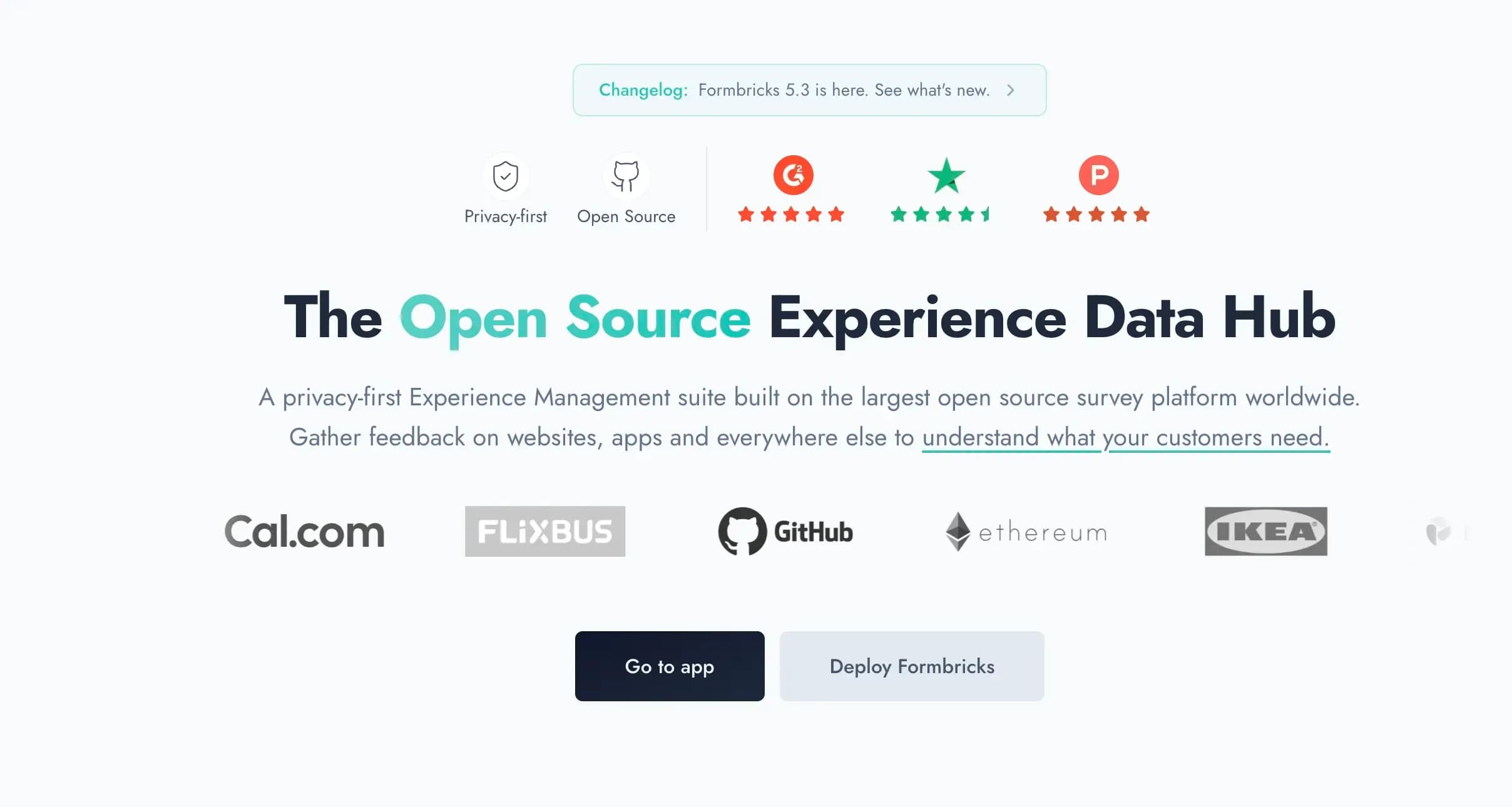
Captured August 15, 2026 from formbricks.com.
Formbricks isn't a single-purpose survey tool, and it isn't split across three separately-priced product lines either. It's an open source feedback and experience management suite built around three things: feedback management, feedback analytics, and workflows and integrations, unified on one platform and one price.
Feedback Management. Formbricks unifies every collection channel Qualtrics splits across CX, EX, and Research: website surveys that target specific visitors, in-app surveys that reach any user cohort inside your product, link surveys, and branded surveys embedded directly in email. One platform handles all of it, rather than routing customer feedback through CX and employee feedback through a separately-priced EX line.
Feedback Analytics. Response data flows into one place regardless of channel. Teams can follow an individual response's full trail or zoom out for the aggregate picture, track partial and dropped-off responses, and segment by custom attributes instead of broadcasting the same survey to everyone. This covers much of the same ground as Qualtrics' CX and EX dashboards, without the separate per-product-line pricing.
Workflows and Integrations. Formbricks Workflows automate what happens after a response comes in, routing and acting on feedback without manual handling. On the integration side, Formbricks connects to Salesforce, HubSpot, Slack, Google Sheets, and Notion through webhooks and an open API, the same API that's free on every tier, including the self-hosted Community Edition.
Formbricks Pricing, Verified Live
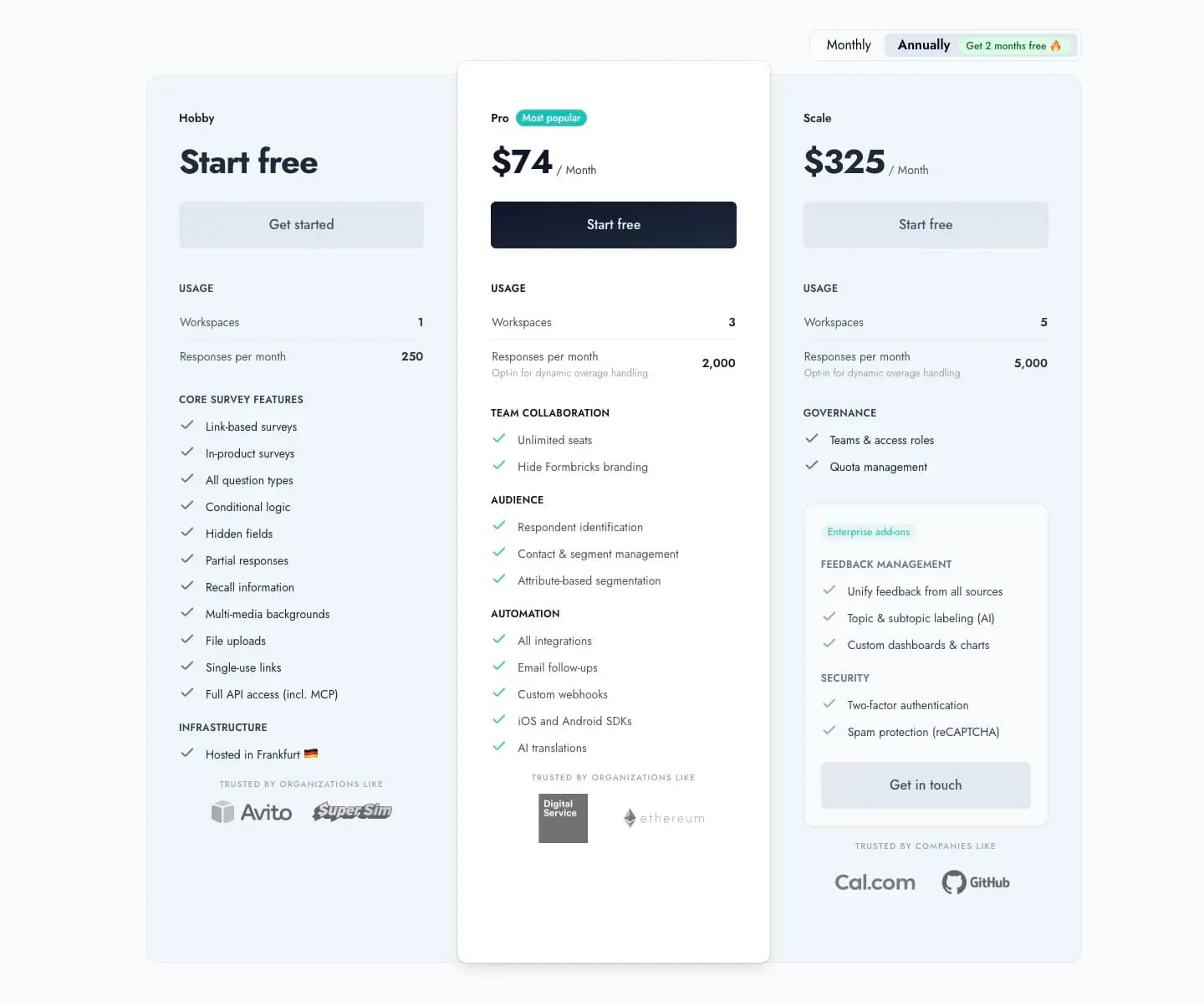
Captured August 16, 2026 from formbricks.com/pricing.
| Plan | Price | Usage |
|---|---|---|
| Hobby | Free forever | 1 workspace, 250 responses/month, full API access (incl. MCP), hosted in Frankfurt |
| Pro | $89/month billed monthly, or $74/month billed annually ($890/year total) | 3 workspaces, 2,000 responses/month, unlimited seats, attribute-based segmentation, all integrations |
| Scale | $390/month billed monthly, or $325/month billed annually ($3,900/year total) | 5 workspaces, 5,000 responses/month, teams & access roles, quota management |
Every tier above is published directly on formbricks.com/pricing as of August 16, 2026. The annual rate works out to roughly two months free compared to paying month to month, which is why the per-month figure shown for annual billing ($74 for Pro, $325 for Scale) is lower than the standalone monthly rate ($89 and $390 respectively), not a simple twelfth of the annual total.
Beyond Scale, Formbricks offers custom Enterprise pricing with a published contact path, rather than a mandatory sales gate before you see any number at all. A separate self-hosting pricing tab also exists on the same page alongside Formbricks Cloud; only the Cloud figures above were reconfirmed here, so check the self-hosting tab directly before quoting a specific self-hosted number.
Self-Hosting: The Path Qualtrics Doesn't Have
The free, self-hosted Community Edition, licensed under AGPLv3, is where Formbricks diverges most sharply from Qualtrics. Data never leaves your own infrastructure, there's no response cap, and even if you stop paying for Enterprise features, the Community Edition and your data remain fully accessible. For a regulated buyer who read the "No path to self-hosting" section above and recognized their own procurement blocker, this is the option Qualtrics doesn't offer at any price or contract tier.
Qualtrics vs Formbricks: Technical & Business Comparison
| Aspect | Qualtrics | Formbricks |
|---|---|---|
| Core Philosophy | Enterprise incumbent, deep research and analytics depth | Unified, transparently-priced feedback and experience suite |
| Product Structure | Three separately-priced lines: CX, EX, Strategy & Research | One platform covering feedback management, analytics, and workflows |
| Pricing Transparency | 1 of 8 tiers has a public price; the rest are Request Pricing | Every tier published, including monthly and annual rates |
| Free Tier | 1 user, 500 total responses, 8 question types | 250 responses/month, full API access, unlimited surveys |
| Data Control | Centrally-hosted cloud only, per its own security docs | Self-hosted Community Edition available under AGPLv3 |
| API Access | Not detailed as free across all tiers | Full API, free on every tier including self-hosted |
| Statistical Depth | StatsIQ (regression, clustering, R-integration), guided research methodologies | Not a published equivalent |
| Billing Flexibility | Annual contracts standard; monthly self-serve only on one tier | Monthly or annual billing on every published tier |
| Compliance Certifications | FedRAMP High, IL4, HITRUST, ISO 27001, ISO 42001, SOC 2 Type 2 | SOC 2 Type II, ISO 27001, GDPR and CCPA compliant cloud; self-hosting puts the full compliance boundary inside your own infrastructure |
| Vendor Stability | Three ownership changes since 2018 (SAP, Nasdaq IPO, Silver Lake/CPP) | Independent, open source, AGPLv3-licensed |
Feature Value Breakdown
Pricing Transparency
Qualtrics' Approach: One of eight product tiers has a public price. The other seven are priced on metrics like Interactions or employee count with no published rate card, requiring a sales conversation to get even a ballpark figure.
Formbricks' Approach: Every tier, Hobby through Scale, is priced and published on the site, with both monthly and annual billing shown directly.
Value Verdict: Formbricks wins clearly here. This is a straightforward comparison of what's published versus what isn't.
Data Residency and Self-Hosting
Qualtrics' Approach: Qualtrics' own security documentation describes centrally-hosted cloud infrastructure only. No self-hosted or customer-premises deployment option is mentioned anywhere on it.
Formbricks' Approach: A free, self-hosted Community Edition is available under AGPLv3, giving regulated buyers a path to keep data entirely on their own infrastructure.
Value Verdict: Formbricks wins for any buyer where self-hosting or strict data residency is a requirement, not a preference.
Feedback Management Breadth
Qualtrics' Approach: Customer Experience, Employee Experience, and Strategy & Research are three separately-branded, separately-priced product lines, each with its own products and quote process.
Formbricks' Approach: Website, in-app, link, and email feedback collection live on one platform under one pricing structure, with feedback analytics and Workflows built in.
Value Verdict: Formbricks wins on unification. Qualtrics' depth within each product line is real, but it comes at the cost of running separate buying processes for each one.
Advanced Statistical and Research Depth
Qualtrics' Approach: The Strategic Research tier includes StatsIQ (regression, clustering, R-integration) and 20+ guided academic-style research solutions, features built for trained researchers running rigorous studies.
Formbricks' Approach: Formbricks does not publish an equivalent statistical analysis suite.
Value Verdict: Qualtrics wins here clearly. If your team needs regression models, cluster analysis, or Van Westendorp-style pricing studies built into the platform itself, that's a real capability gap.
Who Should Actually Use Qualtrics
Qualtrics is worth the contract when research depth is the thing you're actually buying and you'd rather a vendor own the compliance boundary end to end. Outside that profile, you're paying enterprise research prices for survey collection.
For government and healthcare buyers specifically, the easiest procurement path is usually the one that removes the vendor from the data path entirely. Self-hosting Formbricks on your own servers, private cloud, AWS GovCloud, or Azure Government keeps citizen and employee responses inside infrastructure you already run, with SSO, MFA, audit logging, and no mandatory third-party processors for your security review to work through.
Consider a hypothetical: a mid-market SaaS company evaluating Qualtrics for a customer feedback program requests a quote for its CX product line and discovers the price is scoped entirely by "Interactions," a metric with no public rate card, tiers, or calculator, so the team can't ballpark next year's cost before committing to a sales call. This is illustrative rather than a named customer, but it reflects exactly the pricing-opacity pattern documented above.
It's a weaker fit if you need self-hosting or strict data residency control (not offered anywhere in Qualtrics' documented platform), you want transparent self-serve pricing beyond the single entry-level Strategic Research tier, you need one unified feedback platform instead of three separately-priced product lines, or you just need lightweight in-app or in-product feedback rather than a full academic-grade research suite.
Qualtrics Review FAQ
Final Verdict
👍 Qualtrics is the right call if your team runs genuinely advanced research: guided methodologies, StatsIQ regression and clustering, large-scale multi-market studies, and you have the budget and patience for a quote-based enterprise contract across whichever of its three product lines (CX, EX, Strategy & Research) fits your need. Reviewers consistently rate the platform highly for exactly this kind of depth, and its certification list is genuinely deep if you want a vendor to carry the compliance boundary for you.
👉 Formbricks is the better fit if transparent pricing matters, you want to see monthly and annual figures before ever talking to sales, and you'd rather run feedback management, feedback analytics, and workflows on one unified platform instead of three separately-priced product lines. Every tier is published, monthly and annual billing are both available, native integrations and Workflows come free on every plan, and the cloud runs SOC 2 Type II and ISO 27001 compliant with GDPR and CCPA covered. The AGPLv3-licensed Community Edition then gives you a self-hosted path Qualtrics simply doesn't offer, which is usually the fastest way through a government or healthcare procurement review: run it on your own servers, private cloud, AWS GovCloud, or Azure Government and there is no vendor data path and no subprocessor list to clear.
The honest read: these solve different problems for different buyers. If you need one public number to plan around instead of eight tiers spread across three product lines where seven say "Request Pricing," see Formbricks' current pricing here.
Try Formbricks now