

45+ Demographic Survey Questions with Inclusive Wording (2026 Guide)

Johannes
CEO & Co-Founder
9 Minutes
March 25th, 2026
Demographic questions are the most sensitive part of any survey. Most surveys get them wrong. They either ask too many, use outdated terminology, or place them at the very beginning where they tank completion rates before respondents reach a single core question.

When done right, demographics unlock segmented analysis that reveals patterns hidden inside averages. A 4.0 overall satisfaction score might actually be a 3.2 from one age group and a 4.8 from another. Without demographic data, you would never know.
But the way most surveys ask demographic questions actively works against this goal. Tourangeau and Yan (2007), in a review of sensitive survey questions published in Psychological Bulletin, found that poorly designed demographic questions decrease three things simultaneously: the number of participants willing to take the survey at all, response rates to individual items, and the accuracy of the answers that are given (Tourangeau & Yan, 2007).
This guide covers 45+ demographic survey questions across 10 categories, with inclusive wording, ethical guidelines, and practical tips for when to ask them and when to skip them entirely. You also get the 6 core demographic factors explained, a segmentation comparison table, common mistakes, analysis frameworks, and a free template.
The 6 Core Demographic Categories
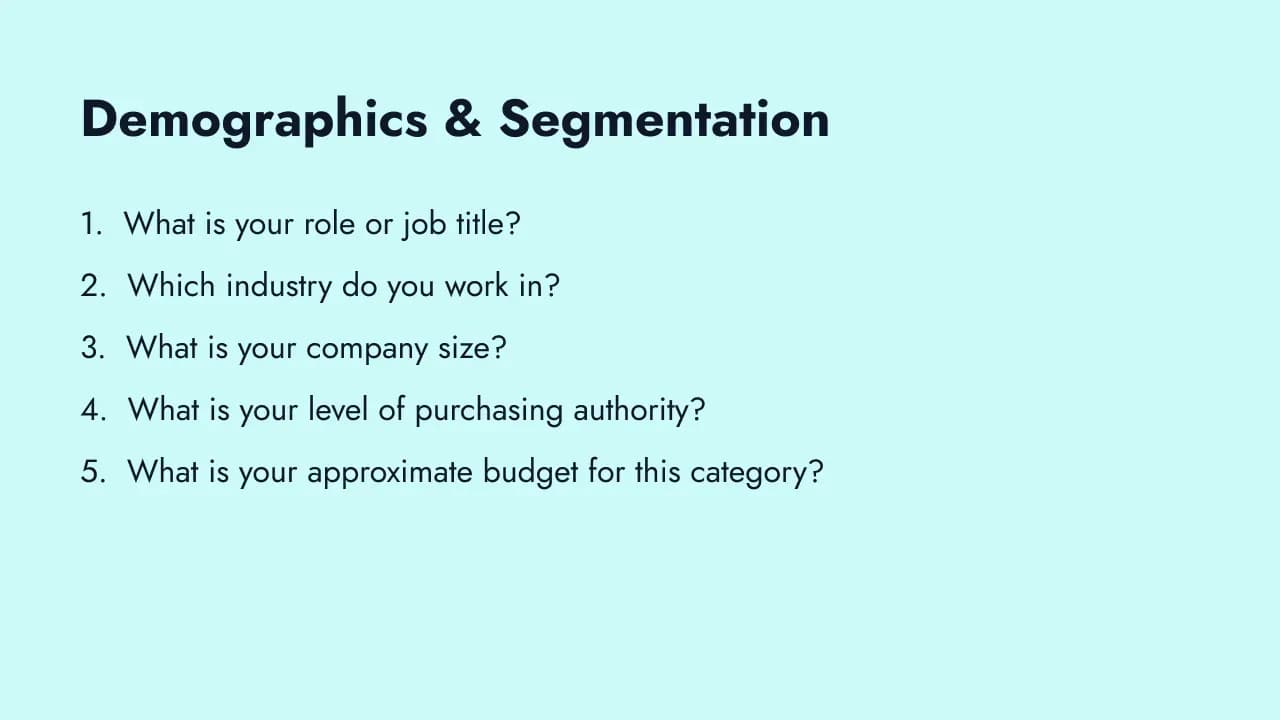
Demographics describe the measurable characteristics of a population. In survey research, six categories appear most consistently across market research, academic studies, and government data collection:
| Category | What It Captures | Common Survey Use |
|---|---|---|
| Age | Life stage, generational cohort | Spotting generational preference differences |
| Gender | Identity and representation | Identifying gender-based experience gaps |
| Income | Purchasing power, economic tier | Price sensitivity and product accessibility |
| Education | Knowledge level, socioeconomic background | Content complexity, trust signals |
| Location | Geographic distribution, urban/rural context | Regional availability, logistics |
| Race / Ethnicity | Cultural background, representation | Equity analysis, targeted outreach |
Researchers often extend this list to include employment status, household size, and disability status depending on the study. These six form a practical baseline for any survey that needs to describe its respondent population or run basic cross-tabulations.
Why Demographic Questions Matter (and When to Skip Them)
Demographic questions serve one purpose: enabling segmented analysis. They let you cross-tabulate your core survey data by audience characteristics so you can spot patterns that averages hide.
The need for accurate demographic data has never been greater. The U.S. Census Bureau's 2020 count found that 57.8% of Americans identify as non-Hispanic white only, down from 63.7% in 2010, a shift of nearly six percentage points in a single decade. Any survey-based research that treats "average American" as a monolith is, by definition, modeling a population that no longer exists. Demographic segmentation is not a methodological nicety. It is the minimum standard for data that reflects who your actual respondents are.
What demographics enable:
- Cross-tabulation. Compare NPS® by age group, satisfaction by income bracket, feature preference by job role. Segmented views surface insights that flat averages bury.
- Representativeness checks. If your respondent sample skews heavily toward one age group or region, your results may not reflect your full audience. Demographics let you measure and correct for that.
- Targeted action. Discovering that customers aged 18-24 rate onboarding 2.8/5 while those 35-44 rate it 4.5/5 tells you exactly where to focus improvement. A customer segmentation strategy depends on having this data.
When NOT to ask demographics:
- When you have no plan to analyze the data by segment
- When the demographic has no connection to your research question
- When you already have the data from another source (CRM, user profile, account settings)
- When the added questions would push your survey past the comfort threshold
The rule is simple: only ask demographic questions you will actually use. Every question without an analytical purpose is a question that increases dropout and collects dust.
Ethical Guidelines for Demographic Questions
Demographic questions touch on identity, income, and personal background. Handling them carelessly erodes trust and produces unreliable data. Follow these guidelines to collect demographics responsibly.
Always include "Prefer not to say." Every demographic question should have an opt-out. Forcing answers on sensitive topics like income or ethnicity pushes respondents to either abandon the survey or give inaccurate answers. Tourangeau and Yan (2007), reviewing sensitive question research in Psychological Bulletin, found that questions perceived as intrusive reliably reduce both response rates and accuracy, and the more sensitive the question and the earlier it appears, the worse the effect (Tourangeau & Yan, 2007). Optional questions with an opt-out produce more honest data overall.
Place demographics at the END of the survey. Starting with personal questions puts respondents on the defensive before they engage with your core content. There is also a documented psychological mechanism at work here: Steele and Aronson's landmark 1995 study in the Journal of Personality and Social Psychology showed that making identity categories salient before a performance task can activate stereotype threat, disrupting both motivation and accuracy. While survey-taking is not a performance test, the same dynamic applies: asking a respondent to state their race or income as the very first interaction frames the entire survey through an identity lens, which changes how people answer. Lead with your core questions, place demographics at the end, and your data will be more accurate and more complete. This alone can increase survey response rates.
Explain why you are asking. A short sentence of context goes a long way. Something like: "The following questions help us ensure our product serves all groups equally. All responses are anonymous." Transparency reduces suspicion and increases willingness to answer.
Use inclusive, current terminology. Language evolves. "Male/Female" as gender options is outdated. "Hispanic" without "Latino/a/x" misses people. Review your wording against current census guidelines and inclusive design standards at least once a year.
Consider anonymity. Anonymous surveys get more honest demographic answers, especially for income, ethnicity, and disability status. If your survey is not anonymous, respondents may select "Prefer not to say" more often or give aspirational rather than truthful answers.
GDPR and privacy compliance. Under GDPR, data like ethnicity, religion, health status, and political views qualifies as special category data. Collecting it requires explicit consent, a stated purpose, and secure storage. The enforcement record is significant: the European Data Protection Board's 2023 annual report documented total GDPR fines of nearly 2 billion euros across EU member states in 2023 alone (EDPB Annual Report 2023). Demographic data from surveys, particularly ethnicity, health, and political orientation, sits squarely in the categories that trigger the highest fines when mishandled. Use a GDPR-compliant survey tool and minimize what you collect. For teams handling sensitive demographic data, self-hosting with Formbricks keeps all data on your own infrastructure.
45+ Demographic Survey Questions by Category
Each question below includes answer options and a guidance note on inclusive wording, when to use it, and common mistakes to avoid.
Age and Generation (Questions 1-5)
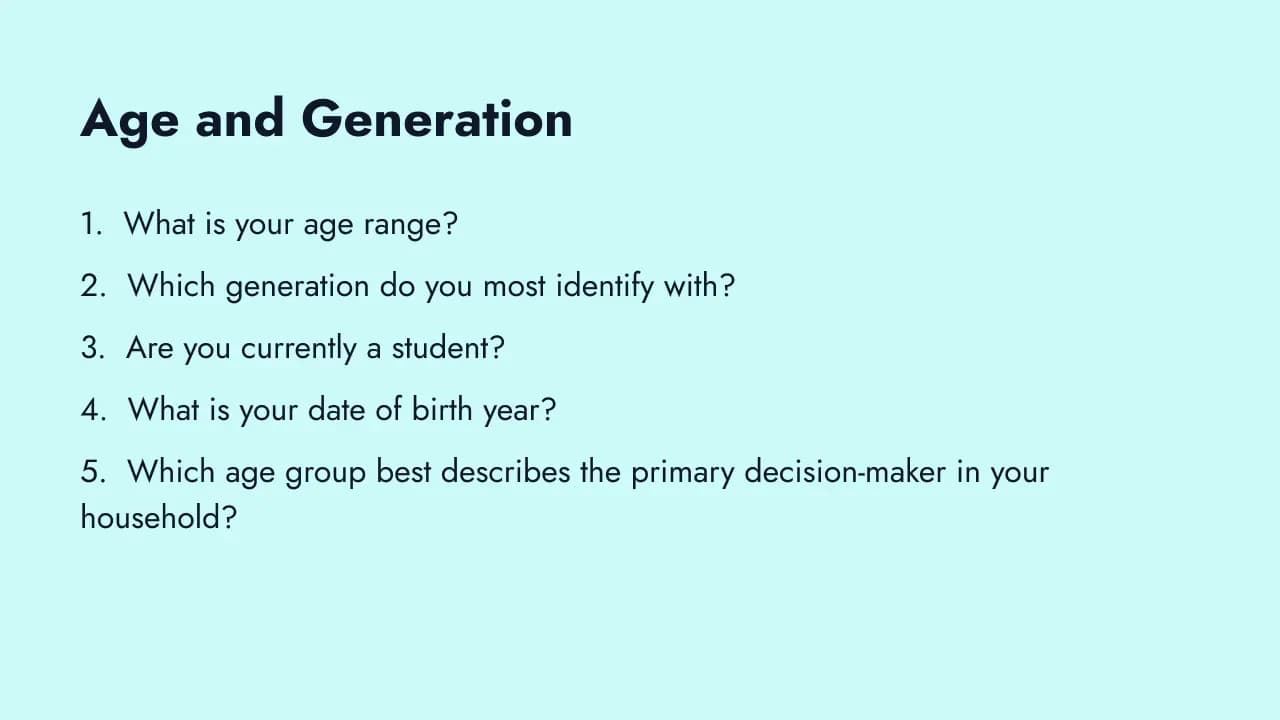
Age is one of the most commonly collected demographics. Use ranges instead of asking for exact age to reduce sensitivity and improve response rates.
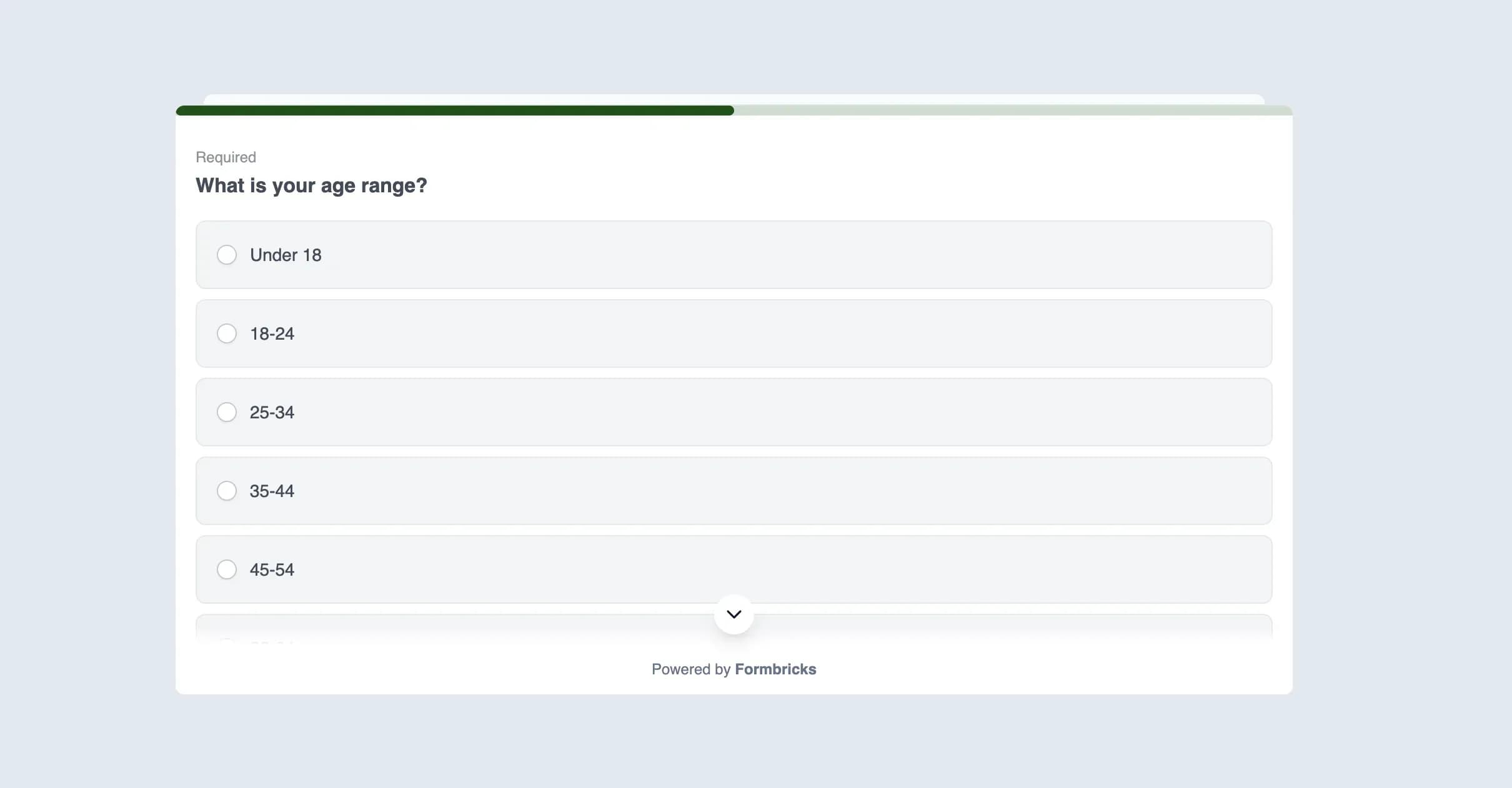
1. What is your age range?
- Under 18
- 18-24
- 25-34
- 35-44
- 45-54
- 55-64
- 65 or older
- Prefer not to say
Use non-overlapping ranges. A common mistake is writing "25-35" and "35-45" where 35-year-olds do not know which to pick. Each range should have a clear boundary.
2. Which generation do you most identify with?
- Gen Z (born 1997-2012)
- Millennial (born 1981-1996)
- Gen X (born 1965-1980)
- Baby Boomer (born 1946-1964)
- Silent Generation (born 1928-1945)
- Prefer not to say
Use this when generational identity matters more than exact age. Include birth year ranges so respondents do not have to guess which label applies to them.
3. Are you currently a student?
- Yes, full-time student
- Yes, part-time student
- No
- Prefer not to say
Useful for education-focused or B2C products. Skip this for B2B surveys where student status is rarely relevant to your analysis.
4. What is your date of birth year?
- [Dropdown: years from 1930 to 2010]
- Prefer not to say
Only use this when you need exact age for statistical analysis (academic research, actuarial studies). For market research, age ranges (Question 1) are less intrusive and produce higher response rates.
5. Which age group best describes the primary decision-maker in your household?
- 18-24
- 25-34
- 35-44
- 45-54
- 55-64
- 65 or older
- Prefer not to say
Use this for household-level surveys (retail, insurance, real estate) where the buyer may not be the respondent. Avoid this in individual-focused surveys where it adds confusion.
Gender and Identity (Questions 6-10)
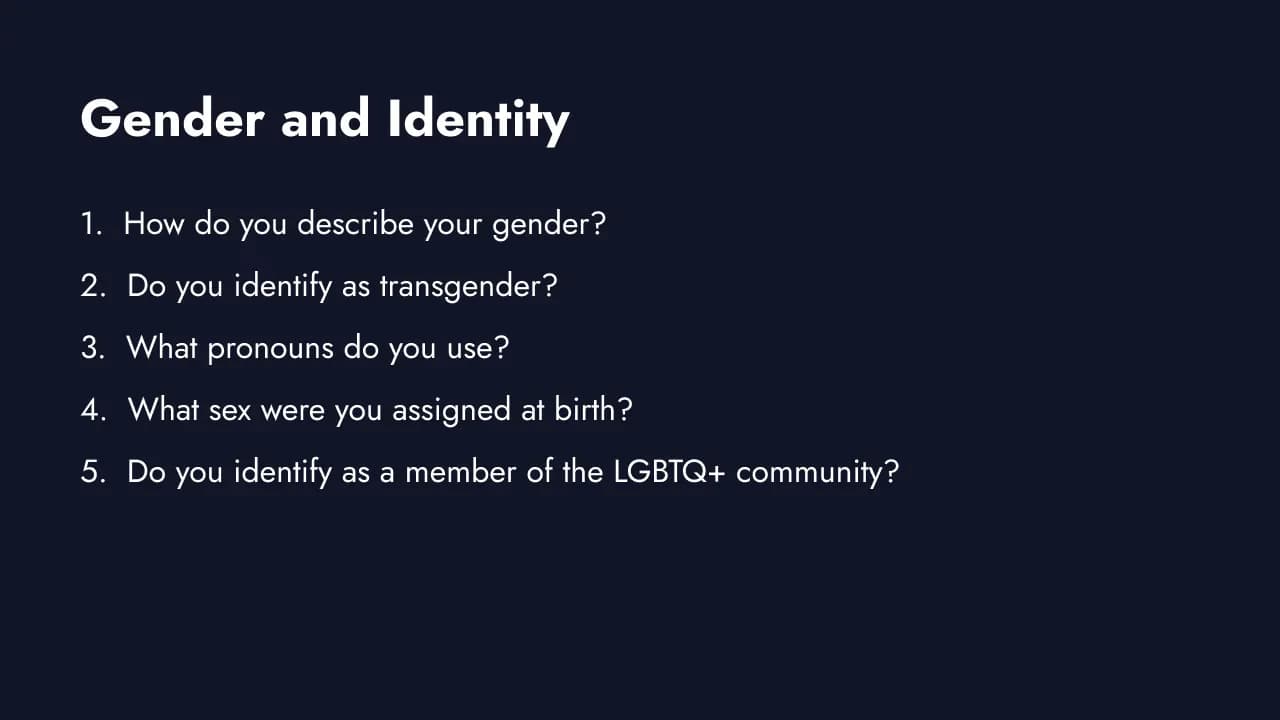
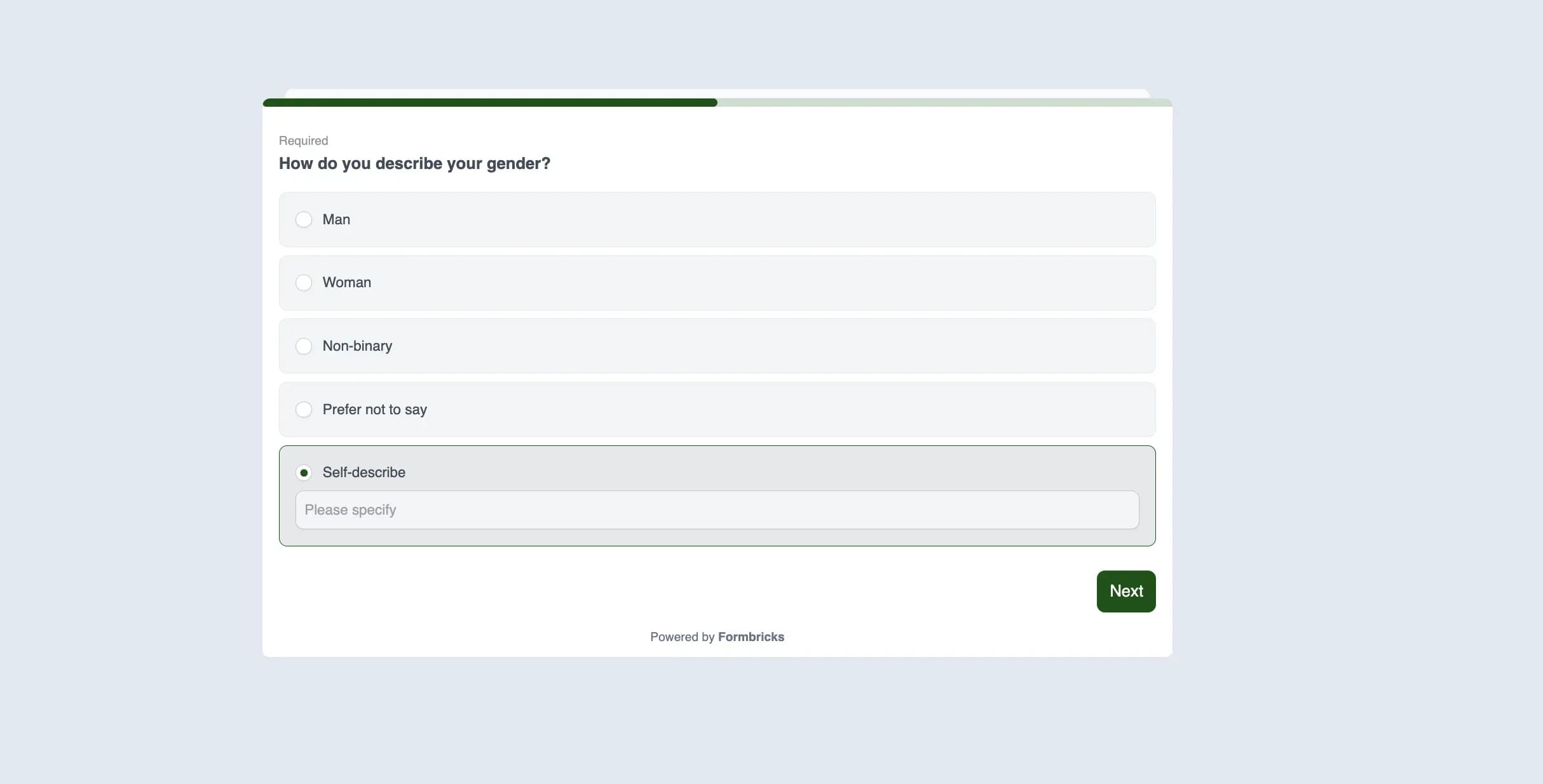
Gender questions require particular care. Separate gender identity from biological sex, use inclusive options, and never force an answer.
6. How do you describe your gender?
- Man
- Woman
- Non-binary
- Self-describe: ___________
- Prefer not to say
Use "Man" and "Woman" instead of "Male" and "Female." Male/Female are sex categories, not gender identities. Include "Self-describe" with a text field rather than "Other," which can feel dismissive.
7. Do you identify as transgender?
- Yes
- No
- Prefer not to say
Only ask this when transgender-specific analysis is relevant to your research. In most market research surveys, this question is unnecessary and may feel invasive.
8. What pronouns do you use?
- He/Him
- She/Her
- They/Them
- Other: ___________
- Prefer not to say
Relevant for personalized communications or research on inclusivity. Skip this if you will not use it to personalize follow-up or segment analysis.
9. What sex were you assigned at birth?
- Male
- Female
- Intersex
- Prefer not to say
This is a separate question from gender identity. Only ask when biological sex data is specifically required for your research (healthcare, clinical studies). Do not use this as a substitute for the gender question.
10. Do you identify as a member of the LGBTQ+ community?
- Yes
- No
- Prefer not to say
Use this when understanding LGBTQ+ representation is relevant to your research. Keep it simple and do not ask for specifics unless your study design requires it. Always include an opt-out.
Race, Ethnicity, and Cultural Background (Questions 11-15)
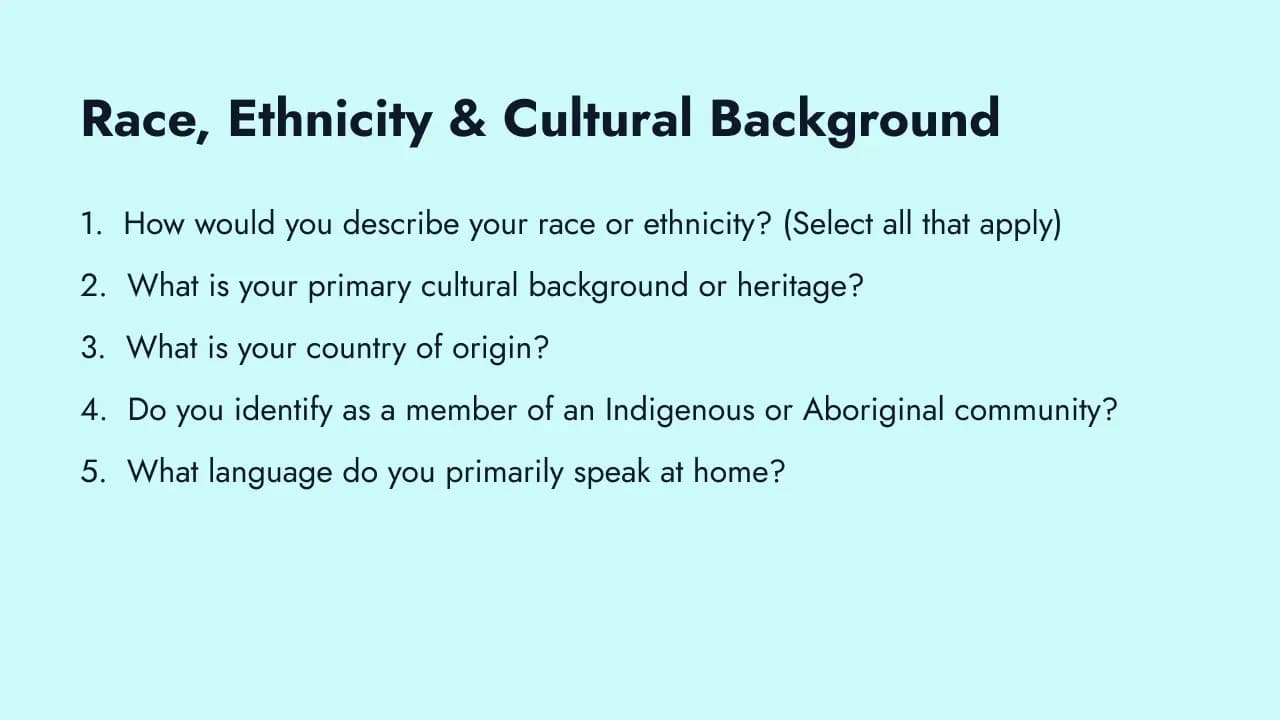
Race and ethnicity questions are among the most sensitive. Use census-aligned categories, allow multiple selections, and always make the question optional.
A brief historical note matters here: the U.S. Census did not allow respondents to select more than one racial category until 2000. Before that, multiracial individuals were forced to choose a single box, which produced systematically inaccurate population data for decades. Subsequent Census Bureau focus groups (2013) also found widespread confusion between race and ethnicity, with many respondents uncertain how to distinguish between "Hispanic" (an ethnicity) and categories like "White" or "Black" (racial categories). Your survey should address this confusion directly by using clear labels and allowing multiple selections.
11. How would you describe your race or ethnicity? (Select all that apply)
- American Indian or Alaska Native
- Asian
- Black or African American
- Hispanic, Latino, or Spanish origin
- Middle Eastern or North African
- Native Hawaiian or Pacific Islander
- White
- Two or more races/ethnicities
- A race/ethnicity not listed: ___________
- Prefer not to say
Allow multiple selections. Many people identify with more than one category. Align options with U.S. Census categories or the equivalent national standard for your audience. Include a write-in option for identities not covered.
12. What is your primary cultural background or heritage?
- [Open-ended text field]
- Prefer not to say
Use this when you need more nuance than broad racial categories provide. Open-ended responses capture specifics like "Korean-American" or "Afro-Caribbean" that checkbox lists miss.
13. What is your country of origin?
- [Dropdown: list of countries]
- Prefer not to say
Use when your audience is international and national origin matters for segmentation. A dropdown keeps the interface clean for long lists. Avoid this when the question could be perceived as gatekeeping.
14. Do you identify as a member of an Indigenous or Aboriginal community?
- Yes
- No
- Prefer not to say
Relevant for surveys in countries with significant Indigenous populations (Canada, Australia, New Zealand, U.S.). Phrasing varies by country. Use the terminology recognized by the local Indigenous communities.
15. What language do you primarily speak at home?
- English
- Spanish
- Mandarin
- Hindi
- Arabic
- French
- Other: ___________
- Prefer not to say
Useful for understanding language accessibility needs. Customize the list based on your audience geography. This can also serve as a proxy for cultural background when direct ethnicity questions are not appropriate.
Education (Questions 16-19)
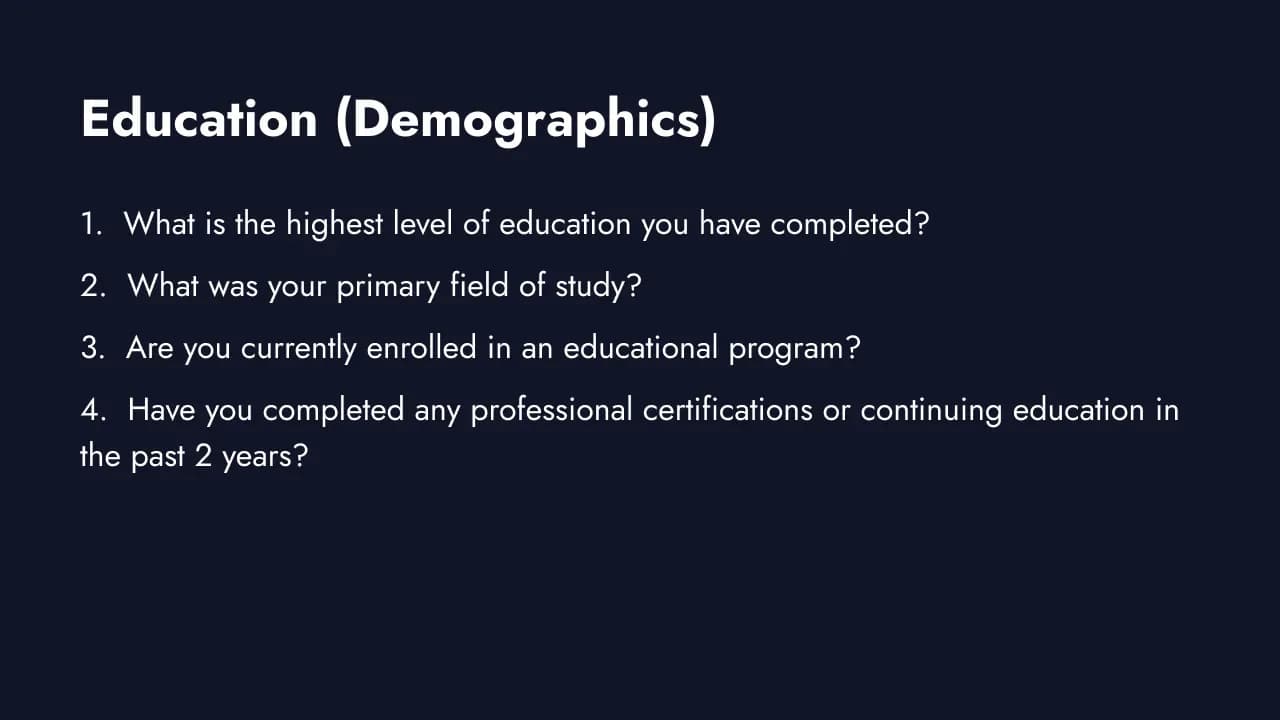
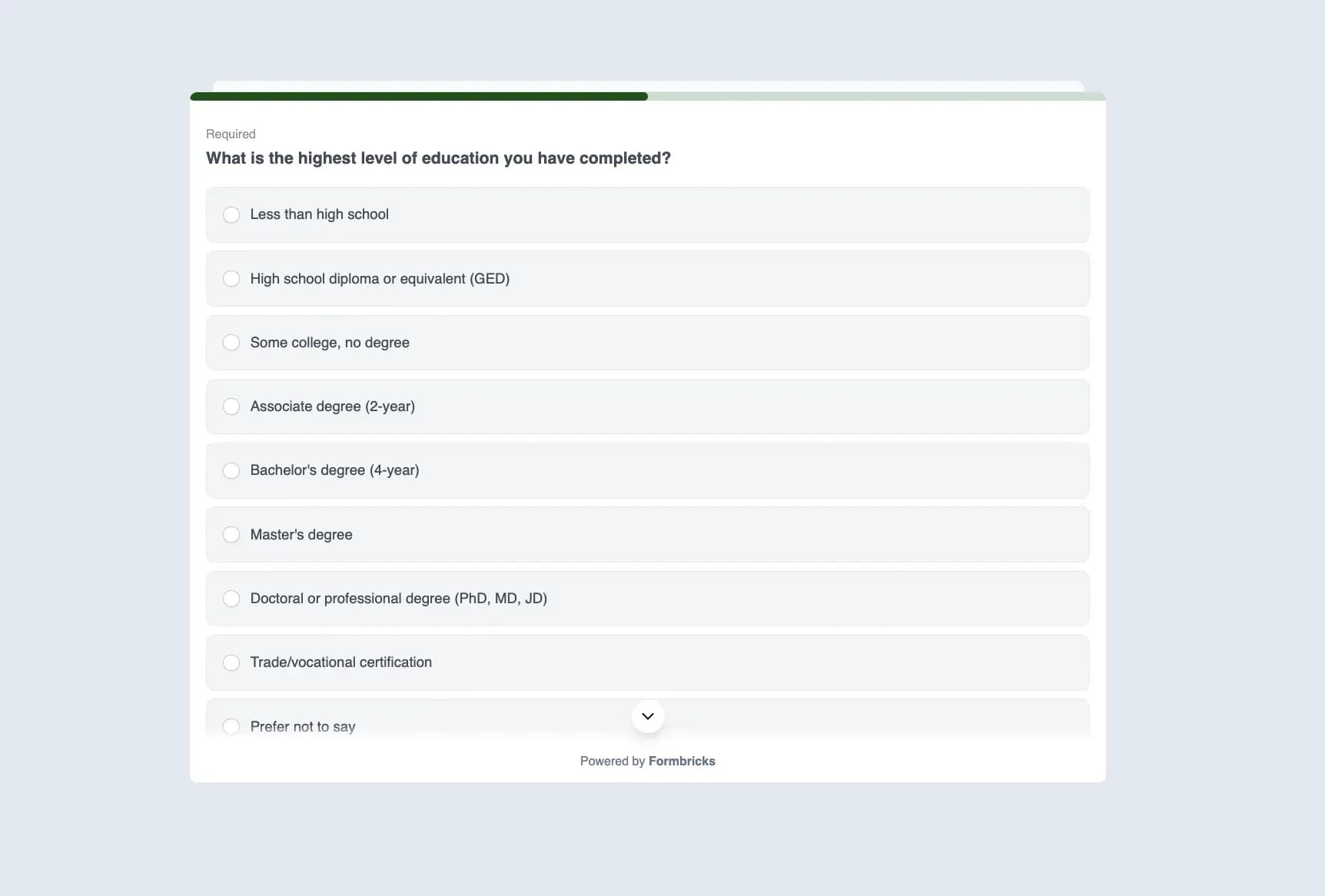
Education questions help segment respondents by knowledge level and socioeconomic background. Focus on completed levels rather than specific institutions.
16. What is the highest level of education you have completed?
- Less than high school
- High school diploma or equivalent (GED)
- Some college, no degree
- Associate degree (2-year)
- Bachelor's degree (4-year)
- Master's degree
- Doctoral or professional degree (PhD, MD, JD)
- Trade/vocational certification
- Prefer not to say
Include trade and vocational certifications. Leaving them out signals that only academic paths count. A common mistake is forgetting "Some college, no degree," which is one of the largest demographic groups in the U.S.
17. What was your primary field of study?
- Arts and Humanities
- Business and Management
- Education
- Engineering and Technology
- Health and Medicine
- Law
- Natural Sciences
- Social Sciences
- Trades and Vocational
- Other: ___________
- Not applicable
- Prefer not to say
Use when field of study is relevant to your product or research (e.g., professional tools, content platforms). Skip for general consumer surveys where it adds length without analytical value.
18. Are you currently enrolled in an educational program?
- Yes, full-time
- Yes, part-time
- No, but planning to enroll within 12 months
- No
- Prefer not to say
Relevant for education technology, financial services, or workforce development surveys. The "planning to enroll" option captures a useful intent signal.
19. Have you completed any professional certifications or continuing education in the past 2 years?
- Yes
- No
- Prefer not to say
Use for professional development or B2B surveys where ongoing education signals engagement level. Avoid making this a multi-select list of specific certifications unless you need that detail.
Income and Employment (Questions 20-26)
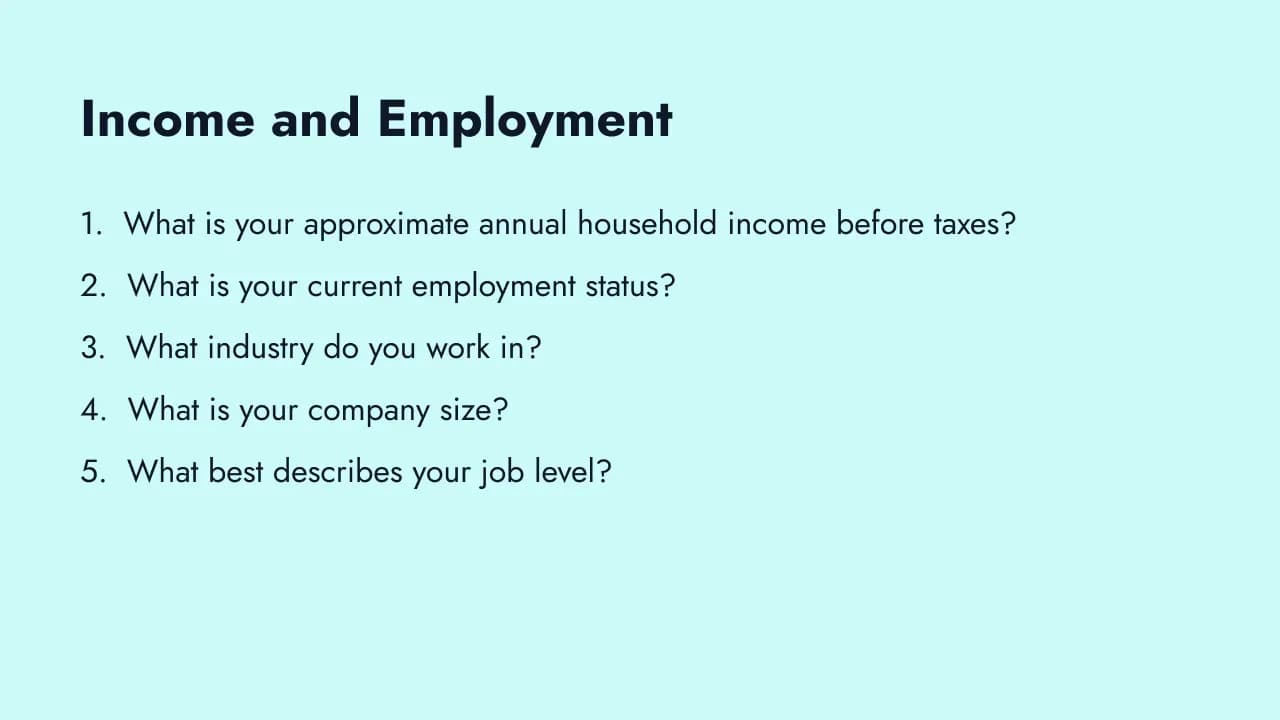
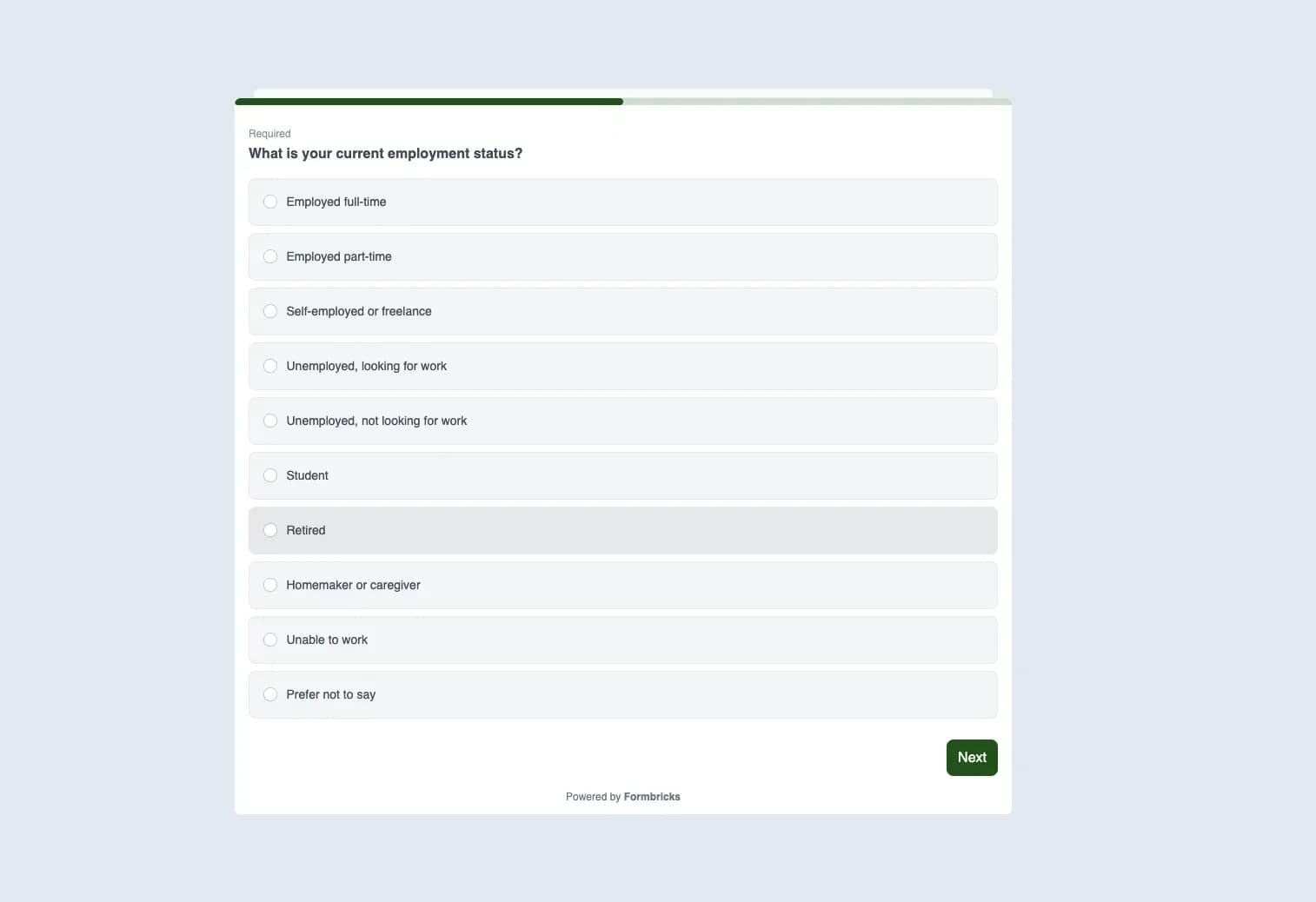
Income and employment questions are the most likely to cause survey abandonment. Use broad ranges for income and always make the question optional.
20. What is your approximate annual household income before taxes?
- Under $25,000
- $25,000 - $49,999
- $50,000 - $74,999
- $75,000 - $99,999
- $100,000 - $149,999
- $150,000 - $199,999
- $200,000 or more
- Prefer not to say
Ask about household income rather than personal income unless individual earnings are specifically relevant. Use broad ranges to reduce discomfort. A common mistake is using overlapping ranges like "$50,000-$75,000" and "$75,000-$100,000."
21. What is your current employment status?
- Employed full-time
- Employed part-time
- Self-employed or freelance
- Unemployed, looking for work
- Unemployed, not looking for work
- Student
- Retired
- Homemaker or caregiver
- Unable to work
- Prefer not to say
Include "Homemaker or caregiver" and "Unable to work" as distinct options. Lumping them under "Unemployed" is both inaccurate and dismissive of unpaid labor and disability.
22. What industry do you work in?
- Agriculture and Farming
- Construction and Real Estate
- Education
- Finance and Insurance
- Government and Public Administration
- Healthcare and Pharmaceuticals
- Hospitality and Food Service
- Information Technology and Software
- Manufacturing
- Marketing, Media, and Advertising
- Nonprofit and Social Services
- Professional Services (Legal, Consulting, Accounting)
- Retail and E-commerce
- Transportation and Logistics
- Other: ___________
- Not currently working
- Prefer not to say
Customize this list for your audience. A SaaS company might expand IT subcategories while condensing others. Always include "Other" with a text field for industries you did not anticipate.
23. What is your company size?
- 1 (Solo/Freelance)
- 2-10
- 11-50
- 51-200
- 201-1,000
- 1,001-5,000
- 5,001-10,000
- 10,000+
- Prefer not to say
Critical for B2B segmentation. Product needs, budgets, and decision processes differ dramatically between a 5-person startup and a 10,000-person enterprise. Skip for B2C surveys.
24. What best describes your job level?
- Individual contributor
- Team lead or supervisor
- Manager
- Senior manager or director
- Vice president
- C-suite executive (CEO, CTO, CFO, etc.)
- Business owner
- Prefer not to say
Use when decision-making authority matters to your analysis. Pair with company size (Question 23) to distinguish a "Manager" at a 5-person company from one at a 5,000-person company.
25. What department do you work in?
- Customer Service/Support
- Engineering/Development
- Finance/Accounting
- Human Resources
- Marketing
- Operations
- Product
- Sales
- Design
- Legal
- Executive/Leadership
- Other: ___________
- Prefer not to say
Useful for B2B product surveys and voice of customer programs where different departments have different needs and pain points.
26. How long have you been in your current role?
- Less than 6 months
- 6 months to 1 year
- 1-3 years
- 3-5 years
- 5-10 years
- 10+ years
- Prefer not to say
Tenure in role can correlate with expertise level and satisfaction. Newer employees may have different needs than veterans. Cross-tabulate with satisfaction to see if tenure changes perception.
Location and Geography (Questions 27-30)
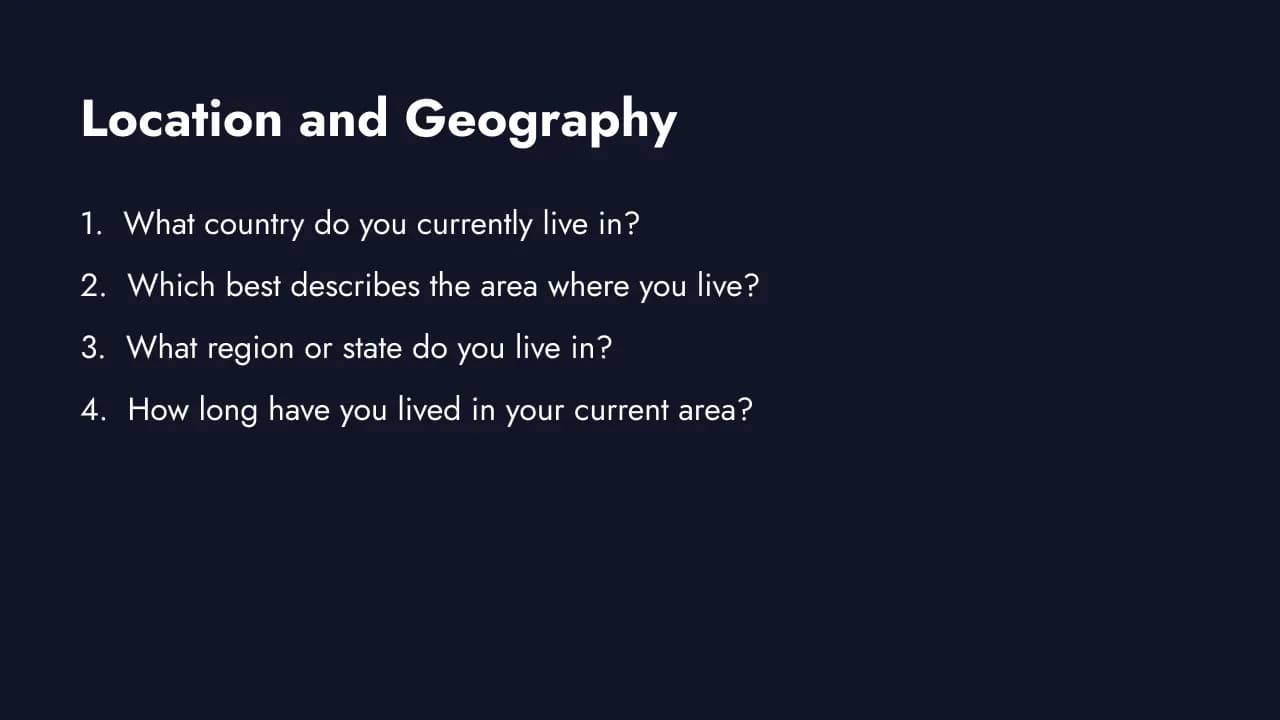
Location data enables regional analysis and helps assess geographic representativeness of your sample.
27. What country do you currently live in?
- [Dropdown: list of countries]
- Prefer not to say
Use a searchable dropdown for international audiences. For domestic-only surveys, replace with state/province. List countries alphabetically or put your most common audience countries at the top.
28. Which best describes the area where you live?
- Urban (city center or metro area)
- Suburban (outside city center but within metro area)
- Rural (small town or countryside)
- Prefer not to say
Urban, suburban, and rural respondents often have different needs, access levels, and price sensitivities. This three-option split is standard and easy to analyze. Avoid more granular options that create small subgroups.
29. What region or state do you live in?
- [Dropdown or open-ended, based on geography]
- Prefer not to say
Customize for your audience. U.S. surveys can use a state dropdown. Global surveys might use continent or region (Northern Europe, Southeast Asia, etc.). Avoid asking for city unless location-specific analysis is planned.
30. How long have you lived in your current area?
- Less than 1 year
- 1-5 years
- 5-10 years
- 10-20 years
- More than 20 years
- Prefer not to say
Relevant for real estate, local services, or community-focused surveys. Longtime residents and recent arrivals often have different perspectives and needs. Skip for most product or SaaS surveys.
Household and Family (Questions 31-35)
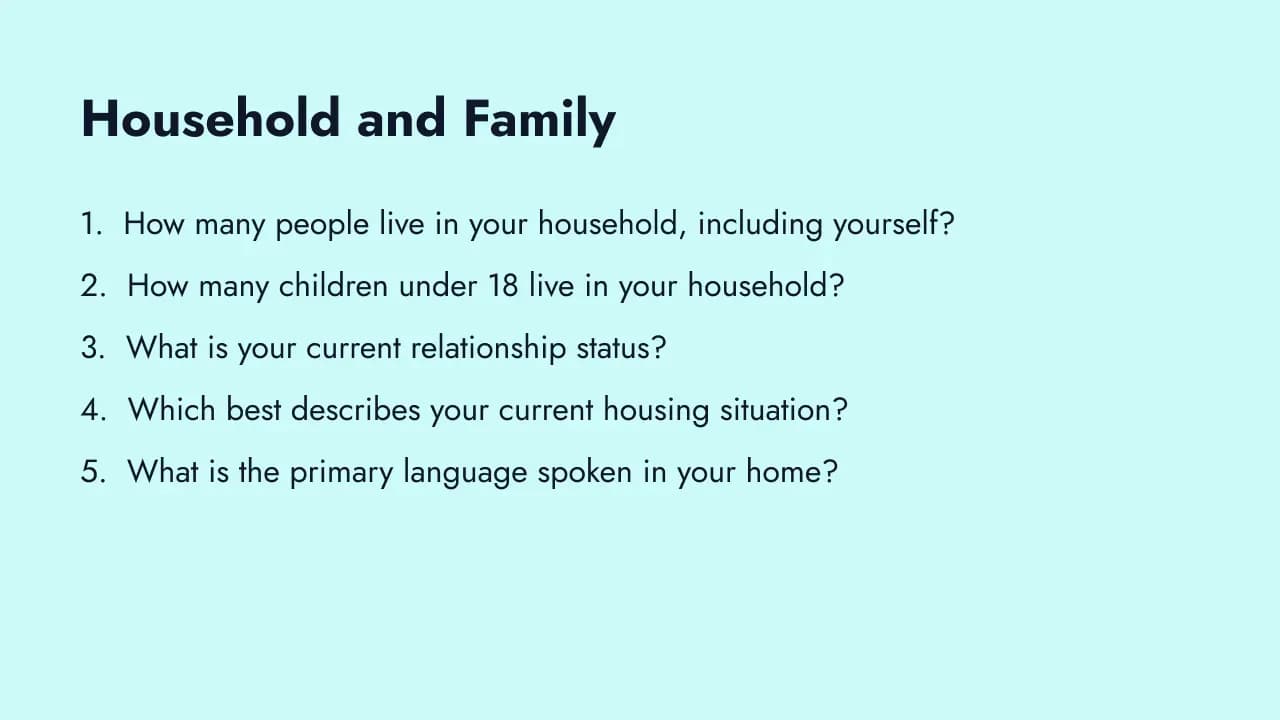
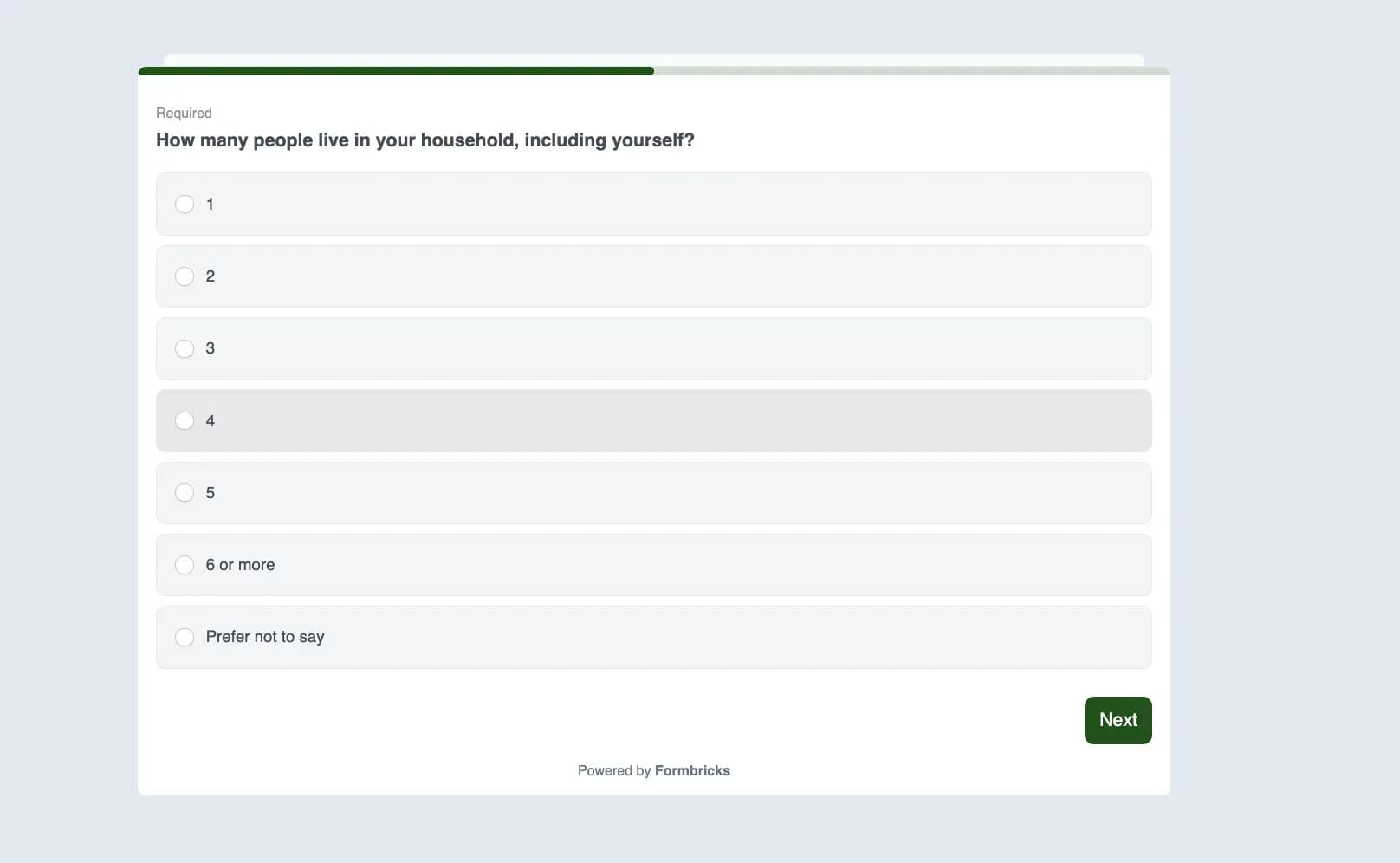
Household data is valuable for consumer products, financial services, and healthcare surveys. Respect the diversity of modern household structures.
31. How many people live in your household, including yourself?
- 1
- 2
- 3
- 4
- 5
- 6 or more
- Prefer not to say
Straightforward and low-sensitivity. Useful for products and services where household size affects usage patterns, pricing tiers, or buying decisions.
32. How many children under 18 live in your household?
- 0
- 1
- 2
- 3
- 4 or more
- Prefer not to say
Critical for family-oriented products, education services, and financial planning tools. Distinguish between "no children" and "children who do not live at home" if that distinction matters for your analysis.
33. What is your current relationship status?
- Single, never married
- In a relationship or domestic partnership
- Married or civil union
- Separated
- Divorced
- Widowed
- Prefer not to say
Use "Married or civil union" to include same-sex marriages. "In a relationship or domestic partnership" captures committed partnerships without legal status. Avoid "Single" as the only non-married option since it erases cohabiting and separated respondents.
34. Which best describes your current housing situation?
- Own my home
- Rent my home
- Live with family or friends (not paying rent)
- Student housing
- Other
- Prefer not to say
Relevant for financial services, real estate, insurance, and home-related products. Housing status correlates with disposable income and purchasing patterns.
35. What is the primary language spoken in your home?
- English
- Spanish
- Mandarin
- Hindi
- Arabic
- French
- Portuguese
- Other: ___________
- Prefer not to say
Customize the list for your geographic audience. Useful for accessibility planning, content localization, and understanding whether language barriers affect product experience.
Technology and Digital Access (Questions 36-38)
Digital access questions are increasingly important for product teams, UX researchers, and anyone distributing digital surveys or products.
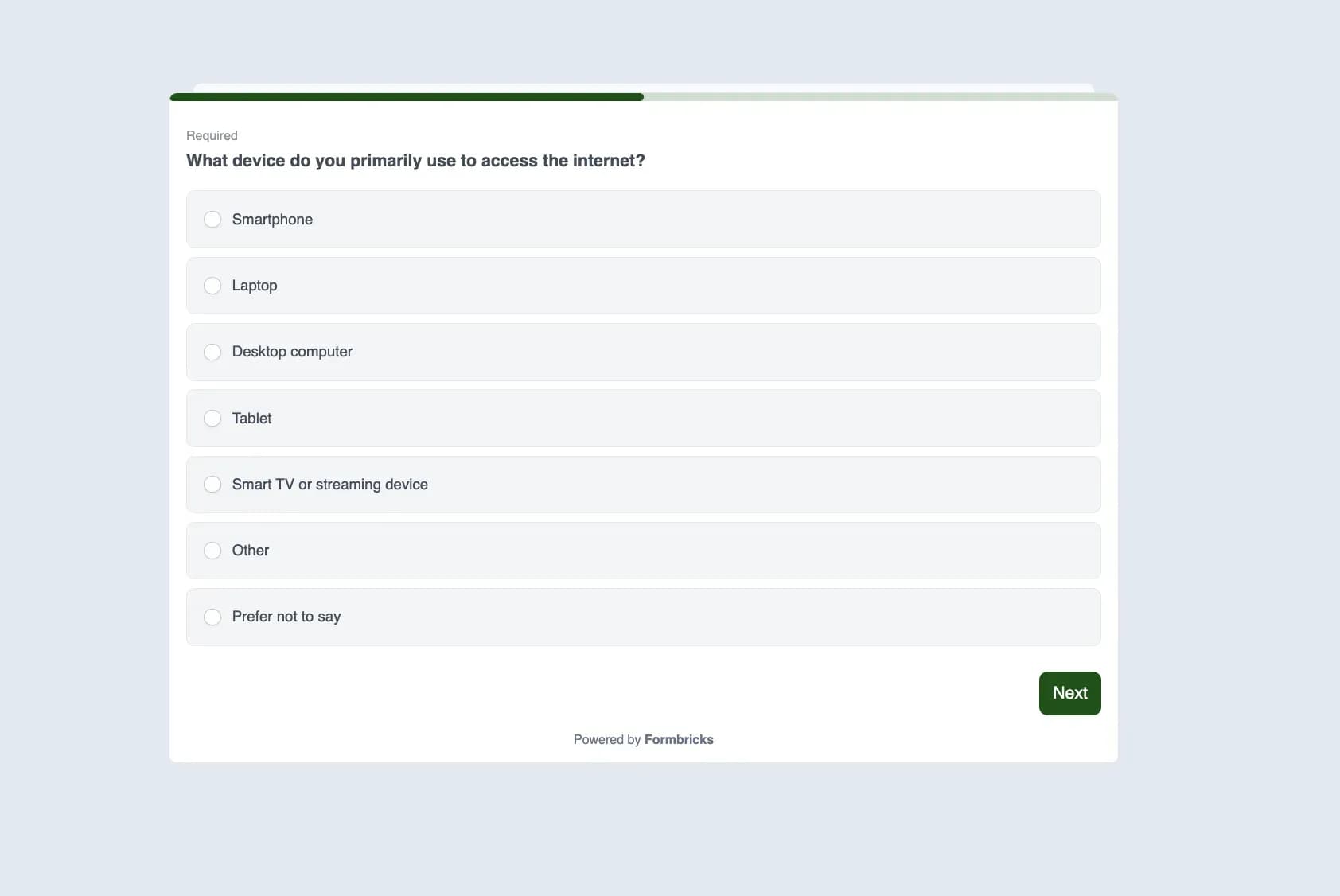
36. What device do you primarily use to access the internet?
- Smartphone
- Laptop
- Desktop computer
- Tablet
- Smart TV or streaming device
- Other: ___________
- Prefer not to say
Critical for UX research and product development. If 70% of your users are on smartphones but your product is optimized for desktop, you have a problem. Cross-tabulate with satisfaction for device-specific insights.
37. How would you rate your internet access at home?
- Reliable, high-speed connection
- Adequate for most tasks
- Unreliable or slow
- I primarily rely on mobile data
- Limited or no internet access at home
- Prefer not to say
Relevant for SaaS products, streaming services, and remote work tools. Users with slow connections have fundamentally different experiences. This question helps you understand if performance complaints are product issues or connectivity issues.
38. How comfortable are you using technology in your daily life?
- Very comfortable: I adopt new tools quickly
- Comfortable: I use technology regularly without issues
- Somewhat comfortable: I manage but need help sometimes
- Not very comfortable: I struggle with new technology
- Prefer not to say
Useful for products targeting broad demographics. Tech comfort level correlates with onboarding needs, support requirements, and feature adoption. Avoid labeling options with judgmental terms like "beginner" or "advanced."
Disability and Accessibility (Questions 39-42)
Disability questions are among the most underused demographics in market research. The CDC's Disability and Health Data System (2024) estimates that 28.7% of U.S. adults, roughly 1 in 4, live with at least one disability, spanning mobility, cognition, independent living, hearing, vision, and self-care limitations. A product team that has never collected disability data is, statistically, ignoring the experience of about one in four of their users. Public health researchers recommend framing these questions around functional impact rather than diagnosis labels, which reduces stigma and captures a broader range of lived experiences.
39. Do you have any physical, mental, or cognitive conditions that substantially affect your daily activities?
- Yes
- No
- Prefer not to say
This broad framing captures a wider range of disabilities than diagnosis-specific lists. Avoid asking respondents to name specific conditions, which feels medical and intrusive in most survey contexts.
40. Do you use any assistive technologies in your daily life?
- Screen reader or magnification software
- Hearing aid or cochlear implant
- Wheelchair or mobility device
- Alternative input device (voice control, eye tracking, switch access)
- None
- Prefer not to say
Critical for UX research and digital product teams. If a meaningful share of your users rely on assistive technology, your product needs to be tested against those tools. This question surfaces that need before a support ticket does.
41. Does your work or daily life require any accessibility accommodations?
- Yes
- No
- Not sure
- Prefer not to say
Use when designing services, events, communications, or physical spaces. A "Not sure" option acknowledges that some people do not frame their situation in accommodation terms but still benefit from accessible design.
42. Do you regularly provide care for someone with a disability, chronic illness, or age-related condition?
- Yes, I am a primary caregiver
- Yes, I provide some care
- No
- Prefer not to say
Caregiver status is a distinct and often overlooked demographic. Caregivers have constrained time, elevated stress, and different purchasing patterns. They are significantly more likely to seek flexible services, remote solutions, and time-saving tools.
Military and Civic Background (Questions 43-45)
Military service and civic engagement questions are standard in government surveys and increasingly relevant for brands, employers, and nonprofits targeting specific communities. According to the U.S. Census Bureau's 2020 American Community Survey, approximately 17.4 million civilians in the United States are veterans, representing around 7% of the adult civilian population. The Census collects veteran status in every ACS cycle because it correlates with healthcare access, employment patterns, disability prevalence, and federal benefit eligibility. If your product or service overlaps with any of those domains, this question belongs in your survey.
43. Have you served in the military, armed forces, reserves, or National Guard?
- Yes, currently serving
- Yes, I am a veteran (no longer serving)
- No
- Prefer not to say
Veteran status is a low-sensitivity question for most respondents and surfaces a community with distinct needs, purchase behaviors, and organizational affiliations. Use it whenever your product or research touches the military or veteran community.
44. What is your voter registration status?
- Registered to vote
- Not registered to vote
- Not eligible to vote
- Prefer not to say
Relevant for civic engagement research, nonprofit surveys, and policy studies. This is a behavioral civic question, not a political preference question, and carries low sensitivity for most respondents.
45. Which best describes your political orientation?
- Very liberal / progressive
- Somewhat liberal
- Moderate / center
- Somewhat conservative
- Very conservative / traditional
- None of the above
- Prefer not to say
Use only when political orientation is directly relevant to your research (media, policy, public affairs). Frame it as orientation rather than party affiliation to capture nuance the party question misses. Always make this question optional, and consider adding a brief note explaining why you are asking.
How Demographics Fit Into the Four Segmentation Types
Many researchers use "demographic data" and "audience data" interchangeably, but demographic questions are just one of four segmentation frameworks. Understanding where they fit helps you decide what else to collect alongside them.
| Type | What It Measures | Example Survey Questions | Best For |
|---|---|---|---|
| Demographic | Who people are (age, gender, income, education, location) | "What is your age range?" "What industry do you work in?" | Describing your audience, equity analysis, representativeness checks |
| Psychographic | How people think (values, lifestyle, personality) | "What matters most when making a purchase?" "How do you prefer to spend free time?" | Brand positioning, messaging strategy, content personalization |
| Geographic | Where people are (country, region, urban/rural density) | "Which best describes where you live?" "What region are you in?" | Localization, regional rollout, logistics planning |
| Behavioral | What people do (usage patterns, purchase frequency, loyalty) | "How often do you use this product?" "When did you last make a purchase?" | Retention analysis, churn prediction, usage-based segmentation |
Demographic data is the most commonly collected because it is stable and easy to ask. The most powerful analyses combine demographic data with at least one psychographic or behavioral dimension, which reveals not just who your respondents are but how their background shapes what they do and believe. For a deeper look at turning this data into strategy, see our guide to customer segmentation.
Common Demographic Survey Mistakes
These mistakes are common, preventable, and silently degrade your data quality.
Mistake 1: Using outdated terminology
"Male/Female" for gender, "Oriental" for Asian, "Handicapped" instead of "Person with a disability." Language evolves, and outdated terms signal that you are not paying attention. Review your demographic questions against current inclusive design standards at least annually.
Mistake 2: Forcing answers without "Prefer not to say"
Making income, ethnicity, or gender mandatory creates a lose-lose situation. Respondents who feel forced either abandon the survey or select a random answer. Both outcomes hurt your data. Every sensitive question needs an opt-out.
Mistake 3: Asking too many demographic questions
If your survey has 10 core questions and 12 demographic questions, something is wrong. Most analyses need 3-5 demographic variables. Each additional question increases the chance someone drops off before finishing. Galesic and Bosnjak (2009), in research published in Public Opinion Quarterly, found that as survey length increases, respondents become progressively more likely to satisfice, selecting answers quickly and carelessly rather than thoughtfully, meaning a longer survey does not just have lower completion rates; it also has lower data quality among respondents who do finish. Ask yourself: "Will I actually build a cross-tab with this variable?" If not, cut it.
Mistake 4: Putting demographics first
Opening a survey with "What is your income?" or "What is your ethnicity?" creates instant friction. Respondents have not built any trust or momentum yet. Place demographics at the end, after respondents have answered your core questions and are already committed to completing the survey.
Mistake 5: Not explaining why the data is needed
A survey that asks about race, income, and gender without context feels like an interrogation. A single sentence changes the dynamic: "These questions help us ensure our product serves all groups equally. All responses are anonymous and used only in aggregate." Transparency builds trust.
Mistake 6: Using overlapping or ambiguous ranges
"25-35" and "35-45" leaves 35-year-olds stranded. "$50,000-$75,000" and "$75,000-$100,000" creates the same problem at $75,000. Use clean boundaries: "25-34" and "35-44," or "$50,000-$74,999" and "$75,000-$99,999." Test your ranges before launching.
How to Analyze Demographic Data
Collecting demographic data is step one. Turning it into insights requires a structured analysis approach.
Cross-tabulation is the core technique. Break your key metrics by demographic segments. Satisfaction by age group. NPS by income bracket. Feature preference by job role. These cross-tabs reveal whether your aggregate numbers tell the full story or mask significant differences. Research by Krosnick (1999) in the Annual Review of Psychology on survey methodology established that respondents in demographically distinct subgroups systematically differ in how they use rating scales, interpret question wording, and express satisfaction, which means that aggregate averages without demographic breakdowns can actively mislead. For detailed guidance, see our framework on analyzing customer feedback.
Check representativeness. Compare your respondent demographics against your known population. If your customer base is 40% aged 18-34 but your survey respondents are only 15% in that range, your results may not generalize. Weight your data or acknowledge the limitation.
Avoid over-interpreting small subgroups. If only 12 people selected "65 or older" in a survey of 500, do not build strategy around their average satisfaction score. Small subgroups produce unreliable estimates. Set a minimum threshold (typically n=30) before drawing conclusions from any demographic segment.
Track demographic shifts over time. Run the same demographic questions in each survey wave. Shifts in your respondent profile can explain changes in your core metrics. If satisfaction dropped 10% and your respondent base shifted from majority power-users to majority new-users, the satisfaction drop might be an onboarding problem, not a product problem.
Use segmentation to prioritize. Once you have cross-tabulated data, use it to allocate resources. If suburban users rate your delivery experience 2.5/5 while urban users rate it 4.2/5, you know where to invest. For new user research, an onboarding segmentation survey helps you collect demographic context during signup. A strong customer segmentation strategy depends on having clean demographic data to work with.
Distribute findings with context. When sharing demographic analysis with stakeholders, pair the numbers with context. "Women rate our checkout experience 1.3 points lower than men" is a finding. "Women rate our checkout experience 1.3 points lower than men, and women make up 62% of our customer base" is an insight that drives action. For more on getting surveys in front of the right people, see our guide on survey distribution methods.
Free Demographic Survey Template
Skip the blank page. Formbricks offers free, open-source survey templates you can deploy in minutes, including a dedicated demographic survey template. Build demographic surveys with inclusive question types, conditional logic, and built-in analytics. Formbricks supports link surveys, in-app surveys, and website surveys so you can reach respondents wherever they are.
Related templates:
- Onboarding Segmentation for new user segmentation
- Market Survey for market research
- Research Survey for comprehensive research
How to get started:
- Sign up at formbricks.com (free tier available, no credit card required)
- Choose a template like the market research survey or start from a blank survey
- Add demographic questions from this guide with the inclusive wording provided
- Set conditional logic to show relevant follow-ups (e.g., only show "field of study" to respondents who completed college)
- Enable "Prefer not to say" on every demographic question
- Launch and monitor responses in real time from your dashboard
Formbricks is open source, privacy-first, and supports self-hosting for teams that need full control over sensitive demographic data. No data leaves your infrastructure unless you choose cloud hosting.
Get Your Free Demographic Survey Template →
Frequently Asked Questions
Try Formbricks now