

How to Build a Voice of Customer Program That Actually Drives Product Decisions

Johannes
Co-Founder
8 Minutes
April 17th, 2026
Most SaaS teams believe they listen to their customers. They run NPS surveys, monitor support tickets, and maybe send a quarterly feedback email. But here is the uncomfortable truth: you are only hearing from customers who speak directly to you.
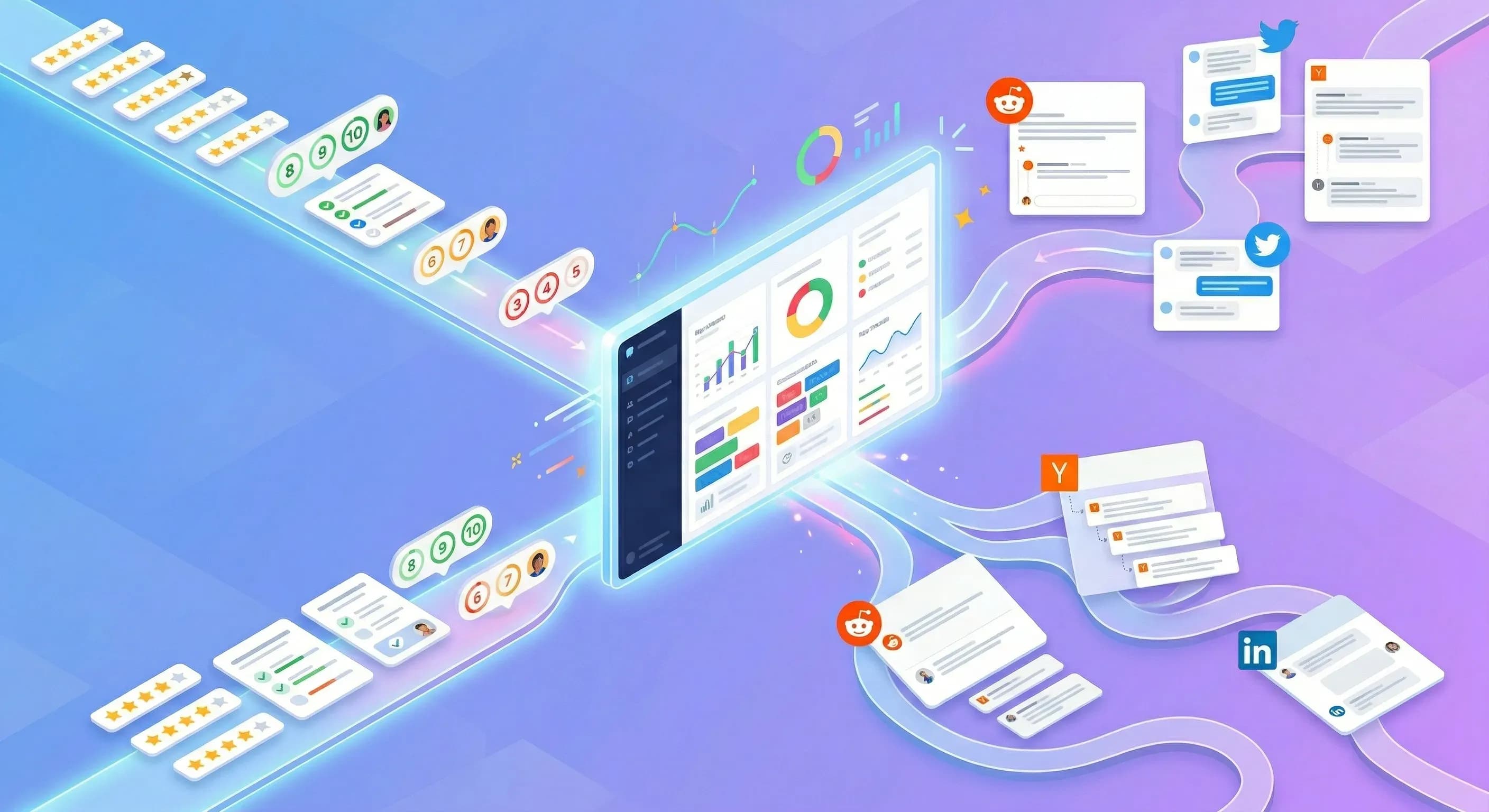
The most honest, unfiltered feedback about your product is happening somewhere else entirely. It is in a Reddit thread where someone compares you to a competitor. It is in a Hacker News comment where a developer explains why they churned. It is in a LinkedIn post where a user describes your product using completely different language than your marketing team uses.
A voice of customer program that only captures structured feedback is like reading every other page of a book. You get the gist, but you miss half the story. This post walks through how to build a VoC program that captures both what customers tell you directly and what they say when you are not in the room, and turns all of it into better product decisions.
What Is a Voice of Customer Program (and Why Most Are Incomplete)
A voice of customer (VoC) program is a systematic process for capturing, analyzing, and acting on customer feedback across every channel where it exists. The emphasis is on systematic and every channel. Most teams have neither.
The typical VoC setup at a B2B SaaS company looks like this: NPS surveys go out quarterly. Support tickets get tagged and triaged. Maybe there is a feature request board. Product does user interviews before big launches. This is all valuable. But it only covers structured feedback -- the feedback you explicitly ask for through channels you control.
The blind spot is unstructured feedback. Your customers are talking about your product on Reddit, Twitter, LinkedIn, Hacker News, GitHub issues, Stack Overflow, YouTube comments, and niche community forums. They are not tagging you. They are not filling out forms. They are just being honest in the places they already hang out.
These two types of feedback are not competing approaches. They are complementary:
- Structured feedback is what you ask for: surveys, NPS ratings, in-app prompts, support conversations.
- Unstructured feedback is what people volunteer: social mentions, community discussions, forum posts, podcast conversations.
A complete VoC program needs both. Most teams only have the first half.
The Two Pillars of Customer Feedback
Think of your VoC program as standing on two pillars. The first is structured feedback, where you go to the customer with a specific question at a specific moment. The second is unstructured feedback, where the customer talks about you without being prompted.
Neither is sufficient alone. Surveys tell you what people think when asked. Community conversations tell you what people think when they are not performing for an audience of one (you). The combination is where real insight lives.
Pillar 1: Structured Feedback -- Surveys, NPS, and In-App Prompts
In-app surveys are the gold standard for structured feedback because they catch users in context. A user who just completed onboarding can tell you how the experience felt. A user who just hit a paywall can tell you whether the upgrade felt worth it. A user who is about to churn can tell you why. That contextual specificity is what makes structured feedback so actionable.

The types that work best for SaaS:
- NPS surveys for overall satisfaction benchmarking
- Feature satisfaction surveys triggered after specific feature use
- Churn/exit surveys at cancellation to understand why
- Onboarding surveys to identify friction early
- PMF surveys (the Sean Ellis test: "How would you feel if you could no longer use this product?")
Best practices are well-established: keep surveys short (one to three questions) — microsurveys are ideal here — trigger them contextually rather than randomly, segment responses by user cohort (plan tier, tenure, usage level), and always close the loop by telling users what changed based on their input.
The strengths of structured feedback are real: high signal, specific to the feature or moment, directly actionable, and statistically measurable. But the limitations matter too. Only active users respond, creating selection bias. People tend to soften criticism when asked directly (social desirability bias). And typical response rates run 10 to 30 percent, meaning you never hear from the majority.
Open-source experience management tools like Formbricks make it straightforward to deploy targeted in-app surveys without engineering overhead or vendor lock-in. You can trigger a two-question survey after a user's third session, or after they use a specific feature for the first time, and capture structured data that directly maps to product decisions.
Pillar 2: Unstructured Feedback -- Social, Communities, and the Open Web
The other half of your VoC lives in places your surveys cannot reach. Reddit. Twitter. LinkedIn. Hacker News. GitHub discussions. Stack Overflow. YouTube. Podcasts. Newsletters. And that is just the start.
Why does this matter? Because unstructured feedback is unsolicited and therefore more honest. Nobody softens their opinion in a Reddit thread. When someone writes "I tried [product] and the onboarding was confusing but the core feature is genuinely better than [competitor]," that is raw signal you will never get from a five-point satisfaction scale.
Here are patterns that show up consistently in unstructured feedback:
Positioning misalignment. One B2B SaaS team discovered that users consistently described their product using completely different language than the team used internally. The team called it "AI-powered recruiting." Users called it "people search." That insight, surfaced through community mentions rather than surveys, directly reshaped their external messaging and positioning.
Early warning signals. A developer tools company caught a bug report on Reddit before it hit their support queue. Because they saw it within minutes instead of hours, they resolved it before other users were affected and responded publicly, earning goodwill instead of frustration.
Hidden customer discovery. A form builder discovered that a major tech company was using their product -- not through any CRM, not through any tagged social post, but through an untagged community mention they would have otherwise missed entirely.
The challenge is obvious: monitoring all of these platforms manually does not scale. Even a small B2B SaaS generating 500 mentions per month cannot keep up by checking Reddit, Twitter, Hacker News, and LinkedIn by hand several times a day. This is where a systematic approach to social listening becomes essential -- you need a way to capture what people say across platforms without manually checking each one.
Building Your VoC Program: A Step-by-Step Framework
Step 1: Map Your Feedback Channels
Before you build anything, audit every place your customers might talk about you. Create a simple matrix:
| Channel | Type | Currently Covered? | Priority |
|---|---|---|---|
| In-app surveys | Structured | Yes/No | |
| Support tickets | Structured | Yes/No | |
| User interviews | Structured | Yes/No | |
| Unstructured | Yes/No | ||
| Twitter/X | Unstructured | Yes/No | |
| Hacker News | Unstructured | Yes/No | |
| Unstructured | Yes/No | ||
| GitHub | Unstructured | Yes/No | |
| Review sites | Unstructured | Yes/No |
Most teams discover they have good coverage on the structured side but almost none on the unstructured side.
Step 2: Deploy Structured Feedback at Key Moments
Place in-app surveys at the moments that matter most: post-onboarding (did they understand the product?), after key feature use (was it useful?), before churn (why are they leaving?), and at usage milestones (how satisfied are power users?).
Use micro-surveys (one to two questions) for continuous signals. Save longer surveys for quarterly deep dives. Segment everything by user cohort so you can spot patterns by plan, tenure, or usage level.
Step 3: Set Up Monitoring for Unstructured Feedback
Pick the platforms that matter for your specific audience. For developer tools, Reddit, Hacker News, GitHub, Twitter, and Stack Overflow are non-negotiable. For broader SaaS, add LinkedIn, YouTube, and news/blog coverage.
The key is automating discovery instead of manual checking. A proper social listening setup covers all the platforms where your audience is active and filters out irrelevant noise -- especially important if your brand name is a common word.
Step 4: Centralize and Tag All Feedback
All feedback -- structured and unstructured -- needs consistent categorization. Whether it comes from a survey response or a Reddit thread, tag it: feature request, bug report, praise, churn risk, competitor mention, positioning insight.
AI-based categorization helps at scale. The goal is that any PM on your team can ask "what are users saying about [feature X]?" and get answers from both survey data and community conversations in one view.
Step 5: Close the Loop
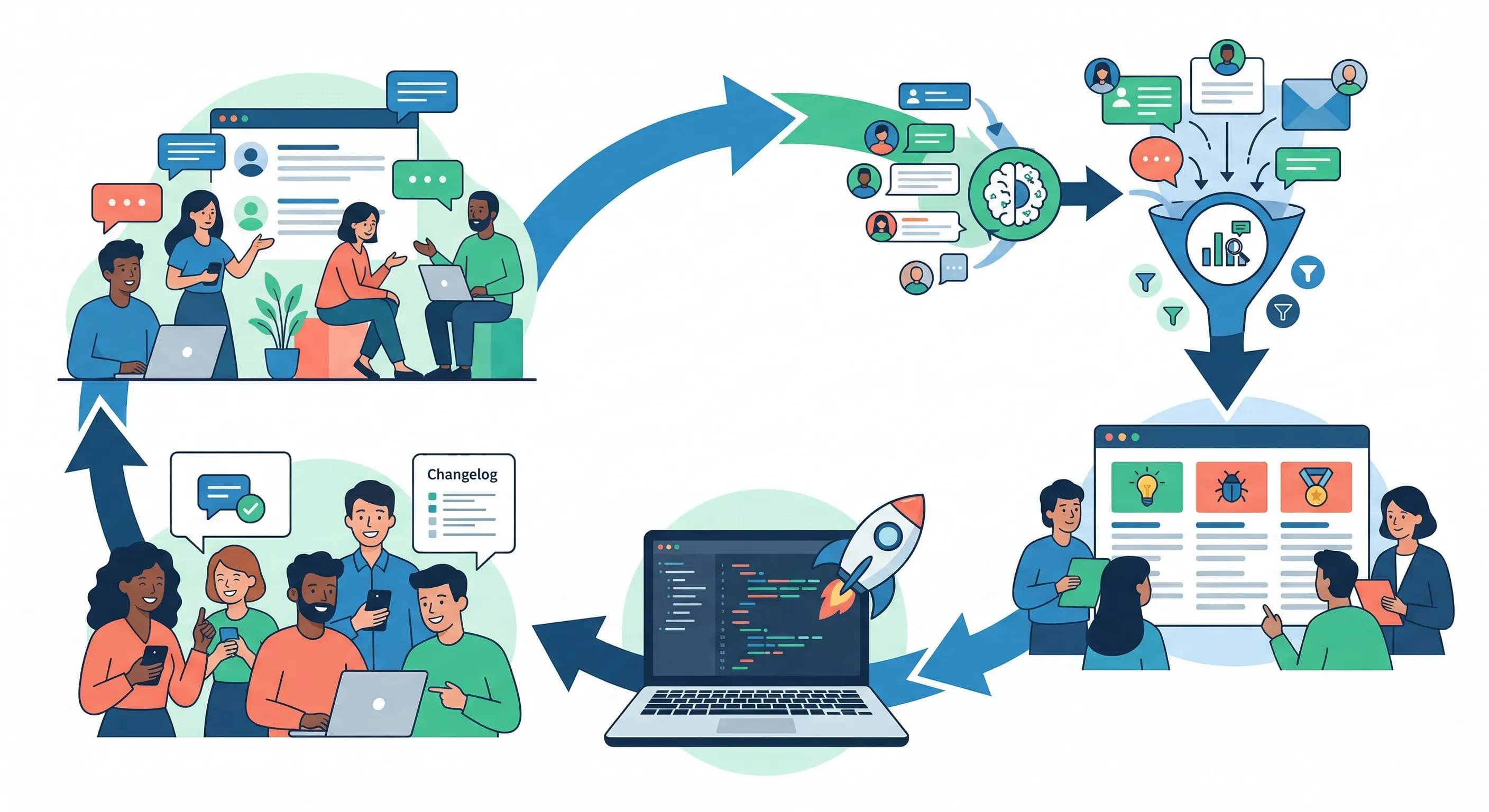
This is where most VoC programs fail. Feedback gets collected but never acted on visibly.
Close the loop in three directions:
- Internal: Feed insights to product, marketing, and support teams on a regular cadence. Not just a quarterly summary -- weekly highlights that include both survey trends and notable community mentions.
- Public: Respond to community feedback where it happens. When someone posts a bug report on Reddit, respond there. When someone praises you on Twitter, thank them. This builds trust and encourages more honest feedback.
- Back to the customer: Tell users when their feedback drove a change. Changelog entries, in-app notifications, or a simple email. "You asked, we built it" is the most powerful retention message in SaaS.
Track your loop closure: time from feedback to action, response rate to community mentions, and NPS trend over time.
Structured + Unstructured: The Feedback Stack in Practice
Here is how the two pillars work together in a real scenario.
You launch a new feature. Your in-app survey shows 60 percent of users find it "useful" and 15 percent find it "confusing." You know you have a problem, but the survey does not tell you what specifically is confusing.
Meanwhile, on Reddit, someone writes a detailed post explaining exactly why the UX flow is counterintuitive and suggests an alternative approach. On Twitter, three users independently highlight one specific aspect of the feature they love.
Now combine the signals:
- The survey tells you the magnitude: 15 percent of users are confused. That is significant enough to act on.
- The Reddit post gives you the diagnosis: here is the specific flow that breaks, and here is what a user thinks would work better.
- The Twitter mentions tell you what to preserve: this specific part is working, do not change it.
Neither source alone gives the full picture. The survey without community feedback tells you something is wrong but not what. The community feedback without the survey tells you one person's opinion but not whether it is representative. Together, you have both the magnitude and the diagnosis.
For the unstructured side, you can measure your share of voice to benchmark how much of the conversation in your category you own versus competitors -- a metric that complements your structured NPS and CSAT scores.
Choosing the Right Tools for Your VoC Stack
You do not need one massive enterprise platform. A focused stack of two to three tools typically works better for SaaS teams. Here is the framework:
For structured feedback: You need an in-app survey tool that lets you trigger contextual surveys without engineering overhead. Formbricks handles this well -- open-source, no vendor lock-in, and built for the kind of targeted, moment-based surveys that actually get responses. You control the data, you control the triggers, and you can self-host if compliance requires it.
For unstructured feedback: You need a social listening tool that covers the platforms your audience actually uses. Look for API access so you can pipe mention data into your existing workflows rather than checking another dashboard. Tools like Octolens monitor mentions across Reddit, Twitter, LinkedIn, Hacker News, and 10+ other platforms, delivering structured data via API so it fits into whatever stack you are already running.
For centralization: Your product management tool (Linear, Notion, Jira) or a lightweight custom dashboard that brings both streams together. The specific tool matters less than the discipline of tagging and routing all feedback consistently.
The stack should be simple: capture (structured + unstructured) -> centralize -> act. Three tools maximum. If your VoC program requires a week of vendor evaluation, it is already too complicated.
Common VoC Mistakes to Avoid
1. Only collecting feedback you ask for. Surveys are essential but they miss the candid conversations happening in public. If your entire VoC program is surveys and support tickets, you are hearing from maybe 20 percent of your user base -- the 20 percent most willing to give you polite, prompted feedback.
2. Collecting feedback but never acting on it. The fastest way to kill survey response rates is to ask for input and then change nothing. Users notice. Close the loop visibly or stop asking.
3. Monitoring manually. Checking Reddit, Twitter, and Hacker News by hand works when you get 10 mentions a week. It breaks at 100. It is impossible at 1,000. Automate discovery early.
4. Ignoring sentiment. Mention volume alone is misleading. Five hundred mentions that are 80 percent negative is a crisis, not a milestone. Track sentiment alongside volume.
5. Siloing feedback by team. When product only sees survey data, marketing only sees social mentions, and support only sees tickets, nobody has the full picture. Centralize access so every team can see both structured and unstructured feedback.
Start Building
A voice of customer program is only as good as the feedback it captures and the actions it drives. Most SaaS teams have half the picture covered: they ask customers directly through surveys, NPS, and support channels. Adding the other half -- what customers say when they are not talking to you -- is what separates teams that react from teams that anticipate. For ready-to-use templates, see our voice of customer templates.
Start with the framework: map your channels, deploy structured feedback at key moments, set up monitoring for unstructured feedback, centralize everything under consistent tags, and close the loop visibly.
The tools exist to make this practical even for small teams. If you are starting from the structured side, Formbricks gives you everything you need to deploy in-app surveys today -- open-source, no vendor lock-in, and ready to integrate into whatever VoC stack you are building.
Frequently asked questions
Try Formbricks now