

30+ Income Survey Questions (Ranges, Examples + Best Practices 2026)

Johannes
CEO & Co-Founder
9 Minutes
May 3rd, 2026
Income is one of the most sensitive topics in any survey. Ask it wrong and respondents abandon the form or give you random numbers. Ask it right and you unlock segmentation data that transforms how you price, position, and market your product.
The key is using ranges instead of exact figures, making every question optional, and only asking when you have a clear plan for how the data will be used. This guide gives you 30+ ready-to-use income survey questions organized by category, with standard household income ranges, ethical guidelines, common mistakes to avoid, and guidance on education level questions that frequently pair with income data.
What you will find in this guide:
- What an income question is and when to ask one
- The types of income your survey might need to distinguish
- Standard household income ranges for surveys
- 30+ income survey questions across 5 categories
- Education level survey questions (frequently paired with income)
- Common mistakes and how to fix them
- How to use income data in analysis
What Is an Income Question in a Survey?
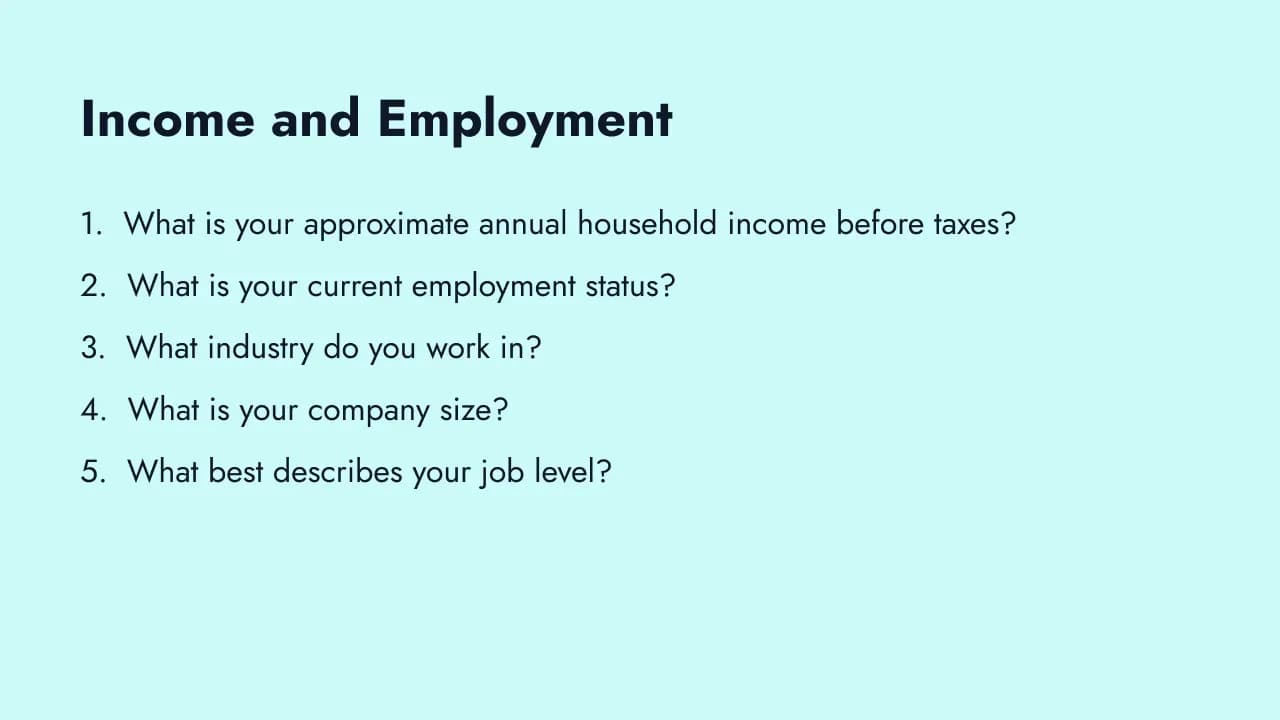
An income survey question asks respondents about their earnings using predefined bracket ranges rather than an exact figure. The most common format is:
"What is your approximate annual household income before taxes?"
Followed by non-overlapping ranges like:
- Under $25,000
- $25,000 to $49,999
- $50,000 to $74,999
- $75,000 to $99,999
- $100,000 or more
- Prefer not to say
Income questions are one of the most valuable demographic data points in research -- but only when collected correctly. They power pricing research, audience segmentation, and affordability analysis. The demographic survey template from Formbricks includes a ready-to-use income section alongside other demographic questions.
Types of Income Your Survey Might Need to Distinguish
Before writing income questions, clarify which type of income is relevant to your research. This affects both how you phrase questions and which ranges make sense.
The 4 main income types in survey research:
| Income Type | What It Covers | Relevant For |
|---|---|---|
| Earned income | Wages, salary, tips from employment | Consumer research, pricing, B2B |
| Business income | Profit from self-employment or ownership | Entrepreneur segments, SMB research |
| Investment income | Capital gains, dividends, interest | Wealth research, financial products |
| Passive income | Rental income, royalties, business interests | Total wealth studies |
The broader 7 types of income that financial planners typically reference are earned income, business income, capital gains, dividend income, interest income, rental income, and royalty income. For most survey research, distinguishing between earned and non-earned income is sufficient -- asking respondents to categorize all seven sources is too cognitively demanding.
Household vs. individual income is the most important distinction. A single earner making $80,000 and a household earning $80,000 with four members have completely different financial realities. Always specify which you mean in the question itself.
Standard Household Income Ranges for Surveys
The brackets below are the most widely used in US consumer research and align with U.S. Census Bureau reporting categories. Use these unless your target demographic is concentrated in a specific income band, in which case add more granularity where it matters.
Annual household income ranges (US standard):
| Range | Label |
|---|---|
| Under $25,000 | Lower income |
| $25,000 to $49,999 | Lower-middle income |
| $50,000 to $74,999 | Middle income |
| $75,000 to $99,999 | Upper-middle income |
| $100,000 to $149,999 | Higher income |
| $150,000 to $199,999 | High income |
| $200,000 or more | Very high income |
| Prefer not to say | N/A |
Monthly household income ranges (for surveys where respondents think in monthly terms):
| Range | Annual Equivalent |
|---|---|
| Under $2,000 | Under $24,000 |
| $2,000 to $3,999 | $24,000 to $47,999 |
| $4,000 to $5,999 | $48,000 to $71,999 |
| $6,000 to $7,999 | $72,000 to $95,999 |
| $8,000 to $11,999 | $96,000 to $143,999 |
| $12,000 or more | $144,000 or more |
| Prefer not to say | N/A |
Monthly framing works better for hourly workers, freelancers, and respondents with variable income who do not naturally think in annual terms.
Overlap rule: Never use ranges like "$25,000-$50,000 / $50,000-$75,000." A respondent earning exactly $50,000 cannot tell which bracket applies. Always use non-overlapping boundaries: "$25,000-$49,999 / $50,000-$74,999."
Why Ask About Income (and When Not To)
Income data is powerful when paired with a clear research goal. It enables pricing research by showing what different segments can afford. It supports market segmentation by grouping respondents into brackets that behave differently. And it powers affordability analysis by revealing who finds your product accessible and who does not.
Cross-tabulating satisfaction scores by income bracket tells you which segments see the most value in your product. If high-income users rate you 4.5/5 but lower-income users rate you 2.8/5, you have a pricing or positioning problem worth solving.
When NOT to ask about income:
- You have no plan to segment or cross-tabulate by income
- The data adds survey friction without analytical value
- Your survey is already long and income is not central to the research goal
- You are collecting it "just in case" with no specific use
The rule is simple: only ask income questions if you can explain exactly how the data will influence a decision. Your survey response rate will suffer if you include it unnecessarily.
Ethical Guidelines for Income Questions
Financial data is personal. Handling it poorly damages trust and produces unreliable data. Follow these guidelines to collect income information responsibly.
Always use ranges, never exact figures. Asking "What is your salary?" feels intrusive. "Which range best describes your annual income?" feels manageable. Ranges reduce anxiety and produce higher completion rates.
Always include "Prefer not to say." Every income question needs an opt-out. Forced responses on sensitive topics produce garbage data because people select random options to move past the question.
Place income questions at the END of the survey. By the time respondents reach the final section, they have invested time and built trust. Leading with income questions signals invasiveness and spikes abandonment.
Explain why you are asking. A brief sentence like "This helps us ensure our pricing works for everyone" reduces resistance. Transparency about purpose increases honest responses.
Specify household or individual income. These are very different numbers. Be explicit about which one you mean.
Consider currency and regional differences. For global surveys, $50,000 means something very different in San Francisco than in Lagos. Use relative brackets or create localized versions.
GDPR treats financial data as sensitive. If you operate in the EU or collect data from EU residents, financial information requires explicit consent and a lawful basis for processing. Use a GDPR-compliant survey tool and document how income data is stored and processed.
Self-host for full data control. When collecting sensitive financial data, keeping it on your own infrastructure removes third-party risk. Formbricks supports self-hosting so income survey data never leaves your servers.
30+ Income Survey Questions by Category
Each question below includes recommended answer options and a usage note. Every income question should be optional with a "Prefer not to say" escape.
Category 1: Household Income (Questions 1-6)
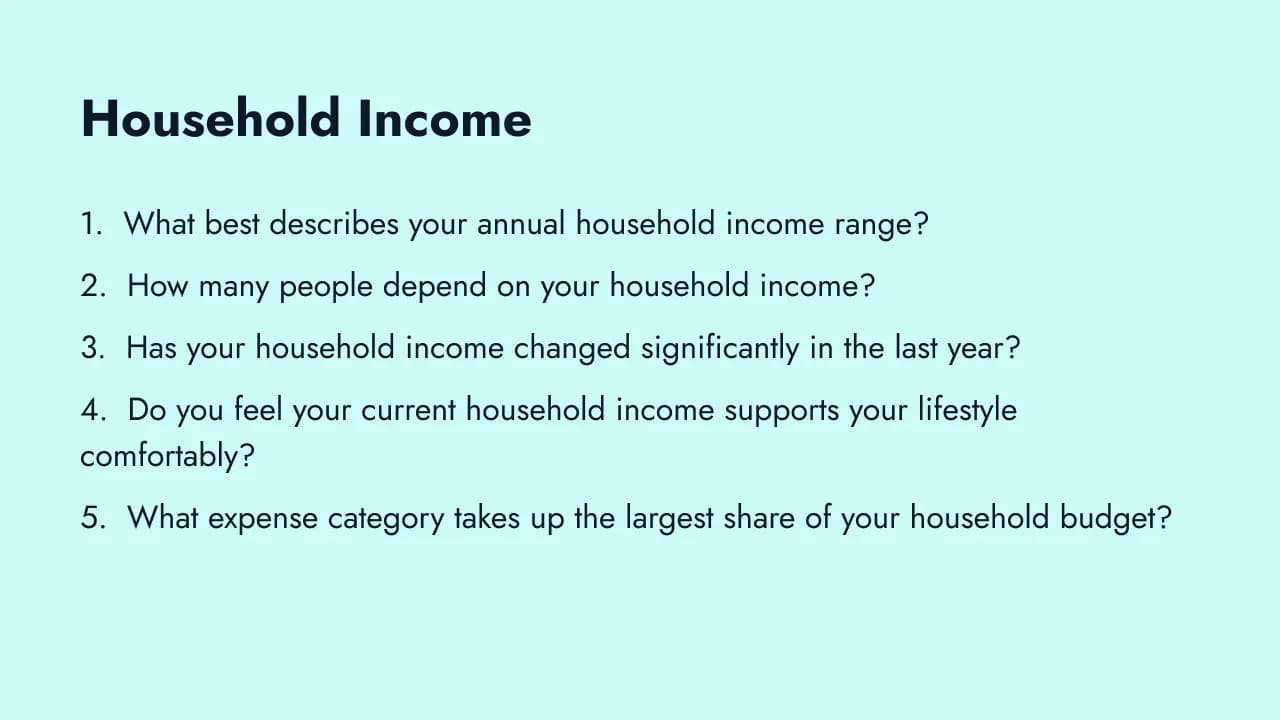
Household income captures the full financial picture of a respondent's living situation. Use these when your product or service is purchased with household budgets -- housing, insurance, family subscriptions, consumer goods.
1. What is your approximate annual household income before taxes?
- Under $25,000
- $25,000 to $49,999
- $50,000 to $74,999
- $75,000 to $99,999
- $100,000 to $149,999
- $150,000 to $199,999
- $200,000 or more
- Prefer not to say
The foundational household income question. Use non-overlapping ranges and always include an open-ended top bracket.
2. What is your approximate monthly household income?
- Under $2,000
- $2,000 to $3,999
- $4,000 to $5,999
- $6,000 to $7,999
- $8,000 to $11,999
- $12,000 or more
- Prefer not to say
Monthly framing works better for respondents who are paid hourly, freelance, or have variable income.
3. How many income earners are in your household?
- 1
- 2
- 3 or more
- Prefer not to say
Context question that helps interpret household income data. A $100,000 household with one earner looks different from one with three earners.
4. Has your household income changed in the past 12 months?
- Increased significantly
- Increased slightly
- Stayed about the same
- Decreased slightly
- Decreased significantly
- Prefer not to say
Trajectory matters as much as absolute numbers. A household experiencing income decline behaves differently from one on an upward trend, even at the same bracket.
5. Which range best represents your household's position relative to the national median?
- Below the national median
- Around the national median
- Above the national median
- Not sure
- Prefer not to say
Useful for international surveys where absolute dollar ranges do not translate.
6. How many people does your household income support, including dependents?
- 1 (myself only)
- 2 people
- 3 to 4 people
- 5 or more people
- Prefer not to say
Per-capita household income is often more predictive of purchasing behavior than total household income. This question enables that calculation.
Category 2: Individual Income and Salary (Questions 7-12)
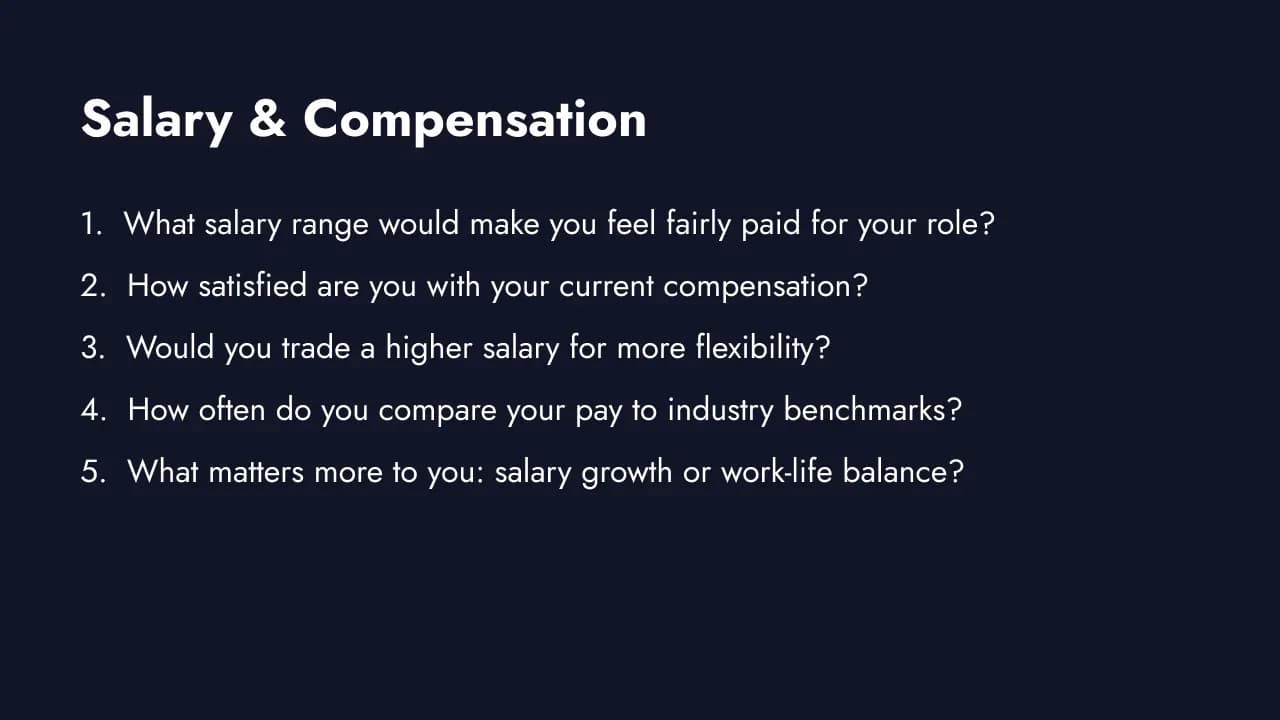
Individual income questions focus on the respondent's personal earnings. Use these for B2B research, professional development products, career-related surveys, or when the purchasing decision is tied to personal discretionary spending.
7. What is your approximate annual salary or personal income before taxes?
- Under $25,000
- $25,000 to $49,999
- $50,000 to $74,999
- $75,000 to $99,999
- $100,000 to $149,999
- $150,000 to $199,999
- $200,000 or more
- Prefer not to say
Specify "before taxes" to standardize responses across different tax situations.
8. What is your primary source of income?
- Salary or wages (full-time employment)
- Self-employment or business ownership
- Freelance or contract work
- Investments or rental income
- Retirement or pension
- Government assistance
- Other
- Prefer not to say
Income source affects financial stability perception. A freelancer earning $80,000 with variable monthly income has different spending behavior than a salaried employee at the same level.
9. Do you have additional sources of income beyond your primary job?
- Yes, significant additional income (more than 20% of primary)
- Yes, minor additional income (less than 20% of primary)
- No
- Prefer not to say
Side income is increasingly common. This question helps you understand total financial capacity without asking respondents to calculate exact totals.
10. What is your approximate hourly wage range?
- Under $15 per hour
- $15 to $24 per hour
- $25 to $39 per hour
- $40 to $59 per hour
- $60 to $99 per hour
- $100 or more per hour
- Not applicable (salaried, not hourly)
- Prefer not to say
Relevant for products targeting hourly workers or when you need to understand time-value trade-offs.
11. How does your current compensation compare to your expectations for your role and experience level?
- Significantly below expectations
- Somewhat below expectations
- Meets expectations
- Somewhat exceeds expectations
- Significantly exceeds expectations
- Prefer not to say
Compensation satisfaction predicts behavior better than absolute income in many purchase contexts.
12. In which industry do you primarily work?
- Technology
- Healthcare or medical
- Education
- Finance or banking
- Retail or consumer goods
- Manufacturing or trades
- Government or public sector
- Nonprofit or social services
- Other
- Prefer not to say
Industry context helps interpret income data. The same $75,000 salary reads differently in retail vs. finance.
Category 3: Family Income (Questions 13-17)
Family income questions go deeper into financial dynamics -- useful for products serving families, educational tools, children's services, or household financial planning.
13. What is your approximate annual family income before taxes, including all earners in your immediate family?
- Under $30,000
- $30,000 to $59,999
- $60,000 to $89,999
- $90,000 to $119,999
- $120,000 to $179,999
- $180,000 or more
- Prefer not to say
Slightly broader brackets than individual income work well here since family income typically spans a wider range.
14. Does your family receive any of the following income types? (Select all that apply)
- Employment wages or salary
- Business or self-employment income
- Investment income (dividends, capital gains, interest)
- Rental property income
- Government benefits or assistance
- Pension or retirement income
- Child support or alimony
- Prefer not to say
Identifies income diversity within families. Multiple income streams indicate different financial stability profiles.
15. Do you currently provide financial support to family members outside your immediate household?
- Yes, significant support (more than 10% of income)
- Yes, minor support
- No
- Prefer not to say
Remittances and extended family support substantially reduce available discretionary income even at high income levels.
16. Does your family currently have children under 18 in the household?
- Yes, one child
- Yes, two or more children
- No
- Prefer not to say
Children under 18 affect disposable income and category spending priorities significantly.
17. How would you describe your family's financial stability over the past three years?
- Improving steadily
- Stable and consistent
- Fluctuating up and down
- Declining gradually
- Prefer not to say
Trajectory is often more predictive of near-term spending than current income level.
Category 4: Financial Wellbeing and Spending (Questions 18-23)
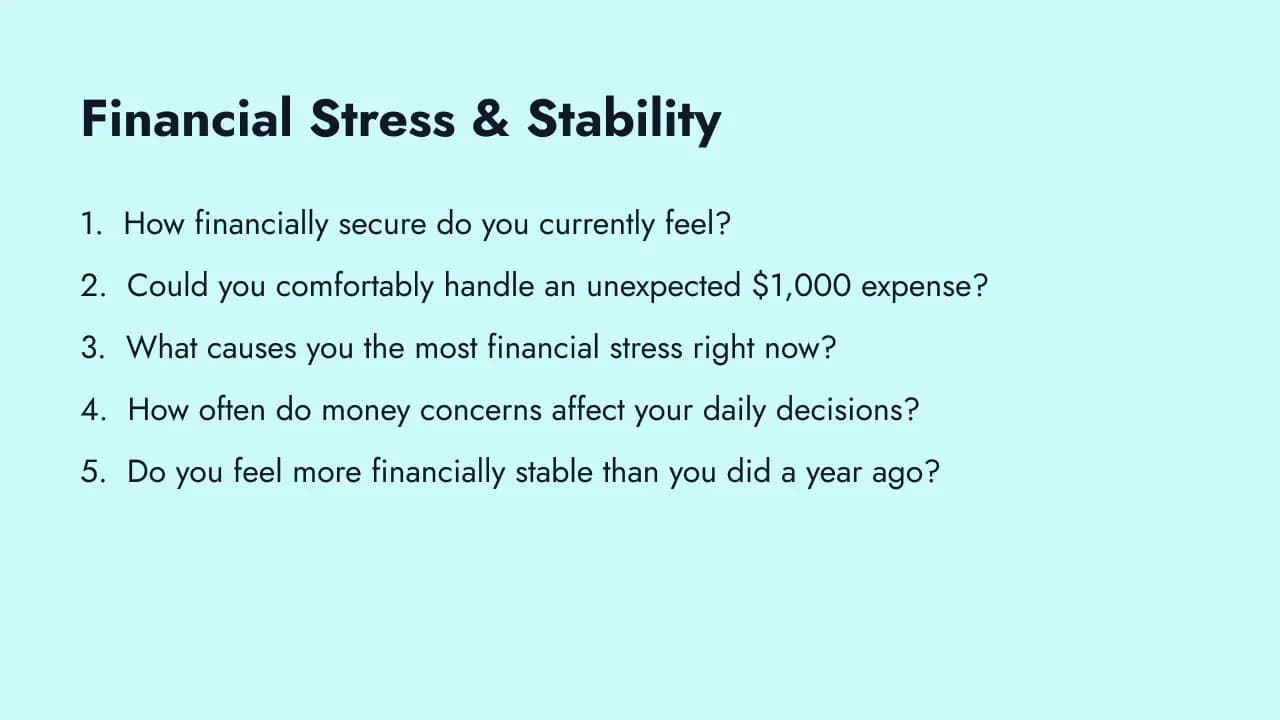
These questions go beyond raw income to understand financial confidence, spending behavior, and price sensitivity. They are often more actionable than income brackets alone for product and pricing decisions.
18. How would you describe your current financial situation?
- Very comfortable, able to save and spend freely
- Comfortable, meeting needs with some discretionary spending
- Getting by, covering necessities but little extra
- Struggling, difficulty covering basic expenses
- Prefer not to say
Perceived financial situation drives purchasing decisions more than actual income. Someone earning $150,000 with heavy debt may feel more constrained than someone earning $60,000 with low expenses.
19. How confident are you in your ability to cover an unexpected $500 expense without borrowing?
- Very confident
- Somewhat confident
- Not very confident
- Not at all confident
- Prefer not to say
A financial resilience indicator used by the Federal Reserve's Survey of Household Economics. It reveals liquidity in a way that income brackets cannot.
20. What percentage of your monthly income do you typically spend on [product category]?
- Less than 1%
- 1% to 3%
- 4% to 7%
- 8% to 15%
- More than 15%
- Not sure
- Prefer not to say
Spending share reveals category importance. Replace [product category] with your specific area.
21. How much do you typically budget for [product/service category] per month?
- Under $25
- $25 to $49
- $50 to $99
- $100 to $199
- $200 to $499
- $500 or more
- I do not budget for this category
- Prefer not to say
Direct budget data for your category. Adjust ranges to match your price point.
22. How price-sensitive are you when choosing [product/service]?
- Price is the most important factor
- Price is one of several important factors
- Price matters, but quality and features matter more
- Price is not a major consideration
- Prefer not to say
Self-reported price sensitivity, combined with income data, helps build pricing tiers.
23. Would a price increase of 10-20% on [product/service] cause you to reconsider your purchase?
- Yes, I would stop buying or switch to an alternative
- I would consider alternatives but might stay
- It would not affect my decision
- Prefer not to say
Basic price elasticity testing. Pair with income brackets to map sensitivity by segment.
Category 5: Purchasing Power and Budget (Questions 24-30)
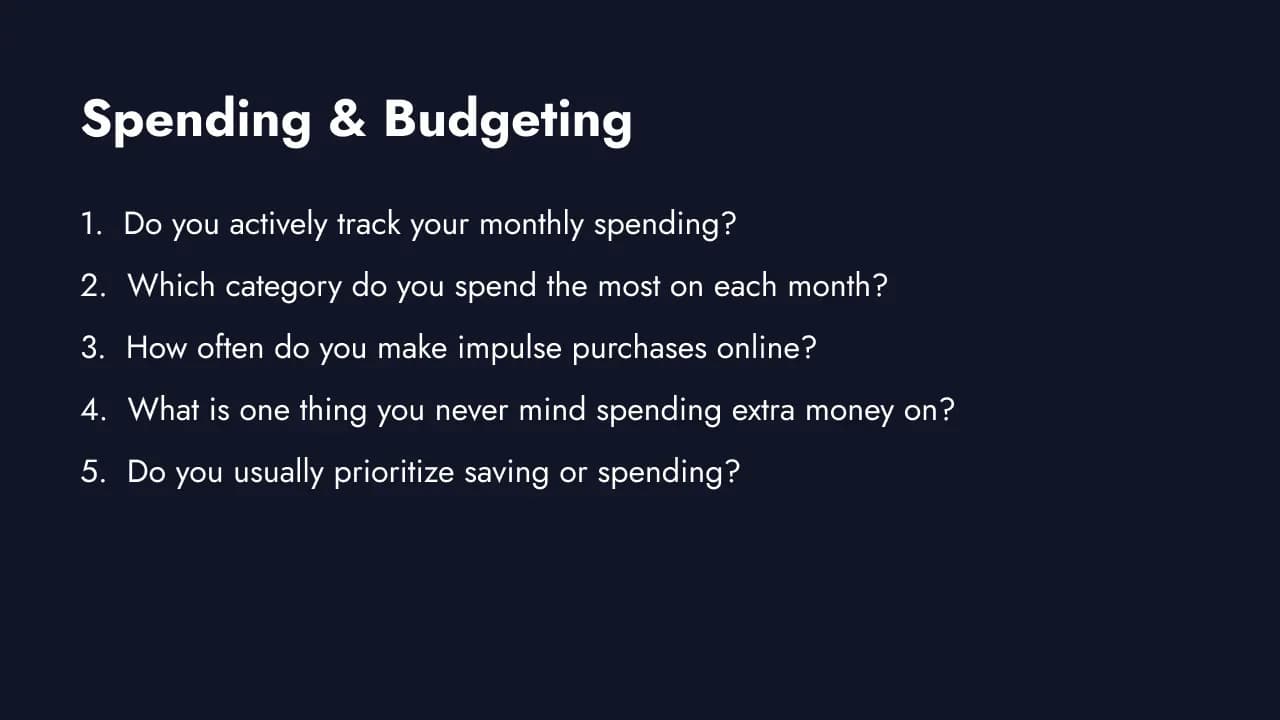
These questions connect income to actual purchasing behavior -- not just what people earn, but how they allocate money toward products like yours.
24. What is your approximate monthly discretionary spending budget (after rent, bills, and necessities)?
- Under $200
- $200 to $499
- $500 to $999
- $1,000 to $1,999
- $2,000 or more
- Not sure
- Prefer not to say
Discretionary budget is the real constraint on purchasing decisions, not gross income.
25. How do you typically pay for [product/service category]?
- Cash or debit (pay in full)
- Credit card (pay in full each month)
- Credit card (carry a balance)
- Installment plan or buy-now-pay-later
- Monthly subscription
- Employer-sponsored or reimbursed
- Other
- Prefer not to say
Payment method reveals both financial behavior and pricing format preferences.
26. What price range feels right for [product/service]?
- Under $[low]
- $[low] to $[mid-low]
- $[mid-low] to $[mid-high]
- $[mid-high] to $[high]
- Over $[high]
- Not sure
- Prefer not to say
Acceptable price range question. Compare responses across income segments to identify price-value alignment.
27. At what price would [product/service] become too expensive for you to consider?
- Under $[amount]
- $[amount] to $[amount]
- $[amount] to $[amount]
- Over $[amount]
- Prefer not to say
The "too expensive" ceiling from Van Westendorp pricing analysis. Plotting this against income brackets shows exactly where each segment draws the line.
28. At what price would [product/service] seem so cheap that you would question its quality?
- Under $[amount]
- $[amount] to $[amount]
- $[amount] to $[amount]
- Over $[amount]
- I would not question quality at any low price
- Prefer not to say
The "too cheap" floor. Together with Question 27, this defines the acceptable price range for each income segment.
29. When choosing [product/service], how important is price compared to other factors?
- Price is the dominant factor
- Price and quality/features are equally important
- Quality/features are more important than price
- Price is a minor factor compared to other considerations
- Prefer not to say
Validates self-reported price sensitivity from a different angle.
30. How often do you make unplanned purchases in [product category]?
- Frequently (multiple times per month)
- Occasionally (once per month)
- Rarely (a few times per year)
- Almost never
- Prefer not to say
Impulse purchase rate by income segment reveals which brackets rely on planned budgeting vs. discretionary spontaneity.
Education Level Survey Questions
Education level is the demographic question most commonly paired with income data. It provides essential context -- two respondents in the same income bracket can have very different behaviors and outlooks depending on their educational background.
Why pair education with income:
- Education predicts income trajectory better than current earnings
- Credential-based purchasing decisions (professional development, certifications) require education context
- Education level affects how respondents read and interpret survey questions
- Regulatory and compliance research often requires both dimensions
Standard education level question:
31. What is the highest level of education you have completed?
- Less than high school diploma
- High school diploma or equivalent (GED)
- Some college, no degree
- Associate's degree (2-year)
- Bachelor's degree (4-year)
- Master's degree
- Professional degree (MD, JD, MBA)
- Doctoral degree (Ph.D., Ed.D.)
- Prefer not to say
Use this exact format for compatibility with U.S. Census Bureau benchmark data. Non-overlapping, exhaustive options with a clear opt-out.
32. Is your highest degree in a field directly related to your current primary income source?
- Yes, closely related
- Somewhat related
- No, different field
- Not applicable
- Prefer not to say
Education-to-income alignment predicts financial satisfaction and career trajectory.
33. Are you currently enrolled in any educational program?
- Yes, full-time
- Yes, part-time
- No, but considering it
- No
- Prefer not to say
Current enrollment status affects both income capacity and time availability -- both relevant for product targeting.
Common Income Question Mistakes
These mistakes are surprisingly common and each one degrades data quality. Every one is fixable.
Mistake 1: Asking for exact salary figures
Bad: "What is your annual salary? $________"
Better: "Which range best describes your annual income?" with predefined ranges.
Most people will skip an open-text salary question. Those who answer often round to the nearest $10,000 anyway, giving you range-level precision with higher friction.
Mistake 2: Overlapping ranges
Bad: "$25,000 to $50,000 / $50,000 to $75,000"
Better: "$25,000 to $49,999 / $50,000 to $74,999"
Someone earning exactly $50,000 cannot tell which bracket applies. Overlapping ranges create confusion and inconsistent data.
Mistake 3: Missing "Prefer not to say"
Bad: Forcing a selection with no opt-out.
Better: Including "Prefer not to say" as the final option on every income question.
Without an opt-out, respondents either abandon the survey or select a random bracket -- both outcomes are worse than a clean skip.
Mistake 4: Asking income questions too early
Bad: Starting the survey with "What is your household income?"
Better: Placing income questions in the final section after all other questions.
Income questions at the top signal invasiveness before trust is established.
Mistake 5: Not specifying household vs. individual
Bad: "What is your income?"
Better: "What is your approximate annual household income before taxes?"
Ambiguity produces inconsistent data. Some respondents will report household income, others individual -- and you will never know which.
Mistake 6: Using US-centric ranges for global surveys
Bad: Showing "$25,000 to $49,999" to respondents in India, Brazil, or Nigeria.
Better: Use relative brackets ("below national median / around national median / above national median") or create localized versions.
Mistake 7: Making income questions mandatory
Bad: Requiring an answer to proceed.
Better: Marking income questions as optional with a "Prefer not to say" option.
Mandatory income questions are the fastest way to reduce completion rates. The data you lose from abandoned surveys outweighs whatever you gain from forced answers.
How to Use Income Data in Analysis
Cross-tabulate with satisfaction, NPS®, or purchase intent. Break your satisfaction scores by income bracket. If lower-income segments report lower satisfaction, the issue might be pricing or perceived value rather than product quality. This kind of customer feedback analysis surfaces patterns that aggregate scores hide entirely.
Map price sensitivity by income bracket. Combine price sensitivity questions (28-30) with income data to build a price elasticity matrix. You will often find that price sensitivity does not map linearly to income -- some high-income segments are highly price-sensitive while some moderate-income segments prioritize quality.
Identify underserved segments. Look for income brackets where demand is high but satisfaction is low. These are segments your product could serve better with adjusted pricing, different feature bundles, or targeted messaging.
Inform pricing tiers and discounts. Income data combined with willingness-to-pay questions gives you direct input for pricing strategy. You can validate whether your current tiers align with what different segments consider fair, and design entry-level tiers for segments priced out of your core offering.
Free Income Survey Template
Formbricks offers free, open-source survey templates you can deploy in minutes with built-in privacy controls for sensitive financial data.
Related templates:
- Demographic Survey for comprehensive demographic data including income and education
- Onboarding Segmentation for user segmentation at signup
- Market Survey for pricing and market research
For teams collecting sensitive financial data, Formbricks supports self-hosting so income responses never leave your infrastructure. It is open source, privacy-first, and built for product, marketing, and research teams who need a GDPR-compliant survey tool without heavy engineering overhead.
Get Your Free Income Survey Template →
Frequently Asked Questions
Try Formbricks now