

50+ Diversity and Inclusion Survey Questions (+ Free DEI Template 2026)

Johannes
CEO & Co-Founder
11 Minutes
May 3rd, 2026
Diversity numbers tell you who works at your company. A DEI survey tells you how those people actually experience working there. Those are two very different things, and the gap between them is where inclusion either happens or fails.
This guide gives you 50+ diversity and inclusion survey questions organized by theme, plus the key DEI frameworks that shape what to measure, guidance for students and employees, and best practices for collecting honest data on sensitive topics.
What you will find in this guide:
- Key DEI frameworks: 4 types of diversity, Big 8, 4 layers, 4 pillars of inclusion
- 50+ DEI survey questions across 7 categories
- Dedicated sections for employees and students
- Thought-provoking questions for deeper reflection
- Anonymity and trust-building guidelines
- Common DEI survey mistakes and how to avoid them
- A free, self-hostable survey template
Key DEI Frameworks: What You Are Actually Measuring
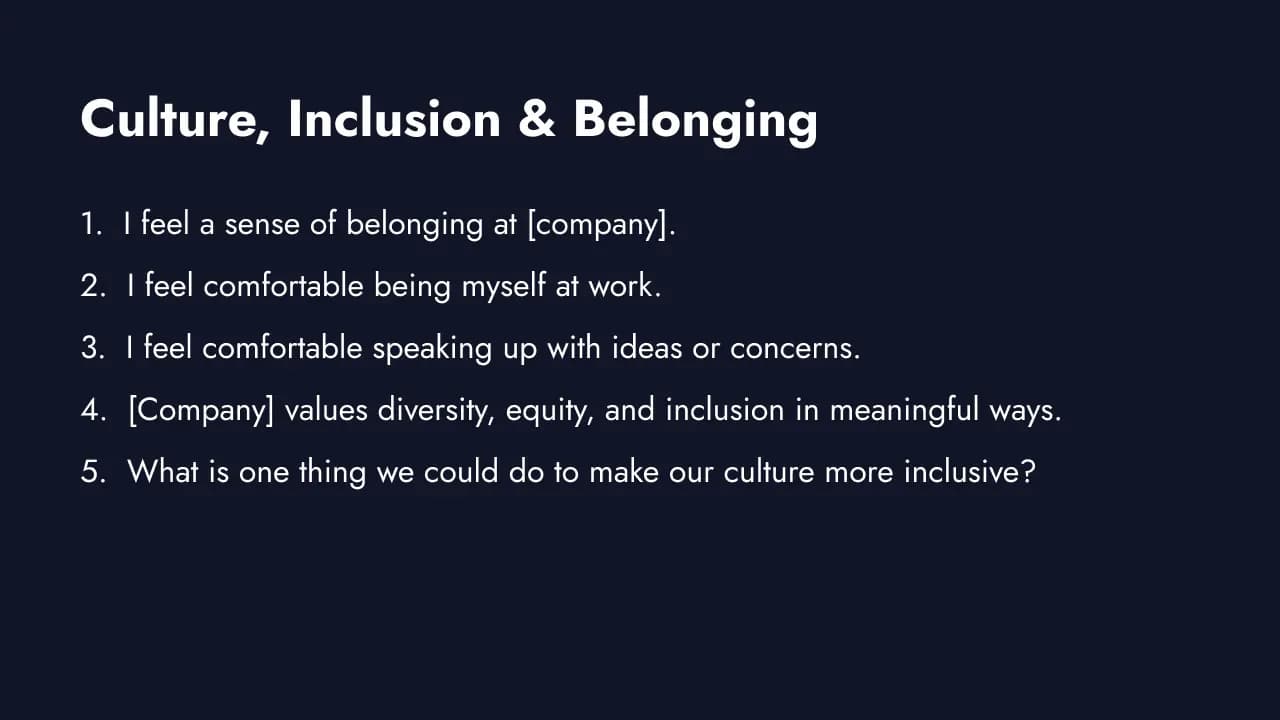
Before writing DEI survey questions, it helps to understand the frameworks that define what diversity and inclusion actually cover. These also directly answer some of the most common questions about the field.
The 4 Types of Diversity
Diversity is not one-dimensional. The four types organize the full range of human differences:
| Type | What It Covers | Examples |
|---|---|---|
| Internal | Characteristics you are born with | Race, ethnicity, gender, age, sexual orientation, physical ability |
| External | Characteristics acquired through experience | Education, socioeconomic background, religion, geographic location |
| Organizational | Workplace-specific attributes | Job function, department, seniority, management level |
| Worldview | Values and perspectives shaped by life | Political beliefs, cultural frameworks, lived experiences |
DEI surveys primarily measure whether people across all four types experience equal belonging, opportunity, and respect.
The Big 8 Dimensions of Diversity
The "Big 8" are the dimensions most commonly associated with systemic discrimination and social inequality: Race, Gender, Sexual orientation, Ability/disability, Religion, Nationality and ethnicity, Socioeconomic class, and Age. These eight receive particular attention in DEI work because they frequently intersect and because disadvantage in one dimension often compounds disadvantage in others.
The 4 Layers of Diversity (Gardenswartz and Rowe)
This model organizes diversity into four concentric layers:
- Personality (core) -- individual traits and communication style
- Internal dimensions -- race, age, gender, sexual orientation, physical ability, ethnicity
- External dimensions -- income, education, work experience, parental status, religion, location
- Organizational dimensions -- department, seniority, job function, management status
Survey questions that segment by layer give you more precise data than questions that treat diversity as a single dimension.
The 4 Pillars of Inclusion
What makes a workplace genuinely inclusive? Most frameworks converge on four pillars:
- Respect -- treating every person with dignity regardless of background
- Belonging -- people feel genuinely welcome and valued, not just tolerated
- Equity -- fair access to opportunities, resources, and advancement
- Psychological safety -- people can speak up, make mistakes, and be themselves without fear
Each theme in the survey questions below maps to one or more of these pillars.
Why DEI Surveys Require Special Care
DEI surveys touch on discrimination, identity, power dynamics, and personal safety. The stakes are higher than a typical engagement survey, and the methodology needs to reflect that.
Anonymity is non-negotiable. People will not report discrimination, microaggressions, or exclusion if they believe their identity can be traced. Use a survey platform that strips identifying metadata from responses. Self-hosting your survey with a tool like Formbricks gives you full control over where sensitive responses are stored and who can access them.
Small group sizes can identify respondents. If only three women work in engineering, reporting DEI results for "women in engineering" effectively identifies those individuals. Never report results for groups smaller than 5.
Social desirability bias is extremely high. People want to appear tolerant and open-minded, even on anonymous surveys. Frame questions around behaviors and experiences rather than attitudes and beliefs to reduce this effect.
Trust must be built before and after. Explain the purpose before launch. Detail how anonymity is guaranteed. After the survey, share aggregate results with all employees and publish a clear action plan. If employees share their experiences and nothing changes, they will not participate next time.
Legal and privacy considerations matter. GDPR applies if you operate in the EU. EEOC guidelines apply in the US. Demographic questions must always be voluntary. For collecting demographic data alongside DEI questions, the demographic survey template provides a privacy-first starting point.
50+ Diversity and Inclusion Survey Questions by Theme
Use a 5-point Likert scale (Strongly Disagree to Strongly Agree) for agreement questions unless otherwise noted. Every question should be optional.
Theme 1: Belonging and Psychological Safety (Questions 1-8)
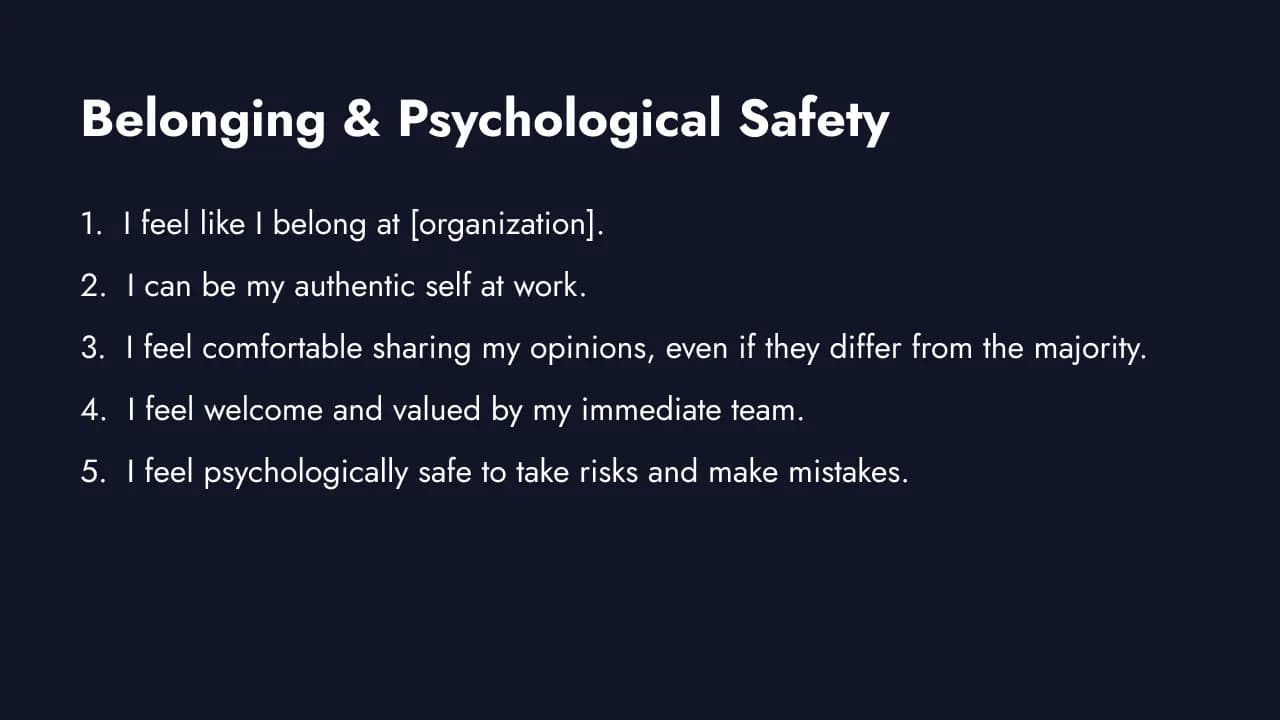
Belonging is the foundation of inclusion. Low scores here signal that diversity efforts are not translating into actual inclusion for employees.
1. "I feel like I belong at [organization]."
- Likert | Essential -- Your headline belonging metric. Track this as the primary indicator of inclusion health over time.
2. "I can be my authentic self at work."
- Likert | Essential -- Measures whether employees feel they need to mask parts of their identity. Gaps between demographic groups reveal where inclusion is failing.
3. "I feel comfortable sharing my opinions, even if they differ from the majority."
- Likert | Essential -- Psychological safety for dissent. If people only feel safe agreeing, you have a conformity culture.
4. "I feel welcome and valued by my immediate team."
- Likert | Recommended -- Inclusion is experienced most directly within teams. Company-level scores can look better than team-level reality.
5. "I feel psychologically safe to take risks and make mistakes."
- Likert | Recommended -- Underrepresented employees often face higher scrutiny for mistakes. Segmenting this question by demographic reveals where psychological safety is unequal.
6. "My unique background and perspective are valued here."
- Likert | Recommended -- There is a meaningful gap between "people tolerate me" and "people value what I bring because of my background."
7. "I would feel comfortable reporting a DEI concern without fear of retaliation."
- Likert | Essential -- Measures trust in reporting mechanisms. Low scores mean existing issues go unreported.
8. "I feel a sense of community with my colleagues."
- Likert | Recommended -- Community belonging predicts retention and engagement, particularly for remote and hybrid employees who lack informal connection opportunities.
Theme 2: Equal Opportunity and Fairness (Questions 9-16)
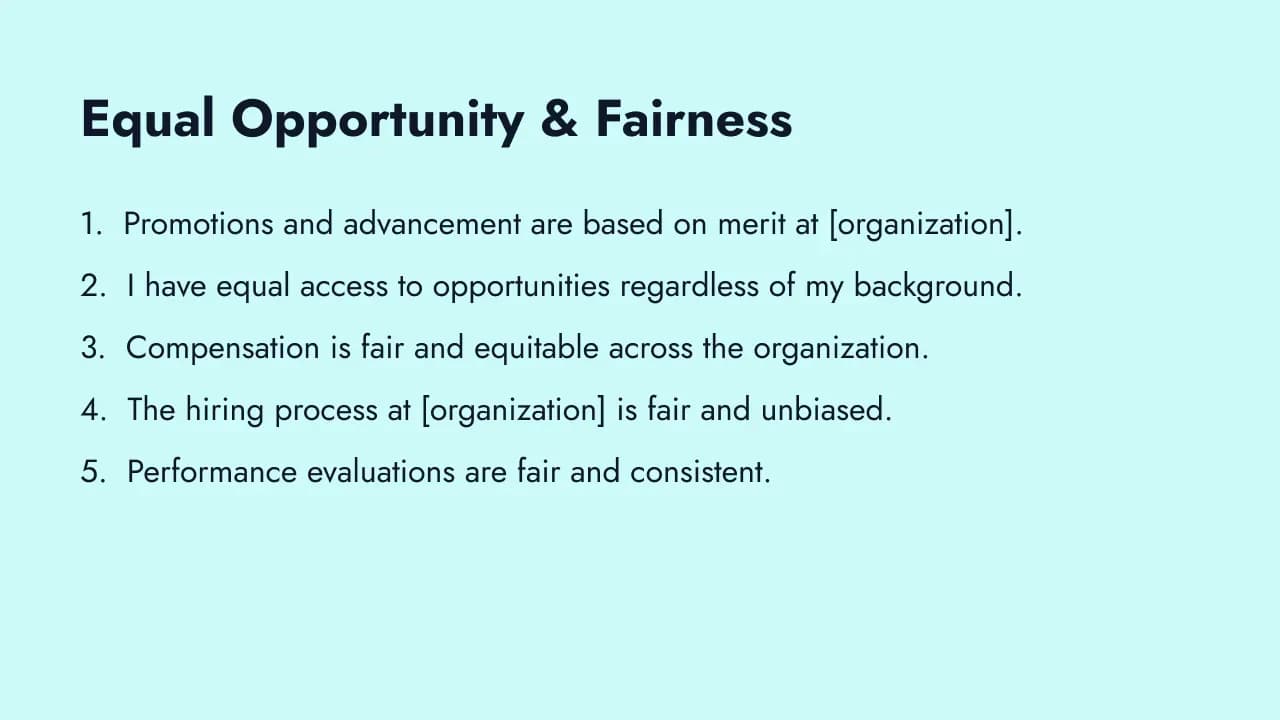
Fairness in opportunity is where inclusion translates into tangible outcomes.
9. "Promotions and advancement are based on merit at [organization]."
- Likert | Essential -- Perceived fairness of advancement. Large gaps between groups indicate systemic barriers that merit language alone does not fix.
10. "I have equal access to opportunities regardless of my background."
- Likert | Essential -- Broad opportunity access. Cross-tabulate with demographics to find where access gaps exist.
11. "Compensation is fair and equitable across the organization."
- Likert | Recommended -- Even if a pay audit shows equity, perception gaps damage trust and retention equally.
12. "The hiring process at [organization] is fair and unbiased."
- Likert | Recommended -- Those who participated in or observed hiring have direct insight into whether the process is equitable.
13. "Performance evaluations are fair and consistent."
- Likert | Recommended -- Subjective evaluations consistently introduce bias. This question reveals whether employees feel that bias in their experience.
14. "I have equal access to mentorship and sponsorship opportunities."
- Likert | Essential -- Unequal mentorship access compounds over time, creating representation gaps in leadership even when hiring is equitable.
15. "Assignments and projects are distributed fairly across the team."
- Likert | Recommended -- High-visibility projects drive career growth. If certain employees consistently get routine work, opportunity is not equal regardless of what policies say.
16. "I am fairly recognized and rewarded for my contributions."
- Likert | Recommended -- Recognition equity. Underrepresented employees sometimes do equal or greater work with less visible credit.
Theme 3: Inclusive Culture and Behavior (Questions 17-24)
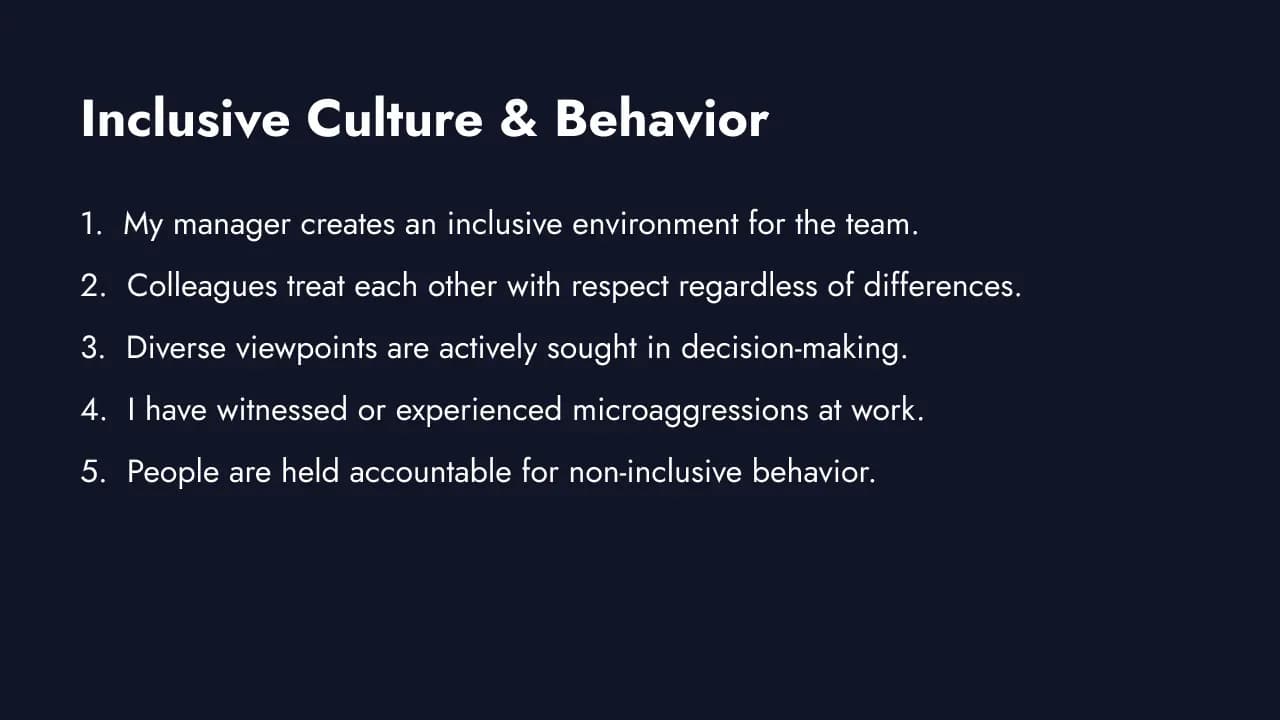
Culture is what happens between policies. These questions measure whether the workplace is actually inclusive day-to-day.
17. "My manager creates an inclusive environment for the team."
- Likert | Essential -- Managers set the tone for inclusion at the team level. Results here can directly target manager development.
18. "Colleagues treat each other with respect regardless of differences."
- Likert | Essential -- Peer-level inclusion. Respect across difference is the minimum bar.
19. "Diverse viewpoints are actively sought in decision-making."
- Likert | Recommended -- Active vs. passive inclusion. Are diverse perspectives invited, or merely tolerated when they appear?
20. "I have witnessed or experienced microaggressions at work."
- Frequency scale (Never / Rarely / Sometimes / Often / Very Often) | Essential -- Use a frequency scale, not agree/disagree. High scores signal a cultural problem that training alone will not fix. Consider a follow-up open-ended question for those responding "Sometimes" or higher.
21. "People are held accountable for non-inclusive behavior."
- Likert | Essential -- Accountability separates performative DEI from real DEI.
22. "Team meetings are structured so everyone can contribute equally."
- Likert | Recommended -- Meeting dynamics reveal power structures. If the same voices dominate every meeting, inclusion is not happening regardless of stated values.
23. "Cultural and religious differences are respected and accommodated."
- Likert | Recommended -- Covers practical accommodation: holiday flexibility, dietary considerations at events, prayer space, cultural awareness.
24. "I feel my language and communication style are respected at work."
- Likert | Recommended -- Language diversity includes accents, non-native English speakers, and communication style differences. Low scores often surface in international or multilingual teams.
Theme 4: Leadership and Representation (Questions 25-31)
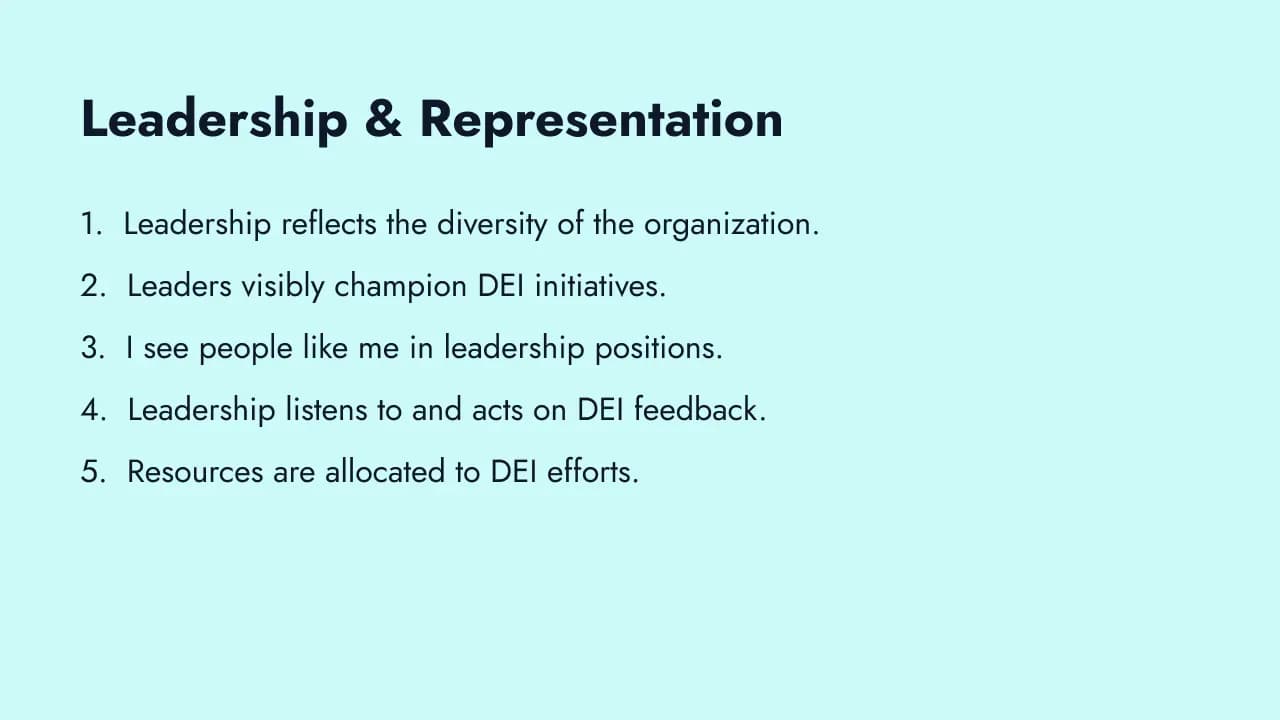
Representation at the top signals who the organization values.
25. "Leadership reflects the diversity of the organization."
- Likert | Essential -- Employees notice who gets promoted to the top. A leadership team that does not reflect the workforce sends a clear message about who belongs.
26. "Leaders visibly champion DEI initiatives."
- Likert | Recommended -- DEI efforts stall when leadership treats them as HR's responsibility rather than a business priority.
27. "I see people like me in leadership positions."
- Likert | Essential -- Subjective and intentionally so. Captures whether each individual feels personally represented.
28. "Leadership listens to and acts on DEI feedback."
- Likert | Essential -- Listening without acting is worse than not asking. This measures whether previous feedback led to visible change.
29. "Resources (budget, time, people) are allocated to DEI efforts."
- Likert | Recommended -- Budget reveals priorities. If DEI has no dedicated resources, employees notice the gap between words and investment.
30. "DEI goals are treated with the same priority as business goals."
- Likert | Recommended -- When DEI goals are the first things cut during busy periods, employees learn where they actually rank.
31. "Senior leaders demonstrate inclusive behaviors in their own interactions."
- Likert | Recommended -- Behavioral modeling from the top influences what behaviors are normalized throughout the organization.
Theme 5: Accessibility and Accommodation (Questions 32-36)
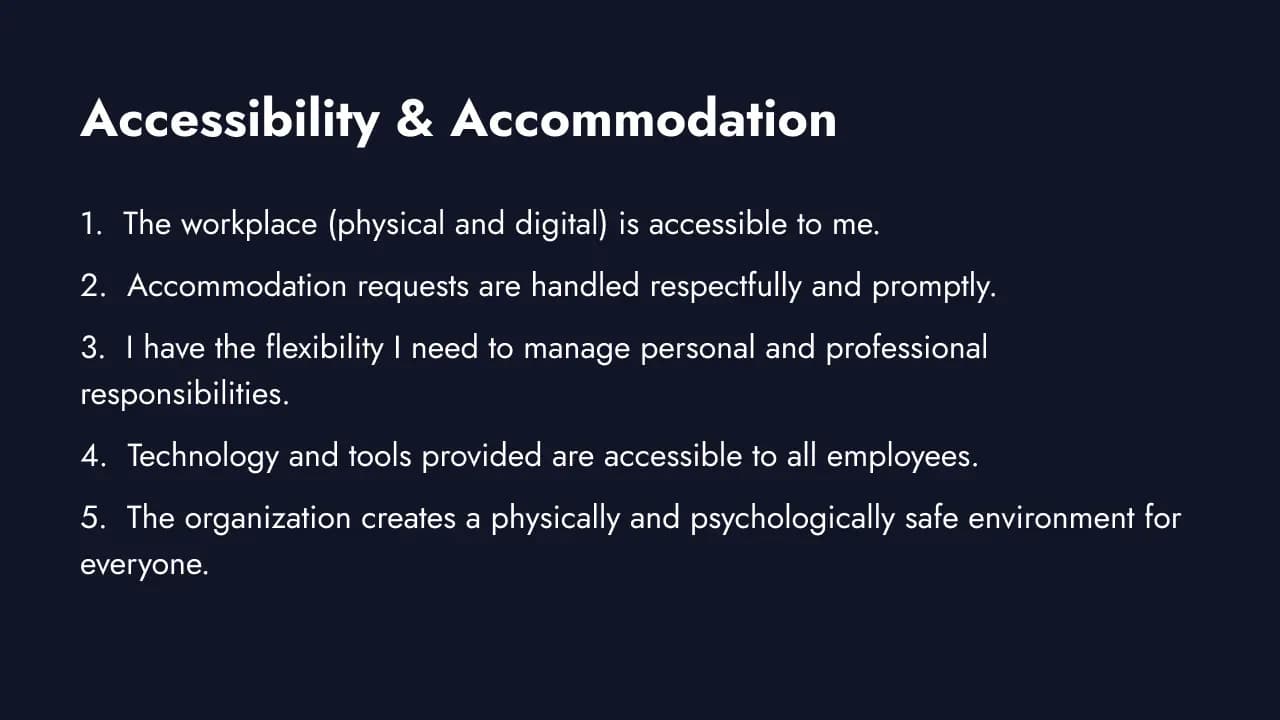
Inclusion means everyone can fully participate -- physically, digitally, and logistically.
32. "The workplace (physical and digital) is accessible to me."
- Likert | Essential -- Covers office accessibility and digital tool accessibility. Low scores from specific groups reveal infrastructure gaps invisible to the majority.
33. "Accommodation requests are handled respectfully and promptly."
- Likert | Recommended -- The experience of requesting accommodation matters as much as whether the request is granted.
34. "I have the flexibility I need to manage personal and professional responsibilities."
- Likert | Recommended -- Flexibility disproportionately affects caregivers, employees with disabilities, and those observing religious practices.
35. "Technology and tools provided are accessible to all employees."
- Likert | Recommended -- Digital accessibility: screen readers, captioning, color contrast, keyboard navigation.
36. "The organization makes meaningful efforts to create a physically and psychologically safe environment for everyone."
- Likert | Recommended -- Broader safety question that covers both physical access and freedom from harassment or hostility.
Theme 6: Thought-Provoking Questions for Deeper Reflection (Questions 37-43)
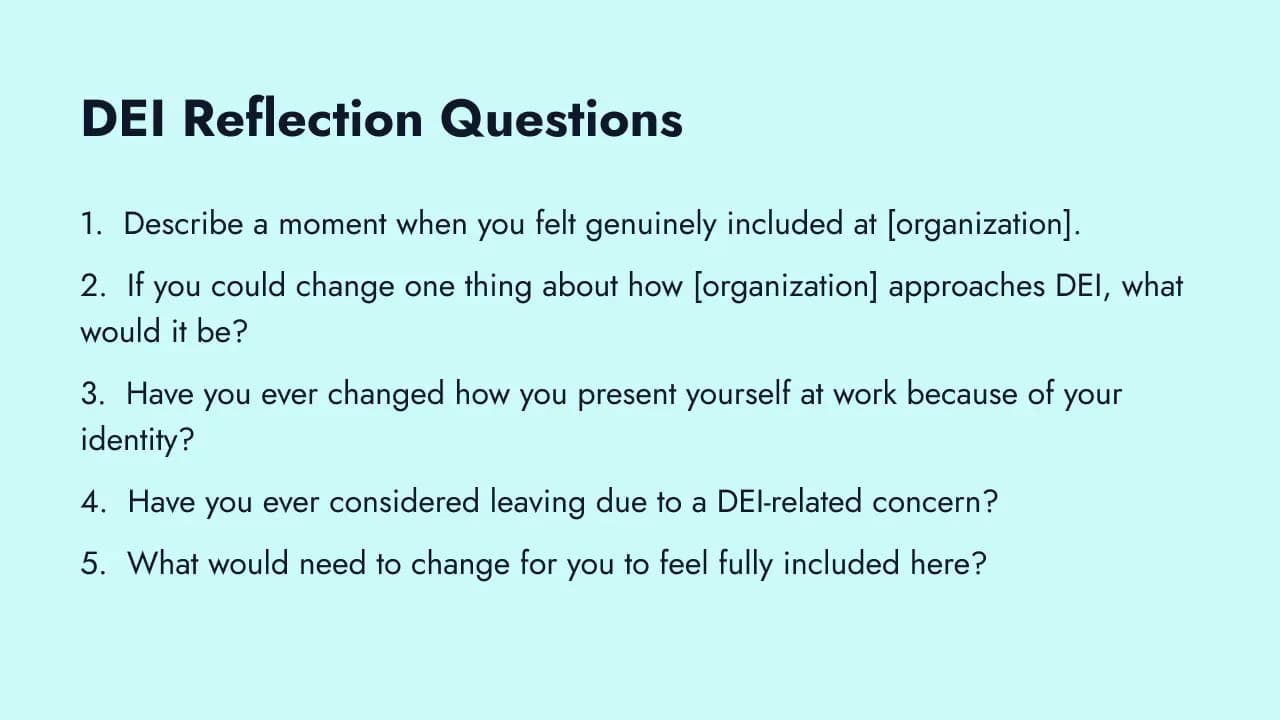
These questions surface systemic patterns and honest perceptions that structured Likert scales miss. Use them to generate qualitative insight alongside your scored data.
37. "Describe a moment when you felt genuinely included at [organization]. What made it feel that way?"
- Open-ended | Recommended -- Positive anchor question. Surfaces the specific behaviors and moments that create inclusion so you can replicate them.
38. "If you could change one thing about how [organization] approaches diversity and inclusion, what would it be?"
- Open-ended | Essential -- The single most actionable open-ended question in a DEI survey. The constraint forces prioritization.
39. "Have you ever changed how you present yourself at work (speech, appearance, behavior) because of your identity?"
- Yes / No with optional explanation | Essential -- Measures "covering" behavior. A high "yes" rate signals that employees feel they cannot be authentic and are managing perception at a cost to themselves.
40. "Have you ever considered leaving [organization] due to a DEI-related concern?"
- Yes / No with optional open-ended follow-up | Essential -- Retention risk indicator. A high "yes" rate is a red flag requiring organizational review, not individual follow-up (which would compromise anonymity).
41. "What would need to change for you to feel fully included here?"
- Open-ended | Recommended -- Solution-oriented and forward-looking. Employees often have practical ideas leadership has not considered.
42. "Do you believe [organization]'s DEI efforts are genuine? Why or why not?"
- Open-ended | Recommended -- Tests for authenticity vs. performative DEI. Honest answers here tell you whether employees believe the organization means what it says.
43. "Is there anything about your experience with inclusion at [organization] that you want to share that we have not asked about?"
- Open-ended | Essential -- The catch-all. Always include as the final question. Some of the most important feedback comes from topics you did not think to ask about.
Theme 7: Diversity and Inclusion Survey Questions for Students (Questions 44-51)
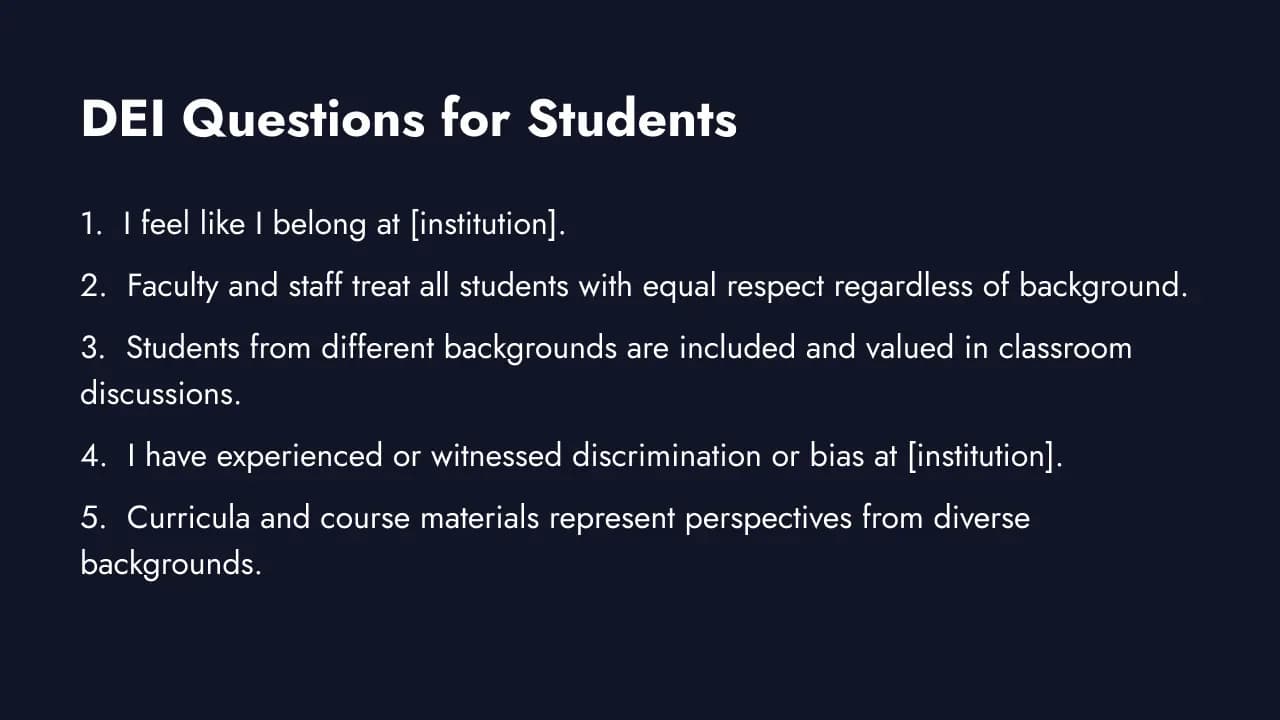
These questions are adapted for educational environments: universities, schools, and student-facing organizations. They measure the same core dimensions of belonging, equity, and inclusion within an academic context.
44. "I feel like I belong at [institution/organization]."
- Likert | Essential -- The foundational belonging question, adapted for educational context.
45. "Faculty and staff treat all students with equal respect regardless of background."
- Likert | Essential -- Peer respect from authority figures. Power dynamics in educational settings make this question particularly important.
46. "Students from different backgrounds are included and valued in classroom discussions."
- Likert | Essential -- Measures whether inclusion happens at the point of learning, not just in policy.
47. "I have experienced or witnessed discrimination or bias at [institution]."
- Frequency scale (Never / Rarely / Sometimes / Often / Very Often) | Essential -- Direct discrimination indicator. Segment by demographic group to identify where discrimination is concentrated.
48. "Curricula and course materials represent perspectives from diverse backgrounds."
- Likert | Recommended -- Representation in content. A curriculum built around a single cultural perspective signals whose knowledge the institution values.
49. "I feel comfortable expressing my cultural, religious, or personal identity in this environment."
- Likert | Essential -- Authenticity in educational context. Students should not feel required to mask their identity to succeed academically.
50. "Resources and support (financial, academic, social) are equitably accessible to all students."
- Likert | Recommended -- Equity in access. First-generation students, students with disabilities, and students from lower socioeconomic backgrounds often face structural barriers invisible to the majority.
51. "What is one change [institution] could make to become more inclusive for students like you?"
- Open-ended | Essential -- Direct student input. Students experiencing exclusion firsthand have the most accurate picture of what needs to change.
DEI Survey Best Practices
Getting honest data on sensitive topics requires more care than a standard engagement survey. These practices are not optional.
Guarantee anonymity and explain the mechanics. Do not just say "this survey is anonymous." Explain how: responses are not linked to email addresses, results are only reported for groups of 5 or more, no manager sees individual responses. The more specific you are, the more trust you build. Self-hosting your survey with Formbricks lets you guarantee data stays within your own infrastructure.
Make every question optional. People should be able to skip any question they are uncomfortable answering. Forced responses on sensitive topics produce unreliable data and erode trust.
Run annually with pulse checks in between. A comprehensive annual DEI survey provides trendable data. Quarterly pulse checks (3-5 questions) let you monitor specific initiatives without waiting a full year. Do not survey more frequently than quarterly to avoid fatigue.
Share aggregate results with all employees. Publish the overall findings, the themes that emerged, and the action plan with timelines. Employees who shared vulnerable feedback deserve to see what the organization will do about it.
Create action plans with accountability and timelines. Each identified theme needs an owner, a specific action, a timeline, and a measurable target. "We will improve inclusion" is not an action plan. "VP of People will launch inclusive meeting training for all managers by Q3 with 90% completion target" is.
Do not run a DEI survey unless you are prepared to act. Running a survey, collecting painful truths, and doing nothing is worse than never asking. It signals that the organization does not care despite claiming to.
Common DEI Survey Mistakes
Running surveys without guaranteed anonymity. If employees can be identified, they will not disclose negative experiences. Use a GDPR-compliant survey tool that strips identifying metadata, and communicate the anonymity protections clearly.
Reporting results for small groups. If your company has 4 nonbinary employees and you report results for "nonbinary employees," you have effectively identified those individuals. Set a minimum group size of 5 for any reported segment.
Asking demographic questions without explaining why. Explain that demographics enable you to identify disparities across groups and that answering is entirely voluntary. Without this context, demographic questions feel invasive and reduce participation.
Surveying without follow-up action. The fastest way to destroy trust is to ask employees about their experiences with discrimination and inclusion, then do nothing with the data.
Using leading or politically loaded language. Avoid language that signals a correct answer. "Do you agree that [company] is an inclusive workplace?" is leading. "I feel included at [company]" on a balanced scale is neutral.
Only surveying underrepresented groups. DEI surveys should go to all employees. Segmented analysis after collection reveals group-level patterns without targeted distribution that makes certain employees feel singled out.
Free DEI Survey Template
Formbricks offers free, open-source survey templates you can customize and deploy in minutes. For DEI surveys specifically, data privacy is not just a best practice -- it is a prerequisite for honest responses. Formbricks supports self-hosting, meaning sensitive DEI survey data never leaves your infrastructure.
Related templates:
- Employee Engagement Survey for measuring overall engagement
- Employee Satisfaction Survey for workplace satisfaction
- Demographic Survey for collecting identity data responsibly
Get Your Free DEI Survey Template →
Frequently Asked Questions
Try Formbricks now