

Canny vs Productboard vs Featurebase (vs Formbricks): Which Feedback Tool Fits Your Team in 2026?

Johannes
Co-Founder @ Formbricks
14 Minutes
August 17th, 2026
If you're comparing Canny, Productboard, and Featurebase, you're evaluating three tools that all touch "product feedback" but solve genuinely different jobs. Before picking one, it's worth being clear about what each is actually built for.
👉 Canny is the classic feature-voting and public roadmap tool, now layered with AI (Autopilot) that reads sales calls and support tickets to capture feedback automatically. It bills by "tracked users," anyone who's given feedback via a post, vote, or comment.
👉 Productboard is the fullest product-management suite of the three: strategy, roadmapping, and AI-drafted delivery-ready specs (Spark), priced per "maker" (the PM who owns strategy, not every contributor).
👉 Featurebase is the broadest bundle: an AI helpdesk, feedback boards, a public roadmap, a changelog, and a knowledge base, all under one per-seat subscription, positioned to replace 4-5 separate tools at once.
None of the three run structured NPS®/CSAT surveys as their core methodology, and none offer a self-hosted deployment option. If either of those matters to your evaluation, there's a fourth option worth knowing about, though we'll be direct: it's not a substitute for the public voting board or roadmap functionality these three compete on.
👉 Formbricks is an open feedback and experience management suite (feedback management, feedback analytics, workflows and integrations) with a genuinely self-hosted option. Its overlap with this comparison is narrow and specific: teams that want structured feedback collection (in-app surveys, NPS, PMF) alongside whichever of these three tools they use for public voting and roadmapping. Formbricks does not do public feedback boards, upvoting, or roadmap publishing, if that's what you need, it's Canny, Productboard, or Featurebase, not Formbricks.
Table of contents:
- Canny vs Productboard vs Featurebase vs Formbricks at a glance
- What buyers actually mean by this comparison
- Canny: AI-captured feedback and public voting boards
- Productboard: the full product-management suite
- Featurebase: the all-in-one support and feedback bundle
- Where Formbricks fits (and where it honestly doesn't)
- Side-by-side pricing
- Feature value breakdown
- Who should choose which platform
- FAQ
- Final verdict
Canny vs Productboard vs Featurebase vs Formbricks at a Glance
| Canny | Productboard | Featurebase | Formbricks | |
|---|---|---|---|---|
| Core job | Public feedback voting and roadmap | Strategy, roadmapping, delivery-ready specs | Support + feedback + help center bundle | Structured feedback collection (surveys, NPS, PMF) |
| Pricing model | Per tracked user | Per maker (PM), contributors free | Per seat | Per workspace/response volume |
| Free plan | 25 tracked users | 1 maker, 500 feedback notes | 1 seat, 1 board, 1 roadmap | 250 responses/month |
| Cheapest paid tier | $79/month (Pro) | $19/maker/month (Plus) | $29/seat/month (Growth) | $74/month (Pro) |
| AI feedback capture | Autopilot reads sales calls & tickets | Spark AI drafts specs from feedback | Fibi AI agent + AI duplicate detection | AI topic/subtopic labeling (Scale tier) |
| Public voting board | Yes, core product | Yes | Yes | No |
| Structured NPS/CSAT surveys | No | No | Basic (Outbound module, Growth+) | Yes, core product |
| Self-hosting | No | No | No | Yes (Community Edition, AGPLv3, free) |
What Buyers Actually Mean by This Comparison
A third-party comparison that surfaced repeatedly while researching this guide frames the pricing-model split cleanly: "Canny bills per tracked user, Featurebase per seat, Productboard per maker." That one line captures most of the practical decision, since each pricing unit rewards a different team shape.
Among the three, Productboard is positioned as the fullest PM operating system, strategy, roadmapping, delivery-ready specs. Canny is the lighter, classic feedback-voting focus with AI capture layered on top. Featurebase is the broadest bundle, adding a full helpdesk and knowledge base around its feedback module.
None of the three treats structured survey research (NPS, CSAT, PMF) as its primary methodology. Featurebase comes closest with a basic "Outbound" survey module on its Growth tier and above, but per its own pricing page, that's a secondary feature bolted onto a support-and-feedback product, not a dedicated survey engine.
Canny: AI-Captured Feedback and Public Voting Boards
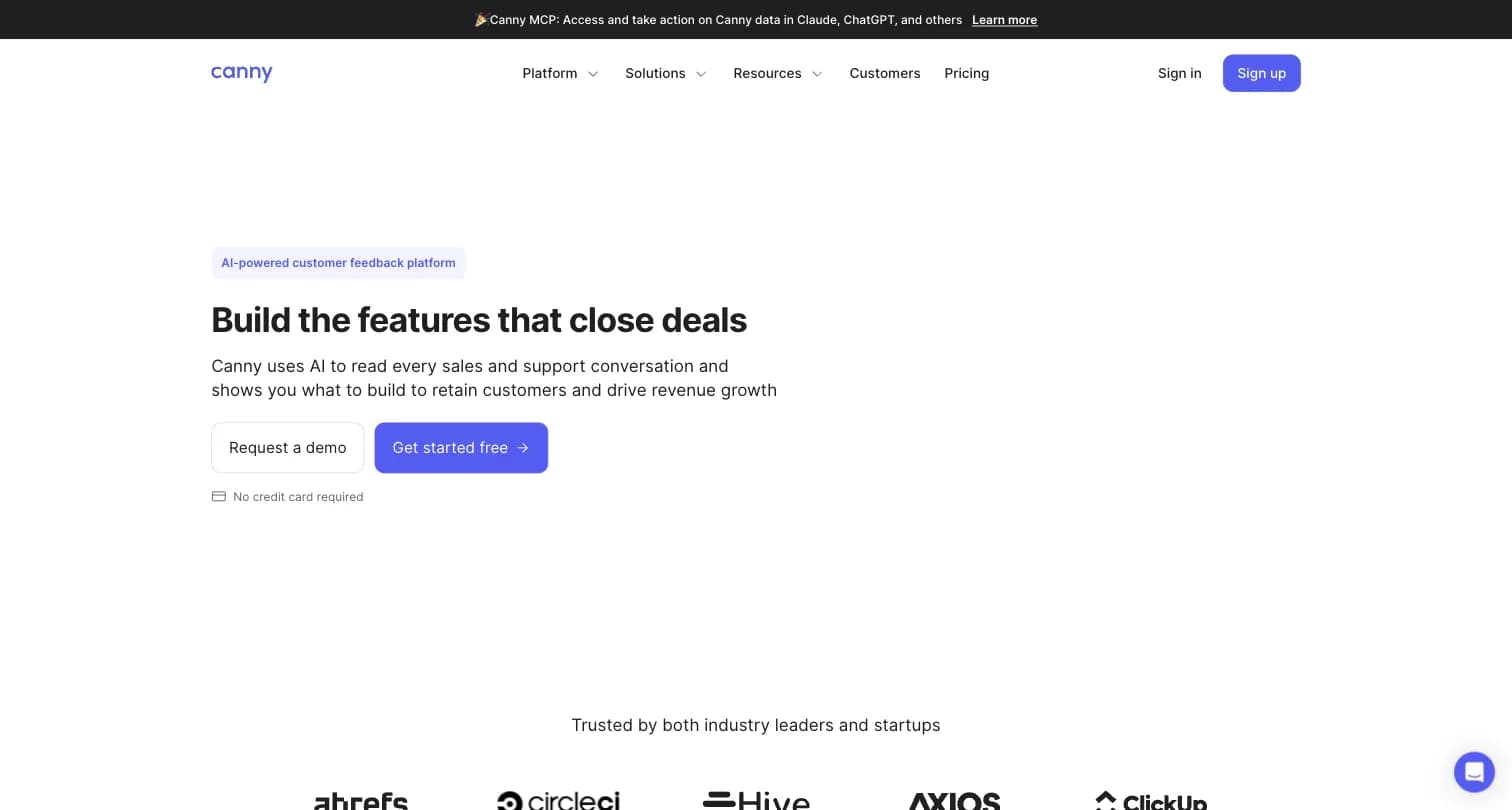
Captured August 15, 2026 from canny.io.
Canny launched in 2017 as feature-voting boards, founded by Sarah Hum and Andrew Rasmussen, who met as a designer and engineer at Meta. The company is bootstrapped and profitable. Its positioning has since shifted toward AI: "Canny uses AI to read every sales and support conversation and shows you what to build to retain customers and drive revenue growth," per its own homepage.
Key features:
- Autopilot AI feedback capture, reads support tickets, sales calls (Gong), and chat tools like Intercom and Slack to automatically capture, deduplicate, and triage feedback without manual entry
- Revenue-linked prioritization, links feedback posts to account/MRR/opportunity data via CRM integrations
- Public feedback boards, roadmap, and changelog in one lightweight tool
- Integrations with Intercom, Zendesk, Slack, Jira, ClickUp, Linear, Asana, GitHub, Azure DevOps, HubSpot, Salesforce, and Zapier
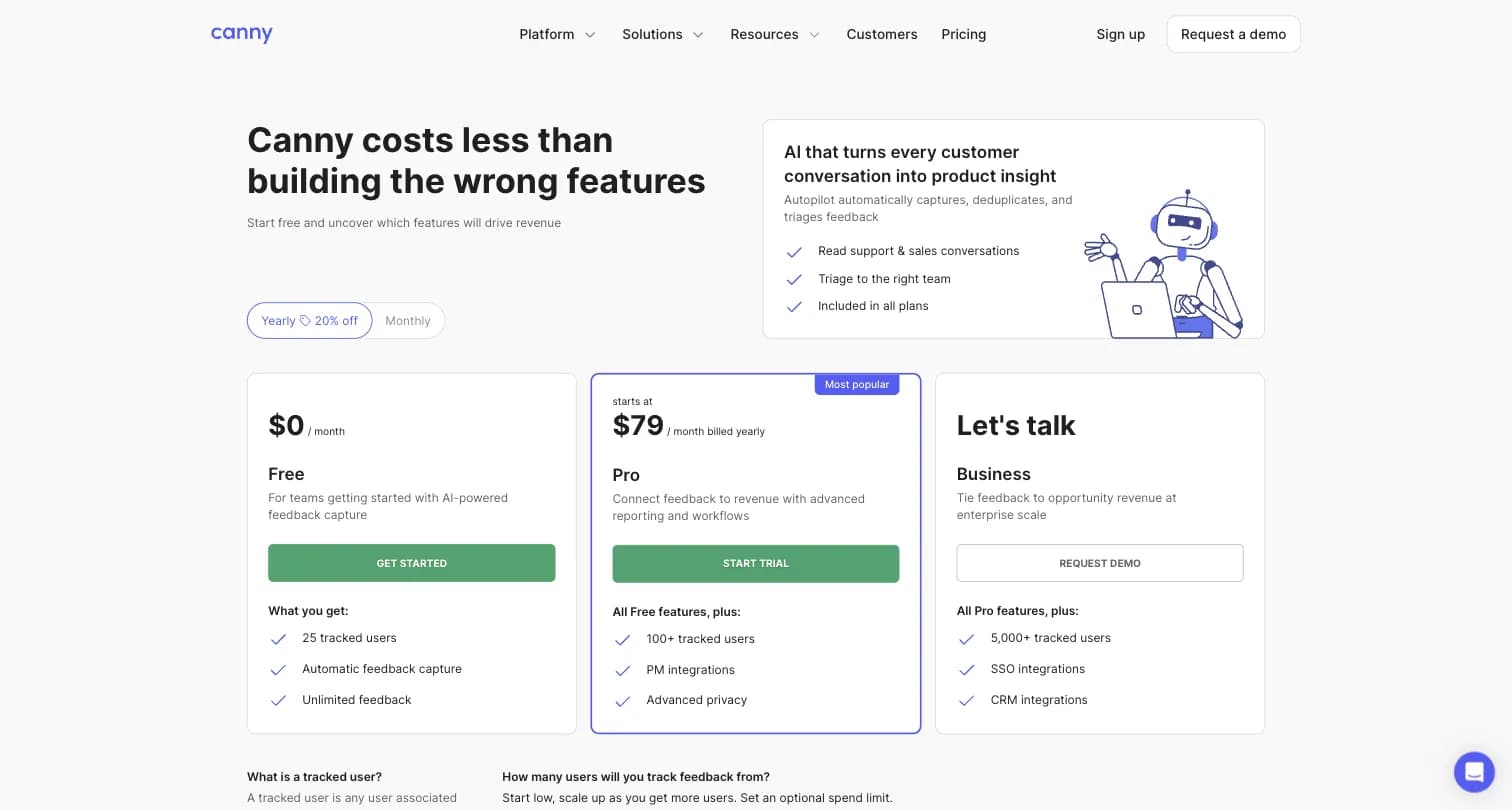
Captured August 15, 2026 from canny.io/pricing.
Pricing:
| Tier | Price | Tracked Users |
|---|---|---|
| Free | $0/month | 25 tracked users |
| Pro | $79/month billed yearly | 100+ tracked users |
| Business | Custom, contact sales | 5,000+ tracked users |
Canny's billing unit, "tracked users," means anyone who's given feedback via a post, vote, or comment (including feedback Autopilot finds automatically). Canny's own FAQ estimates this is typically 1-5% of a B2B SaaS company's total user base, a genuinely unusual pricing model that requires some estimation before you can budget accurately.
Reviews: 4.5 rating across 108 reviews on G2, 4.6 across 77 reviews on Capterra. Reviewers praise ease of use and the ability to merge duplicate requests and link posts to revenue data via HubSpot. Common complaints: filtering by only one attribute at a time, Autopilot sometimes merging tickets unhelpfully, and Pro plan seat/tracked-user caps forcing upgrade friction for growing teams.
Best for: Teams that want an AI (Autopilot) that automatically captures feature requests from sales calls and support tickets without manual logging, plus a public feedback board, roadmap, and changelog in one lightweight tool.
Productboard: The Full Product-Management Suite
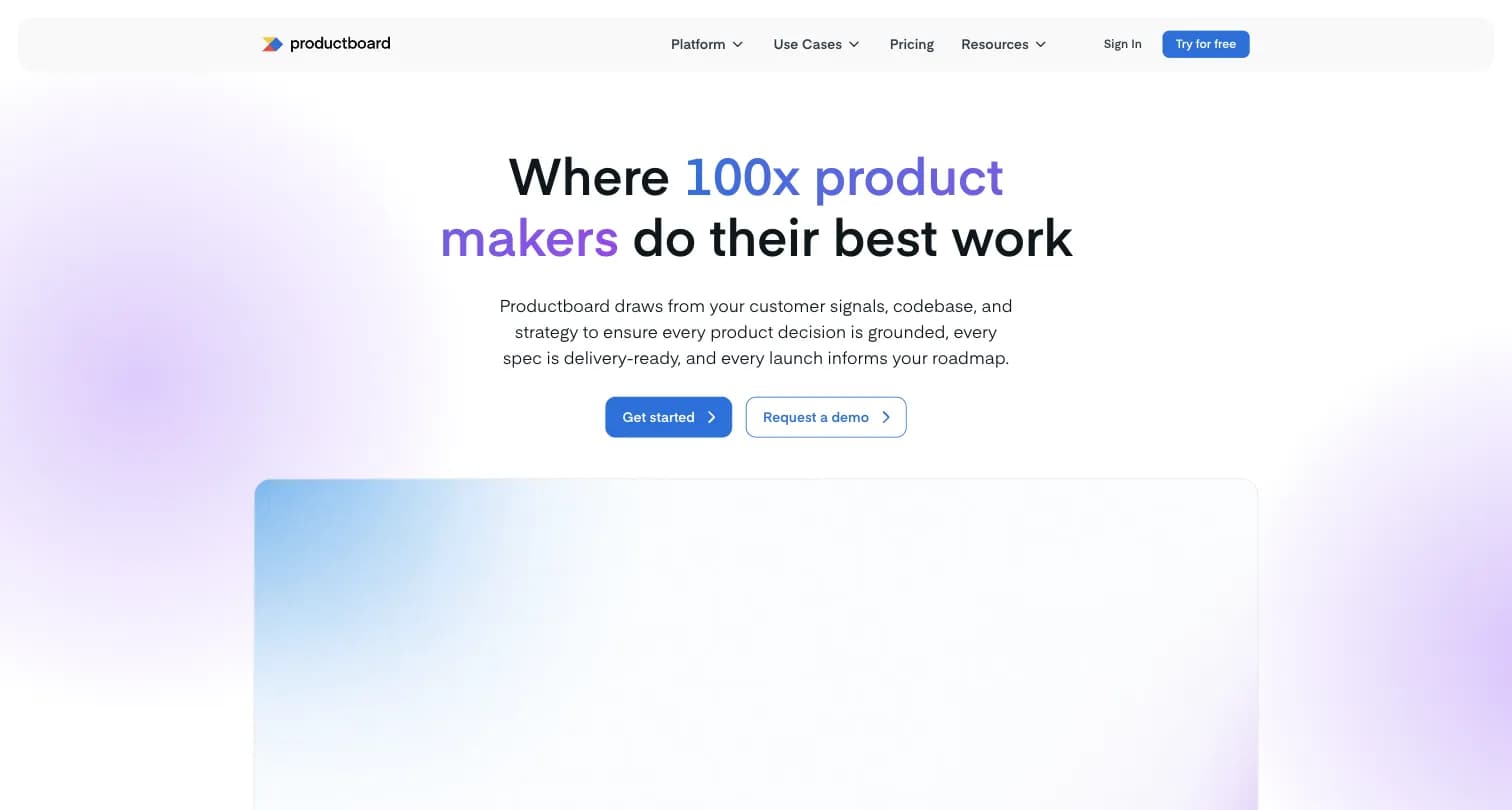
Captured August 15, 2026 from productboard.com.
Productboard was founded in 2014 by Hubert Palan and Daniel Hejl, and has grown to 500+ employees across San Francisco, Vancouver, Dublin, London, Prague, and Brno, backed by Sequoia Capital, Kleiner Perkins, Index Ventures, and Bessemer Venture Partners. It positions itself as an "agentic product management system": "Productboard draws from your customer signals, codebase, and strategy to ensure every product decision is grounded, every spec is delivery-ready, and every launch informs your roadmap."
Key features:
- Spark AI agent, surfaces product opportunities with citations, drafts delivery-ready specs from feedback synthesis, and measures post-launch impact
- Centralized feedback repository, one searchable repository for all product requests with AI-powered trend surfacing
- Roadmapping and prioritization, timeline and column-based roadmaps, customizable prioritization formulas, release planning, dependency tracking (Business tier and above)
- Customer-facing portal for sharing plans and validating ideas

Captured August 15, 2026 from productboard.com/pricing.
Pricing:
| Tier | Price | Notes |
|---|---|---|
| Free | $0 | 1 maker minimum, 25 contributors, 500 feedback notes, 1 teamspace |
| Plus | $19/maker/month billed annually ($25/mo billed monthly) | 250 AI credits/maker/month |
| Business | $59/maker/month billed annually ($75/mo billed monthly), 2-maker minimum | 500 AI credits/maker/month, unlimited feedback notes |
| Enterprise | Custom, 5-maker minimum | 800 AI credits/maker/month, SAML SSO, Salesforce integration |
Productboard's pricing is per "maker" (the PM or lead who owns strategy), not per total user, contributors who just submit or tag feedback don't count toward the maker limit. That's a meaningfully different model than Canny's tracked-user billing or Featurebase's per-seat billing. A second, usage-based dimension (AI credits) sits on top of the seat price; per Productboard's own numbers, analyzing 100 feedback items uses roughly 30-50 credits, so heavy AI users can hit monthly caps.
Reviews: 4.3 rating across 254 reviews on G2, 4.7 across 154 reviews on Capterra. Reviewers praise centralized feedback management and strong Jira/Slack/MS Teams integrations, but flag an overwhelming interface for new or non-PM users, and pricing that scales unpredictably with maker count.
Best for: Product teams that want an AI agent to turn scattered feedback into delivery-ready specs and roadmaps, with enterprise-grade roadmap governance at scale.
Featurebase: The All-in-One Support and Feedback Bundle
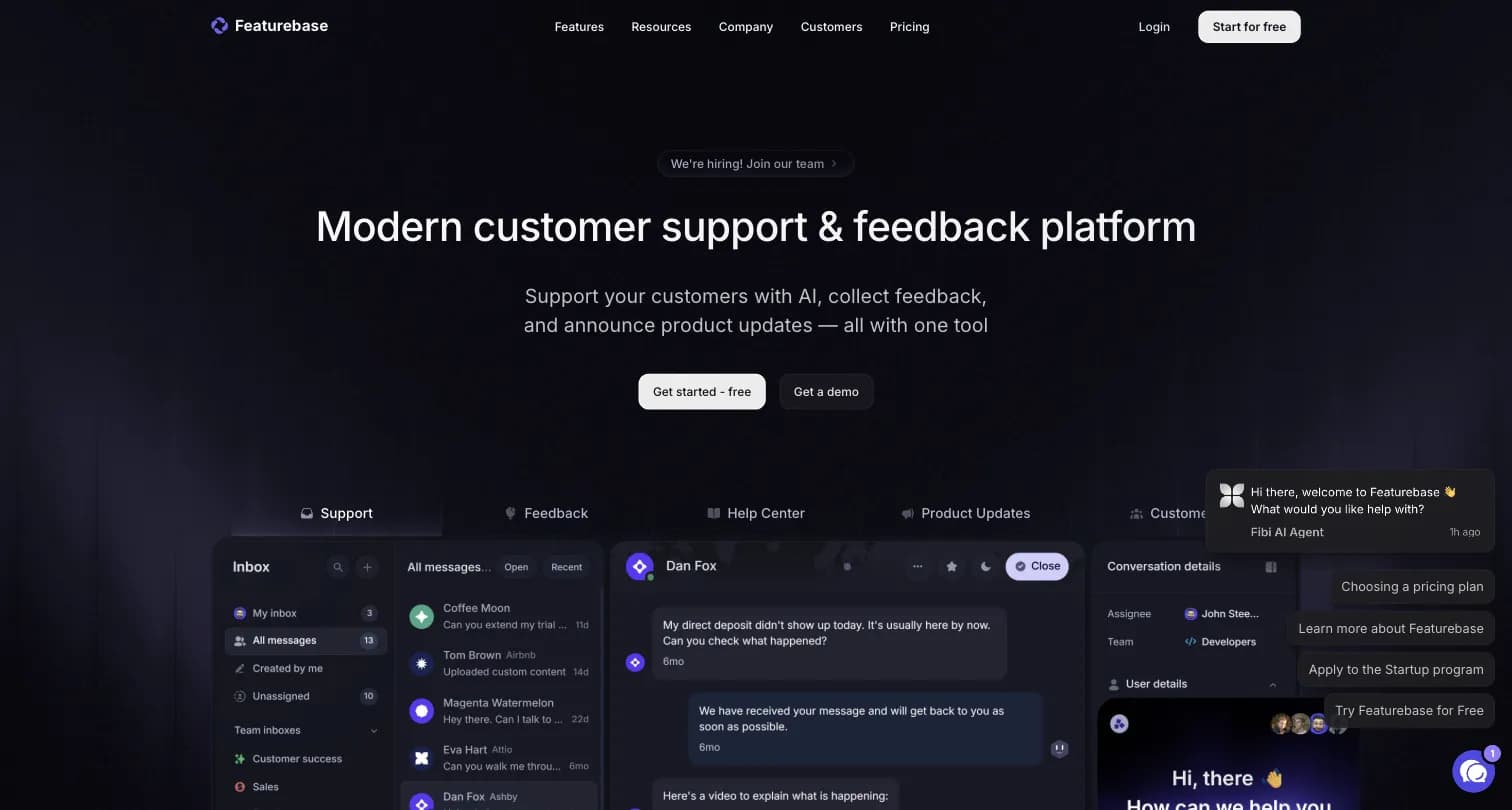
Captured August 15, 2026 from featurebase.app.
Featurebase was founded at the end of 2020 by a 3-person team (Bruno Hiis, Robi, and Markus) based in Tallinn, Estonia, per its own About page, and is fully bootstrapped and profitable. Its positioning is the broadest of the three: "Support your customers with AI, collect feedback, and announce product updates, all with one tool."
Key features:
- Fibi AI support agent, resolves customer issues automatically across an omnichannel inbox (chat, Slack, email), billed per successful resolution
- Feedback and roadmap voting, centralized hub with public boards, in-app widgets, upvoting, and automatic loop-closing when a request ships
- Help Center and changelog, AI-powered self-serve knowledge base (40+ languages) plus public and in-app changelog widgets
- Workflows and automations, no-code visual workflow builder for SLAs, round-robin assignment (Professional tier+)

Captured August 15, 2026 from featurebase.app/pricing.
Pricing:
| Tier | Price | Notes |
|---|---|---|
| Free | $0/month | 1 seat, 1 feedback board, 1 roadmap, no AI features |
| Growth | $29/seat/month billed yearly | Fibi AI Agent (+$0.49/resolution), 5 feedback boards, 5 roadmaps |
| Professional | $59/seat/month billed yearly | Plus 20 free "Lite" seats, workflows, SLAs, 10 boards/roadmaps |
| Enterprise | $99/seat/month billed yearly | Plus 50 free Lite seats, multi-brand workspace, Salesforce/HubSpot sync |
AI features (Fibi resolutions, AI Copilot beyond a free allotment) are billed separately at $0.49/resolution or $19/seat/month for unlimited Copilot, on top of the seat price. Removing Featurebase branding is a further $69/month add-on even on paid plans. Worth flagging: Capterra's own listing shows different flat-rate pricing ($49/$99/$207/month) than Featurebase's current live seat-based pricing, likely a stale, unsynced third-party listing, we treated Featurebase's own live pricing page as authoritative.
Reviews: 4.7 rating across 50 reviews on G2, which categorizes Featurebase broadly across AI Agents, Survey, Live Chat, Knowledge Base, Help Desk, and Product Management, reflecting its all-in-one bundle rather than a single feedback-tool category. Reviewers describe great value for money given how many separate tools it replaces, though AI resolution add-on pricing and seat/Lite-seat allotments make total cost harder to predict than a flat subscription.
Best for: Startups that want to replace 5+ separate tools (helpdesk, feedback board, knowledge base, changelog) with one subscription and a generous free tier.
Where Formbricks Fits (and Where It Honestly Doesn't)
Here's the part worth being upfront about: Formbricks does not compete with Canny, Productboard, or Featurebase on their actual core job. None of Formbricks' feature set includes a public voting board, upvoting, or a customer-facing roadmap page. If that's what you need, this comparison is genuinely between the three tools above, not a four-way race.
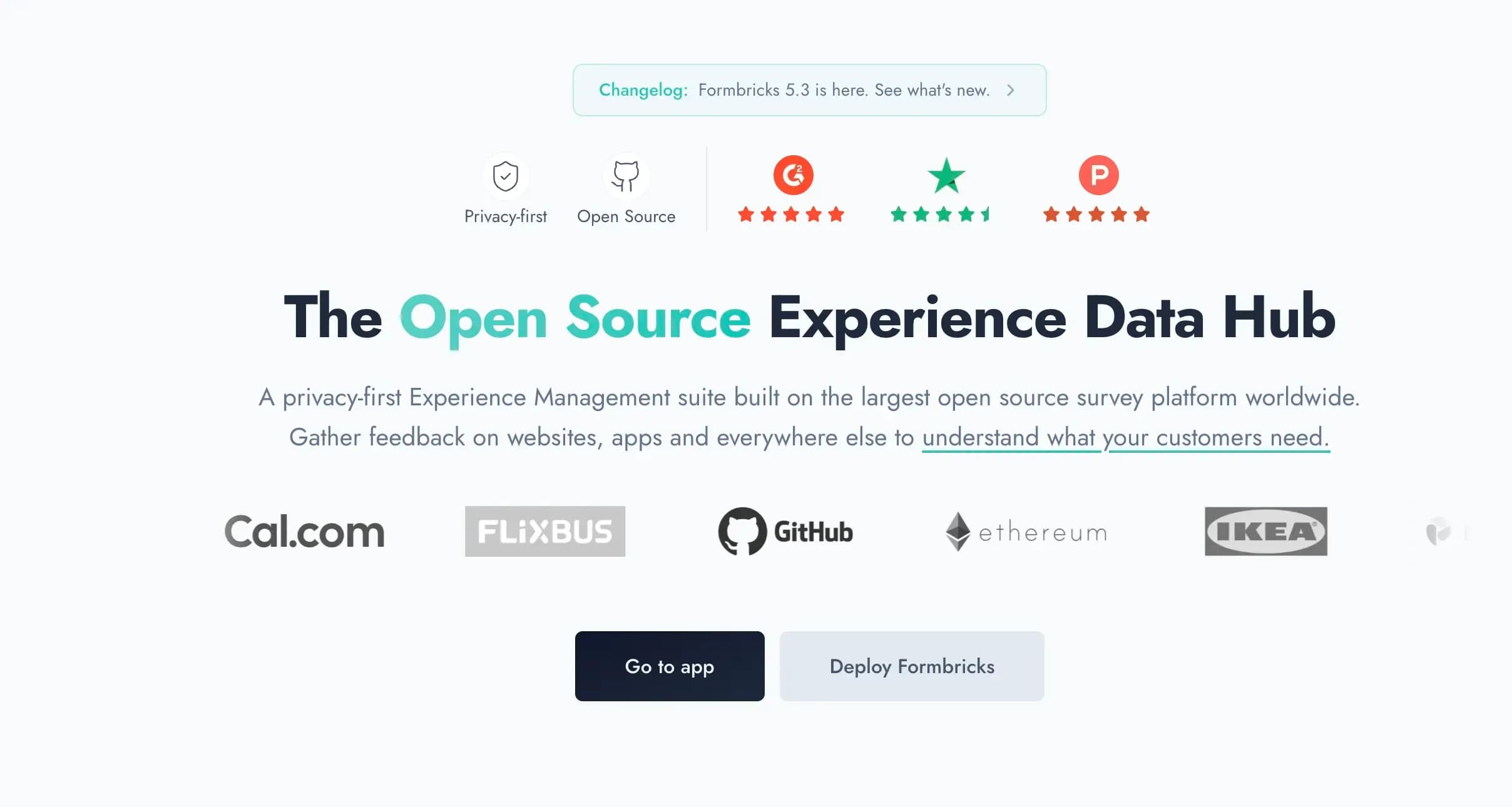
Where Formbricks does overlap is narrower and specific: feedback collection. Formbricks is an open source feedback and experience management suite built around feedback management (website, in-app, link, and email surveys unified on one platform), feedback analytics (dashboards, drop-off tracking, segmentation), and workflows and integrations (post-response automation, native connections to Salesforce, HubSpot, Slack, Google Sheets, and Notion via a free API on every tier).
Concretely, that means:
- If you need structured NPS, CSAT, or PMF surveys as your primary research methodology, Formbricks does that natively; none of Canny, Productboard, or Featurebase treats survey methodology as a first-class function (Featurebase's Outbound module is the closest, and it's explicitly a secondary feature per its own pricing page).
- If you need a genuinely self-hosted deployment for data residency or compliance reasons, Formbricks is the only name in this comparison with that option, its Community Edition is free and self-hostable under AGPLv3. None of Canny, Productboard, or Featurebase publish a self-hosted option anywhere in their documentation.
- If you need a public feedback board, upvoting, or a roadmap page, Formbricks isn't the tool, use Canny, Productboard, or Featurebase for that, potentially alongside Formbricks for the survey side of your feedback program.
Pricing:
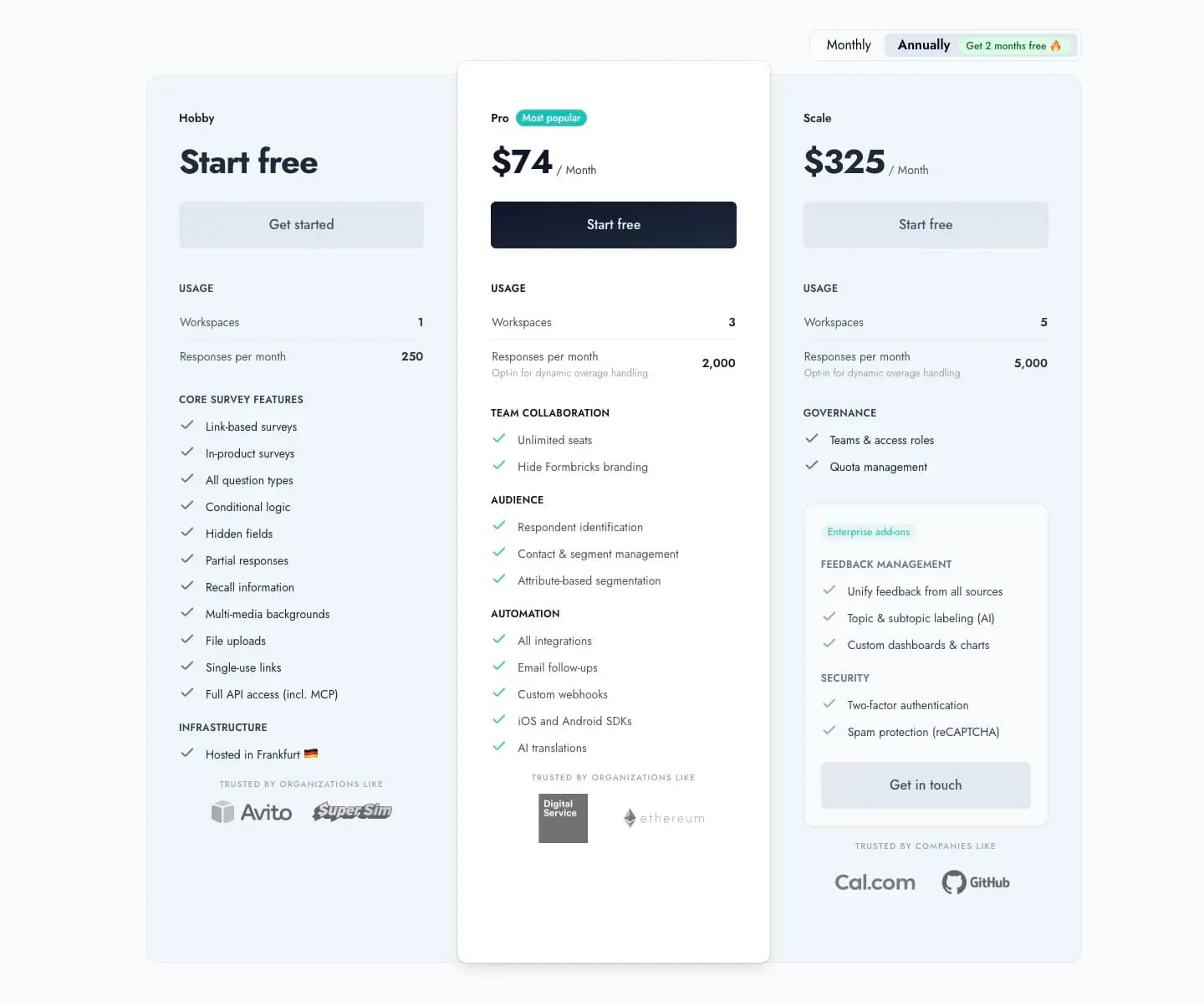
- Hobby (Free): 250 responses/month, 1 workspace, full API access including MCP
- Pro: $74/month ($890/year billed annually), 2,000 responses/month, unlimited seats
- Scale: $325/month ($3,900/year billed annually), 5,000 responses/month, teams and access roles
- Community Edition (self-hosted): Free forever, AGPLv3, unlimited surveys and responses
Best for: Teams already using Canny, Productboard, or Featurebase for public feedback and roadmapping, who also need structured survey research (NPS, CSAT, PMF) or a self-hosted deployment, not a replacement for the roadmap/voting functionality itself.
Side-by-Side Pricing
| Canny | Productboard | Featurebase | Formbricks | |
|---|---|---|---|---|
| Free tier | 25 tracked users | 1 maker, 500 feedback notes | 1 seat, 1 board, 1 roadmap | 250 responses/month |
| Cheapest paid tier | $79/month (100+ tracked users) | $19/maker/month (Plus, annual) | $29/seat/month (Growth, annual) | $74/month (unlimited seats) |
| Mid tier | Custom Business (5,000+ tracked users) | $59/maker/month (Business, 2-maker min) | $59/seat/month (Professional) | $325/month (Scale) |
| Top published tier | Custom | Custom Enterprise (5-maker min) | $99/seat/month (Enterprise) | Custom Enterprise (contact path) |
| Billing unit | Tracked users | Makers (PM/lead), contributors free | Seats | Workspaces/responses, unlimited seats |
| Self-hosting | No | No | No | Yes, free (Community Edition) |
Feature Value Breakdown
Public Voting and Roadmap Functionality
Canny's Approach: This is the entire product, public boards, voting, roadmap, and changelog, with AI capture layered on top.
Productboard's Approach: Full roadmapping and prioritization built into a broader PM strategy suite, plus a customer-facing portal.
Featurebase's Approach: Bundled as one module inside a broader support/helpdesk suite.
Formbricks' Approach: Not offered. No public board, voting, or roadmap feature exists in Formbricks' published feature set.
Value Verdict: Canny, Productboard, and Featurebase all genuinely compete here. Formbricks isn't in this race.
AI-Driven Feedback Capture
Canny's Approach: Autopilot automatically reads sales calls and support tickets to capture and deduplicate feedback without manual entry.
Productboard's Approach: Spark AI surfaces opportunities with citations and drafts delivery-ready specs from synthesized feedback.
Featurebase's Approach: Fibi AI agent resolves support issues; separate AI Copilot and duplicate-detection features exist for feedback.
Formbricks' Approach: AI topic and subtopic labeling exists as a named Scale-tier add-on, not an automated conversation-mining capability.
Value Verdict: Canny and Productboard have the most mature AI capture specifically for turning unstructured conversations into structured feedback. Featurebase's AI is stronger on the support side than the feedback-analysis side.
Structured Survey Research (NPS, CSAT, PMF)
Canny's Approach: Not offered, no survey-builder functionality on its own site.
Productboard's Approach: Not offered as a first-class feature; feedback is captured as "notes," not survey-methodology data.
Featurebase's Approach: Basic in-app NPS/CSAT surveys exist in the Outbound module (Growth tier+), explicitly a secondary feature per Featurebase's own pricing page.
Formbricks' Approach: Purpose-built for multi-question surveys, targeting, and XM data pipelines, this is Formbricks' core product.
Value Verdict: Formbricks wins decisively here, and it's not close. None of the other three treats survey methodology as core to the product.
Self-Hosting and Data Residency
Canny's Approach: Cloud-only, no self-hosted option found anywhere in its documentation.
Productboard's Approach: Cloud-only, hosted from San Francisco and Prague infrastructure per its own about page.
Featurebase's Approach: Cloud-only, built in the EU per its own footer, but no dedicated data-residency or self-hosted tier found.
Formbricks' Approach: Free, self-hosted Community Edition under AGPLv3, the only genuine option in this comparison.
Value Verdict: Formbricks wins decisively for any buyer where self-hosting or data residency is a hard requirement.
Who Should Choose Which Platform
Choose Canny if:
- You want an AI (Autopilot) that automatically captures feature requests from sales calls and support tickets without manual logging
- A public feedback board, roadmap, and changelog in one lightweight tool is your core need
- You're comfortable estimating "tracked users" as your billing metric
Choose Productboard if:
- You want an AI agent (Spark) to turn scattered feedback into delivery-ready specs and roadmaps
- You need enterprise-grade roadmap governance (SSO, custom roles, Salesforce integration) at scale
- Your team is comfortable with maker-based pricing and a learning curve in exchange for a full PM operating system
Choose Featurebase if:
- You want to replace 5+ separate tools (helpdesk, feedback board, knowledge base, changelog) with one subscription
- You're a fast-growing startup that wants an AI support agent (Fibi) alongside lightweight feedback collection
- You value a generous free tier and transparent per-seat pricing to start
Choose Formbricks alongside one of the above if:
- You need structured NPS, CSAT, or PMF surveys that none of the three treats as a first-class feature
- You require self-hosting or a hard data-residency guarantee for compliance reasons
- You're not looking for a public voting board or roadmap, that's not what Formbricks does
Canny vs Productboard vs Featurebase FAQ
Final Verdict
Choose Canny if a public feedback board with AI-driven capture from sales and support conversations is your core need, and you're comfortable budgeting around a tracked-user metric.
Choose Productboard if you want the fullest PM operating system, strategy, roadmapping, and AI-drafted specs, and your team can absorb a maker-based pricing model and a real learning curve.
Choose Featurebase if you want to consolidate a helpdesk, feedback board, changelog, and knowledge base into one subscription, especially as an early-stage team wanting a generous free tier.
Add Formbricks alongside whichever of the three you pick if your feedback program also needs structured NPS, CSAT, or PMF surveys, or a genuinely self-hosted deployment for compliance reasons. It's not a fourth option in the roadmap-and-voting race these three are actually running, it solves the collection half of a feedback program that none of them treats as a first-class function. See Formbricks' current pricing here.
Try Formbricks now