

9 Real Pendo Competitors in 2026, Mapped by Category (Not Just a Switch List)

Johannes
Co-Founder @ Formbricks
12 Minutes
August 16th, 2026
Most "Pendo competitors" pages answer a narrower question than the one you're actually asking. They tell you what to switch to. They rarely map who Pendo actually competes against and why, which matters if you're trying to understand the market before you've decided to move. Pendo's own category placement spans three distinct groups: digital adoption platforms, product analytics tools, and feedback/experience management platforms. Here's the real landscape, grouped by category, with one option none of the current guides mention: self-hosting.
TL;DR
- Pendo's own G2 category tags place it alongside FullStory, Heap (Contentsquare), Smartlook, Amplitude, WalkMe, and Mixpanel, not a single like-for-like rival.
- The market actually splits into three groups: enterprise digital adoption platforms (WalkMe, Whatfix, Userlane, UserGuiding), product analytics and session replay tools (Heap, Amplitude, Gainsight PX, Mixpanel), and feedback and experience management platforms (Formbricks).
- Every paid Pendo tier (Base, Core, Ultimate) is "Custom pricing" behind a demo request, with the free tier capped at 500 Monthly Active Users.
- None of the digital adoption platforms or analytics tools in this list, and not Pendo itself, offer self-hosting. Formbricks is the only name on this page where that's an option.
- Pendo's Sentiment surveys (NPS, PMF, CSAT) are a bolt-on module gated behind its most expensive tier. If feedback is your actual priority rather than a secondary need alongside product analytics, that changes which competitor is the right comparison.
What Is Pendo?
Pendo is a product experience platform combining product analytics, in-app guides, session replay, and Sentiment surveys (NPS, PMF, CSAT) in one suite. It also ships an Agent Analytics module for tracking AI agent adoption and an MCP connection for querying Pendo data from Claude or ChatGPT.
Pendo reports over 14,000 companies using the platform across 115 industries, with more than 20 billion daily events processed and over 1 billion monthly users. The product is organized into three tiers: Base (analytics and guides), Core (adds session replay), and Ultimate (adds Sentiment surveys, Orchestrate, Listen, and Data Sync), all priced on Monthly Active Users through a custom quote. A free plan exists, capped at 500 MAU.
Pendo holds a 4.4 rating across 1,808 reviews on G2. Reviewers cite ease of use and strong analytics as consistent strengths, alongside a noticeable learning curve and Session Replay being gated as a paid upgrade rather than included in every package.
Pendo's Actual Competitive Landscape
Here's what most "Pendo competitors" roundups skip: Pendo doesn't compete in one market, it competes in three, and which one applies to you depends on which part of the bundle you actually use.
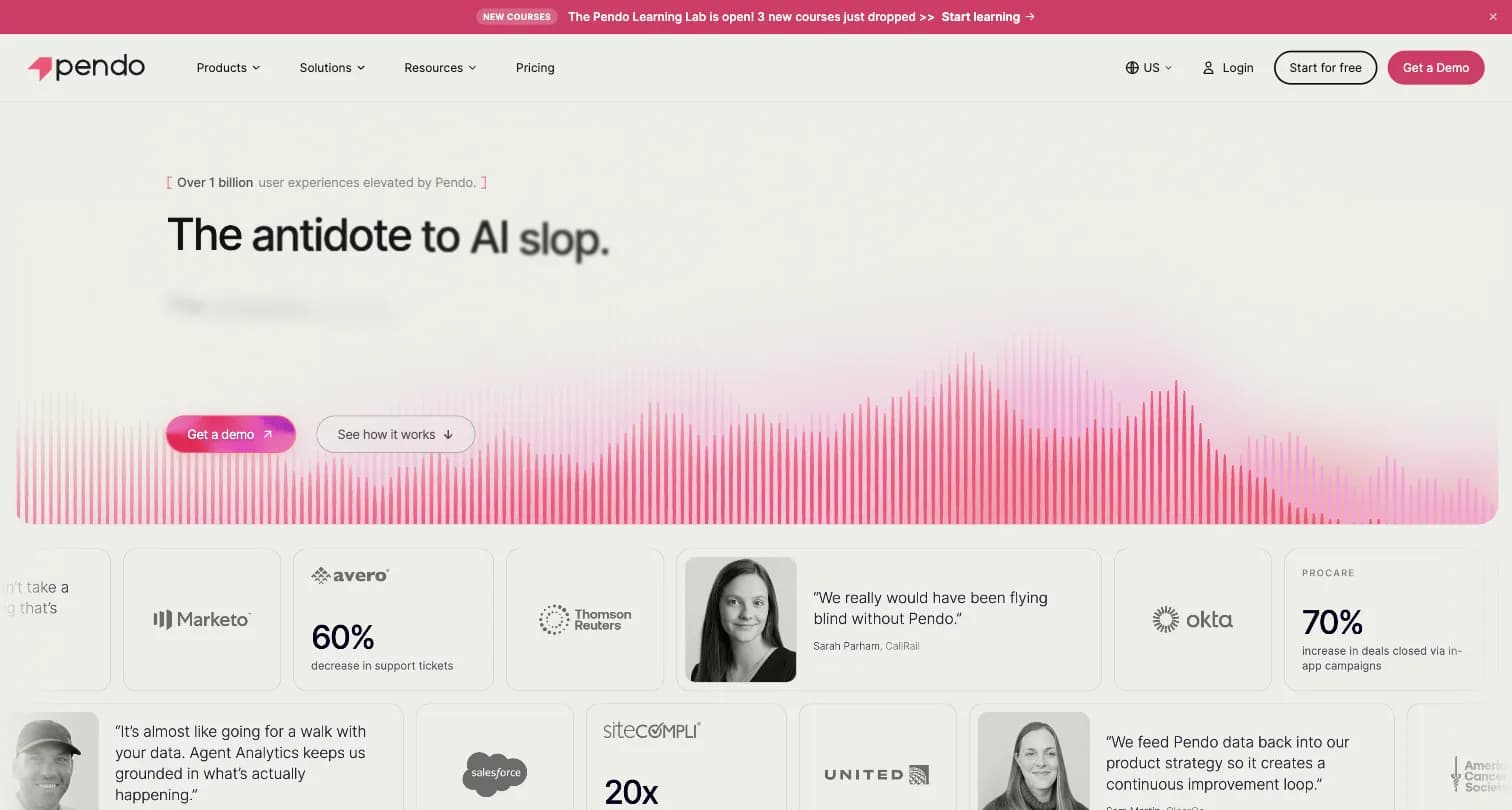
Per Pendo's own G2 category tags (Digital Analytics, Mobile App Analytics, Product Analytics, Digital Adoption Platform, Session Replay), its closest named rivals are FullStory, Heap (Contentsquare), Smartlook, Amplitude, WalkMe, and Mixpanel. That list alone tells you something: five of those six are analytics or session-replay specialists, not full digital adoption suites, and none of them is a dedicated feedback platform.
That's the gap. Pendo's Sentiment surveys (NPS, PMF, CSAT) are real competitors to dedicated feedback and experience management tools, but that segment of Pendo's business rarely shows up in "Pendo competitors" content, because most of it is written by DAP and analytics vendors comparing themselves to Pendo's analytics and guide layer, not its survey layer.
The three real segments, and who plays in each:
- Feedback and experience management: Formbricks. Directly competes with Pendo's Sentiment module specifically, not its analytics or guides.
- Enterprise digital adoption platforms: WalkMe, Whatfix, Userlane, UserGuiding. Compete with Pendo's in-app guides and onboarding layer, often at enterprise IT-led scale.
- Product analytics and session replay: Heap, Amplitude, Gainsight PX, Mixpanel (plus FullStory and Smartlook, per Pendo's own G2 category placement). Compete with Pendo's analytics and behavioral-tracking layer specifically.
Why Companies Look at Pendo's Competitors
We reviewed Pendo's own pricing page, its G2 reviews, and the current top-ranking pages for "Pendo competitors" and "Pendo alternatives." A few reasons come up repeatedly.
1. Every Paid Tier Is a Custom Quote
No numeric price appears anywhere on Pendo's pricing page. Base, Core, and Ultimate are all "Custom pricing" behind a demo request, and the free tier's 500-MAU cap is only stated in an FAQ answer, not shown on the plan card itself.
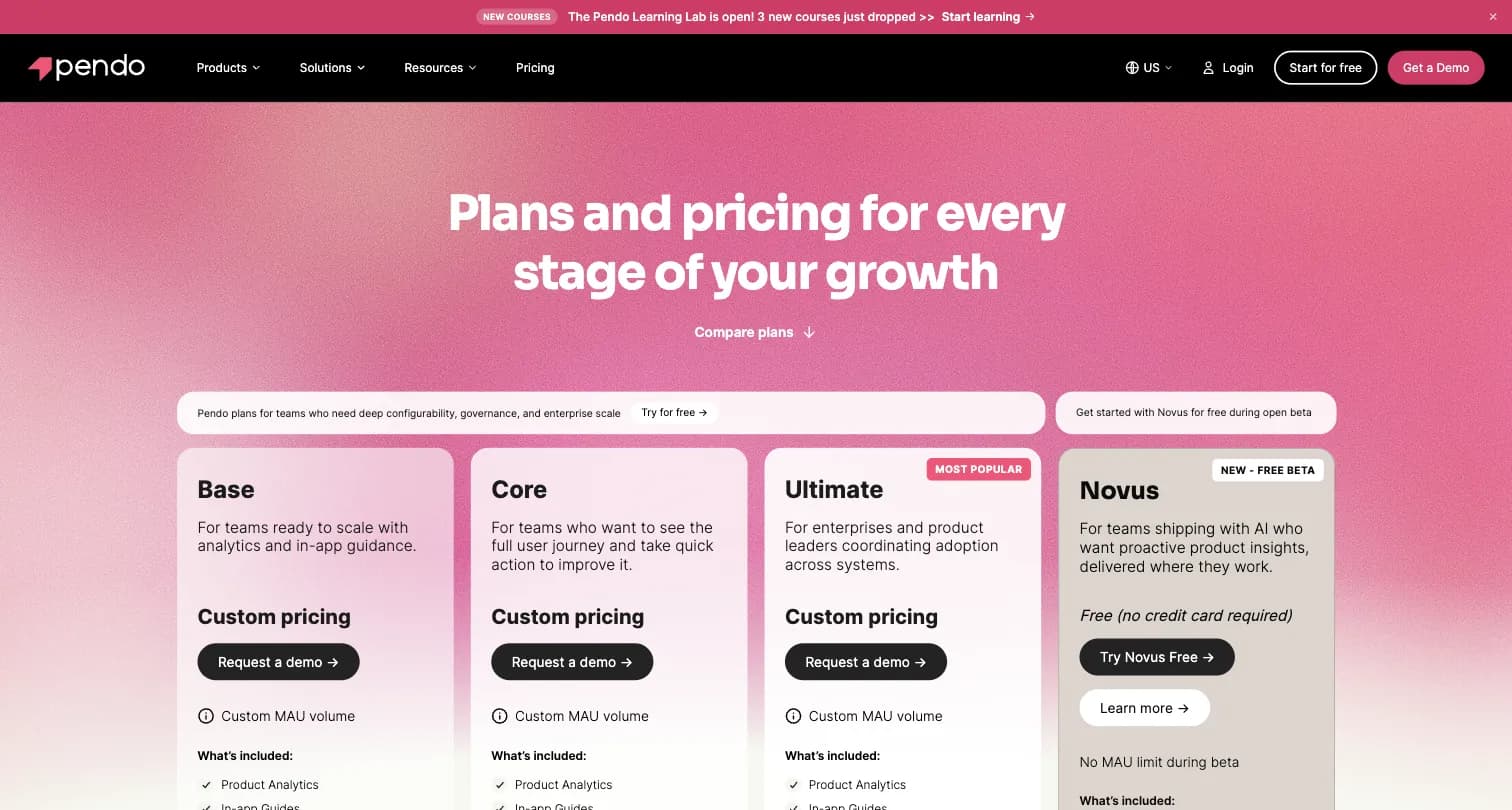
Captured August 15, 2026. Every paid tier reads "Custom pricing."
2. Session Replay and Sentiment Are Locked Behind Upgrades
Session Replay only ships from the Core tier up. Sentiment (NPS, PMF, CSAT surveys) only ships from Ultimate, the most expensive plan. Teams whose primary need is feedback collection end up evaluating a much bigger, pricier platform than they actually need.
3. A Real Learning Curve
Multiple G2 reviewers cite a noticeable learning curve, with initial setup feeling closer to configuring a CRM than a plug-and-play tool. Segmenting behavior data or customizing in-app experiences often needs engineering support even after onboarding.
4. No Self-Hosting, at Any Budget
Pendo is cloud/SaaS-only per its own pricing and product pages. For organizations with a hard data-residency requirement, there's no path to running Pendo on your own infrastructure, regardless of contract size.
Pendo Competitors at a Glance
| Competitor | Category | Best For | Starting Price | Open Source |
|---|---|---|---|---|
| Formbricks | Feedback & Experience Management | Open-source feedback with self-hosting | Free (250 responses/mo), $74/mo Pro | Yes |
| WalkMe | Digital Adoption Platform | Enterprise-wide digital transformation | ~$14,000/year (est.) | No |
| Whatfix | Digital Adoption Platform | Governed, multi-app enterprise adoption | $10,000-$40,000+/year, median $30k-70k | No |
| Userlane | Digital Adoption Platform | Change management across many systems | Custom quote (~$17,500/year est.) | No |
| UserGuiding | Digital Adoption Platform (SMB) | Budget onboarding for small product teams | $174/month | No |
| Heap | Product Analytics | Autocapture analytics, less instrumentation | ~$3,600/year (est.), free tier | No |
| Amplitude | Product Analytics | Behavioral analytics and experimentation | Free (2M events/mo), Plus/Growth custom | No |
| Gainsight PX | Product Analytics + CS | Product usage tied to retention/expansion | Custom | No |
| Mixpanel | Product Analytics | Event-based analytics, fast self-serve | Free (1M events/mo), ~$1,200/year+ | No |
The 9 Real Pendo Competitors, Grouped by Category
Feedback & Experience Management
1. Formbricks: The Only Open-Source Pick, and the Only One That Competes on Feedback Specifically
Formbricks is an open-source feedback and experience management platform. Where Pendo bundles Sentiment surveys as a fourth-tier add-on inside a much broader analytics suite, Formbricks treats feedback management as the core product on every plan, including the free tier.
Key features:
- Feedback management across every channel: website surveys, in-app surveys, link surveys, and email surveys, unified on one platform instead of stitched together from separate point tools
- Feedback analytics: response dashboards, drop-off and partial-response tracking, segmentation, and aggregate plus per-response views
- Workflows and integrations: Formbricks Workflows for post-response automation, plus native integrations to Salesforce, HubSpot, Slack, Google Sheets, and Notion via webhooks
- Free API on every tier, including MCP: full Public Client API and Management API access, plus an MCP connection, available on the free Hobby plan, not gated behind an Ultimate-equivalent tier like Pendo's Sentiment module
- Attribute-based targeting: conditional logic like "show this survey to users on the Pro plan who haven't responded in 30 days," not just static event triggers
- iOS and Android SDKs for native in-app surveys
- Self-hosting on your own infrastructure, with Formbricks never having access to your data when self-hosted
Why Choose Formbricks Over Pendo
Feedback Is the Product, Not a Fourth-Tier Add-On. Pendo's Sentiment surveys only unlock on Ultimate, its most expensive tier, after Base and Core. Formbricks makes feedback management, feedback analytics, and workflow automation the entire product, available from the free Hobby plan, so you're not buying into an analytics-and-guides suite to get a survey feature you'll actually use every day.
⚡ Formbricks in Action: A 30-person product team maps out its Pendo-competitor shortlist and realizes every enterprise DAP and analytics tool on the list, including Pendo itself, is cloud-only. They deploy Formbricks Community Edition instead, keeping all NPS and in-app survey data on infrastructure they control, something none of the other 8 competitors in this market offer at any price.
Self-Hosting Where No Other Name on This List Has It. Across every competitor covered here, digital adoption platforms and analytics tools alike, not one publishes a self-hosted or customer-premises deployment option. Formbricks' Community Edition, licensed under AGPLv3, is free forever and self-hostable, with no MAU cap and no response cap.
⚡ Formbricks in Action: A healthcare SaaS company failed a vendor security review after a cloud-only feedback vendor couldn't answer a data-residency question. They deploy Formbricks Community Edition inside their own VPC, and their security team audits the AGPLv3 source directly instead of taking a vendor's word for it.
Transparent Pricing vs. a Demo-Only Sales Process for Every Paid Tier. Pendo shows no numeric price anywhere on its site, all three paid tiers require a sales call. Formbricks publishes its full pricing table and lets you start using Pro features in minutes.
Formbricks Pricing (verified from formbricks.com/pricing, August 2026):
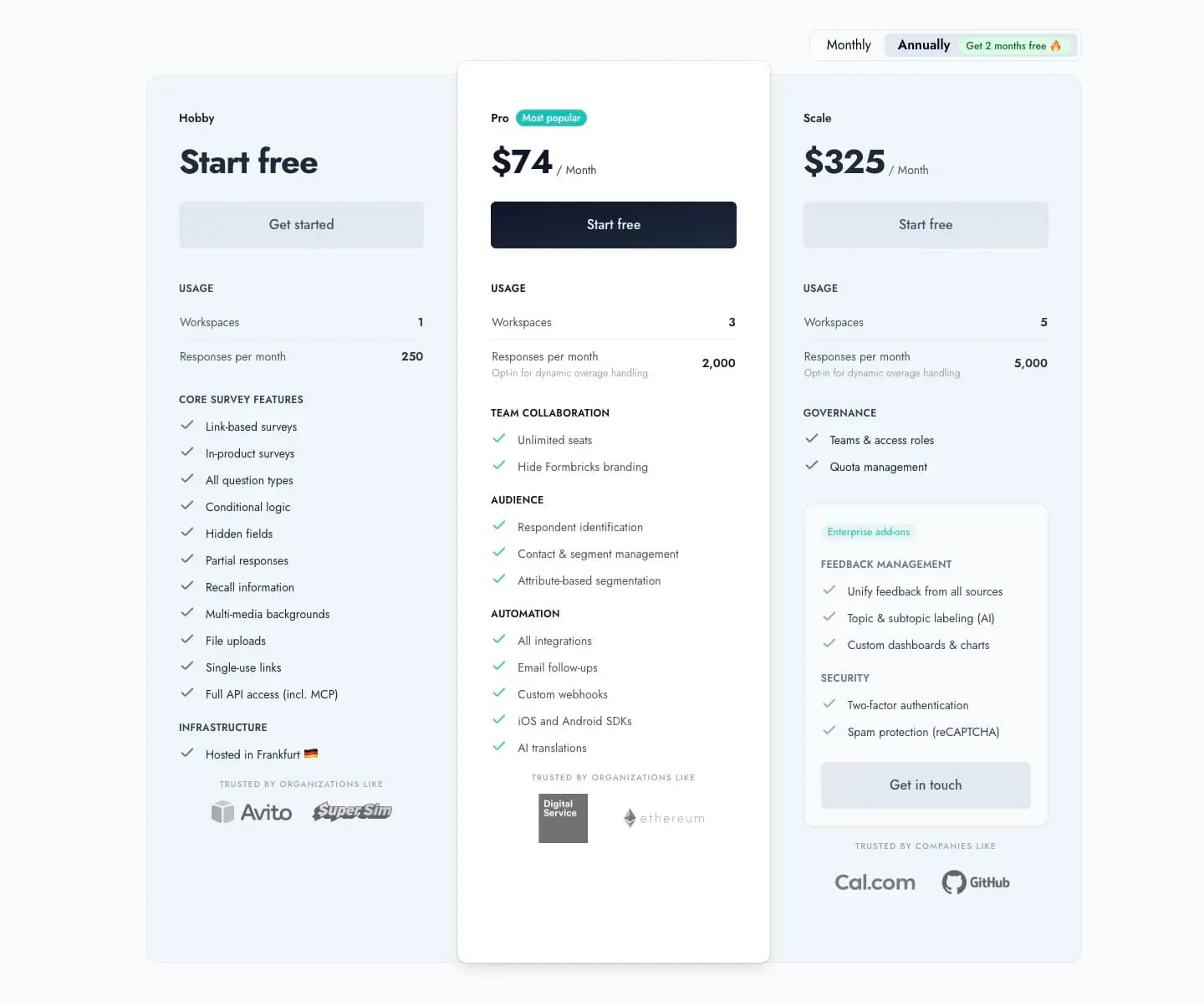
| Plan | Price | Workspaces | Responses/month |
|---|---|---|---|
| Hobby | Free | 1 | 250 |
| Pro | $89/mo, or $74/mo billed annually ($890/year) | 3 | 2,000 |
| Scale | $390/mo, or $325/mo billed annually ($3,900/year) | 5 | 5,000 |
| Enterprise | Custom | Custom | Custom |
The self-hosted Community Edition is free forever and unlimited, with a separate self-hosted Enterprise Edition available on request for SSO and white-glove onboarding.
Who Should Use Formbricks?
- You want feedback management, feedback analytics, and workflow automation as your primary product, not a module bundled into a much larger and pricier analytics suite
- You're in a regulated industry (healthcare, finance, government) with a data-residency requirement that rules out every other name on this page
- You're a developer-led team that wants full API access, including MCP, free on every tier instead of gated behind Enterprise
- You want transparent, published pricing you can evaluate without a sales call
- You need surveys across multiple channels (website, in-app, link, email) unified in one platform rather than scattered across point tools
Enterprise Digital Adoption Platforms
2. WalkMe: The Highest-Rated Enterprise DAP on Gartner's Own Pendo Alternatives Page
WalkMe topped Gartner Peer Insights' list of Pendo alternatives with a 4.5-star rating across 258 reviews, the highest volume of any name on that page. It's built for large organizations rolling out change management and process guidance across many internal systems, not a single product.
Key features:
- Smart Walk-Thrus and SmartTips guiding users through multi-step processes spanning several enterprise systems (CRM, ERP, internal tools)
- Workflow automation that can auto-fill fields and advance users through repetitive steps, not just display guidance
- Discovery module tracking software usage across the entire tech stack to identify unused licenses
How it compares to Pendo: Pendo's guides are typically tied to individual features or pages within a single product. WalkMe is built to guide users through workflows that span multiple enterprise systems at once, and it can execute actions inside applications on a user's behalf rather than only instructing the user.
Pricing: Custom, quote-based. Third-party marketplace data referenced in independent research on Pendo alternatives puts a typical starting contract around $14,000 per year.
Best for: Large enterprises managing digital transformation across many internal systems, where IT and governance teams, not a single product team, own the rollout.
3. Whatfix: The Governance-First DAP for Multi-App Enterprises
Whatfix's own comparison of itself against Pendo, found on its site, frames the difference clearly: Whatfix is built around enterprise adoption as an operating model, with governed content lifecycle management, multi-application rollouts, and simulation training, while Pendo is designed for product teams driving experience improvements inside customer-facing applications.
Key features:
- Flows and Smart Tips for step-by-step, field-level workflow guidance across web, desktop, mobile, and Citrix apps
- Mirror: application simulations for risk-free practice and rollout readiness, a category Pendo doesn't offer
- Agentic AI Agents for content authoring, guidance contextualization, usage-data analysis, and autonomous task execution (Seek)
- Enterprise content lifecycle management: governed release model with staging, auto-testing, rollback, and auto-translation
How it compares to Pendo: Whatfix's own published comparison table notes it covers web, desktop, mobile, and Citrix apps for both employee-facing and customer-facing use cases, versus Pendo's primary focus on web and mobile customer-facing apps. Whatfix also includes simulation training (Mirror) and content-lifecycle governance that Pendo's own documentation doesn't describe.
Pricing: Standard plans start at $10,000/year for a single application, Premium starts at $40,000/year, and Enterprise is fully custom. Whatfix's own FAQ states a median contract value between $30,000 and $70,000 per year. It ranked second on Gartner Peer Insights' Pendo alternatives list with a 4.5-star rating across 249 reviews.
Best for: Enterprises that need governed, multi-application rollouts with simulation training and agentic AI content management, not a single product's onboarding flow.
4. Userlane: Change Management Reviewers Specifically Cite for Regulated Environments
Userlane holds a 4.5-star rating across 33 reviews on Gartner Peer Insights' Pendo alternatives page. One reviewer specifically described using it in a banking environment where "scale, compliance and consistency matter," citing its no-code approach and adoption analytics for identifying friction points.
Key features:
- No-code (low-code) walkthrough builder that product, UX, and training teams can maintain without heavy developer involvement
- Adoption analytics and usage insights for identifying friction points during rollouts
- Three pricing tiers (Application, Department, Organization) scaling from single-app deployment to full software-portfolio optimization with license management and compliance/governance features
How it compares to Pendo: Where Pendo centers on product-led analytics and in-app guides for a single product, Userlane's own pricing structure is built around scaling change management across an entire software portfolio, with dedicated compliance and governance features at the Organization tier that Pendo's product-first structure doesn't offer.
Pricing: All three tiers (Application, Department, Organization) are custom quotes with no published rate card. Third-party estimates referenced in independent research on Pendo alternatives put a typical contract around $17,500 per year.
Best for: Organizations in regulated industries running change management or onboarding across multiple internal applications, where compliance and governance features matter as much as the guidance layer itself.
5. UserGuiding: The Budget Digital Adoption Platform for Small Product Teams
UserGuiding positions itself directly against Pendo and other DAPs on price, with published self-serve pricing starting well below any enterprise DAP on this list.
Key features:
- All core adoption features plus an AI assistant, in-app surveys, and analytics reporting from the entry-level Starter plan
- No-code event tracking, advanced analytics, session replay, and localization/auto-translate from the Growth plan up
- Feature request and roadmap tooling for closing the loop on in-app feedback
How it compares to Pendo: Pendo's paid tiers all require a custom quote regardless of team size. UserGuiding publishes exact self-serve pricing starting at $174/month, a fraction of Pendo's typical enterprise contract, aimed specifically at smaller product teams that don't need Pendo's full analytics-and-guides bundle.
Pricing: Starter is $174/month, Growth is $349/month, and Enterprise is custom quote-based.
Best for: Small to mid-size product teams that want core in-app onboarding, surveys, and analytics without committing to an enterprise DAP contract or a sales call.
Product Analytics & Session Replay
6. Heap: Autocapture Analytics With Less Instrumentation Overhead
Heap is a digital insights platform known for automatically capturing every user interaction, reducing the manual event-tagging work Pendo's no-code feature tagging still requires.
Key features:
- Autocapture analytics that record interactions without pre-defining what to track
- Journey and funnel analysis to identify drop-offs and friction points
- Behavioral search across historical sessions for open-ended exploration
How it compares to Pendo: Pendo's frustration metrics and feature tracking are tied to predefined, tagged features. Heap's autocapture model lets teams explore friction after the fact, without needing to have already decided what to track, at the cost of Pendo's built-in guides, surveys, and session replay bundled into one suite.
Pricing: A free tier is available. Third-party estimates referenced in independent research on Pendo alternatives put Heap's paid plans starting around $3,600 per year.
Best for: Analytics and UX teams that want rapid behavioral insight with less instrumentation setup, and are comfortable pairing Heap with a separate tool for guides or surveys.
7. Amplitude: Analytics-First, With a Notably Generous Free Tier
Amplitude is a product analytics platform focused on behavioral measurement, cohort analysis, and experimentation, commonly selected by teams that want deeper insight into activation and retention than Pendo's bundled analytics provide.
Key features:
- Free tier with 2 million events per month, plus AI Agents and MCP access included even at no cost, per Amplitude's own pricing page
- Behavioral cohorts, funnels, retention, and path analysis for complex product journeys
- Governance tooling to keep metric definitions consistent across teams, plus experimentation workflows for testing and iteration
How it compares to Pendo: Pendo bundles a lighter analytics layer alongside guides, surveys, and replay. Amplitude goes deeper specifically on journey analysis, cohorting, and experimentation governance, but doesn't include Pendo's in-app guide or survey layer at all, so most teams pair it with a separate engagement tool.
Pricing: Free up to 2 million events/month. Plus, Growth, and Enterprise tiers exist above that, but exact self-serve pricing beyond the free tier isn't published on Amplitude's public pricing page and requires selecting a plan directly in-app.
Best for: Analytics-first product and growth teams that need advanced journey and cohort analysis more than they need bundled in-app guides or surveys.
8. Gainsight PX: Product Analytics Tied Directly to Customer Success Outcomes
Gainsight PX combines product usage analytics with in-app engagements and feedback collection, commonly used by product teams working closely with customer success rather than in isolation.
Key features:
- Advanced product analytics for identifying growth and expansion opportunities
- Native omni-channel engagement for onboarding, plus closed-loop feedback for collecting user input
- Support across SaaS, mobile, and desktop runtimes with up-to-the-second data
How it compares to Pendo: Pendo is built as a standalone product-experience suite for product teams. Gainsight PX ties the same category of data (usage analytics, in-app engagement, feedback) directly into retention and expansion workflows, which matters most when the buying committee is anchored in customer success outcomes rather than product-team-only decisions.
Pricing: Custom, quote-based. Gainsight does not publish numeric pricing on its product pages.
Best for: B2B SaaS teams that want product usage data tied directly to churn risk and expansion signals inside a customer success motion, not a standalone product-analytics purchase.
9. Mixpanel: Dedicated Analytics for Teams Replacing Pendo's Analytics Layer Specifically
Mixpanel is a product analytics tool for teams that want to replace Pendo's analytics layer specifically, without the guides, surveys, or session replay bundled in.
Key features:
- Developer-led event model with custom properties for granular, multi-dimensional behavioral tracking
- Dynamic cohort analysis for questions like "which onboarding path leads to the highest 30-day retention"
- Impact analysis linking specific features or releases to engagement, conversion, or retention outcomes
How it compares to Pendo: Pendo's no-code feature tagging is fast to set up but UI-dependent. Mixpanel's event-based model gives engineering teams direct control over what's tracked and how it's sliced, with pricing that scales on event volume instead of Pendo's opaque MAU-based enterprise contracts.
Pricing: Free plan for up to 1 million monthly events. Third-party estimates referenced in independent research on Pendo alternatives put paid plans starting around $1,200 per year, though usage commonly pushes mid-market teams higher.
Best for: Teams that specifically need to replace Pendo's product-analytics layer and are fine sourcing guides, surveys, and onboarding from separate, dedicated tools.
The Gap Every Pendo Competitor Guide Skips
We reviewed four of the current top-ranking pages on Pendo competitors and alternatives, Gartner Peer Insights, Whatfix's own comparison page, and Userpilot's comparison guide. None of them ask a data residency question: can you deploy this on your own infrastructure?
Across all 8 competitors covered above, not one publishes a self-hosted or customer-premises deployment option. Pendo itself is cloud/SaaS-only per its own pricing and product pages. WalkMe, Whatfix, Userlane, UserGuiding, Heap, Amplitude, Gainsight PX, and Mixpanel are all cloud-only SaaS products as far as their public documentation shows.
Formbricks is the exception. Its Community Edition, licensed under AGPLv3, is free and self-hostable on your own infrastructure, with no MAU cap and no response cap.
This matters most for organizations in banking, healthcare, government, or any sector where a compliance or data-residency mandate rules out third-party SaaS hosting entirely, regardless of how good the platform is otherwise. If that's your actual constraint, the comparison isn't Pendo vs. WalkMe vs. Amplitude. It's whether self-hosting is on the table at all, and today, Formbricks is the only name on this page where the answer is yes.
Pendo vs Formbricks vs Whatfix: Three Different Ways to Read This Market
For teams still narrowing down which segment of this market actually applies to them, these three anchor the three different buying motions.
| Factor | Pendo | Formbricks | Whatfix |
|---|---|---|---|
| Core category | Product experience (analytics + guides + replay + Sentiment surveys) | Feedback & experience management | Enterprise digital adoption platform |
| Pricing model | Custom, MAU-based, all tiers | Published $ tiers, free plan included | Custom, per-application + license fees |
| Free tier | Yes, capped at 500 MAU | Yes, 250 responses/month | No |
| Self-hosting | No | Yes (Community Edition, AGPLv3) | No |
| Primary buyer | Product teams | Product, CX, and research teams | Enterprise IT and change management |
| Feedback/surveys | Bolt-on module (Ultimate tier only) | Core product on every tier | Basic in-app surveys, not the focus |
Choose Pendo if you want one platform unifying analytics, guides, session replay, and AI-agent tracking, and you don't mind a custom-quote sales process for every tier.
Choose Formbricks if feedback and surveys are your actual priority, not a fourth-tier add-on, or if self-hosting is a hard requirement none of the other 8 competitors on this page can meet.
Choose Whatfix if you're an enterprise IT or change-management team standardizing adoption across many internal systems, not a single customer-facing product.
How to Choose the Right Pendo Competitor
Picking the right name from this page depends on which segment of Pendo's bundle you're actually replacing.
Start With Your Use Case
- Feedback and surveys as your primary need: Formbricks
- Enterprise-wide digital transformation across many systems: WalkMe or Whatfix
- Change management in a regulated industry: Userlane
- Budget onboarding for a small product team: UserGuiding
- Fast, autocapture analytics with less setup: Heap
- Deep behavioral analytics and experimentation: Amplitude
- Product usage tied to customer success and retention: Gainsight PX
- Dedicated product analytics, nothing else: Mixpanel
Then Evaluate These Criteria
| Criteria | Questions to Ask |
|---|---|
| Which Pendo module matters | Analytics, in-app guides, session replay, or Sentiment surveys, which one are you actually replacing? |
| Pricing transparency | Is pricing published, or does every tier need a sales call? |
| Data residency | Can you self-host? Where does your data actually live? |
| Team size | Do you need a no-code tool, or does engineering own implementation? |
| Integrations | Does it connect to your CRM, helpdesk, and existing analytics stack? |
| API and response limits | Is API access free on every tier, or gated behind Enterprise? |
For related reading, see our Pendo alternatives, Pendo pricing, Qualtrics competitors, and GetFeedback competitors guides.
Frequently Asked Questions
Looking for the only open-source name in Pendo's competitive landscape? Formbricks gives you feedback management across website, in-app, link, and email surveys, feedback analytics, and workflow integrations with Salesforce, HubSpot, Slack, Google Sheets, and Notion, plus a free API on every tier. Self-host it for full data ownership, or start on the cloud Hobby plan for free.
Try Formbricks now