
Pendo Pricing in 2026: Every Tier, the Real Cost Buyers Report, and a Transparent Alternative

Johannes
Co-Founder @ Formbricks
13 Minutes
August 16th, 2026
Pendo's pricing page lists four tiers: Free, Base, Core, and Ultimate. Only one has a number attached to it, and it's $0. Base, Core, and Ultimate all read the same two words: "Custom pricing." There's no calculator, no rate card, and no self-serve checkout for any paid plan.
To get a real number, we pulled third-party purchase data from Vendr and SpendHound, reviewer commentary from G2, and public Reddit threads where actual Pendo customers named their contract size. Combined with Pendo's own pricing and product pages, this is the clearest picture available of what Pendo actually costs, and how it compares to Formbricks, an open feedback and experience management suite built around feedback management, feedback analytics, and workflows, not a single-purpose survey tool.
I believe Pendo is the right call if:
- You're an enterprise team that wants one platform for product analytics, in-app guidance, session replay, and now AI agent adoption tracking
- You don't mind a custom-quote sales process and MAU-based billing that scales with your usage
- Surveys and feedback (Pendo's "Sentiment" module) are a secondary need bolted onto a broader product-analytics program, not your primary buying driver
- You have the budget flexibility for a five-figure-or-higher annual contract
It's a weaker fit if:
- You want transparent, self-serve pricing you can evaluate without a sales call
- Feedback and surveys are your primary use case, not one module inside a much larger product-experience suite
- You need self-hosting or strict data residency control, which Pendo's own pricing and security pages don't offer at any tier
- You're a small team without a dedicated admin or engineering resource to manage the "steep learning curve" reviewers describe
Because of that, I've included a full comparison with Formbricks later in this breakdown, since it's a clear example of a transparently-priced, unified feedback and experience management platform sitting next to Pendo's quote-gated model.
Table of contents:
- Pendo Pricing at a Glance
- The Only Pendo Plan With a Public Price: Pendo Free
- Pendo Base: Custom Pricing
- Pendo Core: Custom Pricing
- Pendo Ultimate: Custom Pricing
- Pendo Novus and the New AI Add-Ons
- What Pendo Actually Costs: Third-Party Benchmark Data
- Where Pendo Pricing Falls Short
- Formbricks: An Open Feedback and Experience Management Suite
- Pendo vs Formbricks: Side-by-Side Pricing
- Feature Value Breakdown
- Who Should Actually Pay for Pendo
- Pendo Pricing FAQ
- Final Verdict
Pendo Pricing at a Glance
| Plan | Price | Priced on | What's included |
|---|---|---|---|
| Free | $0 | Up to 500 MAU | Product Analytics, In-app Guides, Pendo-branded NPS surveys and roadmaps |
| Base | Custom pricing | Custom MAU volume | Product Analytics, In-app Guides |
| Core | Custom pricing | Custom MAU volume | Everything in Base, plus Session Replay |
| Ultimate (Most Popular) | Custom pricing | Custom MAU volume | Everything in Core, plus Sentiment (NPS/PMF/CSAT), Orchestrate, Listen, Data Sync |
| Novus (New, Free Beta) | Free during beta | No MAU limit during beta | Continuous product monitoring, proactive Slack recommendations, AI-generated PRs |
Source: pendo.io/pricing, captured August 15, 2026.
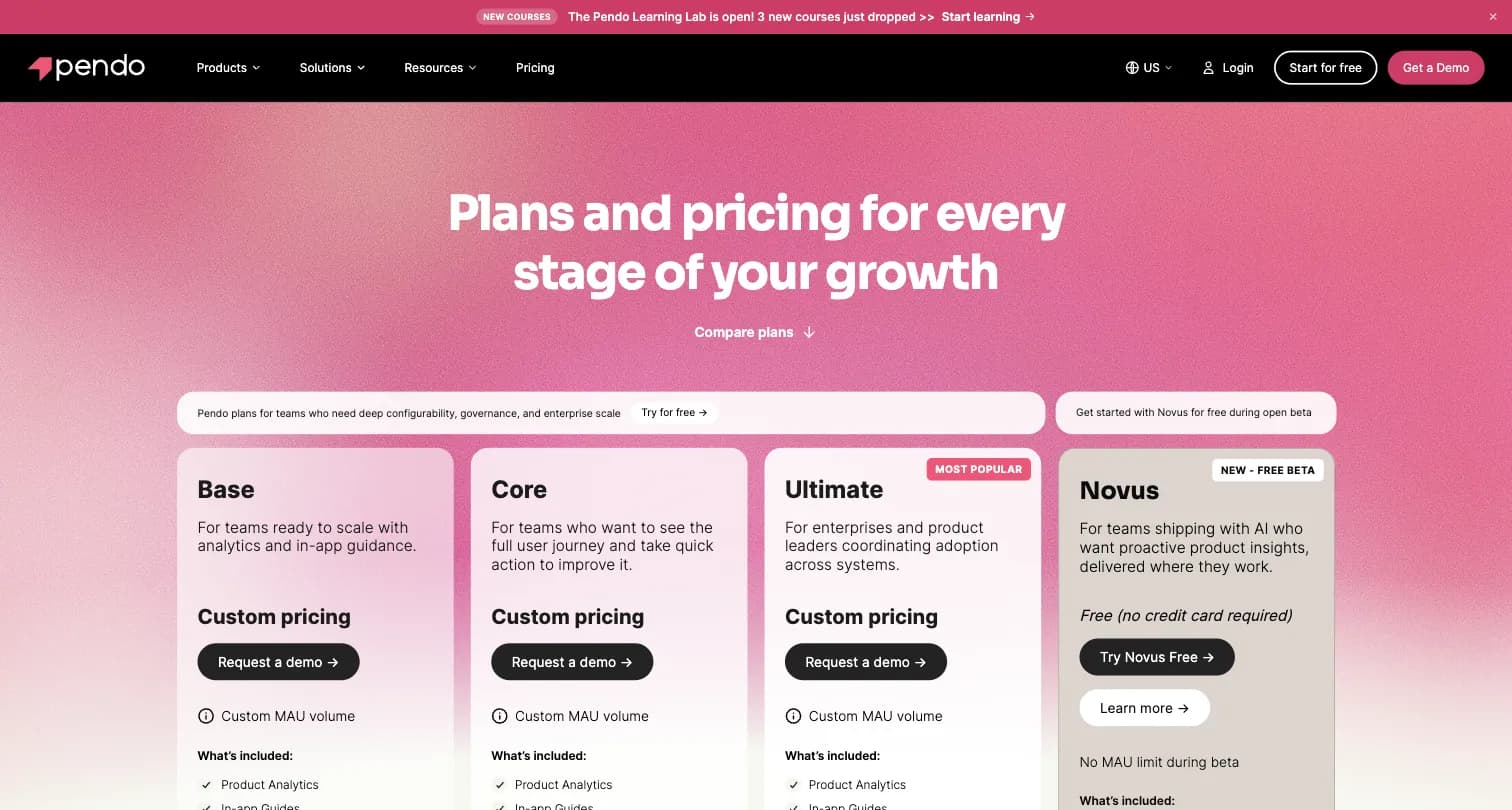
Captured August 15, 2026 from pendo.io/pricing. Every paid tier reads "Custom pricing."
The Only Pendo Plan With a Public Price: Pendo Free
Pendo Free is the single plan in the entire lineup you can start using without talking to sales. It caps out at 500 monthly active users (MAU), a limit Pendo states in its pricing FAQ rather than on the plan card itself.
The free plan includes Product Analytics and In-app Guides, plus Pendo-branded NPS surveys and roadmaps. There are no third-party integrations at this tier, and once you exceed the MAU limit, Pendo stops you from creating new guides, NPS surveys, or segments until you upgrade.
| Pendo Free | |
|---|---|
| Pros | Cons |
| ✅ Real product analytics and in-app guides at $0 | ❌ Hard cap at 500 MAU, easy to outgrow quickly |
| ✅ Includes Leo, Pendo's AI query assistant, at no cost | ❌ NPS surveys carry Pendo branding, not your own |
| ✅ No credit card required to start | ❌ No third-party integrations included |
| ✅ Good proof-of-concept for a single small product | ❌ Once you hit the cap, you can't create new guides or segments |
The Bottom Line: Free is a real proof-of-concept tier, not an operational plan. Most teams that like what they see here move directly into a custom-quote conversation for Base, Core, or Ultimate.
Source: pendo.io/pricing, captured August 15, 2026.
Pendo Base: Custom Pricing
Base is the first paid tier, described by Pendo as built "for teams ready to scale with analytics and in-app guidance." It includes Product Analytics and In-app Guides at a custom MAU volume, with no published starting price anywhere.
| Feature | Included in Base? |
|---|---|
| Product Analytics | ✅ |
| In-app Guides | ✅ |
| Session Replay | Paid add-on |
| Sentiment (NPS, PMF, CSAT surveys) | Paid add-on |
| Journey orchestration | Paid add-on |
| Data Sync | Not included |
Session Replay and NPS surveys, two of the most-evaluated capabilities in this category, are each sold as separate add-ons on top of Base rather than bundled in. Reviewers researching Pendo's real cost structure have found individual Base customers quoted well beyond what the plan name alone implies, including one Reddit thread citing a $30,000-per-year quote just for webhook access.
| Pendo Base | |
|---|---|
| Pros | Cons |
| ✅ Core product analytics and in-app guidance included | ❌ Session Replay is a paid add-on, not bundled |
| ✅ Cost per MAU decreases as you scale volume | ❌ NPS/Sentiment surveys are a paid add-on |
| ✅ Entry point into Pendo's broader platform | ❌ No public number to budget against before a sales call |
| ✅ Unlimited applications at no extra per-app cost | ❌ Add-on pricing can run well above the base plan rate |
The Bottom Line: Base gets you real analytics and guidance, but if session replay or NPS surveys are must-haves, budget for add-on costs on top of a quote you can't see in advance.
Source: pendo.io/pricing and userpilot.com/blog/pendo-pricing, captured August 15, 2026.
Pendo Core: Custom Pricing
Core is positioned "for teams who want to see the full user journey and take quick action to improve it." It includes everything in Base plus Session Replay as a standard feature rather than an add-on.
| Feature | Included in Core? |
|---|---|
| Product Analytics | ✅ |
| In-app Guides | ✅ |
| Session Replay | ✅ |
| Product discovery | Paid add-on |
| Sentiment (NPS, PMF, CSAT surveys) | Paid add-on |
| Journey orchestration | Paid add-on |
Session replay has become a baseline expectation for teams evaluating this category, so needing to step up from Base to Core just to get it is worth factoring into a budget model early. Sentiment surveys, discovery, and journey orchestration all still require Ultimate or a separate paid add-on package at this tier.
| Pendo Core | |
|---|---|
| Pros | Cons |
| ✅ Session Replay bundled in, not a separate line item | ❌ NPS/Sentiment surveys still require Ultimate or an add-on |
| ✅ Full user journey visibility across product touchpoints | ❌ Product discovery and orchestration still gated |
| ✅ Same custom MAU model, cost per MAU drops with volume | ❌ Still no public number for budget planning |
The Bottom Line: Core closes the session-replay gap from Base, but if surveys are the actual reason you're evaluating Pendo, you're still one tier away.
Source: pendo.io/pricing and userpilot.com/blog/pendo-pricing, captured August 15, 2026.
Pendo Ultimate: Custom Pricing
Ultimate is Pendo's most complete tier and is marked "Most Popular" on the pricing page. It's built "for enterprises and product leaders coordinating adoption across systems," and it's the only tier where Sentiment surveys, Orchestrate, Listen, and Data Sync all come standard.
| Feature | Included in Ultimate? |
|---|---|
| Product Analytics | ✅ |
| In-app Guides | ✅ |
| Session Replay | ✅ |
| Product discovery | ✅ |
| Sentiment (NPS, PMF, CSAT surveys) | ✅ |
| Journey orchestration (Orchestrate) | ✅ |
| Listen (feedback and discovery workflows) | ✅ |
| Data Sync | ✅ |
Third-party purchase data reported by Userpilot puts Ultimate-tier deals on Vendr between $75,000 and $150,124 per year. This tier is genuinely built for multi-product enterprises that need premium features and data synchronization across several systems, not single-product mid-market teams.
| Pendo Ultimate | |
|---|---|
| Pros | Cons |
| ✅ Every capability included, no further gating | ❌ Reported deals run $75,000 to $150,124/year on Vendr |
| ✅ Sentiment/NPS surveys finally included, not an add-on | ❌ Overkill for teams that only need feedback, not full analytics |
| ✅ Built for multi-product enterprise coordination | ❌ Still requires a sales conversation for every quote |
| ✅ Data Sync and Listen unlock cross-system workflows | ❌ No self-hosting option at any contract size |
The Bottom Line: Ultimate is where Pendo's platform is genuinely complete, and it's priced like it. If your primary need is a dedicated feedback and survey program rather than full-suite product analytics, this is an expensive way to get there.
Source: pendo.io/pricing and userpilot.com/blog/pendo-pricing, captured August 15, 2026.
Pendo Novus and the New AI Add-Ons
Pendo added a fifth track to its pricing page that isn't a traditional tier: Novus, a free, open-beta product for teams "shipping with AI who want proactive product insights, delivered where they work." It carries no MAU limit during the beta and includes continuous product monitoring, proactive recommendations delivered in Slack, AI-generated pull requests to keep instrumentation current, and auto-instrumentation via GitHub.
Alongside Novus, Pendo sells two AI add-ons that layer on top of any existing paid plan rather than requiring a new tier. Predict handles churn prediction and connects to CRM and BI tools, sold at custom pricing. Agent Analytics tracks how AI agents and users interact with your product, adoption, usage patterns, and failure signals, and is free to start with a 500-prompt-per-month allowance before paid capacity kicks in.
Leo, Pendo's natural-language query assistant for asking questions about your product data, is included at no additional cost on every plan, including Free.
Source: pendo.io/pricing, captured August 15, 2026.
What Pendo Actually Costs: Third-Party Benchmark Data
Since Pendo doesn't publish a number for any paid tier, we pulled what independent purchase-data platforms and real customers report paying.
| Source | Reported figure |
|---|---|
| Vendr (median across 564 purchases) | $49,015/year |
| SpendHound (SMB average) | $54,757/year |
| SpendHound (enterprise average) | $214,512/year |
| Vendr (Ultimate-tier deals) | $75,000 to $150,124/year |
| Reddit, r/SaaS (webhook access alone) | $30,000/year |
| Reddit, r/ProductManagement (2,000 MAU, quoted quarterly) | $2,000/quarter (~$8,000/year) |
| Implementation and onboarding services | $5,000 to $25,000 one-time |
Beyond the subscription line, reviewers flag recurring costs that don't show up in the initial quote. Feature tags need ongoing maintenance as your product changes, described by one G2 reviewer as "a largely manual effort" requiring "dedicated responsibility." Add-on modules like Session Replay or Sentiment surveys on lower tiers carry their own implementation overhead on top of the original onboarding cost.
Renewal risk is a real pattern too. One r/UXDesign user reported Pendo discontinuing their roughly $7,000-per-year starter plan and requiring a move to a $35,000-plus tier at renewal. Vendr reports an average savings of 12% across 564 negotiated purchases, so pricing is negotiable, but the strongest lever (a capped annual escalation rate) is easier to negotiate at signing than at renewal.
Sources: Vendr Pendo marketplace listing, SpendHound Pendo pricing page, userpilot.com/blog/pendo-pricing, captured August 15, 2026.
Where Pendo Pricing Falls Short
Fully Opaque, Sales-Gated Pricing
- No numeric price appears anywhere on the pricing page for Base, Core, or Ultimate
- The free tier's 500-MAU cap only appears in an FAQ answer, not on the plan card
- Pendo's pricing formula (MAU volume times feature bundle) is described qualitatively with no rate card or calculator published
Costs That Extend Well Beyond the Quote
- Implementation and onboarding typically run $5,000 to $25,000, and larger enterprise deployments can exceed that
- One G2 reviewer described the setup as requiring "more collaboration with engineering than you may think from a sales pitch"
- Tagging maintenance is an ongoing manual effort, not a one-time setup cost, according to multiple G2 reviewers
No Path to Self-Hosting
- Pendo's pricing and platform pages describe only centrally-hosted, cloud infrastructure
- Regulated buyers who need on-premise or region-locked deployment have no path with Pendo at any contract size
Renewal and Ownership Risk
- Reviewers report renewal quotes jumping sharply, including one case of a roughly $7,000/year plan being pushed to $35,000-plus
- A capped annual escalation rate is far easier to negotiate before signing than at renewal time
Formbricks: An Open Feedback and Experience Management Suite
Formbricks isn't a single-purpose survey tool. It's an open source feedback and experience management suite built around three things: feedback management, feedback analytics, and workflows and integrations, all published transparently and included on every plan rather than sold as gated add-ons.
Feedback Management. Formbricks unifies website surveys, in-app surveys, link surveys, and branded email surveys on one platform and one price. Where Pendo treats Sentiment (NPS/PMF/CSAT) as a module you add to a broader analytics platform, Formbricks is built around feedback collection as the core product, not a bolt-on.
Feedback Analytics. Every response flows into one place regardless of channel: follow individual feedback trails or zoom out to the aggregate view, track partial and dropped-off responses, and segment by custom attributes. This is a narrower scope than Pendo's full product-analytics suite, and that's the honest trade-off: Pendo goes deeper on feature usage tracking and adoption analytics across an entire product, Formbricks goes deeper on the feedback data itself.
Workflows and Integrations. Formbricks Workflows automate what happens after a response comes in. On the integration side, Formbricks connects to Salesforce, HubSpot, Slack, Google Sheets, and Notion through webhooks and a free, unrestricted API available on every tier, including the self-hosted Community Edition.
Formbricks Free Plan: Free Forever (Cloud) or Free Forever (Self-Hosted)
| Feature | Details |
|---|---|
| Price | $0 |
| Workspaces | 1 |
| Responses | 100/month (cloud) |
| Seats | Unlimited |
| API access | Full, including MCP and integrations |
| Hosting | Frankfurt (cloud) |
Unlike Pendo Free, which caps at 500 MAU with Pendo-branded surveys, Formbricks Free includes the full API from day one, including MCP support, with no separate developer tier to unlock.
The Bottom Line: Free is built for testing and small feedback programs, with the same API access Pro gets and no cap on seats.
Formbricks Pro Plan: $79/month (Monthly) or $59/month Billed Annually
| Feature | Details |
|---|---|
| Price | $79/month billed monthly, or $59/month ($708/year) billed annually, with a 7-day free trial |
| Workspaces | 1, plus $49/month per extra workspace |
| Responses | 1,000/month, plus $49 per 1,000 extra responses |
| API access | Full, unrestricted |
| Added features | Unlimited seats, hide Formbricks branding, contacts and segments, respondent identification, email follow-ups, AI translations, custom CSS, spam protection |
The Bottom Line: Pro is priced for a team running an ongoing feedback program, with a real published number either way you bill it, unlike any paid Pendo tier. Beyond Pro, the Experience Suite is quoted after a call, with human support and custom terms.
Formbricks Self-Hosting: Community Edition
The free, self-hosted Community Edition, licensed under AGPLv3, is where Formbricks diverges most sharply from Pendo:
- Data never leaves your infrastructure. No cloud dependency and no third party holding your feedback data.
- No response limits. Unlimited surveys, responses, and team members.
- No vendor lock-in. Even if you stop paying for Enterprise features, the Community Edition and your data stay accessible.
- Full API on self-hosted, too. The same unrestricted API available on every cloud plan.
Pendo's own pricing and security pages describe centrally-hosted cloud infrastructure only. For a regulated buyer who needs data residency, this is the option Pendo doesn't have at any budget.
Source: formbricks.com/surveys/pricing, captured August 15, 2026.
Pendo vs Formbricks: Side-by-Side Pricing
| Pendo | Formbricks | |
|---|---|---|
| Free tier | 500 MAU, Product Analytics, In-app Guides, Pendo-branded NPS | Free: 100 responses/month, unlimited seats, full API including MCP, hosted in Frankfurt |
| Cheapest paid tier | Base: Custom pricing, no public number | Pro: $79/month, or $59/month billed annually |
| Mid tier | Core: Custom pricing, adds Session Replay | Pro add-ons: $49/month per extra workspace, $49 per 1,000 extra responses |
| Top tier | Ultimate: Custom pricing, reported $75,000-$150,124/year on Vendr | Experience Suite: quoted after a call |
| What surveys/feedback cost | Sentiment module gated to Ultimate or sold as a paid add-on below it | Feedback collection is the core product on every tier, not an add-on |
| Core scope | Product analytics, in-app guides, session replay, AI agent analytics, surveys as one module | Feedback management, feedback analytics, and workflows/integrations as the core suite |
| Self-hosting | Not offered at any tier | Community Edition, self-hosted, free under AGPLv3 |
| Billing flexibility | Custom contract terms, no self-serve monthly option on paid tiers | Monthly or annual billing on Pro |
| Typical real-world annual spend (third-party data) | $49,015 median (Vendr), up to $214,512 average for enterprise (SpendHound) | $0 on Free, $708/year for Pro billed annually, or free self-hosted |
Feature Value Breakdown
Pricing Transparency
Pendo's Approach: One of five plans (Free) has a public number. Base, Core, and Ultimate are all "Custom pricing" with no rate card, and buyers rely on third-party benchmarking data just to get a ballpark figure before a sales call.
Formbricks' Approach: Both self-serve cloud plans, Free and Pro, are priced and published on the site, with both monthly and annual billing shown directly.
Value Verdict: Formbricks wins clearly on transparency. This is what's published versus what isn't, not a subjective call.
Product and Feature Adoption Analytics Depth
Pendo's Approach: Product Analytics, in-app guidance, session replay, retroactive analytics, and now AI agent adoption tracking are built into a single, mature platform used by companies like United Airlines and Salesforce.
Formbricks' Approach: Formbricks does not publish a comparable product-analytics or session-replay suite. Its analytics scope covers feedback responses: aggregate views, drop-off tracking, and attribute segmentation.
Value Verdict: Pendo wins here, clearly. If deep product usage analytics and in-app guidance across an entire product are the actual requirement, that's a real capability gap for Formbricks, not a marketing distinction.
Self-Hosting and Data Residency
Pendo's Approach: Pendo's pricing and platform documentation describe centrally-hosted cloud infrastructure only, with no self-hosted or customer-premises deployment option at any tier or budget.
Formbricks' Approach: A free, self-hosted Community Edition is available under AGPLv3, giving regulated buyers a path to keep feedback data entirely on their own infrastructure.
Value Verdict: Formbricks wins for any buyer where self-hosting or strict data residency is a requirement rather than a preference.
Ease of Self-Serve Evaluation for a Small Team
Pendo's Approach: Every paid tier requires a sales conversation and demo before you see a number, which slows down evaluation for teams trying to compare options on a budget.
Formbricks' Approach: Pricing and the Free plan are fully self-serve, with a 7-day free trial of Pro.
Value Verdict: Formbricks wins on accessibility. A small team can sign up, test the product, and see a real invoice without ever talking to sales.
Feedback Management as a Dedicated Discipline
Pendo's Approach: Sentiment surveys (NPS, PMF, CSAT) are one module bolted onto a much broader product-analytics platform, gated to Ultimate or sold piecemeal as an add-on below it.
Formbricks' Approach: Feedback management, feedback analytics, and post-response workflows are the core product on every tier, not an upsell inside a larger platform.
Value Verdict: Formbricks wins on depth for teams whose primary need is a feedback program, not a full product-analytics deployment.
Who Should Actually Pay for Pendo
Pendo makes sense if you're an enterprise team that wants a single platform unifying analytics, in-app guides, session replay, and AI-agent tracking, you don't mind a custom-quote sales process and MAU-based billing, and surveys or feedback are a secondary need rather than your primary buying driver.
It's a weaker fit if you want transparent, self-serve pricing you can evaluate without a sales call, feedback and surveys are your primary use case rather than one module among many, or you need self-hosting or strict data residency, none of which Pendo's documented platform offers at any price.
As an illustrative example (not a published case study), a 2,000-employee SaaS company already running Pendo for product analytics might add the Ultimate tier's Sentiment module to run NPS inside the same dashboard their product team already uses, rather than adopting a separate survey tool. That's a reasonable trade-off if product analytics is the primary program and surveys are secondary. It's a much more expensive path if surveys are the actual priority.
Pendo Pricing FAQ
Who does Pendo compete with?
What is a Pendo used for?
Is Pendo a unicorn?
Is Pendo a CRM tool?
How much does Pendo cost per month?
Does Pendo have a free plan?
Is Pendo pricing negotiable?
What counts as a Monthly Active User (MAU) in Pendo's pricing?
Are there hidden costs beyond the Pendo subscription quote?
Is there a cheaper, self-hosted alternative to Pendo?
Is Formbricks just a survey tool, or does it do more than data collection?
Does Pendo offer discounts for startups or nonprofits?
Final Verdict
👍 Pendo is the right call if you're an enterprise team that wants product analytics, in-app guidance, session replay, and AI agent tracking unified in one mature platform, and you have the budget and patience for a custom-quote sales process. Third-party purchase data suggests a median annual spend around $49,000, with enterprise Ultimate-tier deals running well into six figures, so this is a real investment, not a line item you can budget from a public number.
👉 Formbricks is the better fit if feedback and surveys are your primary need rather than a module inside a much broader analytics suite, you want a real published price before ever talking to sales, and you'd rather run feedback management, feedback analytics, and workflows on one transparent platform. Both self-serve cloud plans are priced and published, monthly and annual billing are both shown directly, and the AGPLv3-licensed Community Edition gives you a self-hosted path Pendo doesn't offer at any price.
The honest read: these solve different primary problems. Pendo goes deep on product analytics with surveys as one module; Formbricks goes deep on feedback as the core product. If a real number matters before you pick up the phone, see Formbricks' current pricing here.
If product analytics isn't actually your primary need, our Pendo alternatives roundup covers other options built specifically for feedback and in-app surveys.