

8 Best Pendo Alternatives & Competitors in 2026 (Including Open Source)

Johannes
Co-Founder @ Formbricks
11 Minutes
August 16th, 2026
Pendo bundles product analytics, in-app guides, session replay, and NPS/CSAT surveys into one enterprise platform. But every paid tier is "Custom pricing" behind a demo, and if surveys are your actual priority, you're paying for modules you may not need. Every tool on the usual "Pendo alternatives" lists is closed-source. One on this list is open-source and self-hostable.
What Is Pendo?
Pendo is a product experience platform combining product analytics, in-app guides, session replay, and sentiment surveys (NPS, PMF, CSAT) in a single suite. It also ships an Agent Analytics module that tracks AI agent adoption and a Model Context Protocol (MCP) connection so teams can query Pendo data from Claude or ChatGPT.
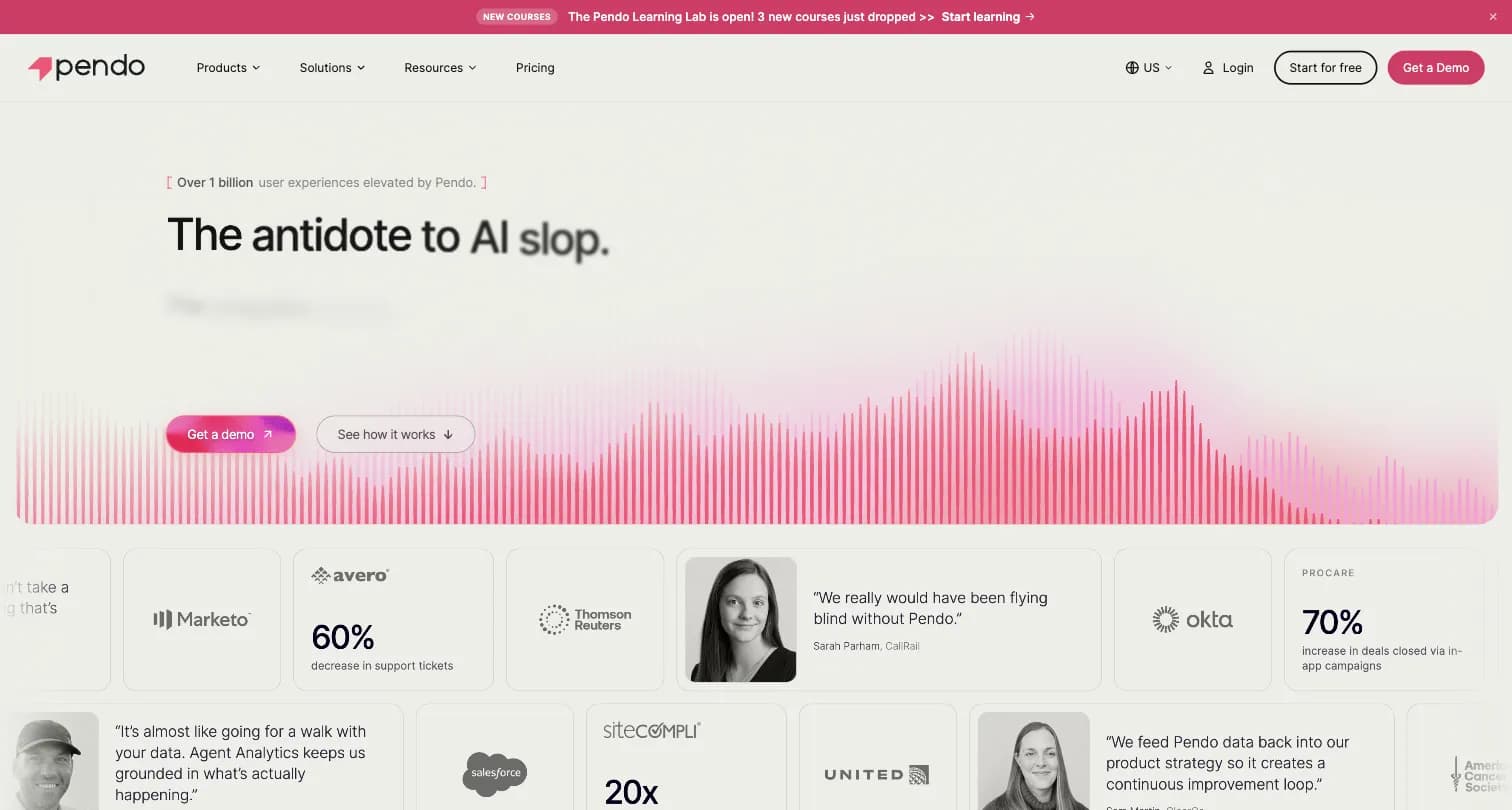
Pendo describes itself as "the antidote to AI slop," positioning the product around surfacing where users and AI agents struggle so teams can act on it. The company reports over 14,000 companies using Pendo across 115 industries, with more than 20 billion daily events processed and over 1 billion monthly users on the platform.
The product is organized into three tiers: Base (analytics and guides), Core (adds session replay), and Ultimate (adds Sentiment surveys, Orchestrate, Listen, and Data Sync). Every tier is priced on Monthly Active Users (MAU) through a custom quote. There's also a Pendo Free plan capped at 500 MAU.
Important: Pendo's survey capability (Sentiment) is one module inside a much broader product-experience suite. If in-app or website surveys are your primary need rather than a secondary add-on to product analytics, that changes which alternatives make sense for you.
Why Teams Look for Pendo Alternatives
We reviewed Pendo's own pricing page, its G2 reviews, Gartner Peer Insights, and independent research on real Pendo switch decisions. Five reasons come up repeatedly.
1. Fully Opaque, Sales-Gated Pricing
No numeric price appears anywhere on Pendo's pricing page. Every paid tier (Base, Core, Ultimate) is "Custom pricing" behind a demo request, and the free tier's 500-MAU cap is only stated in an FAQ answer rather than shown on the plan card itself.
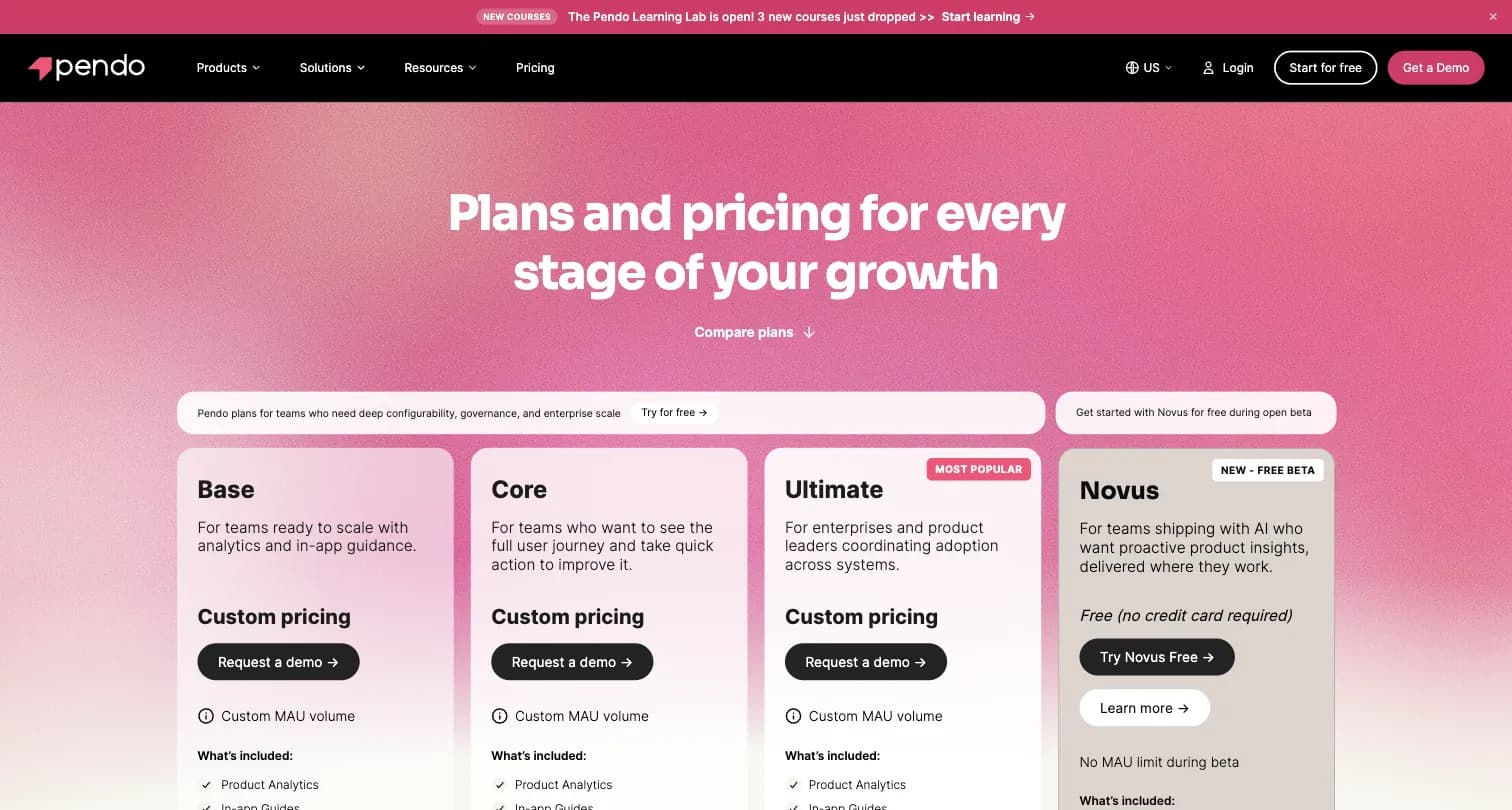
Captured August 15, 2026. Every paid tier reads "Custom pricing."
2. Contracts That Escalate Fast
Pendo doesn't publish contract values, but third-party marketplace data referenced in independent research on Pendo alternatives puts average annual contracts around $48,500, with larger deployments reaching up to $146,000 per year. That's a wide, unpredictable range for a team trying to budget in advance.
3. Steep Learning Curve
Multiple G2 reviewers cite a noticeable learning curve, with initial setup feeling closer to configuring a CRM than a plug-and-play tool. Segmenting user behavior data or customizing in-app experiences often requires engineering support even after onboarding.
4. Modular Licensing Locks Up Core Features
Session Replay is a valuable feature but gated as a paid upgrade, not included in every package. Sentiment (NPS/PMF/CSAT surveys) only ships from the Ultimate tier, so teams whose primary need is feedback collection end up paying for analytics and guide modules they may not use.
5. No Self-Hosting Option
Pendo is cloud/SaaS-only. For organizations with hard data-residency requirements, there's no path to running Pendo on your own infrastructure.
Pendo Alternatives at a Glance
| Alternative | Best For | Free Plan | Starting Price | Open Source |
|---|---|---|---|---|
| Formbricks | Open-source feedback & experience management with self-hosting | Yes (250 responses/mo) | $89/month ($74/mo annual) | Yes |
| Userpilot | Closest all-in-one Pendo alternative for SaaS teams | No (trial only) | $299/month | No |
| Chameleon | Deep customization and control over in-app experiences | No (14-day trial) | $279/month | No |
| WalkMe | Enterprise digital adoption across many internal systems | No | ~$14,000/year | No |
| Whatfix | Enterprise employee and customer onboarding with LMS integration | No | ~$25,000/year | No |
| Appcues | Cross-platform onboarding for web and mobile | No (trial only) | $750/month | No |
| FullStory | Session replay and behavioral UX diagnostics | Yes (limited sessions) | ~$10,000/year | No |
| Mixpanel | Deep product analytics, funnels, and retention | Yes (1M events/mo) | ~$1,200/year | No |
Top 8 Pendo Alternatives in 2026
1. Formbricks: Open-Source, Privacy-First Feedback & Experience Management
Formbricks is an open-source feedback and experience management platform that gives teams full control over their survey infrastructure and data. Where Pendo bundles surveys as one module inside a broader analytics suite, Formbricks is built around feedback management as the core product, not a bolt-on.
Why it stands out as a Pendo alternative:
Pendo locks every paid tier behind a sales demo with zero published pricing. Formbricks publishes exact dollar figures for every tier, and the Community Edition is free forever and self-hostable, with no MAU cap.
Key features:
- Feedback management across every channel: website surveys, in-app surveys, link surveys, and email surveys, all managed from one platform instead of stitching together separate tools
- Feedback analytics: response dashboards, drop-off and partial-response tracking, segmentation, and aggregate plus per-response views
- Workflows and automation: Formbricks Workflows for post-response actions, plus native integrations to Salesforce, HubSpot, Slack, Google Sheets, and Notion via webhooks
- Free API on every tier, including MCP: full API access (Public Client API and Management API) and an MCP connection available on the free Hobby plan, not gated behind Enterprise like Pendo's Sentiment module
- Advanced targeting: attribute-based segmentation with conditional logic, for example "show this survey to users on the Pro plan who haven't responded in 30 days"
- iOS and Android SDKs for native in-app surveys
- Self-hosting on your own infrastructure, with Formbricks never having access to your data when self-hosted
Why Choose Formbricks Over Pendo
Transparent, Self-Serve Pricing vs. a Demo-Only Sales Process. Pendo shows no numeric price anywhere on its site, every tier is "Custom pricing" and requires talking to sales before you know what you'd pay. Formbricks publishes its full pricing table and lets you sign up and start using Pro features in minutes, no call required.
⚡ Formbricks in Action: A 40-person product team evaluating both platforms gets a Pendo quote of $48,000/year after two sales calls and a security review. The same week, they've already deployed Formbricks Pro at $74/month, connected it to Slack and HubSpot, and are collecting NPS responses from their in-app survey the same day.
A Full Feedback Stack, Not a Bolt-On Module. Pendo's Sentiment surveys (NPS, PMF, CSAT) only unlock on the Ultimate tier, the most expensive plan. Formbricks treats feedback collection, analytics, and workflow automation as the core product on every plan, including the free tier, so you're not paying for product-analytics and session-replay modules to unlock a survey feature.
⚡ Formbricks in Action: A support team that only needs CSAT surveys after ticket resolution doesn't need to buy into Pendo's full product-analytics suite to unlock Sentiment. They deploy Formbricks' email and in-app surveys directly, wire the responses into their existing Google Sheets and Slack channel through native integrations, and skip the modules they'd never use.
Self-Hosting for Regulated Industries and Data Residency. Pendo is cloud-only with no path to running it on your own infrastructure. Formbricks offers a free, self-hosted Community Edition (AGPLv3) that keeps all response data on infrastructure you control, which matters for healthcare, finance, and government teams that can't put customer feedback on a third-party server.
⚡ Formbricks in Action: A healthcare SaaS company that failed a vendor security review with a cloud-only feedback tool deploys Formbricks Community Edition inside their own VPC. Their PHI-adjacent survey data never leaves their infrastructure, and their security team can audit the AGPLv3 source directly.
Formbricks Pricing (verified from formbricks.com/pricing, August 2026):
- Hobby (Free): 1 workspace, 250 responses/month, all question types, conditional logic, full API access including MCP, hosted in Frankfurt
- Pro: $89/month billed monthly, or $74/month billed annually ($890/year total), 3 workspaces, 2,000 responses/month, unlimited seats, branding removal, contact and attribute-based segmentation, all integrations, email follow-ups, custom webhooks, iOS/Android SDKs, AI translations
- Scale: $390/month billed monthly, or $325/month billed annually, 5 workspaces, 5,000 responses/month, teams and access roles, quota management, plus Enterprise add-ons for unified feedback management (topic labeling via AI, custom dashboards) and security (2FA, spam protection)
- Enterprise: Custom pricing, contact sales
Self-hosted: Community Edition is free forever, open-source (AGPLv3), with unlimited surveys. A separate self-hosted Enterprise tier is available for teams needing SSO and white-glove onboarding; contact Formbricks for current self-hosted Enterprise pricing.
Who Should Use Formbricks?
- You want feedback management, feedback analytics, and workflow automation as your primary product, not a module bundled into a much larger and more expensive analytics suite
- You're in a regulated industry (healthcare, finance, government) with a data-residency requirement that rules out cloud-only tools
- You're a developer-led team that wants full API access, including MCP, free on every tier instead of gated behind Enterprise
- You want transparent, published pricing you can evaluate and sign up for without a sales call
- You need surveys across multiple channels (website, in-app, link, email) unified in one platform rather than scattered across point tools
- You want to keep access to your data and platform even if you downgrade, since the self-hosted Community Edition never expires
2. Userpilot: Best All-in-One Alternative for SaaS Product Teams
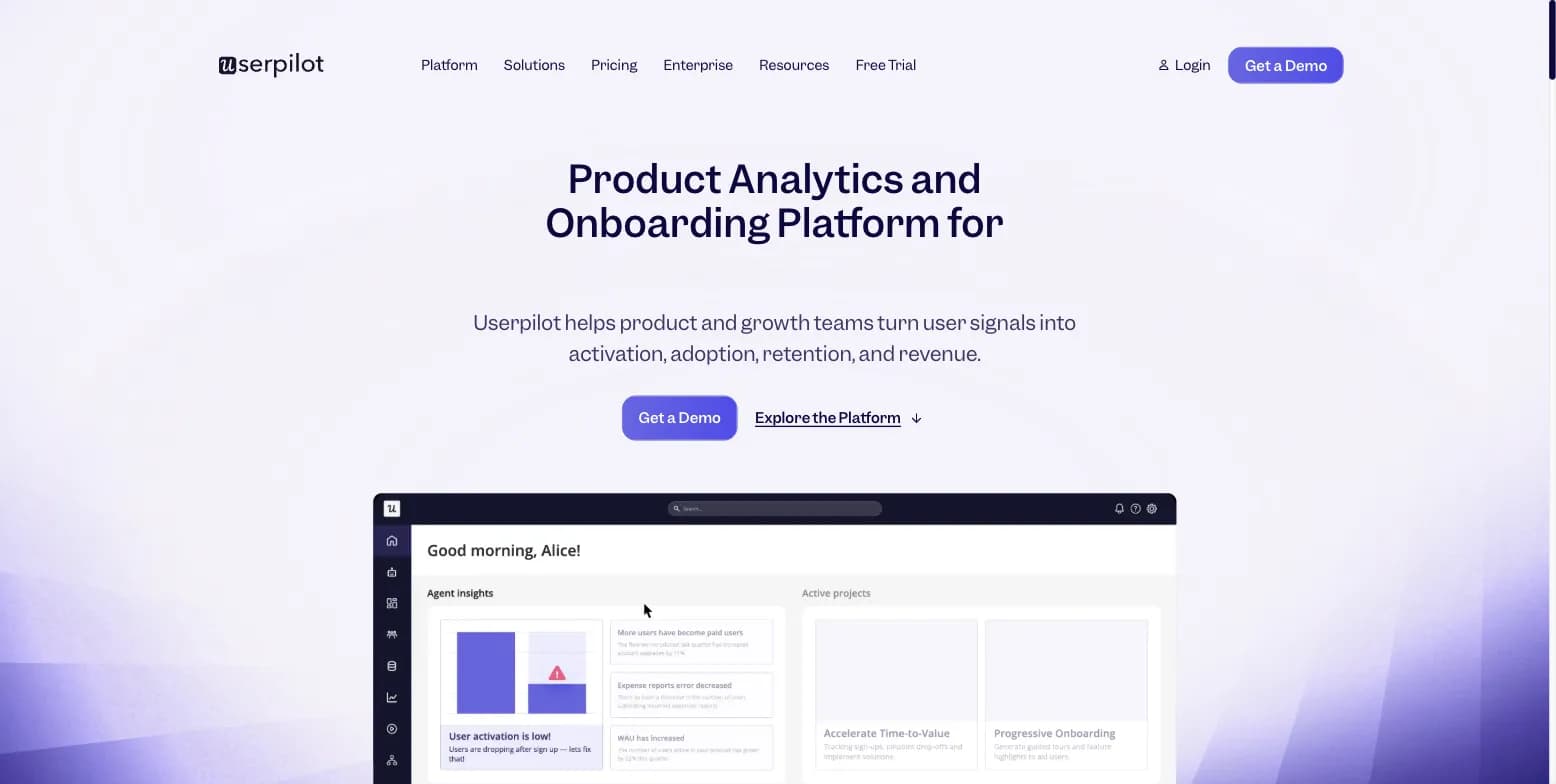
Userpilot is a digital adoption platform combining product analytics, in-app guidance, and user feedback in one code-free product. It's widely cited as the closest feature-for-feature Pendo alternative for SaaS use cases.
Key features:
- No-code onboarding flows, tooltips, and UI patterns without engineering dependency
- Real-time product analytics with funnels and retention views
- NPS, CSAT, and CES in-app surveys with customizable branching
- Event autocapture and session replay (add-on)
- Right-to-left (RTL) language support for localization
Why Choose Userpilot Over Pendo
Real-Time Analytics vs. Delayed Data Processing. Pendo's own documentation states data visibility can take up to an hour depending on processing stage. Userpilot's analytics update in real time, letting teams act on usage data and run A/B tests without the lag.
Survey Access Without an Enterprise Tier. Pendo gates its Sentiment surveys behind the Ultimate plan, with pricing undisclosed. Userpilot includes NPS, CSAT, and CES surveys at its published entry price, so teams aren't forced into enterprise-only pricing just to collect feedback.
Userpilot Pricing:
- Starter: $299/month, up to 2,000 Monthly Active Users, in-app engagement, segmentation, usage-trend analysis, NPS survey
- Growth: From $849/month, advanced product analytics, event autocapture, advanced in-app surveys, email engagement, session replay (add-on)
- Enterprise: Custom pricing
G2 rating: 4.6/5 (1,010 reviews). Reviewers cite an intuitive interface and responsive support, with a learning curve on advanced segmentation and reporting.
Who Should Use Userpilot?
- You want product analytics, in-app guidance, and feedback surveys in a single no-code platform
- Real-time analytics matter more to you than Pendo's delayed data processing
- You need right-to-left language support for localized in-app experiences
- You're comfortable with a $299/month entry price in exchange for closer feature parity to Pendo's Base and Core tiers
3. Chameleon: Best for Advanced Customization and Control
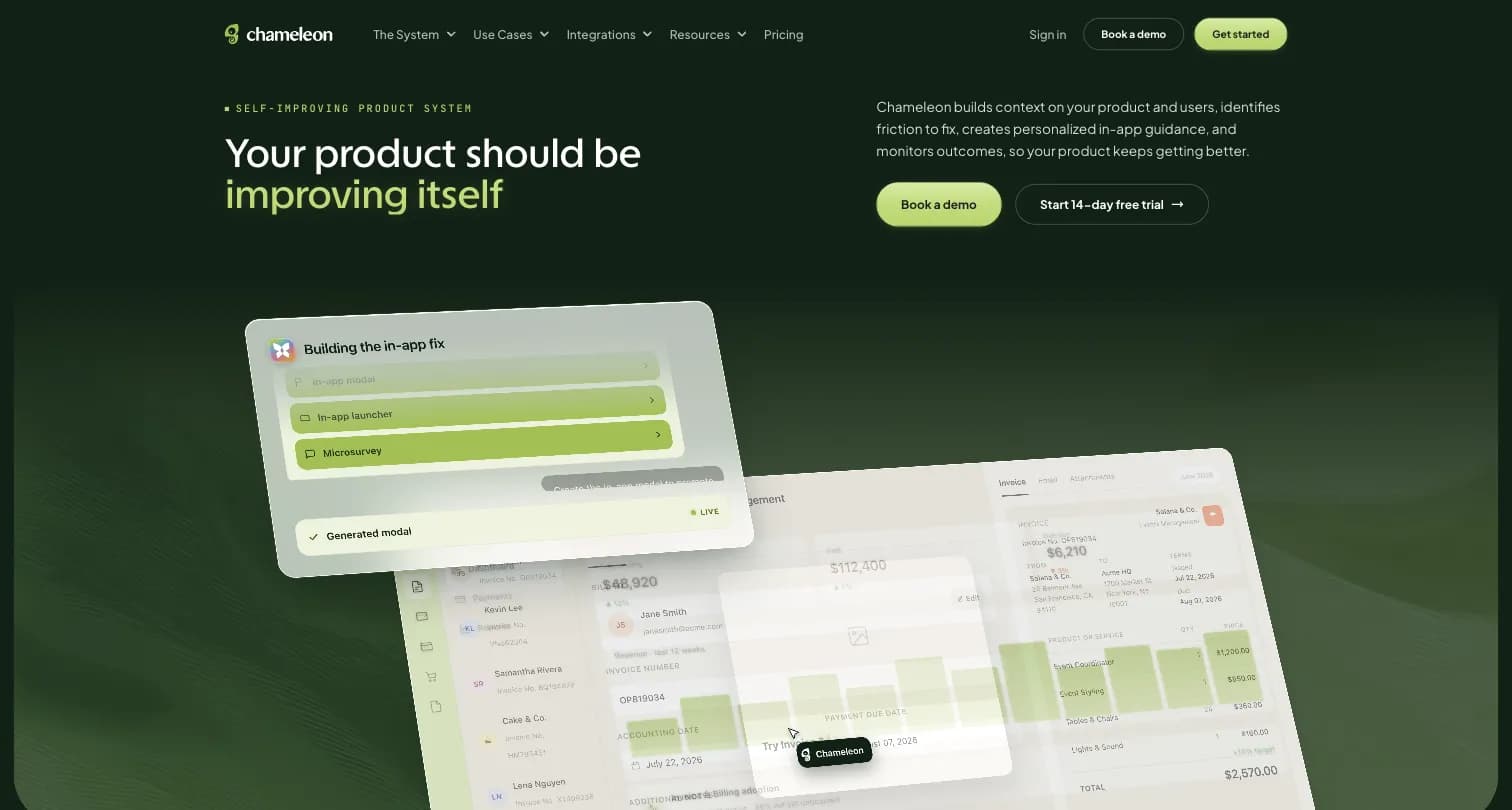
Chameleon is built for teams that want pixel-level control over in-app experiences rather than relying on predefined UI patterns.
Key features:
- Flow versioning, workspace-level permissions, and a change history log for governance
- Deep UI customization: styling, positioning, and behavior of modals, banners, tooltips, and hotspots
- SDK and API layer for programmatic experience triggering based on application state
- Copilot AI builder for faster flow creation
Why Choose Chameleon Over Pendo
Governance and Alerting Pendo Doesn't Have. Chameleon sends automated alerts through Slack or email when engagement on an experience drops. Pendo offers guide display alerts when a step fails to load, but lacks the same performance-tied notification layer, according to G2 reviewer feedback and independent research on Pendo's limitations.
Programmatic Control Over When Experiences Appear. Chameleon's SDK lets developers trigger experiences based on application state, not just tagged elements and predefined segments the way Pendo's guide-triggering model works. Teams building custom application logic get more direct control.
Chameleon Pricing:
- Startup: Starts at $279/month for 2,000 Monthly Tracked Users, up to 10 live experiences
- Pro: Self-serve, starting around $750/month for 5,000 MTUs, up to 20 live experiences, Copilot AI builder, custom CSS
- Enterprise: Custom pricing
G2 rating: 4.4/5 (362 reviews). Reviewers highlight flexible, largely code-free customization, with a learning curve on advanced conditional targeting logic.
Who Should Use Chameleon?
- You have some engineering support and want granular, pixel-level control over how in-app experiences look and behave
- You need governance features like flow versioning, workspace permissions, and change history for a growing team
- You want alerts when engagement on a specific experience drops, not just when a guide fails to load
- You're willing to trade Pendo's bundled analytics depth for flexibility and control
4. WalkMe: Best for Enterprise Digital Transformation
WalkMe is a digital adoption platform built for large organizations rolling out change management and process guidance across many internal systems, not just a single product.
Key features:
- Smart Walk-Thrus and SmartTips that guide users through multi-step processes spanning several enterprise systems (CRM, ERP, internal tools)
- Workflow automation that can auto-fill fields and advance users through repetitive steps, not just display guidance
- Discovery module tracking software usage across the entire tech stack to identify unused licenses
Why Choose WalkMe Over Pendo
Cross-System Process Guidance. Pendo's guides are typically tied to individual features or pages within a single product. WalkMe is built to guide users through workflows that span multiple enterprise systems at once, which matters for large IT-led rollouts.
Automation, Not Just Guidance. WalkMe can execute actions inside applications on a user's behalf. Pendo focuses on tooltips and flows that instruct the user but don't act for them.
WalkMe Pricing: Custom, quote-based. Independent marketplace data referenced in third-party research puts a typical starting contract around $14,000 per year. WalkMe topped the Gartner Peer Insights list of Pendo alternatives with a 4.5-star rating across 258 reviews.
Who Should Use WalkMe?
- You're a large enterprise managing digital transformation across many internal systems, not just one product
- IT and governance teams, not a single product team, own the adoption rollout
- You need workflow automation that executes actions for users, not just tooltips that instruct them
- You want visibility into software usage and license optimization across your entire tech stack
5. Whatfix: Best for Enterprise Employee and Customer Onboarding
Whatfix is an enterprise adoption platform that leans further into structured training and documentation than Pendo, with deep integrations into learning management systems.
Key features:
- Structured, repeatable training modules employees can revisit on demand for compliance and process consistency
- Deep integrations with learning management systems and knowledge bases
- Cross-application guidance managed centrally across a CRM, HR system, and internal tools from one platform
Why Choose Whatfix Over Pendo
Formal Training Infrastructure Pendo Lacks. Whatfix provides hands-on sandboxes and native training wikis for structured employee learning. Pendo's in-app guides are built primarily for feature adoption and product-led messaging, not formal L&D infrastructure.
Centralized Guidance Across Multiple Applications. Whatfix can standardize onboarding across a CRM, HR system, and internal tools from a single platform. Pendo's analytics and guides are typically scoped to one product environment.
Whatfix Pricing: Custom, quote-based. Whatfix ranked second on Gartner Peer Insights' Pendo alternatives list with a 4.5-star rating across 249 reviews, and independent marketplace research puts a typical starting contract around $25,000 per year.
Who Should Use Whatfix?
- You need to standardize structured training and documentation across many internal systems for both employees and customers
- Your onboarding strategy depends on formal learning infrastructure like sandboxes and training wikis, not just tooltips
- You want guidance managed centrally across a CRM, HR system, and internal tools from one platform
- Compliance and process consistency matter more to you than lightweight, fast-to-ship in-app messaging
6. Appcues: Best for Cross-Platform Onboarding
Appcues focuses on shipping onboarding experiences quickly across web and mobile rather than combining onboarding with deep product analytics the way Pendo does.

Key features:
- Cross-platform Workflows linking web and mobile onboarding into one continuous journey
- Event-based triggering usable immediately after defining a custom event, without waiting on data processing
- Fast iteration: create, preview, and publish experiences without navigating multiple modules
Why Choose Appcues Over Pendo
Faster Iteration on In-App Experiences. Pendo separates features across Guides, Data Explorer, and Listen, which adds friction when iterating on onboarding tied to analytics. Appcues keeps experience creation and publishing in one flow.
Immediate Event-Based Targeting. Appcues lets you define and use custom events as soon as you create them. Pendo's feature tagging and Track Events typically require more setup before they're usable for segmentation.
Appcues Pricing: Starts around $750/month for 1,000 Monthly Active Users. G2 rating: 4.6/5. Reviewers note weaker analytics depth compared to Pendo and Userpilot.
Who Should Use Appcues?
- You already know what to ship and want to move fast on onboarding flows and announcements
- You need onboarding to work as one continuous journey across both web and mobile
- You don't need Pendo's deeper product-analytics layer alongside your onboarding tool
- You want to define and act on custom events immediately, without a data-processing delay
7. FullStory: Best for Session Replay and UX Diagnostics
FullStory captures every user interaction automatically and helps teams diagnose friction through session replay and behavioral analytics, rather than structured surveys or in-app guides.

Key features:
- Automatic capture of rage clicks, dead clicks, and browser console errors without manual tagging
- Fully searchable session replay across all past user sessions, not limited to pre-defined segments
- Guides and Surveys for lightweight in-app messaging and feedback collection
Why Choose FullStory Over Pendo
Root-Cause Diagnostics Without Pre-Tagging. Pendo's frustration metrics are tied to predefined, tagged features. FullStory's autocapture surfaces friction signals and lets you jump straight from a funnel drop-off to the exact session replay, without needing to have already defined what you were looking for.
Open-Ended Exploration vs. Structured Tracking. FullStory supports truly exploratory searches across all historical sessions. Pendo's analytics model remains more tag-dependent, which works well for tracking known goals but is less suited to uncovering unknown friction.
FullStory Pricing: Custom, quote-based, with independent marketplace data suggesting contracts typically start around $10,000/year. A free plan is available for up to 30,000 sessions/month.
Who Should Use FullStory?
- You need deep root-cause UX diagnostics and session replay, not structured surveys or in-app guides
- You want to explore user behavior openly, without needing to pre-define which features or segments to investigate
- You're willing to pair FullStory with a lighter onboarding or survey tool for guidance and feedback collection
- A generous free tier (30,000 sessions/month) matters more to you upfront than Pendo's 500-MAU free cap
8. Mixpanel: Best for Deep Product Analytics
Mixpanel is a dedicated product analytics tool for teams that want to replace Pendo's analytics layer specifically, without the guides, surveys, or session replay bundled in.
Key features:
- Developer-led event model with custom properties for granular, multi-dimensional behavioral tracking
- Dynamic cohort analysis for questions like "which onboarding path leads to the highest 30-day retention"
- Impact analysis linking specific features or releases to engagement, conversion, or retention outcomes
Why Choose Mixpanel Over Pendo
Flexible, Developer-Controlled Data Modeling. Pendo's no-code feature tagging is fast to set up but UI-dependent and less flexible for modeling complex behaviors. Mixpanel's event-based model gives engineering teams direct control over what's tracked and how it's sliced.
Usage-Based Pricing That Scales With You. Mixpanel's pricing scales with event volume, letting teams start small and pay more only as usage grows, versus Pendo's opaque MAU-based enterprise contracts.
Mixpanel Pricing: Free plan for up to 1 million monthly events. Paid plans start around $1,200/year, though mid-market teams commonly spend more depending on event volume.
Who Should Use Mixpanel?
- You specifically need to replace Pendo's product-analytics layer, not its guides, surveys, or session replay
- Your engineering team wants direct control over event modeling rather than no-code feature tagging
- You want pricing that scales with actual event volume instead of an opaque MAU-based enterprise contract
- You're fine sourcing onboarding, guides, and surveys from separate, dedicated tools
How to Choose the Right Pendo Alternative
Picking a replacement depends on which part of Pendo's bundle you actually use. Here's how to narrow it down.
Start With Your Use Case
- Feedback and surveys as your primary need: Formbricks
- All-in-one product adoption for SaaS: Userpilot or Chameleon
- Enterprise-wide digital transformation: WalkMe or Whatfix
- Fast onboarding shipping without deep analytics: Appcues
- Session replay and UX diagnostics: FullStory
- Product analytics only: Mixpanel
Then Evaluate These Criteria
| Criteria | Questions to Ask |
|---|---|
| Budget | Is pricing public, or do you need a sales call before you know the cost? |
| Data privacy | Can you self-host? Where is response data stored? |
| Which Pendo module matters | Analytics, in-app guides, session replay, or surveys, which one are you actually replacing? |
| Team size | Do you need a no-code tool, or does engineering own implementation? |
| Integrations | Does it connect to your CRM, helpdesk, and analytics stack? |
| Response/API limits | Is API access free on every tier, or gated behind Enterprise? |
The Privacy Factor
Every tool on this list except Formbricks is closed-source and cloud-only. If data ownership, self-hosting, or a hard compliance requirement is part of your evaluation, that narrows the list significantly.
Formbricks is the only open-source Pendo alternative here. The Community Edition is free forever, self-hostable on your own infrastructure, and Formbricks never has access to your data when self-hosted. Read more about GDPR-compliant survey tools and enterprise survey software built privacy-first.
For more comparison articles, see our Sprig alternatives, Medallia alternatives, Survicate alternatives, and SurveySparrow alternatives guides.
Frequently Asked Questions
Looking for the only open-source Pendo alternative? Formbricks gives you feedback management across website, in-app, link, and email surveys, feedback analytics, and workflow integrations with Salesforce, HubSpot, Slack, Google Sheets, and Notion, plus a free API on every tier. Self-host it for full data ownership, or start on the cloud Hobby plan for free.
Try Formbricks now