
UserVoice Competitors in 2026: Who Actually Competes With It (and Where Formbricks Fits Instead)

Johannes
Co-Founder @ Formbricks
12 Minutes
August 16th, 2026
The two pages currently ranking for "UserVoice competitors" both answer with a flat, numbered list. Savio's own post names 13 tools and sorts them by how much money you'd save switching. Sleekplan's page names 13 more and calls them "alternatives" instead, despite ranking for the competitors query too. Neither draws a line between what actually competes with UserVoice (idea management and feature-request tools) and what's a completely different category stapled onto the same listicle, like Hotjar (behavior analytics) or UserTesting (research panels).
This guide sorts UserVoice's real competitive landscape by category, then gets honest about where a feedback-collection platform like Formbricks fits, which is genuinely not the same category UserVoice competes in, and where neither of the two current top-ranking pages asks the one question that matters most for regulated buyers: can you self-host any of this?
TL;DR
- UserVoice repositioned itself from a feature-voting board into a "revenue-weighted feedback intelligence" platform. Its own FAQ explicitly distinguishes itself from Canny and Productboard, calling them "PM-focused tools built for feedback collection and roadmap planning" without revenue weighting.
- UserVoice's own G2 listing and Savio's competitor research point to the same five names as its closest rivals: Canny, Aha!, Productboard, Savio, and Enterpret.
- UserVoice publishes no pricing anywhere on its own site. The only real dollar figures found come from a vendor-submitted table on G2 ($10,788-$16,188/year), and a third-party estimate from Sleekplan's own comparison page independently lands in the same range ($16,000/year).
- Not one of the 7 competitors covered here, or UserVoice itself, offers self-hosting. Formbricks is the only name on this page where that's an option, and it isn't a like-for-like UserVoice competitor either.
- If your actual need is running structured NPS, CSAT, or PMF surveys rather than a feature-request voting board, none of the 7 competitors below are the right comparison. That's a different tool for a different job.
What Is UserVoice?
UserVoice has no live About page on its own site (uservoice.com/about returns a 404), so some of its history is stitched together from third-party sources. Crunchbase lists a 2008 founding with Richard White, Lance Ivy, and Marcus Nelson as founders; Pitchbook separately lists 2006. A 2023 acquisition announcement from Curious Holdings confirms Richard White as founder and describes UserVoice's earlier era as a San Francisco-based feedback company.
Today, UserVoice positions itself as a customer intelligence platform: "unifies fragmented customer signals into revenue-weighted insights so you can move forward with confidence," per its own homepage. It connects to Salesforce, Gong, Zendesk, Gainsight, Jira, Azure DevOps, and Slack to pull feedback from support tickets, NPS scores, and sales calls into one ranked backlog, using AI to surface themes and churn-risk signals. Customer logos on its homepage include PandaDoc, Electronic Arts, Dropbox DocSend, Humana, Cisco, Intuit, Adobe, GoDaddy, and Box.
UserVoice holds a 4.5 rating across 243 reviews on G2, where it's categorized under Enterprise Feedback Management, Idea Management, and Product Management. Capterra shows a 4.3 rating across 70 reviews, but files it under Knowledge Management and support-ticketing software, reflecting its older helpdesk product line more than its current customer-intelligence positioning. Reviewers cite ease of use and the ability for CSMs to log feedback on behalf of a customer as strengths, alongside a steep learning curve, pricing that "can feel high for smaller organizations," and weak traceability between logged ideas and what actually ships.
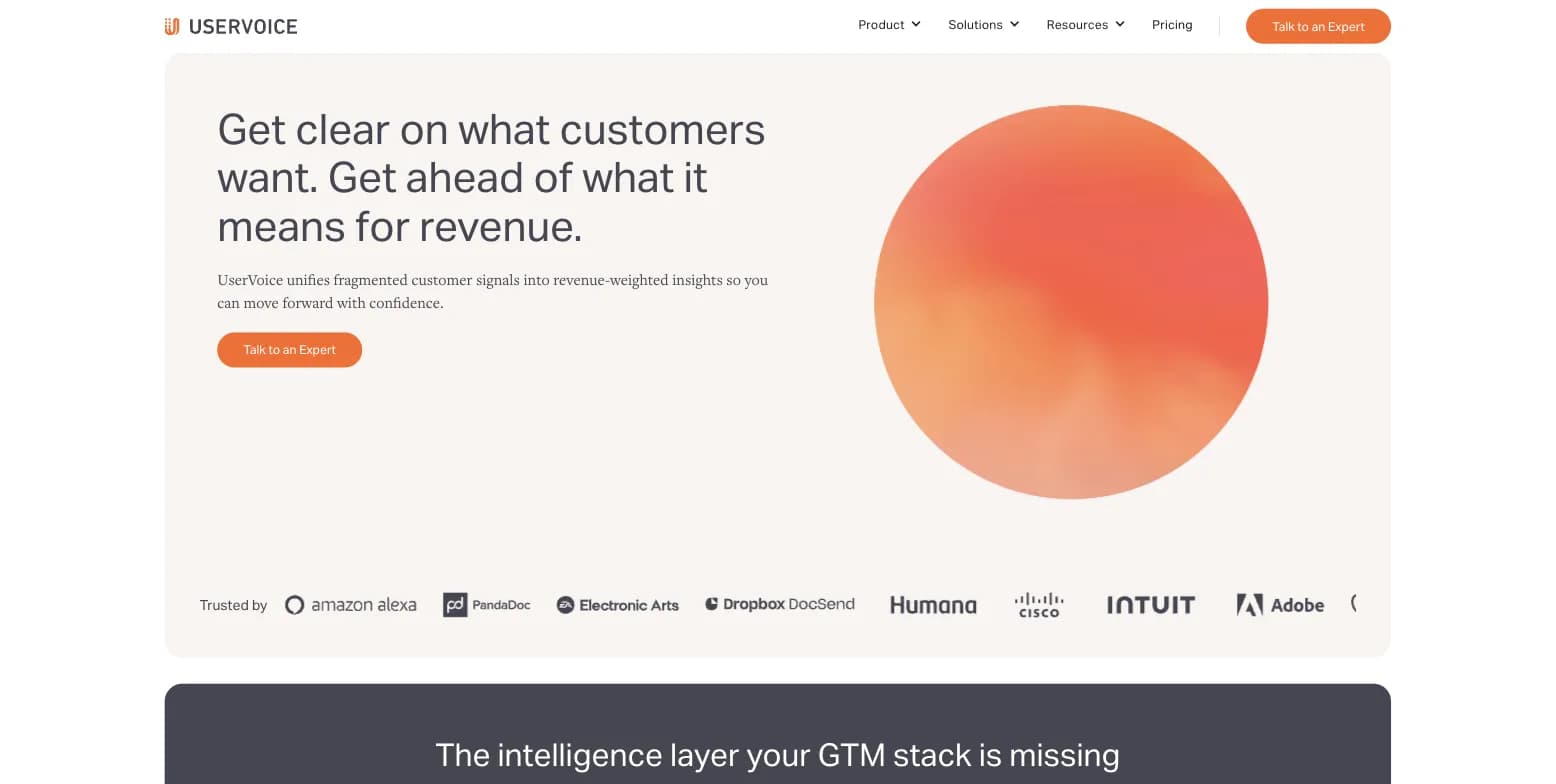
Captured August 15, 2026 from uservoice.com.
UserVoice's Actual Competitive Landscape
UserVoice draws its own category line explicitly. Per its homepage FAQ, it describes Canny and Productboard as "PM-focused tools built for feedback collection and roadmap planning," without revenue weighting, while positioning itself as a customer-intelligence layer serving product, CS, and revenue teams at once.
That distinction matters, because it means UserVoice's real competitive set splits into two groups, plus one adjacent bundle:
- Idea management & feature-request boards: Canny, Productboard, Aha!, Savio, Sleekplan. These compete directly with UserVoice's original core function, capturing and prioritizing feature requests, whether or not they've added revenue-weighting on top.
- Enterprise customer intelligence / voice-of-customer AI: Enterpret. This is the closest match to what UserVoice has repositioned itself as, an AI layer unifying support, sales, and survey signals into prioritized insight, rather than a public voting board.
- Adjacent: support-plus-feedback bundles: Featurebase. Bundles an AI helpdesk with a feedback board and changelog as one module inside a broader support suite, a different buying motion than a dedicated idea-management purchase.
Why Companies Look at UserVoice's Competitors
We reviewed UserVoice's own pricing and homepage FAQ, its G2 and Capterra reviews, and the two current top-ranking pages for "UserVoice competitors" (Savio's own post and Sleekplan's alternatives page). A few reasons for switching come up repeatedly.
1. No Pricing Appears Anywhere on UserVoice's Own Site
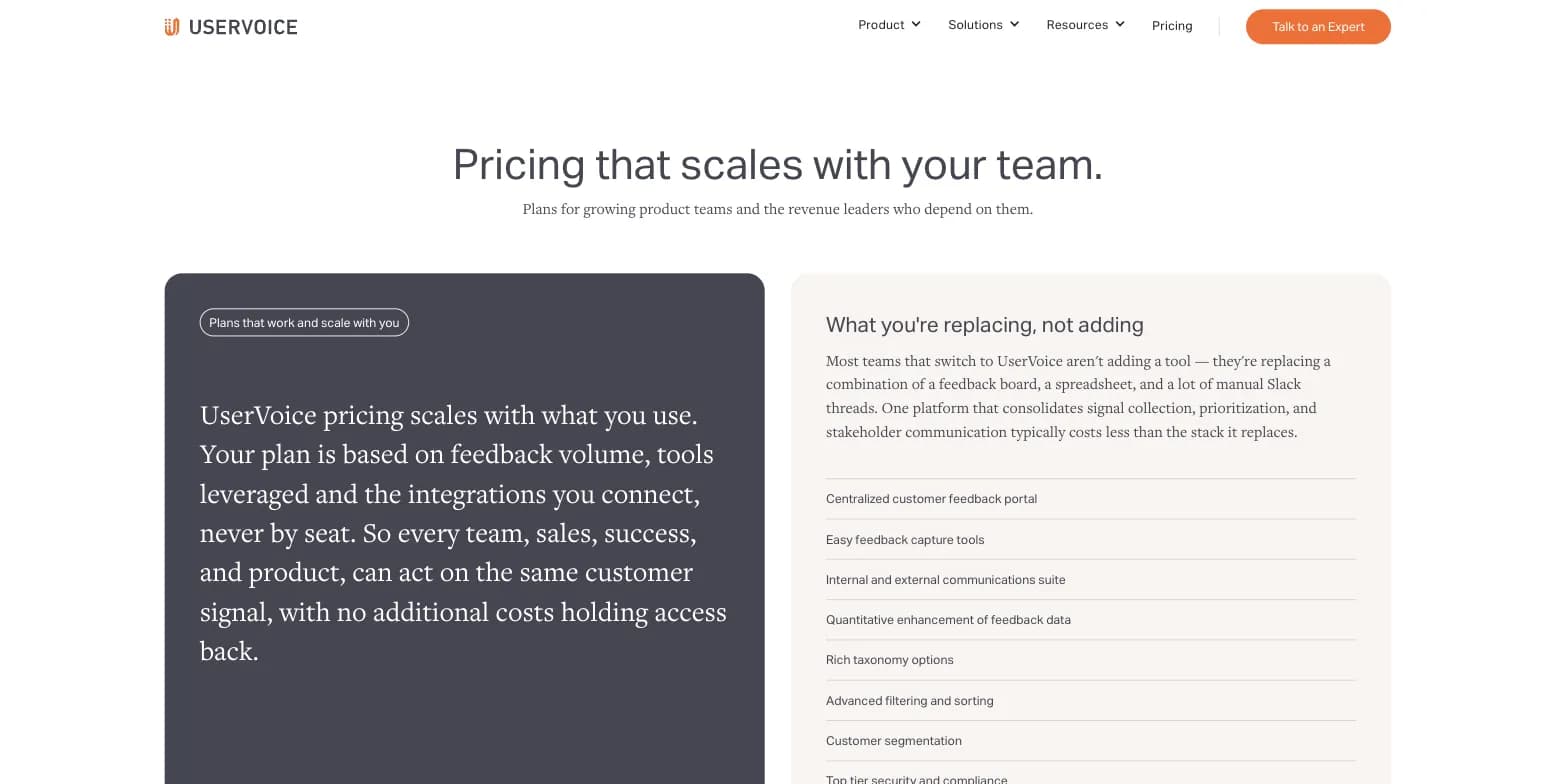
Captured August 15, 2026. UserVoice's own pricing page states pricing "scales with what you use... never by seat," with no dollar figures shown.
UserVoice's own pricing page shows no numbers at all; it states pricing scales with feedback volume and connected integrations. The only real figures found come from a vendor-submitted table on G2: Growth from $10,788/year (200 unique end users/year), Team from $14,388/year, Strategic from $16,188/year (5,000 unique end users/year). Sleekplan's own comparison page independently cites "$16,000 per year" as UserVoice's starting price, landing in the same range from a separate source.
2. No Free Tier, No Self-Serve Trial
Every plan requires booking a demo. A 30-day trial workspace is offered only after that call. Every competitor covered below, except Enterpret, publishes a real free tier or a self-serve starting price you can see before talking to anyone.
3. Positioned Away From the Job Most Buyers Actually Want
UserVoice's own FAQ frames Canny and Productboard as narrower, PM-focused tools "without revenue weighting." That's an honest distinction, but it also means teams that just want a lightweight voting board and public roadmap are paying for revenue-correlation machinery (CRM and sales-call integrations) they may not need.
4. Weak Traceability From Idea to Shipped Feature
One G2 reviewer specifically flagged weak traceability between logged ideas and what actually ships, with no native roadmap or dev-tool integration called out. Competitors like Canny and Productboard build changelog-and-roadmap loop-closing into the core product.
5. No Self-Hosting, at Any Contract Size
UserVoice is cloud-only per its own site; no self-hosted or data-residency option is mentioned anywhere. For organizations with a hard compliance requirement, there's no path to running UserVoice on your own infrastructure regardless of how large the contract is.
UserVoice Competitors at a Glance
| Competitor | Category | Best For | Starting Price | Self-Hosted |
|---|---|---|---|---|
| Canny | Idea Management | AI-captured feedback with public roadmap | Free (25 tracked users), $79/mo Pro | No |
| Productboard | Idea Management / PM Suite | Feedback synthesized into a governed roadmap | Free (1 maker), $19/maker/mo Plus | No |
| Aha! | Idea Management / PM Suite | Enterprise strategy bundled with an Ideas portal | $59-74/user/mo (Premium, annual/monthly) | No |
| Savio | Idea Management | Revenue-weighted prioritization from CRM/helpdesk data | $39/mo (Essentials) | No |
| Sleekplan | Idea Management (SMB) | Budget board, roadmap, changelog, and NPS in one | Free (Indie), $13/mo Starter | No |
| Enterpret | Enterprise Customer Intelligence | AI-unified support, sales, and survey signals at scale | Custom (no published pricing) | No |
| Featurebase | Support + Feedback Bundle | AI helpdesk bundled with feedback boards | Free, $29/seat/mo Growth | No |
| Formbricks | Feedback & Experience Management | Actually collecting the structured survey data these tools don't | Free (250 responses/mo), $74/mo Pro | Yes (Community Edition) |
The Real UserVoice Competitors, Grouped by Category
Idea Management & Feature-Request Boards
1. Canny: AI-Captured Feedback With the Cleanest Public Roadmap
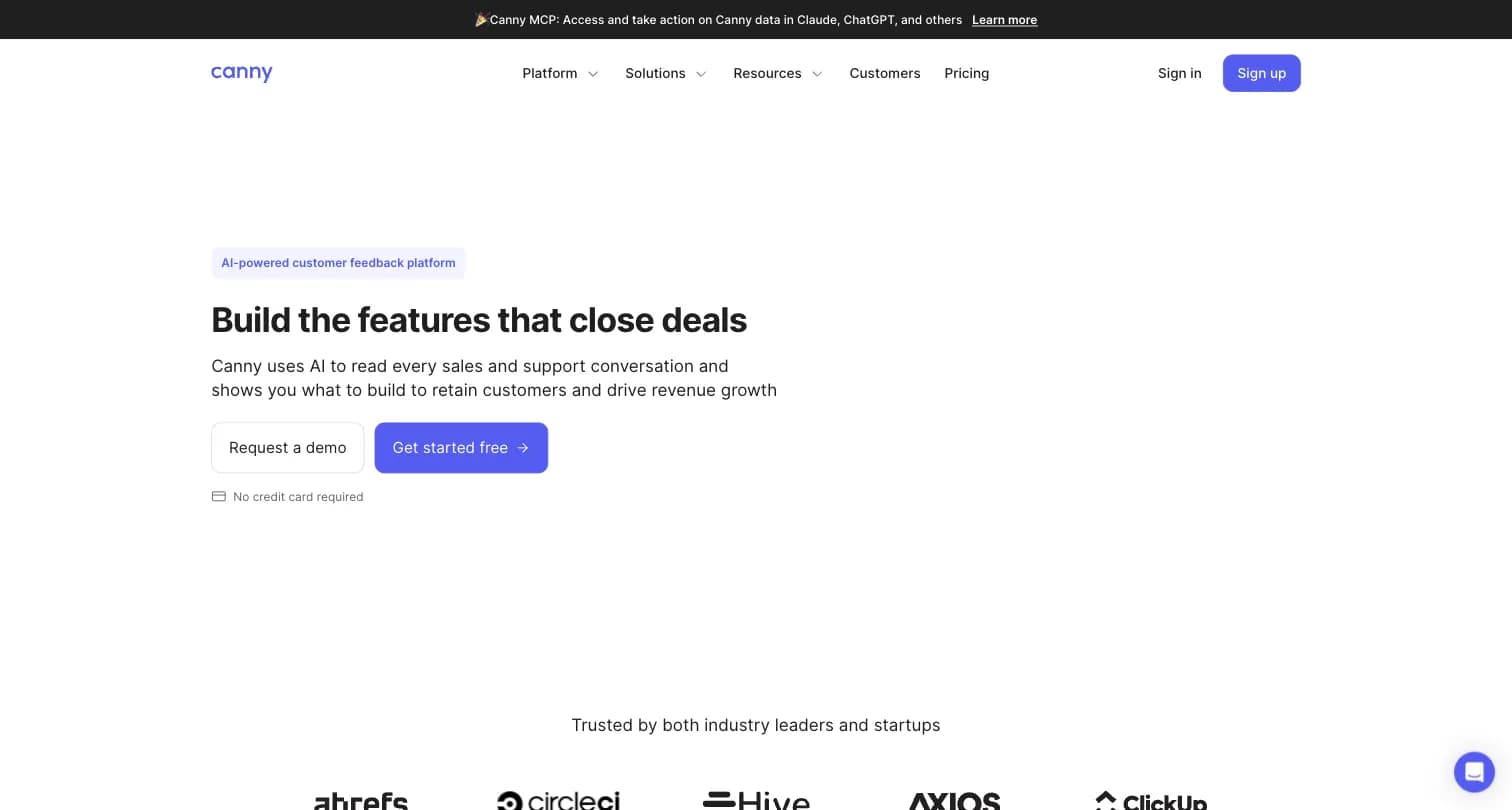
Canny launched in 2017 as feature-voting boards, founded by Sarah Hum and Andrew Rasmussen, who met as a designer and engineer at Meta. It's bootstrapped and profitable, reporting 100K+ registered companies and 15M+ feedback items captured. Its standout feature, Autopilot, reads support tickets, sales calls (via Gong), and chat tools (Intercom, Slack) to automatically capture and deduplicate feedback without manual logging, then links posts to account and MRR data through CRM integrations to score requests by revenue impact, the same underlying idea as UserVoice's own revenue-weighting pitch.
How it compares to UserVoice: Both rank feedback by revenue signal, but Canny's Autopilot automates the capture step itself, while UserVoice leans on manual CSM-logged entries tied to Salesforce/Gainsight data. Canny publishes real pricing; UserVoice doesn't.
Pricing: Free (25 tracked users, unlimited feedback), Pro at $79/month billed yearly (100+ tracked users, PM integrations), Business at custom pricing (5,000+ tracked users, SSO). Billed by "tracked users," anyone who's given feedback via a post, vote, or comment.
Reviews: 4.5 on G2 (108 reviews), 4.6 on Capterra (77 reviews). Reviewers cite ease of setup and revenue-linked filtering as strengths, and single-attribute filtering (can't combine filters) as a limitation.
Best for: Teams that want AI to automatically mine sales and support conversations for feature requests, with transparent, self-serve pricing UserVoice doesn't offer.
2. Productboard: The Full Roadmapping Suite With an AI Agent
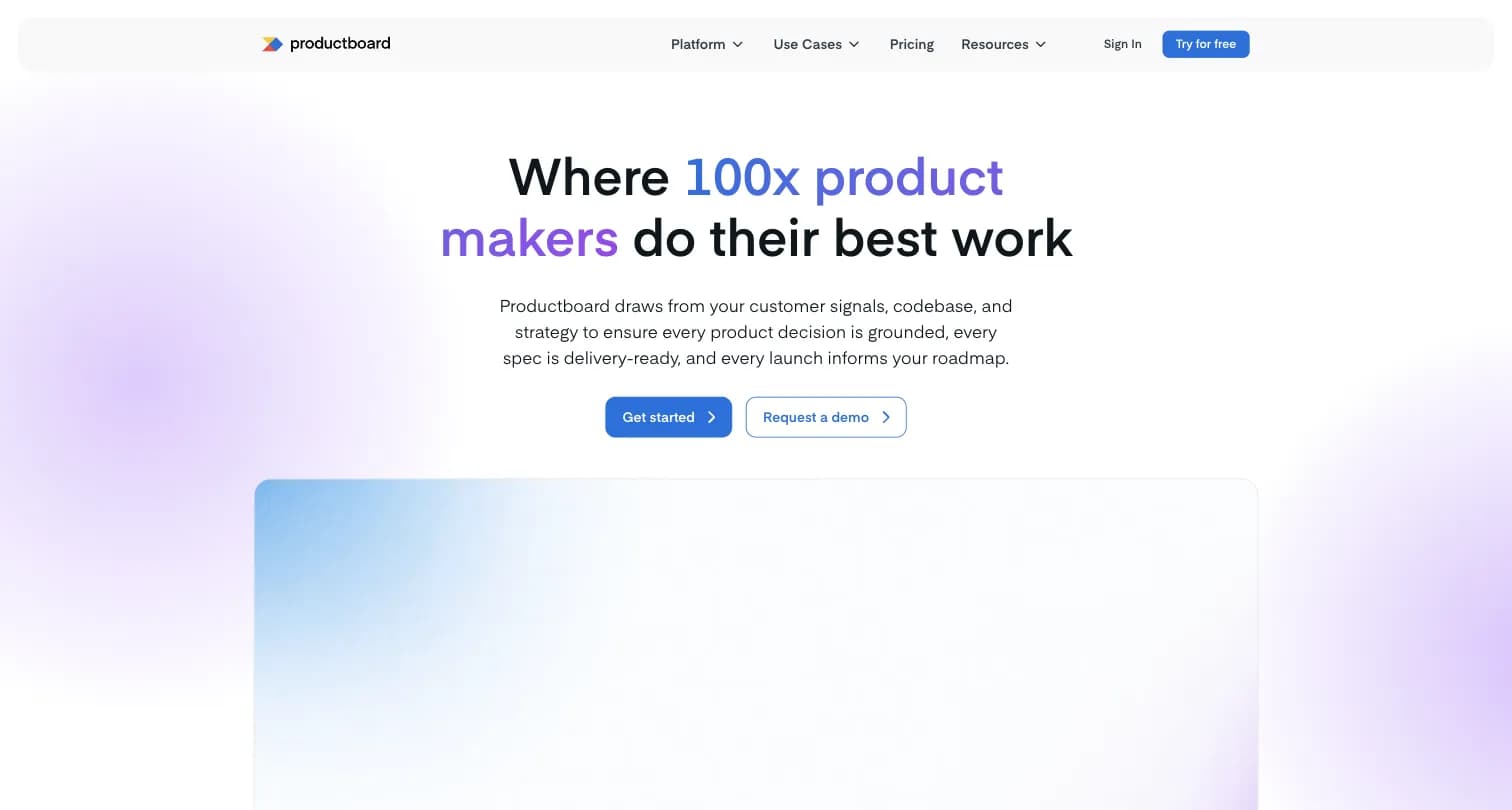
Productboard was founded in 2014 by Hubert Palan and Daniel Hejl, and has grown to 500+ employees and 6,000+ customers including Autodesk, Zoom, Salesforce, and Cartier. Its Spark AI agent surfaces product opportunities with citations, drafts delivery-ready specs from feedback synthesis, and measures post-launch impact. Pricing is per "maker" (the PM who owns strategy), not per total user, so contributors who just submit or tag feedback don't count toward the seat limit.
How it compares to UserVoice: Productboard goes further into roadmapping and release planning than UserVoice does; UserVoice's revenue-weighting is closer to a scoring layer, while Productboard builds out full prioritization frameworks and dependency tracking. Neither publishes what a self-hosted deployment would cost, because neither offers one.
Pricing: Free (1 maker, 500 feedback notes, full Spark AI), Plus at $19/maker/month billed annually, Business at $59/maker/month (2-maker minimum), Enterprise custom (5-maker minimum).
Reviews: 4.3 on G2 (254 reviews), 4.7 on Capterra (154 reviews). Reviewers flag a steep learning curve for new or non-PM users and pricing that scales unpredictably as maker count grows.
Best for: Product teams that want an AI agent turning feedback into delivery-ready specs and a governed roadmap, not just a scored backlog.
3. Aha!: The Enterprise Product-Management Bundle
Aha! sells its Ideas capability, an online feedback and voting portal, as part of a broader suite that includes Roadmaps, Discovery, Whiteboards, Develop, Teamwork, and Knowledge. Its Roadmaps plans (Premium, Enterprise, Enterprise+) each include Aha! Ideas Essentials, Aha! Whiteboards Essentials, and Aha! Knowledge Essentials bundled in, rather than selling Ideas as a standalone line item at the entry tier. The company holds G2 Leader status for Summer 2026 and a "Best Results" badge in Idea Management for Spring 2026, plus a 4.7-star Capterra rating.
How it compares to UserVoice: Aha! is a full strategy-to-delivery product-management suite with an ideas portal bundled in; UserVoice is closer to a dedicated feedback-intelligence layer that plugs into a CRM and helpdesk stack you already have. Unlike UserVoice, Aha! can't segment feature requests by customer attributes like MRR without the CRM-connected Advanced tier of Aha! Ideas, an upgrade on top of the base Roadmaps plan.
Pricing (captured August 2026 from aha.io/roadmaps/pricing): Premium at $59-74/user/month (annual/monthly billing), Enterprise at $99-124/user/month, Enterprise+ at $149/user/month (annual billing only). Aha! Ideas Advanced is a further $20/user/month upgrade for Salesforce and Zendesk integrations and portal customization.
Best for: Teams that already want (or have) Aha!'s full roadmapping and strategy suite, and are fine with an ideas portal bundled in rather than purchased standalone.
4. Savio: Revenue-Weighted Prioritization Built for GTM Teams
Savio centralizes feature requests from Slack, HubSpot, Intercom, Zendesk, Salesforce, and Help Scout in one place, then lets teams filter and sort by customer attributes like MRR, so a product team can see "what my highest-MRR customers are asking for" directly. It also includes a "close the loop" workflow for notifying customers when a request ships, something UserVoice reviewers specifically flagged as weak.
How it compares to UserVoice: Both weight feedback by revenue signal, but Savio's own positioning leans harder into sales and customer-success workflows (its own site markets by role: Product, Sales, and Customer Success teams specifically), while UserVoice frames itself more broadly as a customer-intelligence platform. Savio's pricing is public; UserVoice's isn't.
Pricing: Essentials at $39/month for the first admin ($23 per additional admin), Professional at $79/month for the first admin ($39 per additional admin), Business at custom pricing for large teams. Contributors, viewers, and submitters are free and unlimited on every plan.
Best for: GTM-led teams (Sales, Customer Success, Product) that want feature requests tied directly to account revenue and a free trial without entering a credit card.
5. Sleekplan: The Budget Pick With a Direct UserVoice Migration Tool
Sleekplan markets itself specifically as an affordable UserVoice alternative, going as far as offering a one-click migration tool that imports posts, comments, votes, voters, statuses, and original timestamps from a UserVoice export in under an hour. It bundles a feedback board, public roadmap, changelog, NPS and CSAT surveys, and an in-app widget into one workspace.
How it compares to UserVoice: Sleekplan's own comparison page states UserVoice "starts at $16,000 per year with no free tier," a figure independently in the same range as the $10,788-$16,188/year we found on G2's vendor-submitted table. Sleekplan's own pricing, by contrast, starts at $0. Unlike UserVoice, Sleekplan bundles NPS/CSAT surveys and an in-app widget directly into its lower tiers rather than gating feedback tooling behind enterprise-only contracts.
Pricing: Indie (free forever, unlimited feedback and subscribers, single-admin workspace), Starter at $13/month billed yearly (3 seats, CSAT/NPS, SSO, API access), Business at $38/month billed yearly (10 seats, surveys, topic analytics, custom domain), Enterprise custom (SAML SSO, unlimited seats, multi-workspace).
Reviews: 4.9 on G2, 4.8 on Capterra, per Sleekplan's own site.
Best for: Small to mid-size teams that specifically want to migrate off UserVoice without losing vote history, at a fraction of UserVoice's enterprise pricing.
Enterprise Customer Intelligence
6. Enterpret: The Closest Match to What UserVoice Has Repositioned Itself As
Enterpret describes itself as "customer intelligence infrastructure for teams building with AI," connecting support tickets, sales calls, surveys, app reviews, and community conversations into a structured, evolving taxonomy rather than one-off AI summaries. Its Customer Context Graph attaches segment, LTV, and product-area data to every piece of feedback, and its MCP server exposes that structured understanding to Claude, ChatGPT, Jira, and Linear directly. Customers cited on its own site include Canva (200M+ users), Notion (80% faster insight-to-decision time per its case study), Apollo.io (9x growth from mapping feedback to revenue, per its case study), Atlassian, Strava, and Hinge.
How it compares to UserVoice: This is the most direct category match to UserVoice's current "revenue-weighted feedback intelligence" positioning, both unify support, sales, and product signals into prioritized insight rather than running a public voting board. Enterpret goes further into AI-native infrastructure (an MCP server, an adaptive taxonomy that evolves with your product) aimed at high-velocity companies rather than UserVoice's broader enterprise base.
Pricing: Not published anywhere on Enterpret's site. Pricing is fully custom, based on feedback volume and integrations connected, quoted only after a demo, the same opacity UserVoice itself has.
Best for: High-velocity product organizations that want AI infrastructure connecting support, sales, and market signals into one continuously-updated system, not a public feature-voting board.
Adjacent: Support + Feedback Bundle
7. Featurebase: The AI Helpdesk That Bundles Feedback as One Module
Featurebase was founded at the end of 2020 by a three-person team (Bruno Hiis, Robi, and Markus) based in Tallinn, Estonia, and is fully bootstrapped and profitable. It's built around an AI support agent (Fibi) that resolves customer issues across an omnichannel inbox, with feedback boards, a public roadmap, and a changelog sold as additional modules under the same subscription, alongside a help center supporting 40+ languages.
How it compares to UserVoice: Featurebase's own footer lists Intercom and Zendesk as its primary compare targets ahead of Canny and Productboard, reflecting that it competes as a full support suite with feedback as one module, not primarily as an idea-management tool the way UserVoice does. Teams evaluating Featurebase are usually replacing a helpdesk-plus-feedback stack, not just a voting board.
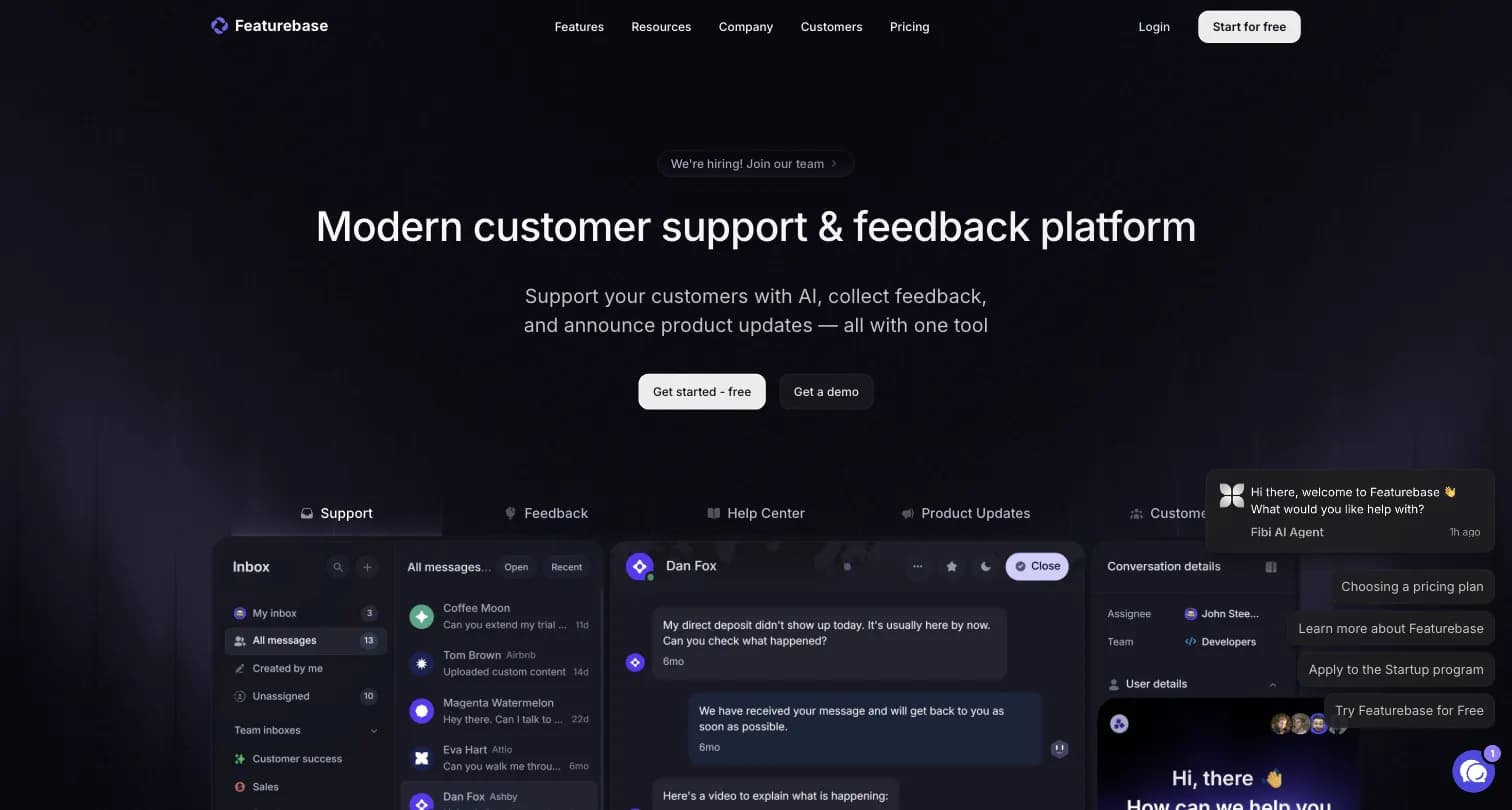
Pricing: Free forever (1 seat, 1 feedback board, 50 help-center articles, no AI features), Growth at $29/seat/month billed yearly (Fibi AI agent, 5 feedback boards), Professional at $59/seat/month (workflows, SLAs, SSO), Enterprise at $99/seat/month (multi-brand, Salesforce/HubSpot sync). AI resolutions and Copilot are billed as separate add-ons on top of seat price.
Reviews: 4.7 on G2 (50 reviews). Reviewers cite strong value for how many separate tools it replaces, and less predictable total cost once AI add-ons are layered on top of seat pricing.
Best for: Fast-growing startups replacing Intercom or Zendesk plus a separate feedback tool with one bundled subscription, not enterprises evaluating idea management as a standalone purchase.
Where Formbricks Fits (and Where It Doesn't)
Being direct about this: Formbricks is not a UserVoice competitor in the category sense. UserVoice ingests support tickets, sales calls, and votes to rank feature demand by revenue impact. Formbricks is a feedback and experience management suite built around feedback management (website, in-app, link, and email surveys), feedback analytics, and workflows and integrations, structured data collection, not idea-management or revenue-weighted prioritization.
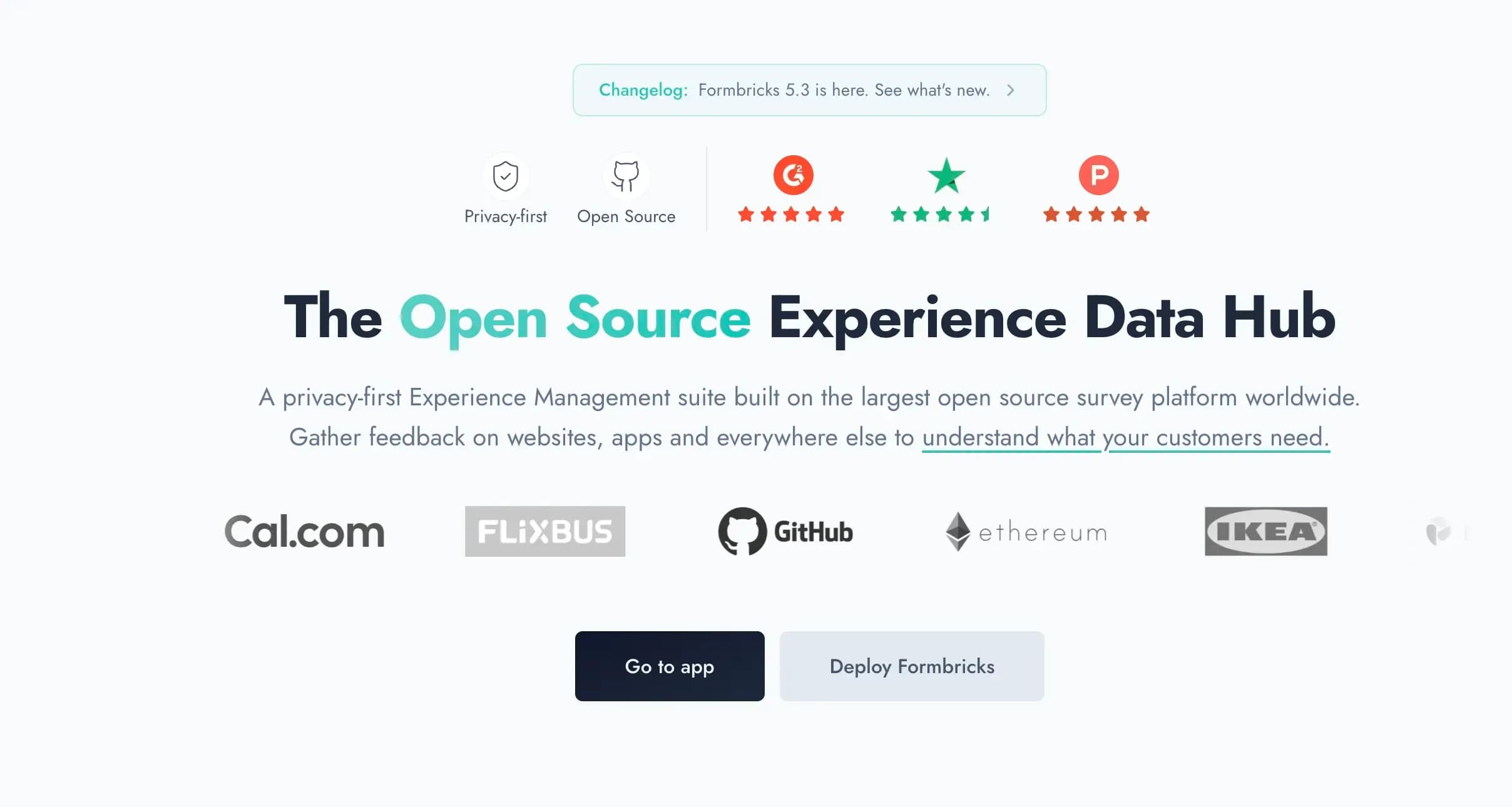
Why it's worth knowing anyway: UserVoice's own brief context is explicit that "teams researching UserVoice alternatives are usually looking for another idea-management tool, not a survey platform." That's honest, and it's true here too. But UserVoice can capture open-ended feedback through its idea portal; it has no dedicated NPS, CSAT, or PMF survey methodology built in. If your actual gap is structured, multi-question survey research, not a feature-request board, none of the 7 competitors above (or UserVoice itself) is the right comparison.
Key features:
- Multi-channel surveys: website pop-up, in-app micro-survey, link, and email-embedded, unified on one platform
- Feedback analytics with drop-off tracking, segmentation, and aggregate plus per-response views
- Formbricks Workflows for post-response automation, plus native integrations to Salesforce, HubSpot, Slack, Google Sheets, and Notion via webhooks
- Attribute-based targeting: conditional logic like "show this survey to users on the Pro plan who haven't responded in 30 days," not a static feedback-board trigger
- Free, unrestricted API on every tier, including MCP, and including the self-hosted Community Edition
- Self-hosting on your own infrastructure, with Formbricks never having access to your data when self-hosted, an option none of the 7 UserVoice competitors above or UserVoice itself publish
Formbricks Pricing (verified from formbricks.com/pricing, August 2026):
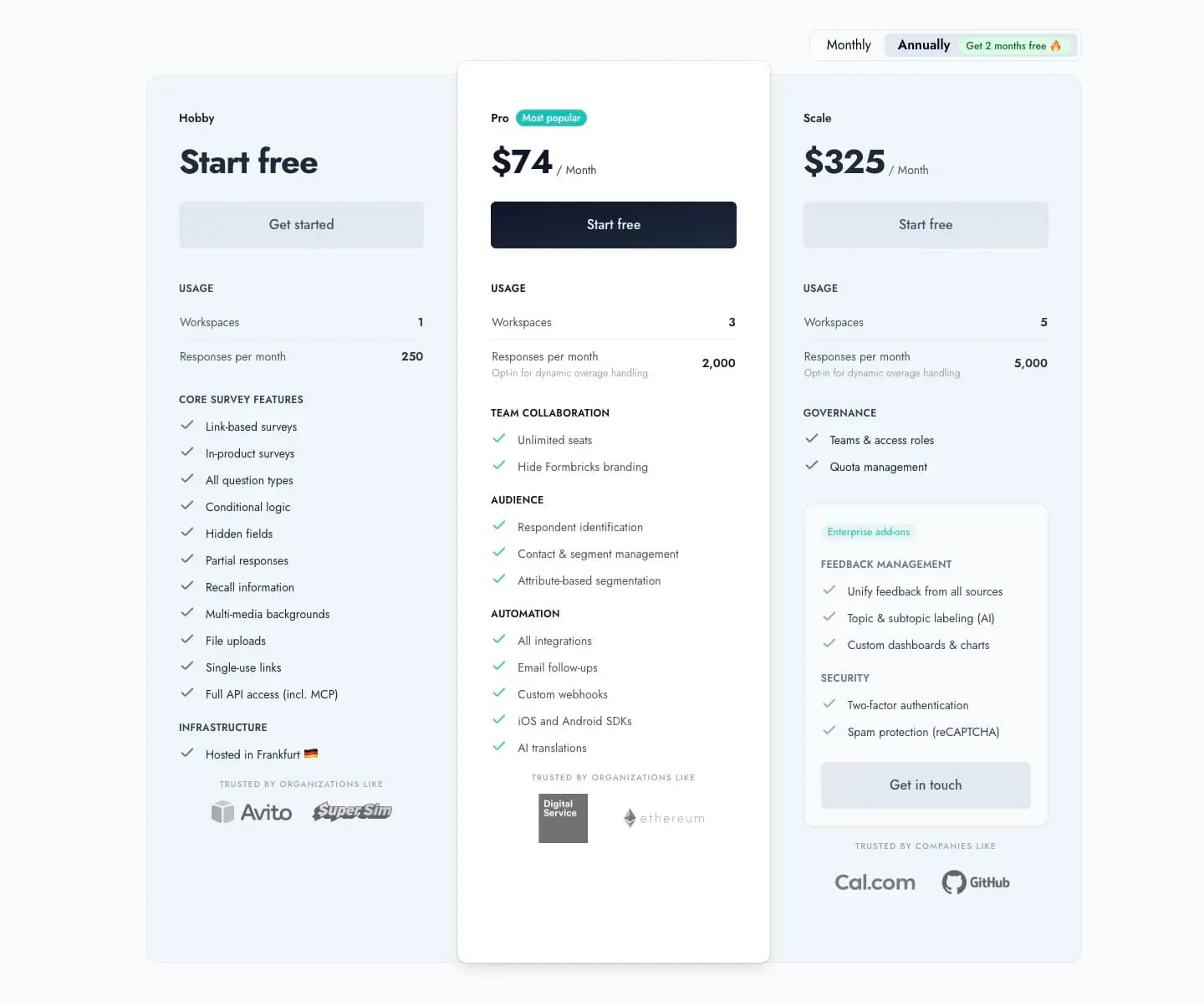
| Plan | Price | Workspaces | Responses/month |
|---|---|---|---|
| Hobby | Free | 1 | 250 |
| Pro | $89/mo, or $74/mo billed annually ($890/year) | 3 | 2,000 |
| Scale | $390/mo, or $325/mo billed annually ($3,900/year) | 5 | 5,000 |
| Enterprise | Custom | Custom | Custom |
The self-hosted Community Edition is free forever and unlimited, with a separate self-hosted Enterprise Edition available on request for SSO and white-glove onboarding.
Best for: Teams whose real gap is upstream of UserVoice entirely, collecting structured survey data (NPS, CSAT, PMF) rather than organizing feature requests, especially those in regulated industries needing self-hosting for data residency.
The Gap Every UserVoice Competitor Guide Skips
Neither of the two pages currently ranking for "UserVoice competitors," Savio's own post or Sleekplan's alternatives page, asks a data-residency question: can you deploy any of this on your own infrastructure?
Across all 7 competitors covered above, not one publishes a self-hosted or customer-premises deployment option: Canny, Productboard, Aha!, Savio, Sleekplan, Enterpret, and Featurebase are all cloud-only SaaS products as far as their own pricing and product pages show. UserVoice itself is cloud-only too.
Formbricks is the exception, but as covered above, it's solving a different job (structured survey collection) rather than idea management. If self-hosting is a genuine requirement, the real comparison isn't UserVoice vs. Canny vs. Aha!. It's whether your actual need is a feature-request board (in which case, none of these 7 names offer self-hosting) or structured feedback collection (in which case Formbricks does).
UserVoice vs Formbricks vs Canny: Three Different Ways to Read This Market
For teams still narrowing down which segment of this market actually applies to them, these three anchor the three different buying motions.
| Factor | UserVoice | Formbricks | Canny |
|---|---|---|---|
| Core category | Revenue-weighted feedback intelligence | Feedback & experience management | Idea management / feature-voting board |
| Pricing model | Custom, no public numbers | Published $ tiers, free plan included | Published $ tiers, free plan included |
| Free tier | No (demo required for a 30-day trial) | Yes, 250 responses/month | Yes, 25 tracked users |
| Self-hosting | No | Yes (Community Edition, AGPLv3) | No |
| Primary buyer | Product, CS, and revenue teams together | Product, CX, and research teams | Product teams |
| Core workflow | CRM/helpdesk-linked idea scoring | Multi-channel survey collection & analytics | Public voting board, roadmap, changelog |
Choose UserVoice if you need to tie feature requests to Salesforce, Gong, Zendesk, and Gainsight data specifically, and you're comfortable with a CSM-driven, demo-gated sales process.
Choose Canny (or Productboard, Aha!, Savio, or Sleekplan) if you want a transparent, self-serve idea-management tool without UserVoice's opacity, matched to your team's size and budget.
Choose Formbricks if your actual need is structured survey collection, not feature-request management, or if self-hosting is a hard requirement none of the 7 idea-management competitors on this page can meet.
How to Choose the Right UserVoice Competitor
Picking the right name from this page depends on which job you're actually hiring UserVoice (or a competitor) to do.
Start With Your Use Case
- AI-automated capture from sales and support conversations: Canny
- Full roadmapping, specs, and release planning: Productboard
- Already bought into (or want) a full product-strategy suite: Aha!
- Feature requests tied directly to CRM and revenue data, GTM-team-led: Savio
- Migrating off UserVoice on a small-team budget: Sleekplan
- Enterprise-scale AI infrastructure unifying support, sales, and market signals: Enterpret
- Replacing a helpdesk-plus-feedback stack with one bundled subscription: Featurebase
- Structured survey data (NPS, CSAT, PMF), not a feature-request board: Formbricks
Then Evaluate These Criteria
| Criteria | Questions to Ask |
|---|---|
| What you're actually replacing | A feature-voting board and roadmap, or the missing ability to run structured surveys in the first place? |
| Pricing transparency | Is pricing published, or does every tier need a sales call, like UserVoice and Enterpret? |
| Data residency | Can you self-host, or is every option here cloud-only? |
| Revenue-weighting | Do you need feedback scored against MRR/ACV/churn risk, or is a simple vote count enough? |
| Team size and budget | Enterprise contract (UserVoice, Aha!, Enterpret) or self-serve SMB pricing (Sleekplan, Savio, Canny)? |
| CRM and helpdesk integrations | Does it connect to the specific stack (Salesforce, Zendesk, Intercom, Gong) you already run? |
For related reading, see our Canny vs Productboard vs Featurebase, Pendo competitors, Userpilot competitors, and Dovetail competitors guides.
Frequently Asked Questions
Looking for structured survey data rather than a feature-request board? Formbricks gives you feedback management across website, in-app, link, and email surveys, feedback analytics, and workflow integrations with Salesforce, HubSpot, Slack, Google Sheets, and Notion, plus a free API on every tier. Self-host it for full data ownership, or start on the cloud Hobby plan for free.
Try Formbricks now