
Dovetail Competitors in 2026: Who Actually Competes With It, and Who Doesn't

Johannes
Co-Founder @ Formbricks
11 Minutes
August 17th, 2026
Dovetail's real competitive set is narrower than most "Dovetail competitors" roundups suggest. It's a customer intelligence platform built to centralize and analyze qualitative research, interviews, sales calls, support tickets, and documents, not a survey tool, not a feature-request board, and not a product analytics suite, even though all three categories get lumped into generic "alternatives" lists online.
This guide sorts the real competitive landscape into what actually competes head-to-head with Dovetail (dedicated research repositories), what solves an adjacent problem well (roadmap and feedback-board tools), and where a feedback-collection platform like Formbricks fits, which is genuinely not the same category, but is worth knowing about if your actual gap is upstream of Dovetail entirely.
Table of contents:
- Dovetail Competitors at a Glance
- What Dovetail Actually Does
- Direct Competitors: Research Repositories
- Adjacent Competitors: Roadmap and Feedback-Board Tools
- Where Formbricks Fits (and Where It Doesn't)
- Dovetail's Own Pricing Shift Is Reshaping This Market
- How to Choose the Right Dovetail Competitor
- Dovetail Competitors FAQ
- Final Verdict
Dovetail Competitors at a Glance
| Competitor | Category | Best For | Starting Price |
|---|---|---|---|
| Condens | Direct (research repository) | Structured qualitative synthesis for research teams | €15/month (Lite) |
| Marvin | Direct (research repository) | AI-assisted tagging and interview analysis | $50/user/month (Essentials), free tier available |
| Aurelius | Direct (research repository) | Deep qualitative coding without per-seat pricing | $79/month (Professional) |
| Userbit | Direct (research repository) | Evidence-linked synthesis at a lower entry price | ~$20 (usage-based tier), free tier available |
| Productboard | Adjacent (roadmap/PM) | Turning feedback into prioritized roadmaps | $19/maker/month (Plus), free tier available |
| Canny | Adjacent (feedback board) | Public voting boards and AI-driven capture | $79/month (Pro), free tier (25 tracked users) |
| Formbricks | Not a competitor (feedback collection) | Actually collecting the feedback Dovetail analyzes | $59/month (Pro, billed annually), free tier available |
What Dovetail Actually Does
Dovetail's own G2 category listing spans User Research, Insight Engines, Transcription, and Text Analysis. It ingests qualitative data from 38+ integrations (Gong, Intercom, Zoom, Salesforce, Slack, Teams), transcribes and tags it with AI, and surfaces themes and opportunities. Enterprise adds autonomous AI Agents that proactively track signals.
What it explicitly doesn't do: run outbound surveys, publish a public feature-request board, or build product roadmaps. That distinction matters for sorting real competitors from adjacent tools.
Direct Competitors: Research Repositories
These are the tools that do what Dovetail does, centralize and analyze qualitative research, and compete for the same buyer.
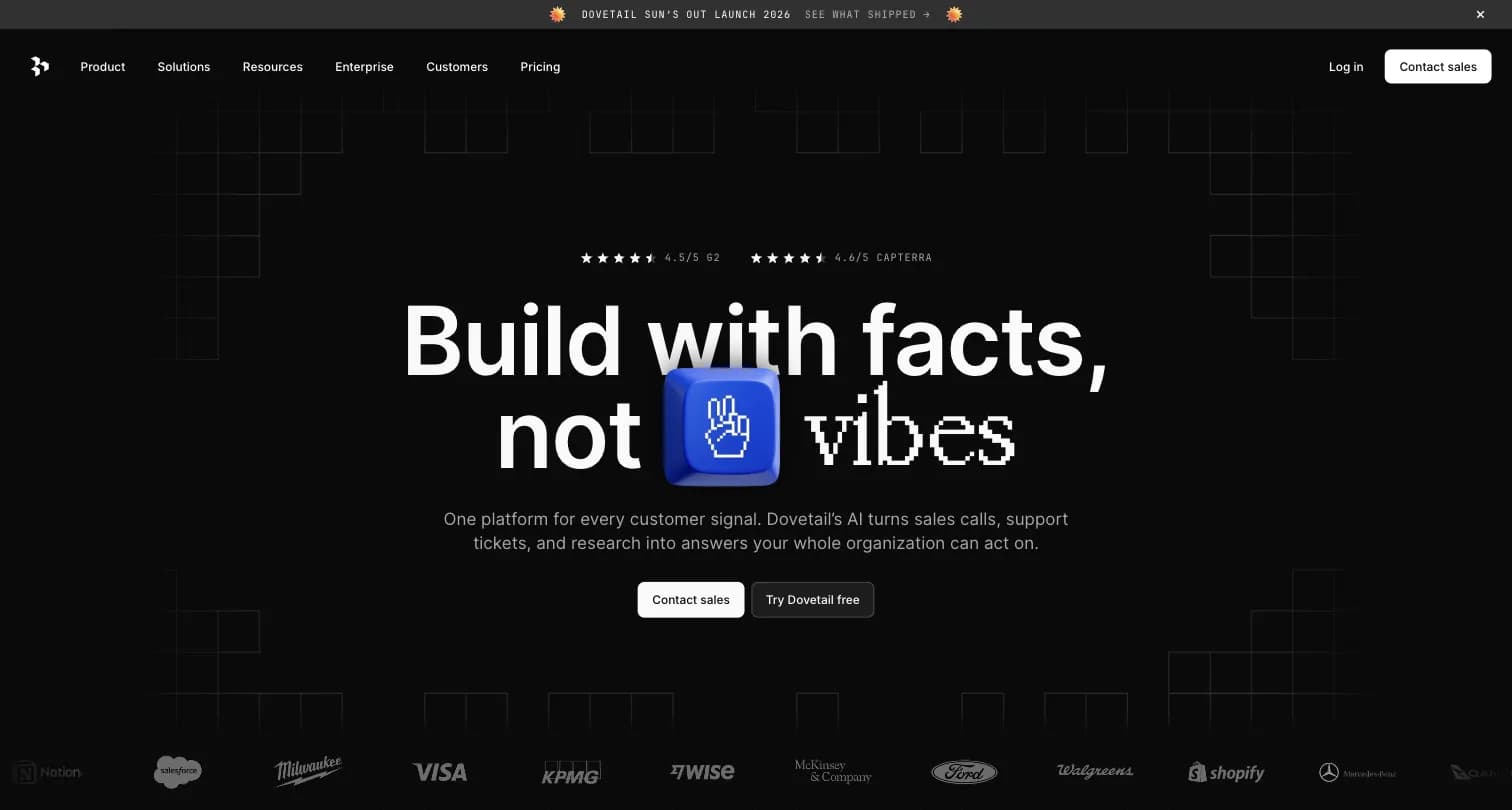
Captured August 15, 2026 from dovetail.com.
Condens
Condens is one of the most frequently cited direct Dovetail competitors among UX researchers, per independent roundups from both HeyMarvin and UXtweak. It focuses on structured coding, synthesis boards, and evidence-linked findings, with strong ResearchOps support for continuous research programs.
Pricing: Lite Plan at €15/month, Business Plan starting at €500/month, custom Enterprise.
Marvin
Marvin is ranked a top Dovetail alternative directly on G2's own competitor listing. It offers AI-powered transcription, live tagging during interviews, and playlists that combine video/audio clips into stakeholder-ready highlight reels.
Pricing: Free tier available, Essentials at $50/user/month, Standard at $100/user/month, custom Enterprise. 15-day trials on paid tiers.
Aurelius
Aurelius is popular with researchers who want deep thematic synthesis without per-seat pricing overhead, its model charges by plan tier rather than multiplying by user count.
Pricing: Professional at $79/month, Premium starting at $259/month, custom Enterprise.
Userbit
Userbit emphasizes linking insights directly to source evidence, keeping findings structured and defensible, at a notably lower entry price than Condens or Aurelius.
Pricing: Free tier, usage-based tier around $20, unlimited tier at $199/month.
Adjacent Competitors: Roadmap and Feedback-Board Tools
These solve a related but distinct problem: what to build next, rather than analyzing how research was gathered.
Productboard
Productboard shows up in "Dovetail alternatives" searches specifically for teams whose end goal is prioritization, not insight storage. Its Spark AI agent surfaces product opportunities with citations and drafts delivery-ready specs.
Pricing: Free (1 maker, 500 feedback notes), Plus at $19/maker/month billed annually, Business at $59/maker/month (2-maker minimum), custom Enterprise (5-maker minimum).
Canny
Canny targets a different job: public feature-request boards with AI-driven capture from sales and support conversations (Autopilot), plus revenue-linked prioritization via CRM integrations.
Pricing: Free (25 tracked users), Pro at $79/month billed yearly, custom Business tier (5,000+ tracked users, SSO).
Where Formbricks Fits (and Where It Doesn't)
Being direct about this: Formbricks is not a Dovetail competitor in the category sense. Dovetail analyzes qualitative research already collected elsewhere. Formbricks is a feedback and experience management suite built around feedback management (website, in-app, link, and email surveys), feedback analytics, and workflows and integrations, the collection layer, not the analysis layer.
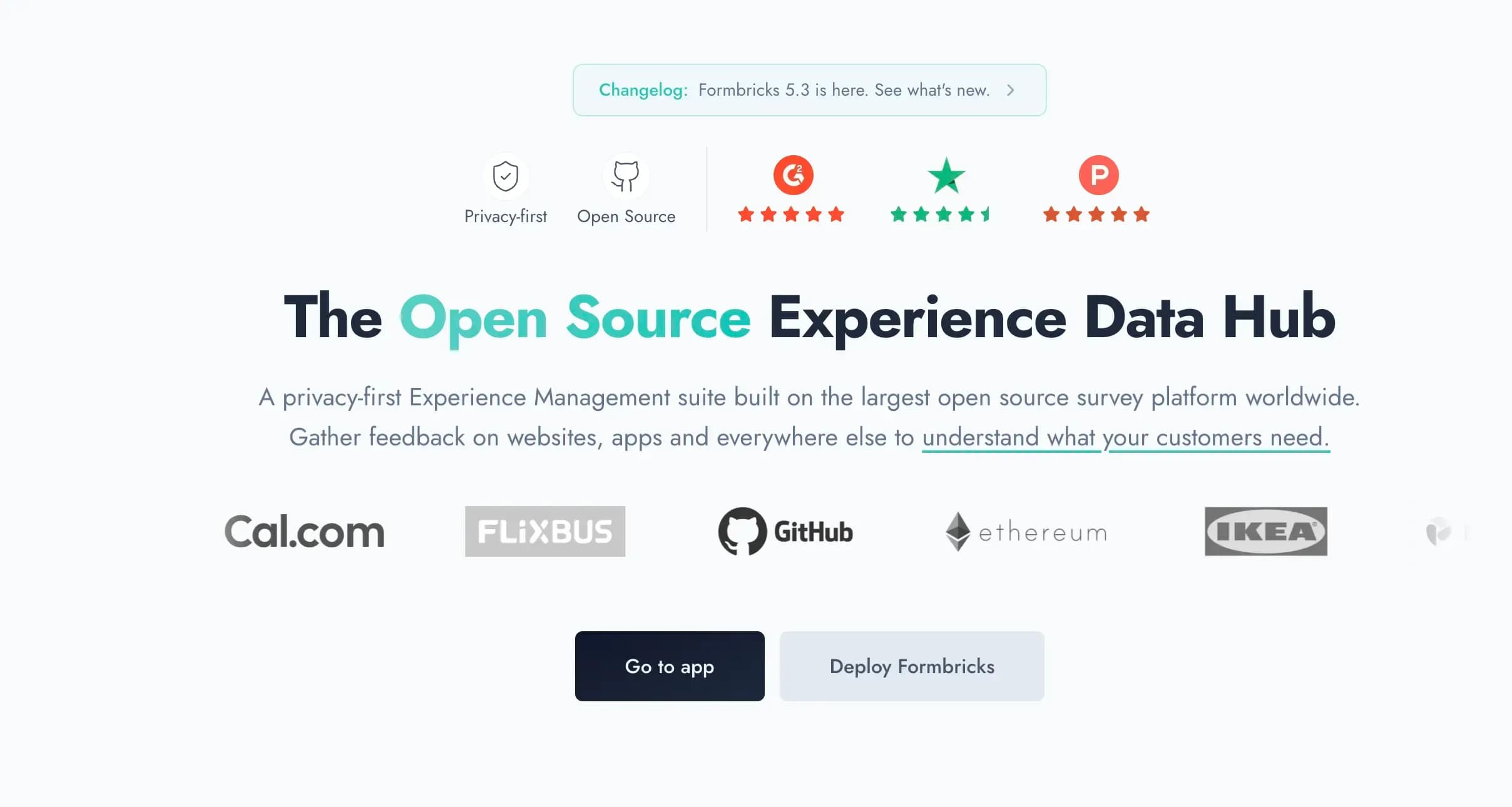
Why it's relevant here anyway: a real share of people researching "Dovetail competitors" are actually missing the collection piece entirely, not looking for a cheaper way to analyze research they already have. Dovetail's own gaps_and_limitations are explicit about this: it has no native outbound survey distribution, teams typically pair it with a separate collection tool.
If that's your actual situation, Formbricks is the collection layer you'd pair with (or use instead of building toward) a research repository like the ones above.
Key features:
- Multi-channel surveys: link, website pop-up, in-app micro-survey, and email-embedded
- Attribute-based targeting and segmentation for in-product surveys
- Feedback analytics with drop-off tracking and custom segmentation
- Formbricks Workflows for post-response automation
- Free, unrestricted API on every tier, including the self-hosted Community Edition
Pricing:
- Free: $0 forever, 100 responses/month, 1 workspace, unlimited seats, full API including MCP
- Pro: $59/month ($708/year billed annually) or $79 billed monthly, 1,000 responses/month, 1 workspace, unlimited seats, 7-day free trial; extra workspaces $49/month each, extra responses $49 per 1,000
- Community Edition (self-hosted): Free forever, AGPLv3, unlimited surveys and responses
Best for: Teams whose real gap is upstream of Dovetail, they need to collect feedback in the first place, especially those needing self-hosting for data residency.
Dovetail's Own Pricing Shift Is Reshaping This Market
Worth noting directly: Dovetail discontinued its self-serve Professional plan (previously roughly $15-39/user/month depending on the source), per PricingSaaS's tracking. Its pricing page now shows only Free and custom Enterprise. Third-party benchmarking from Vendr reports a median real-world contract value of $21,600/year, ranging from $10,800 to $61,200/year.
This shift is itself pushing buyers toward the alternatives on this list. Every direct competitor above (Condens, Marvin, Aurelius, Userbit) still publishes a real self-serve mid-tier price, a genuine differentiator now that Dovetail no longer does.
How to Choose the Right Dovetail Competitor
Start With What You Actually Need
- Qualitative research synthesis at Dovetail's depth, with published pricing: Condens, Marvin, or Aurelius
- A cheaper repository with evidence-linked insights: Userbit
- Feedback synthesis feeding directly into a roadmap: Productboard
- A public voting board and changelog: Canny
- You're missing the collection layer entirely, not the analysis layer: Formbricks
Then Evaluate These Criteria
| Criteria | Questions to Ask |
|---|---|
| Pricing predictability | Is there a published mid-tier, or only Free and custom Enterprise? |
| Data residency | Can you self-host, or is everything vendor-hosted cloud-only? |
| What you're actually replacing | Analysis of existing research, or the missing ability to collect it in the first place? |
| Per-seat vs. flat pricing | Does the tool charge per user (Marvin, Productboard) or a flat plan fee (Aurelius)? |
Dovetail Competitors FAQ
What is an alternative to a Dovetail?
Is Dovetail an AI tool?
Who are Dovetail Workwear competitors?
What's a synonym for Dovetail?
What is Dovetail's biggest competitor?
Does Dovetail have any competitors with self-hosting?
Is Productboard a Dovetail competitor?
What do Dovetail's competitors charge compared to Dovetail?
Final Verdict
Dovetail's real competitive set is narrower than most generic "alternatives" roundups suggest: Condens, Marvin, Aurelius, and Userbit are the direct research-repository competitors, each with a published pricing tier Dovetail no longer offers since discontinuing its Professional plan. Productboard and Canny solve an adjacent problem, turning feedback into roadmaps or public voting boards.
Formbricks isn't a Dovetail competitor in the category sense, it's a feedback and experience management suite for teams whose real gap is collection, not analysis. If that's your actual need, it's worth pairing with (or starting with, instead of) a research repository like the ones above, and it's the only name on this list with a genuinely self-hosted option.