

9 Real Productboard Competitors in 2026, Mapped by Category (Not Just an Alternatives List)

Johannes
Co-Founder @ Formbricks
11 Minutes
August 16th, 2026
Almost every page ranking for "Productboard competitors" today is actually an "alternatives" page wearing a different headline, Gartner's own comparison page, G2's competitor listing, and every independent roundup we checked all frame this as "what should I switch to," not "who else plays in this market." That's a narrower question than the one a buyer researching the landscape is usually asking.
Here's the honest version of that landscape: who actually competes with Productboard on roadmapping and prioritization, who solves an adjacent problem well, and where a feedback and experience management platform like Formbricks fits, which is a different job entirely, not a drop-in replacement.
Table of contents:
- Why "Productboard Competitors" Search Results Skip This Distinction
- What Is Productboard?
- Why Companies Look at Productboard's Competitors
- Productboard Competitors at a Glance
- Direct Competitors: Roadmapping and Prioritization Tools
- Adjacent Competitors: Feedback Boards and General Work Tools
- The AI-Native Newcomers Most Guides Skip
- Where Formbricks Fits (and Where It Doesn't)
- The Gap Every Productboard Competitor Guide Shares
- Productboard vs UserVoice: The Head-to-Head G2 Data
- How to Choose the Right Productboard Competitor
- Productboard Competitors FAQ
- Final Verdict
Why "Productboard Competitors" Search Results Skip This Distinction
"Productboard alternatives" implies you've already decided to leave. "Productboard competitors" is a landscape question, who else is building in this category, and why, before you've made that call. In practice, the two searches return nearly identical pages: Reddit's r/ProductManagement thread, CPO Club's alternatives roundup, Gartner Peer Insights' alternatives page, and Visor's alternatives-with-pricing guide all use "alternative" language even when the underlying query is "competitors."
This guide keeps the landscape framing on purpose. Instead of a single ranked switch list, it groups Productboard's real competitors by what they actually do, then draws a clear (and honest) line around what a feedback-collection platform like Formbricks can and can't compete on here.
What Is Productboard?
Productboard is an agentic product management system combining a centralized feedback repository, roadmapping and prioritization tooling, and a customer-facing portal, built around its Spark AI agent. Founded in 2014 by Hubert Palan and Daniel Hejl, it has grown to 500+ employees across San Francisco, Vancouver, Dublin, London, Prague, and Brno, backed by Sequoia Capital, Kleiner Perkins, Index Ventures, and Bessemer Venture Partners.
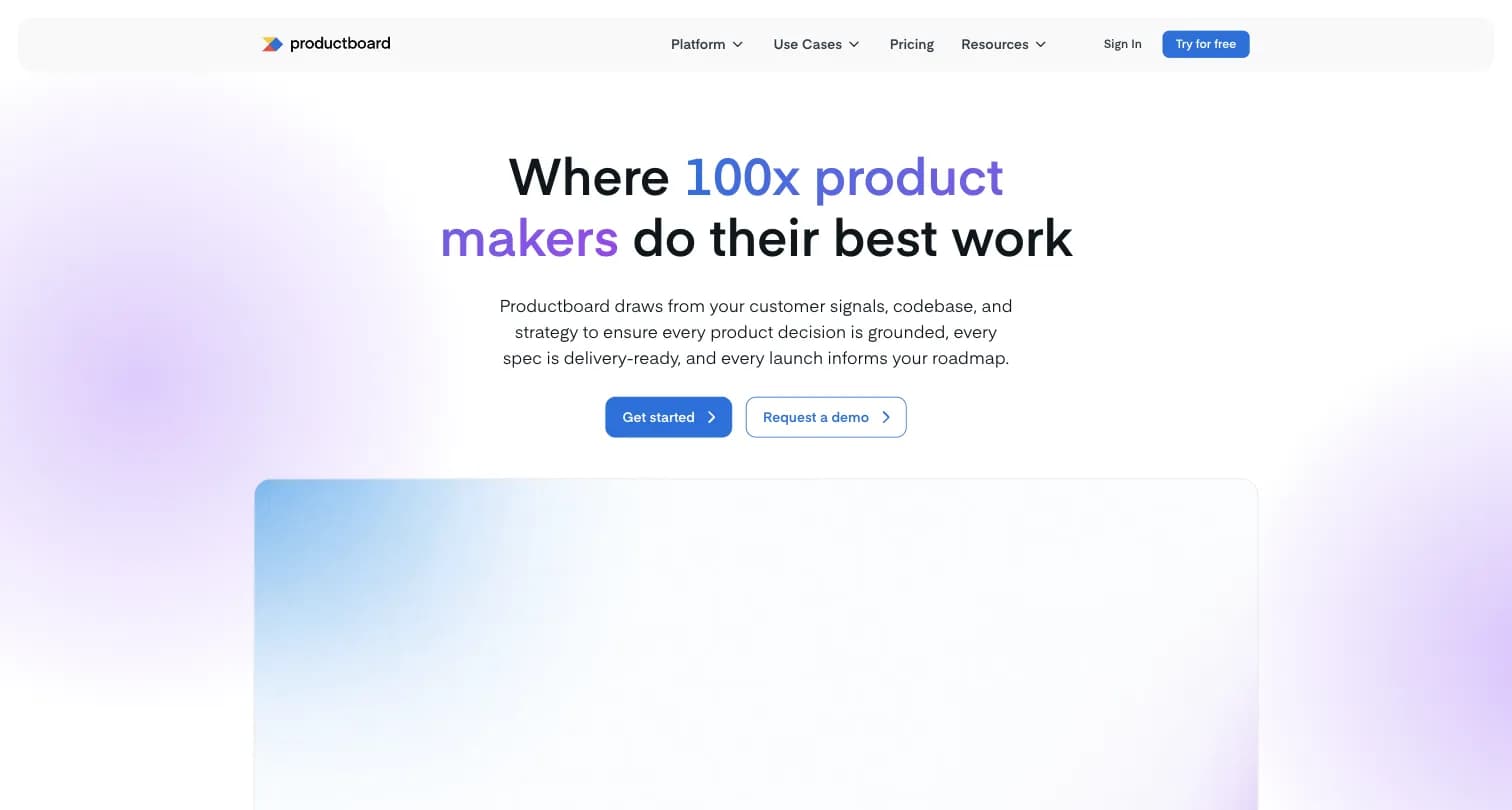
Captured August 15, 2026 from productboard.com.
The company reports 6,000+ customers, including Autodesk, Zoom, Salesforce, Coca-Cola, and Cartier. It reached unicorn status in February 2022 with a $125 million Series D at a $1.725 billion valuation, co-led by Dragoneer Investment Group and Tiger Global, on top of a $72 million Series C from April 2021.
Productboard holds a 4.3 rating across 254 reviews on G2, where it's categorized under Product Management, Strategy & Innovation Roadmapping Tools, and Workflow Management. It holds 4.7 across 154 reviews on Capterra's Product Roadmap software category.
Explicit scope note: Productboard captures and organizes product feedback as notes, then feeds that into roadmaps and prioritization formulas. It is not a survey builder. Teams that need structured NPS, CSAT, or PMF research with actual survey methodology need a separate tool, a distinction that matters for how this guide treats Formbricks later on.
Why Companies Look at Productboard's Competitors
Reviewing Productboard's own pricing page, its G2 and Capterra reviews, and the current top-ranking "Productboard alternatives" content, a few reasons come up consistently.
1. Pricing Runs on Two Dimensions at Once
Productboard prices per "maker" (the PM or lead who owns strategy), not per total user, contributors who just submit or tag feedback don't count toward the maker limit.
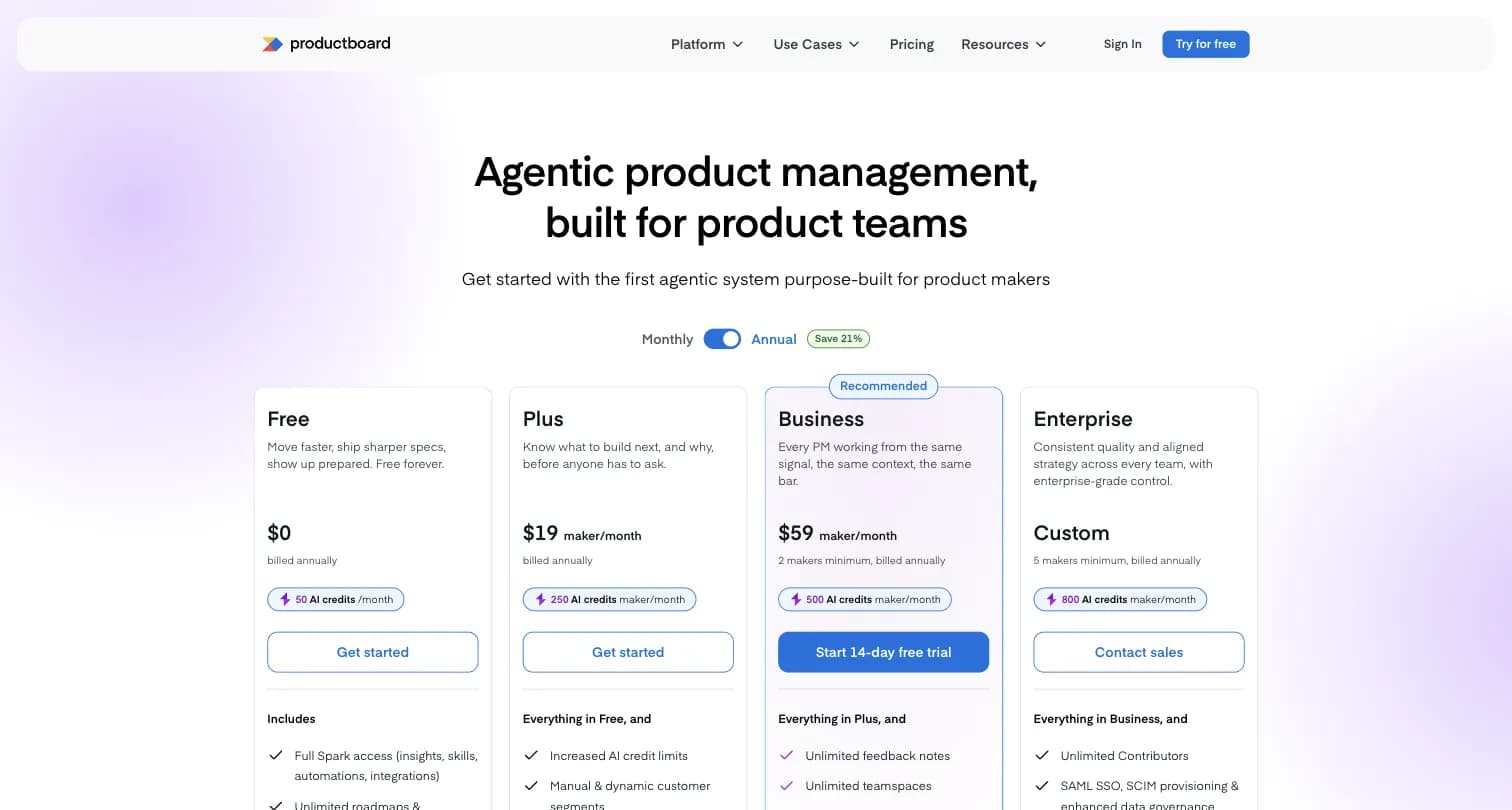
Captured August 15, 2026. Business requires 2 makers minimum, Enterprise requires 5.
On top of seat pricing, Productboard layers an AI credit system. Free includes 50 shared credits per month, Plus includes 250 per maker, Business 500 per maker, and Enterprise 800 per maker. A G2 reviewer specifically flagged this maker-based model as making scaling costs unpredictable, since 100 feedback items analyzed can use 30-50 credits and a single spec can use 50-200.
2. A Steep Learning Curve for the Full Feature Set
Multiple G2 and Capterra reviewers describe the interface as "comprehensive but overwhelming," particularly for new or non-PM users. Onboarding complexity is one of the most consistently repeated complaints across both review sites.
3. Enterprise Features Locked Behind Negotiated Pricing
Dependencies, custom roles and permissions, SAML SSO, and SCIM provisioning are Enterprise-only, and Enterprise pricing is fully custom with a 5-maker minimum. Some Capterra reviewers specifically found unlocking these features frustrating.
4. Minimum Seat Counts Inflate the Real Entry Price
Business requires 2 makers minimum and Enterprise requires 5, so the effective starting price for either tier is well above the per-maker sticker price shown on the pricing page.
5. A Recent Restructuring Raises Long-Term Questions
Productboard cut approximately 30% of its global workforce on April 15, 2026, across engineering, sales, and customer success teams, per InterviewPal's compiled layoff tracking. The restructuring followed reported ARR growth slowing from triple digits in 2021-2022 to more modest double-digit growth, a real consideration for buyers weighing long-term platform investment independent of current product quality.
Productboard Competitors at a Glance
| Competitor | Category | Best For | Starting Price | Self-Hosted |
|---|---|---|---|---|
| UserVoice | Direct (feedback + roadmap) | Best-rated overall alternative per G2 | Custom, not published | No |
| airfocus (by Lucid) | Direct (prioritization/roadmap) | Flexible prioritization scoring | $19/user/month | No |
| Aha! | Direct (product suite) | Comprehensive strategy-to-delivery suite | $59-149/user/month | No |
| ProductPlan | Direct (roadmap visualization) | Clean, shareable roadmap visuals | $39-99/editor/month | No |
| ProdPad | Direct (roadmap + ideas) | Idea management without per-seat sprawl | ~$30/editor/month | No |
| Craft.io | Direct (agile PM) | Easiest reported setup among direct rivals | Custom, not published | No |
| Canny | Adjacent (public feedback board) | Public voting boards, changelog | Free (25 tracked users), $19-79/mo | No |
| Airtable | Adjacent (flexible database) | DIY roadmap builders on a spreadsheet base | Custom, not published | No |
| Formbricks | Not a category competitor (feedback collection) | The structured survey layer Productboard doesn't have | Free (250 responses/mo), $74/month | Yes |
Direct Competitors: Roadmapping and Prioritization Tools
These solve the same job Productboard does: turning customer input into a prioritized roadmap product teams can plan and communicate against.
1. UserVoice: G2's Top-Rated Overall Alternative
Per G2's own Productboard competitors page, UserVoice is rated the best overall alternative, holding a 4.5 rating across 243 reviews versus Productboard's 4.3 across 254. Reviewers rate it higher on meeting requirements (8.9 vs 8.1), usability (8.8 vs 8.1), and ease of setup (8.5 vs 8.2).
Key features: a single platform to collect, analyze, and close the loop on product feedback, Salesforce and Zendesk widgets for capturing feedback directly from sales and support teams, and status tracking that shows customers progress on their submitted ideas.
How it compares: UserVoice reviewers specifically cite feedback management and ease of use as its strongest dimensions (10 and 8 mentions respectively in G2's aggregated review data). Productboard reviewers rate it slightly higher only on ease of admin (8.8 vs 8.6).
Pricing: Not publicly listed, requires a sales conversation.
Best for: Teams that prioritize feedback-loop closing and usability over Productboard's deeper roadmap customization.
2. airfocus (by Lucid): The Lowest Published Entry Price Among Direct Rivals
airfocus holds a 4.4 rating across 142 G2 reviews. Reviewers say it's more usable, better at support, and easier to set up than Productboard.
Key features: flexible prioritization scoring frameworks, roadmap visualization, and feedback-to-priority linking, now under Lucid Software's ownership.
Pricing: Starts at $19/user/month, the lowest published starting price among Productboard's direct roadmapping rivals.
Best for: Smaller product teams that want prioritization rigor without Productboard's maker-based pricing model.
3. Aha!: The Comprehensive Suite, at a Premium
Aha! holds a 4.4 rating across 365 G2 reviews. Reviewers say it's better at meeting requirements and easier to do business with, but consistently flag it as more expensive than Productboard.
Key features: Aha! Roadmaps, Aha! Discovery, Aha! Ideas, Aha! Whiteboards, Aha! Knowledge, and Aha! Develop, a full strategy-to-delivery suite rather than a single roadmap tool. The company is self-funded, profitable, and fully remote.
Pricing: $59-149 per user per month depending on module and tier.
Best for: Teams that want one connected suite spanning strategy, ideation, and delivery tracking, and can absorb a higher per-seat cost.
4. ProductPlan: Roadmap Visualization Specialists
ProductPlan holds a 4.3 rating across 220 G2 reviews. Reviewers say it's easier to set up, more usable, and better at meeting requirements than Productboard, and it's also named directly by CB Insights as one of Productboard's closest competitors.
Key features: drag-and-drop roadmap building, multiple shareable roadmap views, and integrations for keeping roadmaps in sync with delivery tools like Jira.
Pricing: $39-99 per editor per month.
Best for: Teams whose primary need is polished, presentation-ready roadmap visuals for stakeholders and executives.
5. ProdPad: Idea Management Without Per-Seat Sprawl
ProdPad holds a 4.2 rating across 95 G2 reviews. Reviewers highlight it as easier to do business with, easier to set up, and easier to admin than Productboard.
Key features: idea capture and management, roadmap building, and integrations across common product workflows, sitting in the same User Research Repositories and Roadmapping Tools G2 categories as Productboard.
Pricing: Approximately $30 per editor per month, per third-party pricing roundups.
Best for: Teams that want a lighter administrative footprint than Productboard's maker-based licensing model.
6. Craft.io: The Easiest Reported Setup
Craft.io holds a 4.5 rating across 90 G2 reviews, reviewers say it's easier to set up, more usable, and easier to do business with than Productboard.
Key features: agile product management tooling giving teams a clear view of product direction, spanning the same Decision-Making and Strategy and Innovation Roadmapping categories Productboard competes in on G2.
Pricing: Not publicly listed, requires a sales conversation.
Best for: Teams prioritizing fast time-to-value and a shallower learning curve over Productboard's deeper feature set.
Adjacent Competitors: Feedback Boards and General Work Tools
These solve a related but distinct problem, they show up in "Productboard alternatives" searches but aren't purpose-built roadmap tools in the same sense as the six above.
7. Canny: Public Voting Boards, a Different Buyer Motion
Canny targets a narrower job than Productboard: public feature-request boards with AI-driven capture from sales and support conversations, plus revenue-linked prioritization through CRM integrations. It's frequently listed alongside Productboard in "alternatives" roundups from Featurebase and Visor specifically because of its public-facing changelog and voting model.
Pricing: Free (25 tracked users), Core at $19/month (100+ tracked users), Pro at $79/month billed yearly (adds PM tool integrations), custom Business tier.
Best for: Teams whose priority is a public-facing voting board and changelog rather than an internal prioritization system.
8. Airtable: The DIY Roadmap Builder
Airtable holds a 4.6 rating across 3,288 G2 reviews, the highest raw rating of any name in this guide, though it competes on general flexibility rather than purpose-built roadmapping. G2 reviewers rate it better at meeting requirements, more usable, and easier to set up than Productboard.
Key features: a spreadsheet-database hybrid with Kanban views, file attachments, and enough flexibility that many product teams build their own lightweight roadmap and feedback tracker on top of it.
How it compares: Airtable shares Productboard's Strategy and Innovation Roadmapping category tag on G2, but it's a general-purpose building block, not a dedicated roadmap product with prioritization formulas or a customer-facing portal built in.
Pricing: Not publicly listed for teams at this scale, self-serve plans exist but most product-team deployments involve custom configuration.
Best for: Teams comfortable building and maintaining their own lightweight roadmap system rather than adopting a purpose-built tool.
Worth a brief mention alongside Airtable: Asana (4.4 rating, 13,870 G2 reviews) and ClickUp (4.6 rating, 13,734 G2 reviews) both appear on G2's Productboard alternatives list too, but both are broad work-management platforms first. Teams evaluating them against Productboard are usually asking "can our existing project tool absorb roadmapping too," a different question than "which dedicated roadmap tool is best."
The AI-Native Newcomers Most Guides Skip
Every guide we reviewed for this article, Reddit, CPO Club, Gartner, Visor, and G2, names the same six or seven established players. None of them mention the newer AI-native product management tools that CB Insights tracks as direct Productboard competitors from a market-intelligence standpoint: CustomerIQ, Shorter Loop, and Cardinal.
Shorter Loop positions itself as an AI-augmented platform spanning discovery, roadmap planning, and feedback collection in one flow. Cardinal focuses specifically on AI-powered product management automation. CustomerIQ leans toward CRM-adjacent feedback and sales-process automation rather than roadmapping specifically.
None of these three have the review volume or track record of the six direct competitors above, they're a segment worth knowing exists, not yet a segment worth betting a product org on. If you're mapping the full landscape rather than picking a tool this quarter, they're the names to watch.
Where Formbricks Fits (and Where It Doesn't)
Being direct about this upfront: Formbricks is not a Productboard competitor in the category sense. Productboard is a roadmapping and prioritization system, notes in, prioritized specs and delivery plans out. Formbricks is a feedback and experience management suite built around feedback management (website, in-app, link, and email surveys), feedback analytics, and workflows and integrations, the structured collection layer, not the prioritization layer.
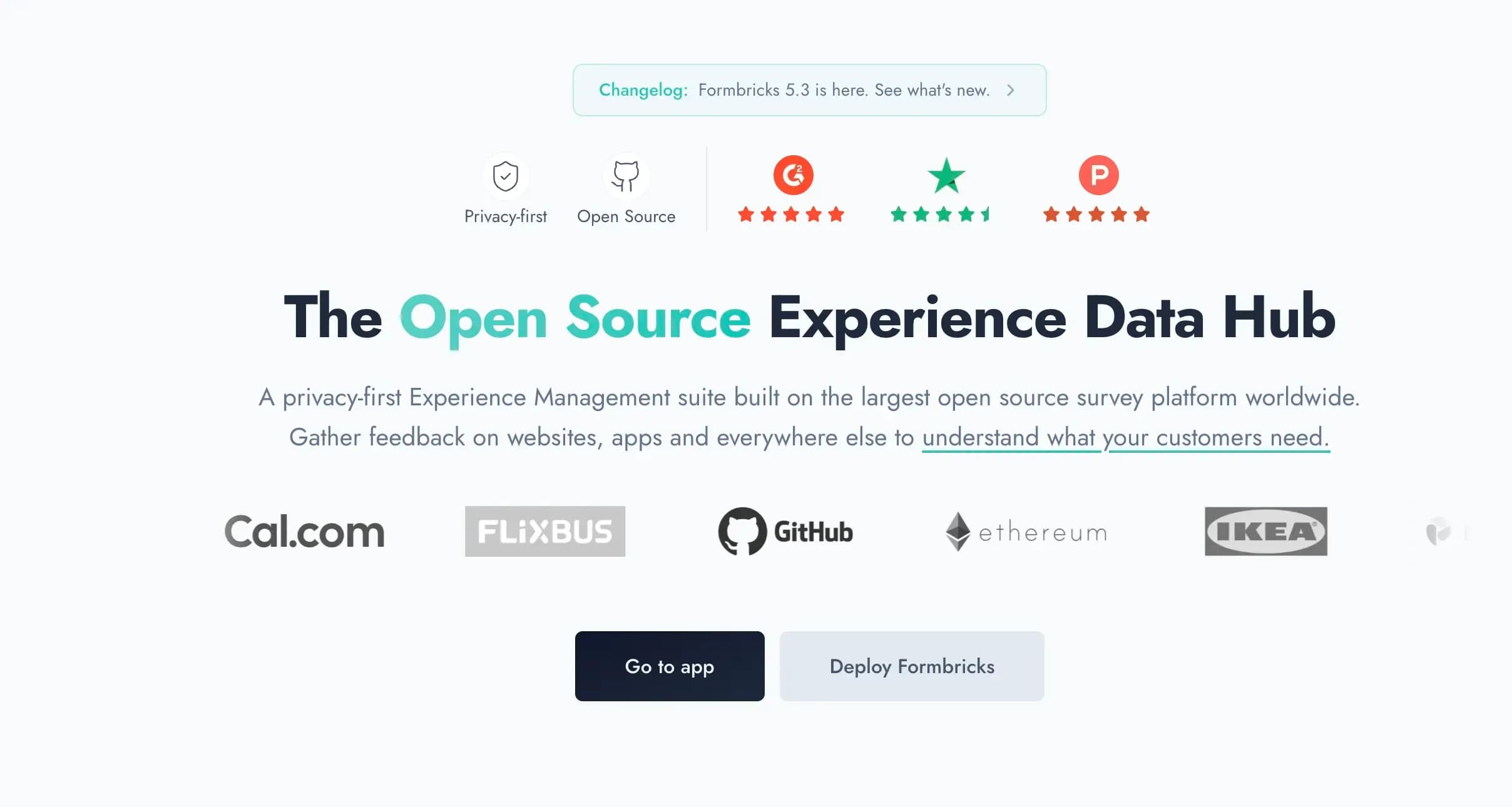
Why it's relevant here anyway: Productboard's own gap is explicit. Its feedback repository organizes notes; it isn't built to run structured NPS, CSAT, or PMF surveys with actual survey methodology, question logic, and response analytics. Teams that need that layer typically run a separate tool and feed the output into Productboard (or a competitor above) for prioritization.
Key features:
- Multi-channel surveys: link, website pop-up, in-app micro-survey, and email-embedded, unified on one platform
- Attribute-based targeting and segmentation for in-product surveys
- Feedback analytics with drop-off tracking, aggregate and per-response views, and custom segmentation
- Formbricks Workflows for post-response automation
- Free, unrestricted API on every tier, including the self-hosted Community Edition, plus native integrations to Salesforce, HubSpot, Slack, Google Sheets, and Notion
Pricing:
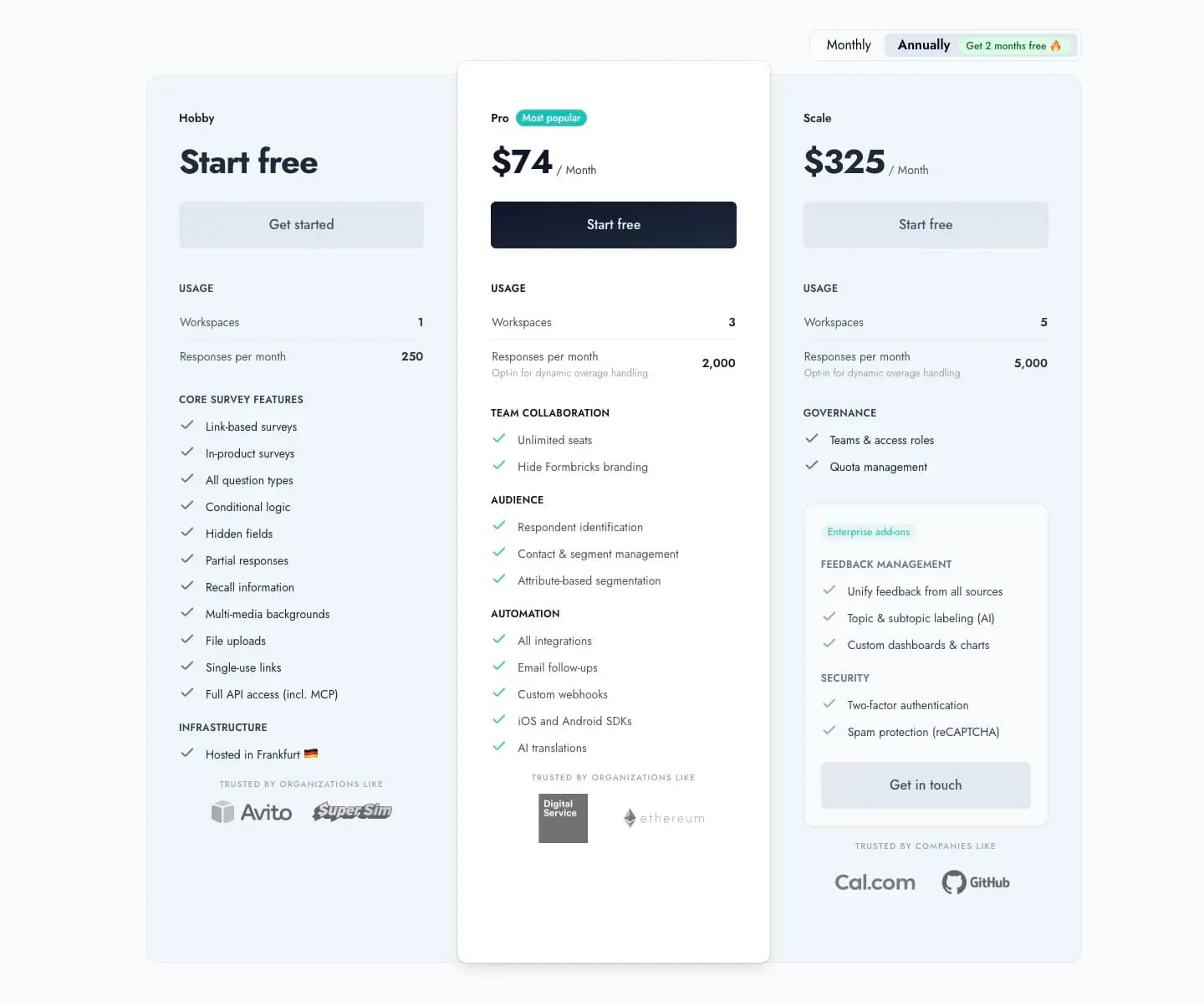
| Plan | Price | Responses/month |
|---|---|---|
| Hobby (Free) | $0 | 250 |
| Pro | $74/month ($890/year billed annually) | 2,000 |
| Scale | $325/month ($3,900/year billed annually) | 5,000 |
| Community Edition (self-hosted) | Free forever, AGPLv3 | Unlimited |
Best for: Teams whose actual gap sits upstream of Productboard and its direct competitors, they need structured survey-based feedback collection, ideally with self-hosting for data residency, before that data ever reaches a roadmap tool.
The Gap Every Productboard Competitor Guide Shares
Every "Productboard alternatives" and "Productboard competitors" page reviewed for this guide, Reddit, CPO Club, Gartner, and Visor alike, evaluates the six to nine names above on prioritization frameworks, roadmap visuals, and pricing. None of them ask two questions that matter for a specific kind of buyer.
Question one: can you self-host? Not one of UserVoice, airfocus, Aha!, ProductPlan, ProdPad, Craft.io, Canny, or Airtable publishes a self-hosted or customer-premises deployment option, and neither does Productboard itself, which runs on centrally-hosted infrastructure across its SF and Prague offices. For organizations in banking, healthcare, or government with a hard data-residency requirement, this question eliminates every name on this list except Formbricks, and Formbricks isn't competing on roadmapping at all.
Question two: does anyone here actually run structured surveys? Productboard captures notes. UserVoice, airfocus, Aha!, ProductPlan, ProdPad, and Craft.io all capture and organize feedback in service of prioritization, none of them are built around survey methodology (NPS scoring logic, CSAT question banks, PMF survey templates). If that's your actual gap, none of the nine names above solve it. That's a separate tool, and it's the one category Formbricks does compete in directly.
Productboard vs UserVoice: The Head-to-Head G2 Data
Since UserVoice is G2's own top-rated Productboard alternative, its dimension-level scoring against Productboard is worth showing directly.
| Dimension | Productboard | UserVoice |
|---|---|---|
| Overall rating | 4.3 (254 reviews) | 4.5 (243 reviews) |
| Meeting requirements | 8.1 | 8.9 |
| Usability | 8.1 | 8.8 |
| Ease of setup | 8.2 | 8.5 |
| Support quality | 8.9 | 9.1 |
| Ease of doing business with | 8.8 | 9.1 |
| Ease of admin | 8.6 | 8.8 |
Productboard only edges ahead on ease of admin. Per G2's aggregated review data, UserVoice users emphasize feedback management and ease of use most, while Productboard users highlight planning and integrations but flag reporting, learning curve, and complexity as recurring friction points.
How to Choose the Right Productboard Competitor
Picking the right name from this guide depends on which part of the job you're actually solving for.
Start With Your Use Case
- Best overall-rated alternative: UserVoice
- Lowest published entry price: airfocus
- Comprehensive strategy-to-delivery suite: Aha!
- Polished, presentation-ready roadmap visuals: ProductPlan
- Lighter idea management, less per-seat overhead: ProdPad
- Fastest reported setup: Craft.io
- Public voting board and changelog: Canny
- DIY flexibility on a spreadsheet base: Airtable
- Structured surveys (NPS, CSAT, PMF) feeding into any of the above: Formbricks
Then Evaluate These Criteria
| Criteria | Questions to Ask |
|---|---|
| Pricing model | Per-maker with AI credits (Productboard), per-editor, per-user, or flat plan? |
| Minimum seat requirements | Does the tier you need have a 2 or 5-seat minimum inflating the real entry price? |
| Data residency | Can you self-host, or is every option here cloud-only? |
| What you're actually replacing | A roadmap tool, a public feedback board, or the missing structured-survey layer upstream of all of them? |
| Team size and learning curve | Does your team need a no-code, fast-setup tool, or can it absorb Productboard's or Aha!'s deeper feature set? |
The Question Most Buyers Skip
Most evaluations jump straight to comparing prioritization frameworks. The question that actually narrows the field fastest is simpler: is your gap "we need a better roadmap tool" or "we don't have structured feedback data to prioritize in the first place"? If it's the second, this is a two-tool decision, a collection layer and a roadmap layer, not a single switch.
For related reading, see our Dovetail competitors, Pendo competitors, and Qualtrics competitors guides.
Frequently Asked Questions
Final Verdict
Productboard's real competitive set splits into two groups: UserVoice, airfocus, Aha!, ProductPlan, ProdPad, and Craft.io compete directly on roadmapping and prioritization, each with a different tradeoff on price, setup speed, or feature depth. Canny and general tools like Airtable solve an adjacent problem, public feedback boards or DIY flexibility.
Formbricks isn't a Productboard competitor in the category sense, it's a feedback and experience management suite for teams whose real gap is structured survey collection, not roadmapping. If NPS, CSAT, or PMF data needs to exist before it can ever reach a roadmap tool, that's the gap Formbricks fills, and it's the only name on this page with a genuinely self-hosted option.
If your evaluation of Productboard (or any of the 8 competitors above) comes down to the feedback layer feeding your roadmap, not the roadmap itself, Formbricks gives you feedback management, feedback analytics, and workflows on one platform, with a free tier and no sales call required to see a real price.
Try Formbricks now