

Best Microsoft Forms Alternative: Open-Source Alternative to MS Forms

Johannes
Founder & CEO
9 Minutes
February 23rd, 2026
Microsoft Forms is one of the most widely used form builders, primarily because it ships with every Microsoft 365 subscription. But that bundled convenience comes at a cost. There is no free standalone tier, limited integrations outside the Microsoft ecosystem, and no option to self-host or fully control your data.
These limitations have driven product teams, researchers, and growing businesses to seek an alternative to Microsoft Forms that offers more flexibility without the vendor lock-in. Whether you need in-app surveys, advanced targeting, open-source transparency, or simply a generous free tier, MS Forms may not be the best fit.
In this guide, we compare the top Microsoft Forms alternatives including Formbricks, Google Forms, Typeform, JotForm, SurveyMonkey, and Tally across the dimensions that matter most: features, integrations, data privacy, pricing, and self-hosting. By the end, you will know exactly which tool fits your use case.
Here is what we cover:
- What Microsoft Forms is and where it falls short
- Why users switch from Microsoft Forms
- Deep-dive: Formbricks vs Microsoft Forms (features, privacy, pricing)
- How all major alternatives compare (multi-tool comparison table)
- When to choose each tool
What is Microsoft Forms?
Microsoft Forms is a cloud-based form builder included as part of the Microsoft 365 platform. It lets you create surveys, quizzes, polls, and feedback forms through a streamlined drag-and-drop interface with no coding required. Responses are collected in real time and can be visualized with built-in charts or exported to Excel for deeper analysis.
MS Forms is tightly integrated with the broader Microsoft ecosystem. You can embed forms in Teams channels, trigger Power Automate workflows from submissions, and share results via SharePoint. It also offers AI-powered question suggestions and basic branching logic for conditional question flows.
The platform is popular with internal teams across HR, marketing, education, and IT, especially in organizations already running Microsoft 365. Its familiar interface and zero-setup convenience make it a go-to for quick internal surveys and quizzes.
However, MS Forms was designed as a lightweight add-on to an enterprise productivity suite, not as a standalone survey platform. This is where its limitations start to show.
Why Users Look for a Microsoft Forms Alternative
When teams evaluate MS Forms for surveys, feedback forms, or quizzes, several pain points surface quickly:
- No free standalone tier. MS Forms requires a Microsoft 365 subscription. If all you need is a simple survey or feedback form, buying the entire 365 suite just to create one is hard to justify.
- Vendor lock-in. MS Forms integrates well within the Microsoft ecosystem (Teams, SharePoint, Excel, Power Automate), but connecting to third-party tools like Google Sheets, Airtable, Notion, or custom webhooks is either impossible or requires workarounds.
- Basic conditional logic. MS Forms supports simple IF/THEN branching, but lacks AND/OR conditions or visual logic builders. If your forms have complex decision trees, you will hit the ceiling fast. As the MightyForms team noted, you "won't be able to view a clean dashboard showing a user's path depending on their answer."
- No payment collection. You cannot collect payments through MS Forms without a third-party workaround. Competitors like JotForm and MightyForms offer native Stripe and PayPal integrations.
- No e-signatures. MS Forms does not support electronic signatures. If you need signed consent forms, contracts, or agreements, you will need a separate tool like Adobe Sign or DocuSign.
- No abandoned form recovery. When a respondent starts filling out a form but does not submit it, that data is lost. Some alternatives (like MightyForms) capture partial submissions so you can recover leads.
- No in-app surveys. MS Forms is designed for standalone links. It cannot be embedded inside your product with behavioral targeting or event-based triggers, which is critical for product feedback.
- No self-hosting. For organizations with strict data residency requirements or those operating in regulated industries, the inability to host forms on their own infrastructure is a dealbreaker.
These are not edge cases. They are the top reasons cited in Reddit threads, Microsoft community forums, and review platforms when users ask "Is there something better than Microsoft Forms?"
Formbricks vs Microsoft Forms: Feature Comparison
To understand how Formbricks stacks up as a Microsoft Forms alternative, let's compare across three critical areas: question types, additional features, and integrations.
Question Types
Question types are the backbone of any survey or form platform. Both tools cover the essentials, but Formbricks adds a few extras:
| Question Type | Microsoft Forms | Formbricks |
|---|---|---|
| Short Text | ✅ | ✅ |
| Long Text | ✅ | ✅ |
| Multiple Choice / Radio | ✅ | ✅ |
| File Upload | ✅ | ✅ |
| Linear Scale | ✅ | ✅ |
| Date | ✅ | ✅ |
| Matrix Question | ✅ | ✅ |
| Picture Selection | ✅ | ✅ |
| Star Rating | ✅ | ✅ |
| NPS® | ✅ | ✅ |
| Book a Meeting | ❌ | ✅ |
| Address | ✅ | ✅ |
| Dropdown | ✅ | ⚙️ |
⚙️ in development
Both platforms cover the standard question types well. The biggest differentiator here is Formbricks' "Book a Meeting" question type, which lets you embed a scheduling step directly inside a survey, which is useful for user interviews and sales qualification flows.
Additional Features
Beyond question types, the platform-level features reveal meaningful differences:
| Feature | Microsoft Forms | Formbricks |
|---|---|---|
| Single Use Survey Links | ❌ | ✅ |
| Verify email before submission | ❌ | ✅ |
| Welcome & Thank-You pages | ✅ | ✅ |
| Custom "Survey closed" message | ✅ | ✅ |
| Form Logic / Branching | ✅ | ✅ |
| PIN protection of surveys | ❌ | ✅ |
| Turn into a quiz | ✅ | ✅ |
| Send form data to the respondent | ✅ | ✅ |
| Randomize answers | ✅ | ✅ |
| Show results to respondents | ✅ | ❌ |
| Customizable UI / Branding | ✅ | ✅ |
| In-App Survey SDK | ❌ | ✅ |
| Behavioral Targeting & Triggers | ❌ | ✅ |
| Multi-Language Support | ✅ | ✅ |
Formbricks pulls ahead with security-focused features (single-use links, email verification, PIN protection) and survey-specific capabilities like an in-app survey SDK with behavioral targeting. MS Forms counters with result sharing, letting respondents see aggregated results after submission.
Integrations
Once you have collected data, you need to move it into your existing workflow. This is where the Microsoft ecosystem advantage (and limitation) becomes clear:
| Integration | Microsoft Forms | Formbricks |
|---|---|---|
| Microsoft Excel | ✅ | ❌ |
| Google Sheets | ❌ | ✅ |
| Airtable | ❌ | ✅ |
| Webhook | ❌ | ✅ |
| Email Notifications | ✅ | ✅ |
| Slack | ✅ | ✅ |
| Zapier | ✅ | ✅ |
| n8n | ✅ | ✅ |
| HubSpot | ✅ | ⚙️ |
| Notion | ❌ | ✅ |
| Salesforce | ❌ | ⚙️ |
| Microsoft Power Automate | ✅ | ⚙️ |
⚙️ in development
If your team lives in Microsoft 365, MS Forms' native Excel and Power Automate integrations are compelling. But if you use a mixed tech stack (Google Sheets for data, Slack for notifications, Airtable for CRM, Notion for documentation), Formbricks offers broader native connectivity out of the box. Formbricks also provides a developer-friendly API with SDKs for multiple frameworks, making custom integrations straightforward.
Look and Feel
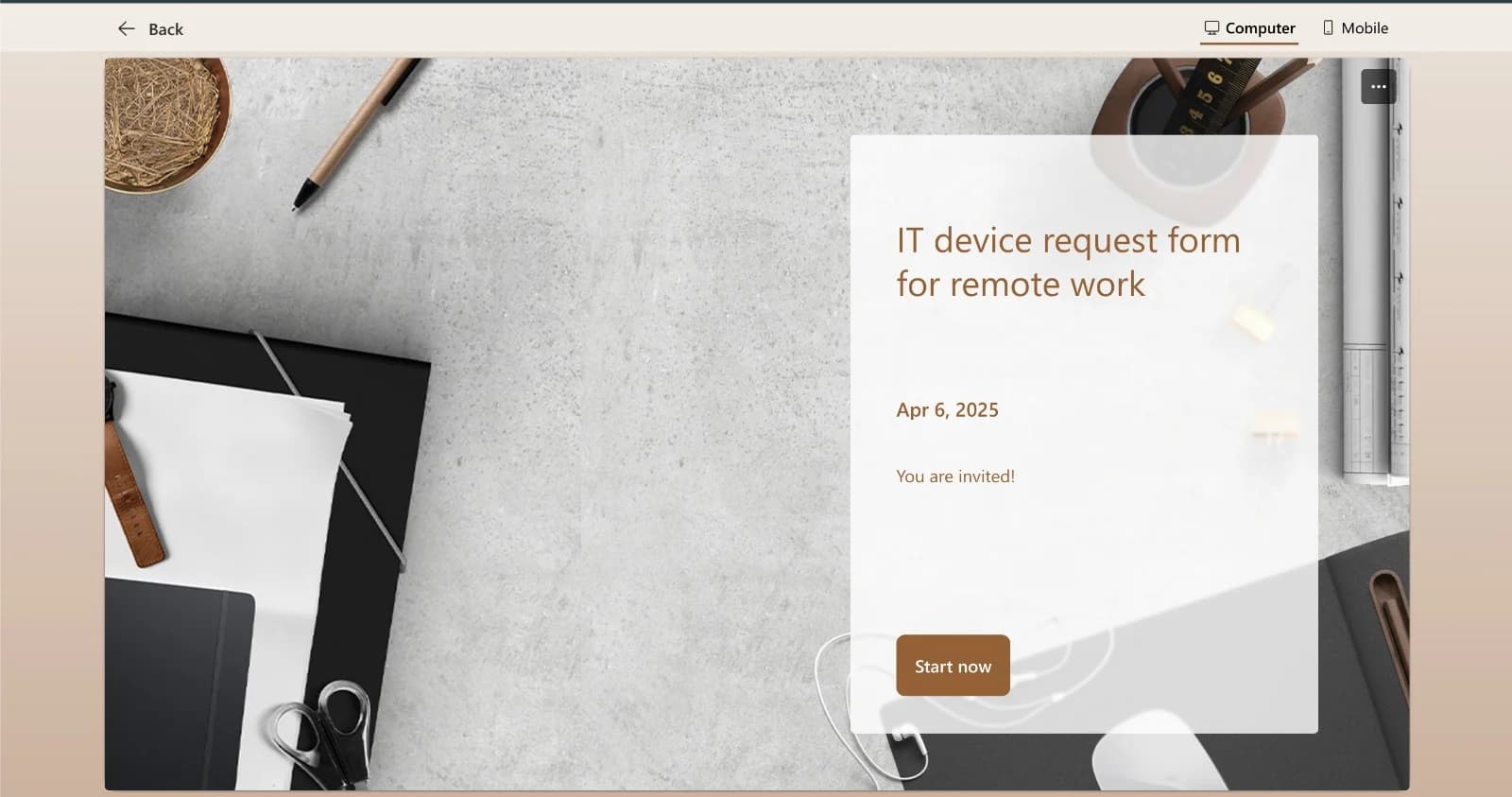
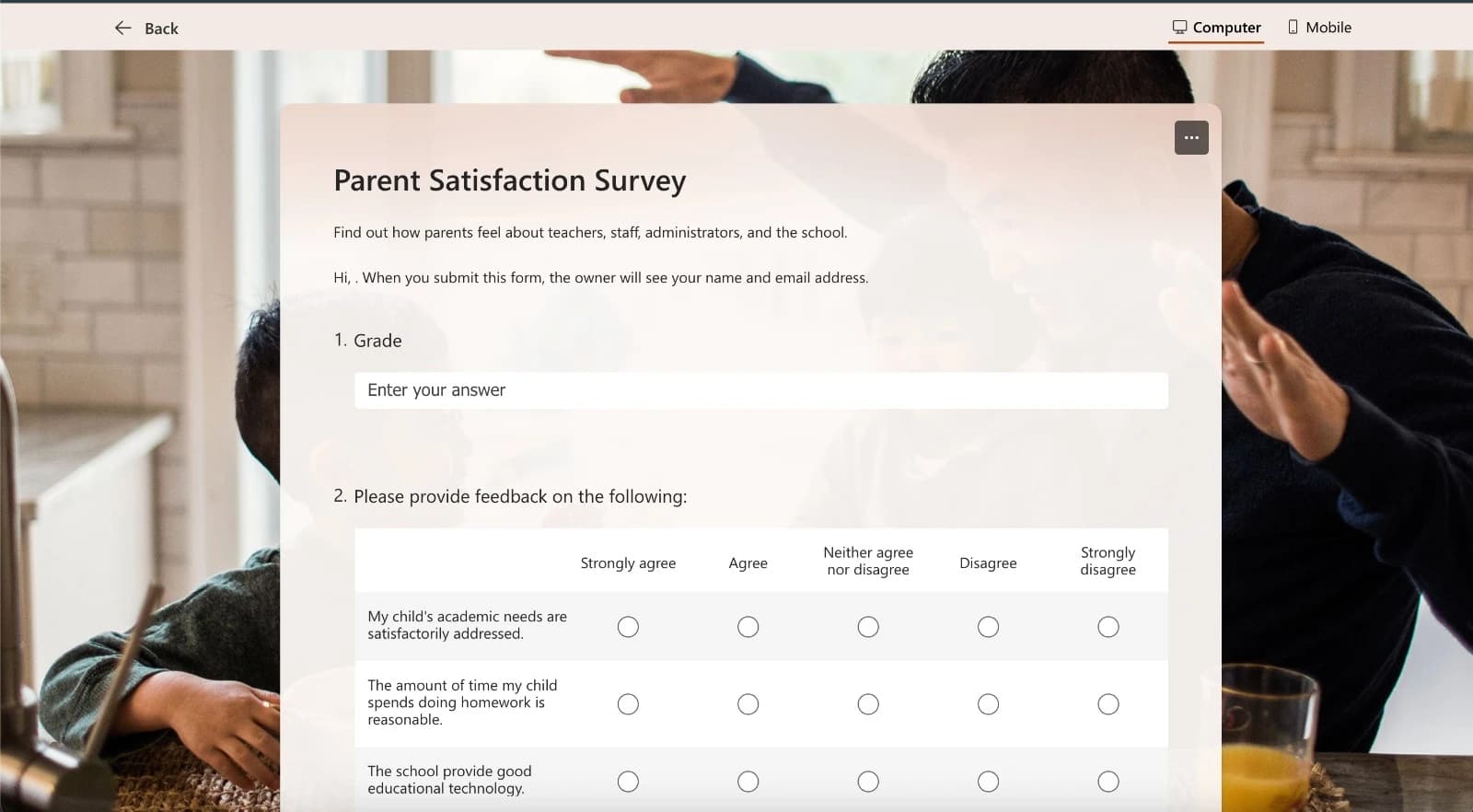
Design is subjective, but customizability and templates determine how quickly you can create professional-looking surveys. Both platforms offer solid starting points:
Microsoft Forms:
Formbricks:


Both platforms look polished and professional. MS Forms benefits from the familiar Microsoft design language. Formbricks offers deeper customization: you can match your brand colors, fonts, and logo for a white-labeled experience. Both provide template libraries to speed up creation. For ready-to-use starting points, explore our survey templates.
Data Privacy & Security
In an era where data privacy regulations are multiplying, how your form builder handles data is a critical decision factor.
Microsoft Forms Security
As a Microsoft product, MS Forms inherits the robust security infrastructure of the 365 platform:
- HIPAA compliant (Health Insurance Portability and Accountability Act)
- GDPR compliant (General Data Protection Regulation)
- FERPA and BAA compliant
- Data encrypted at rest and in transit
The tradeoff: your data lives on Microsoft's cloud infrastructure. You are entrusting survey responses (which may contain sensitive customer feedback, employee data, or PII) to a third party. For many organizations, this is perfectly acceptable. For others, it is a non-starter.
Formbricks Security
Formbricks gives you a choice:
Cloud Option:
- GDPR compliant (headquartered in Germany with strict EU data protection adherence)
- CCPA compliant
- SOC2 certified
- ISO 27001 compliant
- Comparable to MS Forms' cloud security for most use cases
Self-Hosting:
- Complete data sovereignty: responses never leave your servers
- Deploy behind your corporate firewall
- No third-party compliance review needed
- Community Edition is free forever, including for commercial use
For teams handling sensitive data (healthcare surveys, employee engagement, financial feedback), the self-hosting option is Formbricks' strongest differentiator as a Microsoft Forms alternative. You get the convenience of a modern survey tool with the control of an on-premise deployment. Learn more about GDPR-compliant survey tools and our self-hosting options.
Pricing Comparison
Pricing models differ fundamentally between the two platforms.
Microsoft Forms Pricing
MS Forms is not a standalone product. It is bundled with Microsoft 365. Plans start at ~$6/user/month for Microsoft 365 Business Basic. If you already pay for Microsoft 365, MS Forms is effectively "included." If you do not, you are buying an entire productivity suite just to access a form builder.
There is no free tier. No trial of just the forms product.
Formbricks Pricing
Formbricks offers a generous free tier:
- Free: 1,000 responses/month, unlimited surveys, unlimited questions, unlimited team members
- Paid plans: Scale with responses and advanced features (remove branding, advanced targeting, team roles)
- Self-hosted Community Edition: Free forever, even for commercial use
- Self-hosted Enterprise: Contact sales for pricing
If you are already invested in the Microsoft ecosystem and use Teams, SharePoint, and Excel daily, the bundled MS Forms makes practical sense. But if you want a standalone form builder without buying a full productivity suite, or you need open-source survey software you can self-host, Formbricks is the more flexible and cost-effective choice.
Microsoft Forms Alternatives Comparison Table
Formbricks is not the only Microsoft Forms alternative on the market. Here is how the most popular options compare across the features that matter most:
| Feature | Microsoft Forms | Formbricks | Google Forms | Typeform | JotForm | SurveyMonkey | Tally |
|---|---|---|---|---|---|---|---|
| Free Tier | ❌ (needs M365) | ✅ 1,000 responses/mo | ✅ Unlimited | ✅ 10 responses/mo | ✅ 100 responses/mo | ✅ 25 responses/survey | ✅ Unlimited |
| Open Source | ❌ | ✅ | ❌ | ❌ | ❌ | ❌ | ❌ |
| Self-Hosting | ❌ | ✅ | ❌ | ❌ | ❌ | ❌ | ❌ |
| In-App Surveys | ❌ | ✅ | ❌ | ❌ | ❌ | ❌ | ❌ |
| Behavioral Targeting | ❌ | ✅ | ❌ | ❌ | ❌ | ❌ | ❌ |
| Conditional Logic | Basic | Advanced | Basic | Advanced | Advanced | Advanced | Basic |
| Payment Collection | ❌ | ❌ | ❌ | ✅ | ✅ | ✅ | ❌ |
| E-Signatures | ❌ | ❌ | ❌ | ❌ | ✅ | ❌ | ❌ |
| Custom Branding | Limited | ✅ Full | Limited | ✅ Full | ✅ Full | ✅ (paid) | ✅ (paid) |
| Native Integrations | Microsoft only | 15+ | Google only | 50+ | 100+ | 100+ | 10+ |
| API / Webhooks | ❌ | ✅ | ❌ | ✅ | ✅ | ✅ | ✅ |
| GDPR Compliant | ✅ | ✅ | ✅ | ✅ | ✅ | ✅ | ✅ |
| NPS / CSAT / CES | ❌ | ✅ | ❌ | ✅ | ✅ | ✅ | ❌ |
| Multi-Language | ✅ | ✅ | ❌ | ✅ | ✅ | ✅ | ❌ |
| Starts At | ~$6/user/mo | Free | Free | $25/mo | $34/mo | $25/mo | Free |
As the table shows, most alternatives trade one limitation for another. Google Forms and Tally are free but lack advanced features. Typeform and SurveyMonkey are powerful but expensive. JotForm has payments and e-signatures but no self-hosting or in-app capabilities.
Formbricks is the only tool that combines a generous free tier (1,000 responses/month), open-source transparency, self-hosting, in-app surveys with behavioral targeting, and broad native integrations without locking you into a proprietary ecosystem.
When to Choose Microsoft Forms vs Formbricks
Stick with Microsoft Forms if:
- You already have Microsoft 365 and want zero additional cost
- Your team lives entirely in Teams, SharePoint, and Excel
- You only need simple quizzes, polls, or internal forms
Switch to Formbricks if:
- You need a free standalone form builder without buying a productivity suite
- You want in-app surveys with behavioral targeting and event-based triggers
- Data sovereignty matters and you need to self-host on your own infrastructure
- You use a mixed tech stack (Google Sheets, Airtable, Notion, Slack) and need native integrations
- You want an open-source tool with full code transparency and no vendor lock-in
- You are building a product feedback loop or customer experience program and need survey-specific features like NPS, CSAT, and CES
- You want to increase survey response rates with advanced targeting, personalization, and multi-channel distribution
The Verdict
Most teams searching for a Microsoft Forms alternative need more than what MS Forms offers, but they do not want to trade one set of limitations for another. That is where Formbricks stands apart.
It is the only option on this list that is open source, self-hostable, and purpose-built for product feedback with in-app surveys and behavioral targeting. The free tier is generous (1,000 responses/month), the integrations cover modern stacks, and the self-hosted Community Edition is free forever, even for commercial use.
If you want full control over your survey infrastructure without sacrificing features, try Formbricks for free. No credit card required. Or explore our experience management platform to see how it fits into your broader feedback strategy.
Frequently Asked Questions
Try Formbricks now