
9 Best UserVoice Alternatives & Competitors in 2026

Johannes
Co-Founder @ Formbricks
12 Minutes
August 16th, 2026
UserVoice pioneered feature-request tracking back in 2008, and it still shows up in enterprise product stacks today. But there's no pricing on its own site, no self-serve signup, and G2's vendor-submitted pricing table puts its entry tier at $10,788 a year. Most of what's actually on this list is a feature-voting or roadmap tool, not a survey platform, so we're upfront about that split. One entry near the bottom explains honestly where Formbricks fits instead.
Important: If you landed here wanting a place for customers to post and vote on ideas, tools like Canny, Productboard, and Featurebase are the direct comparison set. If what you actually need is structured NPS, CSAT, or PMF surveys, in-app feedback, or website intercepts, that's a different job, and it's the one Formbricks is built for. We cover both honestly below.
What Is UserVoice?
UserVoice launched in 2008 (Crunchbase says 2008, Pitchbook says 2006; UserVoice's own site has no live About page to confirm either way) as one of the first dedicated feature-request and feedback tools on the market. It's since repositioned itself away from a simple voting board toward what it calls a "customer intelligence platform."
The current product ranks feedback and feature requests by correlation to ACV, expansion, and churn risk, not raw vote count, and connects to Salesforce, Gong, Zendesk, Gainsight, Jira, Azure DevOps, and Slack to pull signals from support tickets, sales calls, and NPS data into one place. It's SOC 2 Type 2 certified, GDPR compliant, and built to WCAG accessibility standards. Customer logos on its homepage include PandaDoc, Electronic Arts, Dropbox DocSend, Humana, Cisco, Intuit, Adobe, GoDaddy, and Box.
Important: UserVoice's own homepage FAQ draws a clear line between itself and tools like Canny and Productboard, describing them as "PM-focused tools built for feedback collection and roadmap planning" without revenue weighting, while positioning itself as a customer-intelligence layer for product, CS, and revenue teams combined. That's a meaningfully different pitch than a lightweight voting board, and it shows up directly in the price.
UserVoice Pros & Cons
| Pros | Cons |
|---|---|
| Ties feature requests to specific accounts, letting CSMs submit feedback on behalf of a customer | No pricing anywhere on uservoice.com; every plan requires a sales call |
| Ranks demand by revenue/ACV impact instead of raw vote count | Entry pricing starts around $10,788/year per G2's vendor-submitted table, scaling to $16,188+/year |
| Connects to Salesforce, Gong, Zendesk, Gainsight for cross-tool signal aggregation | Steep learning curve for the underlying data model, per G2 reviewers |
| Strong, stable monthly reporting overviews reviewers found easy to understand | Weak traceability between logged ideas and what actually ships; no native roadmap/dev-tool integration flagged by a reviewer |
| SOC 2 Type 2 certified, GDPR compliant, WCAG-accessible | No self-hosting or data-residency option anywhere in the product |
Why Teams Look for UserVoice Alternatives
We reviewed UserVoice's own pricing page, its G2 reviews, and the SERP pages currently ranking for "UserVoice alternatives" (Canny's own comparison page, Savio's and Frill's roundups). Five reasons come up repeatedly.
1. No Published Pricing, No Self-Serve Signup
UserVoice's pricing page states costs "scale with what you use... never by seat," but shows zero dollar figures. Every plan requires booking a demo. Canny's own UserVoice comparison page calls this out directly: "You have to talk to a salesperson to even try their product."
2. Expensive Entry Pricing
The only real dollar figures we found come from G2's vendor-submitted pricing table: Growth starts at $10,788/year (200 unique end users/year), Team at $14,388/year (3,000 unique end users/month), and Strategic at $16,188/year (5,000 unique end users/year). Independent roundups corroborate this range: Savio's blog cites $799 to $1,349/month ($9,588-$16,188/year), Frill cites a $699/month minimum, and Canny cites "around $15K a year" for the lowest tier.
3. Steep Learning Curve
Canny's comparison page describes UserVoice as "feature bloated," adding that "half the battle is figuring out which features you want to turn on." G2 reviewers separately flag a steep learning curve for the underlying data model.
4. Positioned Away From Pure Feedback-Board Use Cases
UserVoice's own FAQ says Canny and Productboard are "PM-focused tools built for feedback collection and roadmap planning," implying its own revenue-weighting layer is overhead for teams that just want a voting board. If that's your actual use case, several tools below do it more simply and far cheaper.
5. No Self-Hosting or Data Residency
UserVoice is cloud-only. Nothing on its site or in its FAQ mentions a self-hosted or dedicated data-residency option, a hard blocker for regulated buyers.
UserVoice Alternatives at a Glance
| Alternative | Best For | Free Plan | Starting Price | Open Source |
|---|---|---|---|---|
| Canny | Modern, self-serve feature voting + AI capture | Yes (25 tracked users) | $79/month (yearly billing) | No |
| Productboard | Full PM suite: roadmaps, strategy, AI specs | Yes (25 contributors) | $19/maker/month (annual) | No |
| Featurebase | All-in-one support + feedback + help center | Yes (1 seat) | $29/seat/month (yearly) | No |
| Aha! | Enterprise product strategy across ideas, roadmaps, OKRs | No | $39/user/month | No |
| Formbricks | Open-source surveys (NPS/CSAT/PMF), not a voting board | Yes (250 responses/mo) | $89/month ($74/mo annual) | Yes |
| Savio | Revenue-weighted prioritization on an SMB budget | No | $39/month | No |
| Frill | Affordable all-in-one for small SaaS teams | No (paid only) | $25/month | No |
| Pendo | Product analytics bundled with feedback | Yes (limited) | Custom (opaque) | No |
| UseResponse | Public/private feedback portal closest in shape to UserVoice | No | $124/month | No |
Top 9 UserVoice Alternatives in 2026
1. Canny: Best Modern, Self-Serve Feature Voting
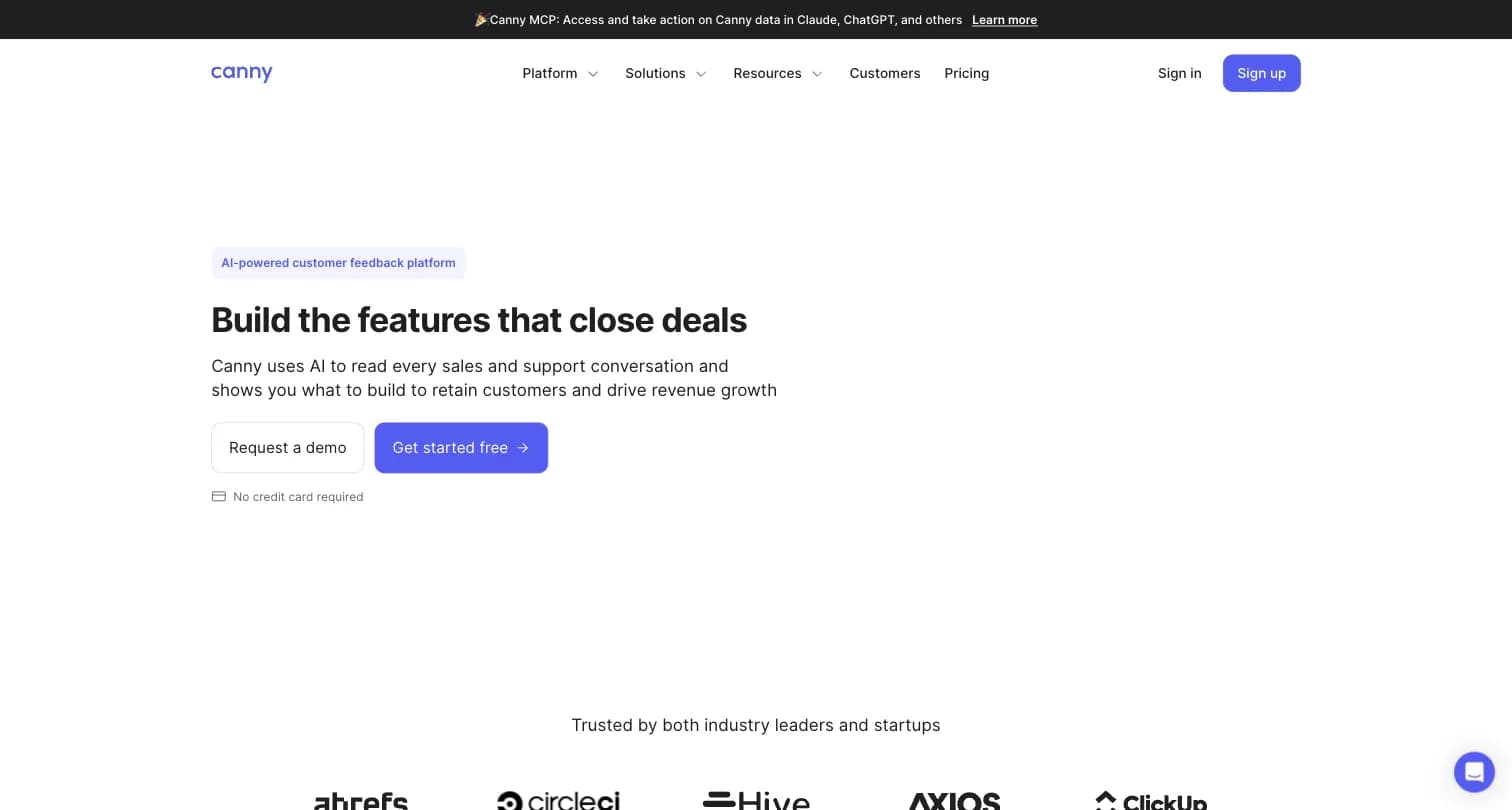
Canny is the most direct like-for-like swap for UserVoice's original use case: a public feedback board with voting, a roadmap, and a changelog, plus AI that captures feedback automatically from sales calls and support tickets.
Key features:
- Autopilot AI feedback capture: reads support tickets, Gong sales calls, and Intercom/Slack chats to automatically capture, deduplicate, and triage feedback without manual entry
- Revenue-linked prioritization: links feedback posts to account/MRR/opportunity data via CRM integrations
- Public feedback boards, roadmap, and changelog to close the loop when features ship
- Integrations: Intercom, Zendesk, Slack, Jira, ClickUp, Linear, Asana, GitHub, Azure DevOps, HubSpot, Salesforce, Zapier
Why Choose Canny Over UserVoice
Self-Serve From Day One, No Sales Call Required. Canny's own comparison page draws the contrast directly: "You have to talk to a salesperson to even try [UserVoice]," while Canny lets you sign up and start collecting feedback free, in minutes.
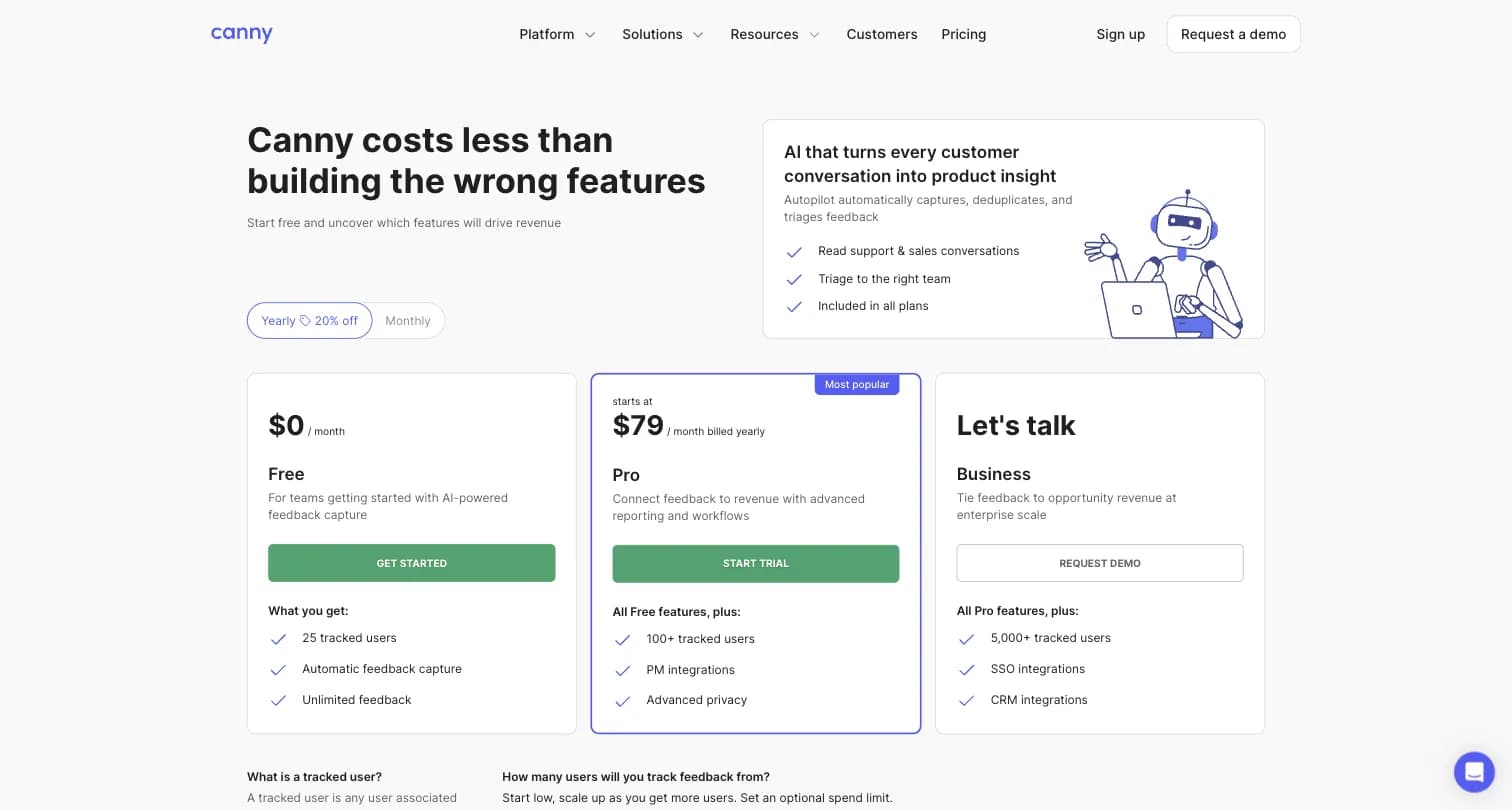
Transparent, Published Pricing. Canny's Free plan is $0/month for 25 tracked users, and Pro starts at $79/month billed yearly. UserVoice's lowest tier runs roughly $899-$1,349/month per G2's vendor-submitted pricing table, and you can't get a quote without multiple sales calls.
Canny Pricing:
- Free: $0/month, 25 tracked users, automatic feedback capture, unlimited feedback and boards, 5 managers
- Pro: $79/month billed yearly, 100+ tracked users, PM integrations (Jira, ClickUp, Linear, Asana, GitHub, Azure DevOps), advanced privacy, 10 managers
- Business: Custom (contact sales), 5,000+ tracked users, SSO integrations, CRM integrations, custom admin roles
G2 rating: 4.5/5 (108 reviews). Capterra: 4.6/5 (77 reviews).
Who Should Use Canny?
- You want a lightweight, self-serve feature-voting board with AI-assisted capture from sales and support conversations
- You're comfortable with "tracked user" pricing (anyone who posts, votes, or comments) rather than a per-seat model
- You don't need structured NPS/CSAT survey methodology, just feature-request voting and a public roadmap
2. Productboard: Best for Large Product Teams Managing Complex Roadmaps
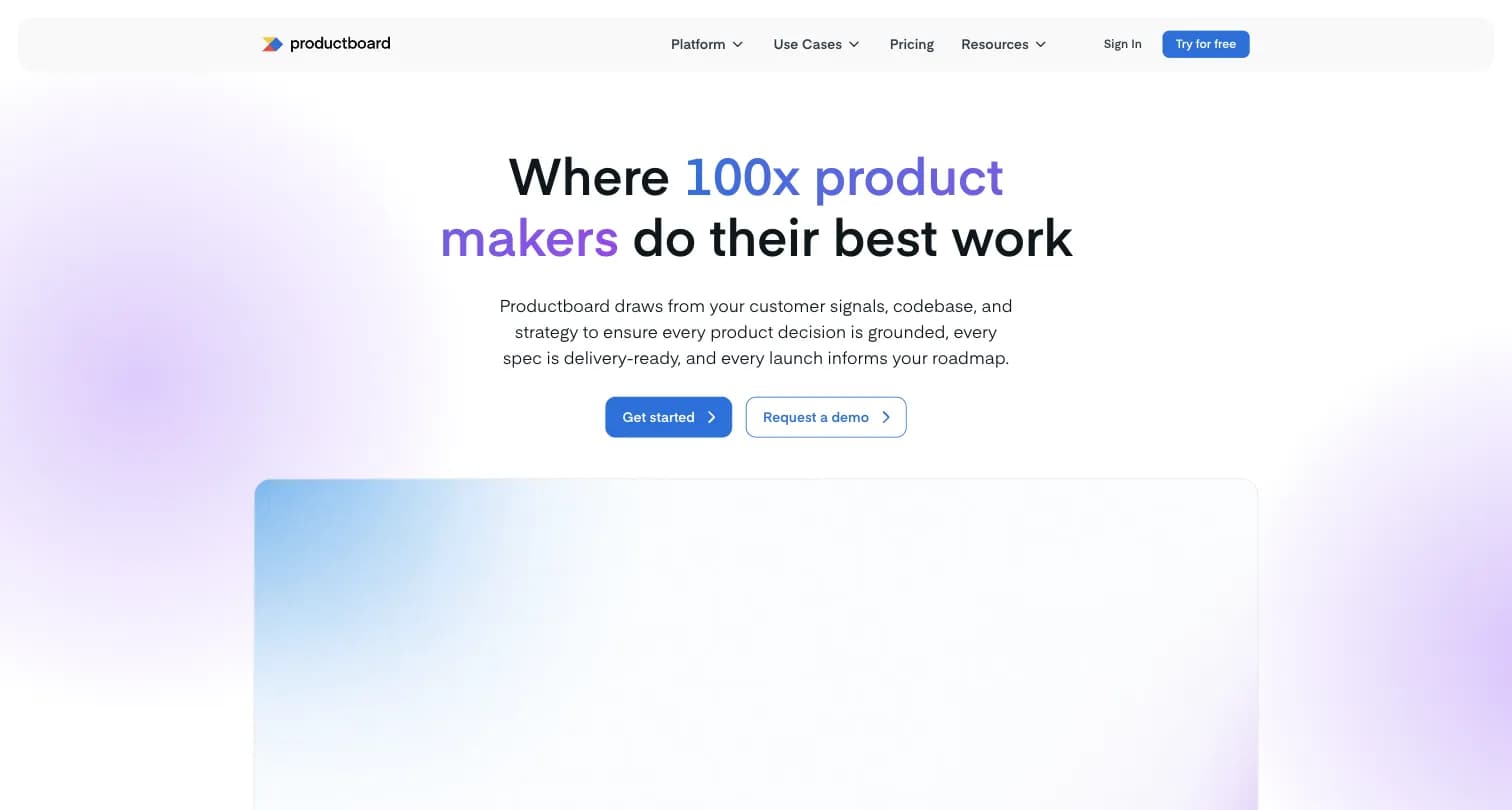
Productboard is a full agentic product management system: feedback repository, roadmapping, and prioritization, with an AI agent (Spark) that drafts delivery-ready specs from feedback synthesis.
Key features:
- Spark AI agent: surfaces product opportunities with citations, drafts specs, and measures post-launch impact
- Centralized feedback repository with AI-powered trend surfacing linking insights to feature ideas
- Roadmapping & prioritization: timeline and column-based roadmaps, customizable prioritization formulas, dependency tracking
- Customer-facing portal for sharing plans and validating ideas
Why Choose Productboard Over UserVoice
A Full PM Operating System, Not Just Feedback Intelligence. UserVoice ranks feedback by revenue impact; Productboard goes further into roadmapping, release planning, and AI-drafted specs, a broader workflow for teams that want one tool from insight to shipped feature.
Lower Entry Cost. Savio's own research puts Productboard at roughly $20-80/maker/month, calculating about $400/month for 5 seats with full features, versus UserVoice's $10,788+/year entry tier. Productboard's own pricing confirms Plus at $19/maker/month billed annually.

Fair trade-off: Productboard's own pricing bundles a second, usage-based dimension (AI credits) on top of seat pricing, and Business/Enterprise tiers carry 2- and 5-maker minimums that inflate the effective entry price beyond the sticker number.
Productboard Pricing:
- Free: $0, 1 maker minimum, 25 contributors, full Spark AI access, 500 feedback notes, 1 teamspace
- Plus: $19/maker/month billed annually ($25/maker/month monthly), manual & dynamic customer segments, feedback loop closing
- Business: $59/maker/month billed annually, 2-maker minimum, unlimited feedback notes and teamspaces
- Enterprise: Custom, 5-maker minimum, SAML SSO, SCIM provisioning, Salesforce integration
G2 rating: 4.3/5 (254 reviews). Capterra: 4.7/5 (154 reviews).
Who Should Use Productboard?
- You're a product team that wants an AI agent to turn scattered feedback into delivery-ready specs and roadmaps
- You need enterprise-grade roadmap governance (SSO, custom roles, Salesforce integration) at scale
- You're comfortable with a maker-based, AI-credit-metered pricing model in exchange for a full PM operating system
3. Featurebase: Best All-in-One Support, Feedback, and Help Center Bundle
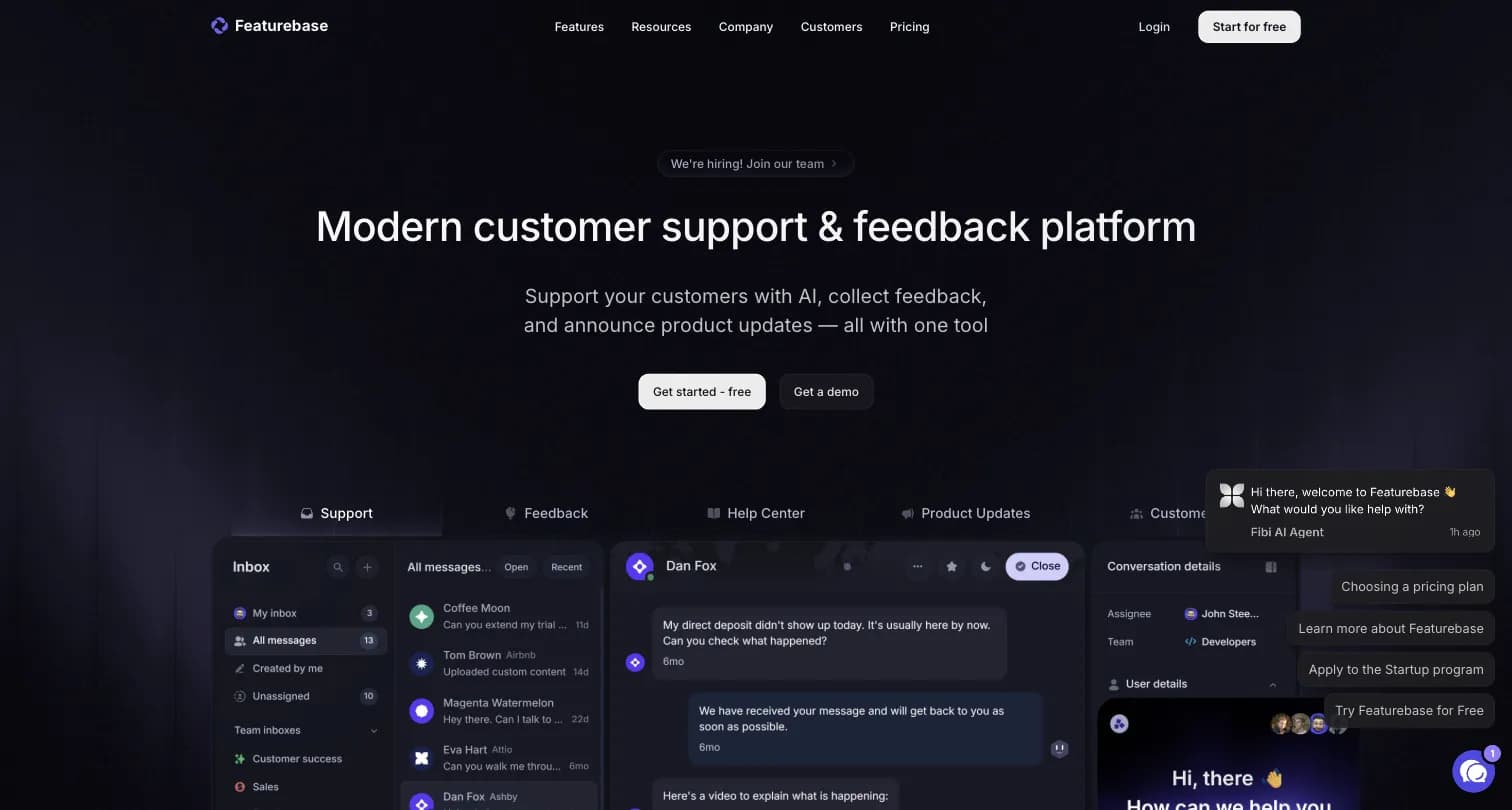
Featurebase bundles an AI helpdesk agent, feedback/roadmap voting, a help center, and changelogs under one subscription, a broader consolidation play than UserVoice attempts.
Key features:
- Fibi AI support agent: resolves customer issues across an omnichannel inbox (chat, Slack, email), billed per resolution
- Feedback & roadmap voting: public boards, in-app widgets, upvoting, automatic notifications when a request ships
- Help Center & changelog: AI-powered self-serve knowledge base with multi-brand/multilingual support (40+ languages)
- Workflows & automations: no-code SLAs, round-robin assignment (Professional tier and above)
Why Choose Featurebase Over UserVoice
Consolidates Tools UserVoice Doesn't Touch. UserVoice is a feedback and idea-management layer. Featurebase replaces that plus a helpdesk, live chat, and a knowledge base in one subscription, useful if you're currently paying for Intercom or Zendesk on top of a feedback tool.
A Real Free Tier and Transparent Seat Pricing. Featurebase's Free plan includes 1 feedback board, 1 roadmap, live chat, and 50 help-center articles at $0. Growth starts at $29/seat/month billed yearly, a fraction of UserVoice's opaque, sales-gated entry cost.

Fair trade-off: Featurebase doesn't do UserVoice's revenue/ACV-weighted prioritization, and AI features (Fibi resolutions, Copilot) bill separately on top of seat price. It's also a young, 3-person bootstrapped team founded in 2020, versus UserVoice's longer (if disputed) 2006-2008 track record.
Featurebase Pricing:
- Free: $0/month, 1 seat, 1 feedback board, 1 roadmap, live chat, unified inbox, 50 help-center articles
- Growth: $29/seat/month billed yearly, Fibi AI Agent (+$0.49/resolution), 5 feedback boards, custom domain
- Professional: $59/seat/month billed yearly, Slack support channel, workflows & automations, SSO
- Enterprise: $99/seat/month billed yearly, multi-brand workspace, Salesforce & HubSpot data sync
G2 rating: 4.7/5 (50 reviews).
Who Should Use Featurebase?
- You want to replace 5+ separate tools (helpdesk, feedback board, knowledge base, changelog) with one subscription
- You're a fast-growing startup that wants an AI support agent alongside lightweight feedback collection
- You don't need UserVoice's revenue-weighted prioritization as your primary decision layer
4. Aha!: Best for Enterprise Product Strategy Across Ideas, Roadmaps, and OKRs
Aha! is a modular product management suite: ideas and feedback portals, roadmapping, whiteboards, OKRs, and delivery planning, sold as separate but integrated products.
Key features:
- Centralized feedback with customizable portals and in-app widgets across channels
- Dynamic forms and upvoting for crowd-sourced feature prioritization
- Modular pricing across Roadmaps, Ideas & Discovery, Whiteboards, Teamwork, Develop, and Knowledge products
- SSO included on all plans, notable versus competitors that gate it behind Enterprise
Why Choose Aha! Over UserVoice
A Full Strategy-to-Execution Suite, Not Just an Ideas Layer. UserVoice ranks and routes feedback. Aha! connects that same feedback to roadmaps, OKRs, and delivery planning in one integrated platform, according to its own product pages and corroborated by Frill's independent research, which calls it "the most comprehensive tool" in its own UserVoice-adjacent comparison set.
Real Savings at Scale. Savio's research calculates 5 product-management seats on Aha! at $745/month with full features, versus UserVoice's comparable tier, putting the switch at over $7,000/year in savings by Savio's own estimate.
Fair trade-off: Aha! lacks UserVoice's customer-attribute segmentation on feedback (per Savio's research) and, like UserVoice, has no simple "close the loop" workflow built specifically for that purpose.
Aha! Pricing (as reported by Frill's independent research, captured 2026): Aha! Roadmaps starts at $59/user/month (includes ideas, whiteboards, knowledge tools); Aha! Ideas and Discovery start at $39/user/month; Whiteboards, Teamwork, and Develop start at $9/user/month; Knowledge starts at $18/user/month. All billed annually.
G2 rating: 4.4/5 (365 reviews, per Frill's research). Capterra: 4.7/5 (per Savio's research).
Who Should Use Aha!?
- You want a single platform spanning ideas, roadmaps, OKRs, whiteboards, and delivery planning
- SSO included on every plan (not gated behind Enterprise) matters to your procurement process
- You have budget for $39-59/user/month and want the most comprehensive suite over a lightweight board
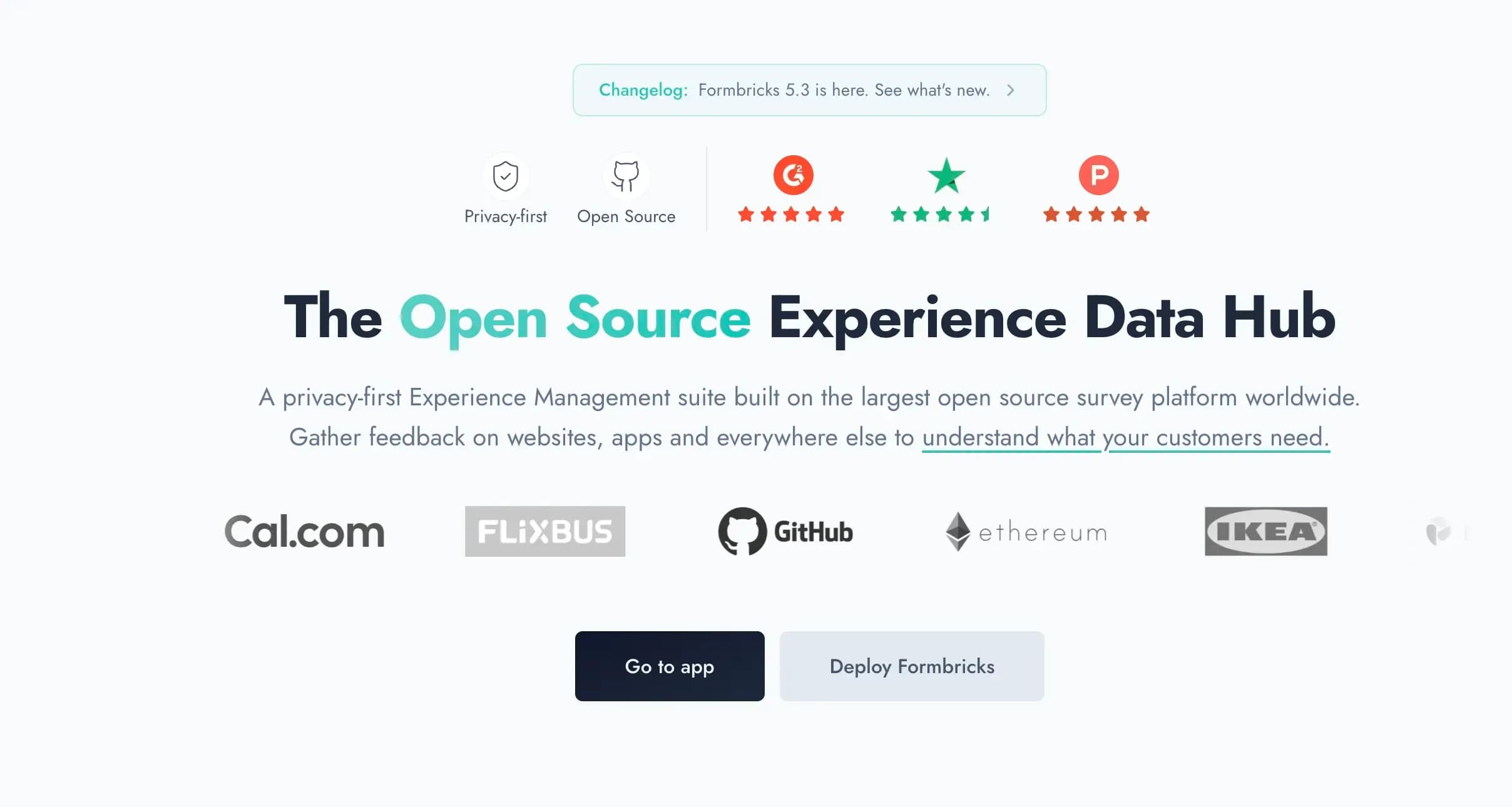
5. Formbricks: The Open-Source Pick, If Your Real Need Is Surveys, Not Voting
Here's the honest part: Formbricks is not a feature-voting board, and it won't replace UserVoice's revenue-weighted idea management. If you need a public board where customers post and vote on ideas, Canny, Productboard, or Aha! are the right comparison set above.
But UserVoice's own competitive-landscape research (and ours) confirms most "UserVoice alternatives" searches actually split into two different jobs: idea management, and structured feedback measurement (NPS, CSAT, PMF, in-app surveys). Formbricks is the open-source answer to the second job, and it already shows up alongside Fider in independent "free UserVoice alternatives" aggregator listings for exactly that reason.
Key features:
- Feedback management across every channel: website surveys, in-app surveys, link surveys, and email surveys, all managed from one platform
- Feedback analytics: response dashboards, drop-off and partial-response tracking, segmentation, aggregate plus per-response views
- Workflows and integrations: Formbricks Workflows for post-response automation, plus native integrations to Salesforce, HubSpot, Slack, Google Sheets, and Notion via webhooks
- Free API on every tier, including MCP: full API access (Public Client API and Management API), not gated behind a $10K+/year enterprise tier the way UserVoice's pricing works
- Advanced targeting: attribute-based segmentation with conditional logic for in-app surveys
- Self-hosting on your own infrastructure, with Formbricks never having access to your data when self-hosted
Why Choose Formbricks Over UserVoice (For the Right Job)
Published, Self-Serve Pricing vs. a Sales-Gated Quote. UserVoice publishes zero dollar figures and requires a demo before you know what you'd pay. Formbricks lists every tier publicly and lets you sign up and start collecting responses the same day.
⚡ Formbricks in Action: A product team that needs a quarterly NPS program gets a UserVoice quote of roughly $10,788-$16,188/year after a sales call. The same week, they deploy Formbricks Pro at $74/month, connect it to Slack and HubSpot, and start collecting NPS responses from an in-app survey.
Self-Hosting for Regulated Industries, Where UserVoice Has No Path At All. UserVoice's own pricing page and FAQ mention no self-hosted or data-residency option anywhere. Formbricks offers a free, self-hosted Community Edition (AGPLv3) that keeps all response data on infrastructure you control.
⚡ Formbricks in Action: A healthcare SaaS company evaluating UserVoice for structured patient-satisfaction surveys rules it out once security confirms there's no self-hosting path at any price. They deploy Formbricks Community Edition inside their own VPC instead.
Where UserVoice Still Has an Edge. To be fair, UserVoice's revenue-weighted idea ranking, deep CRM/Gong/Gainsight integrations, and CSM-driven feedback-to-account tying are purpose-built for feature-request intelligence in a way Formbricks doesn't attempt. Formbricks can capture feature requests through open-text survey questions, but it has no dedicated voting board, roadmap, or churn-risk scoring model.
Formbricks Pricing (verified from formbricks.com/pricing, August 2026):
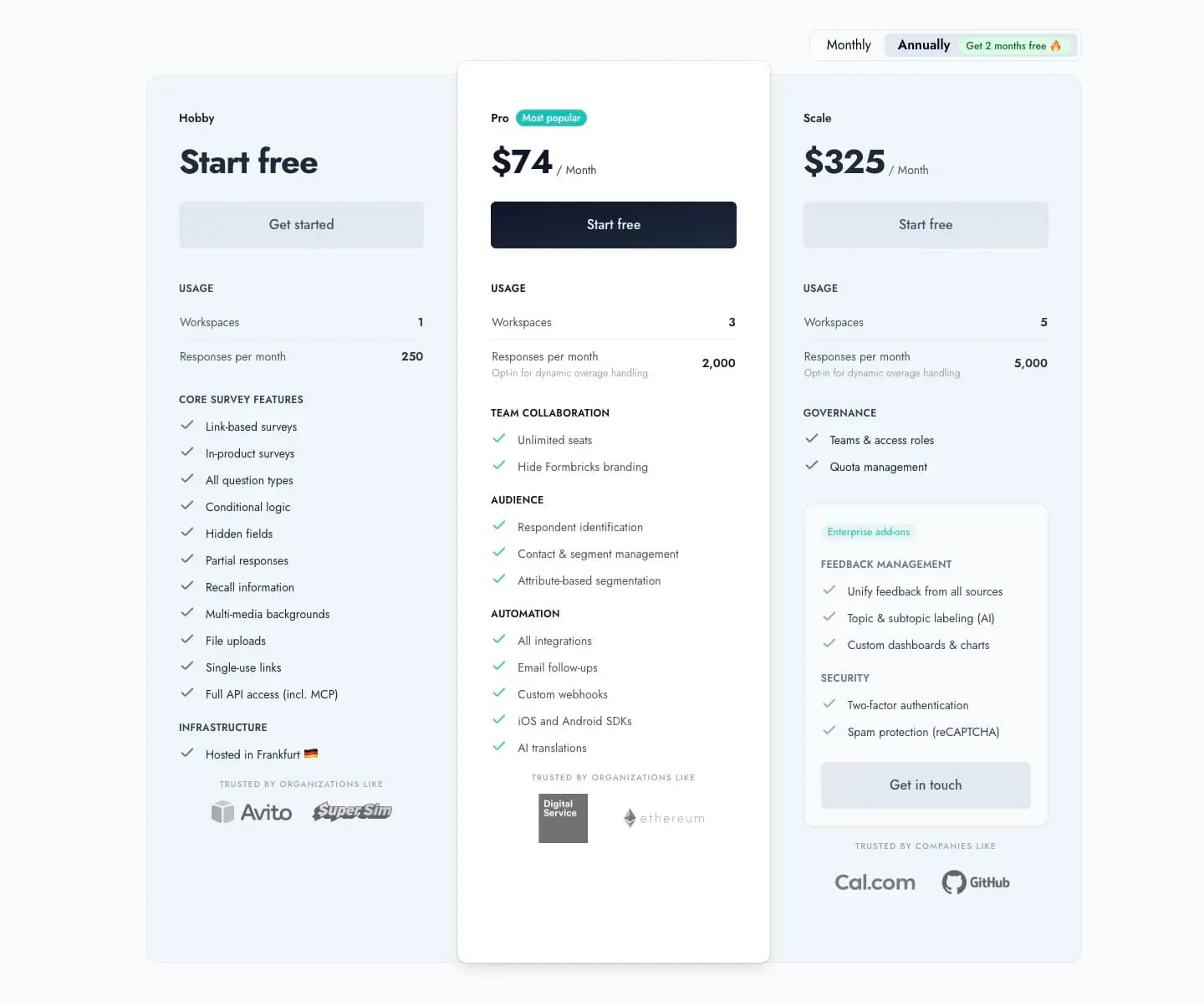
- Hobby (Free): 1 workspace, 250 responses/month, all question types, conditional logic, full API access (incl. MCP), hosted in Frankfurt
- Pro: $89/month billed monthly, or $74/month billed annually ($890/year total), 3 workspaces, 2,000 responses/month, unlimited seats, branding removal, attribute-based segmentation, all integrations, iOS/Android SDKs
- Scale: $390/month billed monthly, or $325/month billed annually, 5 workspaces, 5,000 responses/month, teams and access roles, quota management
- Enterprise: Custom pricing, contact sales
- Self-hosted Community Edition: Free forever, open-source (AGPLv3), no response limits
Who Should Use Formbricks?
- Your actual need is structured NPS, CSAT, or PMF surveys, in-app feedback, or website intercepts, not a public voting board
- You're in a regulated industry (healthcare, finance, government) with a data-residency requirement UserVoice can't satisfy at any price
- You want transparent, published pricing you can evaluate without a sales call
- You want to run feature-request capture (via open-text survey questions) alongside structured research on one platform, without needing UserVoice's full revenue-weighting layer
6. Savio: Best Revenue-Weighted Prioritization on an SMB Budget
Savio centralizes feedback from Slack, HubSpot, Intercom, Zendesk, and Salesforce, then segments it by customer attributes like MRR, the same core capability UserVoice charges enterprise prices for.
Key features:
- Centralizes feedback from any channel via native integrations and a Chrome extension, or by forwarding emails
- Segmentation and filtering by customer attributes (MRR, churned status, plan tier)
- "Close the loop" workflow to notify customers when requested features ship
- A feature-voting board designed so one customer's vote doesn't bias another's, unlike a public tally
Why Choose Savio Over UserVoice
Comparable Segmentation at a Fraction of the Price. Savio's own pricing starts at $39/month, and its research estimates a 5-seat setup with full segmentation features at $235/month ($2,820/year), versus UserVoice's $10,788+/year entry tier, a claimed savings of over $13,300/year by Savio's own calculation.
Fair trade-off (Savio's own admission): Savio has no survey functionality to solicit customer feedback proactively, it's built for centralizing and prioritizing feedback you already receive elsewhere, not for running structured NPS/CSAT campaigns.
Savio Pricing: Starts at $39/month; a 5-seat setup with customer-data segmentation runs approximately $235/month per Savio's own published example.
Who Should Use Savio?
- You want UserVoice-style revenue-weighted prioritization and CRM segmentation without the enterprise price tag
- Your feedback already lives in Slack, Intercom, Zendesk, or Salesforce and you want it centralized, not a new intake channel
- You don't need built-in survey functionality alongside feedback centralization
7. Frill: Best Affordable All-in-One for Small SaaS Teams
Frill combines an ideas board, roadmap, changelog, and lightweight surveys in one product built specifically for small and mid-size SaaS teams priced out of UserVoice.
Key features:
- Customer feedback idea board with a website widget and custom domain
- Announcements portal with automatic notifications and a public changelog
- Roadmap and idea upvoting with third-party integrations
- Bundled survey add-on (1-3 surveys depending on tier)
Why Choose Frill Over UserVoice
A Fraction of the Cost for the Same Core Loop. Frill's Startup plan is $25/month, versus UserVoice's $699-$899/month minimum. Frill's own research reports a G2 reviewer citing a 40% increase in idea-board engagement after switching from UserVoice.
Fair trade-off: Frill is built specifically for SaaS and digital products, so teams needing enterprise-grade analytics, CRM-weighted prioritization, or complex multi-stakeholder workflows will hit limits UserVoice or Aha! don't have.
Frill Pricing: Startup at $25/month (50 ideas, 1 survey); Business at $49/month (unlimited ideas, 3 surveys); Growth at $149/month (everything included); Enterprise from $349/month (SOC 2, audit logs, support).
G2 rating: 4.9/5. Capterra: 4.7/5.
Who Should Use Frill?
- You're a small or mid-size SaaS team priced out of UserVoice's $699+/month minimum
- You want ideas, roadmap, changelog, and a lightweight survey add-on in one affordable product
- You don't need UserVoice's revenue-weighted, CRM-integrated prioritization depth
8. Pendo: Best for Teams That Want Analytics Bundled With Feedback
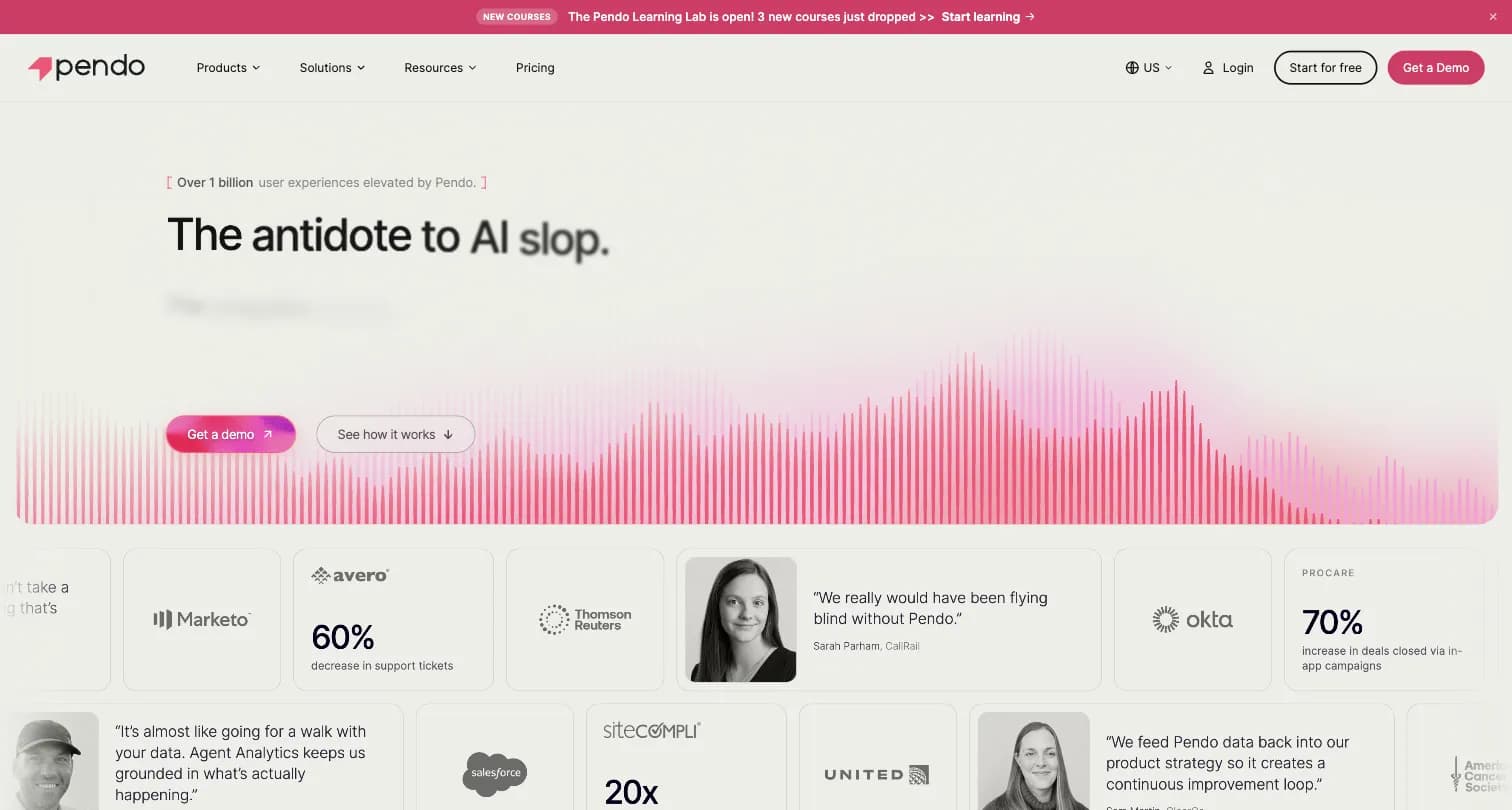
Pendo goes further than UserVoice into product analytics, in-app guides, and session replay, with feedback and roadmapping as one module inside a much broader suite.
Key features:
- Behavioral analytics showing how customers actually interact with your product
- In-app guides and onboarding flows alongside feedback collection
- Customer sentiment surveys (NPS) and roadmap tools tied to usage data
- Customizable dashboards and engagement scoring
Why Choose Pendo Over UserVoice
Analytics Depth UserVoice Doesn't Attempt. UserVoice ranks feedback by revenue impact using CRM data. Pendo goes a step further, tying feedback and roadmap decisions directly to real product-usage analytics, not just account value.
Fair trade-off: Pendo's pricing isn't published anywhere, same as UserVoice. Independent research (via Capiche, cited in Savio's roundup) puts real-world contracts anywhere from $2,000 to $30,000/year, a wide, unpredictable range that requires its own sales conversation to pin down.
Pendo Pricing: Free plan with limited access; paid tiers (Base, Core, Ultimate) are custom-quoted and not published, with third-party research suggesting a typical range of $2,000-$30,000+/year.
G2 rating: 4.4/5. Capterra: 4.5/5.
Who Should Use Pendo?
- You want product analytics, onboarding guides, and feedback bundled in one suite rather than separate tools
- You're comfortable going through a sales conversation for both UserVoice and Pendo, since neither publishes pricing
- Usage-data-informed prioritization matters more to you than UserVoice's CRM/revenue-weighted model
9. UseResponse: Closest in Shape to UserVoice's Original Feedback Portal
UseResponse is the tool structurally closest to UserVoice's original public/private feedback-portal model, with a customer-support lean layered on top.
Key features:
- Public or private feedback collection portal with boards for multiple products
- Anonymous voting to reduce feedback bias between customers
- Multi-language support and a visual product roadmap tool
- Automation triggers for processing incoming feedback
Why Choose UseResponse Over UserVoice
A Direct Structural Match at a Fraction of the Price. UseResponse mirrors UserVoice's original public-feedback-portal shape (as opposed to Canny or Productboard's more voting-board-first design), at a fraction of the cost: $124/month for one user of the feedback module, versus UserVoice's $899+/month entry tier.
Fair trade-off: UseResponse can't segment feedback by customer attributes like MRR the way UserVoice or Savio can, and it has no simple close-the-loop workflow for notifying customers when requests ship.
UseResponse Pricing: $124/month for one user of the feedback solution; scales to $222/month for 5 users ($2,664/year for a 5-person team).
Who Should Use UseResponse?
- You want a feedback portal structurally closest to UserVoice's original public/private board model
- You need multi-language support and anonymous voting to reduce feedback bias
- You don't need UserVoice's revenue/CRM-based segmentation or a close-the-loop workflow
Other UserVoice Alternatives Worth a Quick Look
A few more tools came up repeatedly across our SERP research without warranting a full section:
- Fider: the most established genuinely open-source feature-voting board, and the real direct open-source substitute if a public ideas board (not surveys) is what you need
- Upvoty: a public feedback board with roadmap and changelog, starting at $15/month for 3 team members, per Savio's research
- Hellonext: adds roadmapping and a changelog onto a standard voting board, from $12/month for one board, per Savio's research
- Nolt: couples a voting board with a visual roadmap and anonymous voting, at $25/month per board, per Savio's research
- Feature Upvote: a no-login-required public voting board at $79/month per board, per Savio's research
- Gleap: pairs visual bug reporting (screenshots, session data) with feedback boards and lightweight surveys, from around $31-39/month, per Frill's research
How to Choose the Right UserVoice Alternative
Picking a replacement depends on which job you're actually trying to do.
Start With Your Use Case
- Public feature-voting board + roadmap: Canny, Featurebase, or Fider
- Full PM suite with AI-assisted specs and strategy: Productboard or Aha!
- Revenue-weighted prioritization on a smaller budget: Savio
- Affordable all-in-one for a small SaaS team: Frill
- Analytics bundled with feedback: Pendo
- Structural match to UserVoice's original portal: UseResponse
- Structured surveys (NPS, CSAT, PMF) instead of a voting board: Formbricks
Then Evaluate These Criteria
| Criteria | Questions to Ask |
|---|---|
| What job are you replacing | A voting board and roadmap, or structured survey/NPS data collection? These are different tools. |
| Pricing model | Published self-serve tiers, or a sales-gated quote like UserVoice's? |
| Data ownership | Can you self-host? Where does response or feedback data live? |
| CRM/revenue weighting | Do you need feedback ranked by account value, or is raw vote count enough? |
| Team size | Per-seat, per-maker, or tracked-user pricing, and which model fits your budget as you grow? |
| API access | Is API access free on every tier, or reserved for higher/Enterprise plans? |
The Open-Source Angle
Two genuinely open-source options exist here, for two different jobs. Fider is the open-source pick if you want a self-hostable public voting board. Formbricks is the open-source pick if your real need is structured feedback measurement, surveys, in-app intercepts, and feedback analytics, with a free, self-hostable Community Edition (AGPLv3) and no response limits. Every other tool on this list, including UserVoice itself, is closed-source and cloud-only.
Read more about GDPR-compliant survey software and enterprise survey software built privacy-first.
For more comparison articles, see our Pendo alternatives, Qualaroo alternatives, Sprig alternatives, and Canny vs. Productboard vs. Featurebase guides.
Frequently Asked Questions
Looking for structured surveys instead of a voting board? Formbricks gives you feedback management across website, in-app, link, and email surveys, feedback analytics, and workflow integrations with Salesforce, HubSpot, Slack, Google Sheets, and Notion, plus a free API on every tier. Self-host it for full data ownership, or start on the cloud Hobby plan for free.
Try Formbricks now