

8 Best Chameleon Alternatives & Competitors in 2026 (Including Open Source)

Johannes
Co-Founder @ Formbricks
12 Minutes
August 16th, 2026

Chameleon is a well-regarded platform for building in-app tours, tooltips, and AI-assisted onboarding. But its microsurvey feature is secondary to its core guidance product, there's no forever-free tier, and there's no self-hosting option for teams with data residency requirements. Every tool on the usual "Chameleon alternatives" lists is closed-source. One on this list is open-source and self-hostable. Here are 8 platforms worth a serious look.
What Is Chameleon?
Chameleon is an AI-first product adoption platform that helps SaaS teams build in-app tours, tooltips, banners, and checklists without writing code. Founded in 2015 by Pulkit Agrawal and Brian Norton, it now serves 400+ customers and employs 40+ people distributed across 30+ cities.
The platform's core product is in-app "Experiences": Tours, Tooltips, Banners, Checklists, and Embeds, all built through a no-code editor. Microsurveys exist as one Experience type among these, layered onto the guidance product rather than sitting at the center of it.
Chameleon has also built out four AI agents: Copilot (builds and analyzes experiences), Compass (behavior context), Prism (personalization), and Ranger (governance and cleanup of stale content). An MCP server lets teams query Chameleon data through Claude or other MCP-compatible tools.
Key features:
Important: Chameleon is not a dedicated survey or experience management platform. It's a digital adoption platform where microsurveys are a secondary capability layered onto a tours-and-tooltips product, not the primary focus.
Chameleon Pros & Cons
| Pros | Cons |
|---|---|
| Very flexible customization (branding, color scheme, UI targeting), largely code-free | Learning curve for advanced conditional targeting logic |
| Intuitive interface lets non-technical teams launch experiences quickly | Microsurveys aren't highly customizable, you can't tailor "thank you" responses per rating |
| Four AI agents (Copilot, Compass, Prism, Ranger) automate building and governance | No forever-free tier, cheapest plan starts at $279/month with only a 14-day trial |
| MCP server for querying data from AI tools | Web-focused, with no native iOS or Android SDKs |
| G2 rating of 4.4/5 across 362 reviews | Product analytics are intentionally light, no funnels, session replay, or retention reporting built in |
Why Teams Look for Chameleon Alternatives
We reviewed Chameleon's own pricing page, G2 reviews, and independent coverage from Userpilot and other product-adoption sites to understand why teams evaluate alternatives. Five patterns come up repeatedly.
1. Pricing Climbs Quickly With Usage
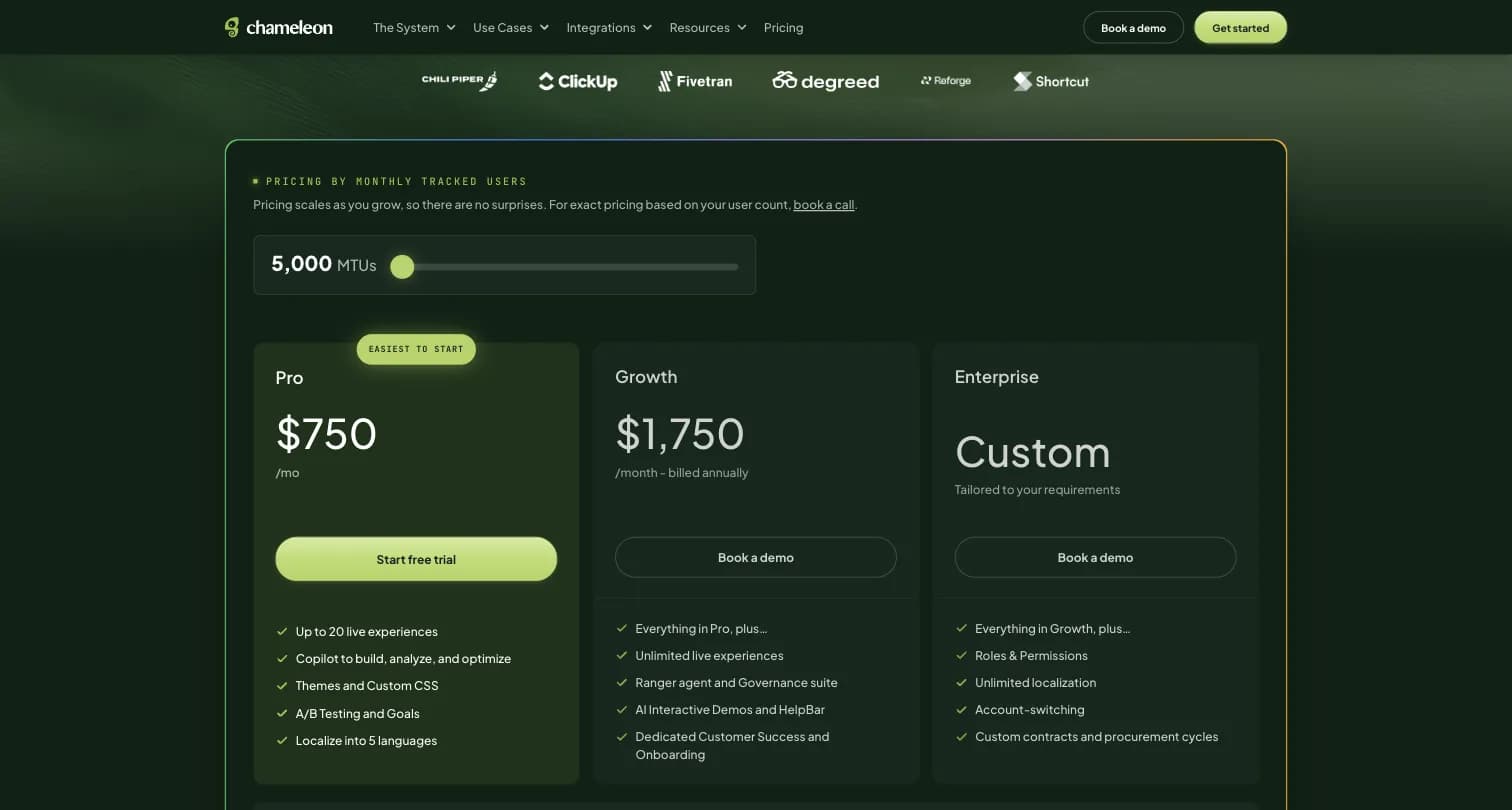
Chameleon's Startup plan starts at $279/month for up to 2,000 Monthly Tracked Users (MTUs). Pro is self-serve starting at $750/month for 5,000 MTUs, and Growth starts at $1,250/month for 5,000 MTUs, billed annually. According to procurement platform Vendr, the median annual Chameleon contract lands near $30,700.
There's no forever-free tier, only a 14-day trial with full Enterprise-level access.
2. No Self-Hosting or Data Residency Option
Chameleon is cloud-only. There's no option to run the platform on your own infrastructure, which becomes a blocker for teams in regulated industries or with strict data residency requirements.
3. Web-Focused, With No Native Mobile SDKs
Chameleon supports web experiences and some hybrid environments, but it doesn't ship native SDKs for iOS or Android. Teams building native mobile products typically need a platform with dedicated mobile support.
4. Microsurveys Are Secondary to Guidance
G2 reviewers specifically note that Chameleon's microsurveys aren't highly customizable, for example, you can't tailor the "thank you" response shown per rating given. Chameleon's core wedge is tours, tooltips, and guidance. Deep survey logic isn't the focus.
5. Product Analytics Are Intentionally Light
Chameleon helps you understand engagement with its own experiences, but it isn't a full product analytics platform. Teams that need automatic event capture, funnels, session replay, or retention analysis typically add a dedicated analytics tool alongside it.
Chameleon Alternatives at a Glance
| Alternative | Best For | Free Plan | Starting Price | Open Source / Self-Hosted |
|---|---|---|---|---|
| Formbricks | Open-source feedback & experience management | Yes (250 responses/mo) | $74/month (billed annually) | Yes / Yes |
| Pendo | Enterprise product analytics | Yes (500 MAU) | Custom | No / No |
| Userpilot | All-in-one onboarding + analytics | No (trial only) | $299/month | No / No |
| Appcues | Cross-channel (web + native mobile) | No (trial only) | Custom | No / No |
| WalkMe | Enterprise digital adoption across many apps | No | Custom | No / No |
| Product Fruits | Affordable AI-powered onboarding | No (14-day trial) | $111/month | No / No |
| Qualaroo | In-app microsurveys | Yes (50 responses/mo) | $19.99/month | No / No |
| Hotjar | Behavior analytics + basic feedback | Yes (200k sessions/mo) | ~$39/month | No / No |
Top 8 Chameleon Alternatives in 2026
1. Formbricks: Open-Source Feedback and Experience Management
Formbricks is an open-source feedback and experience management platform. Unlike Chameleon, which is a digital adoption platform with microsurveys bolted on as a secondary feature, Formbricks is built around feedback collection, feedback analytics, and workflows as its primary product, and it can be fully self-hosted on your own infrastructure.
- Multi-channel surveys: Website, in-app, link, and email surveys unified on one platform, not split across separate products
- Feedback analytics: Response dashboards, drop-off tracking, partial-submission analysis, and segmentation across every survey channel
- Workflows and integrations: Post-response automation plus native integrations with Salesforce, HubSpot, Slack, Google Sheets, and Notion, backed by webhooks and a free API on every tier, including the self-hosted Community Edition
- Advanced targeting: Attribute-based segmentation with conditional logic, for example "show this survey to power users who haven't seen a survey in 10 days"
- iOS and Android SDKs for native in-app surveys, included from the Pro plan
- Multi-language surveys including right-to-left (RTL) support
- Open-source core (AGPLv3): You keep access to the Community Edition and your data even if you stop paying for Enterprise features
Why Choose Formbricks Over Chameleon for Feedback and Data Control
While Chameleon is strong at building tours, tooltips, and AI-assisted guidance, it treats microsurveys as one Experience type among several, with limited customization. Formbricks flips that priority. Here's where it provides concrete advantages over Chameleon:
A Full Feedback and Experience Management Suite, Not a Bolted-On Microsurvey. Chameleon's G2 reviewers specifically flag that microsurveys can't be customized deeply, you can't tailor the "thank you" message shown per rating given. Formbricks is built around feedback as the primary product: website surveys, in-app surveys, link surveys, and email surveys all live in one platform, backed by feedback analytics (drop-off tracking, segmentation, response-level views) and workflows that route responses into Salesforce, HubSpot, Slack, Google Sheets, or Notion. A product team collecting a churn survey inside the app, a CSAT survey by email after a support ticket, and an NPS® link survey for a sales follow-up can run all three from the same contact and segment data, something that isn't possible when microsurveys are a secondary feature of a guidance tool.
Self-Hosting for Data Residency, Where Chameleon Has No Option At All. Chameleon is cloud-only, with no self-hosting path found anywhere on its site. Formbricks offers a separate self-hosting track (the Community Edition, licensed AGPLv3) alongside its managed cloud. For organizations in regulated industries, or teams that simply want their feedback data to never leave their own infrastructure, this is a capability gap Chameleon cannot close, not a matter of upgrading to a higher tier.
A Forever-Free Tier, Where Chameleon's Cheapest Plan Starts at $279/Month. Chameleon offers no permanent free plan, only a 14-day trial with full Enterprise-level access. Formbricks' Hobby plan is free forever: 250 responses per month, one workspace, all question types, conditional logic, and full API access including MCP, hosted in Frankfurt. Teams can build a real feedback program before spending a cent.
Free API Access on Every Tier, Including Self-Hosted. Chameleon gates its more advanced capabilities (governance, enterprise integrations, several AI features) behind Growth or Enterprise pricing. Formbricks includes full API access, incl. MCP, on the free Hobby tier and every paid tier above it, so engineering teams can automate survey creation, pull response data, and wire up webhooks without hitting a paywall first.
⚡ Formbricks in Action: A B2B SaaS company runs an in-app NPS microsurvey and a post-support CSAT email survey through Formbricks, with both feeding the same contact record. A negative CSAT response triggers a Slack alert to the support lead and creates a follow-up task in HubSpot automatically, closing the loop without manual export or a separate integration build.
Formbricks Pricing (verified August 2026):
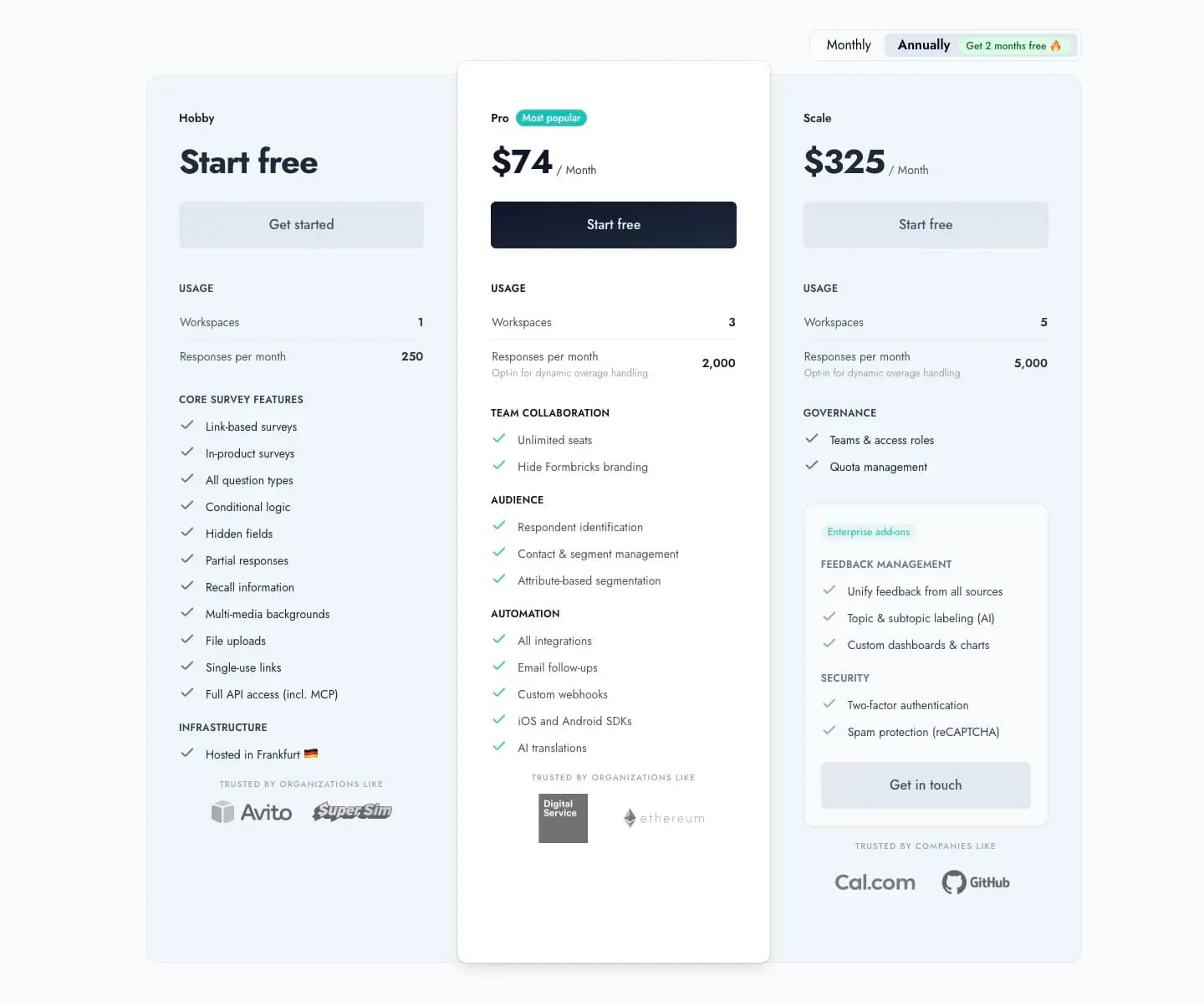
- Hobby (Free): 250 responses/month, 1 workspace, all question types, conditional logic, hidden fields, partial responses, full API access (incl. MCP), hosted in Frankfurt
- Pro: $74/month billed annually for 3 workspaces and 2,000 responses/month, unlimited seats, branding removal, respondent identification, attribute-based segmentation, all integrations, email follow-ups, custom webhooks, iOS/Android SDKs, and AI translations (monthly billing is also available on the pricing page's toggle)
- Scale: $325/month billed annually for 5 workspaces and 5,000 responses/month, teams and access roles, quota management, plus enterprise add-ons like unified feedback from all sources, AI topic/subtopic labeling, custom dashboards, two-factor authentication, and spam protection
- Enterprise: Custom pricing, contact sales
- Self-hosted Community Edition: Free and open-source (AGPLv3), a separate self-hosting pricing path exists alongside the Cloud plans above
Best for: Teams that want feedback collection, feedback analytics, and workflow automation as their primary product, not a secondary feature of a guidance platform, especially those with data residency requirements or a preference for open-source infrastructure.
2. Pendo: Best for Enterprise Analytics Depth With In-App Guidance
Pendo brings product analytics, in-app guidance, session replay, and sentiment surveys into one platform. Where Chameleon's analytics mostly track engagement with its own Experiences, Pendo automatically captures product usage from day one.

Key features:
- Automatic event capture with retroactive analytics, funnels, and retention reporting
- In-app guides, tooltips, onboarding flows, and resource centers
- Sentiment module for NPS, PMF, and CSAT surveys (included from the Ultimate tier)
- Session replay tied to analytics and feedback
- Native iOS and Android SDKs
- Agent Analytics and MCP for tracking AI feature adoption
Why Choose Pendo Over Chameleon for Analytics
Analytics Depth That Chameleon Doesn't Attempt. Pendo processes 20+ billion daily events across 1 billion+ monthly users, with retroactive funnels and retention analysis available the moment it's installed. Chameleon's analytics focus on engagement with its own guidance experiences, not full product usage, so teams needing deep behavioral analysis typically bolt on a separate analytics tool alongside Chameleon.
Native Mobile Coverage. Pendo ships SDKs for native iOS and Android, closing a gap Chameleon's web-focused platform leaves open for teams shipping mobile apps.
Pricing: Free for up to 500 monthly active users (MAU), with basic analytics, in-app guides, and NPS surveys. Paid tiers (Base, Core, Ultimate) are all custom-priced. According to Vendr, the median Pendo buyer pays about $49,000 per year.
Who Should Use Pendo:
- You need deep, automatic product analytics (funnels, retention, session replay) alongside in-app guidance
- Your product ships on native iOS and Android as well as web
- You're comfortable with an enterprise sales process and custom, usage-based pricing
3. Userpilot: Best All-in-One Chameleon Replacement With Built-In Analytics
Userpilot pairs in-app onboarding with product analytics, session replay, and AI in one platform. Where Chameleon centers on building experiences, Userpilot combines engagement with behavioral insight so teams don't need a separate analytics stack.

Key features:
- Automatic event capture for funnels, trends, paths, and cohort reports, no manual instrumentation required
- Session replay with rage-click and frustration-signal detection
- No-code flows, tooltips, banners, checklists, and a resource center
- NPS, CSAT, and in-app/mobile/email surveys with behavioral logic
- AI agent ("Lia") plus agentic analytics for querying product data in natural language
Why Choose Userpilot Over Chameleon for Bundled Analytics
Product Analytics Bundled In, Not a Separate Purchase. Userpilot automatically captures interactions for funnels, trends, and retention without manual event tagging. Chameleon's analytics stay scoped to its own experiences, so Userpilot removes the need to stitch in a dedicated analytics product.
Multi-Channel Workflows From One Platform. Userpilot workflows combine in-app messages with email based on user behavior, letting teams run onboarding and re-engagement campaigns without a separate lifecycle tool, something Chameleon's single-channel, in-app-only Experiences don't cover.
Pricing: Starter begins at $299/month billed annually for up to 2,000 monthly active users. Growth and Enterprise scale with custom pricing (G2's vendor-submitted table lists somewhat different figures for Growth, so confirm current pricing directly with Userpilot before budgeting).
Who Should Use Userpilot:
- You want onboarding, product analytics, and session replay bundled into a single subscription
- You're a product team that wants to avoid stitching together a separate analytics tool
- Your budget starts around $299/month rather than Chameleon's higher Pro and Growth tiers
4. Appcues: Best for Cross-Channel Orchestration
If your onboarding needs to reach beyond the browser, Appcues coordinates in-app messages, email, and push notifications across web and native mobile from a single platform, something Chameleon's web-focused Experiences don't cover.
Key features:
- Native support for web, iOS, Android, React Native, Flutter, and Ionic
- Workflows that combine in-app messages, behavioral email, and push notifications based on user actions or inactivity
- Appcues AI for generating copy, audience targeting, and optimization recommendations
- UI Embeds for adding onboarding content (banners, cards) directly into the product interface
Why Choose Appcues Over Chameleon for Multi-Platform Reach
True Native Mobile Support. Appcues ships native SDKs across iOS, Android, React Native, Flutter, and Ionic, closing the mobile gap in Chameleon's web-centric platform outright.
Coordinated Cross-Channel Campaigns. Appcues workflows tie in-app messaging to email and push in one place. Chameleon's Experiences are scoped to in-app only, so multi-channel campaigns require stitching in separate tools.
Pricing: Appcues no longer publishes fixed subscription rates. Plans are Start (up to 3,000 MAU), Grow (up to 50,000 MAU), and Enterprise, all quoted through sales. According to Vendr, mid-market Appcues contracts commonly fall between $30,000 and $50,000 per year.
Who Should Use Appcues:
- Your product spans web and native mobile and needs one platform for both
- You want in-app messaging, email, and push coordinated without separate lifecycle tools
- You're comfortable with usage-based, sales-quoted pricing
5. WalkMe: Best for Enterprise Adoption Across Many Business Applications
WalkMe is built to help employees adopt complex business software, not to onboard SaaS customers. Instead of guiding users through one product like Chameleon does, it delivers guidance and workflow automation across enterprise apps like SAP, Salesforce, Workday, Oracle, Microsoft, and ServiceNow.
Key features:
- Guidance spanning multiple enterprise systems rather than a single product
- Workflow automation that can complete fields, trigger clicks, and advance users through predefined processes
- Discovery and analytics revealing application usage and adoption trends across a company's software stack
Why Choose WalkMe Over Chameleon for Multi-Application Enterprise Rollouts
Guidance Across the Entire Enterprise Stack, Not One Product. Chameleon guides users through a single web application. WalkMe spans SAP, Salesforce, Workday, and other systems simultaneously, which matters for digital transformation programs rather than product-led SaaS onboarding.
Workflow Automation Beyond Passive Guidance. WalkMe can auto-fill fields and auto-advance users through steps, not just point at where to click, a level of automation Chameleon's guidance-only Experiences don't attempt.
Pricing: WalkMe doesn't publish fixed pricing, quotes are sized to applications, users, and deployment scope. Vendr reports a median annual contract near $39,000.
Who Should Use WalkMe:
- You need employee adoption across many internal, enterprise applications, not a single customer-facing SaaS product
- Your rollout has IT, business, and implementation stakeholders who can support a longer deployment
- You're running a broader digital transformation initiative, not lightweight product onboarding
6. Product Fruits: Best for Affordable, AI-Powered Onboarding
Product Fruits targets teams that want Chameleon-style onboarding without Chameleon-level pricing. It bundles product tours, an AI copilot (Elvin), a help center, and NPS surveys, and independently rates ahead of Chameleon on G2 across ease of setup, support quality, and doing business with.
Key features:
- AI copilot (Elvin) that builds tours, drafts announcements, and drafts surveys from a plain-language description
- Built-in help center and knowledge base alongside onboarding flows
- NPS and in-app surveys triggered at the point of interaction
- Audience segments, dynamic personalization, and custom event triggers
- G2 rating of 4.7/5 and Capterra rating of 4.8/5, both ahead of Chameleon's 4.4/5 on G2
Why Choose Product Fruits Over Chameleon for Price and Support
Lower Published Starting Price. Product Fruits' own comparison page lists its starting price at $187/month against Chameleon's $279/month, with a lower tier (Starter, around $111/month for 1,500 MAU) available below that. Chameleon's Startup plan begins higher and its Pro tier jumps to $750/month.
Built-In Self-Service Support at Lower Tiers. A help center and knowledge base ship alongside onboarding flows, so teams don't need a separate support tool bolted on the way Chameleon's platform assumes.
AI That Builds From Existing Docs. Elvin generates interactive tours directly from existing documentation, reducing the manual build time Chameleon's no-code editor still requires per experience.
Pricing: Starter at roughly $111/month, Pro at $187/month, and Business at $374/month, all MAU-based (figures shown for a 1,500 MAU baseline). Enterprise is custom.
Who Should Use Product Fruits:
- You want Chameleon-style tours and tooltips at a lower published starting price
- You want a help center and knowledge base bundled with onboarding instead of purchased separately
- You're a smaller team that wants unlimited seats without licensing costs scaling per internal user
7. Qualaroo: Best for In-App Microsurveys Specifically
If microsurveys are the actual reason you're evaluating Chameleon, Qualaroo is worth a direct look. Where Chameleon treats microsurveys as one Experience type bolted onto a tours-and-tooltips product, Qualaroo's entire product is contextual "Nudge" surveys.

Key features:
- Nudge™ technology for contextual, non-intrusive survey prompts in-app, on-site, and by email
- AI-powered sentiment analysis on open-ended responses
- Advanced targeting by page, scroll position, time on page, exit intent, and user properties
- Question branching with skip logic
- Templates for NPS, CSAT, CES, UX research, and SaaS feedback
Why Choose Qualaroo Over Chameleon for Survey Depth
Microsurveys Are the Core Product, Not a Secondary Feature. Chameleon's G2 reviewers note limited customization in its microsurveys, including the inability to tailor thank-you responses per rating. Qualaroo is built around contextual survey logic from the ground up, with skip logic, branching, and AI sentiment analysis on every response.
A Forever-Free Tier Where Chameleon Has None. Qualaroo's free plan includes 50 responses per month with all premium features enabled. Chameleon offers only a 14-day trial before its $279/month Startup plan kicks in.
Pricing: Free for up to 50 responses/month. Essentials at $19.99/month, Business at $49.99/month (marked "most popular," including Nudge surveys across in-app, website, and email plus heatmaps and session replay), and Enterprise starting at $149.99/month with SAML/SSO and advanced integrations (Segment, HubSpot, Salesforce, Tableau).
Who Should Use Qualaroo:
- Microsurveys and contextual feedback are your primary need, not tours or product tours
- You want a forever-free tier to start before committing budget
- You need advanced targeting (exit intent, scroll position, time on page) for survey triggers specifically
8. Hotjar: Best for Behavior Analytics Alongside Basic Feedback
Hotjar (now part of Contentsquare) combines heatmaps and session recordings with lightweight, on-site feedback widgets. Where Chameleon tells you what experiences you built and how users engaged with them, Hotjar shows you what users actually did on the page, including where Chameleon's own tooltips might be getting ignored or clicked past.

Key features:
- Heatmaps showing clicks, scrolls, and mouse movement
- Session recordings to watch real user behavior
- On-site feedback widgets and short surveys
- Funnels to identify where users drop off
- Rage-click and error detection for UX issues
Why Choose Hotjar Over Chameleon for Behavioral Context
A Free Tier With Real Functionality Included. Hotjar's free plan covers 200,000 monthly sessions with replays, heatmaps, funnels, and basic surveys. Chameleon has no permanent free plan at all.
Behavioral Data Chameleon Doesn't Offer. Heatmaps and session recordings show exactly where users hesitate or drop off, context that a guidance-and-microsurvey platform like Chameleon can't surface on its own.
Pricing: Free at 200k monthly sessions and 1 project. Growth from around $39/month for 7k+ monthly sessions and zone-based heatmaps. Pro and Enterprise are custom, starting from 1M+ monthly sessions.
Who Should Use Hotjar:
- You want behavior analytics (heatmaps, recordings) alongside lightweight feedback, not deep in-app guidance
- You're evaluating what to pair with Chameleon rather than fully replacing it
- A generous free tier matters more to you than advanced targeting logic
How to Choose the Right Chameleon Alternative
Picking the right replacement depends on what actually pushed you to look past Chameleon in the first place.
Start With Your Use Case
- Feedback and experience management as the primary product: Formbricks or Qualaroo
- Enterprise product analytics alongside guidance: Pendo or Userpilot
- Cross-channel web + native mobile onboarding: Appcues
- Enterprise adoption across many internal business apps: WalkMe
- Budget-friendly onboarding with built-in support: Product Fruits
- Behavior analytics to pair with (not replace) guidance: Hotjar
Then Evaluate These Criteria
| Criteria | Questions to Ask |
|---|---|
| Data ownership | Can you self-host? Where does feedback data live? |
| Survey depth | Does the tool treat surveys as a primary product or a secondary Experience type? |
| Channel coverage | Do you need web, native mobile, email, and link surveys, or just in-app? |
| Analytics depth | Do you need automatic event capture and session replay, or basic engagement tracking? |
| Integrations | Does it connect to your CRM, helpdesk, and Slack out of the box? |
| Pricing model | Per MAU/MTU, per response, per seat, or a flat rate? Is there a real free tier? |
The Data Sovereignty Factor
Every tool on this list except Formbricks is closed-source and cloud-only. That means your survey responses and user attribute data sit on someone else's servers with no option to change that.
Formbricks is the only open-source Chameleon alternative here. You can self-host the entire platform, audit the code, and keep feedback data on your own infrastructure. The Community Edition is free forever with no response limits.
Read more about GDPR-compliant survey tools if data residency is part of your evaluation.
For more comparison articles, see our Medallia alternatives, Survicate alternatives, and SurveySparrow alternatives guides. For building out in-app feedback specifically, check out in-app surveys for product feedback, granular targeting for in-app surveys, and microsurveys.
Frequently Asked Questions
Looking for the only open-source Chameleon alternative? Formbricks gives you website, in-app, link, and email surveys, feedback analytics, and workflow integrations, plus full data ownership through self-hosting. Start free or join the Community Edition, no response limits, no vendor lock-in.
Try Formbricks now