

Verint Pricing in 2026: Why Nothing Is Published, and What Buyers Actually Pay

Johannes
Co-Founder @ Formbricks
13 Minutes
August 16th, 2026
Search for "Verint pricing" and you will not find a single number on Verint's own site. Not for the CX Automation Platform, not for Voice of the Customer, not even for Verint Community, a comparatively narrow forums and community product with its own dedicated licensing page. Every path ends at "Contact us for pricing" or "Get a Demo." We pulled together the only real numbers that exist anywhere, third-party benchmark data, a single reseller SKU, and Verint's own product pages, to build the clearest picture available of what this platform actually costs, and how it compares to Formbricks, an open feedback and experience management suite built around feedback management, feedback analytics, and workflows, not just survey collection.
I believe Verint is the right call if:
- You're an enterprise contact center that wants AI-driven automation (bots, workforce engagement, speech analytics) alongside Voice of the Customer survey capture in one platform
- You're comfortable with a quote-based, sales-led enterprise procurement process with no self-serve number to anchor a budget conversation
- You need FedRAMP Moderate-authorized hosting for public-sector, citizen-experience use cases
It's a weaker fit if:
- You only need lightweight survey or in-product feedback tooling without a contact-center automation layer
- You want to run and review the software yourself before a sales conversation
- You need to avoid the integration friction that multiple reviewers cite when connecting Verint into existing systems
Because of that, I've included a full comparison with Formbricks later in this breakdown. Formbricks also quotes after a call, but its price model is simple and you can evaluate the open source code first, which makes it a useful contrast to Verint's fully quote-gated model.
Table of contents:
- Verint Pricing at a Glance
- The Only Real Numbers Anyone Can Find
- CX Automation Platform: Six Bots, Zero Public Prices
- Voice of the Customer: A Small Module in a Much Larger Suite
- Verint Community: A Separate Product, Still No Public Price
- The Verint Ownership Reality Check
- Where Verint Pricing Falls Short
- Formbricks: An Open Feedback and Experience Management Suite
- What Reviewers Say About the Real Cost
- The Real Math: What Buyers Actually Pay Per Year
- Verint vs Formbricks: Side-by-Side Pricing
- Feature Value Breakdown
- Who Should Actually Pay for Verint
- Verint Pricing FAQ
- Final Verdict
Verint Pricing at a Glance
| Product | Price | Priced on |
|---|---|---|
| CX Automation Platform (bots, copilots, workforce engagement) | Request Pricing | Not disclosed |
| Voice of the Customer (Web & Mobile, Survey Management, Enterprise CX) | Request Pricing | Not disclosed |
| Verint Community, public/external | Request Pricing | Monthly page views + API calls (SaaS), or server/domain (on-prem) |
| Verint Community, private/employee | Request Pricing | Named users, 300-user minimum block |
| Verint Quality Management (single reseller SKU, CDW) | $293.99 per term license | Per license |
| Median annual spend, all Verint products (Vendr, third-party) | $49,451/year | Reported by actual buyers, range $18,858 to $231,780/year |
Source: verint.com/customer-self-service/verint-community/licensing-and-pricing, verint.com, cdw.com, and vendr.com/marketplace/verint, all captured August 15, 2026.
The Only Real Numbers Anyone Can Find
Verint's own site publishes exactly zero prices for its core platform. Every product page, every FAQ, every CTA leads to a demo request or a "Contact Sales" form. That leaves two sources for anything resembling a real figure, and neither comes from Verint directly.
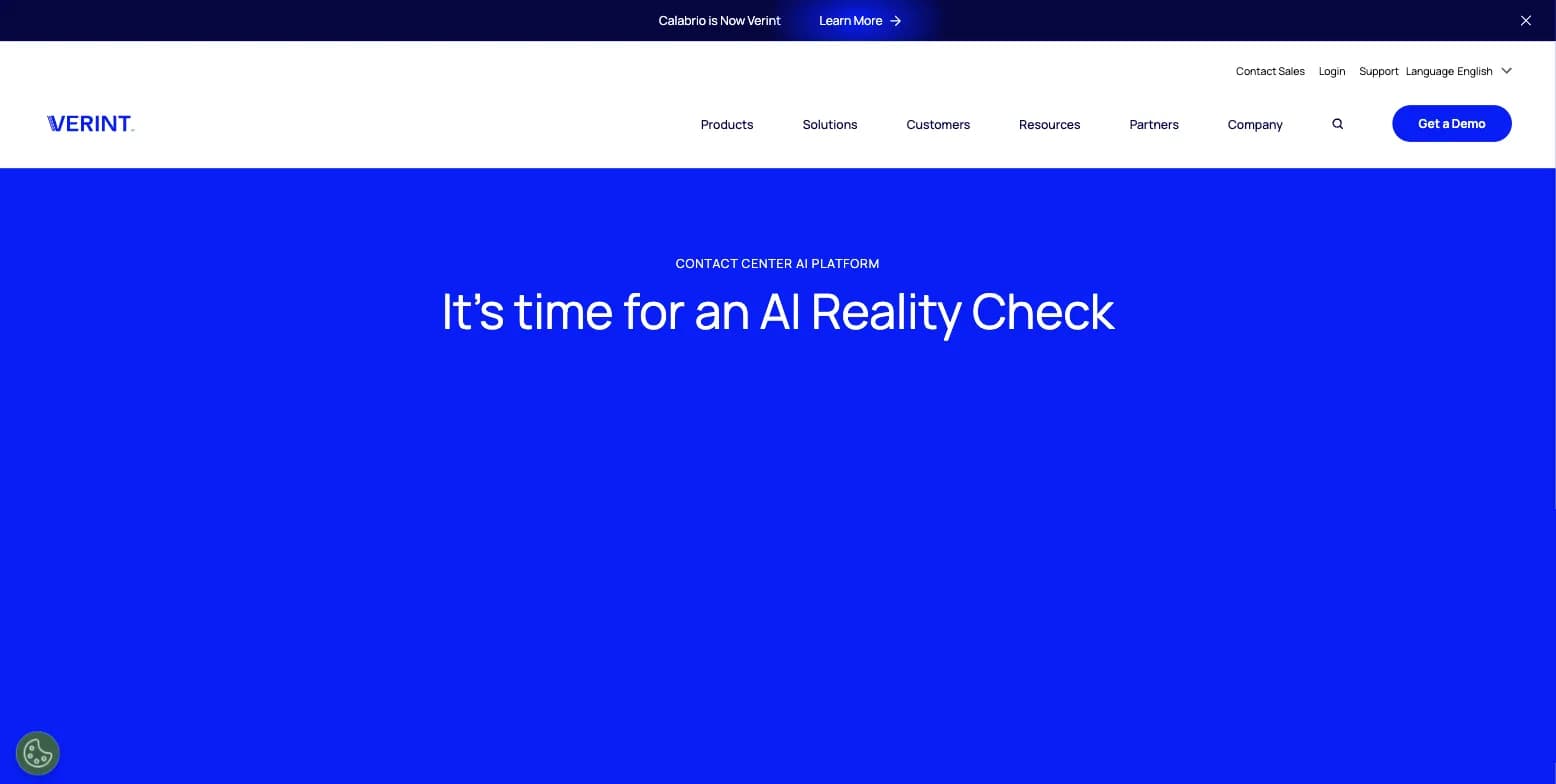
Captured August 15, 2026 from verint.com. Verint has no dedicated pricing page for its core CX Automation Platform, so its homepage, which routes every visitor to "Get a Demo" or "Contact Sales," is the closest thing to one.
Vendr, a third-party SaaS procurement platform, reports a median buyer paying $49,451 per year for Verint, with a range from $18,858 to $231,780 per year based on actual customer contracts. Vendr's community notes cite buyers negotiating discounts as steep as 26% with a multi-year term, and price-increase caps as low as 3% instead of the standard uplift.
CDW, a reseller, lists a single narrow SKU, a term license for Verint Quality Management, at $293.99 per license. This is one component sold through a hardware and software reseller, not a price for the CX Automation Platform or Voice of the Customer line, but it's a real, dated, publicly listed number in a sea of "Contact Sales."
| Source | What it prices | Figure |
|---|---|---|
| Vendr (third-party benchmark) | Verint overall, median across tracked buyers | $49,451/year |
| Vendr (third-party benchmark) | Verint overall, low to high range | $18,858 to $231,780/year |
| CDW (reseller) | Verint Quality Management, 1 term license | $293.99 |
The Bottom Line: If you need a number to bring to a budget conversation before you've talked to Verint's sales team, this is the entire universe of what's publicly available, and none of it comes from Verint itself.
Source: vendr.com/marketplace/verint and cdw.com, captured August 15, 2026.
CX Automation Platform: Six Bots, Zero Public Prices
Verint's homepage centers on its CX Automation Platform, built around six named products, all priced by quote:
| Product | What it does |
|---|---|
| Coaching Bot | Automated agent coaching based on interaction data |
| Interaction Wrap-Up Bot | Automates post-call summaries and wrap-up work |
| Knowledge Automation Bot | Consistent, accurate source of truth for humans and bots |
| Intelligent Virtual Assistant (IVA) | Conversational and agentic AI across CX use cases and channels |
| TimeFlex Bot | Workforce engagement and scheduling automation |
| Genie Bot | GenAI-powered insights generation |
The platform bundles these bots with Workforce Engagement Management, Quality Automation ("automatically evaluate up to 100% of interactions"), and CX Analytics ("turn CX data into insights in minutes"). Verint's own homepage cites customer results like Fiserv moving from evaluating 1% of calls to 96% coverage using Quality Bot, and Pilot Flying J cutting average handle time by 10 minutes using Verint Enterprise Recording, Speech Analytics, and Quality Bot.
None of these six products, or the platform bundling them, has a public price anywhere on verint.com. Every "Explore" link on the homepage leads to a feature description, and every conversion path ends at "Get a Demo."
The Bottom Line: This is Verint's flagship product, the one its homepage is built around, and it has the least pricing transparency of anything in this breakdown. There's no rate card, no calculator, and no self-serve tier at any price point.
Source: verint.com, captured August 15, 2026.
Voice of the Customer: A Small Module in a Much Larger Suite
Verint's Voice of the Customer line, the closest thing to a direct Formbricks competitor, covers three areas:
- Web & Mobile: In-the-moment digital feedback and digital behavior analytics
- Survey Management: Unifies survey data across CX and EX touchpoints
- Enterprise CX: A unified data hub across consumer and contact-center data
Underneath these, Verint runs Speech Analytics, Text Analytics, and Digital Behavior Analytics as the shared analytical layer. A separate FedRAMP Moderate-authorized deployment, delivered via partner TTEC, is available for federal and citizen-experience use cases.
The scale of this product line, relative to the rest of Verint's portfolio, is worth naming directly. Verint's own G2 seller page shows the "Verint Voice of the Customer" listing at 45 reviews and "Verint CX Automation" at 48, while Workforce Management-related listings carry 692 and 324 reviews respectively. If you're evaluating Verint specifically for survey and feedback capture, you're evaluating the smallest module in a contact-center-first company.
The Bottom Line: A team that only needs feedback and survey tooling inherits the sales process, contract structure, and complexity of a much larger workforce-engagement and contact-center automation suite it may never touch.
Source: verint.com/voice-of-the-customer and g2.com/sellers/verint, captured August 15, 2026.
Verint Community: A Separate Product, Still No Public Price
Confusingly, the top-ranking Google result for "Verint pricing" is a licensing page for Verint Community, a forums, blogs, and knowledge-base product that is not the same thing as Voice of the Customer or CX Automation. It still has no public number, but it's the one place Verint documents its pricing metrics in detail:
| Deployment | Licensed by | Minimum |
|---|---|---|
| Public/external communities, SaaS Verint Cloud | Monthly page views + API calls | 1 production domain, 1 production environment |
| Public/external communities, On-Premises or Any Cloud | Server + domain | 1 production server, 1 production domain |
| Private/employee communities | Named users | 300-user minimum block purchase |
Verint's own pricing page notes that "customers anticipating greater than 250,000 page views/month" should plan for a minimum of two production servers, and every tier, from a single-domain public community to a 300-seat internal one, routes to the same "Contact us for pricing" link.
The Bottom Line: Even Verint's most granularly-documented pricing page, the one that actually explains its metrics, still withholds the number those metrics get multiplied by.
Source: verint.com/customer-self-service/verint-community/licensing-and-pricing, captured August 15, 2026.
The Verint Ownership Reality Check
No competitor content covers this, and it matters more for pricing stability than almost anything else in this article. On August 25, 2025, Verint agreed to be acquired by Thoma Bravo in an all-cash deal reflecting an enterprise value of $2 billion, with shareholders receiving $20.50 per share, an 18% premium to the unaffected share price. The acquisition closed on November 26, 2025, and Verint stock was delisted from Nasdaq.
Two weeks later, on December 9, 2025, Thoma Bravo announced it had combined Verint with its existing portfolio company Calabrio, a workforce-optimization vendor, to "create the industry's most comprehensive AI-powered CX platform." Verint CEO Dan Bodner moved to an advisory role, and Mike Lipps, a Thoma Bravo Operating Partner, became Chairman and interim CEO of the combined company. This is why Verint's own homepage currently carries a banner reading "Calabrio is Now Verint."
- Verint is no longer a publicly traded, independently governed company as of November 26, 2025
- It is now part of a private-equity-owned combination with Calabrio, under new executive leadership
- Post-acquisition integrations of this kind (see also Qualtrics' three ownership changes in five years, or SurveySparrow's private-equity-driven consolidation risk) have historically preceded pricing and packaging changes across the survey and CX software category
The Bottom Line: Anyone evaluating Verint on price stability should factor in that the company changed hands entirely within the last year, merged with a formerly separate competitor, and replaced its CEO, all while publishing no rate card for buyers to reference either before or after the deal.
Source: verint.com press release, August 25, 2025 and thomabravo.com press release, December 9, 2025.
Where Verint Pricing Falls Short
Total Pricing Opacity
- No public pricing exists anywhere for the core Voice of the Customer or CX Automation platform
- A separate, narrower Verint Community product has its own licensing page, but still withholds the actual number
- Budget-stage evaluators cannot get even a ballpark figure without a sales conversation, for any product line
A Small Feedback Module Inside a Much Larger Suite
- Verint's own G2 review-count breakdown shows Workforce Management-related listings (692 and 324 reviews) dwarfing the dedicated Voice of the Customer listing (45 reviews)
- The product's center of gravity is contact-center AI and workforce automation, not survey-first experience management
Reviewer-Cited Integration Friction
- Multiple TrustRadius reviewers describe challenges integrating Verint CX Automation with other existing systems
- Reviewers also cite limited reporting and data-filtering capabilities, often requiring manual data export
- Restrictions in customization for charts, branding, and org-specific outputs are noted repeatedly
A Company That Changed Hands Entirely in the Last Year
- Taken private by Thoma Bravo for $2 billion, closed November 26, 2025
- Immediately combined with Calabrio, a separate workforce-optimization vendor, under new leadership
- No public pricing existed before the deal, and none exists after it either
Formbricks: An Open Feedback and Experience Management Suite
Formbricks isn't just a survey tool. It's an open source feedback and experience management suite built around three things: feedback management, feedback analytics, and workflows and integrations, all in the same code you can run and review before you talk to anyone.
Feedback Management. Formbricks unifies every collection channel Verint splits across separate product lines and a separate acquisition-in-progress: website surveys that target specific visitors, in-app surveys that research any user cohort inside your product, link surveys, and branded surveys embedded directly in email, all under one platform and one license.
Feedback Analytics. Response data flows into one place regardless of channel. Follow individual feedback trails or zoom out for the aggregate picture, track partial and dropped-off responses, and segment by custom attributes. This covers the same territory as Verint's Voice of the Customer line, minus the 45-review afterthought status inside a 1,000-plus-review workforce suite.
Workflows and Integrations. Formbricks Workflows automate what happens after a response comes in. On the integration side, Formbricks connects to Salesforce, HubSpot, Slack, Google Sheets, and Notion through webhooks and its open API, which ships in the open source Community Edition too.
How Experience Suite Pricing Works
Here's the honest part first: Formbricks doesn't publish a price list for the Experience Suite either. The right setup depends on your volume, workspaces and deployment, so we quote after a first call. What's different from Verint is what the quote rests on, and what you can do before you ask for one.
| Experience Suite | |
|---|---|
| License | Annual, priced by the responses you collect and the workspaces you run |
| Seats | Unlimited on every plan |
| Term | One, two or three years; longer terms cost less per year |
| Support | Human support with an SLA and a deployment success plan on every license; the Premium plan adds help with resource planning, setup, hosting and AI |
| Deployment | Self-hosted today; dedicated cloud and Managed by Formbricks (EU or Saudi Arabia) coming |
| Overage | Self-hosted, the software keeps running if you go over your licensed volume; we settle it at renewal |
| Procurement | Private offers on AWS Marketplace, so you can use committed cloud spend |
The Bottom Line: It's still a quote. But it's a quote on three things, responses, workspaces and term, and seats are never part of the bill.
Formbricks Self-Hosting: Community Edition
The open source, self-hosted Community Edition, licensed under AGPLv3, is where Formbricks diverges most sharply from Verint's model:
- Evaluate before you talk to anyone. The Community Edition runs on your own servers with community support.
- Trial in your own instance. A trial license key switches on Experience Suite features for 15 days.
- Nothing to migrate. The license key unlocks features in the same code as the open source edition.
- No new processor. Self-hosted, Formbricks adds no new processor to your compliance chain.
For a buyer who just read about Verint changing owners twice within a year while still publishing no rate card, this is the part that matters: you can see the whole product running in your own environment before the first sales conversation.
What Reviewers Say About the Real Cost
Verint holds a 4.4 rating across 1,092 reviews on G2's seller page (an aggregate across 19 product listings), and 8.1 out of 10 across 52 reviews on the dedicated Verint CX Automation TrustRadius listing.
| Verint Reviews | |
|---|---|
| Pros | Cons |
| ✅ Streamlined operations through strong automation and bot functionality | ❌ Limited reporting and data-filtering, often requiring manual export |
| ✅ Delivers valuable insights and high-level trend analysis | ❌ Challenges integrating across multiple existing systems |
| ✅ Ease of system setup and deployment, per multiple reviewers | ❌ Restrictions in customization for charts, branding, and outputs |
| ✅ Improved CSAT and agent efficiency, with cost savings for Fortune 500 customers | ❌ Desire for a more modern, intuitive UI; bot accuracy limits on nuanced queries |
Third-party benchmarking from Vendr shows a median annual Verint spend of $49,451/year, ranging from $18,858 to $231,780/year. This is buyer-reported data aggregated by a procurement platform, not a Verint-published figure, so treat it as directional rather than a quote you can hold Verint to.
The Real Math: What Buyers Actually Pay Per Year
Verint doesn't price by response volume the way Formbricks does, so a strict cost-per-response comparison isn't possible. What we can show is the actual annual spend buyers report for Verint, next to what the Formbricks Experience Suite is priced on.
| Plan | Annual cost | What it's priced on |
|---|---|---|
| Verint (Vendr median, all products) | $49,451/year | Not disclosed by Verint; buyer-reported average |
| Verint (Vendr low end) | $18,858/year | Not disclosed by Verint; buyer-reported low |
| Verint (Vendr high end) | $231,780/year | Not disclosed by Verint; buyer-reported high |
| Formbricks Experience Suite | Quoted after a first call | Responses collected, workspaces run, and license term; unlimited seats |
This isn't a like-for-like comparison. Verint's median buyer figure covers a company that likely uses far more than just the Voice of the Customer module, potentially the full CX Automation Platform, Workforce Engagement, and Quality Automation together. Neither company publishes a number here. The difference is that with Formbricks you know which three inputs drive the quote before you ask for it, and headcount isn't one of them.
Verint vs Formbricks: Side-by-Side Pricing
| Verint | Formbricks | |
|---|---|---|
| Try before a sales call | None found | Open source Community Edition on your own servers, plus a 15-day trial license key for Experience Suite features |
| Price list | Request Pricing, every product line | Not published; quoted after a first call |
| Priced on | Not disclosed | Responses, workspaces, and a one, two or three year term |
| Seats | Not disclosed | Unlimited on every plan |
| Public benchmark data | Vendr third-party median: $49,451/year | None published |
| Feedback channels | Voice of the Customer is one module inside a much larger contact-center suite | Website, in-app, link, and email surveys unified in one platform |
| Post-response automation | Case management and workflow automation exist inside the CX Automation bots | Formbricks Workflows on the same platform, no separate product to buy |
| Integrations | Available, reviewers cite friction connecting to existing systems | Salesforce, HubSpot, Slack, Google Sheets, Notion via webhooks and open API |
| Self-hosting | On-Premises available for Verint Community; not documented for core CX Automation/VoC platform | Self-hosted today, open source Community Edition and Experience Suite in the same code |
| Ownership stability | Acquired by Thoma Bravo (Nov 2025), merged with Calabrio (Dec 2025), new CEO | Independent, no ownership change to price around |
Feature Value Breakdown
Pricing Model
Verint's Approach: No product line, from the flagship CX Automation Platform to the narrower Verint Community, publishes a price. Every path leads to a demo request or contact-sales form.
Formbricks' Approach: Formbricks also quotes the Experience Suite after a call. But the price model is simple: an annual license priced by responses and workspaces, with a one, two or three year term. Seats are never charged, and you can run the full open source code before the call.
Value Verdict: Neither publishes a price, so this isn't a transparency win. Formbricks wins on predictability: you know what drives the quote, and you can evaluate the product before you ask for one.
Contact-Center and Speech Analytics Depth
Verint's Approach: Verint offers deep speech analytics, workforce management, and contact-center AI automation across six named bots, backed by real customer outcomes like Fiserv's jump to 96% call-quality coverage.
Formbricks' Approach: Formbricks does not attempt to compete on contact-center workforce management or speech analytics.
Value Verdict: Verint wins here, clearly. If your evaluation genuinely needs contact-center automation alongside feedback capture, that's real depth Formbricks doesn't offer.
Focus and Simplicity for Pure Survey Use Cases
Verint's Approach: A team that only needs survey and feedback capture inherits the complexity, sales process, and contract structure of a much larger contact-center suite, where Voice of the Customer carries 45 G2 reviews against 1,000-plus for Workforce Management listings.
Formbricks' Approach: Formbricks is purpose-built for feedback management, feedback analytics, and workflows, without a workforce-engagement or contact-center layer to navigate around.
Value Verdict: Formbricks wins for any buyer whose actual need is feedback and survey infrastructure, not contact-center automation.
Data Residency and Self-Hosting
Verint's Approach: On-premises and "Any Cloud" deployment is documented for Verint Community. Self-hosting isn't documented anywhere for the core CX Automation Platform or Voice of the Customer line.
Formbricks' Approach: Formbricks is self-hosted today. The open source Community Edition (AGPLv3) and the Experience Suite run in the same code on your own infrastructure, and self-hosted, Formbricks adds no new processor to your compliance chain.
Value Verdict: Formbricks wins for any buyer where self-hosting the core feedback platform, not just a peripheral community product, is a requirement.
Workflows and Integrations
Verint's Approach: Case management and workflow automation exist inside the CX Automation bots, but reviewers on TrustRadius repeatedly cite integration friction with other existing systems.
Formbricks' Approach: Formbricks Workflows automate post-response actions on the same platform as collection and analytics, with native integrations to Salesforce, HubSpot, Slack, Google Sheets, and Notion through its open API.
Value Verdict: Formbricks wins on accessibility and reported ease of integration, though Verint's automation runs deeper for contact-center-specific workflows.
Who Should Actually Pay for Verint
Verint makes sense if you're an enterprise contact center that wants AI-driven bots, workforce engagement, and speech analytics alongside Voice of the Customer survey capture in one platform, you're comfortable with a fully quote-based enterprise procurement process, and public-sector FedRAMP-authorized hosting is relevant to your use case.
It's a weaker fit if you only need lightweight survey or in-product feedback tooling without a contact-center layer, you want to evaluate the software yourself before a sales call, or you want to avoid the integration friction that multiple reviewers cite, or the procurement uncertainty of a company that changed ownership twice in the last year.
Verint Pricing FAQ
What happened to Verint Systems?
Is Verint up for sale?
What is Verint used for?
Is Verint Systems a good buy?
How much does Verint cost per month?
Does Verint have a free plan or free trial?
Why doesn't Verint publish pricing?
How is Verint Community priced?
Is there an alternative to Verint with a simpler price model?
Does Verint offer self-hosting or on-premise deployment?
Is Formbricks just a survey tool, or does it do more than data collection?
What are the main disadvantages of Verint's pricing model?
Final Verdict
👍 Verint is the right call if your organization runs a large contact center that needs AI-driven bots, workforce engagement, and speech analytics alongside Voice of the Customer survey capture, and you have both the budget and the patience for a fully quote-based enterprise sales process across whichever product line fits your need. Reviewers rate the platform well for automation depth and measurable cost savings, and its FedRAMP-authorized hosting option is a real differentiator for the public-sector buyers who need it.
👉 Formbricks is the better fit if you want a bill that follows responses, not seats, you want to run the software yourself before talking to sales, and you'd rather run feedback management, feedback analytics, and workflows on one unified, purpose-built platform instead of a 45-review module inside a much larger contact-center suite that just changed owners twice in a year. The Experience Suite is also quoted after a call, but on three inputs you know up front, and the AGPLv3-licensed Community Edition gives you a self-hosted path Verint doesn't document for its core platform.
The honest read: these solve different problems. If you'd rather know what drives your price before the first call, here's how Experience Suite pricing works.