

Typeform vs Jotform (vs Formbricks): Which Form Builder Should You Actually Choose in 2026?

Johannes
Co-Founder @ Formbricks
14 Minutes
August 16th, 2026
Whether you searched "Typeform vs Jotform" or "Jotform vs Typeform," you're weighing the same two philosophies: a sleek, one-question-at-a-time conversational form versus a feature-dense, do-anything form builder. Neither is built around a recurring feedback program with segmentation and automated follow-up, they're both, at their core, form builders for a single submission at a time.
I believe Typeform is the right call if:
- Visual design and respondent experience matter more than raw feature count
- Your forms are lead-generation or marketing-facing, where a polished, conversational flow drives completion
- You don't need a payment-heavy or workflow-heavy form (no PDF generation, no e-signatures, no offline mode)
- You're comfortable with a lower response cap at the entry tier in exchange for design polish
I believe Jotform is the right call if:
- You need one platform for forms, payments, PDFs, e-signatures, and approval workflows
- Your free plan needs to be usable: 100 submissions/month beats Typeform's 10
- You want a bigger template library (20,000+ vs Typeform's 3,000+) and more native integrations
- You don't mind a slightly more cluttered editor in exchange for far more built-in functionality
Both platforms are cloud-only, single-submission form tools. Neither is built around an ongoing feedback program: ongoing NPS tracking, segmentation, drop-off analytics, or automated post-response workflows the way a dedicated feedback and experience management platform is. If that's closer to what you actually need, there's a third option worth knowing before you pick between these two.
👉 Formbricks is an open feedback and experience management suite built around three things: feedback management (website, in-app, link, and email surveys, unified), feedback analytics (aggregate and per-response views, segmentation, drop-off tracking), and workflows and integrations (post-response automation plus native connections to Salesforce, HubSpot, Slack, Google Sheets, and Notion). Every tier, including the free Hobby plan, publishes a real price and ships a full API. A free, self-hosted Community Edition exists for teams that need data to never leave their own infrastructure, something neither Typeform nor Jotform offers at any price.
Table of contents:
- Typeform vs Jotform vs Formbricks at a glance
- What buyers actually mean by "Typeform vs Jotform"
- Typeform: conversational design, at a design-forward price
- Jotform: the kitchen-sink form builder
- Formbricks: an open feedback and experience management suite
- Side-by-side pricing
- What reviewers say
- Feature value breakdown
- Who should choose which platform
- Typeform vs Jotform FAQ
- Final verdict
Typeform vs Jotform vs Formbricks at a Glance
| Typeform | Jotform | Formbricks | |
|---|---|---|---|
| Core strength | Conversational, one-question-at-a-time design | Feature-dense: payments, PDFs, e-signatures, workflows | Unified feedback management, analytics, workflows |
| Free plan | Unlimited typeforms, 10 responses/month | 5 forms, 100 submissions/month, 100 MB storage | 250 responses/month, full API incl. MCP |
| Cheapest published paid tier | Basic $39/month (100 responses/month) | Bronze $34/month (1,000 submissions/month) | Pro $74/month (annual) or $89/month |
| Templates | 3,000+ | 20,000+ | Ready-made survey templates (NPS, CSAT, CES) |
| Native integrations | 300+ | 150+ | Native integrations plus free API/webhooks on every tier |
| Payments, PDFs, e-signatures | Not built in | Native on paid tiers | Not the product's focus |
| Data residency / self-hosting | Not offered | Not offered | Free, self-hosted Community Edition |
| Best for | Marketing forms, lead-gen, design-forward brands | Operational forms: payments, approvals, PDF workflows | Ongoing feedback programs, developers, regulated industries |
What Buyers Actually Mean by "Typeform vs Jotform"
Most of what ranks for this comparison (and its reverse, "Jotform vs Typeform") comes from three kinds of sources: independent form-tool blogs (Softr, Zapier, Fomr), Jotform's own vendor-authored comparison page, and Reddit threads where users compare the two after hitting a wall with one.
Softr's own testing frames it simply: "Jotform prioritizes functionality... Typeform prioritizes experience and aesthetics." Zapier's independent breakdown reaches a similar split. Jotform's own comparison page, unsurprisingly, argues Jotform wins on templates (20,000+ vs 800+), payment integrations (40+ vs 1), and free-plan submissions (100 vs 10), while conceding Typeform matches it on API, webhooks, and mobile responsiveness.
Source: Softr's Jotform vs Typeform guide, Zapier's comparison, and Jotform's own comparison page, all captured August 2026.
The honest read: this is a "design vs. depth" question, the same trade-off that shows up in most form-builder comparisons. Typeform wins on respondent experience and completion rates for short, marketing-facing forms. Jotform wins on functionality: more templates, more integrations, more payment processors, and a more usable free plan.
Typeform: Conversational Design, at a Design-Forward Price
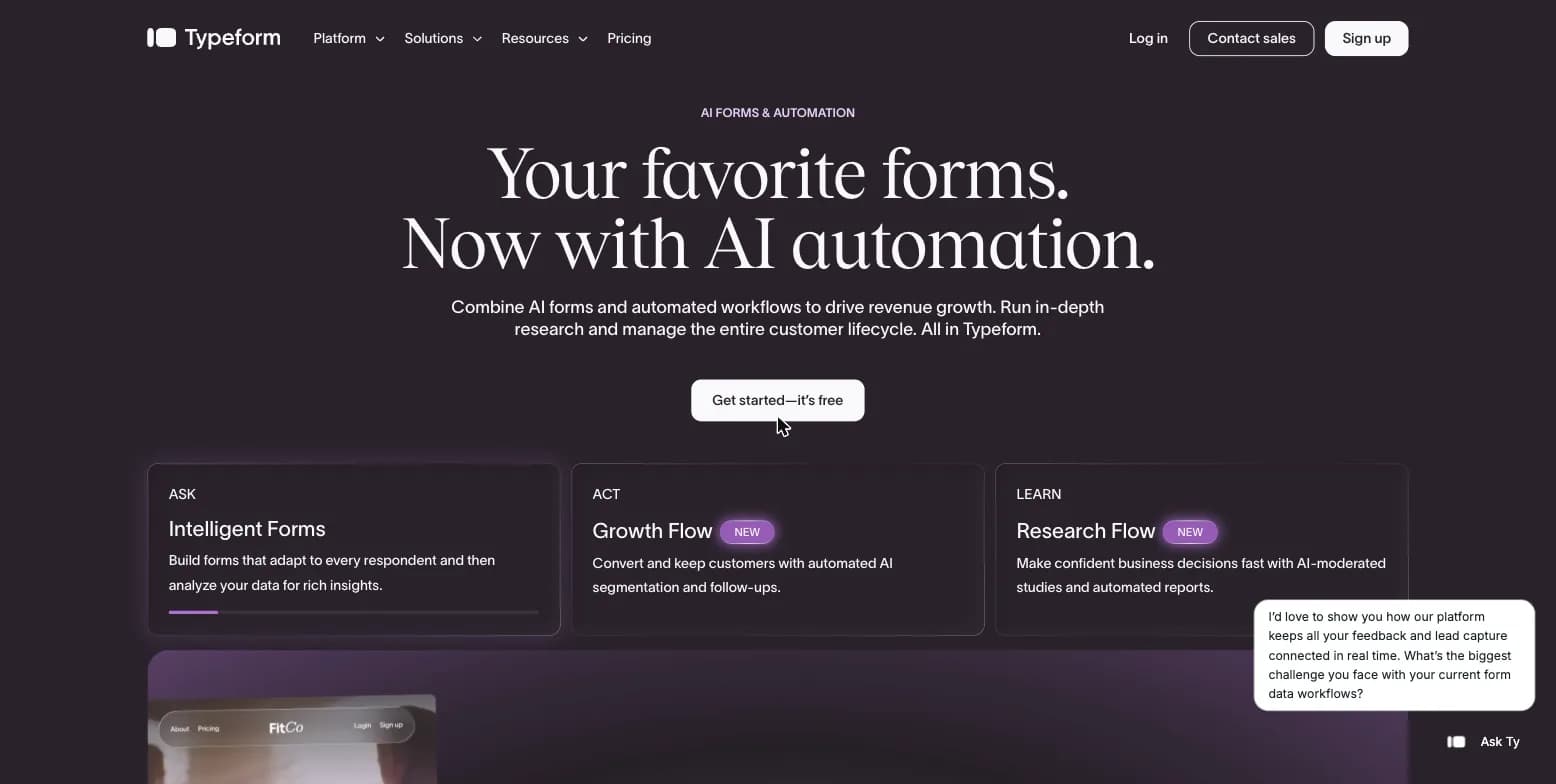
Captured August 15, 2026 from typeform.com.
Co-founders David Okuniev and Robert Muñoz ran separate design agencies in Barcelona before a lead-generation form project for a toilet company (Roca) became the prototype for Typeform in 2012. The company now positions itself around "AI forms and automated workflows," claiming 150,000+ businesses use it and 48M+ responses collected monthly across the platform.
Conversational, One-Question-at-a-Time Format
Typeform's core differentiator is presenting one question at a time in a chat-like flow rather than a dense grid. Jotform's own comparison page concedes this format, offered via Jotform Cards, but notes it's Typeform's default and only format, while Jotform lets you choose between conversational Card forms and traditional Classic forms on the same account.
Pricing
| Plan | Price (annual billing) | Response Limit | Key Features |
|---|---|---|---|
| Free | $0 | 10 responses/month | Unlimited typeforms, 3,000+ templates |
| Basic | $39/month ($468/year) | 100 responses/month | Unlimited typeforms, AI form creation, conditional logic, webhooks |
| Plus | $79/month ($948/year) | 1,000 responses/month | Everything in Basic, remove branding, custom subdomain |
| Business | $129/month ($1,548/year) | 10,000 responses/month | Drop-off rate analytics, conversion tracking, priority support |
| Enterprise | Custom | Custom | VIP account management, enterprise-grade security |
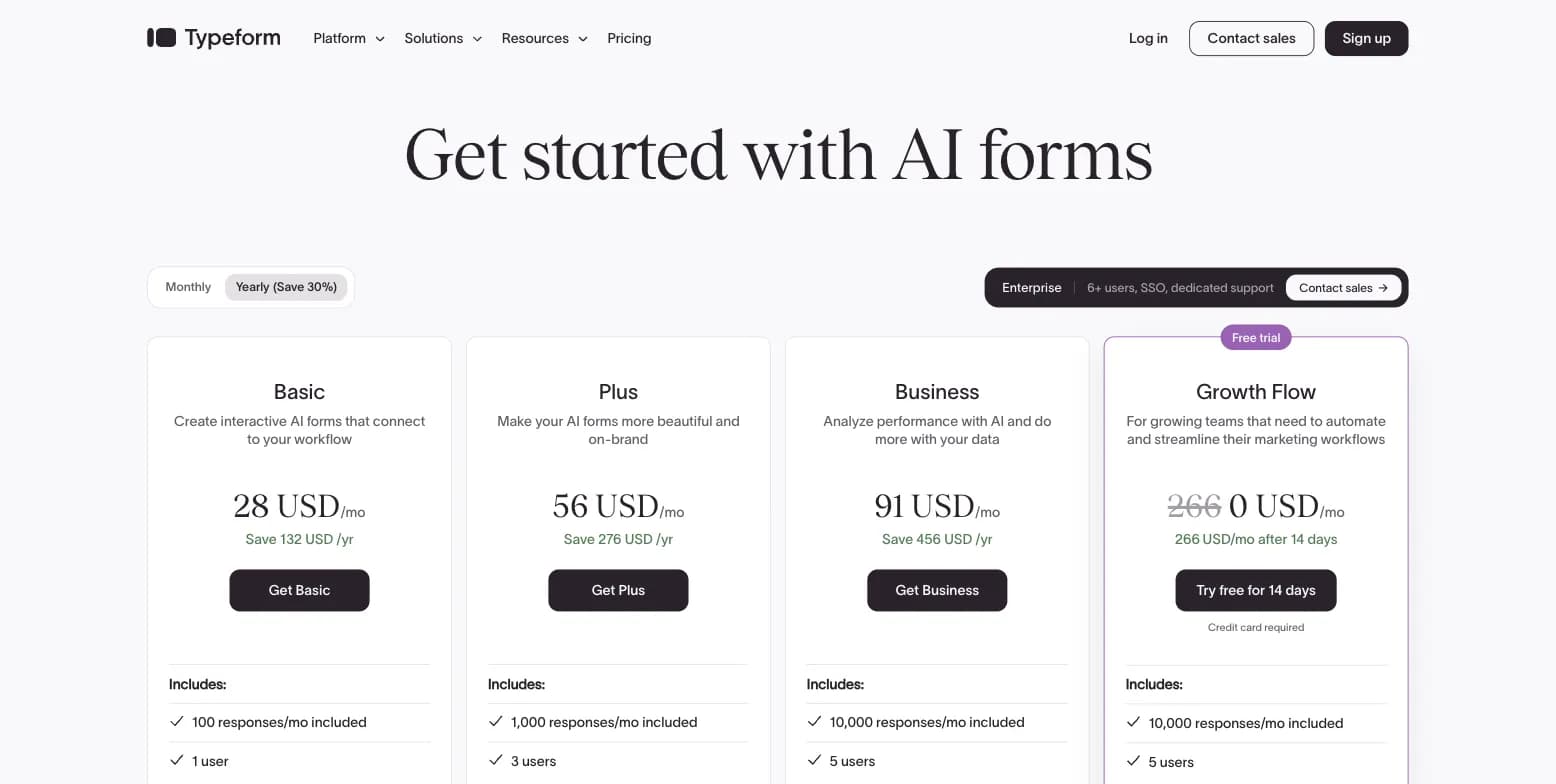
Captured August 15, 2026 from typeform.com/pricing.
Typeform's pricing page also lists a separate "Talent" plan ($169/month) for recruiting forms and a "Growth Flow" add-on ($379/month) for AI-driven lead enrichment, both distinct products layered onto the same pricing page rather than a 5th tier of the core form-builder ladder.
Where Typeform Falls Short
- Free plan caps at just 10 responses/month, the most restrictive free tier of the two
- Not well suited to long or complex surveys, per third-party review aggregation
- No native payment processing beyond a single processor, no PDF generation, no e-signatures
- Not an XM/experience-management platform: optimized for lead-gen and conversational data capture, not structured, recurring CX program management
Jotform: The Kitchen-Sink Form Builder
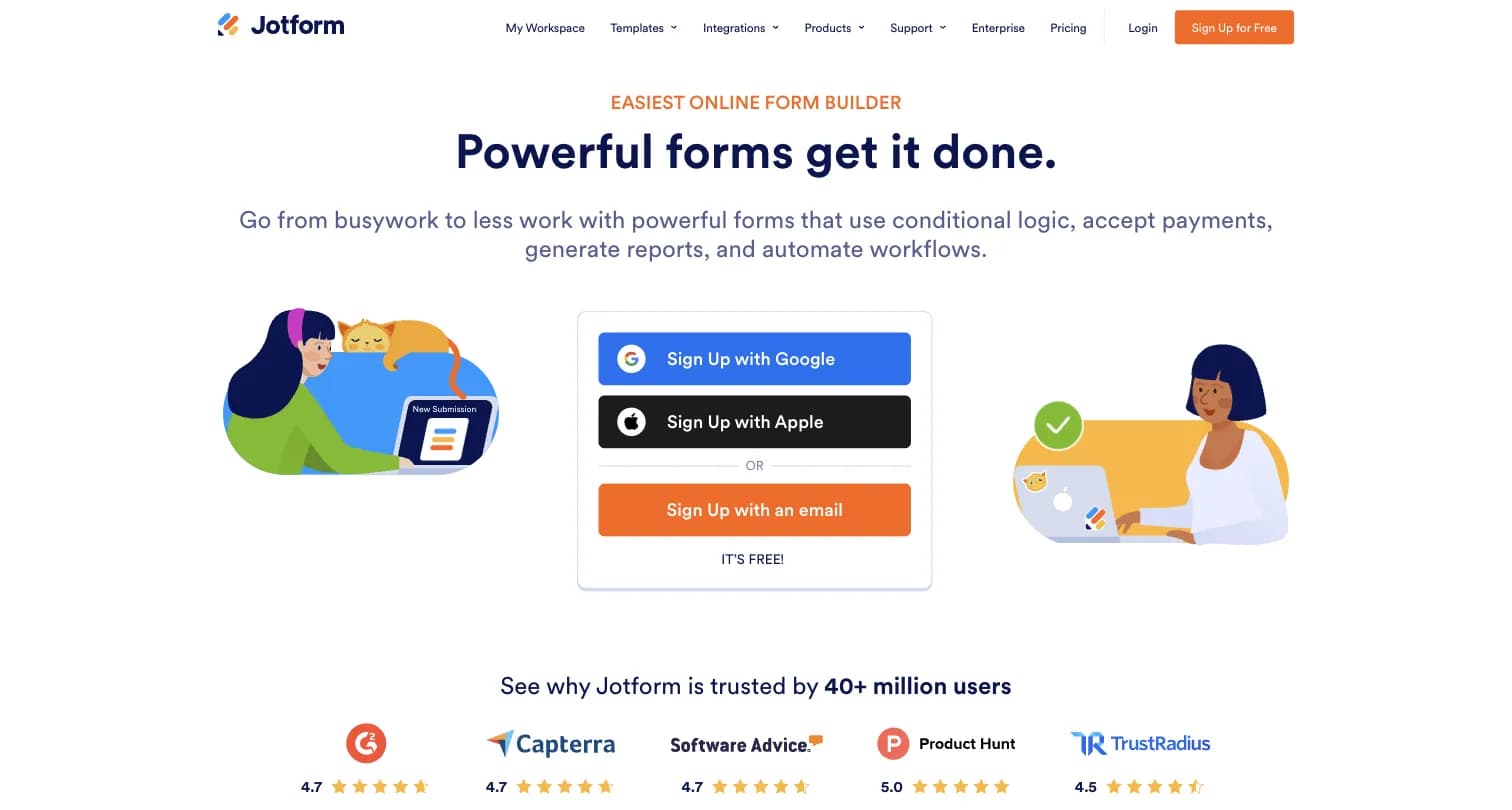
Captured August 15, 2026 from jotform.com.
Founder Aytekin Tank built Jotform in 2006 after growing frustrated coding online forms by hand. The company remained bootstrapped as it grew to 40M+ users, processing $2 billion in payments annually, and now positions itself as an AI-powered online form builder and workflow automation platform.
Functionality Over Polish
Where Typeform focuses narrowly on the conversational form, Jotform bundles a much broader toolkit: 20,000+ templates, 150+ integrations, 40+ payment processor integrations, a PDF editor, e-signature collection, an app and workflow builder, and offline mobile forms. Softr's independent testing summarizes the trade-off directly: "Jotform maximizes features and functionality... It's just not as clean, legible, or pleasing to use as Typeform."
Pricing
| Tier | Price (annual billing) | Submission Limit | Core Features |
|---|---|---|---|
| Starter (Free) | $0 | 100 submissions/month, 5 forms | 100 MB storage, Jotform branding |
| Bronze | $34/month | 1,000 submissions/month, 25 forms | 1 GB storage, no branding |
| Silver | $39/month | 2,500 submissions/month, 50 forms | 10 GB storage, marked "Best Value" |
| Gold | $99/month | 10,000 submissions/month, 100 forms | 100 GB storage, HIPAA-enabled features |
| Enterprise | Custom | Unlimited | SSO, SLAs, data residency, custom branding |
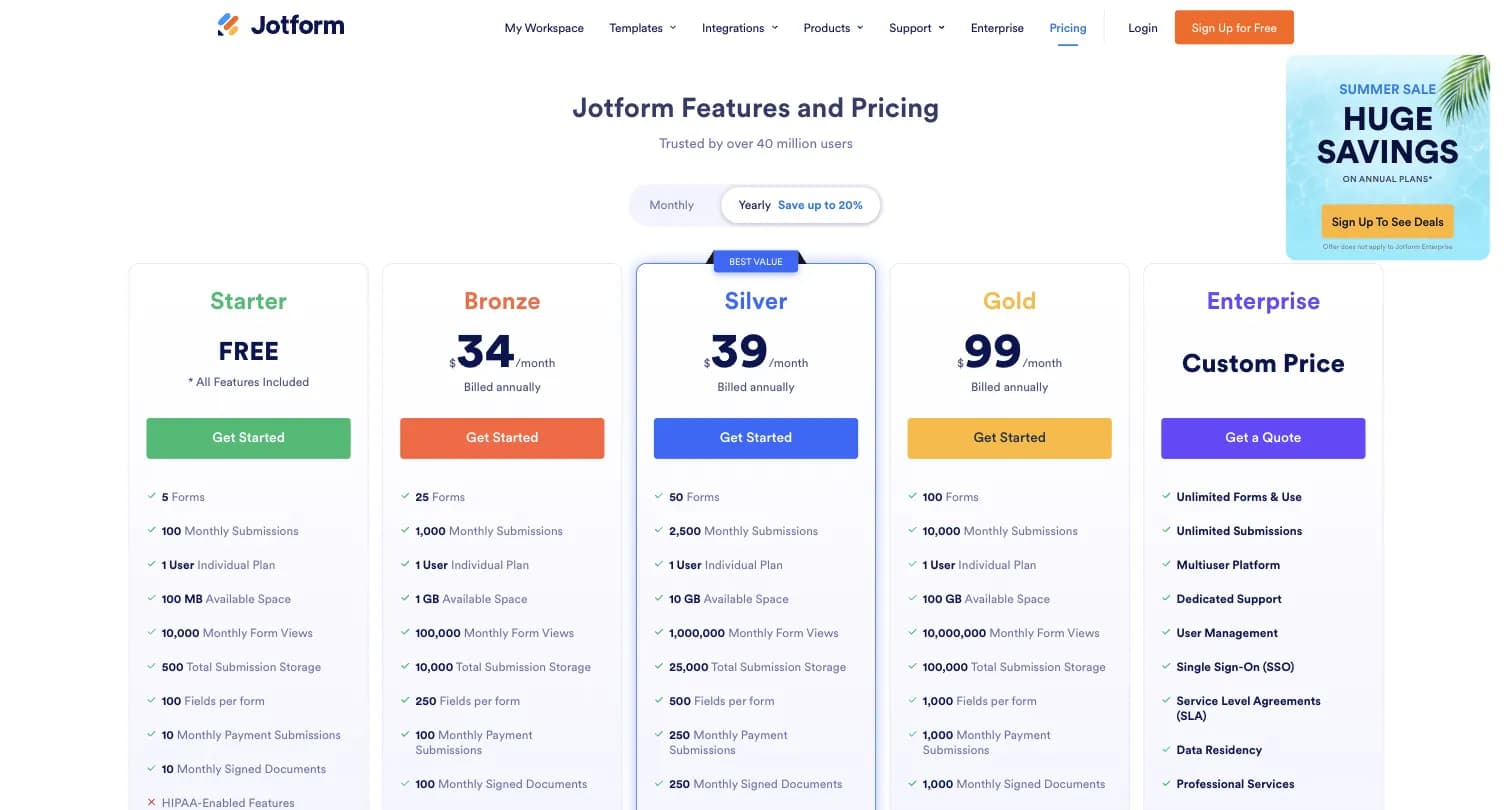
Captured August 15, 2026 from jotform.com/pricing.
Jotform's own site metadata once advertised plans "starting at $19/month," but the live pricing table shows the cheapest paid tier (Bronze) at $34/month billed annually, a discrepancy worth knowing about if you see the lower figure cited elsewhere.
Where Jotform Falls Short
- All plans below Enterprise are single-user; team collaboration requires the custom-priced Enterprise tier
- Pricing becomes restrictive at higher submission volume, per G2 reviewer sentiment
- Form loading times can slow under complex conditional logic, per G2 reviews
- HIPAA-enabled features are gated to the Gold plan and above, not available on Bronze or Silver
- Not an XM/experience-management platform: a general-purpose form builder with no purpose-built NPS/CSAT program management or CX analytics layer
Formbricks: An Open Feedback and Experience Management Suite
Formbricks isn't a third form builder competing on design polish or template counts. It's an open source feedback and experience management suite built around three things: feedback management, feedback analytics, and workflows and integrations, published transparently and included on every tier rather than upsold as add-ons.
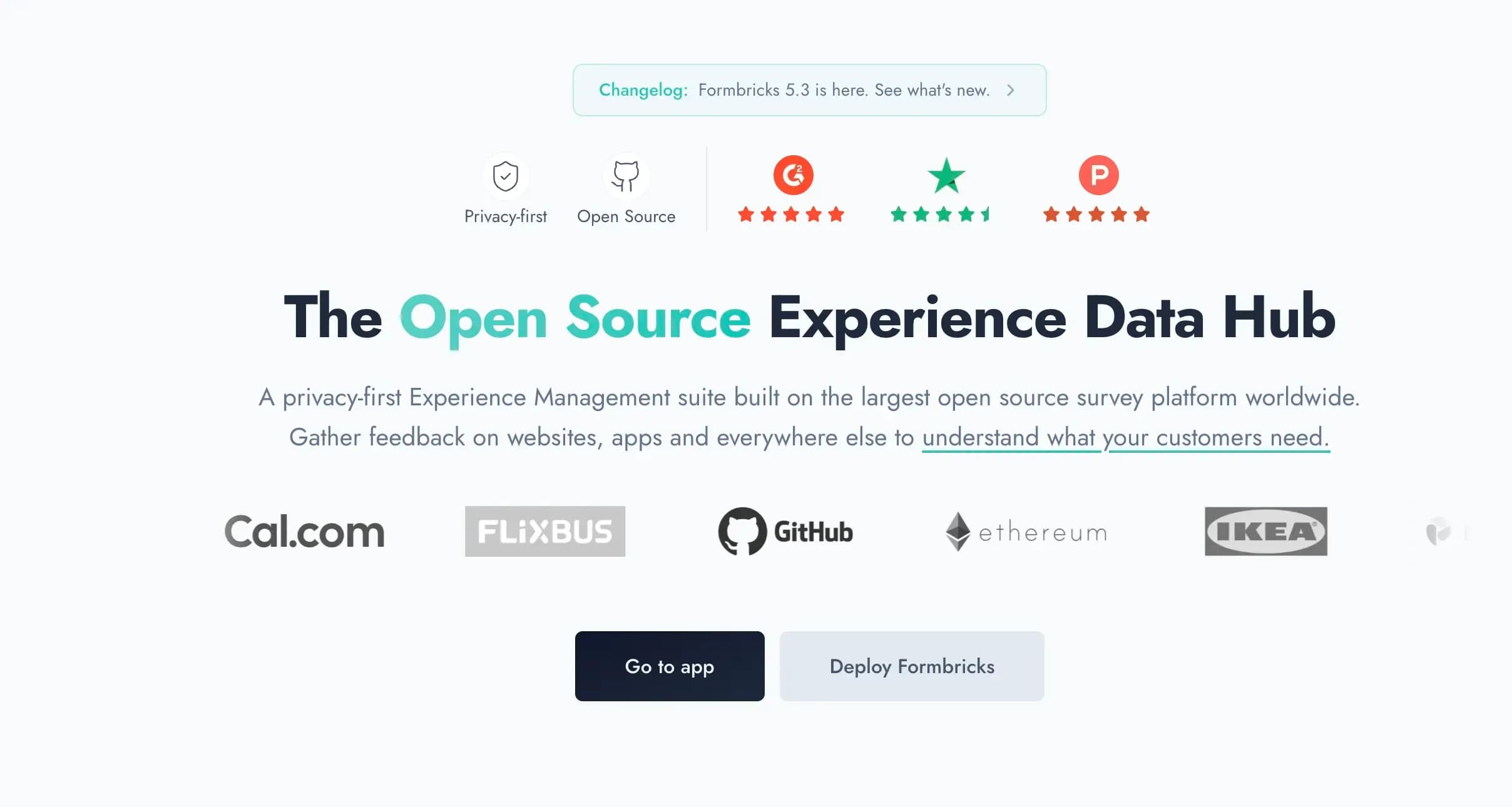
Captured August 15, 2026 from formbricks.com.
Feedback Management. Formbricks unifies collection channels neither Typeform nor Jotform combine on one platform: website surveys that target specific visitors, in-app surveys that reach any user cohort inside your product, link surveys for broad distribution, and branded surveys embedded directly in email.
Feedback Analytics. Response data flows into one place regardless of channel. You can follow individual feedback trails or zoom out for the aggregate picture, track partial and dropped-off responses, and segment by custom attributes, going further than either competitor's per-form submission log.
Workflows and Integrations. Formbricks Workflows automate what happens after a response comes in, routing and acting on feedback without manual handling. On the integration side, Formbricks connects to Salesforce, HubSpot, Slack, Google Sheets, and Notion through webhooks and its open API, free on every tier, including the self-hosted Community Edition.
Formbricks Pricing
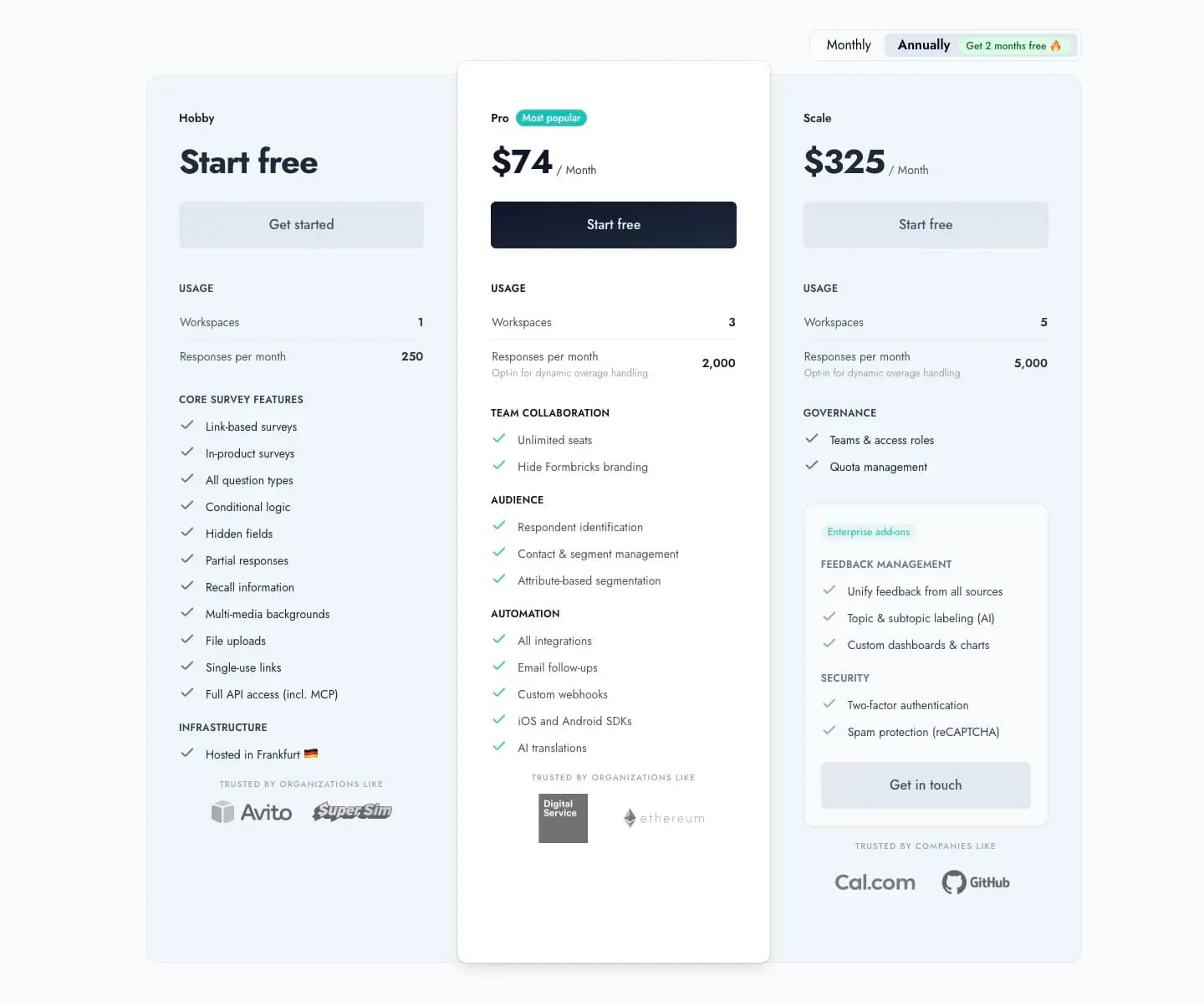
Captured August 16, 2026 from formbricks.com/pricing.
| Plan | Monthly Billing | Annual Billing | Responses/Month | Workspaces |
|---|---|---|---|---|
| Hobby | Free | Free | 250 | 1 |
| Pro | $89/month | $890/year (displayed as $74/mo) | 2,000 | 3 |
| Scale | $390/month | $3,900/year (displayed as $325/mo) | 5,000 | 5 |
At $890/year for 2,000 responses/month (24,000/year), Formbricks Pro works out to roughly $0.037 per response, well below Typeform Basic's $468/year for just 100 responses/month (1,200/year), or Jotform Bronze's $408/year for 1,000 submissions/month (12,000/year).
Formbricks Self-Hosting: Community Edition
The free, self-hosted Community Edition, licensed under AGPLv3, is where Formbricks diverges most sharply from both Typeform and Jotform. Data never leaves your own infrastructure, there's no response cap, and even if you stop paying for Enterprise features, the Community Edition and your data remain accessible. Neither Typeform nor Jotform offers an equivalent self-hosting path at any price, Jotform's data residency is gated behind its custom-priced Enterprise tier.
Side-by-Side Pricing
| Typeform | Jotform | Formbricks | |
|---|---|---|---|
| Free tier | Unlimited typeforms, 10 responses/month | 5 forms, 100 submissions/month | 250 responses/month, full API incl. MCP |
| Cheapest paid tier | Basic: $39/month, 100 responses/month | Bronze: $34/month, 1,000 submissions/month | Pro: $89/mo (or $890/yr annual) |
| Mid tier | Plus: $79/month, 1,000 responses/month | Silver: $39/month, 2,500 submissions/month | Scale: $390/mo (or $3,900/yr annual) |
| Team collaboration | Team seats on Plus and above | Enterprise only (custom price) | Unlimited seats from Pro onward |
| Enterprise | Custom, VIP account management | Custom, SSO, SLAs, data residency | Custom pricing, published contact path |
| Self-hosting | Not offered | Not offered | Free Community Edition, self-hosted |
| Feedback channels | Conversational forms | Forms, payments, PDFs, e-signatures | Website, in-app, link, and email, unified |
What Reviewers Say
Typeform holds a 4.5 rating across 1,017 reviews on G2 and a 4.7 rating across 973 reviews on Capterra. Jotform holds a 4.7 rating across 5,424 reviews on G2, a 4.7 rating across 2,918 reviews on Capterra, and an 8.5/10 score across 388 reviews on TrustRadius.
| Typeform | Jotform | |
|---|---|---|
| What reviewers like | Design quality and user experience, frequently cited as the reason to choose Typeform over form-builder competitors | Ease of use, large template library (10,000+ cited by reviewers), integration with 200+ apps |
| What reviewers dislike | Not well suited to long or complex surveys; higher price per response than form-builder competitors at the entry tier | Pricing becomes restrictive at higher submission volume; advanced features gated to higher tiers; form loading can slow under complex logic |
A Reddit thread comparing the two sums up the split reviewers keep landing on: Typeform has the better interface and design, while Jotform has broader functionality with the tradeoff of a clunkier UI.
Feature Value Breakdown
Design and Respondent Experience
Typeform's Approach: One-question-at-a-time conversational flow with rich media (images, video, GIFs) on every question, widely credited with higher completion rates for shorter forms.
Jotform's Approach: Offers both a Classic (all-questions-on-one-page) layout and a Card conversational layout, but the overall interface is denser and, per Softr's testing, "can feel overwhelming when you're getting started."
Formbricks' Approach: A no-code builder for standard survey layouts, with in-app and website survey targeting that neither competitor offers as a native channel.
Value Verdict: Typeform wins clearly on visual design and engagement for marketing-facing forms. This is Typeform's real differentiator, not a marginal one.
Functionality and Templates
Typeform's Approach: 3,000+ templates, a single native payment processor, no PDF generation, no e-signatures, no offline mode.
Jotform's Approach: 20,000+ templates, 40+ payment processor integrations, native PDF editor, e-signature collection, offline mobile forms, and an app/workflow builder, per Jotform's own comparison page.
Formbricks' Approach: Ready-made NPS, CSAT, and CES templates built for recurring feedback programs rather than one-off operational forms.
Value Verdict: Jotform wins decisively on breadth of built-in functionality. If your form needs to trigger a payment, generate a PDF, or collect a signature, Jotform does it natively and Typeform does not.
Free Plan Usability
Typeform's Approach: Unlimited typeforms, but capped at just 10 responses/month, one of the most restrictive free tiers among mainstream form builders.
Jotform's Approach: 5 forms and 100 submissions/month, 10x Typeform's free response cap.
Formbricks' Approach: 250 responses/month across all surveys, plus full API access including MCP, no question-count restriction.
Value Verdict: Jotform's free plan is meaningfully more usable than Typeform's for anyone testing the platform before paying. Formbricks' free tier goes further with developer-grade API access neither competitor includes for free.
Data Residency and Self-Hosting
Typeform's Approach: No self-hosting or regional data residency choice mentioned anywhere in its pricing or product documentation.
Jotform's Approach: Data residency exists only on the custom-priced Enterprise tier, alongside SSO and SLAs.
Formbricks' Approach: A free, self-hosted Community Edition under AGPLv3 keeps data on your own infrastructure entirely, on every plan.
Value Verdict: Formbricks wins clearly for any buyer where self-hosting or data residency is a hard requirement, not just a nice-to-have gated behind an enterprise contract.
Who Should Choose Which Platform
Choose Typeform if:
- Visual design and respondent engagement drive your form's purpose (lead-gen, marketing, onboarding)
- Your forms are shorter and benefit from a one-question-at-a-time flow
- You don't need native payments beyond a single processor, PDFs, or e-signatures
- A published, real starting price matters more than free-plan generosity
Choose Jotform if:
- You need one platform for forms, payments, PDF generation, and e-signatures
- Your free plan needs to support real usage: 100 submissions/month vs Typeform's 10
- You want the larger template and integration library (20,000+ templates, 150+ integrations)
- You're a single user or can wait for the Enterprise tier to add team seats
Choose Formbricks if:
- You want one platform for website, in-app, link, and email feedback instead of a single-submission form
- You need feedback analytics (segmentation, drop-off tracking) and Workflows built in, not sold separately
- Self-hosting or data residency is a real requirement, not a preference gated behind a custom quote
- Your engineering team wants full API access, including MCP, free on every tier
Typeform vs Jotform FAQ
Final Verdict
👍 Typeform is the right call if visual design and respondent engagement are the priority, especially for shorter, marketing-facing or lead-gen forms where a conversational flow measurably improves completion. Budget for its more restrictive free plan and higher per-response cost at the entry tier.
👍 Jotform is the right call if you need one platform for forms, payments, PDF generation, and e-signatures, with a genuinely usable free plan and the larger template and integration library. Its single-user plans below Enterprise are the main constraint for growing teams.
👉 Formbricks is the better fit if you want one platform for website, in-app, link, and email feedback instead of a single-submission form, and you want feedback analytics and Workflows built in from a published, monthly-or-annual price. The self-hosted Community Edition also gives you a data residency option neither Typeform nor Jotform offers at any price.
The honest read: Typeform and Jotform solve different problems (design vs. functionality), and picking between them usually comes down to whether your form needs to convert respondents or process operational data. If neither answers the feedback-analytics or self-hosting question you came here with, see Formbricks' current pricing here.
Try Formbricks now