
Productboard Pricing in 2026: Every Maker-Based Tier, the AI Credit System, and Where Formbricks Fits

Johannes
Co-Founder @ Formbricks
13 Minutes
August 16th, 2026
Productboard publishes real dollar figures for two of its four tiers, which already puts it ahead of most enterprise product-management software on transparency. But the sticker price is only half the story.
Pricing is per "maker," not per total user, so the real cost depends on how many people on your team need edit access versus how many just submit feedback. On top of that, every plan carries a second, usage-based dimension: AI credits that meter how much you can actually use Spark, Productboard's built-in AI agent. This breakdown walks through all four tiers, where the maker minimums and AI credits change the real number, and how it compares to Formbricks, an open feedback and experience management suite built for a genuinely different job.
I believe Productboard is the right call if:
- You want an AI agent (Spark) that turns scattered customer feedback into delivery-ready specs and roadmaps
- You need enterprise-grade roadmap governance (SAML SSO, SCIM, Salesforce integration) at scale
- Your team is comfortable with maker-based pricing and a real learning curve in exchange for a full product-management operating system
It's a weaker fit if:
- You're a small team that just wants a lightweight feedback board without roadmap and strategy overhead
- You need structured survey or NPS research rather than qualitative feedback notes
- You require self-hosting or EU data residency for compliance reasons
Worth being upfront about: this guide also covers Formbricks later on, but Formbricks is not a substitute for Productboard's core roadmapping and prioritization job. If you're specifically comparing feedback-repository and roadmap tools, the honest comparison set is Aha!, Canny, ProductPlan, and airfocus, not a survey platform. We'll explain exactly where the overlap is, and isn't, further down.
Table of contents:
- Productboard Pricing at a Glance
- Free Plan: $0, 1 Maker Minimum
- Plus Plan: $19/maker/month
- Business Plan: $59/maker/month, 2-Maker Minimum
- Enterprise Plan: Custom, 5-Maker Minimum
- The AI Credit System: A Second Pricing Dimension
- Where Third-Party Pricing Guides Still Show Old Numbers
- Where Productboard Pricing Falls Short
- What Reviewers Say About Productboard
- Where Formbricks Fits (and Where It Honestly Doesn't)
- Productboard vs Formbricks: Side-by-Side Pricing
- Feature Value Breakdown
- Who Should Actually Pay for Productboard
- Productboard Pricing FAQ
- Final Verdict
Productboard Pricing at a Glance
| Plan | Price | Makers | AI Credits | Notes |
|---|---|---|---|---|
| Free | $0 | 1 minimum | 50/month (shared) | 500 feedback notes, 25 contributors, 1 teamspace |
| Plus | $19/maker/month billed annually ($25/maker/month monthly) | 1 minimum | 250/maker/month | Customer segments, feedback loop closing |
| Business | $59/maker/month billed annually ($75/maker/month monthly) | 2 minimum | 500/maker/month | Unlimited feedback notes, 14-day free trial |
| Enterprise | Custom | 5 minimum | 1,500 base + 800/additional maker | SAML SSO, SCIM, Salesforce integration |
Source: productboard.com/pricing, captured August 16, 2026.

Captured August 16, 2026 from productboard.com/pricing.
Productboard's pricing is per "maker," the PM or lead who owns strategy and edits roadmaps. Contributors, colleagues who just submit or tag feedback, are unlimited and free on every tier and never count toward the maker minimum. That's a meaningfully different model than a flat per-seat or per-workspace price.
Free Plan: $0, 1 Maker Minimum
| Feature | Details |
|---|---|
| Price | $0, billed annually or monthly |
| Makers | 1 minimum |
| Contributors | 25 |
| AI credits | 50/month, shared across the whole workspace |
| Feedback notes | 500 |
| Teamspaces / Product Portals | 1 / 1 |
Free is a genuine forever-free tier, not a time-limited trial, and it already includes full Spark AI access, unlimited roadmaps and prioritization, and a customer-facing product portal. The catch is the AI credit pool: 50 credits per month is shared across everyone in the workspace, not per maker, and Productboard's own numbers say analyzing 100 feedback items alone uses 30-50 credits.
| Free Plan | |
|---|---|
| Pros | Cons |
| ✅ Full Spark AI access, not a stripped-down version | ❌ 50 AI credits/month is shared, not per maker |
| ✅ 500 feedback notes and unlimited roadmaps | ❌ Only 25 contributors and 1 teamspace |
| ✅ No credit card required, no expiration | ❌ 1 product portal, no dynamic customer segments |
| ✅ Genuine free-forever tier, not a trial | ❌ A single active maker can burn the credit pool fast |
The Bottom Line: Free is a real product to test Productboard's core workflow, but the shared 50-credit AI pool makes it a light-touch trial of Spark specifically, not a place to run AI-heavy feedback synthesis at any real volume.
Plus Plan: $19/maker/month
| Feature | Details |
|---|---|
| Price | $19/maker/month billed annually, or $25/maker/month billed monthly |
| Makers | 1 minimum, no floor beyond that |
| AI credits | 250/maker/month |
| Added features | Manual and dynamic customer segments, feedback loop closing, product usage integrations (Amplitude, Mixpanel) |
Plus is the cheapest paid tier and the only one with no multi-maker minimum, a single PM can buy exactly one seat. The step up from Free is mostly about segmentation: manual and dynamic customer segments let you slice feedback by who's actually asking for what, rather than treating every piece of feedback the same.
| Plus Plan | |
|---|---|
| Pros | Cons |
| ✅ No maker minimum, priced for a single PM | ❌ 5x AI credit jump from Free (250 vs. 50) is per maker, not a huge absolute increase |
| ✅ Customer segmentation unlocked | ❌ Still capped at 1 teamspace and 1 product portal |
| ✅ 21% cheaper on annual billing ($19 vs. $25/mo) | ❌ Feedback notes still capped at 500, same as Free |
| ✅ Product usage integrations (Amplitude, Mixpanel) | ❌ No dependency tracking or advanced prioritization formulas yet |
The Bottom Line: Plus is built for a solo PM or a very small team that wants segmentation and usage integrations without buying a second maker seat.
Business Plan: $59/maker/month, 2-Maker Minimum
| Feature | Details |
|---|---|
| Price | $59/maker/month billed annually, or $75/maker/month billed monthly |
| Makers | 2 minimum |
| AI credits | 500/maker/month |
| Added features | Unlimited feedback notes, unlimited teamspaces, shared skills library, 2 product portals, 14-day free trial |
Business is where the 2-maker minimum starts changing the real entry price. The $59/maker sticker looks like a jump from Plus's $19, but because you can't buy fewer than 2 makers, the real floor is $118/month billed annually, or $150/month on monthly billing, not $59.
| Business Plan | |
|---|---|
| Pros | Cons |
| ✅ Unlimited feedback notes and teamspaces | ❌ 2-maker minimum means a $118/month annual floor, not $59 |
| ✅ 14-day free trial with unlimited AI credits | ❌ Per-maker AI credits still cap out at 500/month |
| ✅ 2 product portals and shared skills library | ❌ Enhanced platform customization still short of Enterprise |
| ✅ Dependency tracking and customizable feature statuses | ❌ No SSO or SCIM, still Enterprise-only |
The Bottom Line: Business is the practical tier for a growing team that's outgrown Free and Plus's note and teamspace caps, but budget for the 2-maker floor, not the single-seat sticker price.
Enterprise Plan: Custom, 5-Maker Minimum
| Feature | Details |
|---|---|
| Price | Custom, contact sales |
| Makers | 5 minimum |
| AI credits | 1,500 base credits, plus 800 per additional maker |
| Added features | SAML SSO, SCIM provisioning, custom roles and permissions, Salesforce integration, full platform customization |
Enterprise has no published number, and the 5-maker minimum means you're negotiating a real contract before you see a figure. Third-party procurement data gives a useful anchor here: Vendr's analysis of 225+ Productboard contracts puts the median annual contract at roughly $23,333, with average negotiated discounts around 21% off list.
| Enterprise Plan | |
|---|---|
| Pros | Cons |
| ✅ SAML SSO, SCIM, and enhanced data governance | ❌ No public price, 5-maker minimum before any quote |
| ✅ Salesforce integration and unlimited contributors | ❌ Vendr data suggests real deals can still run five figures annually |
| ✅ Full platform customization and dedicated onboarding | ❌ Negotiation-dependent, discounts vary 5-50% by maker count and term |
| ✅ Largest AI credit pool (1,500 base + 800/maker) | ❌ Longest sales cycle of any tier |
The Bottom Line: Enterprise is built for organizations that specifically need SSO, SCIM, or Salesforce sync, not a tier to shop for on price alone. Budget in the low five figures annually and expect a negotiation, not a checkout page.
The AI Credit System: A Second Pricing Dimension
Every Productboard tier now bundles Spark, its AI agent, directly into the maker price rather than selling it as a separate line item. But "included" doesn't mean unlimited: each plan comes with a fixed monthly credit allocation, and different AI tasks consume wildly different amounts.
Per Productboard's own numbers:
- Analyzing 100 customer feedback items uses roughly 30-50 credits
- Drafting a comprehensive product specification uses 50-200 credits
- Free's 50 credits/month are shared across the entire workspace, not per maker
- Plus, Business, and Enterprise allocate credits per maker (250, 500, and 1,500 base + 800/additional maker, respectively)
If you run out mid-cycle, you don't lose access to your workspace or data, you just lose Spark's AI features until the next monthly reset, or until you buy a top-up. Top-ups cost $5 for a 50-credit bundle on monthly billing, or $60 for a 600-credit bundle on annual billing, and can be purchased anytime with pro-rated billing.
Why this matters for budgeting: a 5-maker team on Plus gets 1,250 total AI credits/month (250 x 5). If that team is using Spark heavily for feedback synthesis and spec drafting, and Productboard's own math says 100 feedback items alone can burn 30-50 credits, that allocation disappears fast. The maker price is only the base cost; heavy AI users should budget for the tier above what raw feedback volume alone would suggest.
Where Third-Party Pricing Guides Still Show Old Numbers
Two of the five top-ranking pages for "productboard pricing," a Featurebase comparison and a checkthat.ai breakdown, both still reference Productboard's older tier names: Starter, Essentials, Pro, and Enterprise. Productboard's live pricing page uses Free, Plus, Business, and Enterprise instead.
The per-maker prices line up exactly (Essentials = Plus at $19/maker/month, Pro = Business at $59/maker/month), so the rename doesn't change what you'd actually pay. But it's worth knowing if you land on an older guide and the tier names don't match what you see on productboard.com/pricing.
The bigger discrepancy is AI pricing. Both of those third-party sources, plus Productboard's own archived 2024 pricing comparison PDF, describe "Productboard AI" as a separate $20/maker/month add-on (checkthat.ai cites $15/maker/month annually, $19 monthly, for a standalone "Spark" beta workspace). That's no longer how it works. As of this writing, Spark's AI credits are bundled directly into every tier's base price, Free through Enterprise, with no separate required add-on, only optional credit top-ups if you exceed your monthly allocation.
The Bottom Line: if you're pricing out Productboard from an older guide, recheck the live pricing page. The tier names changed, and AI is no longer a mandatory separate purchase.
Where Productboard Pricing Falls Short
Maker Minimums Inflate the Real Entry Price
- Business requires 2 makers minimum, putting the real floor at $118/month annually, not the $59/maker sticker price
- Enterprise requires 5 makers minimum before you even get a custom quote
- A 2-3 person team evaluating "which tier is cheaper" has to compare floor prices, not per-seat prices
AI Credits Are a Second, Usage-Based Cost Dimension
- Credits are consumed unevenly: 30-50 for analyzing 100 feedback items, 50-200 for a single spec
- Free's 50 credits are shared workspace-wide, not per maker, so even light AI use can exhaust it quickly
- Heavy AI users need to budget beyond the maker price alone, or budget for top-ups
Enterprise Pricing Is Fully Custom and Opaque
- No dollar figure anywhere on the public pricing page
- Vendr's transaction data suggests a median annual contract around $23,333, but that's third-party procurement data, not a Productboard-published number
- The 5-maker minimum means you're already committing to a real conversation before any number appears
Steep Learning Curve for the Full Feature Set
- Multiple G2 and Capterra reviewers flag onboarding complexity and a "comprehensive but overwhelming" interface
- This is a real switching cost for smaller teams evaluating Productboard against lighter tools
Not Built for Structured Survey or NPS Research
- Productboard captures and organizes feedback as notes, not as structured survey responses
- Teams needing NPS, CSAT, or PMF surveys as their primary research methodology need a separate, dedicated tool
What Reviewers Say About Productboard
Productboard holds a 4.3 rating across 254 reviews on G2, and 4.7 across 154 reviews on Capterra.
| Productboard Reviews | |
|---|---|
| Pros | Cons |
| ✅ Centralized feedback management streamlines prioritization and decision-making | ❌ Interface can be overwhelming, especially for new or non-PM users |
| ✅ Strong integrations with Jira, Slack, and MS Teams keep teams aligned | ❌ Pricing model based on maker count makes scaling cost unpredictable |
| ✅ Flexible roadmap and prioritization matrix that's easy to customize | ❌ Enterprise-tier features (dependencies, custom roles) locked behind negotiated pricing |
Productboard's own customer data, cited on its sales and customer success page, claims 74% of customers report greater than 20% improved efficiency on core product management tasks. Case studies it publishes include a 26% reduction in engineering support tickets (120Water) and release planning cut from three weeks to three days (Salesforce).
Where Formbricks Fits (and Where It Honestly Doesn't)
Here's the part worth being upfront about: Formbricks does not compete with Productboard on its actual core job. Productboard's entire product is built around a feedback repository, roadmapping, prioritization formulas, and AI-drafted specs. Formbricks has no roadmap module, no prioritization matrix, and no feature-request voting board. If you're specifically comparing roadmap and feedback-repository tools, Aha!, Canny, ProductPlan, and airfocus are the honest comparison set, not Formbricks.
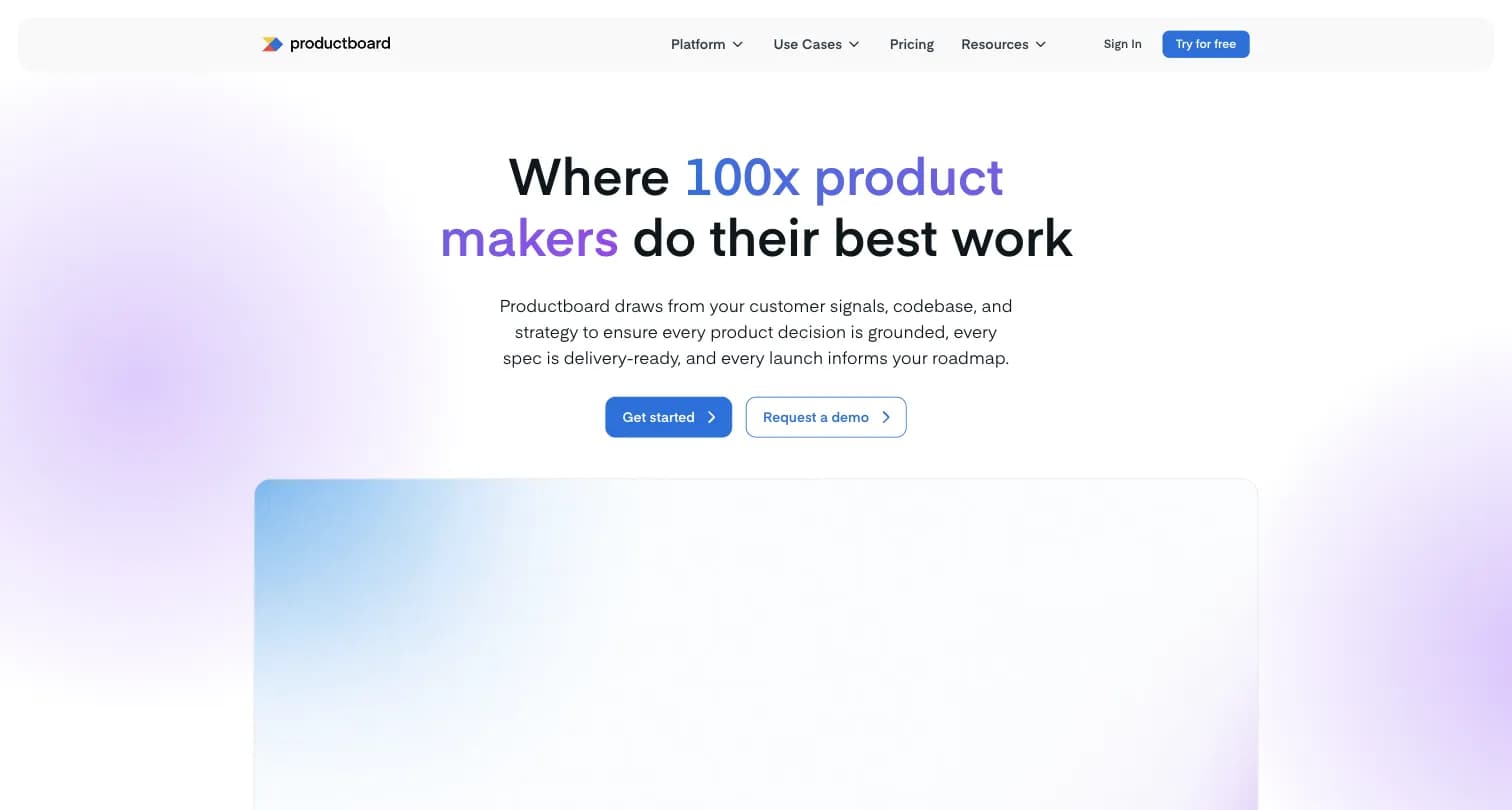
Captured August 15, 2026 from productboard.com.
Where Formbricks does overlap is narrower and specific: structured feedback collection. Formbricks is an open source feedback and experience management suite built around three things, not a survey form builder bolted onto something else.
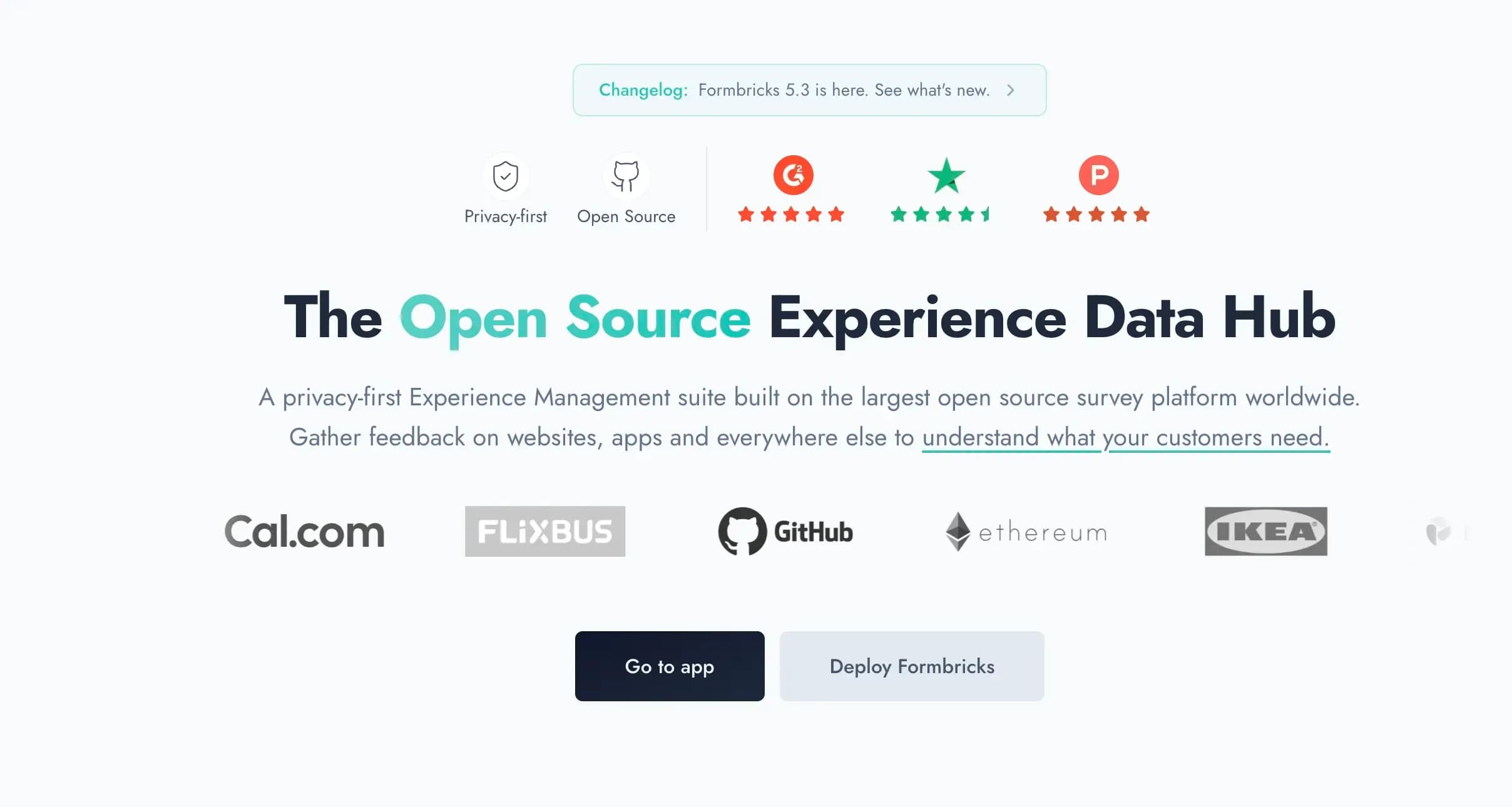
Captured August 15, 2026 from formbricks.com.
Feedback Management. Formbricks unifies website surveys, in-app surveys, link surveys, and branded email surveys on one platform. Where Productboard captures feedback as unstructured "notes" fed into a repository, Formbricks runs structured, multi-question surveys, NPS, CSAT, PMF, as its core product.
Feedback Analytics. Every response flows into one dashboard regardless of channel. You can follow individual response trails, zoom out for the aggregate view, track partial and dropped-off submissions, and segment by custom attributes.
Workflows and Integrations. Formbricks Workflows automate what happens after a response comes in. Native integrations connect to Salesforce, HubSpot, Slack, Google Sheets, and Notion via webhooks and a free, unrestricted API on every tier, including the self-hosted Community Edition.
Concretely: if your team already uses Productboard to manage the roadmap and prioritize what to build, and you separately need structured NPS or PMF surveys to measure whether what you shipped actually worked, that's where Formbricks fits alongside it, not instead of it.
Formbricks Hobby Plan: Free Forever
| Feature | Details |
|---|---|
| Price | $0 |
| Workspaces | 1 |
| Responses | 250/month |
| API access | Full, including MCP |
| Hosting | Frankfurt, Germany |
Where Productboard's Free tier shares 50 AI credits across the whole workspace, Formbricks Hobby ships the full API and MCP connection from day one, scoped to survey responses rather than AI usage.
The Bottom Line: Hobby is for testing a dedicated survey program, not a roadmap tool, alongside whatever Productboard already handles for feedback repository and prioritization.
Formbricks Pro Plan: $89/month (or $74/month billed annually)
| Feature | Details |
|---|---|
| Price | $89/month, or $74/month billed annually ($890/year) |
| Workspaces | 3 |
| Responses | 2,000/month |
| Seats | Unlimited |
| Added features | Attribute-based segmentation, all integrations, custom webhooks, iOS/Android SDKs |
Unlike Productboard, where adding a design lead or engineering manager as an editor means buying another maker seat, Formbricks Pro includes unlimited team seats at one flat price. A 2-person team and a 20-person team pay the same $74-89/month.
The Bottom Line: Pro fits a team running a real, ongoing survey program with unlimited seats, no per-head math required.
Formbricks Scale Plan: $390/month (or $325/month billed annually)
| Feature | Details |
|---|---|
| Price | $390/month, or $325/month billed annually ($3,900/year) |
| Workspaces | 5 |
| Responses | 5,000/month |
| Governance | Teams and access roles, quota management |
| Enterprise add-ons | AI topic/subtopic labeling, custom dashboards, two-factor authentication |
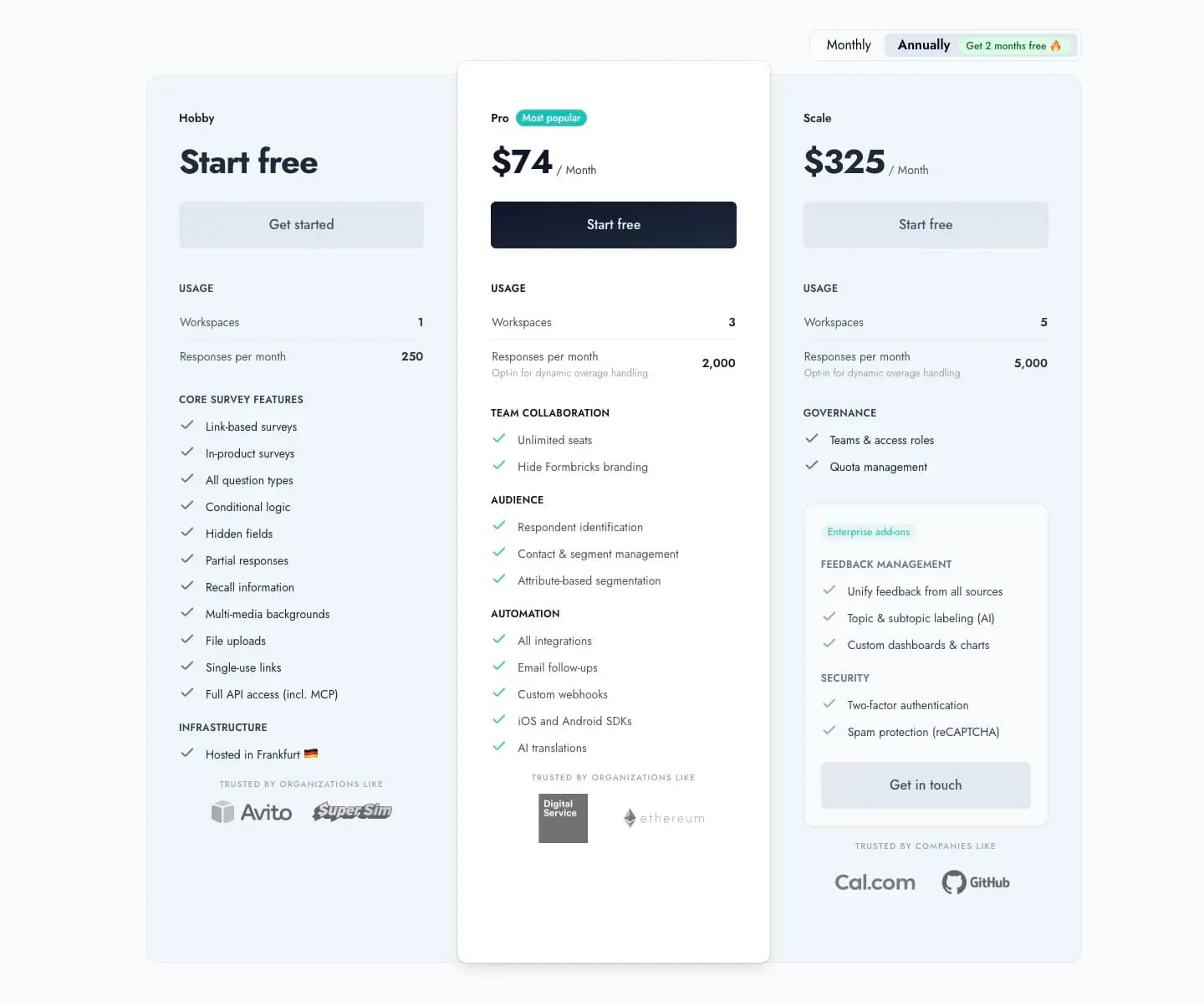
Captured August 15, 2026 from formbricks.com/pricing.
The Bottom Line: Scale is Formbricks' highest published, self-serve tier, still no maker-style seat multiplication, with AI topic labeling available as a named add-on rather than a separate credit system to manage.
Formbricks Self-Hosting: Community and Enterprise Editions
| Feature | Details |
|---|---|
| Community Edition | Open source, free, unlimited surveys and responses |
| Enterprise Edition | Contact us, adds SSO (SAML/OIDC), multi-language surveys, whitelabel, support SLAs |
| License | AGPLv3 |
| Data Control | Data never leaves your own infrastructure |
This is the one dimension where the two products aren't close. Productboard is cloud-only, per its own documentation and about page. Formbricks' Community Edition is free, open source under AGPLv3, and puts survey data entirely on your own infrastructure, a real option for teams with a data residency requirement that Productboard simply doesn't offer at any price.
Productboard vs Formbricks: Side-by-Side Pricing
| Productboard | Formbricks | |
|---|---|---|
| Core job | Feedback repository, roadmapping, AI-drafted specs | Structured feedback collection (surveys, NPS, PMF) |
| Free tier | 1 maker, 500 feedback notes, 50 shared AI credits | 250 responses/month, full API including MCP |
| Cheapest paid tier | Plus: $19/maker/month annual, no minimum | Pro: $74/month annual, unlimited seats |
| Mid tier | Business: $59/maker/month annual, 2-maker minimum ($118/mo floor) | Scale: $325/month annual, 5,000 responses/month |
| Enterprise | Custom, 5-maker minimum, ~$23,333/year median per Vendr data | Custom pricing, published contact path |
| Billing unit | Per maker, contributors free | Per workspace/response volume, unlimited seats |
| Structured surveys (NPS/CSAT) | Not offered, feedback captured as notes | Yes, core product |
| Self-hosting | No | Yes, free Community Edition (AGPLv3) |
Feature Value Breakdown
Roadmapping and Feature Prioritization
Productboard's Approach: Productboard's entire product is built around timeline and column-based roadmaps, customizable prioritization formulas, release planning, and dependency tracking.
Formbricks' Approach: No roadmap module exists in Formbricks' feature set.
Value Verdict: Productboard wins decisively, and it's not close. This isn't a race Formbricks is running.
Structured Survey and NPS/CSAT Research
Productboard's Approach: Feedback is captured as notes and insights, not survey-methodology data, though it integrates with dedicated survey tools.
Formbricks' Approach: Purpose-built for multi-question surveys, NPS, CSAT, and PMF measurement as its core product.
Value Verdict: Formbricks wins decisively. Productboard's own site frames feedback capture as "notes," not structured survey research.
Self-Hosting and Data Residency
Productboard's Approach: Cloud-only, hosted from Productboard's own infrastructure per its about page, with no self-hosted option at any tier.
Formbricks' Approach: A free, self-hosted Community Edition under AGPLv3, plus a Frankfurt-hosted cloud option.
Value Verdict: Formbricks wins decisively for any buyer where self-hosting or EU data residency is a hard requirement.
Pricing Transparency
Productboard's Approach: Free, Plus, and Business all show real per-maker numbers, a genuine strength versus most enterprise PM software. Enterprise is fully custom, and the AI credit system adds a second cost dimension on top of the maker price.
Formbricks' Approach: Every tier, Hobby through Scale, publishes a flat price with no per-seat multiplication and no separate usage-based add-on.
Value Verdict: Both publish real numbers for entry tiers. Formbricks edges ahead once you factor in that Productboard's maker minimums and AI credit system make the effective price harder to predict than the sticker suggests.
Who Should Actually Pay for Productboard
Productboard makes sense if you want an AI agent (Spark) to turn scattered customer feedback into delivery-ready specs and roadmaps, you need enterprise-grade governance like SSO and Salesforce integration at scale, and your team is comfortable with maker-based pricing and a real learning curve in exchange for a full product-management operating system.
It's a weaker fit if you're a small team that just wants a lightweight feedback board without roadmap and strategy overhead, you need structured survey or NPS research rather than qualitative feedback notes, or you require self-hosting or EU data residency for compliance reasons.
As an illustrative example, a 300-person B2B SaaS product org might use Productboard to centralize feedback from Zendesk and Slack into a prioritized roadmap shared with engineering and sales, while running Formbricks in-app NPS surveys separately to track whether shipped features actually moved satisfaction scores. This is a hypothetical scenario based on Productboard's documented workflow and integrations, not a published customer case study.
Productboard Pricing FAQ
Final Verdict
👍 Productboard is the right call if you want an AI agent to turn scattered customer feedback into delivery-ready specs and roadmaps, you need enterprise-grade governance at scale, and you're comfortable with per-maker pricing plus a stacked AI-credit system. Its Free, Plus, and Business tiers are genuinely more transparent than most enterprise product-management software, even if the maker minimums and AI credits mean the real cost takes some math to work out.
👉 Formbricks is the better fit specifically for the structured survey and feedback-collection piece of your program, NPS, CSAT, PMF, not as a Productboard replacement. Every tier is published with unlimited seats and no maker-style multiplication, and the AGPLv3-licensed Community Edition gives you a self-hosted path Productboard doesn't offer at any price.
The honest read: these solve different jobs. If you need a feedback repository and a real roadmapping engine, Productboard does that well, once you budget for the maker minimums and AI credits, not just the sticker price. If you separately need structured survey research or a self-hosted deployment, see Formbricks' current pricing here.
Try Formbricks now