
8 Productboard Alternatives in 2026: Roadmapping Tools, and a Feedback-Collection Option

Johannes
Co-Founder @ Formbricks
12 Minutes
August 16th, 2026
Productboard is a product management system built around three things: a centralized feedback repository, roadmapping and prioritization, and Spark, its AI agent that turns feedback into delivery-ready specs. It's used by 6,000+ customers, including Autodesk, Zoom, and Salesforce, and it's genuinely good at deciding what to build next.
Being direct about this upfront: if you're reading this because you want to replace Productboard's roadmapping and prioritization workflow, the alternatives below (Aha!, Canny, UserVoice, Featurebase, airfocus, ProductPlan, Chisel) are real substitutes. If your actual gap is that you need to run structured NPS, CSAT, or PMF surveys, Productboard was never built for that, its own feedback tooling captures qualitative notes, not survey-methodology data, and no roadmapping tool on this list changes that. Formbricks is on this list for that second group, not as a Productboard clone.
What Is Productboard?
Productboard was founded in 2014 by Hubert Palan and Daniel Hejl to help companies build products that matter. It has grown to 500+ employees across San Francisco, Vancouver, Dublin, London, Prague, and Brno, backed by Sequoia Capital, Kleiner Perkins, Index Ventures, and Bessemer Venture Partners.
Its three pillars:
- Spark AI agent: surfaces product opportunities with citations, drafts delivery-ready specs from feedback synthesis, and measures post-launch impact against what shipped
- Centralized feedback repository: one searchable place for product requests and feedback, with AI-powered trend surfacing
- Roadmapping and prioritization: timeline and column-based roadmaps, customizable prioritization formulas, release planning, and a customer-facing portal for sharing plans
Productboard holds a 4.3 rating across 254 reviews on G2, where it's categorized under Product Management, Strategy & Innovation Roadmapping Tools, and Workflow Management, and a 4.7 rating across 154 reviews on Capterra, listed under Product Roadmap software.
Important: Productboard's own site frames feedback as "notes," not surveys. It has no survey builder, no NPS/CSAT methodology, and no question-branching logic. It's a roadmapping and feedback-repository system, not a data-collection engine.
Why Teams Look for Productboard Alternatives
We reviewed Productboard's own pricing page, its G2 and Capterra reviews, and independent roundups covering real switch decisions. Five reasons come up repeatedly.
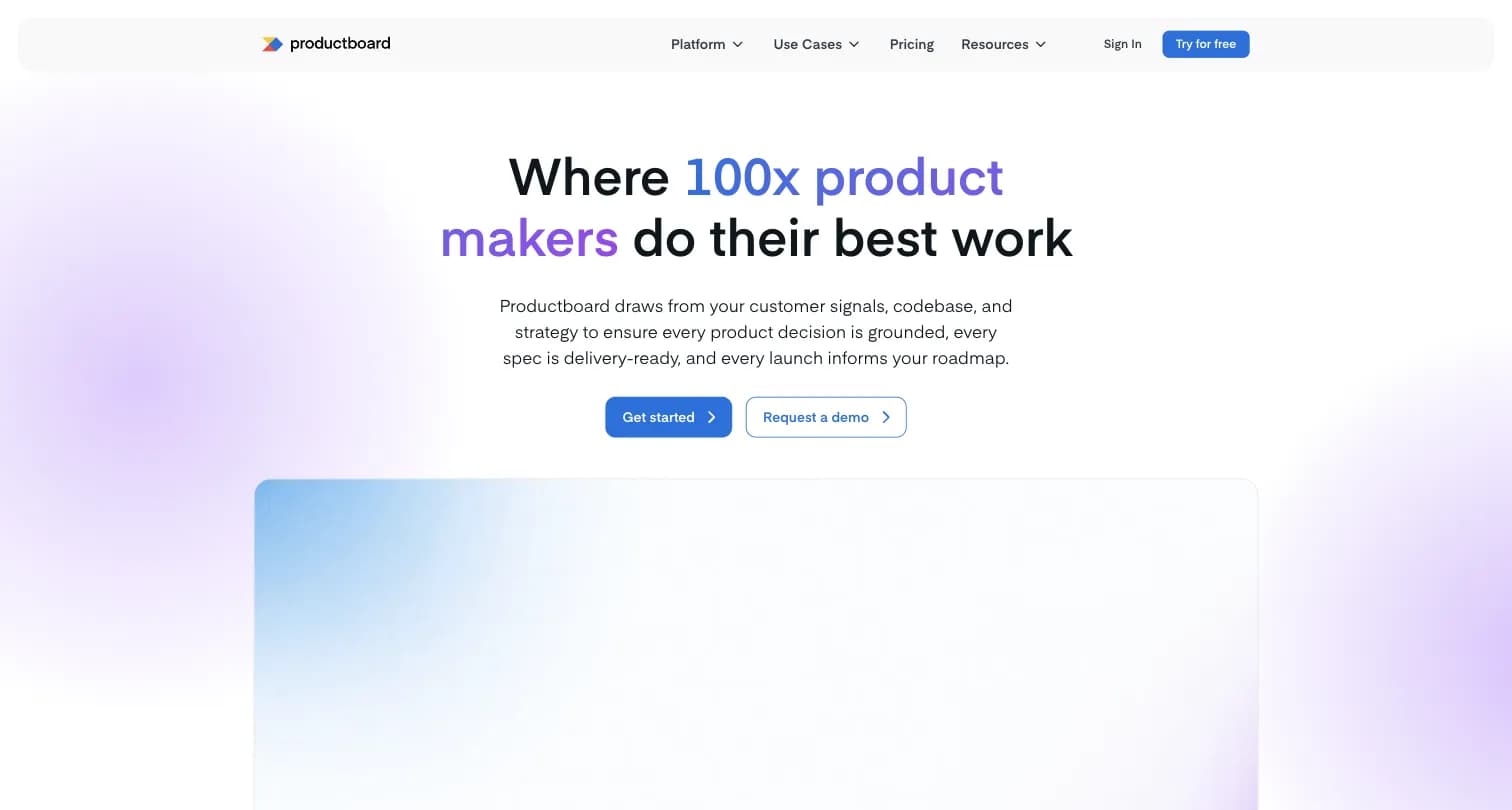
Captured August 15, 2026 from productboard.com.
1. A Second, Usage-Based Pricing Dimension on Top of Seats
Productboard prices per "maker" (the PM or lead who owns strategy; contributors who just submit feedback don't count), but every tier also caps AI credits. The Free plan gets 50 shared credits/month, Plus gets 250/maker, Business gets 500/maker. Since 100 feedback items analyzed uses roughly 30-50 credits and drafting a spec can use 50-200, heavy AI users can hit monthly caps well before they hit a seat limit.
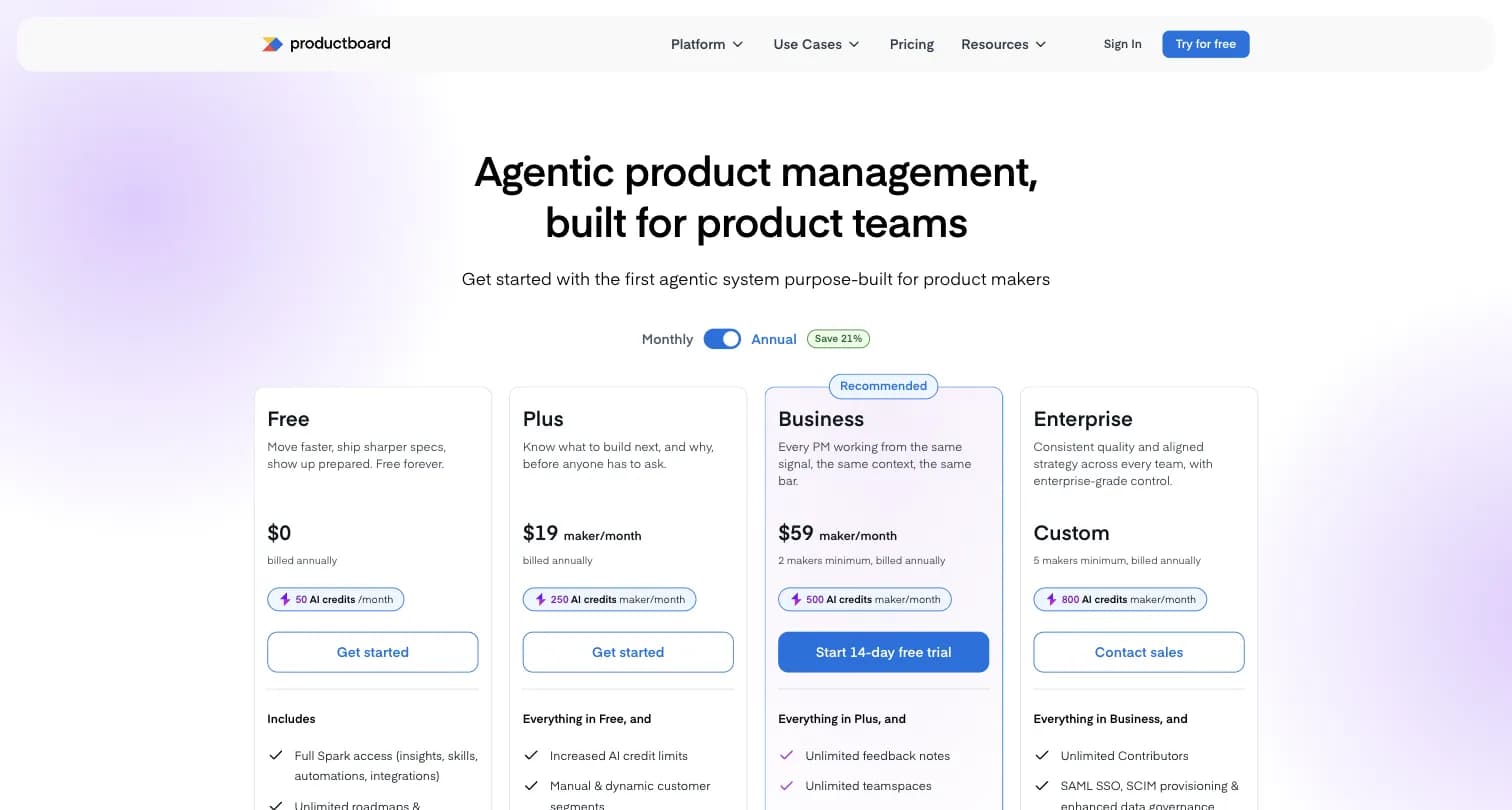
Captured August 15, 2026. Business requires 2 makers minimum; Enterprise requires 5.
2. Maker Minimums Inflate the Real Entry Price
The Business tier ($59/maker/month billed annually) has a 2-maker minimum, and Enterprise (custom) requires 5 makers minimum. The per-maker sticker price undersells what a team actually pays to unlock unlimited feedback notes, unlimited teamspaces, or Salesforce integration.
3. A Steep Learning Curve for the Full Feature Set
Multiple G2 and Capterra reviewers flag onboarding complexity. One Capterra reviewer put it plainly: "there are SO MANY features and the ability to basically customize any of them, it can be a bit overwhelming to get started." Another noted the responsibility is on the user "to not over-complicate the implementation."
4. Limited Data Portability on Lower Tiers
Productboard only offers a public API on its higher tiers, according to third-party comparison research from Canny. Without API access, pulling your own data out for analytics, migrating to another tool, or building something custom into your workflow becomes considerably harder, a real cost if you're not on Business or Enterprise.
5. No Structured Survey or NPS/CSAT Tooling
Productboard captures and organizes feedback notes, but it isn't a survey builder. Teams that need quantitative research, NPS, CSAT, PMF surveys with question logic and response analytics, need a separate tool regardless of which Productboard tier they're on.
Productboard Alternatives at a Glance
| Tool | Best For | Free Plan | Starting Price | Self-Hosted |
|---|---|---|---|---|
| Formbricks | Feedback collection (surveys, NPS/CSAT), not a roadmap substitute | Yes (250 responses/mo) | $74/month ($890/year) | Yes |
| Aha! | Strategic roadmapping tied to company goals | No (30-day trial) | $59/user/month (Roadmaps) | No |
| Canny | AI-driven feedback capture, public voting boards | Yes (25 tracked users) | $79/month (Pro) | No |
| UserVoice | Revenue-weighted feedback intelligence for enterprise | No | ~$10,788/year (Growth) | No |
| Featurebase | All-in-one feedback, roadmap, changelog, and support | Yes (1 seat) | $29/seat/month (Growth) | No |
| airfocus | Flexible prioritization frameworks for agile teams | No | $59/user/month (Core) | No |
| ProductPlan | Simple, visual roadmap-sharing without a feedback layer | No (14-day trial) | $39/editor/month (Basic, annual) | No |
| Chisel | AI PM agent plus feedback and roadmap alignment | Yes | $7/maker/month | No |
The 8 Best Productboard Alternatives in 2026
1. Formbricks: The Feedback-Collection Option (Not a Roadmap Substitute)
Being direct about this one first: Formbricks doesn't do what Productboard does. Formbricks is a feedback and experience management suite built around feedback management (website, in-app, link, and email surveys), feedback analytics (dashboards, segmentation, drop-off tracking), and workflows and integrations. It has no roadmap module, no prioritization matrix, and no Spark-style AI agent that drafts specs from feedback synthesis.
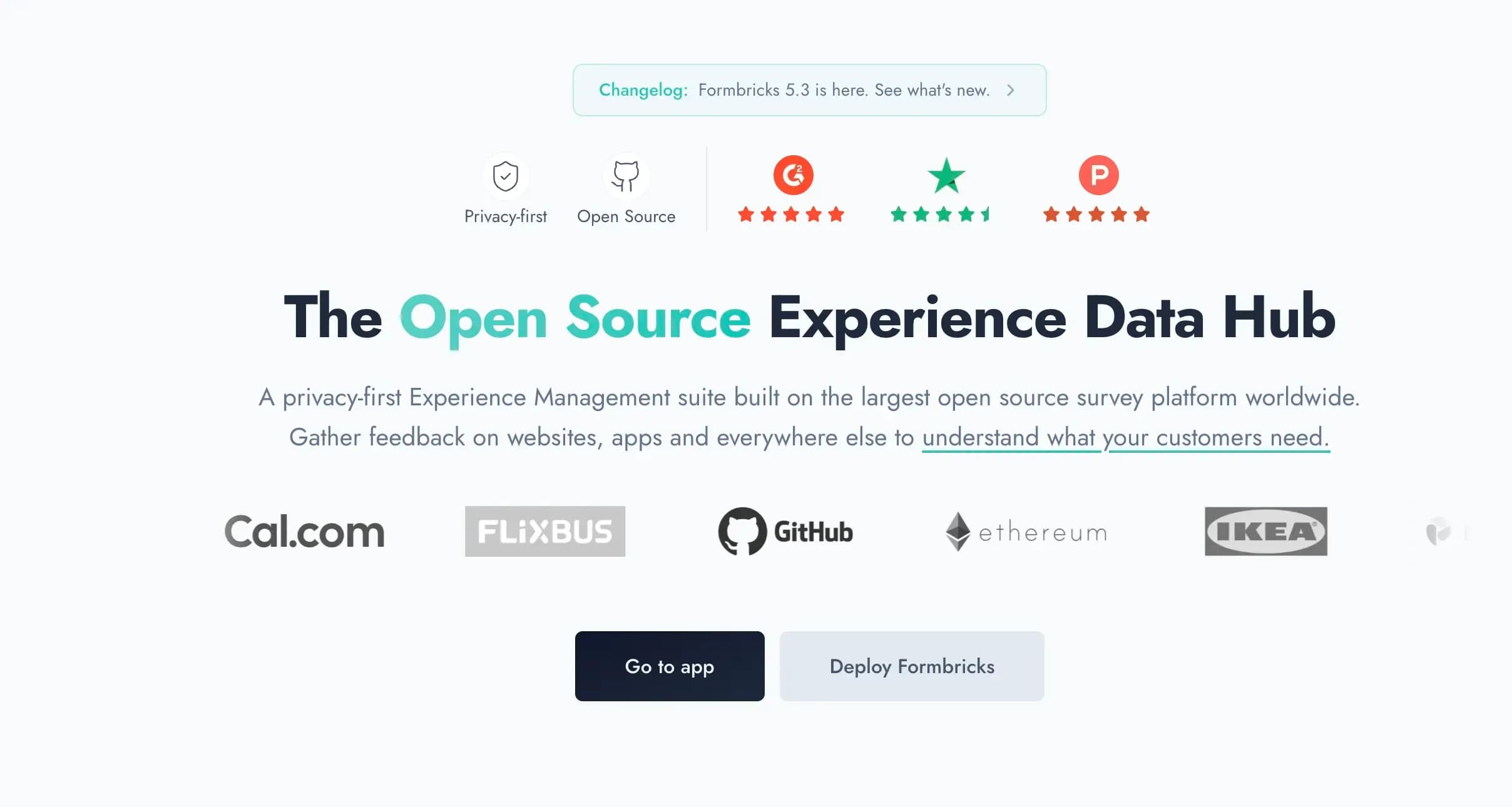
Why it's on this list anyway: a real share of people searching "Productboard alternatives" are trying to solve a broader feedback problem and land on Productboard because it's the best-known name in the space, even though what they actually need is a way to run structured NPS, CSAT, or PMF surveys, something Productboard's note-shaped feedback repository was never built to do. If that's your real gap, Formbricks is the collection tool, not a Productboard replacement.
Key features:
- Multi-channel surveys: link surveys, website pop-ups, in-app micro-surveys, and email-embedded surveys
- Attribute-based targeting and segmentation for in-product surveys
- Feedback analytics: aggregate and per-response views, drop-off tracking, custom segmentation
- Formbricks Workflows for post-response automation
- Open API and webhooks free on every tier, including MCP and the self-hosted Community Edition
- iOS and Android SDKs for native in-app surveys
- Native integrations to Salesforce, HubSpot, Slack, Google Sheets, and Notion
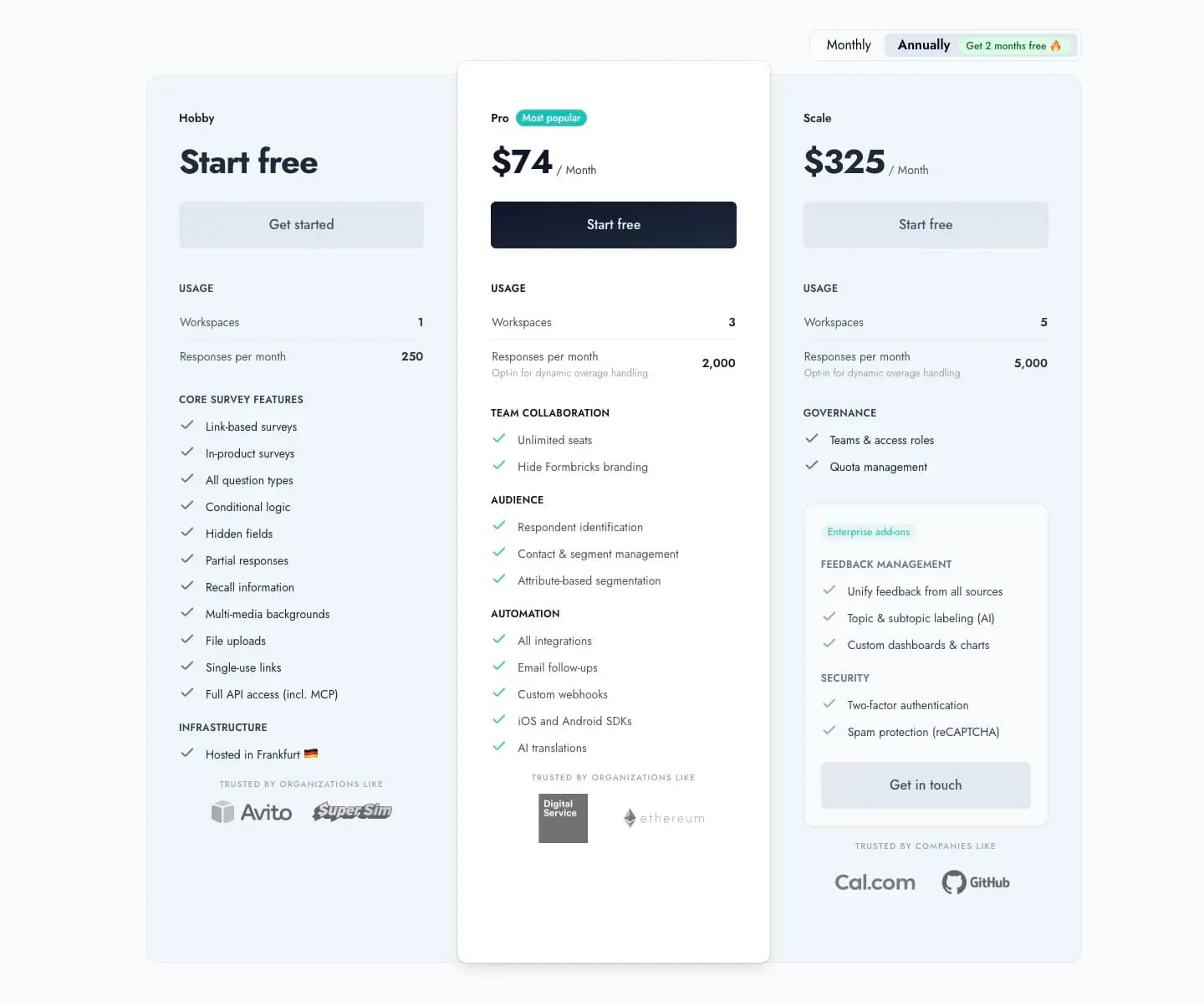
Formbricks Pricing (verified from formbricks.com/pricing, August 2026):
- Hobby (Free): 250 responses/month, 1 workspace, full API access including MCP, hosted in Frankfurt
- Pro: $89/month billed monthly, or $74/month billed annually ($890/year), 2,000 responses/month, 3 workspaces, unlimited seats, branding removal, attribute-based segmentation, all integrations
- Scale: $390/month billed monthly, or $325/month billed annually, 5,000 responses/month, 5 workspaces, teams and access roles
- Enterprise: Custom pricing, contact sales
- Community Edition (self-hosted): Free forever, AGPLv3, unlimited surveys and responses
Who should use Formbricks:
- Your actual gap is collecting structured feedback (NPS, CSAT, PMF, in-app micro-surveys), not roadmapping or prioritization, Productboard doesn't do this and neither do the other 7 tools on this list
- You're in a regulated industry with a data-residency requirement that rules out cloud-only tools
- You want transparent, published pricing and a generous free tier without a maker-based or AI-credit pricing model
- You'd pair Formbricks with a roadmapping tool like the ones below, using surveys to measure whether what you shipped actually moved the needle
2. Aha!: Best for Strategic Roadmapping Tied to Company Goals
Aha! is one of the longest-running product management platforms, built around connecting day-to-day roadmap execution to company-level strategy and goals.
Key features:
- Timeline-based roadmaps with goal and initiative tracking layered on top
- Public ideas portal where customers post and vote on feature suggestions
- Custom fields and extensive reporting for teams scaling across a large organization
- A separate "Ideas" product for feedback capture alongside the core "Roadmaps" product
Why choose Aha! over Productboard: Aha!'s roadmaps tie directly to defined company objectives and key results, so prioritization decisions trace back to strategy rather than living in a standalone prioritization formula the way Productboard's does. Reviewers note this makes it stronger for organizations that need to justify roadmap decisions upward to leadership.
Aha! Pricing: Roadmaps starts at $59/user/month (billed annually) and goes up to $149/user/month; Ideas is priced separately at $39 or $59/user/month. Most teams need both products to cover the full workflow, per Aha!'s own pricing page. G2 rating: 4.3/5. Capterra rating: 4.7/5.
Who should use Aha!: Larger, often project-oriented organizations that want roadmap decisions explicitly tied to strategic goals and OKRs, and don't mind a steeper learning curve and a two-product pricing structure (Roadmaps plus Ideas) to get full feedback-to-roadmap coverage.
3. Canny: Best for AI-Driven Feedback Capture and Public Voting
Canny was founded in 2017 by Sarah Hum and Andrew Rasmussen and has grown to 100,000+ registered companies. Its Autopilot feature reads support tickets, sales calls (via Gong), and chat tools like Intercom and Slack to automatically capture and deduplicate feedback without manual entry.
Key features:
- Autopilot AI feedback capture across support, sales, and chat conversations
- Revenue-linked prioritization by connecting feedback to account/MRR data via CRM integrations
- Public feedback boards, voting, and roadmap with an integrated changelog
- Integrations with Intercom, Zendesk, Slack, Jira, ClickUp, Linear, GitHub, HubSpot, and Salesforce
Why choose Canny over Productboard: Canny's own comparison page argues that Productboard "is an overly complex tool with more customization options than you really need," and multiple Capterra reviewers cited in that comparison describe Productboard's onboarding as long and its customization as more granular than most teams need. Canny also offers a public API on every plan, where Productboard reserves API access for higher tiers, according to Canny's published comparison research.
Canny Pricing: Free (25 tracked users, unlimited feedback, 5 managers), Pro at $79/month billed yearly (100+ tracked users, PM integrations, 10 managers), and a custom Business tier (5,000+ tracked users, SSO, CRM integrations). Billing is by "tracked users," anyone who's given feedback via a post, vote, or comment, not total end users. G2 rating: 4.5/5 (108 reviews). Capterra rating: 4.6/5 (77 reviews).
Who should use Canny: Teams that want an AI agent to automatically mine sales calls and support tickets for feature requests, plus a public voting board and roadmap, without Productboard's broader strategy-and-prioritization-formula layer.
4. UserVoice: Best for Revenue-Weighted Feedback Intelligence at Enterprise Scale
UserVoice has repositioned from a classic feature-voting board into a customer-intelligence platform that ranks feedback by correlation to ACV, expansion, and churn risk rather than raw vote count.
Key features:
- Cross-tool signal aggregation from Salesforce, Gong, Zendesk, Gainsight, Jira, and Slack
- AI theme detection that surfaces emerging themes and churn-risk signals automatically
- Lets customer success managers submit feedback on behalf of a user, tying requests to specific accounts
- SOC 2 Type 2 certified, GDPR compliant, built to WCAG accessibility standards
Why choose UserVoice over Productboard: UserVoice's own FAQ explicitly distinguishes itself from Productboard and Canny, describing them as "PM-focused tools built for feedback collection and roadmap planning" without revenue weighting, while UserVoice ties every request to account-level revenue impact. For enterprise teams where product, CS, and revenue all need the same prioritized view, that's a meaningfully different workflow than Productboard's prioritization formulas.
UserVoice Pricing: No dollar figures appear on uservoice.com itself; pricing requires a demo. A vendor-submitted G2 table lists three tiers starting at $10,788/year (Growth, 200 unique end users/year), $14,388/year (Team), and $16,188/year (Strategic, 5,000 unique end users/year). There's no self-serve free tier; a 30-day trial workspace is offered after booking a demo. G2 rating: 4.5/5 (243 reviews). Capterra rating: 4.3/5 (70 reviews), though Capterra lists UserVoice mainly under Knowledge Management, reflecting its older helpdesk product line.
Who should use UserVoice: Mid-market or enterprise teams (UserVoice's G2 base skews heavily Mid-Market and Enterprise) that need feature requests weighted by revenue and churn risk across Salesforce, Gong, and Gainsight, and are comfortable with a CSM-led sales process instead of self-serve signup.
5. Featurebase: Best All-in-One Feedback, Roadmap, and Support Bundle
Featurebase bundles an AI support agent, feedback/roadmap voting, a help center, and changelogs into one subscription. Founded in 2020 by a 3-person team in Tallinn, Estonia, it's grown to 1,500+ customers including Lovable, Raycast, and OpenSea.
Key features:
- Fibi, an AI support agent that resolves customer issues across chat, Slack, and email (billed per resolution)
- Feedback hub with public boards, in-app widgets, upvoting, and automatic upvoter notifications when a request ships
- AI-powered help center with multi-brand and multilingual (40+ languages) support
- No-code workflow builder for SLAs, round-robin assignment, and automations (Professional tier and above)
Why choose Featurebase over Productboard: Featurebase bundles feedback collection with a full helpdesk and knowledge base in one subscription, useful if you're currently paying for Productboard plus a separate support tool like Intercom or Zendesk. Its Free tier also includes a genuine feedback board and roadmap, where Productboard's Free tier caps out at 500 feedback notes and 25 contributors.
Featurebase Pricing: Free (1 seat, 1 feedback board, 1 roadmap, 50 help-center articles), Growth at $29/seat/month billed yearly (5 boards, 5 roadmaps, Fibi AI agent at $0.49/resolution), Professional at $59/seat/month (SSO, workflows, 10 boards/roadmaps, 20 free "Lite" seats), and Enterprise at $99/seat/month (unlimited boards/roadmaps, Salesforce/HubSpot sync). Removing Featurebase branding is a further $69/month add-on even on paid plans. G2 rating: 4.7/5 (50 reviews).
Who should use Featurebase: Startups and product teams that want feedback collection, a public roadmap, a changelog, and AI-assisted support in one lower-cost tool, rather than paying for Productboard and a separate helpdesk platform.
6. airfocus: Best for Flexible Prioritization Frameworks
airfocus (now part of Lucid) positions itself specifically against Productboard's rigidity, arguing that agile teams need customizable prioritization models rather than one built-in formula.
Key features:
- Multiple prioritization frameworks (RICE, MoSCoW, Priority Poker, and fully custom scoring criteria)
- Roadmaps that adapt across timeline, Now/Next/Later, and OKR-driven views
- AI Assist with built-in prompts and slash commands for faster roadmap and brief creation
- Transparent, published per-user pricing rather than a sales-gated model
Why choose airfocus over Productboard: airfocus's own comparison research argues Productboard's roadmap templates don't flex well to OKR-driven workflows or custom prioritization criteria beyond what's built in, forcing teams into Productboard's specific way of working. airfocus also publishes real per-user pricing on its Core tier, where Productboard's Business and Enterprise tiers require a sales conversation.
airfocus Pricing: Core is $59/user/month, including templates, team workspaces, and Board/Timeline/Table/Chart views, per airfocus's own pricing page as tracked by Capterra. Scale (Priority Poker, portfolio and Gantt views) and Enterprise (OKRs, API access) are both custom-quote tiers.
Who should use airfocus: Agile product teams that want to keep a specific prioritization framework (RICE, MoSCoW, or a fully custom model) tightly connected to the roadmap, without being boxed into Productboard's built-in prioritization formula.
7. ProductPlan: Best for Simple, Visual Roadmap Sharing
ProductPlan focuses specifically on building and sharing clean, presentation-ready roadmaps, without Productboard's broader feedback-repository and AI layer.
Key features:
- Drag-and-drop roadmap builder with unlimited viewer licenses on every plan
- Multiple roadmap views (timeline, swimlane, and Now/Next/Later) built for stakeholder presentations
- Integrations with Jira, Azure DevOps, and Slack for keeping roadmaps synced to delivery work
- Dedicated CSM and custom onboarding included on the Professional tier
Why choose ProductPlan over Productboard: ProductPlan is a lighter, roadmap-first tool without Productboard's AI feedback-synthesis layer or maker-based AI credit system. For teams that just need to build and share a clean roadmap, that's less complexity and a lower learning curve than adopting Productboard's full feedback-to-roadmap workflow.
ProductPlan Pricing: Basic at $39/editor/month billed annually ($49/editor/month billed monthly), unlimited product roadmaps and viewer licenses; Professional at $79/editor/month (dedicated CSM, custom onboarding, security assessment support); Enterprise is custom-quote. A 14-day free trial is available; there's no free tier.
Who should use ProductPlan: Teams that want a simple, visual roadmap tool for stakeholder communication and don't need Productboard's built-in feedback repository, AI agent, or prioritization-formula layer.
8. Chisel: Best for an AI PM Agent Plus Feedback and Roadmap Alignment
Chisel combines an AI-powered PM assistant with customer feedback and roadmap tools, aimed at automating routine PM work while keeping stakeholders aligned.
Key features:
- AI PM agent that generates PRDs, release notes, and status updates from templates
- Customer feedback collection and analysis linked directly to customizable roadmaps
- Team Radar, a shared view of priorities meant to keep stakeholders aligned on what's next
- Treeview dashboard that prioritizes features by impact, revenue, and effort
Why choose Chisel over Productboard: Chisel's AI PM agent extends further into document generation (PRDs, release notes, competitive research) than Productboard's Spark, which focuses more narrowly on spec drafting from feedback. Chisel also publishes a per-maker starting price with a free plan, where Productboard's comparable AI-and-roadmap bundle sits on its paid Business tier.
Chisel Pricing: Free plan available; paid plans start from $7/maker/month, per Chisel's own pricing as tracked by independent review site CPO Club.
Who should use Chisel: Smaller product teams that want AI automation for PM busywork (PRDs, status updates, research) bundled with lightweight feedback and roadmap tools, at a lower entry price than Productboard's Business tier.
How to Choose the Right Productboard Alternative
Start With What You Actually Need
- Roadmapping tied to company strategy and OKRs: Aha! or airfocus
- AI-driven feedback capture from sales and support conversations: Canny
- Revenue-weighted feedback intelligence at enterprise scale: UserVoice
- An all-in-one feedback, roadmap, and support bundle: Featurebase
- A simple, visual roadmap without the feedback-repository layer: ProductPlan
- AI PM automation on a smaller budget: Chisel
- You're missing the collection layer entirely, not the roadmapping layer: Formbricks
Then Evaluate These Criteria
| Criteria | Questions to Ask |
|---|---|
| Pricing model | Per maker, per seat, per tracked user, or usage-based? How does that scale as your team grows? |
| API access | Is it free on every tier, or gated behind a higher plan the way Productboard gates it? |
| What you're replacing | Roadmapping and prioritization, or the ability to collect structured feedback in the first place? |
| Data residency | Can you self-host, or is everything vendor-hosted cloud-only? |
| AI feature limits | Does the AI layer have a hard usage cap (like Productboard's monthly credit system), or is it unlimited? |
The Roadmapping-vs-Collection Gap
None of the seven roadmap-focused or feedback-intelligence tools on this list, Aha!, Canny, UserVoice, Featurebase, airfocus, ProductPlan, or Chisel, are built around structured survey methodology (NPS, CSAT, PMF question logic and response analytics). Formbricks is the exception, but it solves a different problem than Productboard's roadmapping core. If you need both, expect to run two tools: one for deciding what to build, one for measuring whether it worked.
Productboard Alternatives FAQ
The Final Verdict
Productboard remains a strong choice for product teams that want an AI agent turning feedback into delivery-ready specs and roadmaps, if you can absorb the maker-based pricing, AI credit caps, and a genuine learning curve. For teams that want the same roadmapping-and-prioritization job with a different tradeoff, Aha! ties roadmaps tighter to company strategy, Canny and UserVoice lean harder into AI-driven or revenue-weighted feedback capture, Featurebase bundles in a full support suite, airfocus and Chisel offer more flexible prioritization and AI automation, and ProductPlan strips it down to simple, visual roadmap sharing.
For teams whose actual gap is further upstream, they don't have a way to run structured NPS, CSAT, or PMF surveys in the first place, Formbricks is worth a look, not as a Productboard replacement, but as the feedback-collection layer that measures whether what a roadmap tool helped you ship actually worked, with a genuinely self-hosted option none of the other seven tools here offer.
Try Formbricks now