

8 Dovetail Alternatives in 2026: Research Repositories, Feedback Tools, and One Collection-First Option

Johannes
Co-Founder @ Formbricks
13 Minutes
August 16th, 2026
Dovetail has earned its reputation as one of the most recognizable AI-native customer intelligence platforms, turning user interviews, sales calls, support tickets, and survey data into searchable, taggable insights. Teams that need to centralize and analyze qualitative research lean on it heavily.
But recent pricing changes have pushed a lot of buyers to look elsewhere. Dovetail quietly discontinued its Professional plan (previously $15/user/month billed yearly), and its pricing page now shows only a Free tier and a fully custom Enterprise tier, per PricingSaaS's tracking of the change. Third-party benchmarking from Vendr reports a median annual contract value of $21,600, with real deals ranging from $10,800 to $63,528/year, numbers you won't find anywhere on dovetail.com itself.
There's also a more fundamental point worth naming upfront: Dovetail doesn't collect feedback, it analyzes feedback collected elsewhere (interviews, calls, tickets, uploaded surveys). If what you actually need is a way to run outbound NPS®/CSAT surveys, Dovetail was never going to be that tool, no matter how its pricing changes. That distinction shapes which alternatives on this list are true substitutes and which solve an adjacent problem.
This guide covers both kinds: research-repository tools that do what Dovetail does (Condens, Marvin, Aurelius), and feedback-collection tools for teams whose real gap is upstream of Dovetail entirely.
The Best Dovetail Alternatives at a Glance
| Tool | Best For | Free Plan | Starting Price | Self-Hosted |
|---|---|---|---|---|
| Formbricks | Feedback collection with self-hosting, not a Dovetail substitute for analysis | Yes (250 responses/mo) | $74/month ($890/year) | Yes |
| Condens | Structured qualitative synthesis for research teams | No | €15/month (Lite) | No |
| Marvin | AI-assisted tagging and interview analysis | Yes | $50/user/month (Essentials) | No |
| Aurelius | Deep qualitative coding and thematic synthesis | No | $49/month (Professional) | No |
| Userbit | Evidence-linked insight synthesis with usage-based pricing | Yes | $20 (usage-based tier) | No |
| Productboard | Turning feedback into roadmaps for product teams | Yes | $19/maker/month (Plus) | No |
| Canny | Public feedback boards, voting, and roadmaps | Yes (25 tracked users) | $79/month (Pro) | No |
| Featurebase | All-in-one feedback, roadmap, changelog, and support bundle | Yes | $29/seat/month (Growth) | No |
What Is Dovetail?
Dovetail is a customer intelligence platform built to centralize and analyze qualitative research: user interviews, sales calls, support tickets, documents, and uploaded survey data. Founded in 2017 by Benjamin Humphrey and Bradley Ayers in Sydney, it's grown to 100+ employees across Sydney and San Francisco.
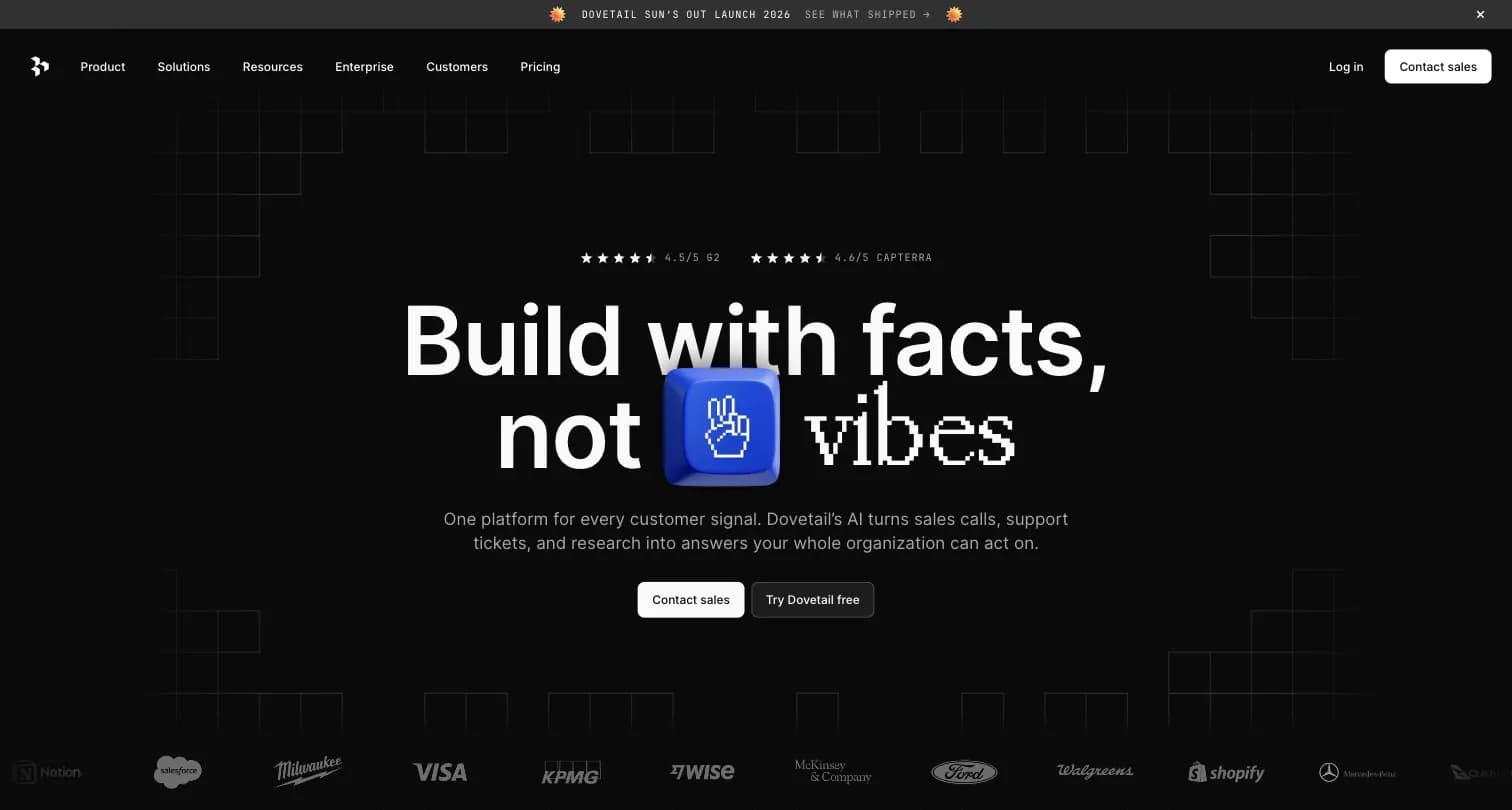
Captured August 15, 2026 from dovetail.com.
Its core strengths:
- AI analysis and tagging across 38+ integrations (Gong, Intercom, Zoom, Salesforce, Slack, Teams)
- Transcription and AI summaries that turn interviews into searchable, taggable insight libraries
- Autonomous AI Agents (Enterprise only) that track signals and proactively surface insights
Dovetail holds a 4.5 rating across 168 reviews on G2. Reviewers praise its ease of use and powerful AI-assisted tagging, but multiple verified reviews specifically call out rising costs and a confusing recent repricing that disrupted how existing repositories were set up.
Important: Dovetail is not a survey or feedback-collection tool. Its own G2 category listing spans User Research, Insight Engines, Transcription, and Text Analysis, not Survey or Feedback Management. If your team needs to actually send NPS or CSAT surveys, Dovetail was never solving that problem.
Why Teams Look for Dovetail Alternatives
1. The Pricing Model Changed, and Not in Buyers' Favor
Dovetail's own pricing page now shows only Free and custom Enterprise, no published mid-tier. The discontinued Professional plan ($15/user/month) left a real gap for teams that don't want to negotiate an enterprise contract for what used to be a self-serve purchase.
2. Real Contracts Run Well Into Five Figures
Vendr's tracked data shows a median $21,600/year contract, ranging up to $61,200/year. One verified G2 reviewer states plainly: "The prices keep going up steadily... they're pushing AI features that, in my experience, don't work very well."
3. No Native Feedback Collection
Dovetail ingests research collected through other tools. Teams that need both collection and analysis end up paying for two separate products, Dovetail for the analysis layer, and something else entirely for actually running surveys.
4. AI Chat Accuracy Is Inconsistent
Multiple G2 reviewers note that AI chat responses and tagging accuracy vary, requiring manual correction, a pattern echoed by third-party roundups from HeyMarvin and UXtweak, both of which flag "AI features lack accuracy" as a common Dovetail complaint.
5. A Steep Learning Curve for Advanced Features
G2 reviewers and UXtweak both cite a genuine learning curve, particularly around the tagging system, with multiple reviewers describing basic actions like building a highlight reel as more involved than expected for new users.
The 8 Best Dovetail Alternatives in 2026
1. Formbricks: The Feedback-Collection Option (Not a Direct Substitute)
Being direct about this upfront: Formbricks doesn't do what Dovetail does. Formbricks is a feedback and experience management suite built around feedback management (website, in-app, link, and email surveys), feedback analytics (dashboards, segmentation, drop-off tracking), and workflows and integrations. It doesn't ingest sales calls, transcribe interviews, or do AI-driven qualitative theme clustering across unstructured research the way Dovetail does.
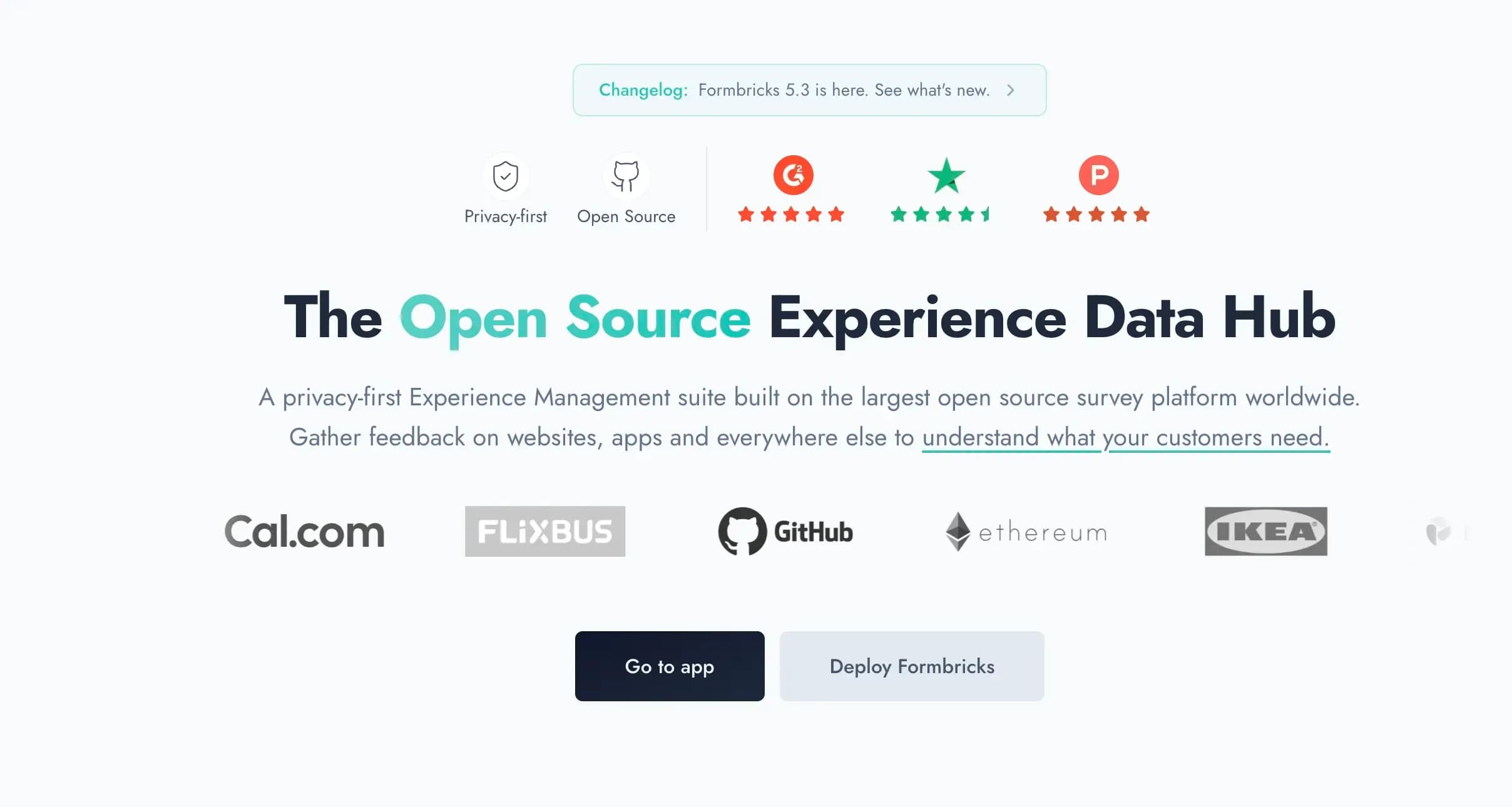
Why it's on this list anyway: a real share of teams searching "Dovetail alternatives" are trying to solve a broader problem, they want feedback insight, and Dovetail is the piece they have, but they're missing the collection layer entirely. If that's your actual gap, upstream of Dovetail, Formbricks is the collection tool you'd pair with (or use instead of building) a research repository.
Key features:
- Multi-channel surveys: link surveys, website pop-ups, in-app micro-surveys, and email-embedded surveys
- Attribute-based targeting and segmentation for in-product surveys
- Feedback analytics: aggregate and per-response views, drop-off tracking, custom segmentation
- Formbricks Workflows for post-response automation
- Open API and webhooks free on every tier, including the self-hosted Community Edition
- iOS and Android SDKs for native mobile surveys
Pricing:
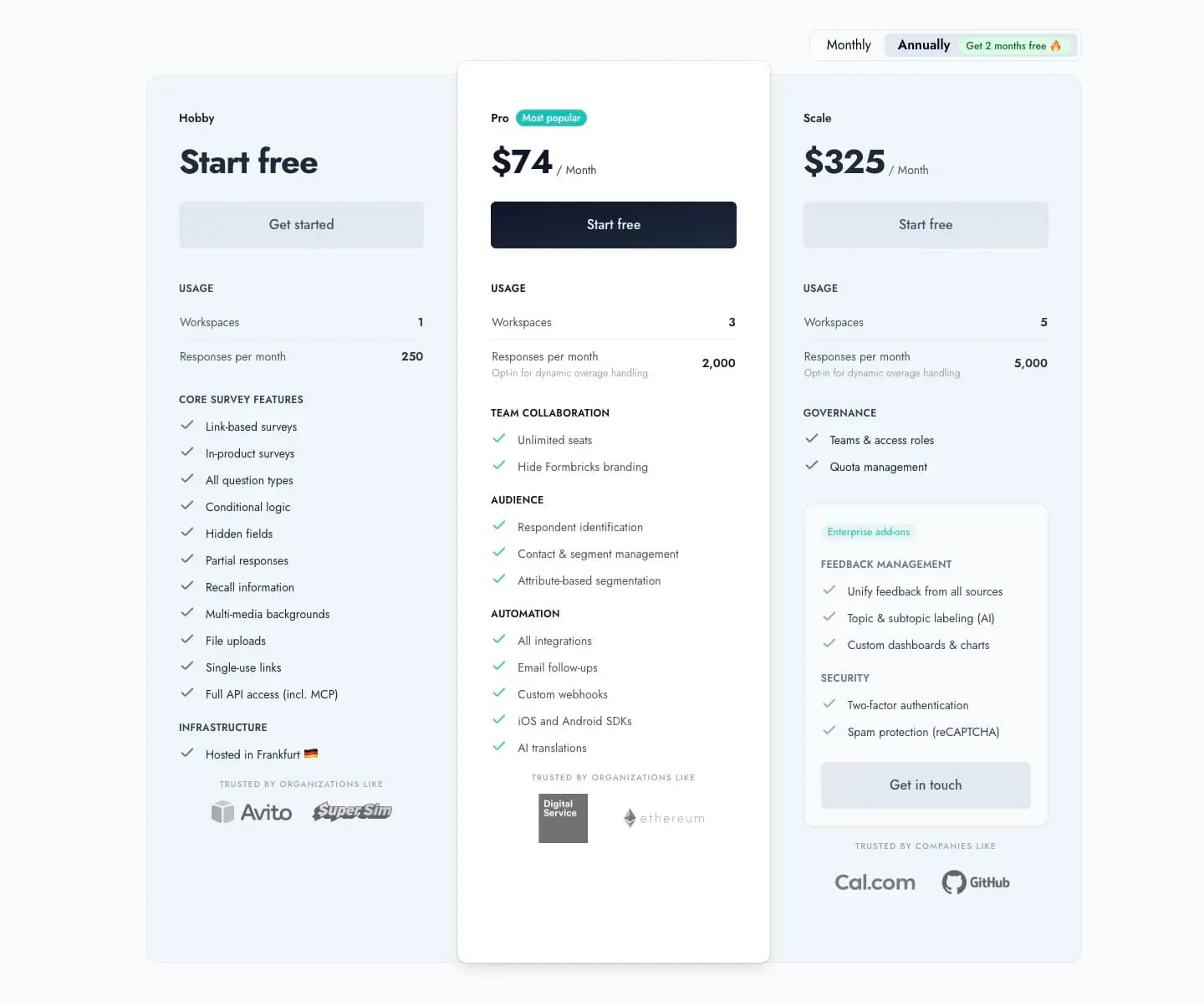
- Hobby (Free): 250 responses/month, 1 workspace, full API access including MCP
- Pro: $74/month ($890/year billed annually), 2,000 responses/month, unlimited seats
- Scale: $325/month ($3,900/year billed annually), 5,000 responses/month, teams and access roles
- Community Edition (self-hosted): Free forever, AGPLv3, unlimited surveys and responses
Best for: Teams whose actual gap is feedback collection, not analysis, especially those in regulated industries needing self-hosting, or anyone pairing a collection tool with a separate research repository like the ones below.
2. Condens: Structured Qualitative Synthesis
Condens is one of the most frequently cited direct Dovetail competitors among UX researchers, per both HeyMarvin's and UXtweak's independent roundups.
Key features:
- Qualitative coding and synthesis with evidence-linked insight libraries
- Split-screen tagging and insight generation
- Strong ResearchOps support for continuous research programs
Pricing: Lite Plan at €15/month, Business Plan starting at €500/month, custom Enterprise plan.
Best for: Research teams that want transparency and flexibility across methods, and a tool built specifically around turning raw research into reusable insights.
3. Marvin: AI-Assisted Tagging and Analysis
Marvin positions itself directly against Dovetail and is ranked a top Dovetail alternative on G2's own alternatives page.
Key features:
- AI-powered transcription, tagging, and real-time note organization
- Playlists combining video/audio clips into stakeholder-ready highlight reels
- Unlimited anonymous viewers on all plans for cross-team accessibility
Pricing: Free tier available, Essentials Plan at $50/user/month, Standard Plan at $100/user/month, custom Enterprise plan. 15-day free trials on paid tiers.
Best for: Teams that want Dovetail's core workflow (transcription, tagging, AI summaries) with a stronger emphasis on live, real-time tagging during interviews.
4. Aurelius: Deep Qualitative Coding
Aurelius is popular with researchers who want powerful thematic synthesis without heavy process overhead.
Key features:
- Advanced coding, tagging, and affinity mapping
- Insight linking directly to source evidence
- Unlimited users on its pricing model, no per-seat fees
Pricing: Professional Plan at $49/month, Premium Plan at $199/month, custom Enterprise plan (all billed yearly).
Best for: Teams prioritizing synthesis quality and simple, non-per-seat pricing over broad stakeholder access.
5. Userbit: Evidence-Based Insight Synthesis
Userbit emphasizes linking insights directly to research evidence, keeping findings structured and defensible for stakeholders.
Key features:
- Research synthesis boards with evidence-based insight linking
- Interview and note management
- Team collaboration tools
Pricing: Free tier available, a usage-based tier starting around $20, and an unlimited version at $199/month.
Best for: Teams that want a balance of flexibility and rigor, with a lower entry price than Condens or Aurelius.
6. Productboard: Turning Feedback Into Roadmaps
Productboard shows up in Dovetail alternative roundups specifically for teams whose end goal is prioritization and roadmapping, not just insight storage.
Key features:
- Spark AI agent that surfaces product opportunities with citations and drafts delivery-ready specs
- Centralized feedback repository with AI-powered trend surfacing
- Customer-facing portal for sharing roadmaps and closing the loop
Pricing: Free tier (1 maker, 25 contributors, 500 feedback notes), Plus at $19/maker/month billed annually, Business at $59/maker/month (2-maker minimum), custom Enterprise (5-maker minimum).
Best for: Product teams that want feedback synthesis to flow directly into a prioritized roadmap rather than staying in a standalone research repository.
7. Canny: Public Feedback Boards and Voting
Canny targets a different job entirely: public feature-request boards with AI-driven capture from sales and support conversations.
Key features:
- Autopilot AI reads support tickets and sales calls (Gong) to automatically capture and deduplicate feedback
- Revenue-linked prioritization via CRM integrations
- Public feedback boards, roadmap, and changelog in one lightweight tool
Pricing: Free (25 tracked users), Pro at $79/month billed yearly (100+ tracked users), custom Business tier (5,000+ tracked users, SSO).
Best for: Teams whose real need is a public voting board and roadmap, not qualitative interview analysis.
8. Featurebase: All-in-One Feedback, Roadmap, and Support Bundle
Featurebase bundles feedback boards, roadmaps, changelogs, a help center, and AI-powered support into one subscription, positioning itself as a lower-cost, faster-to-onboard alternative for teams evaluating Dovetail for product feedback specifically.
Key features:
- AI duplicate-post detection and AI-powered search across feedback
- Feedback boards, roadmaps, and changelog in one platform
- Automated migration tooling specifically built for teams switching from Dovetail
Pricing: Free (1 seat, 1 feedback board, 1 roadmap), Growth at $29/seat/month billed yearly, Professional at $59/seat/month, Enterprise at $99/seat/month.
Best for: Startups and product teams that want feedback collection, a public roadmap, and a changelog in one tool, at a lower price than Canny's comparable tiers.
How to Choose the Right Dovetail Alternative
Start With What You Actually Need
- Qualitative research synthesis at Dovetail's depth: Condens, Marvin, or Aurelius
- A cheaper repository with evidence-linked insights: Userbit
- Feedback that flows straight into a roadmap: Productboard
- A public voting board and changelog: Canny or Featurebase
- You're missing the collection layer entirely, not the analysis layer: Formbricks
Then Evaluate These Criteria
| Criteria | Questions to Ask |
|---|---|
| Pricing predictability | Is there a published mid-tier, or only Free and custom Enterprise? |
| Data residency | Can you self-host, or is everything vendor-hosted cloud-only? |
| What you're actually replacing | Analysis of existing research, or the missing ability to collect it in the first place? |
| AI accuracy tolerance | Are you comfortable manually correcting AI tagging and summaries? |
| Team size and seat pricing | Does the tool charge per seat, per tracked user, or per maker, and how does that scale for you? |
The Data Residency Gap
None of the seven analysis-focused or roadmap-focused tools on this list, Condens, Marvin, Aurelius, Userbit, Productboard, Canny, or Featurebase, publish a self-hosted deployment option anywhere in their documentation. Formbricks is the exception among all eight, its Community Edition is free and self-hostable under an AGPLv3 license, though again, it solves a different problem than Dovetail's research-analysis core.
Dovetail Alternatives FAQ
The Final Verdict
Dovetail remains a strong AI-native research repository, but its recent shift to Free-or-Enterprise-only pricing, combined with real contract values reported by Vendr running from $10,800 to $61,200/year, has pushed a lot of buyers to look elsewhere.
For teams that need what Dovetail does, qualitative research synthesis, Condens, Marvin, and Aurelius are the closest direct substitutes, each with published, more predictable pricing. For teams that want feedback tied directly to a roadmap, Productboard, Canny, and Featurebase solve an adjacent problem well.
For teams whose actual gap is further upstream, they don't have a way to collect feedback in the first place, Formbricks is worth a look, not as a Dovetail replacement, but as the collection layer that feeds a research repository like the ones above, with a genuinely self-hosted option none of them offer.
Try Formbricks now