

8 Best Chameleon Competitors in 2026 (Including an Open-Source Feedback Alternative)

Johannes
Co-Founder @ Formbricks
12 Minutes
August 16th, 2026
Chameleon is a genuinely strong in-app guidance tool: tours, tooltips, banners, checklists, and now AI agents that help build and govern them. Microsurveys ship as one "Experience" type inside that same product, which is exactly why they stay shallow. A one-tap NPS® rating or a thumbs-up tells you a number moved, not why.
That's the gap this list covers differently than most "Chameleon competitors" roundups. Most rank tools purely on in-app guidance depth. This one also asks: if the reason you're shopping is that Chameleon's feedback side feels thin, which of these actually fixes that?
What Is Chameleon?
Chameleon was founded in 2015 by Pulkit Agrawal and Brian Norton, backed by True Ventures at seed and Matrix at Series A. The company describes its mission as building context on a product and its users, identifying friction, creating personalized in-app guidance, and monitoring outcomes, a "self-improving product system."
Chameleon has grown to 40+ employees across 30+ cities and 10+ countries, serving 400+ customers, and reports a 97% overall customer satisfaction rating on its own About page (a self-reported figure distinct from its 4.4/5 rating across 362 reviews on G2).
Chameleon's core product areas:
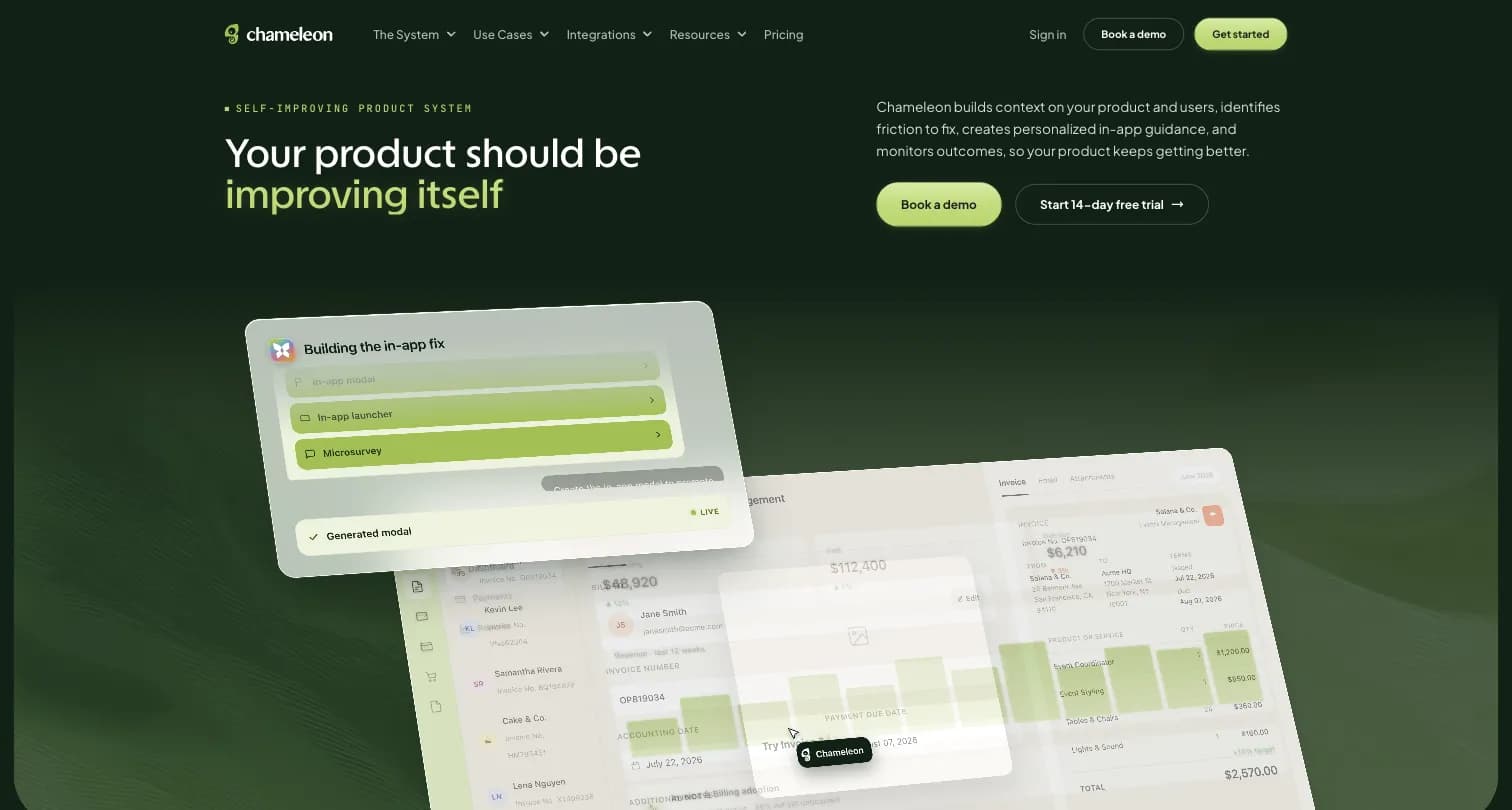
Captured August 15, 2026 from chameleon.io.
- In-app Experiences: Tours, Tooltips, Banners, Checklists, and Embeds, built with a no-code editor
- Microsurveys: In-app feedback collection, positioned as one Experience type alongside tours and tooltips
- AI Agents: Copilot (builds and analyzes experiences), Compass (behavior context), Prism (personalization), Ranger (governance and cleanup)
- Interactive Demos & HelpBar: AI-recorded product demos and an in-app help search bar
- MCP server: Query Chameleon data through Claude or other MCP-compatible AI tools
Why Companies Look for Chameleon Competitors
1. No Forever-Free Tier
Chameleon's cheapest plan, Startup, starts at $279/month for 2,000 Monthly Tracked Users (MTUs). There's no permanent free tier, only a 14-day trial with full Enterprise-level access and no credit card required.
2. Inconsistent Tier Labeling on the Pricing Page
Chameleon's own pricing page shows a "Startup" plan card at $279/month for 2,000 MTUs, while a separate feature-comparison table starts at "Pro," which the page's FAQ text states begins at $750/month self-serve for a 5,000-MTU anchor. The two don't fully reconcile, one is a promoted card, the other only appears in a comparison table and an FAQ answer.
3. Microsurveys Are Secondary to In-App Guidance
G2 reviewers specifically flag that Chameleon's microsurveys aren't highly customizable, for example, you can't tailor the "thank you" response shown per rating given. This lines up with Chameleon's own product structure: microsurveys are one Experience type among tours, tooltips, banners, and checklists, not the platform's primary wedge.
4. Growth and Enterprise Tiers Have No Public Price
Both tiers are "talk to us" only, with MTU-based scaling beyond the two published anchor points ($279 at 2,000 MTU, roughly $750 at 5,000 MTU) left undisclosed.
5. No Self-Hosting Option
No self-hosting or on-premise deployment is mentioned anywhere on Chameleon's site, which rules it out for regulated buyers who need data to stay on their own infrastructure regardless of budget.
Chameleon Competitors at a Glance
| Competitor | Best For | Free Plan | Starting Price | Open Source |
|---|---|---|---|---|
| Formbricks | Open-source feedback and experience management with self-hosting | Yes (250 responses/mo) | $89/month ($74/month billed annually) | Yes |
| Appcues | No-code in-app onboarding at scale | No | ~$249/month (Essentials, annual) | No |
| Userpilot | Product adoption bundled with analytics | No | $299/month (Starter) | No |
| Pendo | Enterprise product analytics and in-app guidance | Yes (500 MAU) | Custom (Base tier) | No |
| WalkMe | Complex enterprise and internal-software rollouts | No | Custom, quote-only | No |
| UserGuiding | Budget no-code onboarding builder | Not independently verified | Not independently verified | No |
| Whatfix | Regulated, training-heavy enterprise rollouts | Not independently verified | Not independently verified | No |
| Userflow | Lower-cost product adoption at similar MTU scale | Not independently verified | Not independently verified | No |
Pricing for UserGuiding and Whatfix wasn't independently confirmed and is left blank rather than estimated.
The 8 Best Chameleon Competitors in 2026
1. Formbricks: The Open-Source Pick for Teams That Only Wanted the Feedback Side
If the reason you're evaluating Chameleon competitors is that microsurveys feel like an afterthought, not the tours and tooltips, Formbricks is built for exactly that gap.
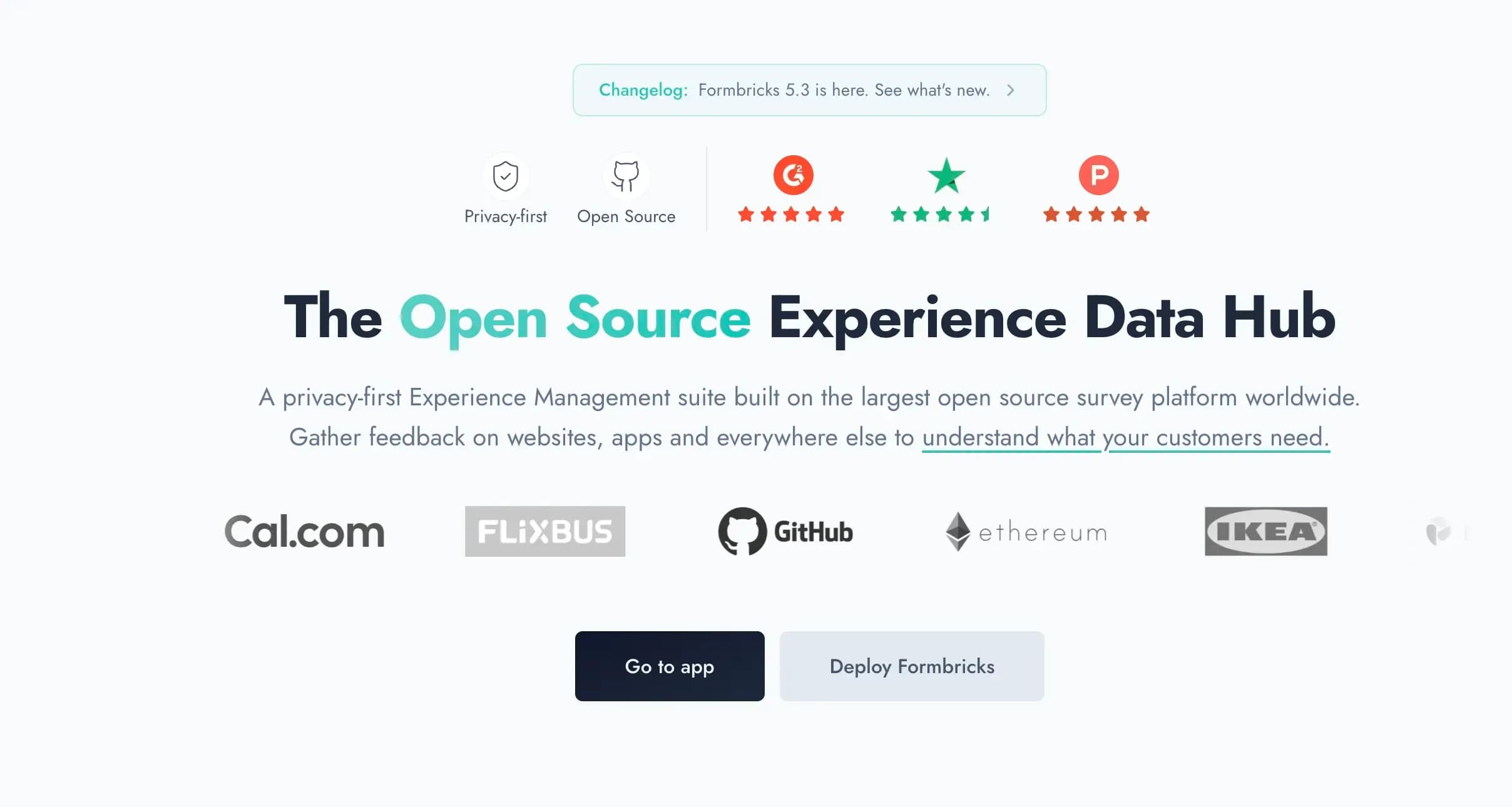
Why it stands out as a Chameleon competitor:
Formbricks is an open-source feedback and experience management suite built around three pillars: feedback management (website, in-app, link, and email surveys unified on one platform, instead of a microsurvey type bolted onto an in-app guidance tool), feedback analytics (response dashboards, drop-off tracking, and segmentation), and workflows and integrations (Formbricks Workflows for post-response automation, plus native integrations to Salesforce, HubSpot, Slack, Google Sheets, and Notion, all through a free API on every tier).
Why choose Formbricks over Chameleon:
1. Feedback is the entire product, not one Experience type among five. Chameleon's microsurveys share a builder with tours, tooltips, banners, and checklists, and G2 reviewers specifically call out limited customization, like being unable to tailor thank-you responses per rating. Formbricks' entire product is built around collecting and acting on feedback, with attribute-based targeting and branching logic as core functionality, not an add-on Experience type.
Formbricks in Action: A product team that adopted Chameleon for onboarding tours finds its NPS microsurvey responses hard to segment by more than a basic trigger. Moving the feedback program to Formbricks means dedicated survey logic without needing to work around a guidance-first builder.
2. A real free-forever tier instead of a 14-day trial. Chameleon has no permanent free plan, only a 14-day trial with full Enterprise access. Formbricks' Hobby plan is free forever, with 250 responses/month and full API access, including MCP, from day one.
3. Self-hosting closes a compliance gap Chameleon can't close at any price. No self-hosting option appears anywhere on Chameleon's site. Formbricks' Community Edition, licensed under AGPLv3, is free and self-hostable on your own infrastructure, giving regulated buyers a path Chameleon simply doesn't offer.
Formbricks in Action: A healthcare organization collecting patient satisfaction data deploys Formbricks on infrastructure it controls, something no Chameleon tier, including Enterprise, can match.
Key features:
- Link surveys, website pop-ups, in-app micro-surveys, and email-embedded surveys, all in one platform
- Feedback analytics with drop-off tracking, completion rates, and response-level detail
- Formbricks Workflows for post-response automation, plus native integrations via webhooks
- Full API and MCP access on every tier, including the free plan
- Attribute-based segmentation for in-app surveys
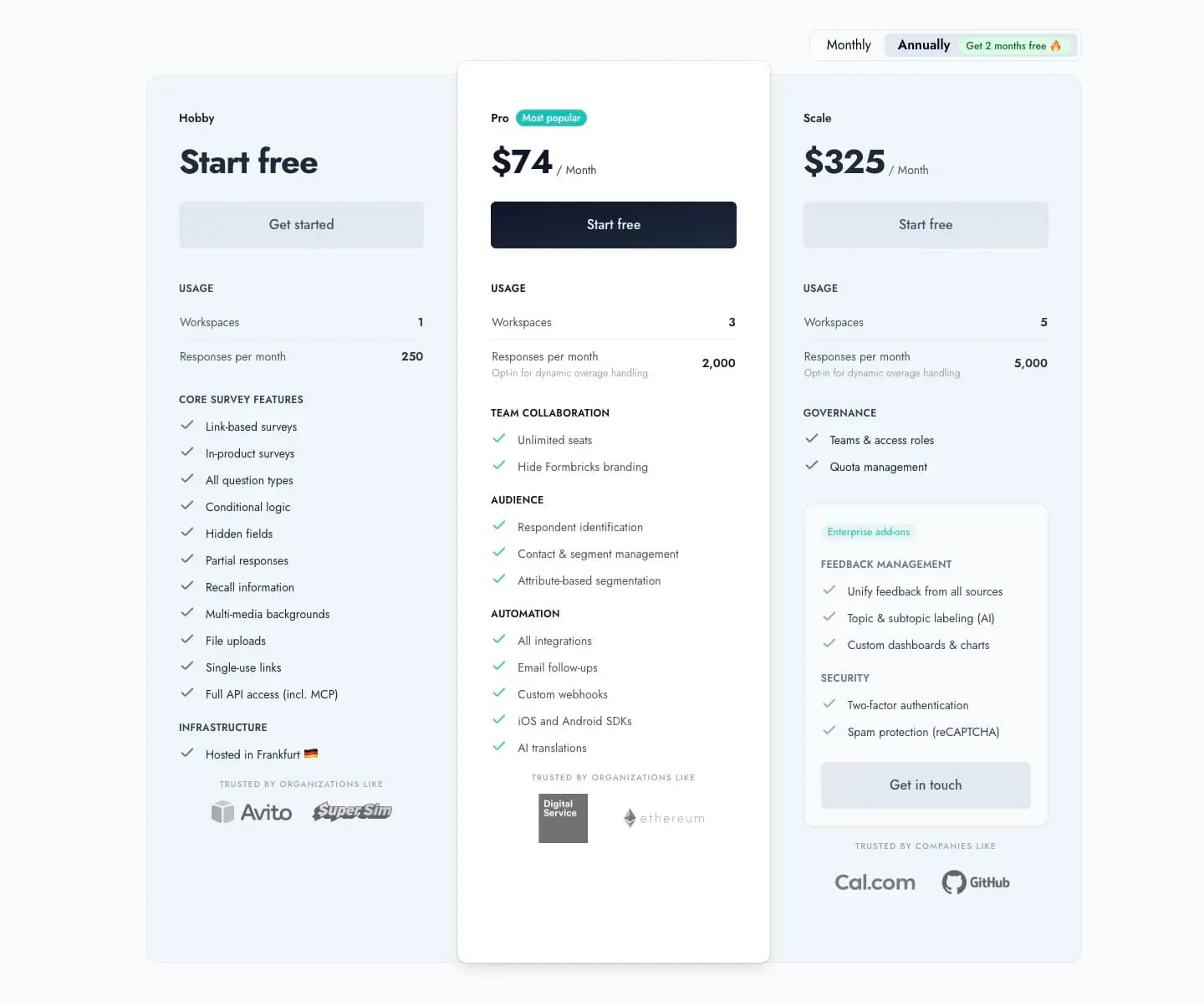
Pricing (verified live from formbricks.com/pricing):
| Plan | Price | Workspaces | Responses/month |
|---|---|---|---|
| Hobby | Free | 1 | 250 |
| Pro | $89/month, or $74/month billed annually ($890/year) | 3 | 2,000 |
| Scale | $390/month, or $325/month billed annually ($3,900/year) | 5 | 5,000 |
The self-hosted Community Edition is free forever and unlimited, with a separate self-hosted Enterprise Edition available on request.
Who should use Formbricks:
- You adopted Chameleon for tours and tooltips but need deeper, dedicated survey logic than a microsurvey Experience type provides
- You need a self-hosted or data-residency path Chameleon doesn't offer at any tier
- You want a real free-forever tier instead of a 14-day trial
- You want feedback management, analytics, and workflows as your core product, not a bolt-on
2. Appcues: Best No-Code In-App Onboarding at Scale
Appcues is one of Chameleon's most direct head-to-head competitors for in-app onboarding, with a mature flow builder, checklists, and a launchpad feature.
How it compares to Chameleon: Both share the same shallow-feedback pattern, Appcues' listening layer is also NPS and short in-app polls rather than deep survey logic, so the two are closely matched on that dimension. Third-party buyer data from Vendr lists Appcues' starting list price at roughly $249/month (Essentials, annual), with typical annual contracts in the $6,000-$15,000 range for 5,000-10,000 users and $25,000-$50,000+ for 20,000+ users.
Key features:
- No-code flow builder, checklists, and launchpad
- Solid audience segmentation for targeting flows
- NPS and in-app poll-based feedback
Who should use Appcues: SMB and mid-market teams that want polished, no-code onboarding flows without engineering, and don't need deep survey logic from the same tool.
3. Userpilot: Best Product Adoption Bundled With Analytics
Userpilot pairs in-app engagement (flows, tooltips, checklists, resource centers) with its own product analytics suite, letting teams see which cohorts complete an onboarding flow and which drop off.
How it compares to Chameleon: Userpilot's Starter tier begins at $299/month for up to 2,000 Monthly Active Users, including in-app engagement, user segmentation, and basic NPS surveys. Its Growth tier starts "from $849/month" for advanced product analytics, event autocapture, and advanced in-app surveys, according to Userpilot's own pricing page. Both tools share the same limitation on the feedback side: surveys are a feature within a broader onboarding and analytics platform, not the dedicated product.
Key features:
- Advanced product analytics: funnels, trends, retention, paths
- No-code flows, tooltips, banners, checklists, resource center
- NPS and in-app survey capability from the Starter tier up
- AI agent "Lia" for data analysis and an MCP server for external AI tools
Who should use Userpilot: Teams that want onboarding flows and product usage analytics under one roof, and are comfortable with surveys as a secondary feature rather than the primary buying driver.
4. Pendo: Best Enterprise Product Analytics and In-App Guidance
Pendo is the broadest, most enterprise-oriented alternative on this list, bundling product analytics, in-app guides, session replay, and now AI agent adoption tracking into one platform used by 14,000+ companies according to the company.
How it compares to Chameleon: Pendo's Free tier supports up to 500 Monthly Active Users with Product Analytics, In-app Guides, and Pendo-branded NPS surveys. Every paid tier above that, Base, Core, and Ultimate, is "Custom pricing" with no public number. Third-party buyer data from Vendr puts a median annual Pendo contract at $49,015, ranging from roughly $17,945 to $150,124 depending on scope. Like Chameleon, Pendo's Sentiment (NPS/PMF/CSAT) surveys are gated, in Pendo's case to the Ultimate tier or sold as a paid add-on below it.
Key features:
- Product Analytics with retroactive tracking and cross-product dashboards
- In-app Guides and Session Replay (Core tier and above)
- Sentiment surveys (NPS, PMF, CSAT) from Ultimate
- Five AI products: Leo, Agent Analytics, MCP, Insights, and Predict
Who should use Pendo: Enterprise teams that want analytics, guidance, session replay, and AI agent tracking in one platform, and don't mind a custom-quote sales process.
5. WalkMe: Best for Complex Enterprise and Internal-Software Rollouts
WalkMe is the enterprise digital adoption platform (DAP) benchmark, purpose-built for guiding employees and customers through complex, multi-application workflows like ERP and CRM systems.
How it compares to Chameleon: WalkMe's cross-application overlays go well beyond what Chameleon targets, which is primarily single-product guidance. Vendr's buyer data shows no published starting price for WalkMe, custom quote only, with typical annual contracts running $20,000-$40,000 for 5,000-10,000 users and $60,000-$150,000+ for 20,000+ users, generally higher than Chameleon or Userpilot at comparable scale. WalkMe's feedback and sentiment capabilities are described as minimal relative to its guidance depth.
Key features:
- Cross-application digital adoption overlays
- Enterprise-grade implementation and governance tooling
- Minimal qualitative feedback capability
Who should use WalkMe: Large enterprises rolling out complex or internal software across multiple applications, where guidance depth matters more than survey sophistication.
6. UserGuiding: Best Budget No-Code Onboarding Builder
UserGuiding positions itself as a value-focused alternative for SMBs that need a working onboarding flow live quickly and affordably, without Chameleon's or Appcues' more extensive feature sets.
How it compares to Chameleon: UserGuiding covers the core Chameleon use cases (tours, tooltips, checklists) at what third-party roundups describe as a lower price point, with a lighter overall feature set and shallower survey capability. Specific current pricing wasn't independently confirmed.
Key features:
- No-code tour and checklist builder
- Positioned for fast time-to-launch
- Lighter targeting and analytics than Chameleon or Userpilot
Who should use UserGuiding: Small teams and startups that need onboarding tours live this week on a constrained budget.
7. Whatfix: Best for Regulated, Training-Heavy Enterprise Rollouts
Whatfix rounds out the enterprise DAP category alongside WalkMe, with strong in-app content, self-help widgets, and training-documentation generation.
How it compares to Chameleon: Whatfix is positioned for regulated or training-intensive environments where guidance doubles as compliance enablement, a use case Chameleon doesn't specifically target. Like WalkMe, its qualitative feedback depth is described as minimal relative to its guidance and training capabilities. Specific current pricing wasn't independently confirmed.
Key features:
- In-app content and self-help widgets
- Training-document generation
- Enterprise DAP positioning for regulated industries
Who should use Whatfix: Regulated industries and enablement-heavy rollouts where training documentation and compliance tracking matter as much as user guidance.
8. Userflow: A Lower-Cost Option at Similar MTU Scale
Userflow is named directly on Chameleon's own alternatives page as a more affordable option at comparable usage scale.
How it compares to Chameleon: Chameleon's own alternatives page positions Userflow as a lighter-weight, lower-cost product adoption platform, describing it as coming "with a solid suite of tools and customization." Userflow doesn't publish self-serve pricing, so a direct per-MTU comparison against Chameleon's Startup tier ($279/month for 2,000 MTUs) isn't independently verifiable.
Key features:
- Product tours and in-app guidance, per Chameleon's own comparison
- Lower entry price point at a larger MTU allowance than Chameleon's Startup tier
Who should use Userflow: Teams that want core in-app guidance functionality at a lower monthly cost than Chameleon's Startup tier, without needing Chameleon's AI agent layer.
The Feedback Depth Gap Most Chameleon Competitor Lists Skip
Most "Chameleon competitors" and "Chameleon alternatives" roundups rank tools on one axis: in-app guidance breadth, tours, tooltips, checklists, launch flows. That's the right lens if guidance is genuinely what you need more of.
None of them consistently separate that question from a second one: is your microsurvey data actually helping you decide what to build? Chameleon's own G2 reviewers flag limited microsurvey customization, and independent analysis of the digital adoption category makes a similar point: one-tap NPS ratings and thumbs-up polls tell you a number moved, not why.
That's the gap Formbricks fills differently than the guidance-first tools on this list. It doesn't compete with Chameleon, WalkMe, or Whatfix on cross-application tours and enterprise rollout tooling, and it isn't trying to. It's a feedback and experience management suite built around three things none of the guidance-first competitors above lead with as their core product: unified feedback management across website, in-app, link, and email surveys; feedback analytics with drop-off and segmentation built in; and Formbricks Workflows for what happens after a response comes in, plus a free API on every tier including the self-hosted Community Edition.
How to Choose the Right Chameleon Competitor
Your answer depends on which part of what Chameleon does is actually the reason you're shopping.
Start with your situation:
- You only ever used Chameleon's microsurveys, not its tours: Formbricks, since feedback is the core product rather than one Experience type
- You need polished no-code onboarding at SMB or mid-market scale: Appcues or UserGuiding
- You want onboarding flows bundled with product analytics: Userpilot
- You need enterprise-scale analytics, guides, and AI agent tracking: Pendo
- You're rolling out complex, multi-application software at a large enterprise: WalkMe or Whatfix
- You want core guidance functionality at a lower MTU price than Chameleon's Startup tier: Userflow
Then evaluate against these criteria:
| Criteria | Questions to Ask |
|---|---|
| What you actually use Chameleon for | In-app guidance, or the microsurvey feedback loop specifically? |
| Pricing transparency | Is the real starting tier shown as a headline card, or buried in a comparison table? |
| Data residency | Can you self-host if compliance requires it? |
| Survey depth | Can you customize logic and follow-up per response, or only fire a one-tap poll? |
| Scale of rollout | Single product, or complex multi-application enterprise deployment? |
If your honest answer to the first question is "the feedback loop," the rest of this list narrows fast: only Formbricks is built around feedback management, feedback analytics, and workflows as its core product, with a free, self-hosted path none of the guidance-first tools above offer.
Frequently Asked Questions
If you adopted Chameleon for its microsurveys rather than its tours and tooltips, Formbricks gives you feedback management, feedback analytics, and workflows on one platform, with a free self-hosted Community Edition and a real free-forever tier, not a 14-day trial.
Try Formbricks now