
8 Canny Alternatives in 2026: Feature-Voting Boards, AI Feedback Tools, and Where Formbricks Fits

Johannes
Co-Founder @ Formbricks
13 Minutes
August 16th, 2026
Canny built its name on a simple idea: let customers post feature requests, vote on them, and watch a public roadmap turn those votes into shipped changelog entries. That model still works. But two things are pushing teams to look for Canny alternatives in 2026: Canny's "tracked user" pricing climbs fast as your feedback program grows, and its board-based model only captures the minority of users motivated enough to visit a page and vote.
One honesty note before the list starts: this guide covers real feature-voting and roadmap tools, plus Formbricks. Formbricks is a feedback and experience management suite (surveys, feedback analytics, and workflows), not a public voting board or roadmap tool. If what you need is what Canny does, a public board where customers post and vote on ideas, Formbricks isn't a substitute. It earns a spot on this list only for the narrower, adjacent need: structured feedback collection (NPS®, CSAT, PMF surveys) that none of the seven roadmap-focused tools below treat as a first-class feature.
The Best Canny Alternatives at a Glance
| Tool | Best For | Free Plan | Starting Price | Self-Hosted |
|---|---|---|---|---|
| Formbricks | Structured feedback collection (surveys, NPS, PMF), not a roadmap tool | Yes (250 responses/mo) | $74/month ($890/year annual) | Yes |
| UserVoice | Revenue-weighted feedback intelligence for enterprise teams | No (30-day trial after demo) | $10,788/year (Growth) | No |
| Productboard | Full product-management suite: strategy, roadmaps, AI-drafted specs | Yes (1 maker) | $19/maker/month (Plus, annual) | No |
| Featurebase | All-in-one feedback, roadmap, changelog, and helpdesk bundle | Yes | $29/seat/month (Growth, annual) | No |
| Gleap | AI feedback capture bundled with support and bug reporting | 14-day trial | $149/month (Team, unlimited tracked users) | No |
| UserJot | Flat-priced, unlimited-user Canny replacement | Yes (unlimited users) | $29/month (Starter) | No |
| Sleekplan | Budget-conscious board with built-in NPS/CSAT | Yes | ~$13/month (Starter, billed annually) | No |
| Pendo | Feedback tied to in-product analytics for teams already on Pendo | Yes (500 MAU) | Custom (avg. ~$48,500/year per third-party data) | No |
What Is Canny?
Canny launched in 2017 as feature-voting boards, founded by Sarah Hum and Andrew Rasmussen, who met as a designer and engineer at Meta. The company is bootstrapped and profitable. Its positioning has since expanded to AI: "Canny uses AI to read every sales and support conversation and shows you what to build to retain customers and drive revenue growth," per its own homepage. Canny states it's used by 100K+ registered companies and has captured 15M+ feedback items.
Key features:
- Autopilot AI feedback capture, reads support tickets, sales calls (Gong), and chat tools like Intercom and Slack to automatically capture, deduplicate, and triage feedback without manual entry
- Revenue-linked prioritization, links feedback posts to account, MRR, and opportunity data via CRM integrations
- Public feedback boards, roadmap, and changelog in one lightweight tool
- Integrations with Intercom, Zendesk, Slack, Jira, ClickUp, Linear, Asana, GitHub, Azure DevOps, HubSpot, Salesforce, and Zapier
Canny pricing:
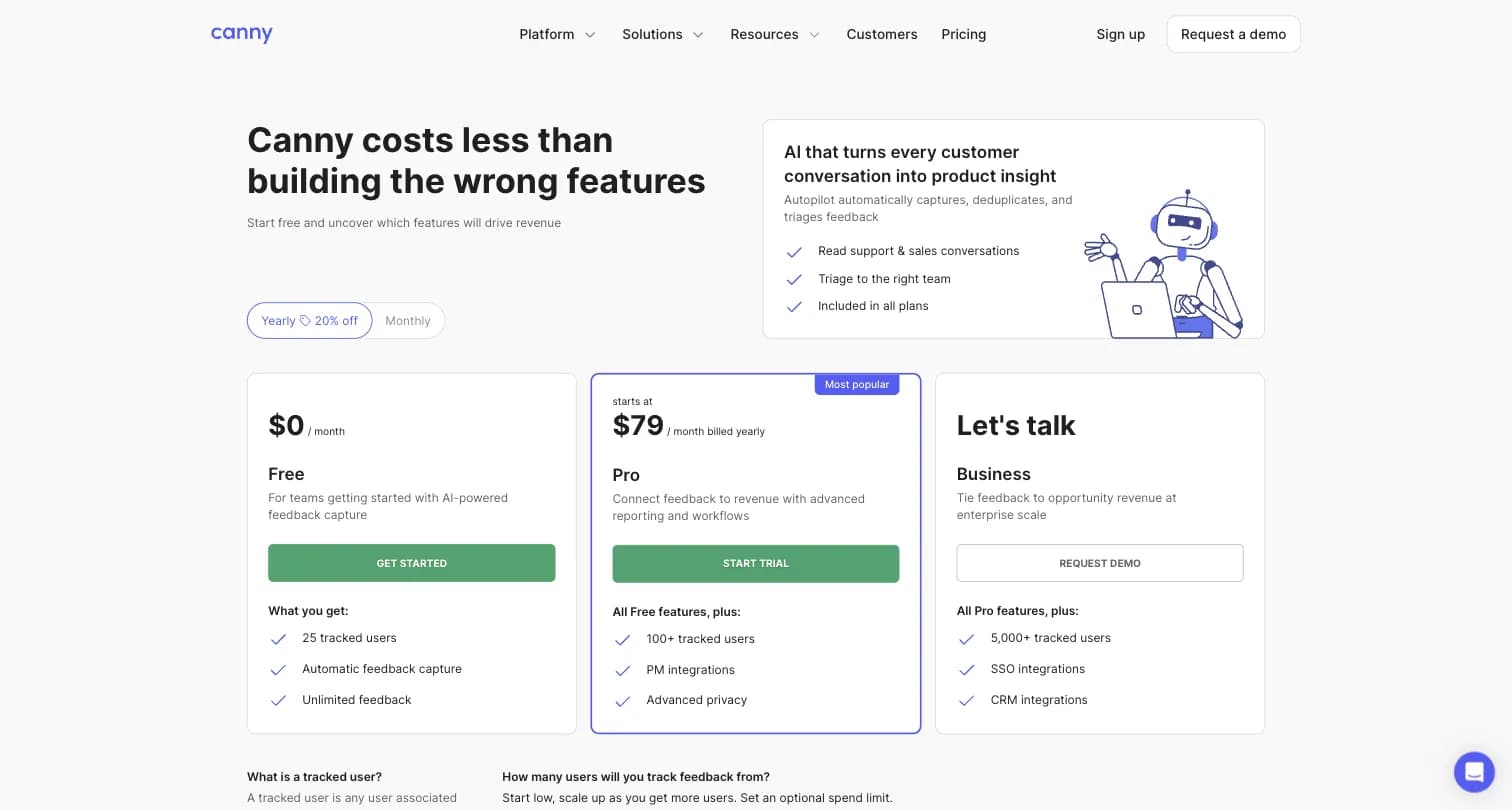
Captured August 15, 2026 from canny.io/pricing.
| Tier | Price | Tracked Users |
|---|---|---|
| Free | $0/month | 25 tracked users |
| Pro | $79/month billed yearly | 100+ tracked users |
| Business | Custom, contact sales | 5,000+ tracked users |
Canny's billing unit, "tracked users," means anyone who's given feedback via a post, vote, or comment, including feedback Autopilot finds automatically. Canny's own FAQ estimates this is typically 1-5% of a B2B SaaS company's total user base.
Reviews: 4.5 rating across 108 reviews on G2, 4.6 across 77 reviews on Capterra. Reviewers praise ease of use and the ability to merge duplicate requests and link posts to revenue data via HubSpot. Common complaints: filtering by only one attribute at a time, Autopilot sometimes merging tickets unhelpfully, and Pro-plan tracked-user caps forcing upgrade friction for growing teams.
Important: Canny has no survey-builder functionality on its own site. It captures and prioritizes feature requests, not structured quantitative research like NPS, CSAT, or PMF surveys. Teams needing both end up pairing Canny with a separate survey tool, which is exactly where a tool like Formbricks fits into this comparison, not as a Canny substitute, but as the survey layer alongside it.
Why Teams Look for Canny Alternatives
1. Tracked-User Pricing Climbs Fast as Engagement Grows
This is the single most-repeated theme across the pages ranking for "Canny alternatives" today. Per Gleap's own comparison page, Canny runs roughly $80/month at 1,000 tracked users, climbing to roughly $275/month at 10,000, and $579+/month at 50,000. Per UserJot's own comparison page, Canny Core runs $311 to $661/month at 1,000 engaged users and $499 to $1,036/month at 2,500, with Canny Pro running $99 to $1,349/month across the same range. The two sites' exact figures differ slightly since they're each vendor-published estimates, not Canny's own numbers, but the direction is consistent: cost scales with how many people actually engage, not with team size or seats.
2. The Board Only Captures the Motivated Minority
Gleap's own positioning makes a fair point regardless of which tool you pick: "Canny's model: user visits the board, searches, votes. That captures the motivated minority. The quiet majority, mentioning feature ideas in chats, emails, bug reports, goes unheard." Several of the alternatives below (Gleap, UserVoice) build their pitch specifically around auto-capturing feedback from support tickets and sales calls rather than waiting for a board visit.
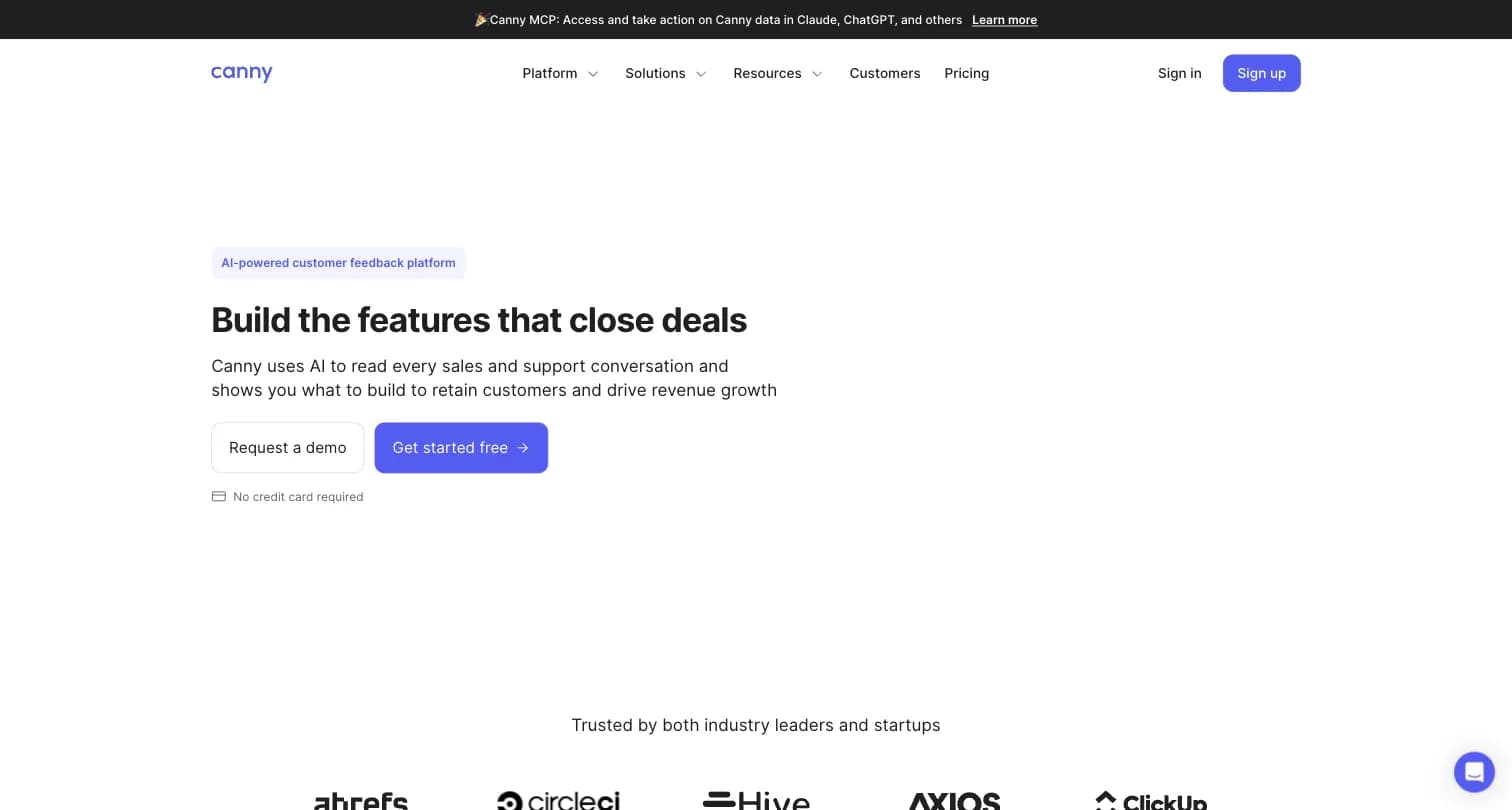
Captured August 15, 2026 from canny.io.
3. Some Teams Want a Genuinely Self-Hosted Board
The #2 organic result for "canny alternatives" is a r/selfhosted thread asking specifically for a self-hosted option, a real, sourced signal that a meaningful share of searchers want infrastructure control, not just a cheaper SaaS bill. Worth being direct about this: none of the seven roadmap/voting tools in this guide, including Canny itself, publish a self-hosted deployment option. Formbricks is the only self-hosted name anywhere in this comparison, and it solves the survey side of a feedback program, not the public-board side that r/selfhosted was actually asking about.
4. No Native Survey or NPS Methodology
Across every tool in this roundup except Formbricks, feedback is captured as a "post," "note," or "idea," not as a structured survey response. If your feedback program needs both a public roadmap and quantitative NPS/CSAT/PMF tracking, you'll likely end up running two tools regardless of which board you pick.
The 8 Best Canny Alternatives in 2026
1. Formbricks: The Feedback-Collection Option (Not a Roadmap Substitute)
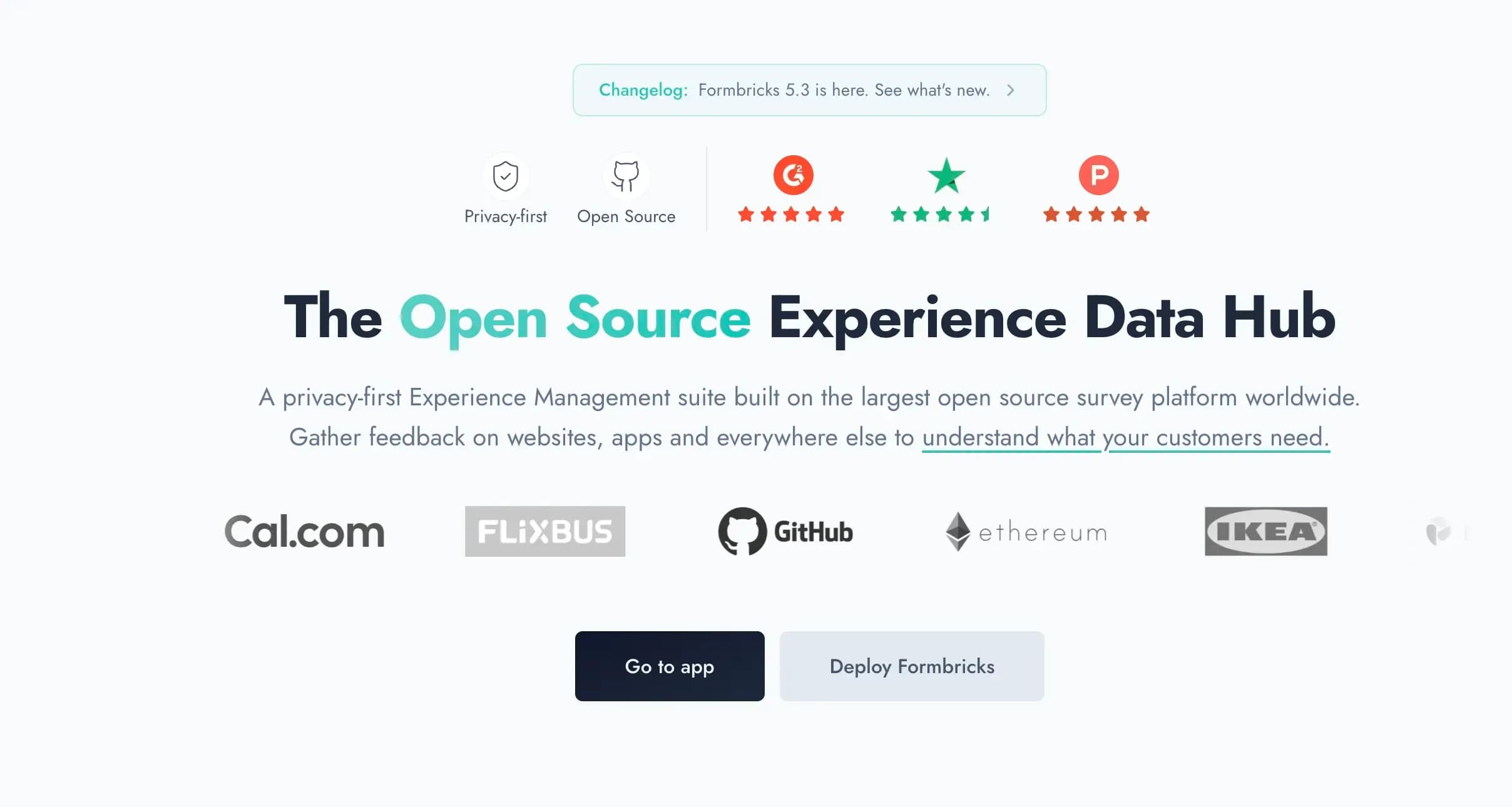
Being direct about this upfront: Formbricks doesn't do what Canny does. Formbricks is a feedback and experience management suite built around feedback management (website, in-app, link, and email surveys unified on one platform), feedback analytics (dashboards, segmentation, drop-off tracking), and workflows and integrations (post-response automation, native connections to Salesforce, HubSpot, Slack, Google Sheets, and Notion via a free API on every tier). It has no public feedback board, no upvoting, and no customer-facing roadmap page.
Why it's on this list anyway: a real share of teams searching "Canny alternatives" are actually trying to solve a broader feedback-program problem, and Canny is only the roadmap piece of it. If your organization needs structured NPS, CSAT, or PMF surveys as a primary research methodology, none of the other seven tools in this guide treat that as a first-class feature (Featurebase's Outbound module comes closest, and it's explicitly a secondary add-on per Featurebase's own pricing page). Formbricks is purpose-built for exactly that gap.
Key features:
- Multi-channel surveys: link surveys, website pop-ups, in-app micro-surveys, and email-embedded surveys
- Attribute-based targeting and segmentation for in-product surveys
- Feedback analytics: aggregate and per-response views, drop-off tracking, custom segmentation
- Formbricks Workflows for post-response automation
- Open API and webhooks free on every tier, including the self-hosted Community Edition
- iOS and Android SDKs for native mobile surveys
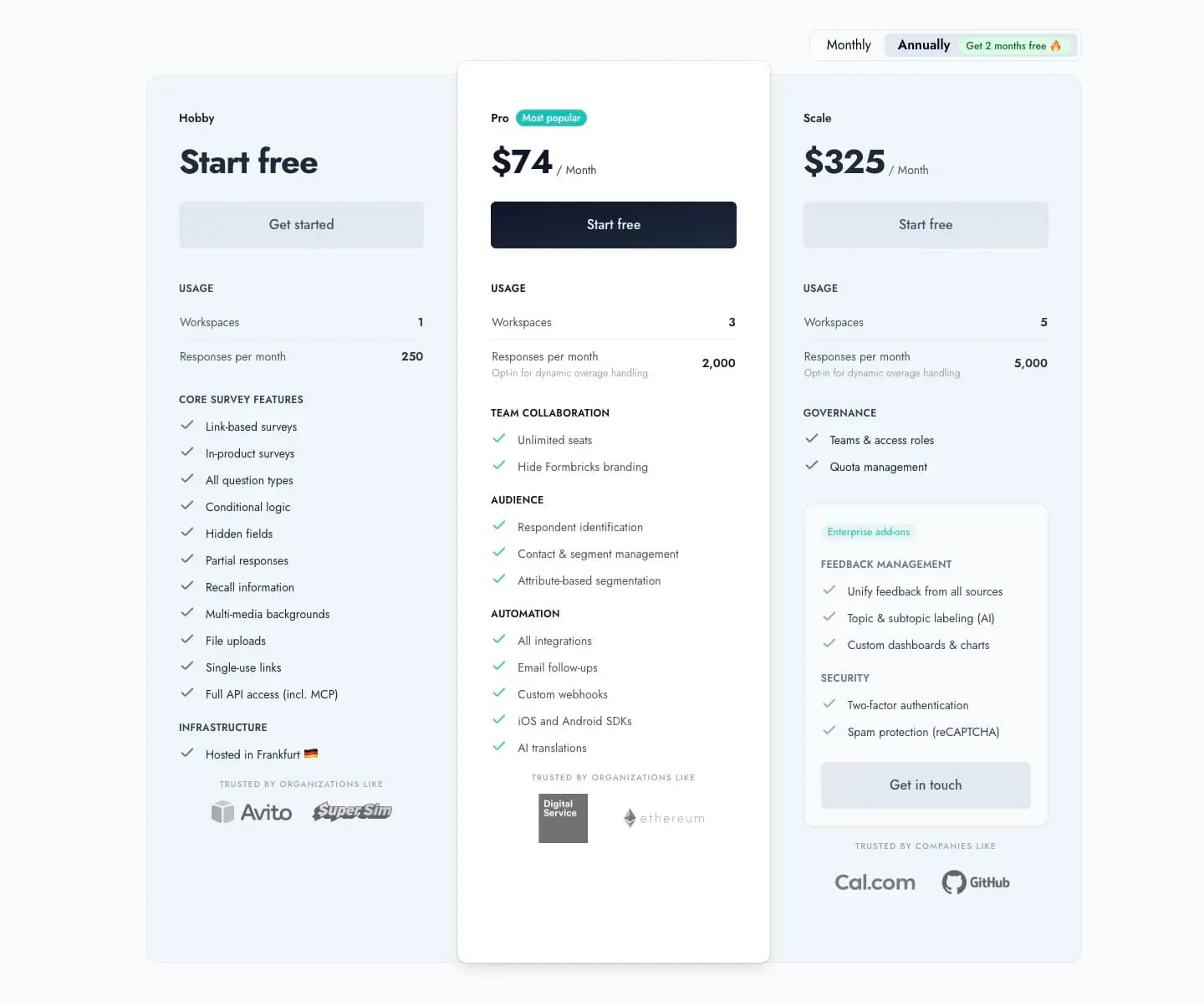
Pricing:
- Hobby (Free): 250 responses/month, 1 workspace, full API access including MCP, hosted in Frankfurt
- Pro: $74/month ($890/year billed annually), 2,000 responses/month, unlimited seats, branding removal
- Scale: $325/month ($3,900/year billed annually), 5,000 responses/month, teams and access roles
- Community Edition (self-hosted): Free forever, AGPLv3, unlimited surveys and responses
Best for: Teams that also need structured NPS, CSAT, or PMF surveys, or a genuinely self-hosted deployment for compliance reasons, alongside whichever of the other seven tools they pick for public voting and roadmapping. Not for teams whose actual need is a public feedback board, that's Canny, UserVoice, Productboard, Featurebase, Gleap, UserJot, Sleekplan, or Pendo below.
2. UserVoice: Revenue-Weighted Feedback Intelligence
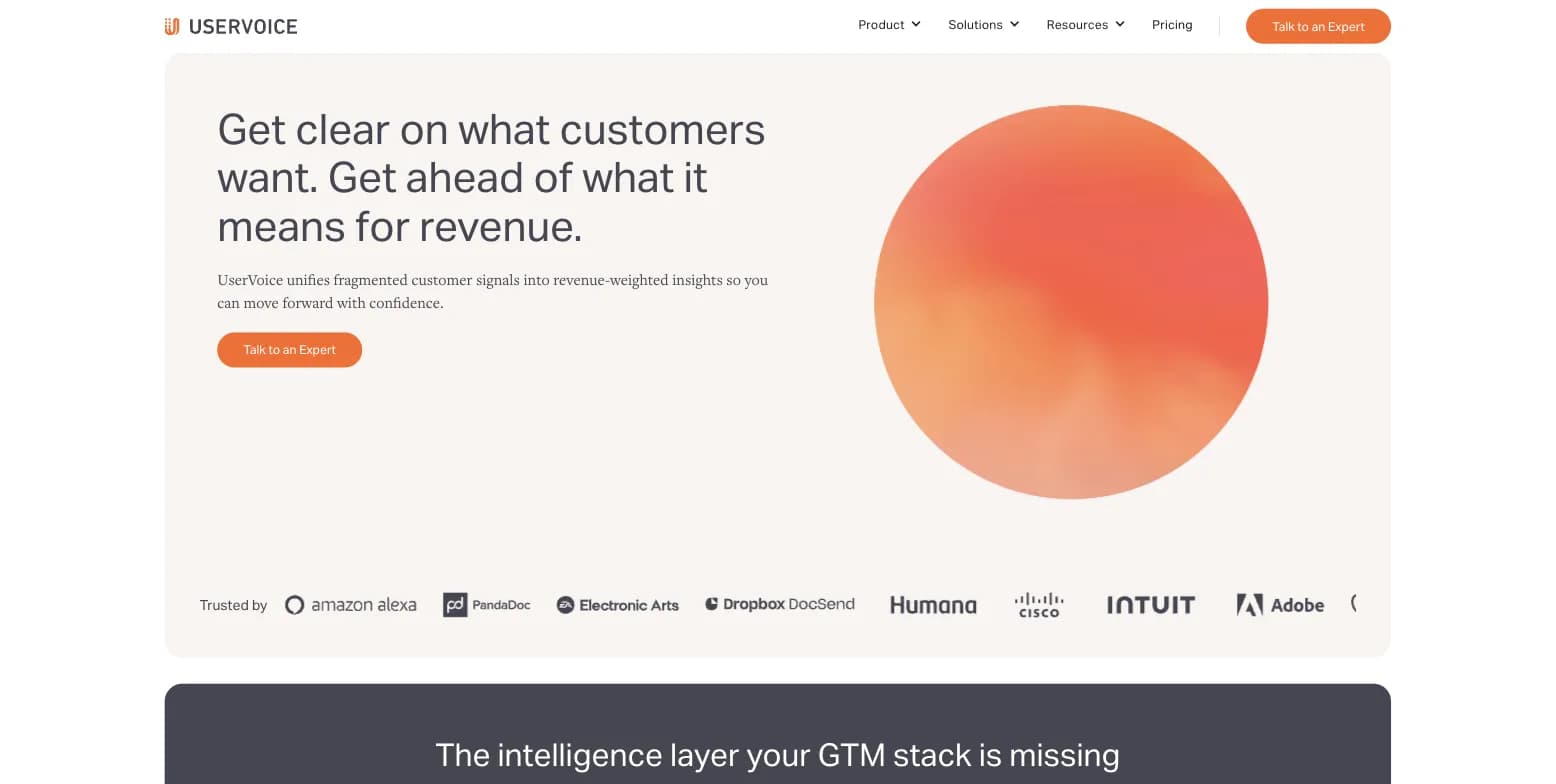
Captured August 15, 2026 from uservoice.com.
UserVoice has repositioned from an early feature-voting board into what it calls a "customer intelligence platform," explicitly distinguishing itself from Canny and Productboard in its own FAQ, describing them as "PM-focused tools built for feedback collection and roadmap planning" without revenue weighting.
Key features:
- Revenue-weighted feedback intelligence, ranks requests by correlation to ACV, expansion, and churn risk rather than raw vote count
- Cross-tool signal aggregation from Salesforce, Gong, Zendesk, Gainsight, Jira, Azure DevOps, and Slack
- AI theme detection to surface emerging themes and churn-risk signals automatically
- SOC 2 Type 2 certified, GDPR compliant, WCAG-accessible
Pricing: No public pricing on uservoice.com itself. Per a vendor-submitted table on G2: Growth starts at $10,788/year (200 unique end users/year), Team at $14,388/year (3,000 unique end users/month), Strategic at $16,188/year (5,000 unique end users/year). No self-serve checkout exists; every plan requires booking a demo.
Reviews: 4.5 rating across 243 reviews on G2, 4.3 across 70 reviews on Capterra. Reviewers praise ease of use and the ability for CSMs to log feedback on a user's behalf, tying requests to specific accounts. Complaints include a steep learning curve and pricing that feels high for smaller organizations.
Best for: Enterprise teams (UserVoice's own G2 base skews Mid-Market/Enterprise) that need to tie feature requests to revenue, ACV, or churn-risk data across a CRM stack, and are comfortable with a CSM-led sales process instead of self-serve signup.
3. Productboard: The Full Product-Management Suite
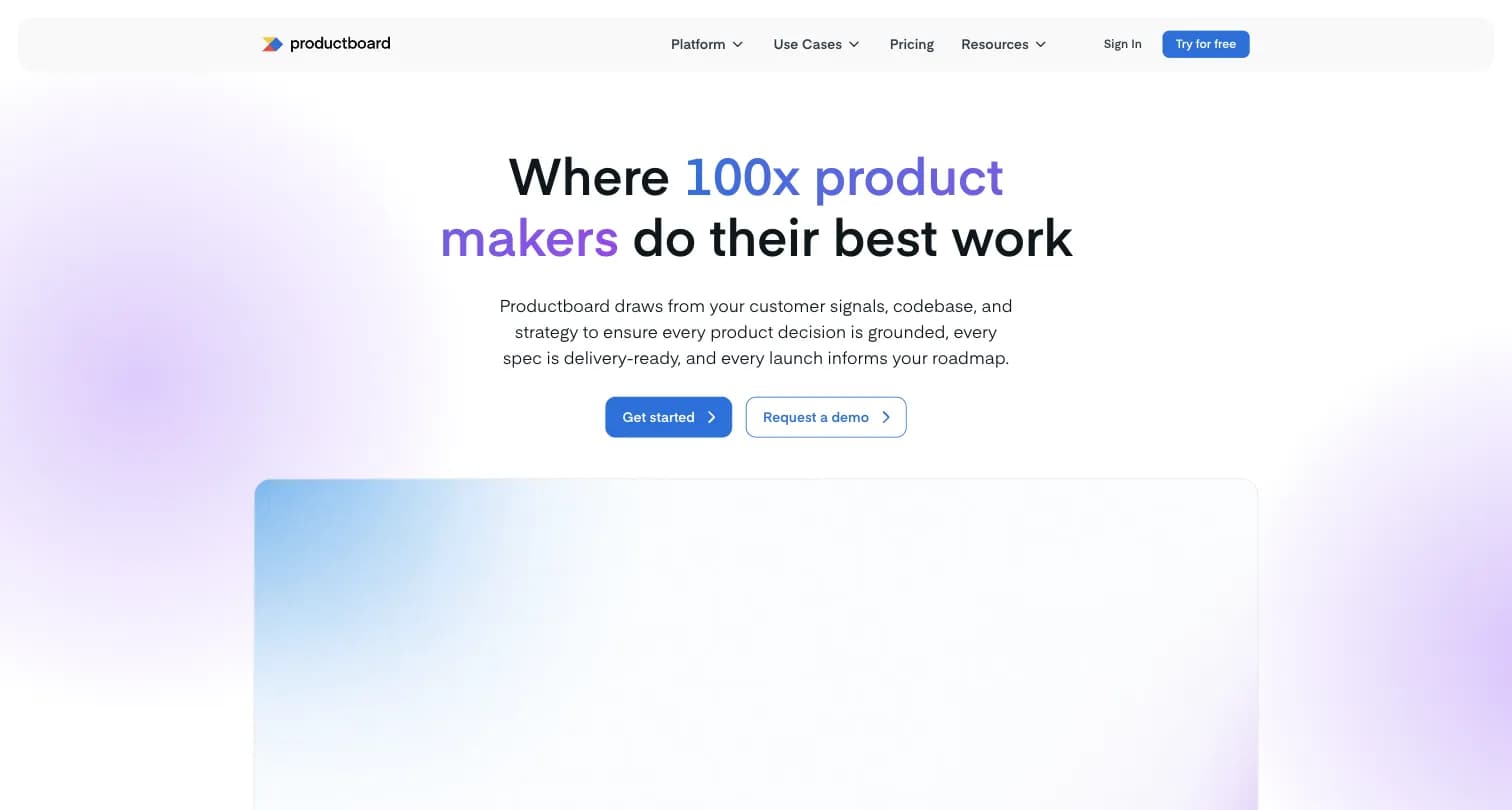
Captured August 15, 2026 from productboard.com.
Productboard is the fullest PM operating system among Canny alternatives: strategy, roadmapping, and AI-drafted delivery-ready specs, priced per "maker" (the PM who owns strategy, not every contributor). Founded in 2014 by Hubert Palan and Daniel Hejl, it's grown to 500+ employees and 6,000+ customers, backed by Sequoia Capital, Kleiner Perkins, Index Ventures, and Bessemer Venture Partners.
Key features:
- Spark AI agent, surfaces product opportunities with citations, drafts delivery-ready specs from feedback synthesis
- Centralized feedback repository with AI-powered trend surfacing
- Roadmapping and prioritization: timeline and column-based roadmaps, customizable formulas, dependency tracking (Business tier+)
- Customer-facing portal for sharing plans and validating ideas
Pricing: Free (1 maker minimum, 25 contributors, 500 feedback notes), Plus at $19/maker/month billed annually ($25/mo monthly), Business at $59/maker/month billed annually (2-maker minimum), custom Enterprise (5-maker minimum). A second, usage-based dimension (AI credits) sits on top: analyzing 100 feedback items uses roughly 30-50 credits, so heavy AI users can hit monthly caps.
Reviews: 4.3 rating across 254 reviews on G2, 4.7 across 154 reviews on Capterra. Reviewers praise centralized feedback management and strong Jira/Slack/MS Teams integrations, but flag an overwhelming interface for new or non-PM users.
Best for: Product teams that want an AI agent to turn scattered feedback into delivery-ready specs and roadmaps, with enterprise-grade roadmap governance (SSO, custom roles, Salesforce integration) at scale.
4. Featurebase: The All-in-One Support and Feedback Bundle
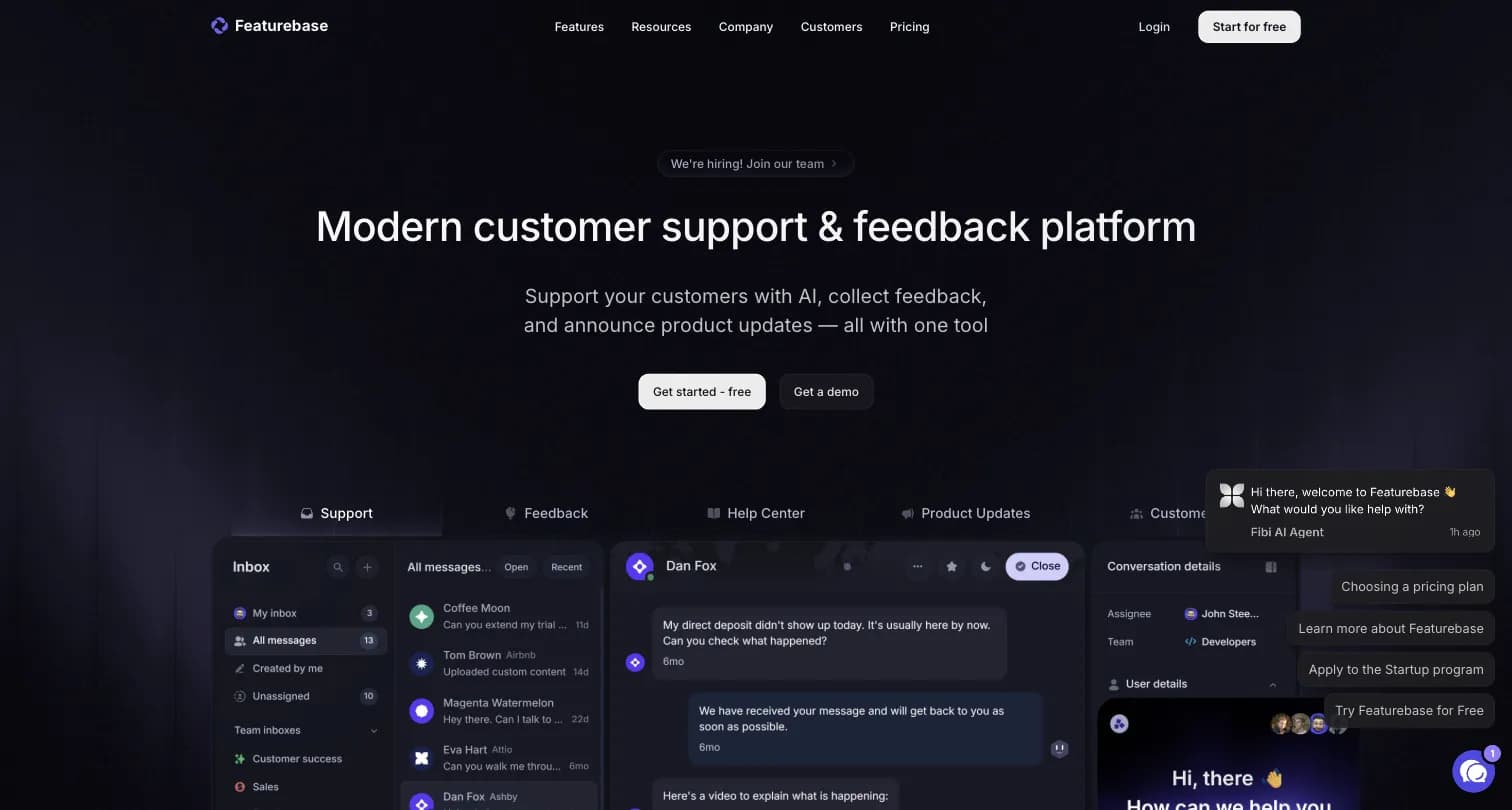
Captured August 15, 2026 from featurebase.app.
Featurebase is the broadest bundle of the group: an AI helpdesk, feedback boards, a public roadmap, a changelog, and a knowledge base, all under one per-seat subscription. Founded at the end of 2020 by a 3-person team in Tallinn, Estonia, it's fully bootstrapped and profitable.
Key features:
- Fibi AI support agent, resolves customer issues automatically across chat, Slack, and email, billed per successful resolution
- Feedback and roadmap voting with public boards, in-app widgets, and automatic loop-closing when a request ships
- AI-powered self-serve knowledge base (40+ languages) plus public/in-app changelog widgets
- Basic in-app NPS/CSAT surveys via its Outbound module (Growth tier+), an explicitly secondary feature per its own pricing page
Pricing: Free (1 seat, 1 feedback board, 1 roadmap), Growth at $29/seat/month billed yearly, Professional at $59/seat/month (plus 20 free "Lite" seats), Enterprise at $99/seat/month. AI features beyond a free allotment are billed separately at $0.49/resolution or $19/seat/month for unlimited Copilot; branding removal is a further $69/month add-on.
Reviews: 4.7 rating across 50 reviews on G2, which categorizes Featurebase across AI Agents, Survey, Live Chat, Knowledge Base, Help Desk, and Product Management, reflecting its all-in-one scope. Reviewers describe great value given how many separate tools it replaces.
Best for: Fast-growing startups that want to replace a helpdesk, feedback board, knowledge base, and changelog with one subscription and a generous free tier.
5. Gleap: AI Feedback Capture Bundled With Support and Bug Reporting
Gleap positions itself directly as a Canny alternative, arguing that feedback boards miss the "quiet majority" who mention ideas in support chats rather than visiting a board to vote.
Key features:
- Kai PM, auto-captures feature requests from support conversations, sales calls, NPS comments, and in-app interactions, then clusters with AI and scores by revenue impact
- Kai, an AI support agent that resolves inbound questions in the same widget
- Kai Code, turns bug reports (with session replay, console logs, network requests) into pull requests
- Public, private, and embedded feedback boards with Linear, Jira, and Notion sync
Pricing: Per Gleap's own pricing page, the Team plan is $149/month flat, with unlimited tracked users and unlimited team seats, positioned directly against Canny's $79-$579+/month tracked-user tiers. AI usage (Kai, Kai Code) is billed separately by actual tokens and model used. A 14-day free trial is available; Gleap states it removed a standing free plan.
Reviews: 4.6 rating on G2, described by Gleap as trusted by 4,500+ teams.
Best for: Teams that want feedback capture, AI support, bug reporting, and a public roadmap in one tool, and want to avoid tracked-user pricing entirely as their user base scales.
6. UserJot: Flat Pricing, Unlimited Users
UserJot markets itself explicitly as the Canny alternative for teams that don't want to budget around tracked-user growth.
Key features:
- Ranked feedback board with AI duplicate detection as users type
- Context-aware triage action bar (rather than a generic status dropdown) designed to move items to inbox zero
- AI-drafted changelog generated automatically when a post is marked Completed, with automatic voter notifications
- Built-in Canny importer (boards, posts, votes, comments, statuses) that most teams complete in about two minutes, per UserJot's own site
Pricing: Free (unlimited posts, unlimited users, 2 feedback boards, public roadmap and changelog), Starter at $29/month (custom domain, guest posting, 5 boards, one integration), Professional at $59/month (unlimited boards, SSO, unlimited integrations). Per UserJot's own comparison page, at 1,000 engaged users UserJot costs $29/month against Canny's $311-$661/month, and at 2,500 engaged users, $59/month against Canny's $499-$1,036/month.
Best for: Startups and small SaaS teams that want a focused, opinionated feedback-roadmap-changelog loop without Canny's five-level "Ideas" hierarchy, and want pricing that doesn't change as their user base grows.
7. Sleekplan: Budget-Conscious Board With Built-In Surveys
Sleekplan positions itself as the direct, budget-conscious alternative to Canny, with workspace-based rather than tracked-user pricing.
Key features:
- Core modules: feedback boards, voting, public roadmap, and a changelog
- Built-in CSAT and NPS so teams track sentiment alongside raw feature requests, a rarer combination among pure voting-board tools
- Sleek Intelligence: AI auto-collection from external sources, automatic theme detection, and an AI product-management copilot
- Visual analytics and light segmentation
Pricing: Per Sleekplan's own blog, a free plan includes core feedback with unlimited end-users and submissions; Starter runs roughly $13/month billed annually, Business roughly $38/month billed annually.
Best for: Teams that want a like-for-like Canny replacement plus native NPS/CSAT surveys in the same tool, without per-tracked-user cost growth.
8. Pendo: Feedback Tied to In-Product Analytics
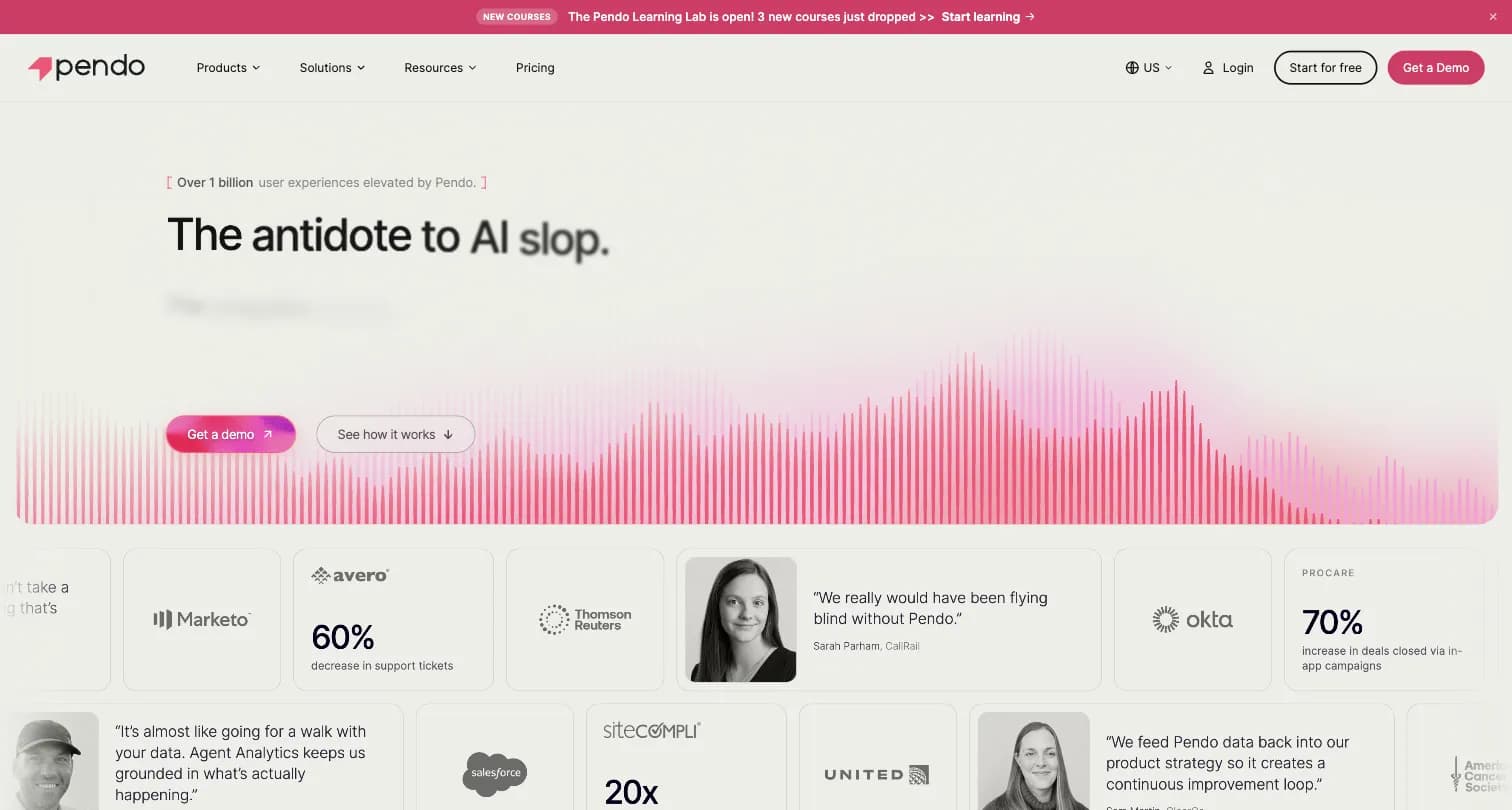
Captured August 15, 2026 from pendo.io.
Pendo shows up in Canny-alternative roundups (including Sleekplan's own comparison) specifically for teams that already run Pendo for product analytics and in-app guides, and want feedback collection to live in the same data layer rather than a separate tool.
Key features:
- Product analytics, in-app guides, and session replay as the core platform, with a dedicated Feedback module layered on top
- Sentiment and NPS surveys tied directly to usage data (Ultimate tier)
- AI agent analytics for teams tracking agentic product usage
Pricing: Fully custom, quote-based, across Base, Core, and Ultimate tiers, priced on Monthly Active Users. A Pendo Free plan exists, capped at 500 MAU. Pendo doesn't publish contract values, but third-party marketplace data referenced in independent research on Pendo alternatives puts average annual contracts around $48,500, with larger deployments reaching up to $146,000/year.
Best for: Teams that already use Pendo for product analytics and in-app guides, and want feedback and NPS tied to the same usage data rather than a standalone feedback board.
How to Choose the Right Canny Alternative
Start With What You Actually Need
- A public voting board plus AI capture from support/sales: Canny or Gleap
- Revenue-weighted feedback intelligence for enterprise CS/product teams: UserVoice
- A full PM operating system with AI-drafted specs: Productboard
- Replace 4-5 tools (helpdesk, board, changelog, knowledge base) at once: Featurebase
- Flat pricing, unlimited users, no tracked-user math: UserJot
- A cheaper board with built-in NPS/CSAT: Sleekplan
- Feedback tied to product analytics you already pay for: Pendo
- You're missing structured survey data, not a roadmap board: Formbricks
Then Evaluate These Criteria
| Criteria | Questions to Ask |
|---|---|
| Pricing model | Does it bill per tracked user, per seat, per maker, or flat, and how does that scale as your user base grows? |
| Feedback capture method | Does it wait for users to visit a board and vote, or does it auto-capture from support tickets and sales calls? |
| Survey/NPS methodology | Is structured quantitative research (NPS, CSAT, PMF) a first-class feature, or would you need a second tool? |
| Data residency | Can you self-host, or is everything vendor-hosted cloud-only? |
| What you're actually replacing | A voting board specifically, or a broader feedback program that includes surveys? |
The Self-Hosting Gap
None of the seven roadmap-and-voting tools in this guide, Canny, UserVoice, Productboard, Featurebase, Gleap, UserJot, or Sleekplan, publish a self-hosted deployment option anywhere in their documentation. Formbricks is the exception among all eight, its Community Edition is free and self-hostable under an AGPLv3 license, though again, it solves the survey-collection half of a feedback program, not Canny's public-board core.
Canny Alternatives FAQ
The Final Verdict
Canny remains a clean, purpose-built feature-voting and roadmap tool, and it's a reasonable default for teams that just want a public board. But its tracked-user pricing climbs faster than seat-based or flat-rate models as engagement grows, which is exactly why UserJot, Sleekplan, and Gleap have built their entire pitch around escaping that metric.
For teams that need what Canny does, a public board, voting, and a roadmap, UserJot and Sleekplan are the closest budget-friendly substitutes, while Gleap adds AI support and bug reporting on top. For enterprise teams, UserVoice and Productboard offer more governance and AI-driven prioritization at a real cost increase. Featurebase is the broadest bundle if you're consolidating multiple tools, and Pendo fits teams already invested in its analytics platform.
For teams whose actual gap is further upstream, they don't have a way to run structured NPS, CSAT, or PMF surveys in the first place, Formbricks is worth a look, not as a Canny replacement, but as the survey layer that pairs with whichever board above you choose, with a genuinely self-hosted option none of the other seven offer. See Formbricks' current pricing here.
Try Formbricks now